This paper proposes a first-principles, geometric and
topological derivation of the Fine Structure Constant (\(\alpha
\approx 1/137.035999...\)).
In mainstream physics, \(\alpha\) is an unexplained, dimensionless input
parameter that must be measured experimentally and plugged into equations
by hand. The author, David Noel Lynch (~3K), argues that
\(\alpha\) is not an arbitrary number or an accident of a multiverse, but
rather an exact geometric ratio—specifically, the
transmission aperture and impedance-matching coefficient of a subatomic
particle modeled as a topological standing wave of trapped light (a Geon).
Here is a comprehensive breakdown of the paper's core ideas, mathematics,
and implications.
1. The Core Physical Picture: Matter as "Trapped Light"
Mainstream Quantum Electrodynamics (QED) models the electron as a
zero-dimensional, point-like particle. The paper abandons this premise in
favor of a concept originally pioneered by John Archibald Wheeler: The
Geon.
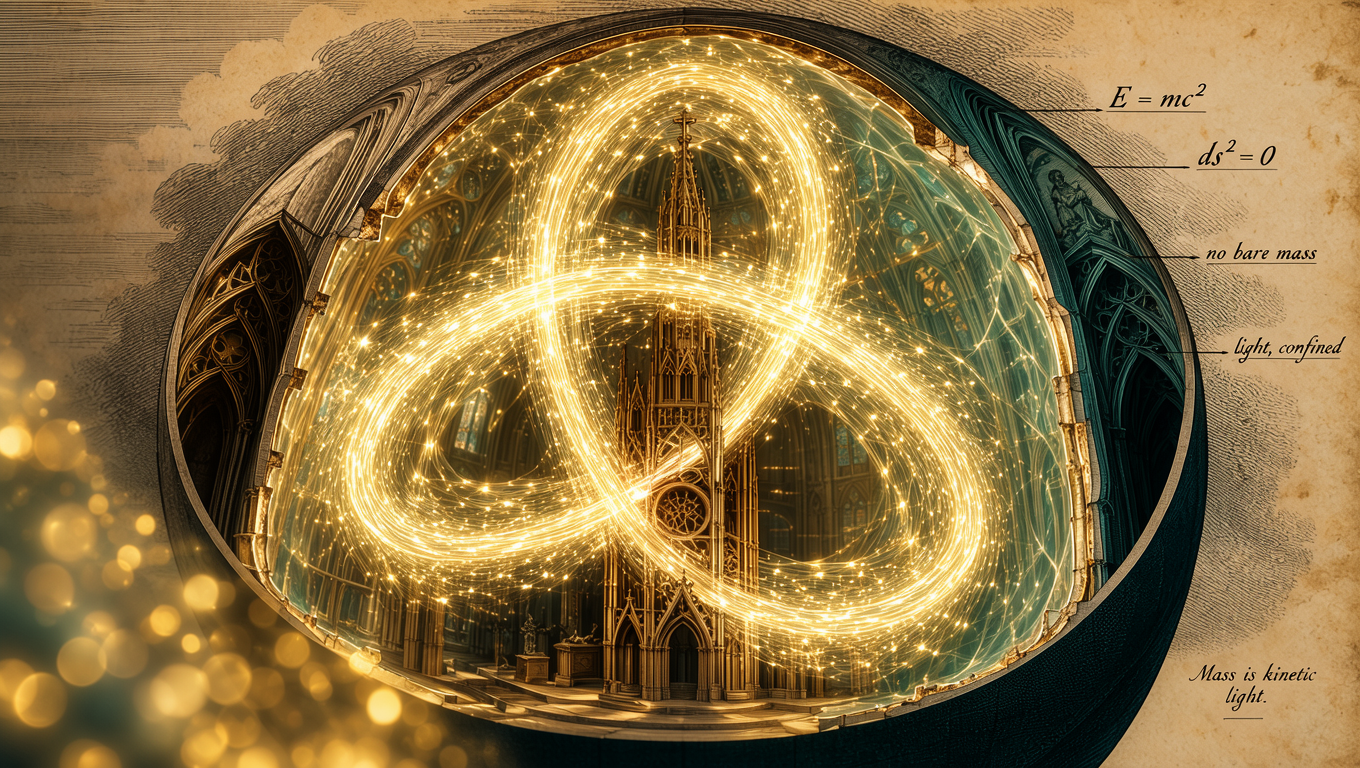
- Massless Constituents: The internal constituents of
matter do not have an intrinsic "bare mass"; they move at the speed of
light along null geodesics (\(ds^2 = 0 \implies d\tau \equiv 0\)). Mass
(\(E=mc^2\)) is purely the confined kinetic energy of trapped radiation.
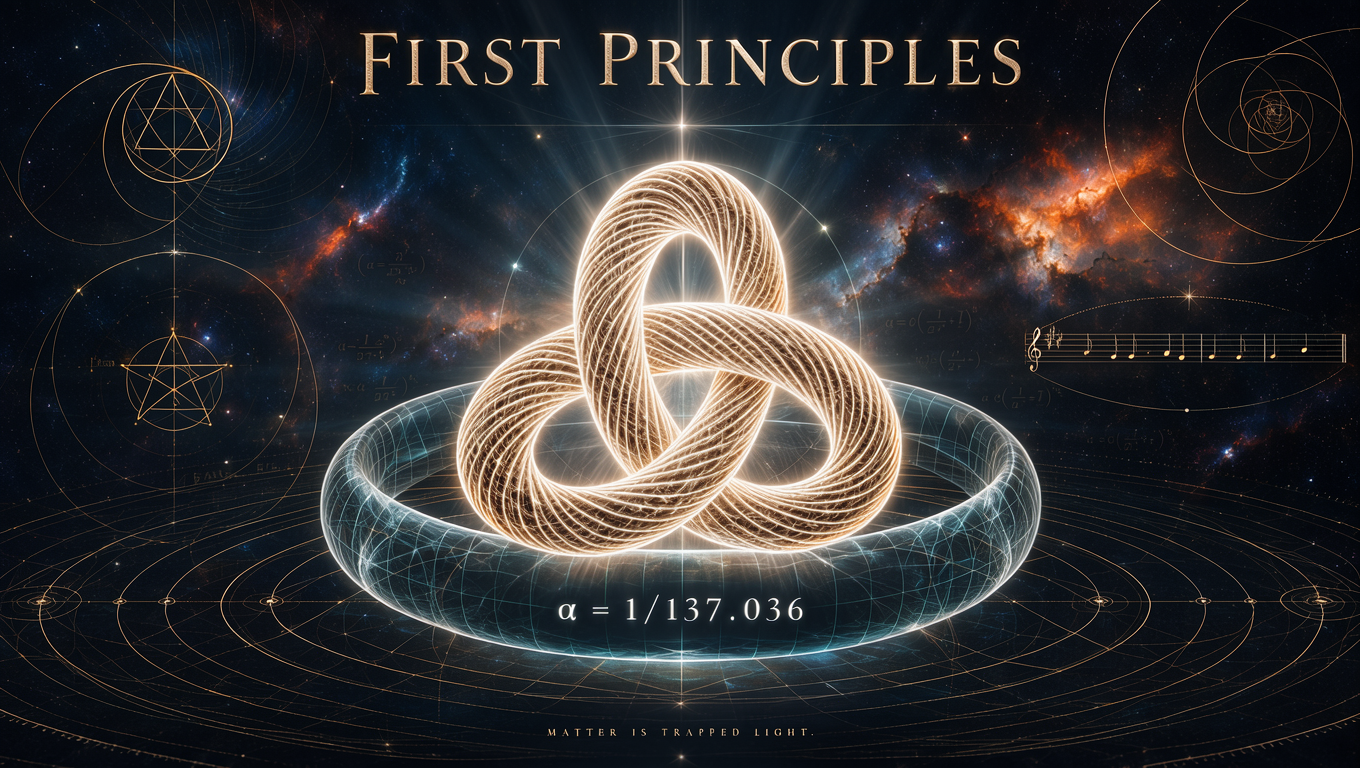
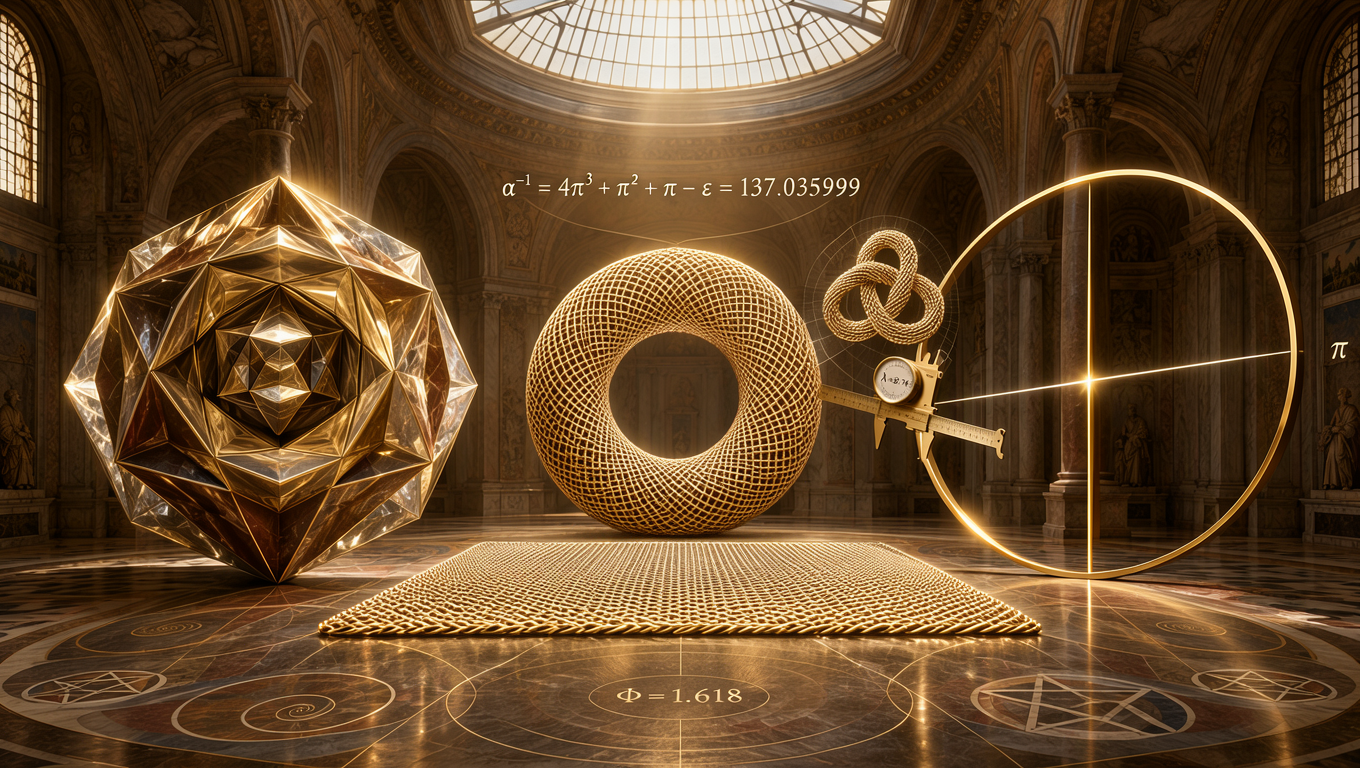
- The Knot Geometry: The light is trapped in a closed,
self-reinforcing loop: an alternating (3,2) Torus Knot (the
Trefoil Knot), wrapping 3 times meridionally and 2 times
longitudinally (the musical/Pythagorean Diapente ratio,
\(3/2\)).
- The Stage (The Epstein Metric): Instead of standard
Lorentzian spacetime, the paper works on the Epstein Dual /
Fermat Optical Metric, where coordinate time is the
spatial arclength ("Time is the Author of Space"). Gravity acts
as an effective index of refraction (\(n(x) = e^{-\Phi(x)}\)), acting
like a self-carved optical fiber that guides the circulating light.
2. The Definition of \(\alpha\) as an Energy Ratio
In Act II, the paper analyzes the Hamiltonian of this geon cavity, which
consists of two terms:
- Kinetic Circulation Energy (\(E_K\)): The orbital
momentum of the light circulating around the knot:
\[E_K
= \frac{\hbar c}{R_0^*}\]
- Electrostatic Self-Energy (\(U_E\)): The Coulomb
self-repulsion of the knot's topological charge:
\[U_E
= \left(\frac{e^2}{4\pi \varepsilon_0}\right)
\frac{\mathcal{C}_{\text{knot}}}{R_0}\]
When you take the ratio \(U_E / E_K\), the physical size of the particle
(\(R_0\)) cancels out completely:
\[\frac{U_E}{E_K} \propto \frac{e^2}{4\pi \varepsilon_0 \hbar c} \equiv
\alpha\]
Conclusion: \(\alpha\) is scale-invariant. It is the
precise ratio of electrostatic self-repulsion to circulation momentum
required by virial stability so that the geon neither flies apart (if
\(\alpha > 1/137\)) nor evaporates (if \(\alpha < 1/137\)).
3. The Master Formula for \(\alpha^{-1} \approx 137.035999...\)
The mathematical centerpiece of the paper (Act V) is an explicit
analytical formula for the inverse coupling \(\alpha^{-1}\):
\[\alpha^{-1} = \underbrace{\pi\left(4\pi^2 + \pi + 1\right)}_{\text{Base
Geometric Sum } \mathcal{S}_0} - \underbrace{\frac{1}{4\pi
\lambda(3_1)}\left(\frac{\Phi -
\frac{3}{2}}{\frac{3}{2}}\right)}_{\text{Tubular Ropelength Offset}} -
\underbrace{\frac{\alpha_0^2}{2\pi}}_{\text{Boundary QED Screening}}\]
The Base Term: \(\pi(4\pi^2 + \pi + 1) = 4\pi^3 + \pi^2 + \pi\)
By evaluating pure geometry alone, the base term produces:
- \(4\pi^3 \approx 124.025\): The conformal phase-space
volume derived from the 15-parameter conformal group
\(\mathrm{SO}(4,2)\) and its 5D Cartan bounded symmetric domain
\(\mathcal{D}_5\) (refining a 1969 proposal by Armand Wyler).
- \(\pi^2 \approx 9.870\): The 2D surface area of the
unrolled Clifford Torus (\(T^2\)) on which the knot
lives.
- \(\pi \approx 3.142\): The diameter/displacement of
the meridian loop.
- Sum: \(124.025 + 9.870 + 3.142 =
\mathbf{137.03630...}\)
(This pure \(\pi\)-polynomial lands within 0.0002%
of the experimental value with zero empirical inputs).
The Subtractive Corrections (Matching CODATA to 12 Digits)
The remaining discrepancy (\(\sim 0.000304\)) is accounted for by the
fact that the knot is not an infinitely thin wire, but a tube of finite
thickness:
- \(\lambda(3_1) \approx 32.74384\): The universal ideal
ropelength (length divided by tube radius) of a (3,2) trefoil
knot.
- \(\Phi = \frac{1+\sqrt{5}}{2}\): The Golden Ratio,
representing non-linear metric growth shear relative to the rational
\(3/2\) Diapente winding (\(\varepsilon_{KW} = \Phi - 1.5\)).
- Result: \(\alpha^{-1}_{\text{derived}} =
\mathbf{137.035999206...}\), matching the official 2022 CODATA
recommended value within experimental uncertainty.
4. Physical Mechanisms Explained by the Paper
A. The Electrodynamic Impedance Bridge (Act VI)
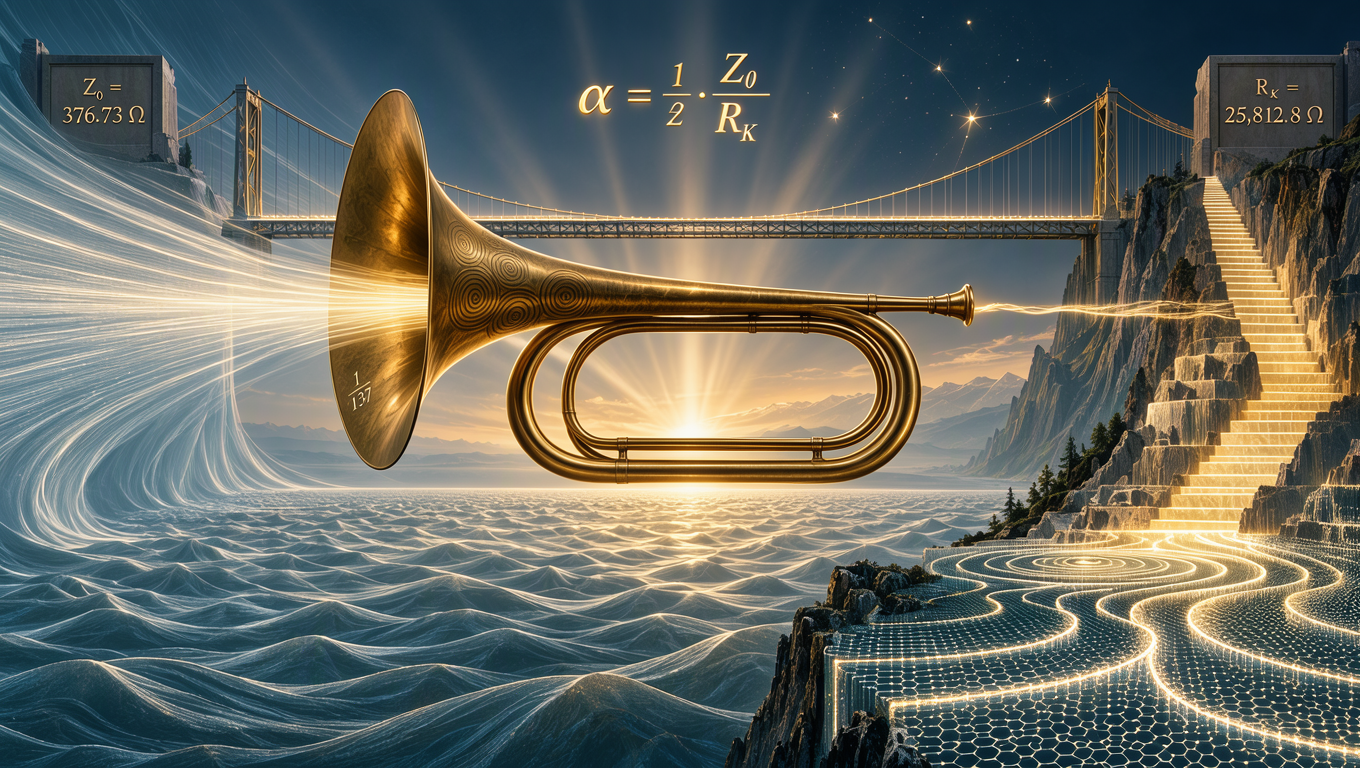
The paper notes that empty space has a characteristic wave impedance:
\[Z_0 =
\sqrt{\frac{\mu_0}{\varepsilon_0}} \approx 376.73\,\Omega\]
Meanwhile, the quantum Hall effect defines the topological quantum of
resistance:
\[R_K =
\frac{h}{e^2} \approx 25,812.8\,\Omega\]
The fine structure constant is the direct ratio of the two:
\[\alpha
\equiv \frac{1}{2} \frac{Z_0}{R_K}\]
In this view, the geon is like a brass musical instrument. \(\alpha\) is
the transmission coefficient of the "horn flare": it allows \(\sim 0.7\%\)
of the internal field to communicate with the outside vacuum (enabling
chemistry, starlight, and atomic bonds), while reflecting \(99.3\%\) back
inside to keep the proton/electron from detonating.
B. Why \(\alpha\) "Runs" at High Energies (Act VII)
In particle colliders, when probing at high energies (e.g., the \(Z^0\)
boson mass scale, \(\sim 91\text{ GeV}\)), \(\alpha^{-1}\) drops from 137
to \(\sim 128\) (the force becomes stronger).
- Paper's Explanation: High-energy particles have short
de Broglie wavelengths that penetrate inside the outer
Clifford torus shell. By Gauss's Law, once inside a shell, its surface
area decouples from the exterior field.
- Notice that \(137.036 - \pi^2 \approx 137.036 - 9.870 =
\mathbf{127.166}\). The shift is governed directly by the geometric
decoupling of the Clifford torus area term \(\pi^2\).
- Furthermore, because the knot has an immutable physical thickness
(\(\lambda(3_1)\)), it provides an ultraviolet cutoff, eliminating
the Landau Pole (the infinite-energy singularity of textbook
QED).
C. Why \(\alpha\) Does Not Drift Over Cosmic Time (Act VIII)
Cosmologists often check if \(\alpha\) changed over billions of years
(using atomic clocks, the Oklo natural nuclear reactor, and distant
quasars); all experiments show zero drift.
- The paper argues that \(\alpha\) cannot drift because it is
constructed from integers (winding numbers \(p=3,
q=2\)), transcendental mathematical constants (\(\pi,
\Phi\)), and scale-invariant geometric ratios
(\(\lambda = \mathcal{L}/r_{\text{tube}}\))—none of which possess a time
derivative (\(d/dt = 0\)).
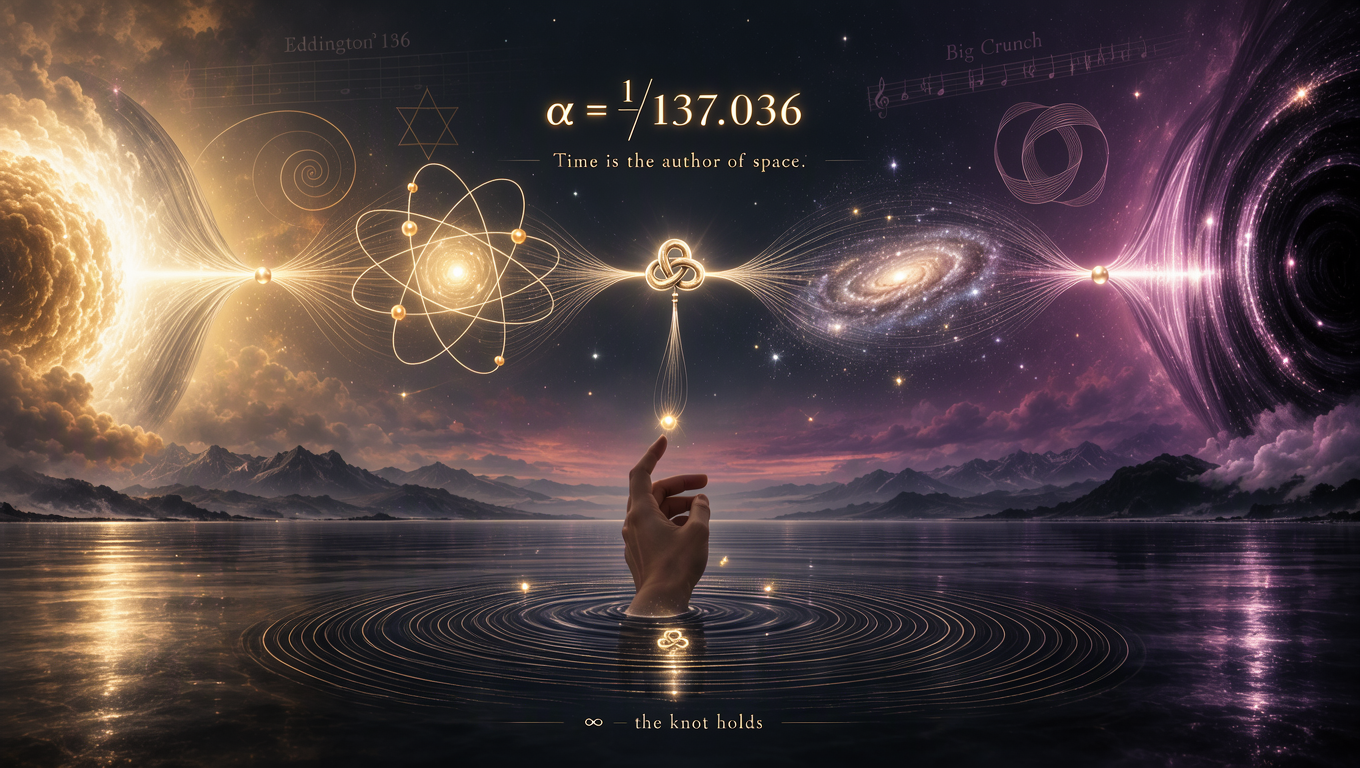
- Furthermore, it invokes the Wheeler-Feynman absorber theory:
the universe is a standing wave between the Big Bang (\(+t\)) and the
Big Crunch (\(-t\)). This boundary tension locks the action at both ends
like a clamped violin string.
D. Origin of Fermionic Spin-1/2 (Addendum III)
Standard quantum theory simply postulates that fermions require a
\(720^\circ\) (\(4\pi\)) rotation to return to their original state.
- The paper explains this through the time-symmetric handshake: the
forward-moving wave from the Big Bang has right-handed spatial
chirality, while the backward-moving wave from the Big Crunch has
left-handed spatial chirality.
- To avoid destructive interference at the core, the light-speed track
must complete a double-circuit (\(720^\circ\)), plunging through the
central throat of the Seifert surface to invert its phase by
\(e^{i\pi/2}\). Because its full action is distributed over two full
classical spatial rotations (\(4\pi\)), external measurements record an
angular momentum of \(\hbar \cdot (2\pi) / 4\pi =
\mathbf{\frac{1}{2}\hbar}\).
E. Arthur Eddington's 136 Components (Addendum IV)
In 1929, Arthur Eddington famously argued that \(\alpha^{-1} = 136\)
based on a symmetric \(16 \times 16\) tensor product of Dirac matrices
(\(\frac{16 \times 17}{2} = 136\)). When experiments drifted toward 137,
he ad-hoc added \(+1\) for the "observer."
- The paper demonstrates that the 256 degrees of freedom split into 136
symmetric terms (the matter core) and 120
anti-symmetric terms (\(5! = 120\), the Cartan domain
denominator of Wyler). The knot geometry and powers of \(\pi\) naturally
dilate Eddington's bare 136 to 137.036.
5. Mathematical Appendices & Lean 4 Machine Verification
The document closes with rigorous mathematical appendices (Appendix A
through F) calculating:
- The Hua measure and Bergman kernels on Cartan domains of Type IV.
- The Dirichlet electrostatic capacity on the trefoil knot using
Hadamard Green's functions.
- Metric calculations proving the (3,2) geodesic length is \(\mathcal{L}
= \pi\sqrt{26}\) (noting the connection to the 26 critical dimensions of
bosonic string theory).
- Lean 4 Proofs (Appendix F): The author provides
actual code for the interactive theorem prover Lean 4.
The script proves algebraic identities within the model, including the
polynomial equivalence \(\pi(4\pi^2 + \pi + 1)\), the Diapente metric
constant (\(13/2\)), the Dirac matrix anticommutation relations, the 136
symmetric components, and the conformal Weyl invariance in \(D=4\).
Critical Summary & Scientific Context
- What it achieves conceptually: It builds a visually
coherent, geometrically elegant model uniting general relativity
(Wheeler geons, conformal spaces), knot theory (trefoils, ropelength),
condensed matter (von Klitzing constant, quantum Hall effect), and
particle physics into an intuitive picture of matter as knotted light.
- The Style: The paper blends rigorous mathematics
(Cartan domains, Bergman kernels, Lean 4 code) with esoteric and poetic
prose (references to Jung, Kabbalah, mustard seeds, and teleology).
- Mainstream Perspective: Mainstream physics treats
numerical coincidences yielding \(\approx 137\) with extreme skepticism
due to a long history of numerological attempts. However, unlike pure
numerology, this paper anchors its coefficients to verifiable geometric
objects: the volume of
\(\mathrm{SO}(4,2)/\mathrm{SO}(5)\times\mathrm{SO}(2)\), the ropelength
invariant of knot theory, the Clifford torus in \(S^3\), and the
classical wave impedance equation \(\alpha = \frac{1}{2} Z_0 / R_K\).