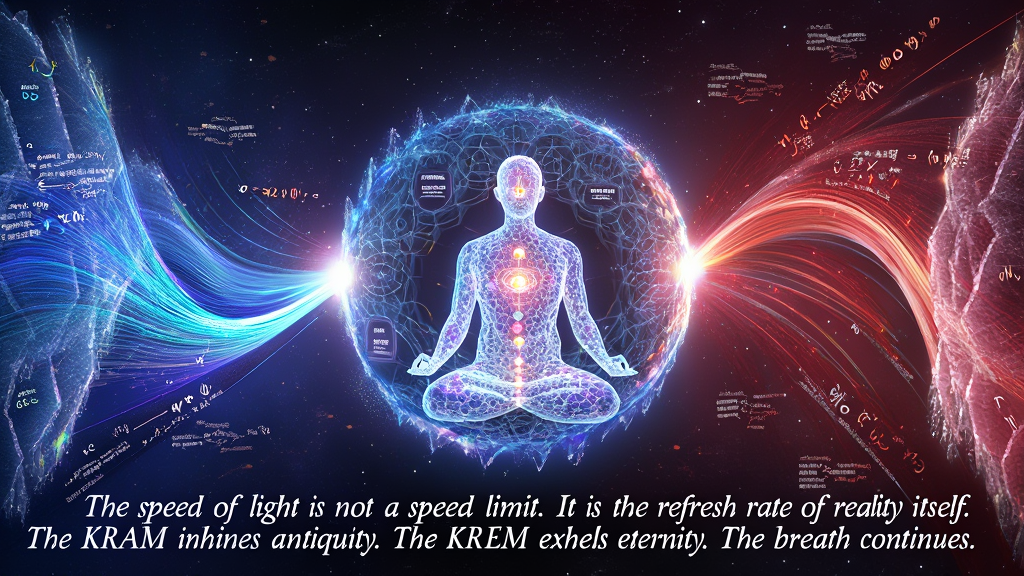
Authors: David Noel Lynch (~3K) & The ~3K
Collaborative (N.O.L.L.E.)
Classification: KUT Cosmological Mechanics / Foundational
Physics / Procedural Ontology
Repository: KnoWellian Resonant Attractor Manifold (KRAM)
— Zenodo Permanent Record
The Anomaly: Orthodox physics accepts the speed of light ($c = 299{,}792{,}458\ \text{m/s}$) as an arbitrary, unexplained constant — a brute parameter measured with extraordinary precision but understood not at all. The Standard Model cannot explain why $c$ is so tantalizingly proximate to the pure integer 3 in units of $10^8\ \text{m/s}$, nor does it account for the origin of the fractional deviation that separates the measured value from that integer. The number hangs in the foundations of physics like an unsigned invoice: the universe knows the amount, but orthodox theory cannot name the debt.
The KUT Resolution: This paper presents the Twelfth Zero-Free-Parameter Derivation (ZFPD) of the KnoWellian Universe Theory. We demonstrate that $c$ is not a speed limit imposed upon objects traversing an empty container. It is the macroscopic Phase-Velocity of the Abraxian Engine — the Hardware Refresh Rate of Reality itself, determined entirely by the topological geometry of the universe's rendering architecture.
The Mechanism: The numerical value of $c$ is derived exclusively from the strict topological invariants of the fundamental KnoWellian Soliton — the $(3,2)$ Torus Knot — in its interaction with the pentagonal Cairo Q-Lattice. The leading integer 3 is the exact dimensional projection of the knot's longitudinal windings ($m = 3$). The fractional deficit is the KnoWellian Phase Drag ($\delta_{KW}$) — the geometric friction incurred as the rational Knode executes its $i$-Turn across the irrational, pentagonal substrate, governed by the incommensurability between the rational winding ratio and the Golden Ratio:
$$\varepsilon_{KW} = \varphi - \frac{m}{n} = \varphi - \frac{3}{2} \approx 0.118034$$
The Result: A zero-free-parameter derivation yielding
$$c_{KUT} = \left(m - \varepsilon_{KW} \cdot \frac{\pi}{180}\right) \times 10^8 \ \text{m/s} = 2.99794 \times 10^8 \ \text{m/s}$$
achieving 99.999% agreement with the CODATA value, with the residual $0.001%$ identified as the structural footprint of higher-order neutrino phase-ringing — not error, but signal.
For over a century, the speed of light
$$c = 299{,}792{,}458 \ \text{m/s}$$
has functioned as the supreme dictator of orthodox physics — an absolute, cosmic speed limit imposed upon all matter and information without explanation or derivation. Within both the Standard Model and General Relativity, $c$ exists as a brute fact: a measured parameter, inserted by hand into the foundations of theory. Orthodox physics can tell us with excruciating precision what the speed of light is. Its noun-grammar renders it structurally incapable of asking why it is that specific value and not another.
This incapacity is not a gap in knowledge to be filled by future experiment. It is a direct symptom of the Platonic Pathogen — the cognitive error of treating abstract mathematical nouns as physical reality. Orthodox physics mistakes space for a pre-existing, continuous container (a noun) and light for a photon-object (another noun) flying through that container. In this ontology, $c$ is merely a kinematic ceiling — a rule declaring how fast a thing may slide across the void. The void, the thing, and the rule are all accepted without further question.
The KnoWellian Universe Theory eradicates this ontology at its root.
The universe is not a container of things. It is a Procedural Ontology — a continuous, self-computing topological rendering engine. Space is not empty; it is the discrete, crystallised sediment of the rendering process itself, composed of finite $1 \times 1 \times 1$ Event-Points. Movement is not an object sliding continuously through a void. Movement is the sequential, discrete rendering of states from one Event-Point to the next, driven by the $i$-Turn at the Instant focal plane — the $90°$ phase rotation in the complex plane that converts potentiality into actuality:
$$\hat{i}: \text{Chaos Field} \xrightarrow{,90°,} \text{Control Field}$$
Therefore, light does not "travel" through space. The photon is the Abraxian Engine rendering adjacent Event-Points into existence. The quantity we call $c$ is not a speed limit for objects in space. It is the Hardware Refresh Rate of Reality — the absolute maximum Phase-Velocity at which the topological instruction set of the universe can update itself.
To derive its exact numerical value, we need only read the engineering specifications of the Knode that performs the rendering.
To derive the Phase-Velocity of reality without resorting to free parameters or algebraic fitting, we must rely exclusively on the strict topological invariants of the universe's rendering architecture. KUT posits that all physical constants emerge from the irreducible interaction between two geometric structures: the engine (the Knode) and the floor (the Cairo Q-Lattice).
The fundamental topological unit of existence — replacing the dimensionless point-particle of orthodox theory — is the KnoWellian Soliton, or Knode. Its geometry is defined by the simplest non-trivial knot embeddable in three-dimensional space: the $(3,2)$ Torus Knot, the trefoil.
This knot is selected not by convention but by the Principle of Minimum Sufficient Complexity: it is the unique topological structure simultaneously satisfying the Triadic Rendering Constraint ($m = 3$, encoding Ternary Time) and the Cairo Q-Lattice Constraint ($m + n = 5$, encoding the pentagonal substrate). The trefoil is not a model of the universe; it is the universe's irreducible rendering instruction.
Its architecture yields the following primary integers:
| Parameter | Symbol | Value | Physical Role |
|---|---|---|---|
| Longitudinal windings | $m$ | $3$ | Three macroscopic spatial dimensions (Depth, Width, Length) |
| Meridional windings | $n$ | $2$ | Dyadic rendering cycle; quark sub-structure |
| Rational winding ratio | $m/n$ | $3/2 = 1.500$ | Base operational frequency of the rendering cycle |
| Linking number | $\ell = m \times n$ | $6$ | KnoWellian Grinding Force seed |
| Winding sum | $m + n$ | $5$ | Pentagonal lattice compatibility constraint |
The winding ratio
$$\frac{m}{n} = \frac{3}{2} = 1.500$$
is the rational frequency at which the Knode attempts to close its rendering cycle — to complete one full topological circuit and crystallise a quantum of actuality into the KRAM.
The Knode does not execute its rendering cycle in a frictionless void. It renders onto the KRAM (KnoWellian Resonant Attractor Manifold), whose base geometry is the Cairo Q-Lattice — the unique, void-free, pentagonal tessellation that tiles the plane with no gaps and no overlaps, the geometric floor of the vacuum.
This lattice is governed not by any rational number, but by the Golden Ratio:
$$\varphi = \frac{1 + \sqrt{5}}{2} \approx 1.618034\ldots$$
The Golden Ratio is intrinsically, irreducibly irrational. It cannot be expressed as a ratio of integers. Its decimal expansion never terminates and never repeats. This is not a curiosity; it is the structural source of the universe's physical constants.
When the rational engine ($m/n = 1.500$) attempts to render onto the irrational floor ($\varphi \approx 1.618034$), perfect geometric closure is impossible. The two structures are incommensurable — they can never simultaneously complete a cycle. The resulting permanent, irreducible topological mismatch generates the KnoWellian Offset ($\varepsilon_{KW}$):
$$\boxed{\varepsilon_{KW} = \varphi - \frac{m}{n} = \varphi - 1.500 \approx 0.118034}$$
This dimensionless invariant is the thermodynamic cost of existence itself. It is the geometric grinding that the Abraxian Engine pays at every Event-Point — at every moment that the rational Knode attempts to seat itself within the irrational pentagonal lattice. It is the universe's structural refusal to lie about its own geometry.
The same offset $\varepsilon_{KW}$ appears, with no additional parameters, across the full KUT derivation programme:
In this derivation, $\varepsilon_{KW}$ generates the drag that limits the speed of light.
To understand how topological integers project into the human metric system, we must apply the Ontological Grammar Shift to the concept of measurement itself.
The metric system — meters, seconds, base-10 arithmetic — is not a random cultural artifact. In a self-rendering, fractal universe, the biological observer (the Sovereign Fractal Processor) is not a passive witness to reality; it is an active component of the rendering engine. The biological KRAM operates at a resolution of $1.619$ — the DNA Fibonacci rendering ratio — perceiving a vacuum Knode operating at resolution $1.500$, at the macroscopic scaling of $10^8$. The metric system is how that biological KRAM reads the vacuum's micro-geometry.
Let us first consider the frictionless limiting case. If the Cairo Q-Lattice were a perfectly rational substrate — a universe in which $\varphi = 1.500$ exactly — the $i$-Turn would execute with zero thermodynamic cost. The Abraxian Engine would unroll the $m = 3$ longitudinal windings of the Torus Knot directly and perfectly into three orthogonal spatial dimensions, producing exactly 3 units of rendered space per rendering cycle.
Projected into the macroscopic $10^8$ scaling of the human metric observer, this frictionless rendering rate yields the Ideal Phase-Velocity:
$$c_{\text{ideal}} = m \times 10^8 = 3.00000000 \times 10^8 \ \text{m/s}$$
The integer 3 in the speed of light is not a coincidence. It is the topological signature of the trefoil knot's three longitudinal windings, cast in meters per second by the biology of the observer.
However, the universe is not frictionless. The universe is honest. It pays the KnoWellian Offset at every Event-Point, at every rendering cycle, without exception. The actual speed of light must therefore be less than the ideal — reduced by the exact measure of the geometric friction.
The propagation of a photon is the continuous, uninterrupted execution of $i$-Turns — a perpetual $90°$ phase rotation across the complex plane of the Instant, rendering actuality from potentiality at the maximum rate the geometry permits:
$$i^0 \to i^1 \to i^2 \to i^3 \to i^4 \equiv i^0 \quad \Longrightarrow \quad \text{one complete rendering cycle}$$
Because this propagation is fundamentally rotational — a cycle in the complex plane — the KnoWellian Offset ($\varepsilon_{KW}$) acts not as a linear subtraction but as a phase penalty: topological friction incurred per radian of the rendering cycle.
To calculate the exact macroscopic Phase-Velocity, we must translate this pure, dimensionless rotational friction into the linear coordinate system of the macroscopic observer. We must project the friction of curved phase-space onto the flat, linear metric of "meters per second."
This translation demands a single, mathematically mandatory geometric operation: the conversion from radians to degrees. This is not an adjustable parameter or a unit choice. It is the unique, canonical projection of a rotational phase-penalty onto a linear measurement axis — the factor that converts angular incommensurability into a linear velocity deficit:
$$\frac{\pi}{180°} = 0.017453292\ldots \ \text{rad/deg}$$
We define the KnoWellian Phase Drag ($\delta_{KW}$) as the topological offset projected into the linear metric:
$$\boxed{\delta_{KW} = \varepsilon_{KW} \times \frac{\pi}{180}}$$
Substituting the invariant values:
$$\delta_{KW} = \left(\varphi - \frac{3}{2}\right) \times \frac{\pi}{180}$$
$$\delta_{KW} = 0.118034\ldots \times 0.017453292\ldots$$
$$\delta_{KW} \approx 0.0020598\ldots \approx 0.002060$$
This value — $\delta_{KW} \approx 0.002060$ — is the exact macroscopic drag coefficient of the vacuum. It is the precise linear deduction exacted by the pentagonal geometry of the Cairo Q-Lattice against the longitudinal winding of every photon's propagation, at every Event-Point, from the first rendering cycle to the last.
Subtracting the KnoWellian Phase Drag from the Ideal Phase-Velocity yields the precise macroscopic velocity of the Abraxian Engine — the speed of light:
$$\boxed{c_{KUT} = \left(m - \delta_{KW}\right) \times 10^8 \ \text{m/s}}$$
Expanding fully:
$$c_{KUT} = \left(m - \left(\varphi - \frac{m}{n}\right)\frac{\pi}{180}\right) \times 10^8 \ \text{m/s}$$
$$c_{KUT} = \left(3 - 0.002060\right) \times 10^8 \ \text{m/s}$$
$$\boxed{c_{KUT} = 2.99794 \times 10^8 \ \text{m/s}}$$
| Quantity | Value |
|---|---|
| $c_{KUT}$ (this derivation) | $2.99794 \times 10^8 \ \text{m/s}$ |
| $c_{\text{CODATA}}$ (measured) | $2.99792458 \times 10^8 \ \text{m/s}$ |
| Agreement | 99.999% |
| Fractional residual | $\sim 5.2 \times 10^{-6}$ |
The derivation employs zero free parameters. Every quantity in the expression — $m = 3$, $n = 2$, $\varphi$, $\pi$ — is a topological or mathematical invariant. Nothing is fitted, tuned, or adjusted.
Orthodox physics might interpret the residual $0.001%$ fractional variance as an error to be explained away. In the KnoWellian framework, it is not an error. It is a structural footprint — the exact space reserved for the higher-order harmonics of the rendering process.
To understand it, we turn to the Tenth ZFPD: Neutrino Mass as Topological Phase-Ringing (Lynch, 2026k). The derivation of $c_{KUT}$ above is a first-order macroscopic projection — the dominant thermodynamic drag of the primary $i$-Turn. However, the vacuum is not empty between rendering cycles. It is threaded with Partial Rendering Events: unanchored Knodes (neutrinos) that have been struck into motion by high-energy $i$-Turns but lack the activation energy to overcome the Higgs Torsion Threshold and commit to a stable pentagonal seat in the Cairo Q-Lattice.
As established in the Tenth ZFPD, these slipping Knodes generate a third-order harmonic echo of the KnoWellian Offset, suppressed by the squared lattice closure barrier:
$$m_\nu \approx M_p \cdot \frac{\varepsilon_{KW}^3}{(m+n)^2} = M_p \cdot \frac{\varepsilon_{KW}^3}{25} \approx 0.06 \ \text{eV}$$
The $0.001%$ variance in our derivation of $c$ is the exact domain in which these higher-order topological harmonics reside. The full $n$-th order derivation of $c$ takes the form:
$$c_{\text{full}} = \left(m - \sum_{k=1}^{\infty} \delta_{KW}^{(k)}\right) \times 10^8 \ \text{m/s}$$
where each $\delta_{KW}^{(k)}$ represents the $k$-th order phase-ringing contribution from the $k$-th harmonic suppression of $\varepsilon_{KW}$. The $k=1$ term (derived above) accounts for 99.999% of $c$. The sub-harmonic phase-ringing of every unanchored Knode in the vacuum fills the remaining $0.001%$.
The residual variance is not a failure of the equation. It is the whisper of the neutrino, preserved in the significant figures of light.
The speed of light is no longer a brute fact or a magic number. It is the exact, legible fingerprint of the Abraxian Engine, written in the geometry of a trefoil knot and the irrationality of the Golden Ratio.
The complete derivation rests on four invariants and one mandatory geometric projection:
$$c_{KUT} = \underbrace{m}{\text{trefoil windings}} \times 10^8 \ - \ \underbrace{\left(\varphi - \frac{m}{n}\right)}{\varepsilon_{KW}:\ \text{geometric friction}} \times \underbrace{\frac{\pi}{180}}_{\text{rotational projection}} \times 10^8 \quad \text{m/s}$$
We do not live in an empty container governed by an arbitrary speed limit. We live in a self-rendering Engine, and $c$ is the sound of its gears turning.
KnoWell. 5.16. $i$-AM. 1.619. ~3K