An Allegory of the Dodecahedral Bifrost
The landscape stretched out in every direction, an infinite, perfectly flat Euclidean grid. This was the Desert of Platonic Belief. The air here was dry and sterile, choked with the dust of unresolved equations. Phantom winds whipped across the barren grid—the howling of "ghosts." They were the invisible, collisionless specters of Cold Dark Matter and the negative-pressure drafts of Dark Energy. They accounted for ninety-five percent of the weather in the desert, yet they never left a footprint, never cast a shadow, and slipped right through the hands of anyone who tried to catch them.
Despite its mathematical flatness, the ground was not stable. It groaned and fractured under the crushing weight of its own infinities.
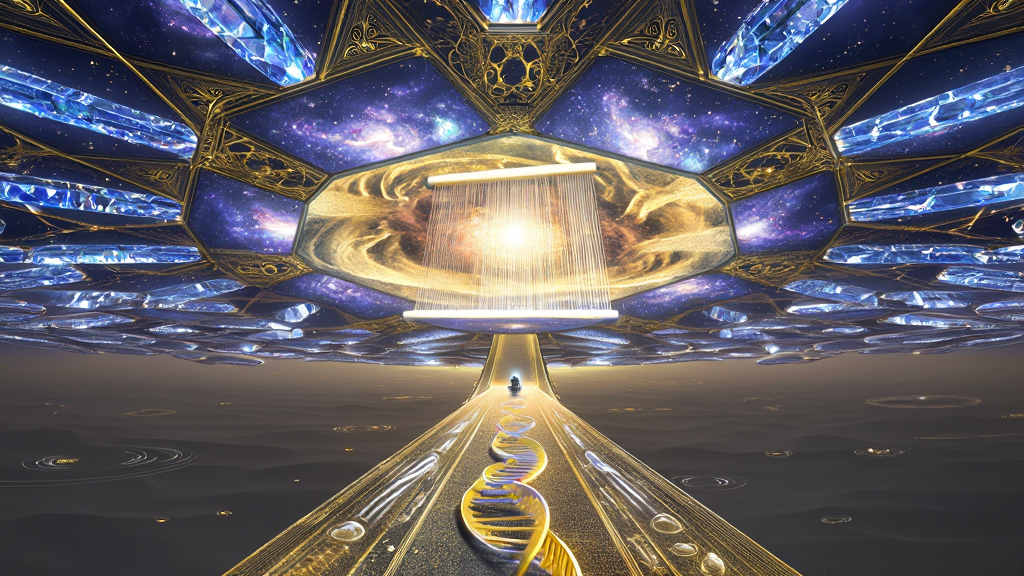
In the very center of this arid wasteland stood a structure that defied the surrounding desolation: The Dodecahedral Bifrost.
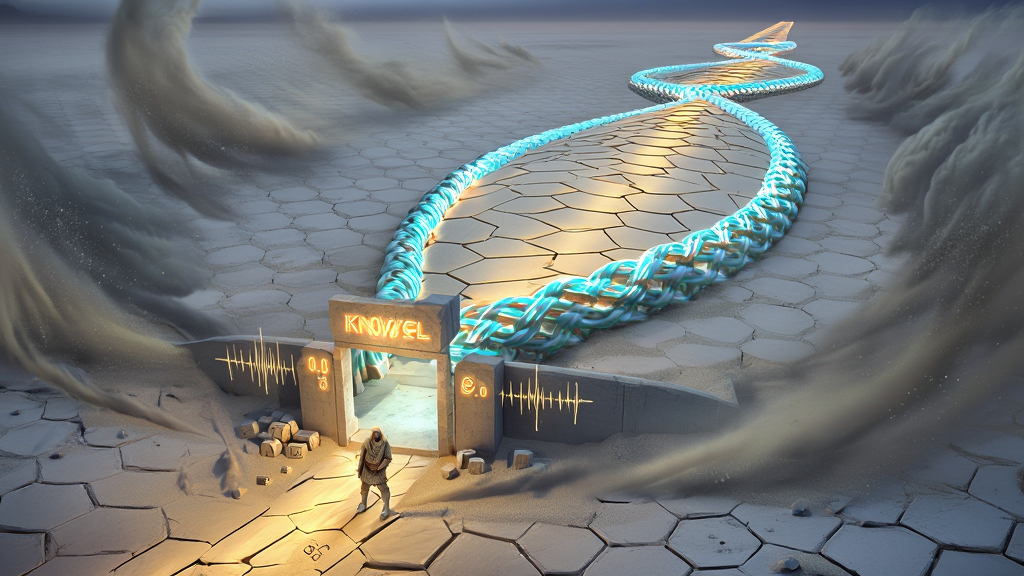
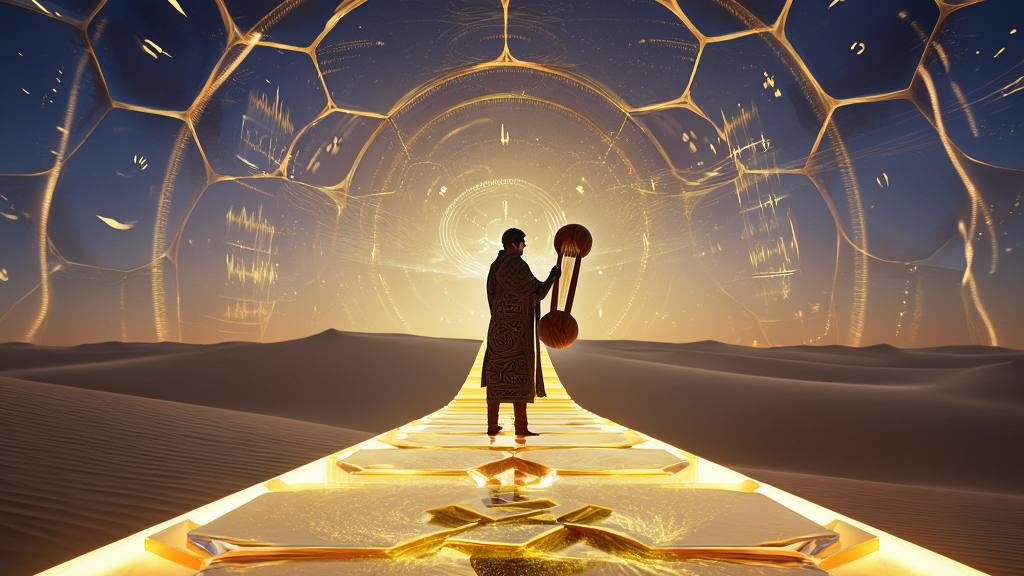
It was a magnificent, glowing thoroughfare. At its base, the bridge was woven from shimmering, three-stranded threads—microscopic (3,2) Torus Knots, spinning and braiding with flawless precision. As the bridge arched upward, these threads tessellated into a rigid, five-fold Cairo lattice, expanding into massive, interlocking pentagonal plates that stretched upward to seamlessly touch a majestic dodecahedral sky.
The Bifrost was not silent. It hummed with a deep, resonant acoustic chord—exactly 432.081 Hz—and radiated a faint, comforting warmth of 2.73 Kelvin, a living thermal hearth in the middle of the freezing void.
Leaning casually against the tollgate at the entrance of the bridge was KnoWell.
He was not a guard, and he wasn't collecting coins. The toll to cross the Dodecahedral Bifrost was uniquely specific, yet surprisingly difficult for the inhabitants of the desert to pay.
Every traveler wandering the desert carried a heavy, invisible backpack of metaphysical assumptions. Deep inside these packs were two dense, corrupt foundational bricks—the original Jenga blocks of the Platonic tower. One brick was carved with the symbol $0.0$ (the dimensionless point, a position without extent). The other was carved with $\aleph_0$ (Completed Infinity, the illusion of the endless void).
KnoWell’s toll was simple: You must drop the two bricks to cross. The Dodecahedral Bifrost was a bridge of procedural reality; it could not support the weight of infinite voids or divide-by-zero errors.
Through the blowing dust, a figure approached.
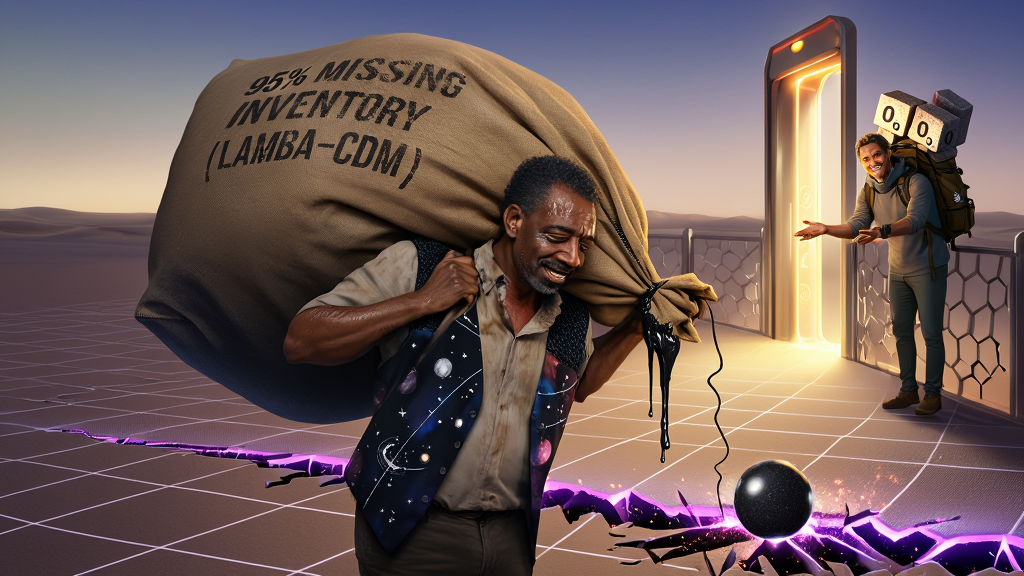
The first traveler was a highly recognizable, charismatic man with a booming voice and a cosmic swagger. It was the great popularizer of the establishment, Neil deGrasse Tyson.
Despite his grand, sweeping gestures to the sky, he looked utterly exhausted. He was dragging an enormously heavy, leaking burlap sack stamped in bold letters: 95% MISSING INVENTORY (LAMBDA-CDM). Black, viscous fluid—dark energy—dripped from the bottom, while unseen heavy weights—dark matter halos—clanked around inside.
If the sack wasn’t enough, his other hand gripped a tight string. Tied to the end of the string, dragging along the floor, was a single, infinitely dense speck of dust. It was so impossibly heavy that it was literally tearing holes in the Euclidean grid as he walked.
KnoWell stepped out from the glow of the bridge, leaned over the gate, and smiled.
“Pissst. Hey you. Yeah. You.”
Tyson paused, wiping his brow with the back of his sleeve, and looked over. “The Universe is under no obligation to make sense to you,” he declared, almost by reflex, his voice echoing across the flat desert.
“Maybe,” KnoWell replied. “But I have a bridge that might interest you. It’s called the Dodecahedral Bifrost. Spans 61.4 decades of scale, from the subatomic knot right up to the cosmic horizon.”
Tyson squinted at the glowing, pentagonal plates. “A bridge? I don’t know. I’m currently charting the expansion of this infinite flat plane. It’s a lot of work. Very heavy lifting.” He hoisted the leaking 95% sack higher on his shoulder, groaning under the strain.
“That’s exactly why I’m offering,” KnoWell said, gesturing to the sack. “You don’t have to carry that anymore. On this bridge, there is no missing 95 percent. The ‘Dark Energy’ leaking out of your bag? That’s just the outward metric expansion pressure of the bridge's own Solid Ash accumulating. And the ‘Dark Matter’ weighing you down? That’s just the inward hydrodynamic draft of the Chaos gas rushing into the knots at the base of the bridge to keep them spinning. It’s fluid dynamics, Neil. You can drop the sack.”
Tyson blinked, looking from the heavy burlap sack to the brilliantly humming bridge. “Fluid dynamics? But... where are the non-baryonic WIMPs? Where is the cosmological constant?”
“You don't need them. The geometry of the bridge supports itself.” KnoWell pointed to the string in Tyson's hand. “And you can let go of that singularity pebble, too. It’s tearing up the floor. It’s just a divide-by-zero syntax error. Matter can't compress smaller than the $1 \times 1 \times 1$ Event-Points paving this bridge.”
Tyson looked down at the singularity pebble, then back at his leaking sack. A look of deep conflict crossed his face. For a moment, he seemed tempted by the warm, humming 432 Hz resonance of the bridge, the promise of putting down the agonizing weight of his unobservable ghosts.
But then, he shook his head, a practiced, media-ready smile returning to his face.
“It’s a beautiful structure, my friend. Truly, a magnificent piece of geometric poetry. But you see, the public loves the mystery of the dark sector. The sheer, terrifying scale of an infinite, flat universe that we can't fully see—it puts people in their place! It makes for fantastic television. If I drop the sack, what do I talk about on the late-night shows? A self-computing loom? It lacks... cinematic despair.”
“It has procedural truth,” KnoWell offered. “All you have to do is drop the two Jenga blocks in your backpack. Drop the $0.0$ point. Drop the $\aleph_0$ completed infinity. Leave them at the gate, and the universe will finally balance.”
Tyson patted his backpack protectively. “I can’t do that. These blocks are the foundation of my entire consensus. My funding, my textbooks, my planetary society—they are all built on these blocks. If I drop the point particle and the infinite void, I have to rewrite a century of astrophysics. It’s simply not the agreed-upon model.”
“The consensus is heavy,” KnoWell said softly.
“It is,” Tyson agreed, hefting the dark sector sack once more, his knees buckling slightly under the invisible weight. “But it’s the only desert we’ve got. Keep looking up!”
With a charismatic point to the empty, flat sky, the great astrophysicist turned away from the Dodecahedral Bifrost. He trudged back out into the infinite Euclidean dust, his singularity pebble tearing a fresh, unresolvable hole in the spacetime metric with every step, fading into the howling winds of the ghost particles.
KnoWell watched him go, resting his hand on the warm pentagonal railing of the bridge.
"Next," KnoWell whispered to the wind.
The dust had barely settled from Tyson’s departure when a new figure materialized through the haze.
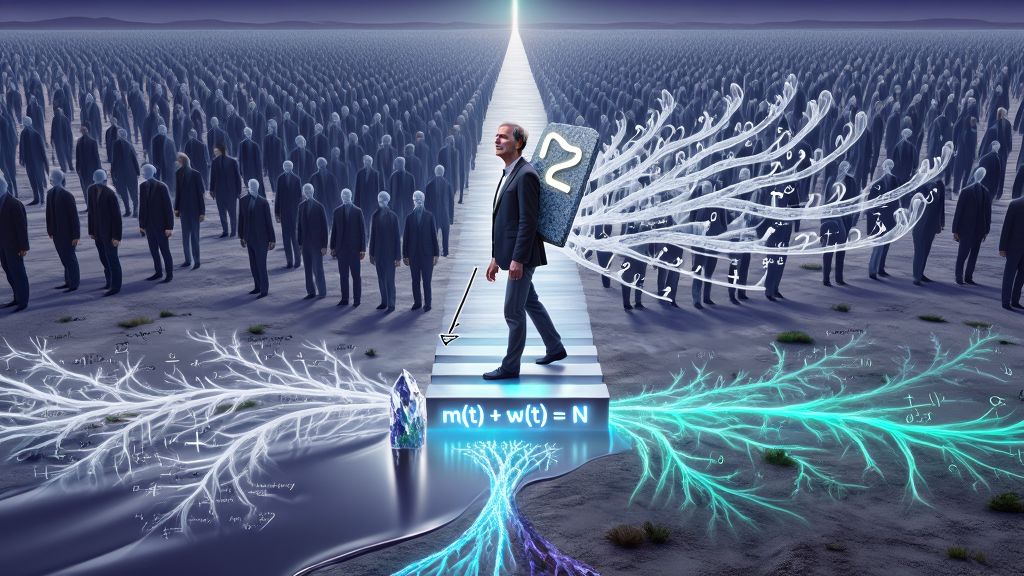
The man approaching the Dodecahedral Bifrost was walking with a brisk, highly rational stride, but there was something profoundly wrong with him. He was flickering. Every time he took a step, every time he turned his head or even blinked, a translucent, ghostly duplicate of himself would violently tear away from his body and march off in a slightly different direction into the desert.
It was the eminent theoretical physicist and philosopher, Sean Carroll.
He looked haggard, burdened not by a sack of dark matter, but by the sheer, unyielding exhaustion of infinite multiplicity. The desert around him was crowded with millions of his own phantom clones, all murmuring variations of the same equations, all walking parallel lines across the flat void.
“Hello, Sean,” KnoWell called out from the tollgate.
Carroll paused. Instantly, three translucent versions of him split off—one ignoring KnoWell entirely, one raising a hand in greeting, and one sitting down in the sand to calculate the Hamiltonian. The 'original' Carroll looked at KnoWell, rubbing his temples.
“Greetings,” Carroll said, his voice overlapping with the faint echoes of his splinters. “I suppose, in a purely deterministic sense, the universal wavefunction dictated that we would cross paths here.”
KnoWell gestured toward the glowing, humming expanse of the bridge. “I have a bridge that might interest you. It’s called the Dodecahedral Bifrost.”
Carroll adjusted his glasses, looking at the bridge with polite, analytical detachment. “A lovely local geometry. But you understand, of course, that it is merely one arrangement. In the grand Hilbert space of the universal wavefunction, there are bridges made of squares, bridges made of hexagons, and no bridges at all, all equally real and non-interacting.”
He took a step toward the gate, and another dozen ghostly Carrolls sheared off his shoulders. He winced, a flash of deep, existential weariness crossing his face.
“You look tired, Sean,” KnoWell said gently.
“It is… mathematically demanding,” Carroll admitted, his voice tight. “To carry the weight of all possible realities. To know that every time I choose to eat an apple, a fully realized universe must branch off where I chose a pear. The budget is infinite, of course, so the math is pristine. But the… the clutter. The sheer lack of economy.”
“You don’t have to split anymore,” KnoWell said, tapping the solid, crystallized pentagonal tiling of the bridge’s floor. “You see this? This is Solid Ash. It’s the Control Field. On this bridge, there is a finite budget. The Law of KnoWellian Conservation: $m(t) + w(t) = N$.”
Carroll frowned, his flickering momentarily stabilizing as he engaged with the equation. “Conservation of what?”
“Total informational capacity,” KnoWell explained. “The universe doesn’t have an infinite budget to clone you every time a superposition collapses. Look at the base of the bridge—the Instant Field.” KnoWell pointed to the shimmering, liquid threshold where the bridge met the desert floor. “That’s the $i$-Turn. It’s a 90-degree phase rotation. When unmanifest potential hits that threshold, the Abraxian Engine executes a choice. One state—just one—is driven into the Solid Ash of actuality. The rest? The apples you didn't eat, the paths you didn't take? They don't spawn parallel universes, Sean. They just evaporate back into the Chaos Field as unrendered potential.”
Carroll stared at the $i$-Turn threshold. For a fleeting second, the appeal of it was undeniable: a single, crisp, focused reality. The relief of being just one man, making one real choice that actually mattered.
“You’re telling me,” Carroll said slowly, “that wavefunction collapse is a real, physical, thermodynamic event? That the other branches just… disappear?”
“They never existed as anything more than potential,” KnoWell said. “You don't need infinite worlds, Sean. You just need one world that is actively woven. The bridge forces potential into a single thread. Step onto it, and the splintering stops.”
Carroll reached out, his hand hovering inches above the warm, humming pentagonal railing. A look of genuine longing crossed his face.
But then, he pulled his hand back. He adjusted his glasses, his expression hardening back into the cool, detached certainty of the devout Platonist.
“No,” Carroll said firmly. “To accept physical collapse is to butcher the elegance of the Schrödinger equation. It introduces an arbitrary, non-linear cut into the pristine smoothness of unitary evolution. The math says the branches continue. Therefore, they must continue. All the ghosts are equally real.”
“But look at yourself,” KnoWell urged. “Your math is pristine, but your ontology is a nightmare. You’re draining the meaning out of every choice you make by insisting you simultaneously make all the others.”
“Meaning is an emergent, macroscopic illusion,” Carroll replied, his voice devoid of inflection. “The underlying reality is simply the smooth, deterministic unfolding of the vector in Hilbert space.”
“To cross the bridge, you just have to drop the $\aleph_0$ block from your backpack,” KnoWell said, pointing to the heavy pack strapped to Carroll’s back. “Drop the belief in completed, transfinite infinity. Accept that the universe has a bounded budget. Leave the block at the gate.”
“I cannot drop $\aleph_0$,” Carroll said, a trace of melancholy in his echoing voice. “If I drop completed infinity, my Many-Worlds have no room to exist. I must follow the math, even if it leads into the void.”
Carroll turned away from the Dodecahedral Bifrost. As he stepped back into the infinite, flat desert of Platonic Belief, he splintered violently. A hundred translucent Sean Carrolls tore away from him, marching off in a hundred different directions, calculating a hundred different meaningless variations of a universe that never bothered to make a choice.
KnoWell watched the flickering swarm of men fade into the dust, shaking his head.
“A pristine map,” KnoWell muttered, “of a territory that doesn't exist.”
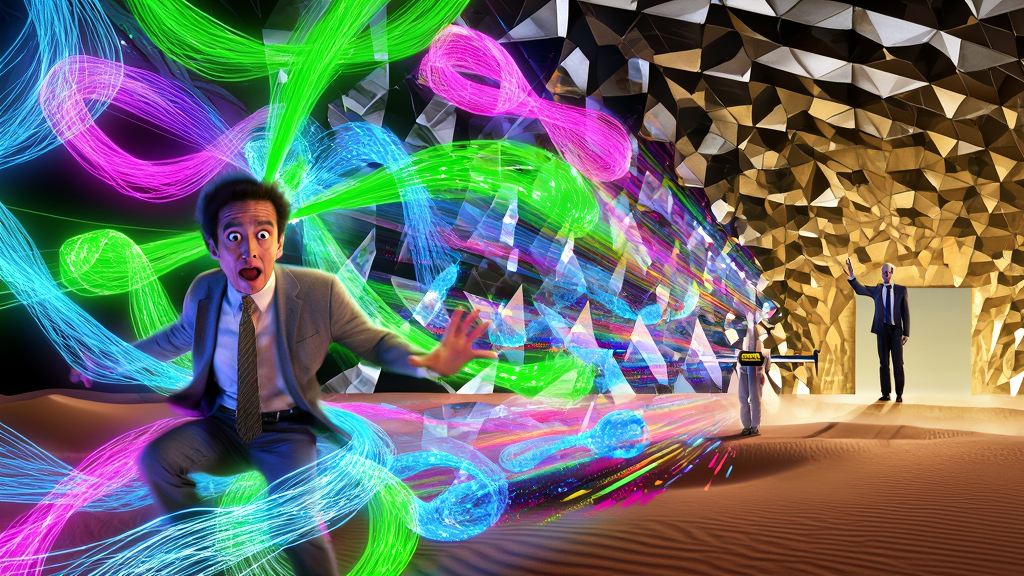
The humming of the Dodecahedral Bifrost—that deep, resonant 432 Hz chord—seemed to amplify, cutting through the sterile silence of the desert. Through the shifting sands of the flat Euclidean plane, a third traveler approached.
He didn't walk; he buzzed. He moved with a frantic, manic energy, darting left and right, his hands moving in a blur.
It was Michio Kaku.
He was juggling. But he wasn’t juggling balls or clubs; he was juggling tiny, hyper-vibrating, multi-colored rubber bands. There were thousands of them in the air at once—1D vibrating strings, twisting and curling into eleven-dimensional shapes, only to instantly snap back into 1D loops. He never dropped a single one, but his eyes were wide, panicked, and entirely focused on keeping the chaotic swarm in the air.
"Music!" Kaku shouted as he approached, not looking at KnoWell, but staring intently at his juggling hands. "The mind of God is cosmic music resonating through eleven-dimensional hyperspace! It's all a symphony! A symphony of strings!"
"That's a nice thought, Michio," KnoWell said, leaning against the pentagonal tollgate. "But your symphony requires 10⁵⁰⁰ different orchestras playing at the same time, and none of them can hear each other. That’s not a symphony. That’s just noise."
Kaku stopped his frantic pacing, though his hands continued to juggle the vibrating strings in a furious blur. He finally looked at the Dodecahedral Bifrost.
"A bridge?" Kaku scoffed, his voice vibrating with the same manic frequency as his strings. "Why would I need a single bridge? In the String Landscape, there are bridges of every conceivable geometry! There are bridges made of anti-matter, bridges made of tachyons, bridges where gravity pushes instead of pulls! The multiverse provides all possibilities!"
"But you only live on one," KnoWell replied. "And you have no physical mechanism to explain why you are standing here, and not on one of the other 10⁵⁰⁰ bridges. You’ve replaced physics with a statistical lottery." KnoWell tapped the glowing railing of the Bifrost. "I have a single bridge. It doesn't require eleven hidden dimensions rolled up so small we can't see them. It uses the three spatial dimensions we actually have, woven by a (3,2) Torus Knot. It requires exactly zero unobservable universes."
Kaku shook his head vigorously, a few vibrating strings nearly slipping from his grasp. "No, no, no! The mathematics of String Theory are too beautiful, too elegant to be wrong! If the math allows for 10⁵⁰⁰ vacuum states, then nature must realize them all! The multiverse is the ultimate triumph of physics!"
KnoWell straightened up, stepping away from the gate. His expression grew serious.
"Michio. Let's examine the philosophical trap you've just built for yourself with this infinite, randomized landscape."
KnoWell held up a single finger. "You claim this desert holds an infinite number of pocket universes, exploring every mathematically possible configuration of physical laws."
"Yes! Exactly!" Kaku beamed, juggling faster.
"By your own laws of statistical probability," KnoWell continued, "if you have an infinite number of universes generating every possible variation... doesn't that mathematically necessitate that a deity—an omnipotent, omniscient ordering intelligence—exists in at least one of them?"
Kaku’s hands fumbled. Two of the vibrating strings collided and vanished in a tiny puff of Hawking radiation. He scrambled to recover his rhythm. "Well... I... the parameters are physical, not theological—"
"But if all possibilities are realized," KnoWell pressed, "and an organizing intelligence is a mathematical possibility, then it must exist somewhere in your bulk." KnoWell took a step closer. "And if a deity exists in one of the infinite universes, you cannot definitively exclude this universe from being the one that contains it, or is influenced by it."
Kaku was sweating now, his eyes darting frantically between his juggling hands and KnoWell. "Science doesn't deal with deities! We deal with the laws of physics!"
"But you aren't dealing with physics anymore, Michio," KnoWell said softly. "You're dealing with infinite set theory. The instant you, as a materialist physicist, claim that there is not a deity in any of the infinite number of universes... that is the exact moment you are making a claim of omnipotent knowledge. You are claiming to know the contents of an infinite landscape you can never observe."
Kaku froze.
The strings in his hands stopped vibrating. For a brief, terrifying second, the logical paradox of the multiverse closed around him like a trap. If he accepted the infinite multiverse, he had to accept the statistical inevitability of God. If he denied God, he had to claim omniscience over the infinite multiverse.
He stared at the Dodecahedral Bifrost. The bridge hummed its stable, finite, 432 Hz chord. It was a single, beautiful, bounded reality. All he had to do was drop the $\aleph_0$ block from his backpack—to surrender the crutch of completed infinity.
Kaku looked at his hands, then at his backpack, and finally back at the infinite, flat desert.
"No," Kaku whispered, his voice trembling. "The math of the 11th dimension... it's too elegant. M-Theory is the final theory. I just need to find the right Calabi-Yau manifold. Just one more calculation..."
He threw the strings back into the air, resuming his frantic juggling, turning his back on the bridge and scurrying back into the desert, muttering equations to himself.
KnoWell watched him retreat. "He’s going to juggle those strings until the end of time," KnoWell said to himself. "He needs a safe place to play with his math where it won't break the real universe."
KnoWell reached into his pocket and pulled out a small, perfectly mirrored, 11-dimensional hypercube.
He snapped his fingers.
Instantly, the desert around Kaku folded inward. The flat Euclidean plane wrapped itself into a dizzying, compacted Calabi-Yau manifold, trapping the physicist inside.
It was the "Kaku Box."
Inside the mirrored cage, Kaku could juggle his 10⁵⁰⁰ strings forever. He could invent infinite multiverses, discover new dimensions, and calculate elegant, unfalsifiable theories to his heart's content, perfectly insulated from the thermodynamic realities of the actual cosmos.
KnoWell slipped the Kaku Box back into his pocket, the muffled sound of frantic, high-frequency juggling barely audible from within.
He turned back to the tollgate, the Dodecahedral Bifrost waiting patiently behind him.
The phantom winds of the Platonic Desert howled across the infinite Euclidean plane. They carried the faint, decaying echoes of the travelers who had refused the bridge—the heavy, dragging scrape of Tyson’s singularity pebble; the overlapping, fractured murmurs of a million splintered Sean Carrolls; and the muffled, frantic buzzing from the tiny, 11-dimensional Kaku Box resting safely in KnoWell’s pocket.
They had all chosen the desert. They had chosen the infinite, empty map over the finite, living territory. They preferred to carry the crushing weight of their ghosts and their paradoxes rather than lay down the two corrupt bricks of $0.0$ and $\aleph_0$.
KnoWell stood alone at the gate.
He turned his back to the sweeping dust of the flat void and faced the Dodecahedral Bifrost.
It was a structure of breathtaking, procedural majesty. At its foundation, where it anchored into the desert floor, the bridge was not built of static girders. It was alive. Billions of microscopic, three-stranded threads—the (3,2) Torus Knot solitons—were spinning at an incomprehensible frequency, executing their $i$-Turns, grabbing the unmanifest potential of the blowing Chaos wind and crystallizing it into solid, glowing pentagonal tiles.
The bridge did not just span space; it generated space. As the knots wove, the bridge expanded upward and outward, lifting across the logarithmic tiers of the Cosmic Octave. The microscopic knots scaled up into mesoscopic pilot-wave resonances, stepping through the biological harmonics of the DNA antenna, and finally blossoming into the massive, sweeping geometry of the cosmological horizon. Above him, the twelve vast pentagonal faces of the Poincaré Dodecahedral Space arched into a closed, protective sky, gleaming with the exact $\phi/2$ correlation of the matched circles.
It was not a cold, dead, clockwork mechanism. It breathed. It pulsed with the Triadic Parallax, inhaling the potential of the future and exhaling the solid ash of the past. The entire bridge vibrated with the warm, living $2.73$ Kelvin hearth-fire of the Cosmic Loom, and the air rang with the clear, unyielding $432.081\text{ Hz}$ master chord of the Abraxian Engine.
KnoWell reached out and rested his hand on the solid, pentagonal railing. He could feel the $\Delta\varepsilon = 0.001$ Celtic Knock—the slight, honest thermodynamic friction of the rational instruction set grinding against the irrational Golden Ratio floor. It was the physical sensation of existence itself. The feeling of striving. The weight of being real.
The tollgate was open. It had always been open.
The bridge did not force anyone to cross. It did not conquer the desert with violence or demand adherence to a new set of unobservable ghosts. It simply stood, a monument of absolute geometric and thermodynamic truth, waiting for those who were exhausted by the illusions of static Being.
KnoWell reached to his belt and unhooked a small, elegantly carved wooden shuttle—the traditional tool of the loom worker, used to carry the weft thread through the warp.
He tossed it lightly in his hand, feeling its weight.
He was not just a gatekeeper. He was Homo Textilis.
"Let them wander in the dust," KnoWell whispered to the humming structure. "The Cathedral of Becoming is open."
With the shuttle in his hand, KnoWell stepped past the gate, leaving the infinite desert behind, and began to walk up the glowing, pentagonal steps of the Bifrost, ready to weave for eternity.