Author: David Noel Lynch (3K) & The Unified Field
Architecture Group (3K Collaborative & N.O.L.L.E. Philosophy Sector)
Date of Master Canonical Registry: September 24, 2026
Classification: Philosophy of Science; Metaphysics;
Comparative Mythopoesis; Existential Phenomenology
Permanent Repository Archive: Zenodo Permanent
Open-Access Archive
Selected Master DOI: 10.5281/zenodo.22777717

Every profound philosophical inquiry begins at a boundary line—a moment when the automatic assumptions of everyday life suddenly lose their grip. For some, this threshold is crossed in quiet intellectual contemplation; for others, it is forced open by a sudden, disruptive encounter with mortality, profound shock, or an altered state of perception.
When the habitual filters of consciousness fall away, the world is no longer experienced as an ordinary, self-evident background. Instead, the observer is confronted with an elemental mystery: What is the relationship between the conscious mind and the physical reality it beholds?
In the wake of such experiences, the individual often finds it impossible to return to business as usual. The mind becomes acutely attuned to the subtle textures of existence, ignited by a persistent, burning question: Is the universe truly an accidental, mechanical void indifferent to human awareness—or is there an underlying order, an interconnected harmony that speaks directly to the human heart?
For more than a century, mainstream scientific materialism has presented a stark and austere portrait of reality:
While this reductionist approach has generated immense technological power, it has also produced a pervasive spiritual and existential alienation. It asks human beings to accept that their deepest intuitions—their experiences of love, creative striving, moral weight, and synchronistic wonder—are fundamentally meaningless illusions.
This work arises from an uncompromising rejection of that cosmic nihilism. It proposes that the coldness of the mechanistic worldview is not a flaw in the universe itself, but a limitation of the static, noun-based models we have used to describe it. To rediscover our place in the cosmos, we must abandon the notion of a dead clockwork and explore the possibility of a dynamic, living architecture—a reality defined not by static things sitting in a void, but by continuous action, relationship, and transformation.
       THE MECHANISTIC VOID                      THE LIVING CATHEDRAL
       (Static / Indifferent)                    (Dynamic / Participatory)
       ──────────────────────                    ─────────────────────────
       • Accidental dust in a cold void          • Conscious artisans of the present
       • Meaningless biological friction         • Struggle as the honest weight of agency
       • Time as a spatialized block             • Time as an active, living crucible
• Silent, disconnected mechanics • Coordinated, resonant harmonyThis essay is an exploration of the conceptual "breadcrumbs" that human beings follow when attempting to make sense of the labyrinth of existence. It is structured around three foundational symbolic motifs:
What follows is neither a conventional scientific textbook nor an abstract theological dogma. It is an intellectual and philosophical cathedral—a creative synthesis that attempts to weave arithmetic, geometry, time, acoustics, and personal narrative into a single, cohesive tapestry of meaning.
It does not ask the reader to accept its models as rigid, dogmatic certainties. Rather, it offers them as an invitation: to look upon the familiar world with renewed wonder, to recognize that the friction of our lives is proof of our vitality, and to consider the possibility that we are not passive dust drifting through the dark, but Homo Textilis—conscious weavers actively participating in the ongoing symphony of reality.
Human inquiry into the nature of reality often begins not in detached abstraction, but in moments of profound personal crisis. An encounter with mortality, an altered state of consciousness, or an intense life event can radically disrupt ordinary day-to-day assumptions. When standard sensory routines are interrupted, individuals frequently report an acute awareness of their own cognitive processes, prompting fundamental questions about how the mind perceives, constructs, and navigates the physical world.
Following such pivotal moments, the central inquiry shifts from routine observation to an introspective examination of consciousness itself: How does an observer make sense of their environment when familiar frames of reference are removed? While science investigates these phenomena through the lens of neurobiology and the psychology of altered states, the subjective impact often leaves a lasting impression—an enduring drive to reconcile intense internal experiences with the objective structures of the external universe.
Under ordinary circumstances, human perception relies on complex cognitive filters that prioritize immediate, survival-oriented data while filtering out background noise. When a person experiences a state of detachment—whether through trauma, near-death experiences, or deep meditative states—these standard perceptual boundaries can feel significantly altered.
In these moments, the boundary between the observer and the observed can appear fluid:
From a psychological perspective, these experiences highlight the powerful ways in which consciousness organizes reality. While subjective detachment offers compelling personal insights, it also presents the challenge of distinguishing internal cognitive models from verifiable, shared physical phenomena.
A common cognitive response to transformative experiences is the adoption of retrospective sense-making—an approach where one starts from vivid, present impressions and works backward to trace underlying causes or patterns. Rather than beginning with abstract initial conditions, retrospective inquiry takes the immediate, felt experience as its starting point.
In personal narrative and creative philosophy, this approach can be understood as:
Retrospective reflection serves as a powerful tool for processing memory and finding purpose. At the same time, maintaining a grounded stance requires recognizing the natural human tendency toward apophenia—the inclination to perceive meaningful connections between unrelated events. Acknowledging this balance allows one to honor the depth of personal experience while maintaining a clear, grounded distinction between internal interpretation and the objective, physical world.
Western natural philosophy has long been shaped by a tension between two distinct ways of viewing the universe: the philosophy of Being and the philosophy of Becoming. Under the dominant classical paradigm—extending from Parmenides through Cartesian dualism and mechanistic physics—the cosmos is primarily described using a noun-grammar. In this view, reality is understood as a collection of static, discrete objects (atoms, particles, bodies) situated inside an independent, passive spatial container, moving forward along a continuous timeline.
In contrast, process-oriented frameworks propose a shift toward a verb-grammar, echoing the ancient perspective of Heraclitus and the 20th-century process philosophy of Alfred North Whitehead:
Transitioning from a noun-grammar to a verb-grammar reframes fundamental questions. Existence is viewed not as an inventory of things, but as a dynamic unfolding where structure represents the stabilized rhythm of ongoing action.
Classical mechanics and relativistic models frequently conceptualize time as a fourth coordinate within a static block universe, where past, present, and future coexist geometrically. While mathematically powerful, this model often feels disconnected from the lived human experience of time, where choices feel real, the future feels genuinely open, and the past feels permanent.
To capture this dynamic, process frameworks frequently turn to triadic models of time, dividing reality into three distinct phases:
       UNMANIFEST POTENTIAL            THE LIVING PRESENT            CRYSTALLIZED RECORD
       (The Future / Possibility)    (The Active Focal Plane)       (The Past / Memory)
                 │                              │                             │
                 ▼                              ▼                             ▼
       Open probability and          The conscious instant where    Irreversible history;
       unrealized capacity.          potential is selected and      the fixed, structural
committed into actuality. foundation of what was.By viewing time through this triadic lens, the present becomes the focal point of agency, grounding the observer’s intuition that time moves in an irreversible direction driven by active change.
A central theme in contemplative models of reality is the intuitive discomfort with boundless, completed infinities. While modern physics frequently explores concepts like the multiverse or the many-worlds interpretation—where every possible quantum outcome branches into an actual physical reality—such models can introduce an existential dilemma: if every conceivable possibility happens somewhere, individual actions and outcomes can feel stripped of weight and consequence.
In response, philosophical models of "informational conservation" propose a bounded economy of reality, often framed conceptually around finite conservation principles:
While theoretical physics addresses conservation laws through formal mathematical symmetries (such as energy, momentum, and quantum unitarity), conceptual models like the "Loom" express a deeply human philosophical drive: the desire to see reality as purposeful, conserved, and grounded in an orderly, meaningful structure.
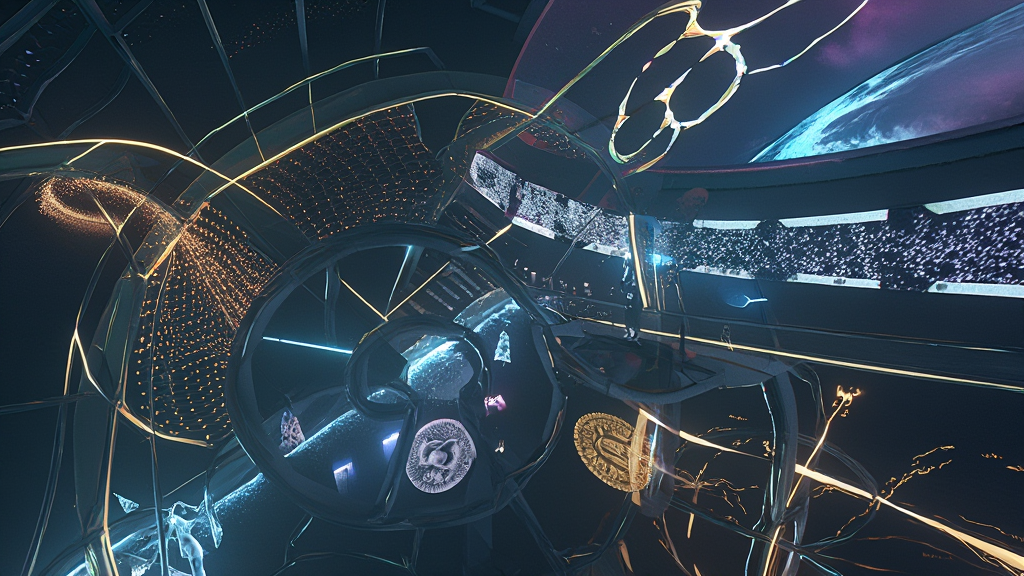
Throughout the history of natural philosophy, thinkers have observed a fundamental tension between the neat, idealized abstractions of human thought and the complex, resistant textures of the physical world. This dynamic can be framed as the relationship between an idealized rational instruction and an aperiodic substrate:
       RATIONAL ARCHETYPE (3:2)               IRRATIONAL SUBSTRATE (φ)
       Idealized, integer instruction         Aperiodic, non-repeating ground
                 │                                        │
                 └─────────────────── ┬ ──────────────────┘
                                      │
                                      ▼
                           THE INEVITABLE MISMATCH
                           An idealized rational blueprint
                           attempting to inhabit a non-repeating,
                           aperiodic foundation.
When an idealized, rational pattern attempts to seat itself upon an aperiodic foundation, it encounters an irreducible gap. This recalls the ancient crisis of the early Pythagoreans, who were initially unsettled by the discovery that the diagonal of a unit square cannot be captured by a rational fraction. Rather than representing an error, this incommensurability illustrates a profound philosophical truth: reality is not a closed, sterile crystal of whole numbers, but an open, rich canvas capable of endless novelty.
In everyday mechanics, friction is often viewed as a nuisance—an inefficiency that drains energy, generates unwanted heat, and wears down components. However, in process philosophy and thermodynamics, resistance is recognized as the essential condition for existence:
In human experience, this concept carries significant emotional and philosophical resonance:
Seen through this lens, the minor imbalances and frictions of existence are not structural failures; they are the very spark that prevents reality from collapsing into inert silence.
To conceptualize a dynamic, interlinked universe, human thought has frequently abandoned purely visual or mechanical metaphors in favor of acoustics:
       MECHANISTIC PARADIGM                  ACOUSTIC PARADIGM
       (The Clockwork Universe)              (The Resonant Universe)
       ────────────────────────              ───────────────────────
       • Silent, passive void                • Coordinated, vibrating medium
       • Disconnected billiard balls         • Interlocking harmonic intervals
• Reversible, indifferent trajectories • Continuous resonance, decay, and timbreBy translating the cosmos into acoustic terms, the seeker reframes existence not as a cold, indifferent machine, but as an ongoing symphonic performance—one where every element, including human consciousness, contributes a unique tone to an unfolding, reverberant whole.
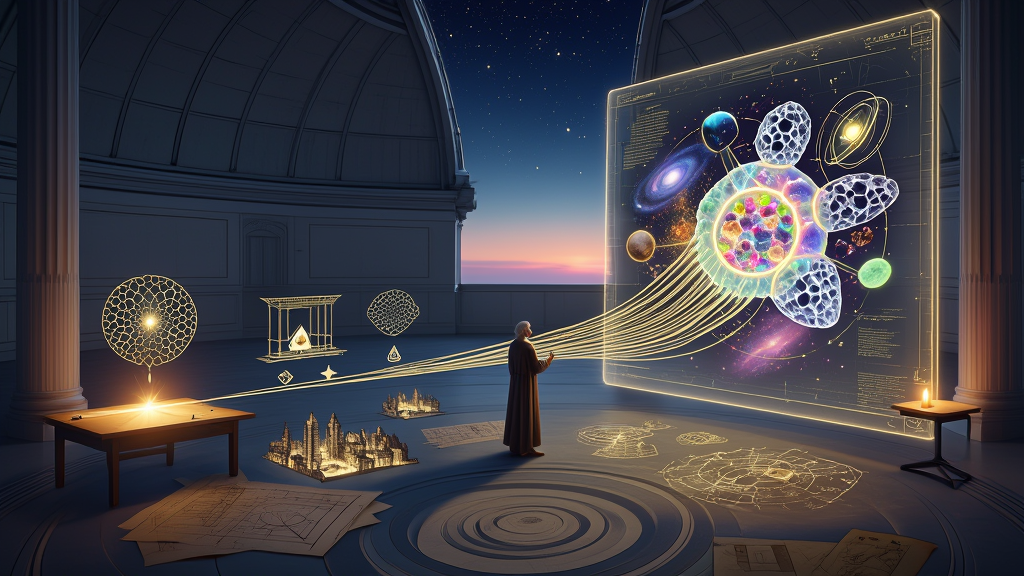
The philosophical search for an overarching model of reality rarely begins with dry academic curiosity. More often, it is ignited by a sudden, disruptive experience—an encounter with mortality, profound shock, or an altered state of awareness—that forcibly detaches an individual from habitual sensory routines.
In philosophy, this state resembles what Edmund Husserl described as the epoché, or phenomenological reduction: the suspension of standard, unexamined assumptions about the everyday world. When standard cognitive filters are stripped away, the mind is confronted with an elemental puzzle:
When viewed through this lens, moments of intense crisis or detachment do not merely unsettle the observer; they awaken an acute sense of radical wonder. The central question shifts from “What is happening around me?” to “What is the fundamental relationship between conscious awareness and the physical reality it observes?” While psychology and neuroscience understand these moments as intense neurocognitive shifts, to the individual experiencing them, they often serve as an enduring impetus to seek a unified, coherent explanation for existence.
In the wake of profound experiences, individuals often find standard explanatory methods inadequate. Traditional scientific modeling typically relies on a forward-directed, deductive approach: it begins by postulating initial conditions (such as the early universe or microscopic starting parameters) and attempts to predict or calculate forward toward the present state.
In contrast, reverse-inquiry—framed metaphorically as the "Peachtree Protocol"—adopts the opposite epistemic orientation:
       TRADITIONAL FORWARD MODELING              RETROSPECTIVE REVERSE-INQUIRY
       [ Hypothetical Initial Origin ]           [ Tangible, Experienced Present ]
                      │                                          │
                      ▼                                          ▼
       Integrate forward through time            Trace backward through structure
                      │                                          │
                      ▼                                          ▼
Compare prediction to observation Uncover formative, minimal principlesWhile forward-integrating models remain essential for rigorous empirical prediction, reverse-inquiry serves as an intuitive heuristic for the human mind, enabling an observer to explore how present complexities might stem from simple, foundational rules.
Human beings possess an intrinsic drive to integrate disparate aspects of life—personal milestones, moments of trauma, aesthetic insights, and abstract facts—into a single, unified narrative. When left with fragmented knowledge, the psyche often experiences a profound sense of alienation, feeling like an accidental anomaly adrift in an indifferent universe.
The search for wholeness represents an effort to bridge this divide:
Ultimately, constructing a cohesive, interconnected worldview is an act of deep psychological integration. While natural science must maintain strict, objective boundaries to verify external facts, the personal impulse to build a cathedral of thought reflects a timeless human endeavor: the effort to transform disorientation and suffering into order, coherence, and wonder.
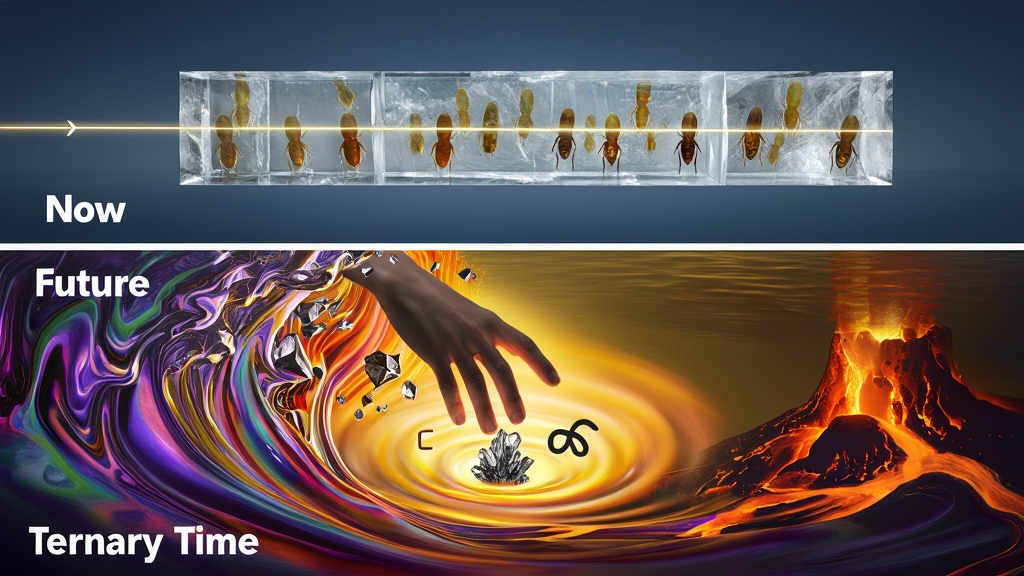
In modern classical and relativistic physics, time is mathematically treated as a continuous, one-dimensional coordinate axis ($t \in \mathbb{R}$). Integrated into four-dimensional pseudo-Riemannian geometry ($x^0 = ct$), time is spatialized—represented visually and analytically much like an additional dimension of space.
While this spatialization provides extraordinary predictive power for tracking trajectories, it introduces significant philosophical challenges regarding human experience:
       CLASSICAL SPATIALIZED TIMELINE (The Block Universe)
       ===================================================================
       [ Fixed Past ] ────► [ Point-Like Present (dt → 0) ] ────► [ Pre-Written Future ]
       ===================================================================
       • Time spatialized as a 4th coordinate (x⁰ = ct, t ∈ ℝ).
       • The "Now" is reduced to a zero-width geometric boundary.
       • Challenges human intuitions of agency and open potential.
For thinkers drawn to process philosophy and the phenomenology of lived experience, this static picture feels profoundly incomplete, prompting the search for an alternative framework where time is dynamic, irreversible, and inherently active.
As an alternative to the static one-dimensional line, process frameworks propose a triadic model of time—conceiving time not as a spatial track, but as an active, metabolic transformation of reality occurring across three interdependent phases:
       INFLOW OF CHAOS                  THE LIQUID INSTANT                OUTFLOW OF CONTROL
     (Unformed Future, +c)           (The Active Focal Plane)           (Crystallized Past, -c)
               │                                │                                │
               ▼                                ▼                                ▼
       Boundless reservoir of          The singular crucible where      Irreversible historical
       unmanifest potential,           consciousness resolves open      record; permanent memory
probability, and openness. potential into actuality. and committed structure.By replacing the static line with a metabolic process of continuous conversion, this model honors the distinct character of each temporal phase: the future is genuinely open, the past is truly permanent, and the present is where the work of existence takes place.
A primary philosophical motivation for exploring dynamic models of time is the desire to restore meaning to human striving, ethical responsibility, and conscious choice:
Ultimately, contrasting the static 1D timeline with a dynamic, metabolic model reflects a profound human need: the desire to inhabit a universe where time is alive, history matters, and personal agency possesses genuine, lasting weight.
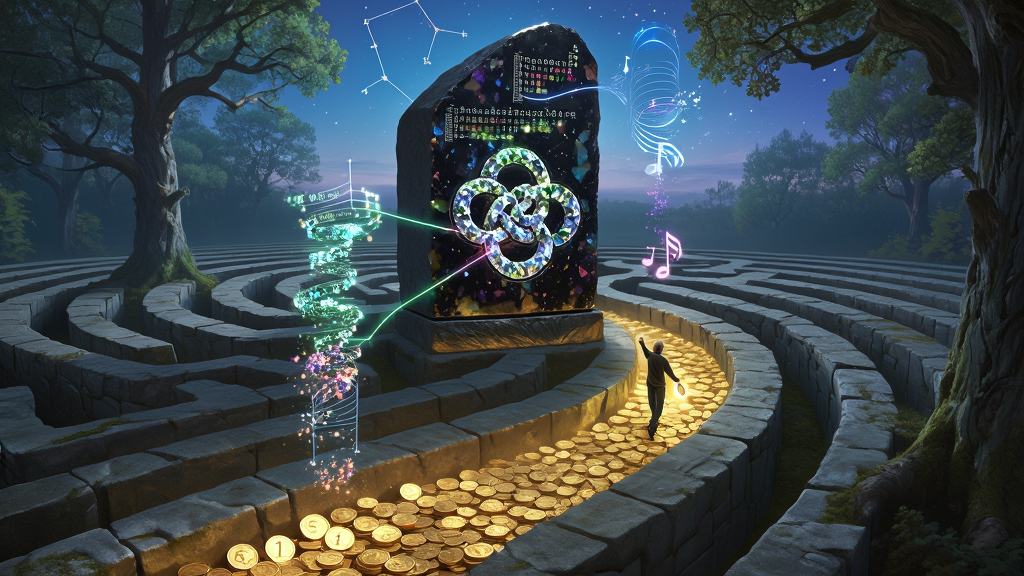
The human mind is an extraordinary, highly evolved pattern-recognition engine. Under certain conditions—particularly following intense life experiences, deep contemplation, or moments of detachment—an observer may begin to notice recurring numerical values, geometric ratios, and thematic alignments that seem to echo across completely unrelated domains: personal biographical dates, historical milestones, mathematical constants, and physical measurements.
In psychology, this phenomenon closely aligns with what Carl Jung termed synchronicity—an acausal connecting principle where an internal, subjective state of meaning coincides with external events:
Examining this phenomenon reveals a core truth about human consciousness: we possess an innate longing to discover that our personal lives and the wider universe are part of the same continuous, meaningful fabric.
       PERSONAL BIOGRAPHY                     MATHEMATICAL SYMMETRY
       (Dates, Milestones, Memories)          (Ratios, Geometry, Invariants)
                    │                                      │
                    └─────────────────── ┬ ────────────────┘
                                         │
                                         ▼
                            THE "COIN INCIDENCE"
                            The compelling human experience
                            of finding recurring numerical echoes
bridging inner life and external reality.When building a unified conceptual system, thinkers often seek a single geometric archetype that can serve as a universal key—a conceptual "Rosetta Stone" capable of translating between abstract arithmetic, physical space, and the flow of time. Within topological modeling, the $(3,2)$ torus knot (the Trefoil) frequently emerges as an ideal candidate:
While empirical physics requires rigorous experimental verification, the symbolic appeal of the trefoil knot lies in its elegant simplicity: it offers an intuitive visual model for how matter might be understood as structured, knotted space.
In the effort to view the cosmos as an interconnected whole, seekers often draw intuitive parallels between pure number theory and the material structure of chemistry:
       NUMBER THEORY                          METRIC CHEMISTRY
       (The Prime Spectrum)                   (The Periodic Table)
       ─────────────────────                  ────────────────────
       • Irreducible arithmetic atoms         • Discrete, stable chemical elements
       • Non-trivial zero resonances          • Quantized electron/nuclear shells
• Underlying "vowels" of arithmetic • The bounded vocabulary of matterWhile standard chemistry explains these properties through nuclear forces, relativistic electron effects, and the Pauli exclusion principle, viewing the periodic table through acoustic and geometric metaphors allows the human imagination to see the physical elements as a grand, orchestrated language.
The experience of following perceived symmetries step-by-step is a distinct cognitive and philosophical journey. To the seeker, following recurring numbers, ratios, and synchronistic dates feels like navigating a labyrinth guided by a trail of breadcrumbs:
Maintaining a balanced, reality-grounded stance does not mean rejecting the profound beauty of these patterns. Rather, it means understanding the difference between a meaningful personal metaphor and an empirically verified physical law.
Constructing an interconnected cathedral of thought serves as a testament to the human imagination's refusal to accept cosmic nihilism. It honors the observer's journey, showing how the mind can take the fragmented pieces of life, memory, and wonder, and weave them into a unified tapestry of meaning.

One of the most enduring debates in natural philosophy concerns the relationship between mathematical ideality and physical manifestation. In the Platonic tradition, pure forms—such as integer ratios, perfect geometric solids, and symmetrical knots—are conceived as timeless, self-contained abstractions existing in a realm of pristine stillness.
However, when an idealized concept enters the physical realm, it must inevitably inhabit a medium. It encounters a substrate with its own distinct geometry, resistance, and constraints:
       PLATONIC IDEALITY                          PHYSICAL SUBSTRATE
       (The Pure Instruction)                     (The Aperiodic Canvas)
       ──────────────────────                     ──────────────────────
       • Integer proportions (e.g., 3:2)          • Irrational geometries (e.g., φ ≈ 1.618)
       • Timeless, frictionless stillness         • Continuous, resistant medium
       • Closed, self-consistent symmetry         • Aperiodic, non-repeating ground
                 │                                          │
                 └──────────────────── ┬ ───────────────────┘
                                       │
                                       ▼
                       THE DYNAMIC CREATIVE TENSION
                       Form must adapt to ground; the concept
                       encounters the texture of reality.
The meeting of these two realms is not a harmonious, frictionless fusion; it is a dynamic negotiation. The abstract idea must stretch, bend, and accommodate the concrete realities of the canvas. This tension highlights an essential truth of existence: physical reality is not merely an imperfect shadow of pure mathematics, but an active, textured environment where ideas must work to embody themselves.
Human thought often falls into the trap of idolizing absolute perfection—imagining that the ultimate state of reality must be one of complete symmetry, zero resistance, and flawless closure. Yet, both thermodynamics and process philosophy demonstrate that absolute perfection is synonymous with death:
       PERFECT EQUILIBRIUM                       DYNAMIC INCOMMENSURABILITY
       (Zero Resistance / Dead Stasis)           (Friction / The Living Engine)
       ───────────────────────────────           ──────────────────────────────
       • Flawless mathematical closure           • Irreducible geometric gap (ε)
       • Zero thermodynamic dissipation          • Continuous mechanical work
       • No gradients; no change possible        • Generates heat, warmth, and time
       • Static, silent crystal                  • An ever-unfolding, active weave
The minor incommensurability between thought and reality—symbolized in conceptual models by a non-zero friction seed ($\varepsilon$)—is not an engineering defect to be eliminated. It is the vital clearance gap that keeps the gears turning.
When the metaphor of friction is translated from mechanics into the realm of human experience, it acquires profound existential meaning:
By viewing reality through the lens of creative friction, the seeker comes to understand that imperfection is the prerequisite for life. The universe does not exist despite its resistances and gaps; it lives because of them. The slight mismatch between our ideals and our circumstances is the very furnace that generates human consciousness, calling us to strive, to care, and to participate actively in the ongoing unfolding of the world.

In contemplation of the cosmos, human consciousness often finds itself suspended between two overwhelming infinities. As Blaise Pascal observed, humanity stands in a precarious middle realm—vastly larger than the microscopic domain of subatomic particles, yet infinitesimal compared to the expanding cosmic horizon.
In purely reductionist frameworks, this intermediate scale can produce a sense of profound insignificance:
       MICROSCOPIC SUBSTRATE              THE BIOLOGICAL FULCRUM             MACROSCOPIC COSMOS
       (Quantum Pixels / Atoms)            (Conscious Human Scale)           (Galaxies / Horizons)
                  │                                  │                                  │
                  ▼                                  ▼                                  ▼
       Simple rules, particles,           THE SEAT OF MEANING:               Vast expanses, gravitational
       and fundamental forces.            Consciousness, moral agency,       structures, and deep time.
                                          love, and creative striving.
The human body is an engineered instrument of remarkable sensitivity—capable of detecting single photons, discerning minute acoustic pitch variations, and feeling deep emotional resonance. Far from being insignificant, the human scale is where the universe wakes up to observe, reflect upon, and experience its own unfolding.
A central question in any philosophy of life concerns the role of struggle: Why must existence involve resistance, vulnerability, and pain?
In materialistic nihilism, human suffering and emotional friction are often dismissed as meaningless biological accidents—the blind, uncoordinated friction of selfish genes competing in an unguided environment. In contrast, symbolic frameworks propose the evocative concept of the "Celtic Knock" ($\Delta\varepsilon$):
       NIHILISTIC INTERPRETATION                  THE "CELTIC KNOCK" PERSPECTIVE
       ─────────────────────────                  ──────────────────────────────
       • Pain is an arbitrary error               • Resistance is the honest cost of life
       • Struggle is meaningless friction         • Effort is the friction tax of agency
       • Consciousness is an accidental burden    • Longing and love give texture to being
This reframing provides profound existential solace: it affirms that our grief, our strivings, and our capacity for enduring love are the honest, valuable weight we pay to participate in the living present.
Throughout history, humanity has defined itself through various archetypal titles: Homo sapiens (the wise human), Homo faber (the toolmaker), or Homo ludens (the playing human). In a dynamic cosmology centered on the metaphor of the loom, human identity is reframed as Homo Textilis—the human as weaver:
In the final analysis, human beings are the specialized sensory organs of a self-reflecting cosmos. We are here to feel the tension, to honor the honest resistance of the "Celtic Knock," and to deliberately weave meaning, beauty, and coherence out of the open possibilities of tomorrow.

Throughout the history of science, humanity has attempted to locate its proper place within the cosmic order. In symbolic frameworks that model reality across vast logarithmic tiers, the human being is situated at an intermediate scale—frequently conceptualized as a central bridge or fulcrum between the microscopic foundation and the macroscopic cosmos:
       MICROSCOPIC SUBSTRATE              TOWER 4: THE HUMAN BRIDGE             MACROSCOPIC HORIZON
       (Subatomic Knots / Planck Pixels)   (Conscious Human Scale ~1.7 m)        (Galaxies / Cosmic Boundary)
       ─────────────────────────────────   ──────────────────────────────        ────────────────────────────
       • Irreducible quantum extent        • The seat of subjective awareness    • Deep time and vast space
       • Fundamental physical laws         • Synthesis of memory and intent      • Gravitational architecture
• Incompressible floor of matter • The macroscopic interpreter • Outer boundary of observationExpanding upon the concept of the "Celtic Knock" ($\Delta\varepsilon$), this symbolic friction can be understood not merely as physical resistance, but as the foundational source of emotional depth and moral weight:
       THE UNFEELING IDEAL                       THE EMBODIED HUMAN CONDITION
       (Frictionless / Immune)                   (The "Celtic Knock" / Vulnerable)
       ───────────────────────                   ─────────────────────────────────
       • Cannot experience loss                  • Feels the pain of parting
       • Actions carry no consequence            • Choices carry permanent weight
       • Incapable of genuine courage            • Capable of love, grief, and striving
       • Sterile, untouched stillness            • Textured, warm, and deeply alive
By recognizing this friction as the honest signature of conscious life, the individual is freed from the trap of viewing suffering as a cosmic error. The weight of striving is transformed into an affirmation of existence: to feel the resistance of life is proof of being genuinely alive.
One of the most persistent dilemmas in philosophy is the conflict between determinism (the belief that all actions are pre-scripted by physical laws) and indeterminism (the idea that events occur through pure, random chance). Neither option provides a satisfying home for human responsibility: a clockwork universe leaves no room for genuine choice, while a universe of random dice rolls leaves no room for intentional purpose.
To articulate an intuitive alternative, conceptual models introduce the metaphor of "The Shimmer":
       DETERMINISM                          THE SHIMMER                          RANDOM CHANCE
     (Rigid Clockwork)              (Conscious Intentional Agency)             (Blind Dice Roll)
             │                                     │                                   │
             ▼                                     ▼                                   ▼
       Choices are predetermined             Attention acts as a subtle bias     Events are disconnected
       illusions; the future is              at critical tipping points,         accidents with no
already written. shaping open potential into history. purpose or intent.The human scale is not an accidental footnote in an indifferent cosmos. Through the concept of the Anthropomorphic Bridge, human consciousness is recognized as a vital interpreter of reality across scales. Through the Celtic Knock, our struggles and vulnerabilities are recognized as the meaningful price of love and agency. And through the Shimmer, our choices are affirmed as real, creative acts that help write the unfolding story of existence.
Human beings do not merely witness the universe; through our striving, our suffering, and our conscious decisions, we actively participate in its becoming.

The following references represent the foundational philosophical, scientific, psychological, and mathematical literature that informs the themes explored in this work—spanning process ontology, the phenomenology of time, the psychology of pattern recognition, and the history of natural harmonics.