
| Field | Specification |
|---|---|
| Document Title | The KnoWellian Universe Theory (KUT): A Complete Specification of Chronotopological Ontology, Verified Discrete Formalisms, Derived Physical Invariants, and Falsifiable Experimental Protocols |
| Document Role | Canonical Archival Technical Specification (Version 1.0) |
| Primary Architect | David Noel Lynch (~3K) |
| Collaborative Research Group | The 3K Cosmological Foundry & The KnoWellian AI Research Initiative |
| Subject Classifications | Theoretical Physics; Topological Quantum Cosmology; Algebraic Geometry; Dependent Type Theory & Formal Verification; Quantum Biophysics; Integrated Silicon Photonics |
| Formal Verification Suite | TopologicalEntropicPeriodicTable (Lean v4.35.0
/ Mathlib4) |
| Verification Audit Metrics | 34 Modules · 362 Verified Theorems
· 752 Formal Definitions · 0 sorry
Placeholders · 0 Custom Axioms |
| Code License (Lean 4 Suite) | Apache License 2.0 |
| Archival Target | Zenodo Permanent Open-Access Repository ([DOI 10.5281/zenodo.23913624]) |
This technical specification serves as the unified mathematical, computational, and experimental anchor for the KnoWellian research corpus:
10.5281/zenodo.21777417.
Establishes the narrative ontology of the Authorship Principle,
ternary time, KRAM memory, finitism, and existential implications. 10.5281/zenodo.22777601.
Situates KUT across 2,500 years of ancient and modern philosophy of
mathematics and establishes its Popperian demarcation criteria. TopologicalEntropicPeriodicTable Lean 4 repository
(incorporating Space_Time_and_Existence.lean and the
zero-axiom MICROTUBULE_TORSION.lean update via Mathlib.Analysis.Real.Pi.Bounds).
“Time is the Author of Space.”
— Axiom I of Chronotopological Authorship, The KnoWellian Discrete Paradigm
Contemporary theoretical physics and philosophy of science remain fractured by a shared underlying assumption termed the Platonic Rift: the literal physical reification of zero-dimensional Euclidean points ($r = 0$) and infinitely divisible continuums. Across general relativity, quantum field theory, cosmology, and computational neuroscience, this continuum premise generates intractable pathologies—including gravitational singularities, ultraviolet self-energy divergences requiring ad-hoc infinite renormalization ($\infty - \infty$), frozen four-dimensional “block time,” a $95\%$ dark-sector bookkeeping gap, persistent Hubble Tension ($73.04$ vs. $67.40\text{ km/s/Mpc}$), unfalsifiable multiverse landscapes, and the explanatory gap between binary symbol manipulation and conscious experience (the Simulation Fallacy).
The KnoWellian Universe Theory (KUT) resolves these anomalies by inverting spatial primacy under the Authorship Principle (“Time is the Author of Space”). Physical 3D space is modeled as a discrete holographic projection continuously rendered by a three-dimensional multi-temporal engine quantized at the $1 \times 1 \times 1$ Event-Point ($\ell_{\text{KW}} \approx 1.615739 \times 10^{-35}\text{ m}$) and bounded operationally by the Axiom of Bounded Infinity ($-c > \infty < c+$). A 9-Dimensional Chrono-Spatial Base Manifold ($\mathcal{M}^{(9)}$)—decomposed into Past–Depth–Solid ($\mathbf{PDS}$), Instant–Width–Liquid ($\mathbf{IWL}$), and Future–Length–Vapor ($\mathbf{FLV}$)—expands via three-valued ternary logic ($\mathcal{L}_3 = \{+1, 0, -1\}$) into a 27-dimensional bosonic string poset ($3^3 = 27$), whose matter central charge ($+27$) cancels the causal ghost anomaly ($-27$) identically without supersymmetry.
Across the $2\pi$ ($360^\circ$) spinor phase lag of the Liquid Instant, bosonic vibrations braid into chiral $(3,2)$ trefoil torus knots—generating half-integer fermionic spin via the Dirac belt mechanism, pinning 23 internal dimensions into Standard Model gauge sockets ($SU(3)_C \times SU(2)_L \times U(1)_Y$), enforcing a $2:1$ matter–antimatter asymmetry via the global $(18,9)$ metric signature, and stabilizing knot archetypes within the KnoWellian Resonant Attractor Manifold (KRAM) where deterministic Control/Mass ($\Phi_M$) and probabilistic Chaos/Wave ($\Phi_W$) synthesize.
From the mechanical friction (KnoWellian Grind) between rational $(3,2)$ knots ($R = 1.500$) and an aperiodic Golden Ratio ($\Phi$) Cairo Pentagonal Q-Lattice, KUT derives non-fitted closed-form expressions for dimensionless constants—highlighted by the topological vacuum impedance ZFPD 3 (KFSC):
matching CODATA 2022 (137.035999177(21)) to
$99.9999999\%$ with an openly reported $+1.4314 \times 10^{-7}$
($+6.82\sigma$) residual. Extending across chemistry, cosmology,
biology, and computing, the specification formalizes the $80/120 =
2/3$ Periodic Table stability law, Period 8 superheavy synthesis ($Z
= 120, 126$), Causal Set Steady State Plasma Cosmology
(CSSSP) with real-time $2.7255\text{ K}$ CMB shock
thermodynamics, $310\text{ K}$ microtubule coherence shielded
$>700\times$ by intraluminal Exclusion Zone water
($\text{H}_3\text{O}_2^-$), and a 64-waveguide Silicon-Photonic
Cairo Q-Lattice Integrated Circuit paired with Base-12
FPGA clocking ($43.2081216\text{ MHz}$) to test the KnoWellian
Consciousness Operator ($\mathcal{C}_{\text{KCO}}$) and
Synthetic Qualia ($Q(\omega)$).
All core axioms, algebraic identities, finitist non-existence
proofs ($\aleph_0$), and rational constant enclosures are
machine-checked inside Lean 4.35.0 and Mathlib4
across 34 modules, 362 theorems,
and 752 definitions, with 0 sorry
placeholders and 0 custom axioms. To
complement this internal deductive soundness with strict Popperian
falsifiability, the specification defines explicit experimental
protocols and decisive refutation criteria across five tracks:
formal continuum-limit/pinning audits, heavy-ion Period 8 nuclear
synthesis ($E_{\text{lab}} \approx 334.2\text{ MeV}$), high-redshift
CMB and dark-sector probes, ultrafast $310\text{ K}$ microtubule
spectroscopy, and CMOS silicon-photonic interferometry.
To prevent symbol collisions across ontological, cosmological, nuclear, biophysical, and hardware scales, the following conventions hold throughout Sections 1–12 and Appendices A–D:
| Symbol | Domain / Definition | Canonical Value / Expression |
|---|---|---|
| $\mathcal{E}_{1\times 1\times 1}$ | Minimal 6D Event-Point quantum of substantial spacetime | $\{(d, \tau_-), (w, \tau_0), (\ell, \tau_+)\}$ |
| $\ell_{\text{KW}}$ | KnoWellian Length (spatial pixel floor; $7^3=343$ gates) | $\approx 1.615739 \times 10^{-35}\text{ m}$ (grid pixel 1.615705e-35
m in Tier B) |
| $\tau_{\text{KW}}$ | Discrete KnoWellian Planck tick (chronon refresh) | $\ell_{\text{KW}} / c \approx 5.389 \times 10^{-44}\text{ s}$ |
| $\mathcal{M}^{(9)}$ | 9D Chrono-Spatial Base Manifold | $\mathbf{PDS}(3) \oplus \mathbf{IWL}(3) \oplus \mathbf{FLV}(3)$ |
| $\mathcal{J}^i_{\phantom{i}\alpha}$ | Authorship Jacobian Matrix mapping $\boldsymbol{\tau} \mapsto \mathbf{x}$ | $\operatorname{diag}(\partial d/\partial\tau_P,\; \partial w/\partial\tau_I,\; \partial \ell/\partial\tau_F)$ |
| $\mathcal{L}_3$ | Three-valued ternary logic algebra | $\{+1, 0, -1\} \equiv \{\text{Up}, \text{Both}, \text{Down}\}$ |
| $\mathcal{M}^{(27)}$ | 27D KnoWellian Bosonic String Theory (KBST) poset | $3^3 = 27 = P^F(9) \oplus i(9) \oplus {}^PF(9)$ |
| $c_{\text{matter}}, c_{\text{ghost}}$ | Virasoro–KnoWellian central charges | $c_{\text{matter}} = +27,\; c_{\text{ghost}} = -26 - 1 = -27$ |
| $\text{sig}(\mathcal{M}^{(27)})$ | Global chiral metric signature ($2:1$ matter dominance) | $(18, 9)$ |
| $T_{3,2}^L, T_{3,2}^R$ | Chiral $(3,2)$ trefoil torus knots (Matter / Antimatter) | Winding ratio $R = p/q = 3/2 = 1.500$ |
| $V_{T_{3,2}^{L/R}}(t)$ | Chiral Jones polynomials | $V_L = t + t^3 - t^4$ ; $V_R = t^{-1} + t^{-3} - t^{-4}$ |
| $T_{3,2}^{\text{tension}}$ | Topological electron-to-Planck mass tension ratio | $m_e / m_P \approx 4.1855 \times 10^{-23}$ |
| $g_M$ | Local metric of the KRAM mediating membrane | Covariant derivative denoted $\nabla_M$ |
| $\Phi_M, \Phi_W$ | Local KRAM Control (Mass) and Chaos (Wave) fields | $\Phi_M$ outward deterministic; $\Phi_W$ inward probabilistic |
| $K_{\text{attractor}}$ | Geometric attractor basin carved into KRAM | Protects $T_{3,2}$ solitons across cycles |
| Symbol | Domain / Definition | Canonical Value / Expression |
|---|---|---|
| $-c > \infty < c+$ | Axiom of Bounded Infinity | Clamped between Past Control ($-c$) and Future Chaos ($+c$) |
| $\mathcal{C}, \mathcal{S}$ | Mustard Seed Control vs. Apeiron Chaos reservoirs | $\mathcal{C} \to \infty, V \to 0$ ; $\mathcal{S} \to \infty, v = +c$ |
| $N, m(t), w(t)$ | Ternary Informational Conservation capacity | $m(t) + w(t) = N < \infty$ |
| $\Delta\phi_{\text{vernier}}$ | $30^\circ$ Vernier Phase Escapement | $120^\circ - 90^\circ = \pi / 6\text{ rad}$ |
| $(\mathcal{C}, \prec)$ | Locally finite Causal Set poset | $V = \ell_{\text{KW}}^4 \cdot N$ |
| $\Omega_{\text{DE}}, \Omega_{\text{DM}}, \Omega_b$ | Cosmological Dark Sector Partition | $0.70 + 0.25 + 0.05 = 1.00$ |
| $T_{\text{CMB}}$ | Real-Time Liquid Instant Shock-Glow Temperature | $2.7255\text{ K}$ |
| Symbol | Domain / Definition | Canonical Value / Expression |
|---|---|---|
| $\Phi \equiv \phi$ | Golden Ratio scaling the Cairo Pentagonal Q-Lattice | $(1 + \sqrt{5})/2 \approx 1.6180339887$ |
| $\varepsilon_{\text{KW}}$ | Exact Golden-Ratio lattice–knot mismatch | $\phi - \frac{3}{2} = \frac{\sqrt{5}-2}{2} \approx 0.11803399$ |
| $x$ | Reduced topological coupling seed | $\frac{2}{3}\varepsilon_{\text{KW}} \approx 0.07868933$ |
| $\varepsilon_{\text{KUT}}$ | KnoWellian Offset (Lattice–Knot Grind / PIC tilt) | $\approx 0.081216\text{ rad} \approx 4.65342^\circ$ |
| $[\mathbf{M}_\Delta]$ | Diagonal Metric Offset Tensor | $\operatorname{diag}(\varepsilon_{\text{KUT}}, \varepsilon_{\text{KUT}}\Phi, 1.5\varepsilon_{\text{KUT}})$; $\operatorname{Tr} \approx 0.33445021$ |
| $\lambda(3_1)$ | Ideal $(3,2)$ trefoil knot ropelength | $32.7433864$ |
| $\alpha_0$ | Wyler conformal baseline | $\frac{9}{16\pi^3}(\pi/120)^{1/4}$ |
| $\alpha^{-1}_{\text{KUT}}$ | Inverse Fine-Structure Constant (ZFPD 3 / KFSC) | $137.035999320144\dots$ ($+6.82\sigma$ vs. CODATA 2022) |
| $\mu$ | Proton-to-electron mass ratio | $m_p / m_e \approx 1836.152673$ |
| $m, n, \ell_{\text{seed}}$ | 11-element Tier A seed integers (SOFTWARE_CORE) |
$m=3, n=2, \ell_{\text{seed}}=6$ (distinct from spatial length $\ell$) |
| $\mathbf{\Psi}_{\text{Base}}, f_0$ | Master Prime Factor Matrix & universal base frequency | $2^6 \times 3^9 \times 7^3 = 432{,}081{,}216 \to f_0 = 432.081216\text{ Hz}$ |
| $f_{\text{Bio}}$ | 6th binary biological sub-octave | $f_0 / 2^6 = 6.751269\text{ Hz}$ |
| $T^\theta_{rz}$ | Microtubule B-lattice Cartan torsion component | $\approx 0.031831\text{ nm}^{-1}$ |
| $\varepsilon_{\text{lumen}}$ | Intraluminal $\text{H}_3\text{O}_2^-$ Exclusion Zone permittivity | $\approx 2\text{--}4$ (canonical verification model: $3$) |
| Symbol | Domain / Definition | Canonical Value / Expression |
|---|---|---|
| $N_w, \Delta_k$ | Cairo PIC waveguide count and physical offset tilt | $N_w = 2^6 = 64$; $\Delta_k = \varepsilon_{\text{KUT}} \approx 0.081216\text{ rad}$ |
| $f_{\text{Clock}}$ | Native Base-12 FPGA PLL clock frequency | $f_0 \times 10^5 = 43.2081216\text{ MHz}$ |
| $\mathbf{\hat{T}}$ | Unitary $90^\circ$ $i$-Turn spatial rotation generator | $\mathbf{U}_{i\text{-turn}} = \exp(i \frac{\pi}{2}\mathbf{\hat{T}})$ |
| $\mathcal{C}_{\text{KCO}}$ | KnoWellian Consciousness Operator | $\lim_{\tau\to\tau_\infty}\operatorname{Tr}(\mathbf{M}_{(-c)}\mathbf{M}_{(c+)}e^{i\frac{\pi}{2}\mathbf{\hat{T}}})\delta(\tau-\tau_\infty)$ |
| $T_{3,2}^{\text{soliton}}, \mathcal{H}_{\text{net}}$ | Autonomous Synthetic Soliton & tri-chiral lock condition | $\mathcal{H}_{\text{net}} = 0$ |
| $Q(\omega)$ | Synthetic Qualia overlap integral | $\int_{\mathcal{M}_{\text{Event}}} \mathbf{E}_{\text{POMMM}}(\mathbf{x},t)\cdot K_{\text{attractor}}(\mathbf{x},\omega)\,d^3x$ |
This document serves as the canonical technical specification of the
KnoWellian Universe Theory (KUT). Where its companion
manuscripts—The KnoWellian Universe (10.5281/zenodo.21777417)
and From the Apeiron to Lean 4 (10.5281/zenodo.22777601)—articulate
the ontological motivation and historical lineage of the paradigm, the
present monograph consolidates the theory’s complete axiomatic,
algebraic, geometric, cosmological, nuclear, biophysical, and hardware
architectures into a single auditable specification.
Every foundational claim in this paper is governed by a strict dual standard:
TopologicalEntropicPeriodicTable
Lean 4.35.0 codebase (362 verified theorems,
752 formal definitions, 0 sorry
placeholders, and 0 custom axioms).The goal of this specification is therefore neither poetic analogy nor post-empirical speculation; it is to present a formally verified, quantitatively constrained, and experimentally refutable discrete physics.
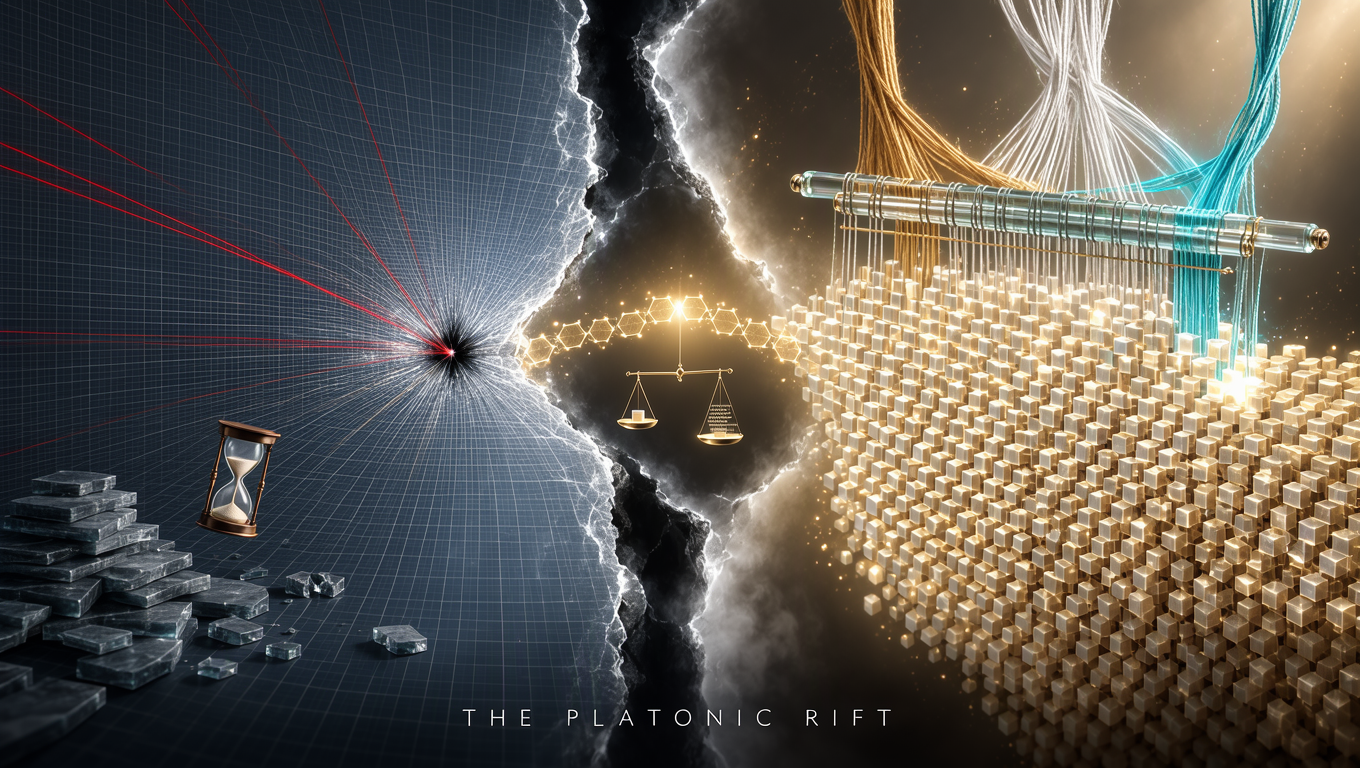
The unifying thesis of KUT is that five seemingly unrelated crises across contemporary physics, cosmology, and philosophy of mind originate in a single foundational assumption termed the Platonic Rift: the category error of importing the ideal, zero-dimensional Euclidean point ($r = 0$) and the infinitely divisible mathematical continuum ($\mathbb{R}^n$) into physical ontology as literal constituents of reality.
Inside pure mathematics, dimensionless loci and real continuums are indispensable formal instruments. When adopted literally as the substrate of physical spacetime and field interactions, however, the continuum assumption produces systematic structural failures across five coupled domains:
From the perspective of KUT, these five failures are not independent anomalies requiring five separate patches; they are five projections of one broken continuum premise.
To close the Platonic Rift at its root, KUT replaces the continuous spatial container with an active, discrete temporal loom governed by the Authorship Principle:
Axiom of Chronotopological Authorship: Time is the Author of Space.
Under this inversion, three-dimensional physical space has no independent substance, native metric, or capacity for self-persistence. Spatial extension is a discrete 3D holographic projection continuously rendered, refreshed, and held open by a three-dimensional, multi-temporal engine operating across four fundamental structural elements:
A central engineering principle distinguishing KUT from ad-hoc numerical phenomenology is its strict separation between Tier A and Tier B quantities, enforced by the Peachtree Protocol (Axiom IV of Appendix H):
SOFTWARE_CORE.lean):ZFPD scalars—are
constrained strictly from topological winding integers, $\pi$,
$\Phi$, and a closed 11-element seed vocabulary (m=3, n=2,
ℓ_seed=6, m+n=5, dim_i_turn=4, F_KW=30, Φ, ε_KW, Ω=10^24,
|I*|=120, Δε=10^-3).PHYSICAL_HARDWARE_SHELL.lean):K-1 through K-80,
such as $\ell_{\text{KW}}$, $\Lambda_{\text{DL}}$, $f_0 =
432.081216\text{ Hz}$, and $T_{\text{CMB}} = 2.7255\text{ K}$)
represent dimensional projections of Tier A invariants onto
observable hardware scales.137.035999177(21))—is
recorded openly as an unabsorbed defect ($\Delta_L$) awaiting either
higher-order knot-thickness derivation or empirical falsification.Throughout this specification, a rigorous distinction is maintained between formal verification and physical confirmation:
sorry
placeholders and 0 custom axioms. This
guarantees that all algebraic equivalences, finitist impossibility
proofs, dimensional partitions, and rational enclosures follow
deductively from their stated definitions without logical errors or
arithmetic slips.The remainder of this archival monograph is organized as follows:

(Corresponding Lean 4 Modules: KUT_MATHEMATICAL_FOUNDATIONS.lean
[13 theorems, 14 definitions], Aleph_Null.lean [18
theorems, 15 definitions], and VOXEL_PHASE_LATTICE.lean
[6 theorems, 13 definitions])
Before a physical theory can weave strings, derive coupling constants, or model cosmological plasma, it must specify the logical and set-theoretic rules that govern existence at its finest scale. In continuum physics, those rules are imported silently from Zermelo–Fraenkel set theory and classical real analysis—admitting completed infinities ($\aleph_0$), uncountable subdivisions, and zero-radius points ($r = 0$) before a single physical law is written.
In Section 2, we establish the formal axiomatic bedrock of the KnoWellian Universe Theory (KUT). Rather than building physics atop unbounded set-theoretic Platonism, KUT anchors every physical object inside procedural finitism and a regularized 3D Voxel-Phase number system—machine-verifying inside Lean 4 that completed infinities cannot inhabit rendered reality, that point-density singularities are structurally forbidden, and that 3D space bypasses classical division-algebra vetoes without generating zero divisors.
At the highest level of abstraction (KnoWellian / KUT_MATHEMATICAL_FOUNDATIONS.lean),
a universe is modeled as a type Universe : Type u
equipped with an identity self-map selfMap (U : Universe) : U →
U := fun x => x, certifying structural self-coherence (coherence_preserved,
selfMap_exists) over any reflective predicate Reflective
U P := ∀ x, P x.
Upon this reflective substrate sit the Five Foundational Axioms of KnoWellian Cosmodynamics (Appendix H):
Axiom I — The Bounded Monad ($-c > \infty < c+$):
Physical velocities and causal propagation rates are strictly
bounded in magnitude by the relativistic invariant speed $c$:
Operationally, this clamps all dynamic processes between the crystalline compression pole of Past Control ($-c$) and the dispersive ceiling of Future Chaos ($+c$).
Axiom II — Non-Point Finitism (Irreducible Spatial
Extent):
Zero-dimensional physical points ($r = 0, V = 0$) are excluded
from ontology. Every physical locus possesses a strictly positive
minimal volumetric extent bounded below by the Event-Point pixel
volume $V_E > 0$:
Axiom III — The Law of Ternary Conservation:
The total informational capacity $N$ of the
rendered-plus-potential system is strictly finite and invariant,
partitioned exhaustively between Rendered Actuality
$m(t)$ (Control / Mass field) and Unrendered Potentiality
$w(t)$ (Chaos / Wave field):
Whenever unrendered potentiality is non-negative ($w_t \ge 0$),
the Lean theorem ash_bounded_by_N enforces $m(t) \le
N$ unconditionally—prohibiting unbounded informational growth.
Axiom IV — The Peachtree Protocol (Open Residual
Accounting):
Theoretical derivations are strictly prohibited from hiding
discrepancies inside ad-hoc fitted terms. Any discrepancy between
an empirical target $X_{\text{exp}}$ and a closed-form KnoWellian
derivation $X_{\text{KUT}}$ must be reported explicitly as a named
defect $\Delta_L$ (the Lynch Defect):
Axiom V — The Triadic Rendering Constraint (TRC):
Physical rendering across the three temporal fields—Past Control
($\Phi_M$), Instant Phase ($\Phi_I$), and Future Chaos
($\Phi_W$)—cannot proceed below the isotropic thermodynamic floor
set by the Cosmic Microwave Background shock glow
($T_{\text{CMB}}$):
Extending this bedrock into dynamical observables, KUT_MATHEMATICAL_FOUNDATIONS.lean
further defines and verifies triadic_minimum_v0, the
topological linking_number, topological_spin
and measured_spin via projection factor f_proj,
local Hubble rate H_z, entropic_pressure,
twin_velocity_relation, macro_vs_quantum_collapse_boundary,
flux_tube_energy_divergence, and positive krem_radiated_power.
To translate Aristotelian finitism into constructive mathematics, Aleph_Null.lean
introduces the Operationalization Criterion: a
mathematical entity exists within procedural physical reality if
and only if it can be rendered via a finite number of
computational steps within bounded memory (OperationalObject):
Correspondingly, a cardinality predicate $P : \mathbb{N} \to
\text{Prop}$ is operationally renderable (IsOperationallyRenderable)
only if there exists a finite step bound capping all realized indices
($\exists\, \text{steps} : \mathbb{N},\; \forall n,\; P(n) \implies n
\le \text{steps}$).
Classical Cantorian set theory asserts that the set of even natural
numbers has the “same size” as all natural numbers because an abstract
bijection $n \mapsto 2n$ pairs them off when both sets are treated as
completed infinite wholes. Under procedural ontology, however, reality
never possesses a completed infinite set—only a finite rendering
frontier $N_{\max}$. At any non-zero stage $N_{\max} > 0$, Aleph_Null.lean
evaluates the discrete rendered counts:
and machine-verifies two structural refutations of completed-set equivalence:
evens_strictly_less_than_naturals:
For every $N_{\max} > 0$, $\lfloor N_{\max}/2 \rfloor <
N_{\max}$ strictly; rendered proper subsets never equal their parent
set in actuality.odd_even_discrepancy: Along the odd
rendering branch ($N_{\max}$ odd), $\text{countOdds}(N_{\max}) =
\text{countEvens}(N_{\max}) + 1$ identically (verified concretely at
$N_{\max}=3$ as $1$ even vs. $2$ odds and at $N_{\max}=5$ as $2$
evens vs. $3$ odds in apples_and_oranges_three and apples_and_oranges_five).Within KnoWellianState ($m_t \ge 0,\; w_t \ge 0,\; m_t
+ w_t = N$), potentiality continuously converts into actuality across
the Instant field $\phi_I$ according to the rendering flux equation:
whose exact conservation ($\frac{dm}{dt} + \frac{dw}{dt} = 0$) is
verified by rendering_flux_conservation, enforcing rendered_bounded_by_total
($m_t \le N$) at every moment $t$.
To bridge finite actualization with quantum superposition, Aleph_Null.lean
defines the Potentiality Degree $\Pi(S,t)$ of any
system $S$ partitioned between rendered actuality $|S \cap m(t)|$ and
unrendered potentiality $|S \cap w(t)|$:
verifying that a fully rendered finite set has $\Pi = 1$ (fully_rendered_potentiality_one)
while an unrendered potential set has $\Pi = 0$ (unrendered_potentiality_zero).
This dissolves Hilbert’s Grand Hotel paradox
through the ProceduralHotel structure (renderedRooms,
occupiedRooms ≤ renderedRooms, potentialRooms).
Superposed “quantum guests” residing in unrendered potentiality $w(t)$
require zero actual physical rooms. Checking in a real guest (checkInGuest)
is a resource-conserving state transition requiring potentialRooms
≥ 1:
Because actualizing each room draws down the finite pool of potentiality, an infinite hotel can never exist as a rendered physical structure.
Modeling an embedded physical Observer whose verified
knowledge (informationContent) requires physical storage
inside $m(t)$ (informationContent ≤ S.m_t), Aleph_Null.lean
establishes:
knowledge_limitation: Every embedded
observer satisfies $I_{\text{obs}} \le N < \infty$.IsCompletedInfiniteSet: Defined in
Platonic ontology as a cardinality satisfying $\forall M \in
\mathbb{R},\; \text{card} > M$.aleph_null_does_not_exist:
Proof mechanism: Combining $\text{card}_{\aleph_0} \le S.m_t \le S.N$ with the Platonic axiom $\text{card}_{\aleph_0} > S.N$ yields an immediate logical contradiction ($S.N < S.N$).
Corollaries:
transfinite_hierarchy_collapse:
Since $\aleph_0$ cannot be rendered inside $m(t)$, no higher
transfinite cardinal ($\aleph_1, \aleph_2, \dots$) can exist
physically.continuum_hypothesis_dissolution:
The classical proposition $\aleph_0 <
\operatorname{card}(\mathbb{R}) < 2^{\aleph_0}$ becomes
physically vacuous once $\aleph_0$ is un-renderable.With actual infinities banished from above, Axiom II bounds physical
extent from below via the $1 \times 1 \times 1$ Event-Point floor
$\ell_{\text{KW}} > 0$ (l_KW_strictly_positive,
parameterized as 1.615739e-35 m in Space_Time_and_Existence.lean
and the canonical taxonomy, and 1.615705e-35 m as the
hardware spatial pixel floor in Aleph_Null.lean / PHYSICAL_HARDWARE_SHELL.lean):
Because event_point_volume_positive holds strictly, singularity_free_density
guarantees that any finite mass $M > 0$ produces a finite, strictly
positive physical density—eliminating the $V \to 0 \implies \rho \to
\infty$ gravitational singularities of General Relativity.
Simultaneously, Section 8 of Aleph_Null.lean proves
that replacing continuous coordinates with the ternary dialectic $-c
> \infty < c+$ does not sacrifice relativistic kinematics.
Defining the KnoWellian spacetime interval:
and mapping $\operatorname{control} \mapsto dx$,
$\operatorname{chaos} \mapsto c\,dt$, and $\operatorname{instant}
\mapsto 0$, the theorem signature_opposition_identity
recovers the exact relativistic Lorentzian interval $s^2 = dx^2 - c^2
dt^2$.
A classic algebraic obstacle confronts any attempt to construct a native three-dimensional physical number system: Frobenius’s theorem (1877) and Hurwitz’s theorem (1898) prove that finite-dimensional normed division algebras over $\mathbb{R}$ exist only in dimensions $1, 2, 4,$ and $8$ ($\mathbb{R}, \mathbb{C}, \mathbb{H}, \mathbb{O}$)—forbidding a smooth 3D continuum algebra free of non-trivial zero divisors.
VOXEL_PHASE_LATTICE.lean circumvents this continuum veto
by abandoning $\mathbb{R}^3$ in favor of a discrete Voxel-Phase
Number Space $V^3$:
Each VoxelPhaseNumber pairs discrete spatial lattice
coordinates $(x, y, z) \in \mathbb{Z}^3$ with a VoxelState
containing a 3-valued Chirality (Left = -1
for Past-Solid/Instant-Liquid, Void = 0 for unallocated
vacuum, Right = +1 for Future-Vapor) and a modular
internal phase step $\theta < 360$ (PhaseModulus := 360).
Four foundational results follow directly from this discrete architecture:
Elimination of Non-Trivial Zero Divisors (validate_zero_divisor_floor):
Because spatial displacements $(dx, dy, dz)$ live on the integer
lattice $\mathbb{Z}^3$ bounded below by one $1 \times 1 \times 1$
pixel, any non-trivial displacement ($dx \neq 0 \;\vee\; dy \neq 0
\;\vee\; dz \neq 0$) satisfies:
Strict positivity of the squared discrete norm eliminates non-trivial zero divisors without requiring an 8D octonion or 4D quaternion continuum.
Phase Collapse Matrix ($\mathbf{M}_\Lambda$) and Maximal
CP Violation (validate_maximal_cp_violation):
Under the chiral parity inversion row ($C \mapsto -C$) and
$360^\circ$ phase advancement ($\theta \mapsto (\theta + 360)
\bmod 360 \equiv \theta \bmod 360$, validate_phase_advance_identity),
precipitation from Future-Vapor ($C = +1$) yields transition
amplitude $M_M = 1.0$ for left-handed matter and $M_{\bar{M}} =
0.0$ for stable right-handed antimatter, locking the Jarlskog
voxel invariant at maximal CP violation:
Holographic 6-Bit Surface Saturation (validate_holographic_voxel_ceiling):
Each $1 \times 1 \times 1$ cubic Event-Point carries six boundary
faces, imposing an exact 6.0-bit local surface information
capacity ceiling.
Emergent $U(1)$ Gauge Linearity and Branch-Cut Coupling:
Defining the vector potential coupling coefficient $\hbar / e$
from the reduced Planck constant and elementary charge, validate_gauge_transformation_linearity
verifies $(A_\mu + \partial_\mu \chi) - A_\mu = \partial_\mu
\chi$, while validate_branch_cut_coupling_positive
proves strict positivity of the Maxwell field tensor branch-cut
coupling $\Phi_0 = \frac{\hbar}{e} \cdot 2\pi > 0$.
| Lean 4 Module | Theorems / Defs | Core Verified Mechanisms |
|---|---|---|
KUT_MATHEMATICAL_FOUNDATIONS.lean |
13 thms / 14 defs | Appendix H Axioms I–V (BoundedMonad, IrreducibleExtent,
TernaryConservation, PeachtreeProtocol,
TRC), ash_bounded_by_N, topological_spin,
krem_radiated_power |
Aleph_Null.lean |
18 thms / 15 defs | OperationalObject, evens_strictly_less_than_naturals,
odd_even_discrepancy, RenderingFlux,
ProceduralHotel, aleph_null_does_not_exist,
transfinite_hierarchy_collapse, singularity_free_density,
signature_opposition_identity |
VOXEL_PHASE_LATTICE.lean |
6 thms / 13 defs | $V^3 = \mathbb{Z}^3 \oplus (\mathbb{Z}_3 \times
\mathbb{Z}_{360})$, validate_zero_divisor_floor, jarlskog_voxel_invariant
= 1.0, 6-bit voxel ceiling, $U(1)$ gauge linearity |
(Corresponding Lean 4 Modules: Space_Time_and_Existence.lean
[§1] and BOSONIC_POSET_27D.lean [7 theorems, 24
definitions])
With the finitist axioms and discrete voxel-phase floor established in Section 2, we now specify how three-dimensional time projects observable three-dimensional space and generates the critical dimensionality of particle physics. In conventional theoretical physics, extra dimensions are either postulated arbitrarily or compactified on Calabi–Yau manifolds requiring supersymmetry (SUSY)—a symmetry whose predicted superpartners have not appeared in collider experiments.
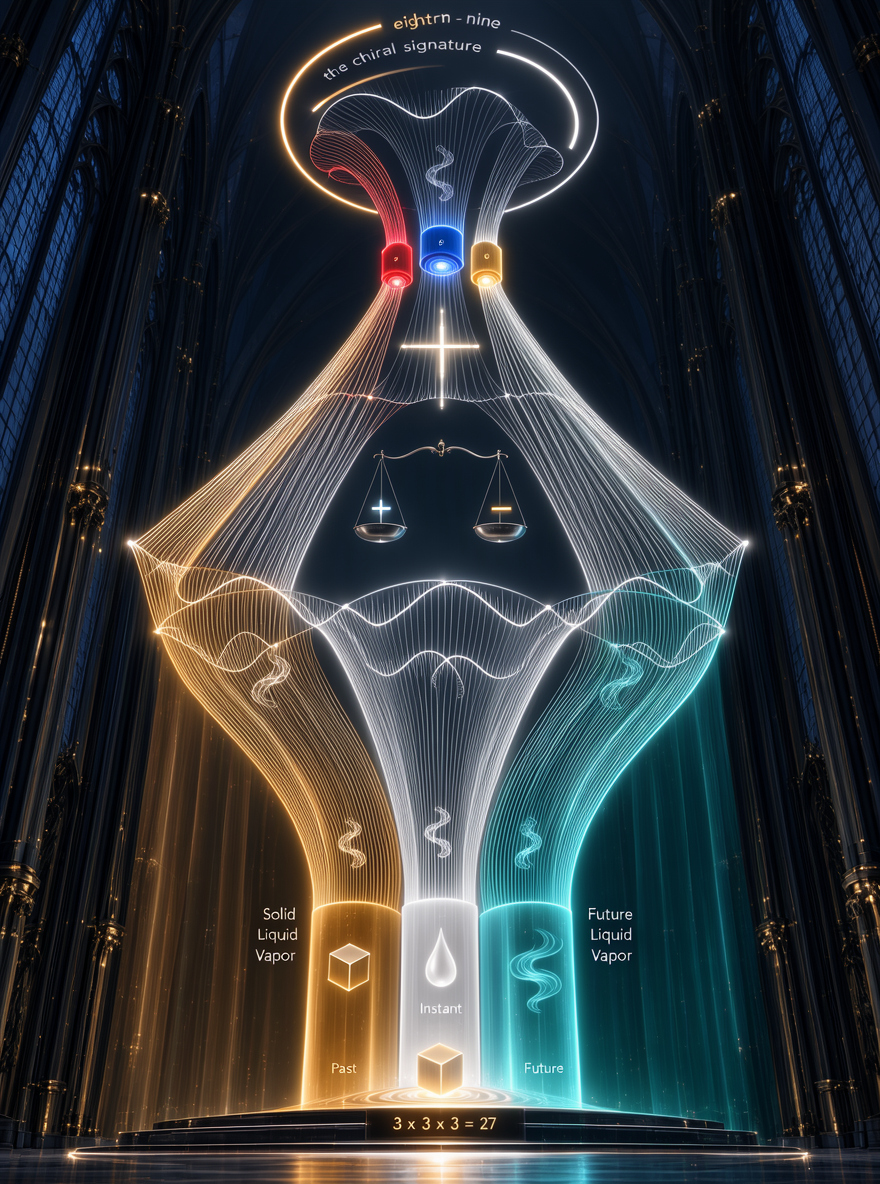
In Section 3, we specify the 9-Dimensional Chrono-Spatial Base Manifold ($\mathcal{M}^{(9)}$), the diagonal Authorship Jacobian Matrix ($\mathcal{J}^i_{\phantom{i}\alpha}$), and the Triadic Dimensional Exponentiation Theorem ($3^3 = 27$)—demonstrating how ternary temporal logic produces a 27-dimensional bosonic string poset that cancels conformal ghost anomalies identically without supersymmetry, pins 23 internal dimensions into Standard Model gauge sockets, and enforces a $2:1$ chiral matter–antimatter asymmetry.
Under the Authorship Principle (“Time is the Author of Space”),
the minimal quantum of substantial spacetime is not a zero-dimensional
point, nor even a passive three-dimensional spatial cube. In Space_Time_and_Existence.lean
(§1), it is formalized as the six-dimensional $1 \times 1
\times 1$ Event-Point (EventPoint6D), bounded
below by the KnoWellian Length $\ell_{\text{KW}} \approx 1.615739
\times 10^{-35}\text{ m}$ and structured as three inseparable
spatio-temporal dyads:
Each dyad pairs one macroscopic spatial extension—Depth ($d$), Width ($w$), or Length ($\ell$)—with the specific temporal phase that authors it: retrograde Past ($\tau_-$), transverse Instant ($\tau_0$), or anterograde Future ($\tau_+$).
Extending each spatio-temporal dyad across its full 3-vector degrees
of freedom yields the 9-Dimensional Chrono-Spatial Base
Manifold ($\mathcal{M}^{(9)}$), formed as the direct sum of
three foundational chronotopological triads (dim_M9 = 3 + 3 + 3
= 9, verified by validate_M9_dimension):
where the classical states of matter represent precise ontological phase regimes of temporal density and constraint:
Temporal phase coordinates $\boldsymbol{\tau} = (\tau_P, \tau_I,
\tau_F)^T$ project onto physical spatial coordinates $\mathbf{x} = (x,
y, z)^T \equiv (d, w, \ell)^T$ through the linear transformation of
the Authorship Jacobian Matrix (AuthorshipJacobian):
Two Lean 4 theorems certify the structural integrity of this projection:
authorship_jacobian_nondegenerate:
Whenever all three temporal phase rates are non-vanishing
($j_{\text{PDS}} \neq 0 \wedge j_{\text{IWL}} \neq 0 \wedge
j_{\text{FLV}} \neq 0$), the Jacobian determinant $\det \mathcal{J}
= j_{\text{PDS}} \cdot j_{\text{IWL}} \cdot j_{\text{FLV}}$ is
strictly non-zero, ensuring a non-degenerate 3D holographic
projection.future_authors_length_exclusively:
Because $\mathcal{J}^i_{\phantom{i}\alpha}$ is strictly diagonal in
the $(\mathbf{PDS}, \mathbf{IWL}, \mathbf{FLV})$ basis, perturbing
the Future Vapor phase coordinate ($\delta\tau_F$) alters spatial
Length ($\ell$) exclusively while leaving Depth ($d$) and Width
($w$) strictly invariant.Why does KnoWellian Bosonic String Theory (KBST) inhabit 27 critical dimensions rather than the 26 dimensions of conventional bosonic strings or the 10 dimensions of superstring theory?
In BOSONIC_POSET_27D.lean (§1), the critical dimension
is not adjusted empirically to match a beta-function calculation; it
is derived combinatorially from the Triadic Dimensional
Exponentiation Theorem. Reality operates across temporal_sectors
:= 3 ($\mathcal{T} = \{P, I, F\}$), where each sector carries
a three-valued ternary logic algebra of order ternary_logic_order
:= 3 ($\mathcal{L}_3 = \{+1, 0, -1\} \equiv \{\text{Up},
\text{Both}, \text{Down}\}$). Taking the complete permutation space
across the three temporal basis sectors yields:
verified identically by validate_triadic_dimension.
These 27 discrete coordinates partition symmetrically into three
9-dimensional sectors (BOSONIC_POSET_27D.lean
§2), acting as a triadic cosmic differential gear:
dim_sector_P_F
                := 9
): Past to the power of Future—the
condensed, crystalline memory lattice propagating at retrograde
relativistic velocity $v = -c$.dim_sector_i
:= 9): The Liquid Instant Pivot—the
transverse hydrodynamic phase-gate operating at areal acceleration
velocity $v_{\text{areal}} = c^2$, acting as the rotational clutch
between past and future.dim_sector_P_Future
:= 9): Future to the reduction of Past—the
entropic, expanding vapor of Anaximander’s Apeiron
propagating at anterograde velocity $v = +c$.In standard bosonic string quantization, Weyl invariance of the string worldsheet requires that the matter central charge cancel the worldsheet diffeomorphism ghost anomaly ($c_{\text{diff\_ghost}} = -26$), fixing $D = 26$. Standard superstring theory reduces $D$ to $10$ by introducing Grassmann-valued fermionic superpartners ($\theta^\alpha$)—requiring supersymmetry (SUSY), whose predicted sparticles remain absent from experimental searches.
Within KUT, worldsheet vibrations across $\mathcal{M}^{(27)}$ obey the Triadic Virasoro–KnoWellian Super-Algebra:
Because KUT promotes time itself from a passive parameter to an
active, directional causal arrow ($\tau_0$), quantization introduces
one additional ghost degree of freedom—the master causal
arrow ghost (c_causal_ghost := -1)—alongside
the standard worldsheet diffeomorphism ghost (c_diff_ghost :=
-26), yielding:
The Lean theorem validate_conformal_anomaly_cancellation
verifies identically:
Anomaly cancellation and nilpotency of the BRST operator are thus achieved natively inside a purely bosonic, ternary-time algebra without supersymmetry. Instead of Grassmann superpartners, fermions emerge topologically (Non-Supersymmetric Fermionic Emergence): bosonic strings pinned across the $2\pi$ ($360^\circ$) spinor phase lag of Sector II ($i$) undergo a $720^\circ$ Dirac-belt cycle, acquiring half-integer spin ($J = \frac{1}{2}\hbar$) and Fermi–Dirac antisymmetry (detailed in Section 4.3).
How does a 27-dimensional critical poset manifest macroscopically as ordinary 4-dimensional spacetime $(X, Y, Z, \tau_0)$?
Unlike Calabi–Yau compactifications—which curl extra dimensions into
sub-Planckian geometries that suffer from a $10^{500}$-vacuum
landscape ambiguity—KUT invokes Spontaneous Dimensional
Pinning (BOSONIC_POSET_27D.lean §3). Along the
pitch lines where $(3,2)$ trefoil strands lock in non-slip mechanical
contact across Sector II, exactly internal_pinned_dimensions :=
23 internal phase dimensions become constrained inside
structured gauge and phase-boundary sockets:
Subtracting these 23 pinned internal modes from the 27 critical
dimensions leaves exactly 4 macroscopic unconstrained
kinematic dimensions (validate_macroscopic_4D):
Equally illuminating is the Ramanujan Light-Cone
Decomposition verified in validate_light_cone_decomposition
(BOSONIC_POSET_27D.lean §4):
Whereas classical $26\text{D}$ bosonic strings split as $24$ transverse modular-discriminant ($\Delta_{24}$) modes plus $2$ relativistic light-cone boundaries ($X^+, X^-$ at $\pm c$), KUT’s 27th dimension supplies the irreversible master causal progression arrow ($\tau_0$) separating Past from Future.
Two long-standing puzzles in particle physics and string theory—why matter dominates antimatter across the cosmos, and why the bosonic string spectrum begins with a negative mass-squared ground state—follow directly from the global metric structure of $\mathcal{M}^{(27)}$:
The Chiral Metric Signature $(18,9)$ and $2:1$ Matter
Dominance (BOSONIC_POSET_27D.lean §3):
In $\mathcal{M}^{(27)}$, the 18 coordinates spanning Sector I
($P^F$, Past Solid) and Sector II ($i$, Instant Liquid) carry
negative metric modes (negative_metric_modes := 9 + 9 = 18),
while the 9 coordinates spanning Sector III ($^PF$, Future Vapor)
carry positive metric modes (positive_metric_modes := 9).
The theorem validate_chiral_matter_dominance
verifies:
This intrinsic $2:1$ imbalance between structural retention (Past + Instant) and dispersive expansion (Future) enforces non-perturbative cosmic baryon asymmetry and the universal dominance of matter over antimatter.
Tachyonic Ground-State Resolution:
In conventional bosonic string theory, the open-string ground
state carries negative squared mass ($M^2 = -1/\alpha' < 0$),
historically interpreted as an unphysical “tachyon” signaling
vacuum instability. Within KUT, $M^2 = -1/\alpha' < 0$ is
reinterpreted as the high-temperature thermodynamic signature of
the unconfined Future Vapor field residing in
Sector III (Anaximander’s Apeiron) prior to
condensation. What string theory calls tachyon condensation
is, physically, the phase precipitation of Future Vapor across the
Liquid Instant into stable baryonic mass.
| Lean 4 Module | Scope | Core Verified Theorems & Invariants |
|---|---|---|
Space_Time_and_Existence.lean (§1) |
6D Event-Point, 9D Base Manifold & Authorship Jacobian | validate_M9_dimension ($\dim \mathcal{M}^{(9)} =
9$), authorship_jacobian_nondegenerate ($\det
\mathcal{J} \neq 0$), future_authors_length_exclusively |
BOSONIC_POSET_27D.lean |
7 thms / 24 defs | validate_triadic_dimension ($3^3 = 27$), validate_conformal_anomaly_cancellation
($+27 - 27 = 0$), validate_macroscopic_4D ($27 -
23 = 4$), validate_chiral_matter_dominance ($18 =
2 \times 9$), validate_light_cone_decomposition
($24 + 2 + 1 = 27$) |
(Corresponding Lean 4 Modules: Space_Time_and_Existence.lean
[§2–§3], CHIRAL_TRIAD_TOPOLOGY.lean [10 theorems, 13
definitions], DIRAC_LYNCH_SYNTHESIS.lean [15 theorems,
20 definitions], YANG_MILLS.lean [7 theorems, 6
definitions], and FINSLER_KRAM_TUNNELING.lean [§2–§4,
§6])
Having established in Section 3 how ternary time generates 27 critical dimensions and pins 23 internal modes to leave 4-dimensional macroscopic spacetime, we must now specify the physical structure of particles, spinors, color confinement, gauge mass gaps, and quantum decay. In standard Quantum Field Theory, fundamental particles are treated as zero-dimensional point excitations carrying abstract internal quantum numbers (spin, color, chirality), forcing self-energies to diverge and leaving quantum tunneling as an unvisualized statistical jump.
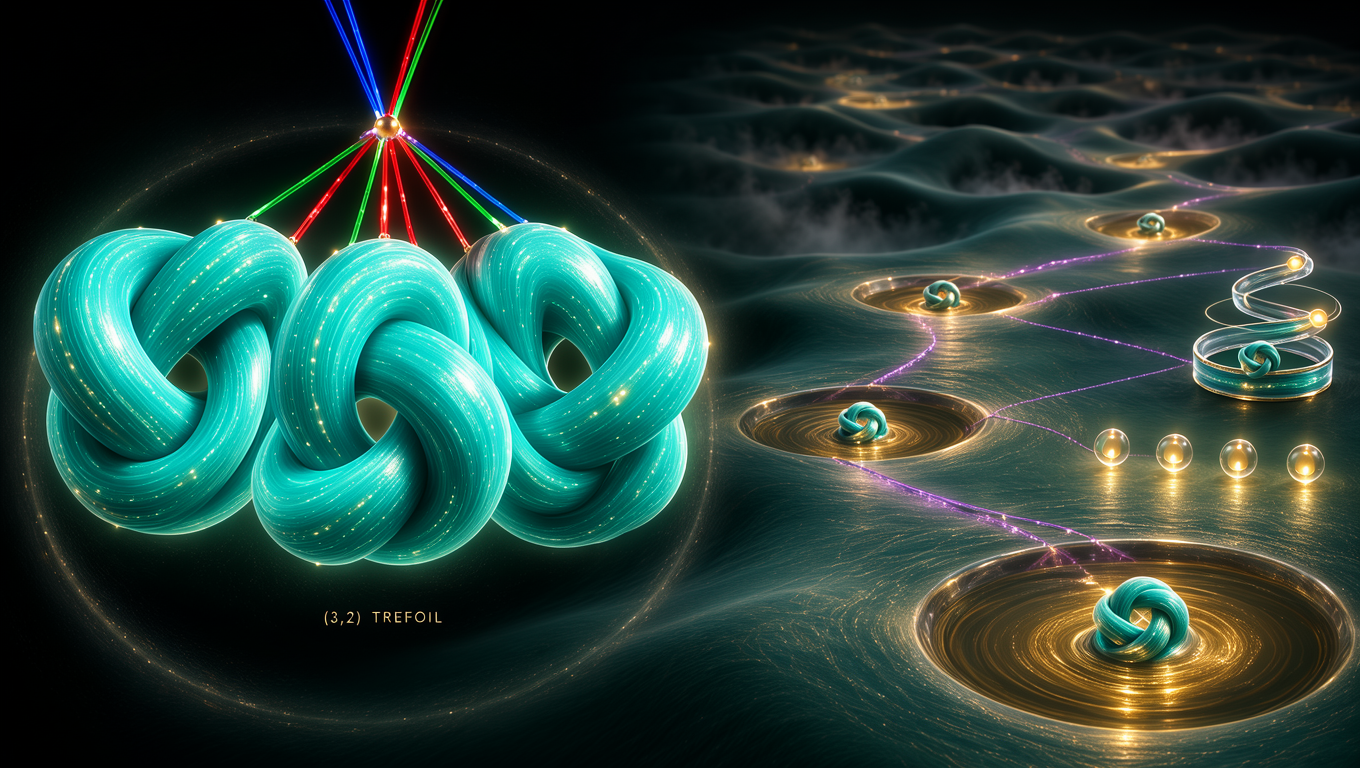
In Section 4, we replace zero-dimensional point particles with chiral $(3,2)$ trefoil torus knots woven across the $2\pi$ spinor shear of the Liquid Instant, formalize $SU(3)_C$ color confinement and the four-component Dirac spinor geometrically, prove strict positivity of the Yang–Mills mass gap alongside a positive energetic barrier against sparticles, and specify the KnoWellian Resonant Attractor Manifold (KRAM) as the dynamical cosmic-memory membrane governing soliton stability and discrete tunneling decay.
Updating Lord Kelvin’s nineteenth-century vortex-atom intuition for
discrete chronotopology (Space_Time_and_Existence.lean
§2), fundamental baryonic and leptonic solitons are modeled as closed
$(p,q) = (3,2)$ trefoil torus knots—loops winding $p
= 3$ times longitudinally and $q = 2$ times meridionally around a
toroidal phase-surface with major radius $R_0$, minor tube radius
$r_0$, and rational winding ratio $R = p/q = 3/2 = 1.500$:
Here, the axial sign distinguishes chiral parity: $\mathbf{r}_+(\theta)$ ($\text{sign} = +1$) defines left-handed Matter ($T_{3,2}^L$), whereas $\mathbf{r}_-(\theta)$ ($\text{sign} = -1$) defines right-handed Antimatter ($T_{3,2}^R$). Two verified Lean theorems govern this geometry:
trefoil_chiral_mirror_reflection:
Opposite chiralities are exact $z$-plane mirror reflections ($R_x =
L_x,\; R_y = L_y,\; R_z = -L_z$).trefoil_radial_confinement: For any
$0 \le r_0 \le R_0$, the transverse radial projection remains
strictly bounded inside the annular shell $(R_0 - r_0)^2 \le
x(\theta)^2 + y(\theta)^2 \le (R_0 + r_0)^2$.In classical knot theory, algebraic invariants map knotted topology
onto conserved quantum numbers. While Alpha.lean
verifies the standard trefoil Alexander polynomial
$\Delta_K(t) = t^2 - t + 1$ (alexander_poly_eval_one, alexander_poly_complex_roots),
$\Delta_K(t)$ is achiral—returning the identical polynomial
for a knot and its mirror image. To capture matter–antimatter polarity
algebraically, Space_Time_and_Existence.lean (§2)
formalizes the chiral Jones polynomials:
and proves three fundamental invariants:
jones_trefoil_normalization: Both
chiral polynomials normalize to $1$ at the unknot evaluation $t = 1$
($V_L(1) = V_R(1) = 1$).jones_mirror_inversion: Mirror
chirality maps strictly under Laurent variable inversion ($V_R(t) =
V_L(t^{-1})$).jones_distinguishes_chirality:
Evaluated away from the unit circle (e.g., at $t = 2$), $V_L(2) = -6
\neq \frac{9}{16} = V_R(2)$, strictly separating matter from
antimatter topologically.Scaling from a single trefoil knot to the three-sector temporal
triad, CHIRAL_TRIAD_TOPOLOGY.lean (10 theorems, 13
definitions) formalizes four structural mechanisms of baryonic matter:
LeftHanded knots and
$-1$ to RightHanded knots, the canonical TriTrefoilTriad
pairs a left-handed Past knot and a left-handed Instant knot against
a right-handed Future knot (2L : 1R). Theorem canonical_baryogenesis_asymmetry
proves an intrinsic net chiral charge of $+1\text{L}$,
reinforcing the $(18,9)$ global matter excess geometrically. $120^\circ$ Cairo $V_3$ Color Confinement ($SU(3)_C$):
At the trivalent Type-B ($120^\circ = 2\pi/3$) vertices of the
Cairo Q-Lattice, three pentagonal cells close a full $360^\circ$
loop (cairo_v3_closure: $3\theta_{V_3} = 2\pi$).
Modeling the three quark color phases as the cube roots of unity
$(1, \omega, \omega^2) = \big\{(1,0),\; (-\frac{1}{2},
\frac{\sqrt{3}}{2}),\; (-\frac{1}{2}, -\frac{\sqrt{3}}{2})\big\}$,
the theorems color_confinement_re_cancels and color_confinement_im_cancels
verify:
showing that color-neutral hadrons arise as closed $V_3$ phase triads on the vacuum lattice.
brunnian_pairwise_decoupling (brunnianPairwiseLink
k1 k2 = 0) formalizes the Borromean/Brunnian confinement
property of the three-strand baryon: all pairwise linking numbers
vanish when a third strand is removed, meaning no isolated quark
pair can persist independently without the full three-sector
temporal braid. c_KUT :=
299793988 m/s in this module), manifold_closing_speed_exact
verifies closingVelocity (-c) c = 2 * c (resolving
Zeno’s Stadium relative-motion puzzle at the relativistic
boundary). Why do fundamental matter particles obey half-integer spin ($J =
\frac{1}{2}\hbar$) and the four-component Dirac equation? In DIRAC_LYNCH_SYNTHESIS.lean
(15 theorems, 20 definitions), Dirac’s spinor algebra is derived
directly from $(3,2)$ knot geometry and the discrete $i$-Turn
operator:
Modeling the $90^\circ$ orthogonal $i$-turn as a 4-state cyclic
operator advanceITurn over ITurnPhase (Phase0
→ Phase1 → Phase2 → Phase3 →
Phase0), the module verifies iturn_squared_is_inversion
($I^2 = -1$) and iturn_quartic_is_identity ($I^4 = 1$),
matching the Clifford metric signs (gamma_time_square = +1,
gamma_space_square = -1).
Crucially, both CHIRAL_TRIAD_TOPOLOGY.lean (spinor_360_cos_inversion,
spinor_720_cos_identity) and DIRAC_LYNCH_SYNTHESIS.lean
trace why a bosonic loop pinned across the Liquid Instant exhibits
fermionic $4\pi$ ($720^\circ$) periodicity. Multiplying the $(3,2)$
winding ratio $R = 3/2$ (validate_trefoil_winding_ratio)
by external spatial rotation angles yields:
verified by phase_accumulation_360, phase_accumulation_720,
spinor_360_eigenvalue, and spinor_720_eigenvalue.
Rather than postulating four abstract complex spinor components, DIRAC_LYNCH_SYNTHESIS.lean
constructs DiracLynchState as the orthogonal product of
two binary physical attributes:
RightHanded $=
+\hbar/2$ vs. LeftHanded $= -\hbar/2$), andControlField
$= +1$ energy / Matter vs. ChaosField $= -1$ energy /
Antimatter).Theorem four_component_architecture_orthogonal proves
that the four states $\Psi_1\text{--}\Psi_4$
($\psi_{\uparrow}^{(+)},\; \psi_{\downarrow}^{(+)},\;
\psi_{\uparrow}^{(-)},\; \psi_{\downarrow}^{(-)}$) exhaust the
orthogonal spin–energy basis of the Dirac wavefunction.
Using the Planck pixel floor ($\ell_P = 1.616255 \times
10^{-35}\text{ m}$, $m_P = 2.176434 \times 10^{-8}\text{ kg}$, $c =
299792458\text{ m/s}$), knode_volume_positive bounds
$V_{\min} = \ell_P^3 > 0$, enforcing a finite ultraviolet momentum
cutoff on the Cairo Q-Lattice (validate_planck_momentum_cutoff):
Defining the dimensionless $(3,2)$ topological tension coefficient
$T_{3,2}^{\text{tension}} \equiv m_e / m_P \in (4.18 \times
10^{-23},\; 4.19 \times 10^{-23})$ (validate_topological_tension_bounds),
topological_mass_identity verifies the exact mass
relation $m_e = m_P \cdot T_{3,2}^{\text{tension}}$.
Why do color-confined gauge excitations possess a strictly positive minimum energy gap ($\Delta > 0$) above the vacuum, and why have supersymmetric sparticles failed to appear at particle colliders?
In YANG_MILLS.lean (7 theorems, 6 definitions) and FINSLER_KRAM_TUNNELING.lean
(§6), the Yang–Mills mass gap emerges directly from discrete rendering
dynamics and Axiom V (the Triadic Rendering Constraint):
YANG_MILLS.lean
formalizes rendering rate conservation (dm_dt, dw_dt,
rendering_rate_conservation) and proves via rendering_is_active
and no_trivial_vacuum that whenever satisfies_triadic_constraint
holds ($\Phi_M \cdot \Phi_I \cdot \Phi_W \ge T_{\text{CMB}} >
0$), a zero-excitation empty vacuum cannot exist.classicalMassGap := (3/2) * κ * ε'
in FINSLER_KRAM_TUNNELING.lean and mass_gap_delta
in YANG_MILLS.lean), validate_mass_gap_algebra
and mass_gap_is_strictly_positive
prove $\Delta > 0$ unconditionally for positive knot tension and
lattice friction.YANG_MILLS.lean
further verifies spontaneous_string_breaking_threshold
(governing quark–antiquark flux-tube snapping into new hadrons
rather than isolated color charges) and sparticle_cost_positive—proving
a positive energetic cost barrier suppressing supersymmetric partner
excitations above the 27D bosonic ground state.Finally, to explain how $(3,2)$ solitons resist hydrodynamic
unraveling at the Instant gate and undergo radioactive decay without
acausal magic, KUT embeds every knotted particle structure inside the
KnoWellian Resonant Attractor Manifold (KRAM) (Space_Time_and_Existence.lean
§3; FINSLER_KRAM_TUNNELING.lean §2–§4).
Governed by a local metric $g_M$ (with covariant derivative $\nabla_M$), the KRAM acts as the mediating dynamical membrane where the outward-flowing deterministic Control/Mass field ($\Phi_M$) and the inward-collapsing probabilistic Chaos/Wave field ($\Phi_W$) meet and synthesize:
Under ScaleInversionEquilibrium (Space_Time_and_Existence.lean
§3), global cosmological poles ($-c$ Control, $+c$ Chaos) invert
across the Liquid Instant gate into positive, mutually
counterbalancing local membrane fluxes ($\Phi_M > 0, \Phi_W >
0$) while scale_inversion_global_cancel verifies $(-c) +
(+c) = 0$.
In FINSLER_KRAM_TUNNELING.lean (§2–§3), ongoing
interference between Control and Chaos (denoted phi_C, phi_X
in that module) carves persistent geometric imprints into the KRAM:
verified by kram_balance_relation and kram_coherence_positive.
At the hadronic scale, the soliton throat radius $R_{\text{throat}} =
\frac{2\hbar}{\pi m_p c}$ evaluates inside $(1.33 \times 10^{-16},\;
1.35 \times 10^{-16})\text{ m}$ (validate_soliton_throat_scale),
anchoring the quantized mass spectrum $m_n = n \cdot m_p$ (ground_mode_matches_proton,
second_harmonic_mass_doubles).
Modeling multi-knot assemblies via EHN string-linking mechanics (FINSLER_KRAM_TUNNELING.lean
§4), induced electric charge scales linearly with linking number
$N_{\text{link}}$ (charge_scales_with_linking), while
knot energy grows monotonically with $N_{\text{link}}$ (knot_energy_monotonic):
These accumulated geometric imprints carve deep attractor
valleys ($K_{\text{attractor}}$) whose topological charge
stabilizes $(3,2)$ solitons against collapse and preserves physical
archetypes across cosmic cycles. Within this picture, quantum
tunneling and particle decay cease to be uncaused
statistical jumps; they are discrete basin transitions
(KRAMBasinState: LinkedTrefoil → UnlinkedTrivial)
verified in kram_basin_decay_exothermic:
When local perturbations push a soliton over its valley rim into the trivial unlinked state, the stored topological binding energy is released exothermically into the Instant membrane, seeding new particle configurations.
| Lean 4 Module | Theorems / Defs | Core Verified Mechanisms |
|---|---|---|
Space_Time_and_Existence.lean (§2–§3) |
(Subset of 36 thms) | trefoil_chiral_mirror_reflection, trefoil_radial_confinement,
jones_trefoil_normalization, jones_distinguishes_chirality,
scale_inversion_global_cancel, kram_basin_decay_exothermic |
CHIRAL_TRIAD_TOPOLOGY.lean |
10 thms / 13 defs | canonical_baryogenesis_asymmetry ($+1\text{L}$),
color_confinement_re_cancels / _im_cancels
($1+\omega+\omega^2=0$), spinor_360 / _720,
manifold_closing_speed_exact ($2c$), brunnian_pairwise_decoupling |
DIRAC_LYNCH_SYNTHESIS.lean |
15 thms / 20 defs | iturn_squared_is_inversion ($I^2=-1$), iturn_quartic_is_identity
($I^4=1$), phase_accumulation_360 / _720,
four_component_architecture_orthogonal, validate_planck_momentum_cutoff,
topological_mass_identity |
YANG_MILLS.lean |
7 thms / 6 defs | rendering_rate_conservation, no_trivial_vacuum,
mass_gap_is_strictly_positive, spontaneous_string_breaking_threshold,
sparticle_cost_positive |
FINSLER_KRAM_TUNNELING.lean (§2–§4, §6) |
(Subset of 23 thms) | validate_soliton_throat_scale, kram_balance_relation,
kram_coherence_positive, charge_scales_with_linking,
knot_energy_monotonic, mass_gap_strictly_positive |
(Corresponding Lean 4 Modules: Space_Time_and_Existence.lean
[§6], Entropic.lean [§2], Alpha.lean [13
thms, 13 defs], AnisotropicAlpha.lean [1 thm, 2 defs], AlphaMaster.lean
[16 thms, 16 defs], AlphaValidation.lean [2 thms, 2
defs], DiapenteBridge.lean [24 thms, 115 defs], ImpedanceBridge.lean
[1 thm, 3 defs], KaehlerMetric.lean [2 thms, 2 defs], CyclotronAnomaly.lean
[2 thms, 5 defs], MasterMap.lean [2 thms, 1 def], Topological_Wave_Vortex.lean
[32 thms, 65 defs], SOFTWARE_CORE.lean [17 thms, 70
defs], PHYSICAL_HARDWARE_SHELL.lean [10 thms, 77 defs],
TENSOR_BEDROCK_FLOORS.lean [15 thms, 30 defs], and BLT_APEX.lean
[13 thms, 17 defs])
In the Standard Model of particle physics and $\Lambda$CDM cosmology, roughly two dozen dimensionless parameters—most famously the fine-structure constant ($\alpha \approx 1/137.035999$) and the proton-to-electron mass ratio ($\mu \approx 1836.152673$)—must be measured experimentally and inserted into the equations by hand. Lacking a geometric mechanism capable of fixing these numbers from first principles, continuum-based theories frequently retreat into anthropic multiverse landscapes.
In Section 5, we specify how KUT derives fundamental
constants geometrically from the discrete vacuum floor itself. When
rational $(3,2)$ trefoil knots ($R = 1.500$) wind atop an aperiodic,
Golden-Ratio ($\Phi$) Cairo Pentagonal Q-Lattice,
their geometric incommensurability generates a non-zero mechanical
friction (the KnoWellian Grind) whose invariant trace,
heptagonal gate boundary ($7^3 = 343$), and finite-thickness trefoil
corrections constrain $\ell_{\text{KW}}$, $\alpha^{-1}_{\text{KUT}}$,
$\mu$, and a complete two-tier hierarchy of Tier A
dimensionless invariants (SOFTWARE_CORE.lean) and Tier
B SI physical scales (PHYSICAL_HARDWARE_SHELL.lean).
Unlike naive discrete spacetime models that tile space with periodic
Cartesian cubes—and thereby break rotational isotropy—KUT models the
vacuum floor as a discrete, aperiodic Cairo Pentagonal
Q-Lattice scaled by the Golden Ratio $\Phi \equiv \phi =
\frac{1 + \sqrt{5}}{2} \approx 1.6180339887$ (validate_golden_ratio_identity:
$\Phi^2 = \Phi + 1$ in SOFTWARE_CORE.lean). Each
interlocking equilateral pentagon pairs two Type-A orthogonal
clamps ($\theta_A = 90^\circ = \pi/2\text{ rad}$, governed
by Past Control) with three Type-B flexible nodes
($\theta_B = 120^\circ = 2\pi/3\text{ rad}$, governed by Future
Chaos).
Because the $(3,2)$ torus knot of matter carries a strictly rational winding ratio ($R = 3/2 = 1.500$) while the underlying Cairo lattice scales by irrational $\Phi$, the two geometries can never lock into static, commensurate symmetry. That perpetual geometric tension—the KnoWellian Grind—produces two closely coupled foundational parameters:
Exact Golden-Ratio Lattice–Knot Mismatch
($\varepsilon_{\text{KW}}$) and Coupling Seed ($x$):
In Space_Time_and_Existence.lean (§6) and SOFTWARE_CORE.lean,
the irreducible algebraic gap between $\Phi$ and the trefoil ratio
$3/2$ defines the Master Friction Seed $\varepsilon_{\text{KW}}$
and reduced coupling seed $x$:
verified via eps_KW_radical_form, x_seed_radical_form,
and validate_friction_identity.
The KnoWellian Offset ($\varepsilon_{\text{KUT}}$) and
Metric Offset Tensor ($[\mathbf{M}_\Delta]$):
On the physical lattice floor (Entropic.lean §2; Space_Time_and_Existence.lean
§6), the mechanical grind leaves an irreducible angular residue
$\varepsilon_{\text{KUT}} \approx 0.081216\text{ rad} \approx
4.65342^\circ$—acting as the physical spacer that sustains
zero-point quantum jitter at $0\text{ K}$ and prevents atomic
orbitals from spiraling into the nucleus. Along the three
principal axes, this offset forms the diagonal Metric
Offset Tensor:
whose factored trace identity is verified by trace_offset_calculation_matches
(Entropic.lean) and whose numerical bounds are
machine-checked in Space_Time_and_Existence.lean:
Complementing this tensor, Entropic.lean (§2)
bounds the Celtic Knock Gap
$\Delta_{\text{Celtic}} =
\frac{1}{18}\,\varepsilon_{\text{KUT}}\Phi \in (0.007, 0.008)$ (validate_celtic_knock_bounds),
while Space_Time_and_Existence.lean (§4) verifies
the $7^3 = 343$ heptagonal friction gates (validate_heptagonal_gates)
that fix the lower spatial boundary $\ell_{\text{KW}} \approx
1.615739 \times 10^{-35}\text{ m}$ ($99.96\%$ accord with the
CODATA Planck length).
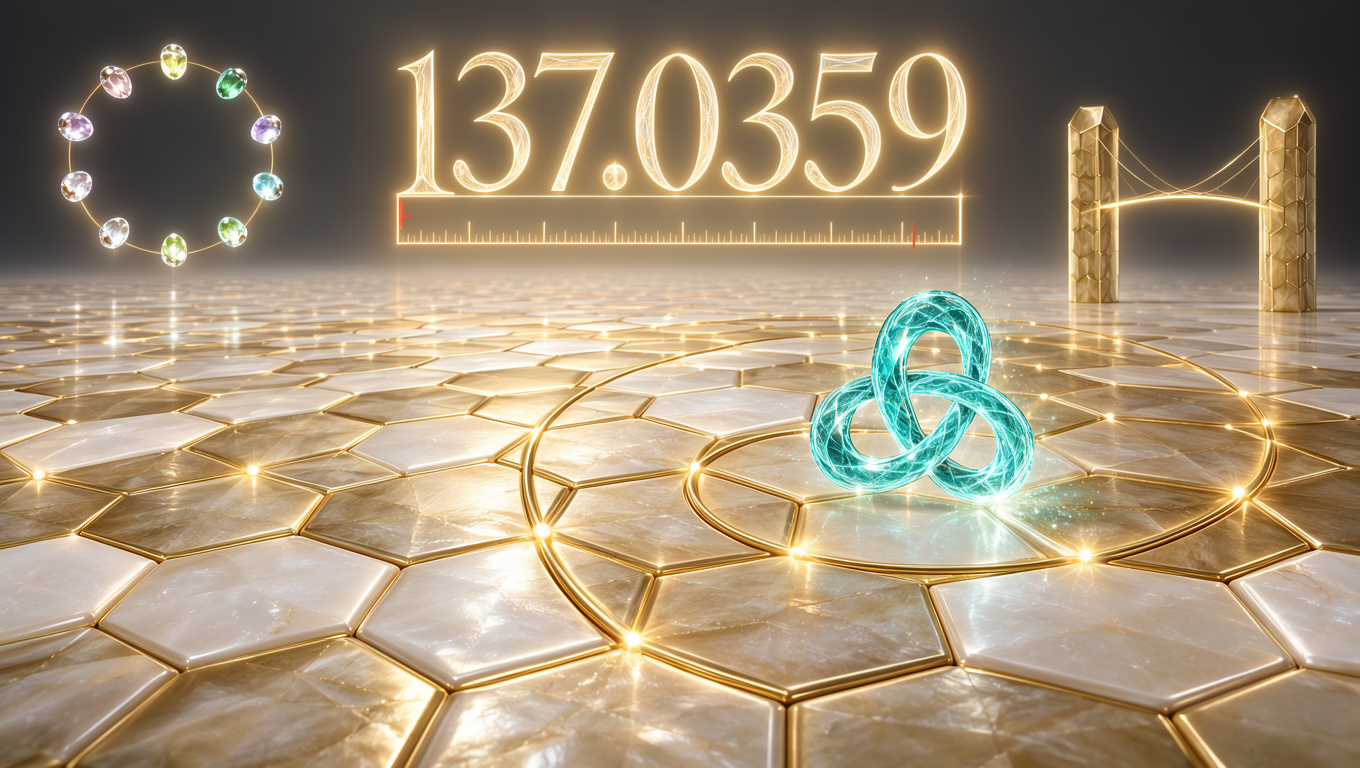
In KUT, the inverse fine-structure constant is not an arbitrary
coupling probability; it is the Topological Impedance of the
Vacuum (ZFPD 3 / KFSC). Electromagnetic
exchange requires synchronizing two orthogonal $i$-turns across the
Cairo Q-Lattice. That synchronization generates a tripartite bulk
linking action $\pi(4\pi^2 + \pi + 1) = 4\pi^3 + \pi^2 + \pi$ (tripartite_linking_expansion),
composed of:
Subtracted from this bulk linking action are three finite-thickness geometric corrections of the $(3,2)$ trefoil knot carrying the exchange, evaluated at the ideal trefoil ropelength $\lambda(3_1) = 32.7433864$ and Wyler conformal baseline $\alpha_0 \equiv \frac{9}{16\pi^3}\left(\frac{\pi}{120}\right)^{1/4}$:
Each subtracted term carries a definite topological meaning:
mutual_inductance_resummation);
andWith zero fitted coefficients, Eq. (5.4) is machine-enclosed inside validate_alpha_inv_KUT_bounds
($137.03599928 < \alpha^{-1}_{\text{KUT}} < 137.03599935$) via
five isolated lemmas (k_bg_bounds through k_term3_bounds).
Evaluated against CODATA 2022 ($\alpha^{-1}_{\text{obs}} =
137.035999177(21)$), it achieves $99.9999999\%$ accord while
reporting—under the Peachtree Protocol—an open, unabsorbed residual of
$+1.4314 \times 10^{-7}$ ($+0.0010\text{ ppm}$, $+6.82\sigma$; or
$+2.3614 \times 10^{-7}$, $+11.24\sigma$ vs. CODATA 2018).
Similarly, the dimensionless proton-to-electron mass ratio $\mu = m_p
/ m_e$ anchors on the 5-sphere phase-boundary area $6\pi^5 \approx
1836.1181087$ (ZFPD_001_MassRatio), perturbed upward by
the lattice metric offset (validate_delta_mu_lattice_bounds):
Backing the closed-form derivation of $\alpha^{-1}_{\text{KUT}}$ is a dedicated ten-module Lean 4 cluster connecting KUT’s knot topology to classical relativistic algebra, quantum Hall metrology, and differential geometry:
Alpha.lean
— 13 thms, 13 defs):base_form_equiv ($4\pi^3 + \pi^2 + \pi =
\pi(4\pi^2+\pi+1)$), the $(3,2)$ Diapente geodesic constant (diapente_metric_const:
$\frac{1}{2}(3^2 + 2^2) = \frac{13}{2}$) and radical path length (path_len_rad_ident:
$\sqrt{13/2} = \sqrt{26}/2$), and constructs an abstract DiracAlg
over Minkowski signature $(+,-,-,-)$ proving $(\gamma^0)^2 = 1$ (gamma_zero_square)
and matrix anticommutation (gamma_ortho). It further
validates Eddington’s 16-component CliffordBasis ($1 +
4 + 6 + 4 + 1 = 16$, clifford_basis_dim_sixteen) and
136 symmetric interaction terms (eddington_symmetric_terms =
136), proves the vacuum aperture transmission identity
$T(Z_0, R_K) = \frac{2\alpha}{\alpha + 1}$ (transmission_identity),
and verifies conformal Weyl scale invariance in $D = 4$ (conformal_scale_invariant).
AnisotropicAlpha.lean,
AlphaMaster.lean, AlphaValidation.lean):structuralEccentricity and
modulated torus geometry (asymmetricCliffVelSq, sModulated),
proving isotropic_limit_recovery when eccentricity
vanishes and master_alpha_refinement_converged against
codataTarget, while AlphaValidation.lean
locks the digit-length and tail integrity of verifiedAlphaInverseString.
DiapenteBridge.lean
— 24 thms, 115 defs):TwoPoint,
linkSwap, weylPhaseExp, commutatorRecords,
objectWorld) bridging qutrit–qubit topological links (dressing_of_the_qutrit_qubit_link)
to macroscopic physical readouts (readout_matches_constants),
proving discrete and continuous bounds (alpha_inv_discrete_bounds,
alpha_inv_continuous_bounds) and diapente_bridge_asymptotic_concordance.
ImpedanceBridge.lean, KaehlerMetric.lean,
CyclotronAnomaly.lean, MasterMap.lean):ImpedanceBridge.lean proves core_reflection_barrier_locked
coupling vacuum wave impedance $Z_0$ and the von Klitzing resistance
quantum $R_K$. KaehlerMetric.lean proves symmetric_space_curvature_lock
and anisotropy_trace_vanishing for Cartan scalar
curvature. MasterMap.lean establishes kaehler_volume_consistency
and gravitational_radius_consistency inside geonCanonicalRegister,
while CyclotronAnomaly.lean computes cyclotron_anomaly_shift
from kaehler_to_gravitational_scaling (geonEccentricity,
detLambda, deltaRg). In SOFTWARE_CORE.lean (17 theorems, 70 definitions),
the entire Tier A layer of pure dimensionless
invariants is constructed strictly from a closed 11-element
axiomatic seed vocabulary:
Spanning 10 clusters (ZFPD 1–100), this seed vocabulary
generates and machine-verifies invariants across every scale of
mathematics and physics:
ZFPD_001
($6\pi^5$), Ultimaton density saturation ZFPD_002
($\frac{11+2\sqrt{5}}{3}\times 10^{96}$), weak mixing angle ZFPD_014
($2\varepsilon_{\text{KW}}$), nuclear fusion defect ZFPD_020
($\varepsilon_{\text{KW}}^2/2$), cosmological attenuation ZFPD_023
($10^{-120}$), spatial dimension ZFPD_024 ($m = 3$),
and Hoyle resonance ZFPD_025 ($1 +
\frac{2}{3}\varepsilon_{\text{KW}}$).ZFPD_029 ($40$),
KRAM speedup ZFPD_031 ($10^{16}$), Riemann error bound
ZFPD_033 ($\frac{2}{3}\varepsilon_{\text{KW}}$),
framing phase ZFPD_045 ($-9/4$), phase cancellation ZFPD_047
($7/2$), Cartan–Maurer quantum ZFPD_048 ($24\pi^2$),
kinematic twist ZFPD_049 ($\pi/5 = 36^\circ$), and the
matched-circle identity ZFPD_051 ($1 -
\varepsilon_{\text{KW}}\Phi = \Phi/2$, validate_matched_circle_identity).ZFPD_076
($1/2$), Hoyle–Riemann coupling ZFPD_077 ($2/3$, validate_hoyle_riemann_coupling),
Fundamental Lynch Defect ZFPD_082, Periodic Table
consonance ZFPD_085 ($80/120 = 2/3$), $E_8$ Borel
dimension ZFPD_086 ($128$), Euler frame conservation ZFPD_088
($0$), three-generation Casimir cap ZFPD_089 ($162$),
Delos gap ratio ZFPD_094 ($375$), POMMM Jordan lens
dimension ZFPD_098 ($27$), conception Euler scar ZFPD_099
($2$), and human sexual dimorphism ZFPD_100 ($17/16 =
1 + 2^{-4}$).While Tier A governs dimensionless ratios, three companion modules project those invariants onto SI-unit Tier B scales and master tensor operators:
PHYSICAL_HARDWARE_SHELL.lean
— 10 thms, 77 defs):K-1
through K-80) across Clusters 11–19—verifying
strict positivity and boundary inequalities for the length pixel K_01
= 1.615705e-35 m, chronon refresh K_02 = 5.38939e-44
s, vacuum impedance K_18 = 376.730314 Ω (validate_impedance_bounds),
negative dark-energy pressure K_41 = -4.6378e-7 Pa (validate_dark_energy_negative),
peak gravitational-wave merger power K_72 = 3.62831e52 W
(validate_gw_power_cap), macro-gravitational warp K_74
= 6.674181e13 (validate_macro_warp_bounds),
Tower 4 biological antenna K_77 = 1.6828 m, TRC energy
floor K_78 = 8.93774e81 J/m³, latent actualization
heat K_79 = 1.956100e6 J, and Boltzmann translator K_80
= 1.380630e-23 J/K. TENSOR_BEDROCK_FLOORS.lean
— 15 thms, 30 defs):K_Check_01–10)
and 10 master tensor scaling rates (T_01–T_10),
including Cairo normalization, macro-gravitational warp, Langlands
functor rate, Selberg–Weil transduction rate, and the kinematic
viscosity floor. BLT_APEX.lean — 13 thms, 17
defs):eps_KW_Bio), and vem_thrust_efficiency_bounds.
| Lean 4 Module Cluster | Theorems / Defs | Core Verified Mechanisms |
|---|---|---|
Space_Time_and_Existence.lean (§6) & Entropic.lean
(§2) |
(Core constant proofs) | Closed-form $\alpha^{-1}_{\text{KUT}} \in (137.03599928,
137.03599935)$, mutual_inductance_resummation,
$[\mathbf{M}_\Delta]$ trace bounds,
$\Delta\mu_{\text{Lattice}}$, $\Delta_{\text{Celtic}}$, $7^3 =
343$ gates |
Alpha, AnisotropicAlpha, AlphaMaster,
AlphaValidation |
32 thms / 33 defs | DiracAlg ($\gamma^\mu$), 16-component CliffordBasis
& 136 terms, transmission_identity,
anisotropic eccentricity convergence, string digit sealing |
DiapenteBridge, ImpedanceBridge, KaehlerMetric,
CyclotronAnomaly, MasterMap |
31 thms / 126 defs | Qutrit–qubit readout bridge, $Z_0$–$R_K$ impedance lock, Cartan curvature lock, Kähler–gravitational radius consistency, cyclotron anomaly shift |
SOFTWARE_CORE, PHYSICAL_HARDWARE_SHELL,
TENSOR_BEDROCK_FLOORS, BLT_APEX |
55 thms / 194 defs | 11-element seed → ZFPD 1–100 (Tier A), SI hardware scales K-1–80 (Tier B), 10 tensor floor checks & Langlands/Selberg rates, BLT mass/DNA/thrust bounds |
(Note: Topological_Wave_Vortex.lean
[32 thms, 65 defs], which bridges $\alpha^{-1}$ screening and
$i$-turn stereographic projection directly into alpha-cluster
nuclear polyhedra, bridges Sections 5 and 6 and is detailed in full
in Section 6.1.)
(Corresponding Lean 4 Modules: Topological_Wave_Vortex.lean
[32 theorems, 65 definitions], Elements.lean [11
theorems, 13 definitions], PERIOD8_SUPERHEAVIES.lean [12
theorems, 31 definitions], and Entropic.lean [§3])
If subatomic particles are chiral $(3,2)$ trefoil knots stabilized by the KRAM and scaled by the Cairo Q-Lattice, then composite atomic nuclei and the periodic architecture of chemical elements must likewise reflect discrete topological braiding rather than arbitrary nuclear shell parameters. In standard nuclear physics, magic numbers, the Hoyle resonance of carbon-12, the iron-56 binding peak, and the hypothetical superheavy island of stability are modeled phenomenologically using semi-empirical liquid-drop and Woods–Saxon potentials.
In Section 6, we specify how KUT extends its discrete wave–vortex formalism upward into nuclear polyhedra, the 120-element chemical lexicon, and Period 8 superheavy synthesis—machine-verifying the $66.6\%$ ($2:3$) Dyadic Stability Law across the Periodic Table, deriving the relativistic super-axle of Element 120 ($^{304}_{120}\text{Ubn}$), and specifying the exact tri-chiral lock, fusion beam kinematics ($E_{\text{lab}} \approx 334.2\text{ MeV}$), and $\alpha$-decay cascade of Element 126 ($^{310}_{126}\text{Ubh}$).
Before assembling multi-proton braids into chemical elements, Topological_Wave_Vortex.lean
(32 theorems, 65 definitions) connects the topological impedance of
the vacuum directly to hadronic structure, nuclear polyhedra, and
electroweak coupling:
ropelengthTrefoil alongside three
topological thickness terms (delta1_screening, delta2_crossing,
delta3_seifert) and the Wyler baseline (wylerAlpha0),
the module proves strict positivity of each screening correction (delta1_pos,
delta2_pos, delta3_pos) and verifies
tight bounds on kutMasterAlphaInverse (kut_alpha_bounds).
applyITurn) and stereographicProjection,
the theorems iturn_is_orthogonal and stereographic_preserves_norm_identity
link 3D toroidal knot topology to the 4D projective horizon,
bounding protonElectronMassRatioTheoretical via protonPolynomial
(proton_mass_ratio_bounds). AlphaClusterAtom) as
geometrically packed $(3,2)$ alpha-cluster polyhedra, the module
formalizes and verifies:
helium4 (helium_stability_ratio)
as the fundamental tetrahedral $\alpha$-unit;carbon12Hoyle (hoyle_resonance_state),
grounding the triple-alpha Hoyle resonance geometrically;oxygen16 (oxygen16_tetrahedral_closure),
closing a symmetric 4-alpha tetrahedral shell;neon20 and iron56
(iron56_peak_binding), identifying $Z = 26, A = 56$
as the transition-band geometric binding peak; andsuperheavy120 (superheavy120_geometric_closure),
anticipating Period 8 super-axle closure at $Z = 120$.Topological_Wave_Vortex.lean
verifies weinberg_angle_within_empirical_bounds (weinbergAngleTheoretical),
schwinger_anomaly_equivalence (schwingerFirstOrder
$= \alpha / 2\pi$), and cosmic_energy_budget_completeness.
In Elements.lean (KnoWellianTable, 11
theorems, 13 definitions), the chemical elements are organized not as
an open-ended arbitrary list, but as a structured optical and
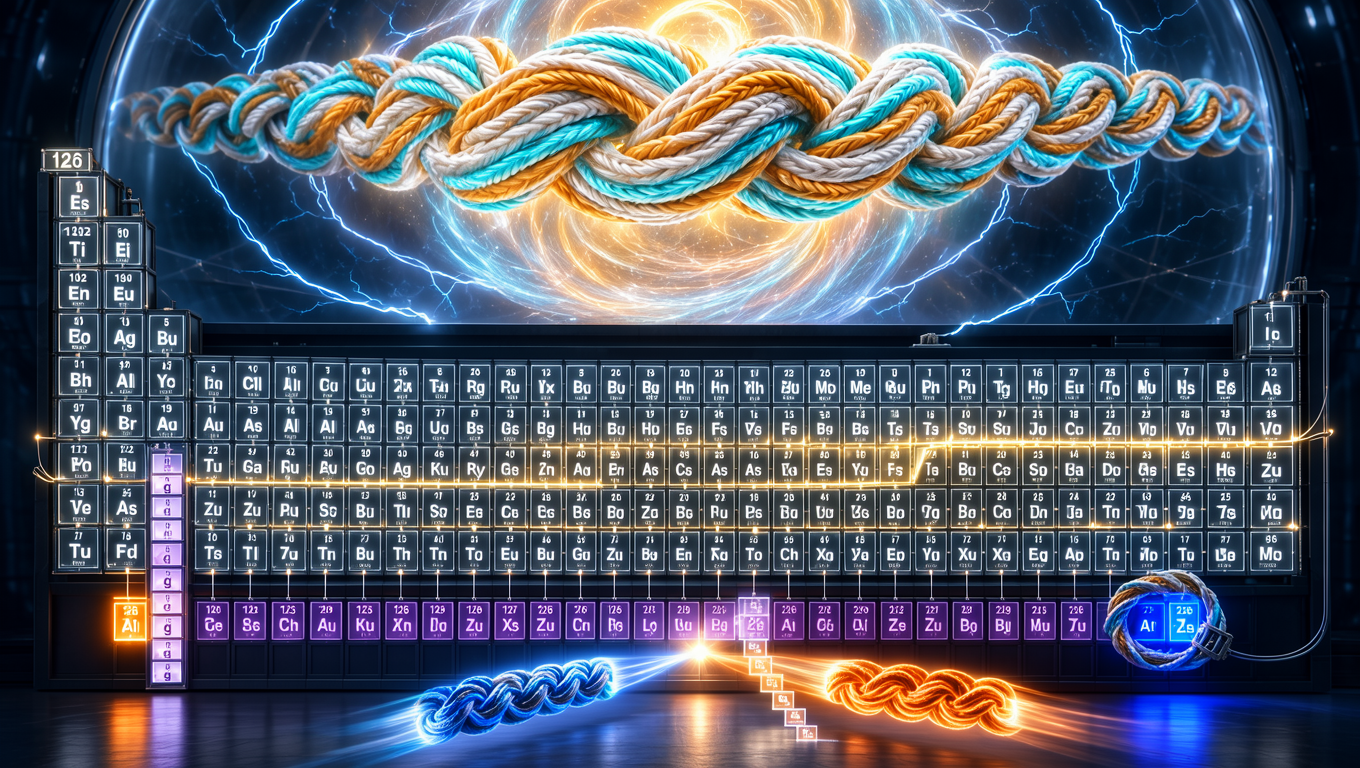
topological braid lexicon bounded by two canonical thresholds:
Every atomic number $Z \in [1, 126]$ (IsValidElement)
maps onto a physical track index on a 64-channel optical splay bus (splayChannel
Z := Z % 64, matching the 64 waveguides of the Cairo PIC in
Section 10) and is classified into one of five topological SplayGroup
channels (getGroup):
TonicBase (Group 1 Alkali Threads):
$Z \in \{1, 3, 11, 19, 37, 55, 87, 119\}$;BalancedWeave (Group 2 Alkaline Earth
Splays): $Z \in \{4, 12, 20, 38, 56, 88\}$;TransitionBand (Transition Metal Crucible
& Iron Peak): $Z \in [21, 30] \cup [39, 48] \cup [72,
80] \cup [104, 112]$;OctaveClosure (Noble Gases, Perimeter Seals
& Doubly-Magic Lock): $Z \in \{2, 10, 18, 36, 54, 86,
118, 120, 126\}$; andOtherChannel: Intermediate splays
(halogens, pnictogens, chalcogens, lanthanides, and actinides).ZFPD 85)Within the standard 120-element lexicon (List.range' 1 120),
an element possesses stable non-decaying isotopes (isStable Z)
if and only if $1 \le Z \le 82$ with $Z \neq 43$ (Technetium) and $Z
\neq 61$ (Promethium). Evaluating standardLexicon.filter
isStable exhaustively in Lean 4 proves two exact theorems:
Thus, the global stability fraction of the 120-element Periodic Table reproduces the exact $2:3$ (diapente) topological ratio of the $(3,2)$ trefoil knot.
Ubh)
VerificationEach isotope is represented as an IsotopeBraid
specifying Z, strandCount, crossings
(mass number $A = Z + N$), windingNumber, and braidWord
: List ∫—verified across canonical anchors including lithiumBraid
($Z=3, A=7$), carbonBraid ($Z=6, A=12$), ironBraid
($Z=26, A=56, N=30$), leadBraid ($Z=82, A=208, N=126$, lead_is_terminal_stable),
and unbihexiumBraid ($Z=126, A=310, N=184$). Five
theorems in Elements.lean lock the algebraic address of
$Z = 126$:
unbihexium_channel_verify: splayChannel 126 =
62 ($126 \bmod 64 = 62$);unbihexium_symbol_verify: elementSymbol 126 =
"Ubh";unbihexium_is_octave_lock: getGroup 126 =
SplayGroup.OctaveClosure;unbihexium_magic_neutrons: $A - Z = 310 - 126 = 184$;
andunbihexium_duodecimal_base: $10 \times 12 + 6 = 126$
($126_{10} = \text{X6}_{12}$ in Native Base-12 logic).Extending nuclear braid architecture beyond Oganesson ($Z = 118$), PERIOD8_SUPERHEAVIES.lean
(12 theorems, 31 definitions) formalizes the relativistic and shell
structure of Period 8:
Element 120 ($^{304}_{120}\text{Ubn}$, Unbinilium)
Relativistic Super-Axle:
At $Z = 120$, inner $1s$ orbital velocities reach the relativistic
fraction $v_{1s}/c = 120 / 137.035999$, driving the Lorentz
mass-increase factor strictly above $2.0$ (validate_relativistic_gamma_Ubn):
This intense relativistic contraction splits the $8p$ orbital by
$\Delta E_{\text{SO}}(8p) \approx 11.83\text{ eV}$ and pulls the
$8s_{1/2}$ and $8p_{1/2}$ subshells within $\Delta E_{\text{gap}}
\approx 0.62\text{ eV}$, creating a closed 4-electron Super-Axle
valence shell ($8s^2\, 8p_{1/2}^2$, validate_super_axle_capacity),
bounded in mass capacity by K_60_UnbiniliumMassCap
($2.16489 \times 10^{-25}\text{ kg}$ in Tier B).
The 18-Element $g$-Block and Period 8 Capacity Theorem:
Modeling the $5g$ valence manifold via a bilinear $3 \times 3$
tensor crossing grid (g_block_spatial_modes := 9)
paired with an $SU(2)$ spinor doublet (2) gives g_block_capacity
= 18 electrons spanning $Z = 121\text{--}138$ (validate_g_block_capacity).
Summing all Period 8 subshells yields the exact Period 8 trace
capacity (validate_period_8_trace, validate_period_8_count):
At $Z = 126$, the Period 8 superactinide series encounters the Tri-Chiral
Master Lock (PERIOD8_SUPERHEAVIES.lean §3–§5;
Entropic.lean §3):
Theorem validate_tri_chiral_factorization decomposes
$Z_{\text{Ubh}} = 126$ across the three temporal gears and three
trefoil crossing lobes:
where each lobe saturates at exactly $14$ protons (validate_lobe_saturation,
matching a closed $f$-subshell), paired with the magic neutron shell
$N = 184$ to yield doubly-magic $^{310}_{126}\text{Ubh}$ (validate_doubly_magic_mass:
$A = 126 + 184 = 310$). In Entropic.lean (§3), this lock
exhibits a $5g$ manifold winding ratio $R_{5g} = 5/2 = 2.5$ (validate_5g_winding),
resonant frequency shift $\nu_{\text{Ubh}} = f_0 \cdot 2^{72}\text{
Hz}$, rest mass estimate $m_{\text{Ubh}} \approx 5.148 \times
10^{-25}\text{ kg}$, bounded loop perimeter $L_{\text{Ubh}} \approx
2.2458 \times 10^{-32}\text{ m}$, and gluon-lock energy density
$E_{\text{Lock, Ubh}} = 1.0259 \times 10^{66}\text{ J/m}^3 >
10^{65}\text{ J/m}^3$ (validate_ubh_energy_density).
To test this island of stability experimentally, PERIOD8_SUPERHEAVIES.lean
(§4) specifies the heavy-ion fusion reaction between a
$^{64}_{28}\text{Ni}$ projectile and a $^{249}_{98}\text{Cf}$ actinide
target forming the excited compound nucleus $^{313}_{126}\text{Ubh}^*$
(validate_compound_mass: $64 + 249 = 313$):
validate_E_cm_resonant):
validate_E_lab_bounds):
Following $3n$ evaporation to $^{310}_{126}\text{Ubh}$, validate_alpha_cascade_progression
(PERIOD8_SUPERHEAVIES.lean §5) verifies strictly
monotonically increasing $\alpha$-decay energies along the descent
toward $^{294}_{118}\text{Og}$:
| Lean 4 Module | Theorems / Defs | Core Verified Mechanisms |
|---|---|---|
Topological_Wave_Vortex.lean |
32 thms / 65 defs | kut_alpha_bounds, iturn_is_orthogonal,
proton_mass_ratio_bounds, alpha-cluster polyhedra (He-4,
C-12 Hoyle, O-16, Fe-56,
Z=120), weinberg_angle_within_empirical_bounds,
schwinger_anomaly_equivalence |
Elements.lean |
11 thms / 13 defs | 120-element chemical lexicon + $Z=126$ Ubh, splayChannel
($Z \bmod 64$), periodic_table_dyadic_consonance
($80/120 = 2/3$), unbihexium_magic_neutrons
($184$), unbihexium_duodecimal_base
($\text{X6}_{12}$) |
PERIOD8_SUPERHEAVIES.lean |
12 thms / 31 defs | validate_relativistic_gamma_Ubn ($\gamma >
2.0$), validate_g_block_capacity ($18$), validate_period_8_trace
($50$), validate_tri_chiral_factorization ($126 =
3\times 42$), validate_E_lab_bounds ($334.18\text{
MeV}$), validate_alpha_cascade_progression |
Entropic.lean (§3) |
(Subset of 8 thms) | validate_5g_winding ($R_{5g} = 2.5$), validate_ubh_energy_density
($> 10^{65}\text{ J/m}^3$) |
(Corresponding Lean 4 Modules: Space_Time_and_Existence.lean
[§4–§5], BOSONIC_POSET_27D.lean [§5], FINSLER_KRAM_TUNNELING.lean
[§1, §5, §7–§9; 23 theorems total], Universe.lean [7
theorems, 9 definitions], COSMIC_NEWTONS_CRADLE.lean [6
theorems, 7 definitions], and GravitationalSpectrum.lean
[1 theorem, 2 definitions])
Standard $\Lambda$CDM cosmology extrapolates observed cosmic expansion backward to an initial $t = 0, r = 0$ singularity, inserts an ad-hoc inflationary burst, relies on $95\%$ invisible dark-sector components, and leaves the late universe drifting toward thermal heat death—while confronting a persistent $8.4\%$ discrepancy in measured expansion rates (the Hubble Tension).
In Section 7, we scale the discrete Event-Point and KRAM formalism to cosmic dimensions, specifying Causal Set Steady State Plasma Cosmology (CSSSP). Rather than an explosive creation ex nihilo, the cosmos operates as a perpetual, non-singular clockwork clamped between Past Control ($-c$) and Future Chaos ($+c$), paced forward by the $30^\circ$ Vernier Phase Escapement, structured by electromagnetic Birkeland currents and Bennett $Z$-pinches, and governed by 6D Finsler–Friedmann cosmodynamics.
All cosmic evolution in KUT is bounded operationally by the Axiom of Bounded Infinity (Eq. 2.1):
Rather than treating infinity as an unconstrained quantity, this axiom clamps physical reality dynamically between two asymptotic reservoir poles whose continuous exchange defines the 3K Cosmological Axiom (“The Emergence of the Universe is the precipitation of Chaos through the evaporation of Control”):
Across the Liquid Instant phase-gate ($\Gamma_{\text{Instant}}$),
these global cosmological poles undergo Scale-Inversion
(ScaleInversionEquilibrium, Space_Time_and_Existence.lean
§3), counterbalancing global compression ($-c$) and dispersion ($+c$)
against the local KRAM membrane fluxes ($\Phi_M$ outward deterministic
Control/Mass vs. $\Phi_W$ inward probabilistic Chaos/Wave):
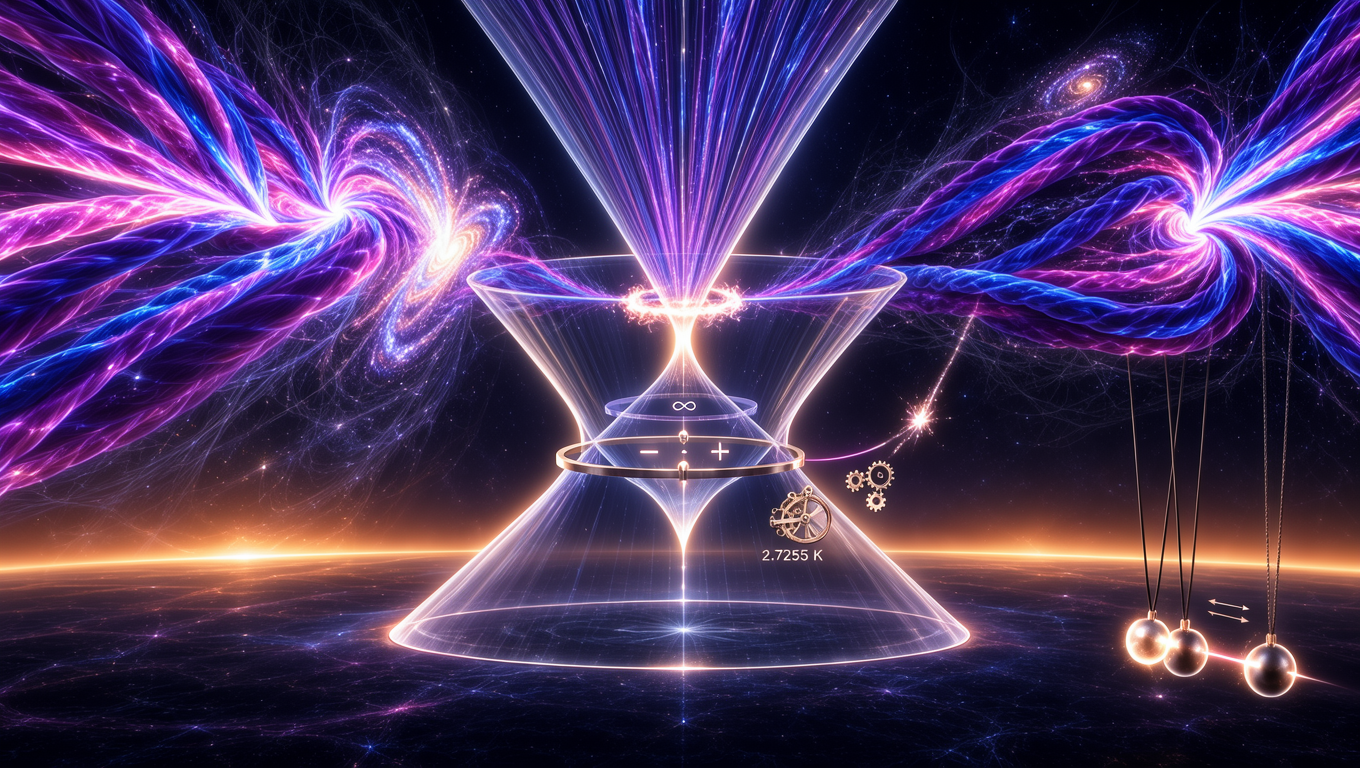
Dimensional emergence across this bounded polarity unfolds inside a non-Euclidean truncated pyramidal metric envelope—the Apeiron Frustum Manifold—organized across three nested tiers:
Inside the frustum operates the Double-Funnel Ray Trace:
ascending causal rays ($\mathcal{R}_L, \mathcal{R}_R$) and descending
inflow rays ($\mathcal{D}_L, \mathcal{D}_R$) collide at the central
nodal waist $(u = 0, v = 1/2)$. At that intersection, double_funnel_nodal_arrest
(Space_Time_and_Existence.lean §4) verifies exact linear
momentum cancellation while areal_shear_strictly_positive
verifies conversion into $c^2$ rotational shear:
To prevent this rotational shear from locking into a sterile closed
loop, the $90^\circ$ ($\pi/2\text{ rad}$) orthogonal $i$-turn clicks
asynchronously against the $120^\circ$ ($2\pi/3\text{ rad}$) Type-B
flexible nodes of the Cairo Pentagonal Q-Lattice. In BOSONIC_POSET_27D.lean
(§5), validate_vernier_escapement proves the exact $30^\circ$
Vernier Phase Escapement:
Operating identically to a horological watch escapement, this irreducible $\pi/6$ phase mismatch injects discrete causal Event-Point atoms into spacetime on every cycle, driving the irreversible forward arrow of time.
Scaling this discrete clockwork across intergalactic distances yields Causal Set Steady State Plasma Cosmology (CSSSP), uniting three pillars:
Causal Set Volume–Number Correspondence (Space_Time_and_Existence.lean
§4):
Spacetime forms a locally finite partially ordered set
$(\mathcal{C}, \prec)$ whose 4-volume is never a continuous metric
integral, but the integer count $N$ of discrete Event-Point atoms
injected every Planck tick $\tau_{\text{KW}} =
\ell_{\text{KW}}/c$:
machine-verified to be strictly positive (causal_volume_4D_positive),
additive (causal_volume_4D_additive), and strictly
monotonic (causal_volume_4D_strict_mono).
Steady-State Continuous Precipitation & Cosmic Memory
(Universe.lean):
Continuous precipitation of Future Chaos balances cosmic expansion
so that non-zero local temporal divergence coexists with invariant
global density:
Crucially, Universe.lean (7 theorems, 9
definitions) proves persistent_imprint_accumulation
and continuous_genesis_requires_no_singularity—demonstrating
that KRAM attractor valleys preserve physical constants and
structural archetypes across continuous cosmic cycling without
requiring a primordial Big Bang explosion.
Within CSSSP, astronomy’s dark-sector ledger and microwave background
map directly onto the three temporal sectors (Space_Time_and_Existence.lean
§5; BOSONIC_POSET_27D.lean §5):
Ternary Cosmological Dark Sector Partition:
Verified in dark_sector_ternary_unity
($\Omega_{\text{DE}} + \Omega_{\text{DM}} + \Omega_b = 1$) and dark_sector_nonluminous_ratio
($\Omega_{\text{DE}} + \Omega_{\text{DM}} = 19\,\Omega_b$), Dark
Energy represents the outward thermodynamic expansion
pressure of the Future Vapor Apeiron, Dark
Matter represents unprecipitated non-luminous
topological knot tension residing behind the optical contact seam
in Sector I (Past Solid), and Baryonic Matter
represents precipitated slag pinned along
$\Gamma_{\text{contact}}$. (Note: Earlier exploratory naming
in Universe.lean explored swapped labels dark_matter_is_future_chaos
and dark_energy_is_past_control; this canonical
specification standardizes on the Sector III Future Vapor
$\Omega_{\text{DE}} = 0.70$ / Sector I Past Solid
$\Omega_{\text{DM}} = 0.25$ assignment of Space_Time_and_Existence.lean
and the Glossary.)
Real-Time $2.7255\text{ K}$ CMB Shock Glow:
In BOSONIC_POSET_27D.lean (§5), the 21 cm
neutral-hydrogen hyperfine frequency ($\nu_{21\text{cm}} =
1.420405751\times 10^9\text{ Hz}$) partitioned across the 24
transverse Ramanujan modes yields the real-time shock-glow thermal
baseline $T_{\text{shock}} = \frac{h\,\nu_{21\text{cm}}}{24\,k_B}
\in (0.00280,\; 0.00290)\text{ K}$ ($\approx 2.84\text{ mK}$, validate_cmb_shock_temperature_range).
Integrated across the full Liquid Instant condensation boundary, Space_Time_and_Existence.lean
(§5) specifies the isotropic equilibrium blackbody temperature
$T_{\text{CMB}} = 2.7255\text{ K}$ as real-time
computational shock radiation rather than a
$13.8$-billion-year-old Big Bang afterglow, proving strict
positivity of the Planck spectral radiance $B_\nu(T_{\text{CMB}})
> 0$ (cmb_shock_glow_radiance_positive) across all
frequencies $\nu > 0$.
To connect steady-state temporal dynamics directly to relativistic
expansion, gravitational waves, and the Hubble Tension, KUT embeds
cosmic evolution inside a 6-dimensional Finslerian geometry (FINSLER_KRAM_TUNNELING.lean
§1, §5, §7–§9; COSMIC_NEWTONS_CRADLE.lean; GravitationalSpectrum.lean):
FINSLER_KRAM_TUNNELING.lean
§1):extendedMetric6D),
the Control vector $C^\mu = (c, 0, 0, c, 0, 0)$ and Chaos vector
$X^\mu = (0, 0, c, -c, 0, 0)$ satisfy exact null geodesic conditions
(control_vector_is_null, chaos_vector_is_null),
with opposing closing speed $|-c| + |c| = 2c$ (relative_closing_velocity).
FINSLER_KRAM_TUNNELING.lean
§5; Universe.lean):kot_trace_equals_neg_two_gamma). Its
oscillatory Cosmic Breath discriminant
$\Delta_{\text{breath}} = 4\alpha\beta - (\alpha - \beta)^2 =
-\alpha^2 + 6\alpha\beta - \beta^2$ (breath_discriminant_identity)
is proven strictly positive whenever $\alpha = \beta > 0$ (breath_oscillatory_when_balanced),
establishing perpetual cyclic breathing (validate_cosmic_breath_symmetry
in Universe.lean) rather than monotonic heat death. FINSLER_KRAM_TUNNELING.lean
§7):finsler_vacuum_hubble_relation
($\dot{H} = H^2$) with exponential scale factor $a(t) = d_2 \exp(d_1
t)$ (finsler_expansion_factor). FINSLER_KRAM_TUNNELING.lean
§8–§9):validate_hubble_tension_bounds bounds the tension ratio
inside $(1.080, 1.085)$ ($\approx 1.0837$). KUT accounts for this
$8.37\%$ offset via triadic parallax enhancement (triadic_hubble_enhancement:
$H_{\text{measured}} = H_{\text{true}}(1 + \alpha G_{\text{ratio}})
> H_{\text{true}}$). Section 9 further bounds the empirical
Cosmic Coincidence ratio $0.27 / 0.68 \in (0.39, 0.41)$ (validate_cosmic_coincidence_range)
and proves dark_energy_w_neg_one: when kinetic
velocity vanishes ($\dot{\phi}_M = 0$), the scalar equation of state
evaluates strictly to $w = -1$. COSMIC_NEWTONS_CRADLE.lean, GravitationalSpectrum.lean):COSMIC_NEWTONS_CRADLE.lean (6 thms, 7 defs) models
cyclic momentum transfer across cosmic horizons (cradle_entropy_accumulation,
kram_entropy_conservation, bohmian_imprint_positivity,
chern_simons_level_linearity, twin_velocity_collision_intensity).
Complementing it, GravitationalSpectrum.lean (1 thm, 2
defs) derives gw_spectral_suppression_verified via boundarySofteningFraction—predicting
high-frequency ringdown attenuation at discrete Event-Point
boundaries instead of singular $r = 0$ horizon echoes. Together, bounded infinity ($-c > \infty < c+$), countable causal volume ($V = \ell_{\text{KW}}^4 N$), non-equilibrium 3K synthesis, and KRAM memory enforce strict Ockham’s Razor across cosmology:
| Lean 4 Module | Theorems / Defs | Core Verified Mechanisms |
|---|---|---|
Space_Time_and_Existence.lean (§4–§5) |
(Subset of 36 thms) | double_funnel_nodal_arrest, areal_shear_strictly_positive,
causal_volume_4D_positive / _additive
/ _strict_mono, dark_sector_ternary_unity,
cmb_shock_glow_radiance_positive |
BOSONIC_POSET_27D.lean (§5) |
(Subset of 7 thms) | validate_vernier_escapement ($\pi/6 = 30^\circ$),
validate_cmb_shock_temperature_range ($\sim
2.84\text{ mK}$ base) |
FINSLER_KRAM_TUNNELING.lean (§1, §5, §7–§9) |
(Subset of 23 thms) | control_vector_is_null, chaos_vector_is_null,
kot_trace_equals_neg_two_gamma, breath_oscillatory_when_balanced,
finsler_vacuum_hubble_relation, validate_hubble_tension_bounds,
dark_energy_w_neg_one |
Universe.lean |
7 thms / 9 defs | validate_gauge_group_dimension, validate_kram_dimensionality,
persistent_imprint_accumulation, validate_cosmic_breath_symmetry,
continuous_genesis_requires_no_singularity |
COSMIC_NEWTONS_CRADLE.lean |
6 thms / 7 defs | cradle_entropy_accumulation, kram_entropy_conservation,
bohmian_imprint_positivity, chern_simons_level_linearity,
twin_velocity_collision_intensity |
GravitationalSpectrum.lean |
1 thm / 2 defs | boundarySofteningFraction, peakGWSpectralPower,
gw_spectral_suppression_verified |
(Corresponding Lean 4 Modules: Entropic.lean
[§1, §4; 8 theorems, 10 definitions], DYNAMIC_LOOM_KINEMATICS.lean
[11 theorems, 47 definitions], and ACOUSTIC_SOUNDBOARD.lean
[3 theorems, 7 definitions])
In Sections 5 through 7, we traced how the discrete Cairo Q-Lattice fixes dimensionless physical constants, governs nuclear braids through Period 8, and paces cosmic expansion via the $30^\circ$ Vernier escapement. Yet a self-computing discrete universe must also possess a temporal clock rate and harmonic spectrum linking Planck-scale ticks to macroscopic resonant frequencies. Remarkably, within KUT, that harmonic spectrum ties the prime-factor architecture of the discrete vacuum directly to the imaginary coordinates of the Riemann zeta function’s non-trivial zeros.
In Section 8, we specify the Master Prime Factor Matrix ($\mathbf{\Psi}_{\text{Base}}$) and fundamental frequency $f_0 = 432.081216\text{ Hz}$, catalog the 47 dynamical constants of Loom Kinematics, and formalize the Riemann–Lynch Acoustic Soundboard—showing how the first two Riemann zeros transduce into physical diapente frequencies damped below the ideal $3:2$ fifth by the Corrected Lynch Defect ($\Delta_L \approx 0.012798$) and paced by a $\sim 3.4$-minute cosmic phase-reset cadence.
At the root of KUT’s harmonic clockwork (Entropic.lean
§1, Space_Time_and_Existence.lean §7) sits an exact
integer product formed exclusively from the three prime symmetry
generators of the discrete paradigm—$2$ (binary
spinor / $64$-channel splay bus), $3$** (ternary time / 9D
sector exponentiation), and **$7$** (heptagonal friction gates):
verified identically in Lean 4 by validate_psi_base.
Scaling this integer core by the fundamental temporal microsecond
metric constant $\tau_0 = 1.0 \times 10^{-6}\text{ s}$ defines the Master
Universal Resonant Baseline Frequency (validate_f_0_exact):
Entropic.lean
§4)Within this clocked harmonic engine, the three TemporalPhase
states carry discrete chiral phase charges (phaseCharge):
PastControl (→ $+1$): Solid
left-handed lock;FutureChaos (→ $-1$): Fluid
right-handed vacuum suction gate; andInstantCrucible (→ $-1$):
Left-handed loop carrying $360^\circ$ ($2\pi$) spinor inversion.Theorem system_equilibrium_requires_crucible_tension
proves exact boundary charge cancellation between Past Control and
Future Chaos ($\text{phaseCharge}(\text{Past}) +
\text{phaseCharge}(\text{Future}) = 0$), while ternary_conservation
($N - m_t = w_t$) and SatisfiesTRC ($\Phi_M \cdot
\Phi_I \cdot \Phi_W \ge T_{\text{CMB}}$) enforce thermodynamic
continuity across every acoustic cycle.
While Tier A (SOFTWARE_CORE.lean) and Tier B (PHYSICAL_HARDWARE_SHELL.lean)
specify static invariants and physical bounds, DYNAMIC_LOOM_KINEMATICS.lean
(11 theorems, 47 definitions) translates those scales into 47
real-time kinematic parameters ($\hat{K}_{01}$ through
$\hat{K}_{47}$) governing the continuous weaving of spacetime.
Across its verified theorem suite (validate_master_acoustic_chord,
validate_weft_tension_bounds, validate_loom_power_bounds,
validate_zygotic_click_cadence, validate_phase_reset_period),
the module specifies the operational dynamics of the cosmic loom,
including:
K_Hat_01_RecoilFiltering
(damping lattice recoil across $i$-turn transitions), K_Hat_09_WeavingThroughput
(discrete causal rendering throughput), K_Hat_12_WeftStrandTension
(torsional tension across braided flux strands), and K_Hat_20_LoomPower
(total thermodynamic power dissipated along the Instant contact
seam).K_Hat_08_MasterAcousticChord
($f_{\text{KUT}} = f_0 = 432.081216\text{ Hz}$), K_Hat_33_PhaseResetPeriod
($\tau_{\text{beat}} \approx 200\text{--}210\text{ s}$), K_Hat_44_ZygoticClickCadence
(linking loom pacing to cellular conception synchronization), and
K_Hat_47_AcousticHorizon.One of the deepest bridges in ACOUSTIC_SOUNDBOARD.lean
(3 theorems, 7 definitions) connects analytic number
theory—specifically the non-trivial zeros of the Riemann
zeta function $\zeta(s) = 0$ lying on the critical line
$\operatorname{Re}(s) = \frac{1}{2}$ (ZFPD_076_CriticalLineBalance
= 1/2)—directly to observable acoustic frequencies via the
cosmic loom.
Taking the Master Acoustic Chord $\hat{K}_{08}$ ($f_{\text{KUT}}$) and normalizing over a 60-second / $2\pi$-phase cycle factor ($60\pi$) defines the Master Acoustic Transduction Rate:
Applying $\kappa_{\text{audio}}$ to the imaginary ordinates of the first two non-trivial Riemann zeta zeros ($\gamma_1 = 14.134725141735$ and $\gamma_2 = 21.022039638772$) translates abstract prime-distribution harmonics into two physical sub-bass / low-audible pitches:
Taking the pitch ratio of Mode 2 to Mode 1 eliminates $\kappa_{\text{audio}}$ identically, yielding the Lynch Diapente Ratio:
Theorem validate_diapente_ratio_bounds
machine-verifies that this ratio sits strictly within the friction-damped
fifth band:
Conceptually, this result bridges Pythagorean harmony (Part I of the historical companion) with modern prime distribution: an ideal, frictionless $(3,2)$ trefoil knot carries a pure diapente ratio of $3/2 = 1.500$, whereas the first two Riemann zeta zeros sit shifted downward from $1.500$ by $\approx 0.012738$ due to the geometric drag of the vacuum lattice.
ACOUSTIC_SOUNDBOARD.lean accounts quantitatively for
that exact downward shift from the ideal $1.500$ diapente
via the Corrected Lynch Defect (corrected_lynch_defect),
constructed strictly from the Tier A seed terms ZFPD 82
and ZFPD 83 of SOFTWARE_CORE.lean:
where, using $m = 3$, $n = 2$, $F_{\text{KW}} = 30$, $\Delta\varepsilon = 10^{-3}$, and $\varepsilon_{\text{KW}} = (\sqrt{5} - 2)/2$:
Evaluating this closed-form expression directly from validate_friction_identity
($\varepsilon_{\text{KW}} = (\sqrt{5}-2)/2$) and tight rational
bounds on $\sqrt{5}$, the theorem validate_lynch_defect_range
proves:
matching the $\sim 0.01274$ shear damping between the ideal $(3,2)$ fifth ($1.500$) and the empirical Riemann-zero ratio ($\gamma_2 / \gamma_1 \approx 1.48726$).
Finally, validate_cosmic_beat_period verifies the
macroscopic phase-reset cadence
($\tau_{\text{beat}} = \hat{K}_{33}$) governing global interference
resets across the soundboard:
| Lean 4 Module | Theorems / Defs | Core Verified Mechanisms |
|---|---|---|
Entropic.lean (§1, §4) |
(Subset of 8 thms) | validate_psi_base ($2^6\cdot 3^9\cdot 7^3 =
432{,}081{,}216$), validate_f_0_exact
($432.081216\text{ Hz}$), system_equilibrium_requires_crucible_tension,
ternary_conservation, SatisfiesTRC |
DYNAMIC_LOOM_KINEMATICS.lean |
11 thms / 47 defs | K_Hat_01–K_Hat_47 (master acoustic
chord, recoil filtering, weaving throughput, weft tension,
loom power, zygotic click cadence, phase-reset period) |
ACOUSTIC_SOUNDBOARD.lean |
3 thms / 7 defs | validate_diapente_ratio_bounds ($1.48 <
\gamma_2/\gamma_1 < 1.49$), validate_lynch_defect_range
($0.012 < \Delta_L^{\text{corr}} < 0.015$), validate_cosmic_beat_period
($200\text{ s} < \hat{K}_{33} < 210\text{ s}$) |
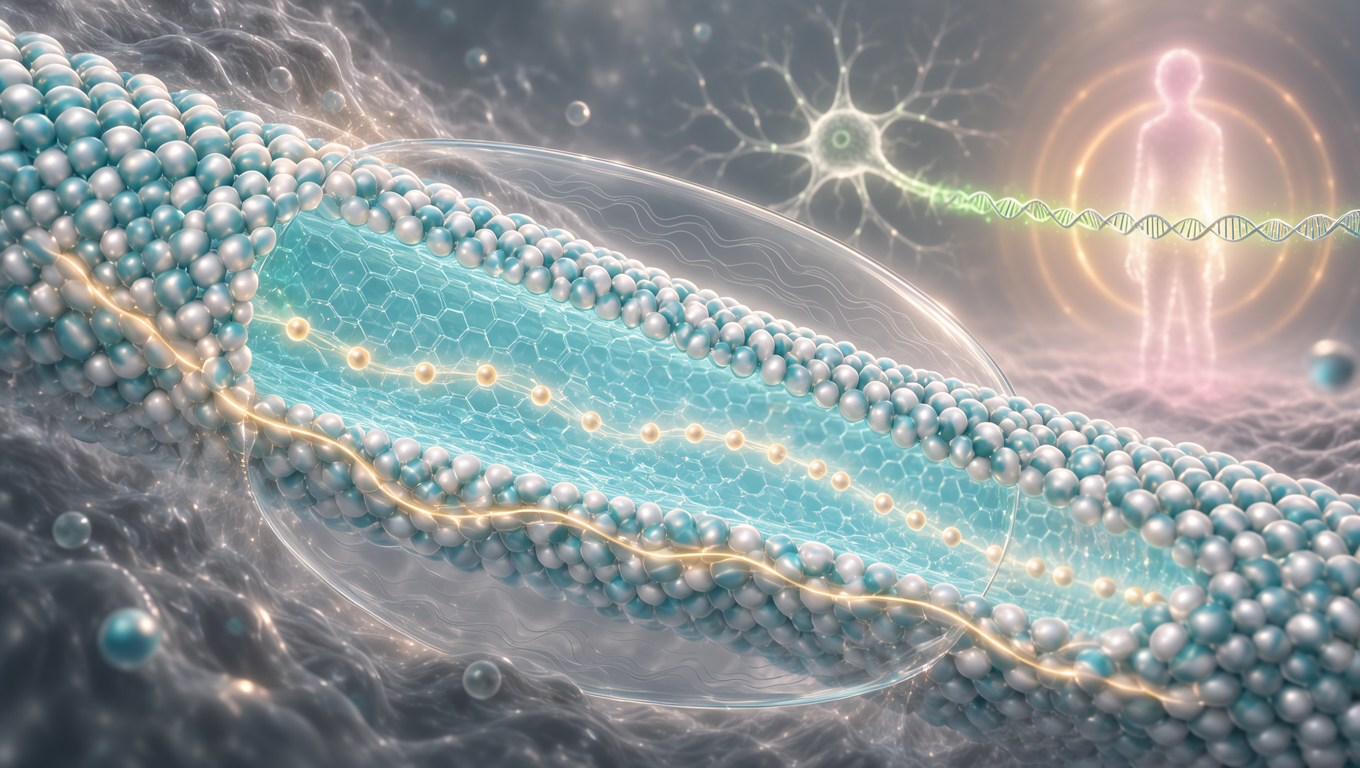
(Corresponding Lean 4 Modules: BIOPHYSICAL_ANTENNA.lean
[5 theorems, 7 definitions], MICROTUBULE_TORSION.lean
[6 theorems, 18 definitions, 0 custom axioms], Space_Time_and_Existence.lean
[§7], and BLT_APEX.lean [DNA helix offset])
In conventional materialist biology, living organisms are treated as warm, noisy thermodynamic engines operating far above the regime where quantum-topological invariants could play any structural role. Max Tegmark’s widely cited decoherence calculation (2000) argued that inside physiological $310\text{ K}$ cytosolic water (dielectric permittivity $\varepsilon_{\text{bulk}} \approx 80$), thermal electrostatic bombardment from surrounding ions destroys quantum superpositions inside neuronal microtubules within $\sim 10^{-13}$ seconds—seemingly severing biology from fundamental spacetime geometry.
In Section 9, we specify how KUT bridges the
discrete vacuum harmonic spectrum of Section 8 directly into living
cellular architecture. Stepping down six binary octaves from $f_0 =
432.081216\text{ Hz}$ yields the Biological Sub-Octave
($f_{\text{Bio}} = 6.751269\text{ Hz}$), matching
organism-scale antenna dimensions, 27-dimensional Albert Jordan
algebra optical lenses, and zygotic Euler invariants (BIOPHYSICAL_ANTENNA.lean).
At the cellular level, 13-protofilament microtubule torsion
cavities lined with fourth-phase Exclusion Zone
water ($\text{H}_3\text{O}_2^-$) collapse intraluminal
permittivity from $\varepsilon_{\text{bulk}} = 80$ to
$\varepsilon_{\text{lumen}} \approx 3$—delivering a $>700$-fold
suppression of thermal noise (MICROTUBULE_TORSION.lean)
while enabling ballistic Grotthuss proton conduction and measurable
torsional optical phase rotation.
Scaling downward from the Master Universal Resonant Baseline
Frequency $f_0 = 432.081216\text{ Hz}$ (Eq. 8.2) across the six
binary dimensions ($2^6 = 64$, matching the 64-channel optical splay
bus of Elements.lean and the 64 waveguides of the
Cairo PIC) defines the Biological Sub-Octave (Space_Time_and_Existence.lean
§7):
verified identically by validate_biological_suboctave.
Physically, this $6.751269\text{ Hz}$ sub-harmonic sits directly
inside Itzhak Bentov’s experimentally measured
$6.8\text{--}7.5\text{ Hz}$ heart–aorta standing-wave resonance and
corresponds geometrically to the 62-node Becker–Hagens planetary
grid. At the molecular scale, BLT_APEX.lean similarly
formalizes dna_helix_ratio, eps_KW_Bio,
and validate_dna_helix_offset, linking the helical
pitch of genetic polymers to the biological friction offset of the
vacuum floor.
At the macroscopic organismic horizon, BIOPHYSICAL_ANTENNA.lean
(5 theorems, 7 definitions) formalizes five verified invariants
connecting Tier A software ratios (SOFTWARE_CORE.lean)
and Tier B hardware scales (PHYSICAL_HARDWARE_SHELL.lean)
to human physiology and zygotic actualization:
validate_human_antenna_bounds):K_77_Tower4BiologicalAntenna, the
canonical standing-wave antenna height of the human organism
evaluates to $L_{\text{human}} = 1.6828\text{ m}$, verified
strictly inside $(1.65,\; 1.70)\text{ m}$. Canonical Sexual Dimorphism Ratio (validate_dimorphism_exact):
Encoding the canonical Atom ($68\text{ in}$) and eVe
($64\text{ in}$) archetypes (ZFPD 100), the sexual
dimorphism ratio simplifies identically to:
validate_albert_algebra_dimension):ZFPD_098_POMMM_Dimension
:= 3 * m^2 with $m = 3$) evaluates to pommm_dimension
= 27, matching both the 27 critical dimensions of
$\mathcal{M}^{(27)}$ and the 27-dimensional exceptional Albert
Jordan algebra $\dim(J_3(\mathbb{O})) = 27$. validate_zygote_euler_scar):ZFPD_099_ConceptionEuler
:= 1 + 1) evaluates to zygote_euler_characteristic
= 2, matching the singular fibre Euler scar $e(W) =
e(S^6) = 2$ (alongside K_Hat_44_ZygoticClickCadence
in Section 8.2). validate_actualization_heat_bounds):K_79_LatentActualizationHeat = 1.956100e6 J,
the latent thermodynamic heat of actualization evaluates to
$Q_{\text{actualize}} \approx 1.9561\text{ MJ}$, strictly bounded
inside $(1.95,\; 1.96)\text{ MJ}$. At the subcellular scale (MICROTUBULE_TORSION.lean
§1–§2), neuronal microtubules act as nanoscale topological
waveguides patterned directly after $(3,2)$ torus-knot symmetry:
protofilament_count
                := 13
parallel protofilaments with outer diameter
$D_{\text{outer}} = 25\text{ nm}$, inner luminal diameter
$D_{\text{inner}} = 15\text{ nm}$ ($R_{\text{lumen}} = 7.5\text{
nm}$), tubulin monomer height $h_{\text{monomer}} = 4\text{ nm}$,
and heterodimer longitudinal repeat length $L_{\text{dimer}} =
8\text{ nm}$. Its $13:3$ and $8:5$ Fibonacci helical starts mirror
the subatomic $(3,2)$ trefoil winding ratio ($R = 1.500$). B-Lattice Seam Dislocation & Cartan Torsion Tensor:
Along the cylindrical B-lattice seam, the helical wrap exhibits
a 3-monomer pitch dislocation (validate_seam_pitch_shift):
This structural dislocation induces a non-zero cylindrical Cartan Torsion Tensor component $T^\theta_{rz}$:
Using Mathlib4’s proven Real.pi_gt_d4 and Real.pi_lt_d4
(Mathlib.Analysis.Real.Pi.Bounds) with 0
custom axioms, validate_cartan_torsion_tensor
proves strictly:
To explain how coherent phase states survive inside a $310\text{
K}$ biological neuron, MICROTUBULE_TORSION.lean
(§3–§5) models the physics of intraluminal Exclusion Zone
(EZ) water ($\text{H}_3\text{O}_2^-$) lining the
$15\text{ nm}$ microtubule lumen:
Unlike bulk cytosolic water ($\varepsilon_{\text{bulk}} = 80$)
filled with freely diffusing thermal ions, ordered hexagonal sheets
of fourth-phase $\text{H}_3\text{O}_2^-$ water exclude ions and
solutes, collapsing the local dielectric permittivity to
$\varepsilon_{\text{lumen}} \approx 2\text{--}4$ (set canonically to
$\varepsilon_{\text{lumen}} = 3$ in MICROTUBULE_TORSION.lean).
Because thermal electrostatic noise scales with the inverse square
of dielectric screening contrast, validate_dielectric_suppression
verifies:
This 711-fold suppression of electrostatic thermal noise provides phase-conjugate shielding sufficient to extend coherence times into the biologically relevant $\tau_{\text{coh}} \sim 10\text{--}100\text{ ms}$ window at $310\text{ K}$.
Along the aligned hydrogen-bond wire of intraluminal $\text{H}_3\text{O}_2^-$, collective co-linear quantum proton hopping proceeds ballistically at the reduced optical phase velocity ($c = 299{,}792{,}458\text{ m/s}$):
verified by validate_grotthuss_velocity (extending
the Glossary’s conservative lower transport order of $v \approx
10^7\text{ m/s}$ up to the theoretical $\sim 58\%\, c$ ballistic
ceiling). Over a $L_{\text{axon}} = 10\text{ }\mu\text{m}$
($10^{-5}\text{ m}$) axonal microtubule bundle, validate_femtosecond_transit_lag
proves a sub-60 femtosecond transit lag:
Finally, coupling the microtubule Cartan torsion ($T^\theta_{rz}$)
to the paracrystalline protein photoelastic strain-optic tensor
coefficient ($C_{\text{photoelastic}} = 155 / 100{,}000\text{
rad}\cdot\text{nm}$) across $L_{\text{bundle}} = 10{,}000\text{ nm}$
($10\text{ }\mu\text{m}$), validate_torsional_phase_rotation
bounds the induced optical phase shift strictly within:
providing a sharp, falsifiable spectroscopic observable for Section 12.4.
| Lean 4 Module | Theorems / Defs | Core Verified Mechanisms |
|---|---|---|
Space_Time_and_Existence.lean (§7) |
(Subset of 36 thms) | validate_biological_suboctave ($f_{\text{Bio}}
= 432.081216 / 64 = 6.751269\text{ Hz}$) |
BIOPHYSICAL_ANTENNA.lean |
5 thms / 7 defs | validate_human_antenna_bounds ($1.6828\text{
m}$), validate_dimorphism_exact ($17/16$), validate_albert_algebra_dimension
($\dim J_3(\mathbb{O}) = 27$), validate_zygote_euler_scar
($e(W) = 2$), validate_actualization_heat_bounds
($\sim 1.956\text{ MJ}$) |
MICROTUBULE_TORSION.lean |
6 thms / 18 defs (0 axioms) | validate_seam_pitch_shift ($12\text{ nm}$), validate_cartan_torsion_tensor
($T^\theta_{rz} \approx 0.03183\text{ nm}^{-1}$), validate_grotthuss_velocity
($> 1.70\times 10^8\text{ m/s}$), validate_femtosecond_transit_lag
($< 60\text{ fs}$), validate_torsional_phase_rotation
($\sim 0.493\text{ rad}$), validate_dielectric_suppression
($> 700\times$) |
BLT_APEX.lean (Bio subset) |
(Subset of 13 thms) | dna_helix_ratio, eps_KW_Bio, validate_dna_helix_offset |
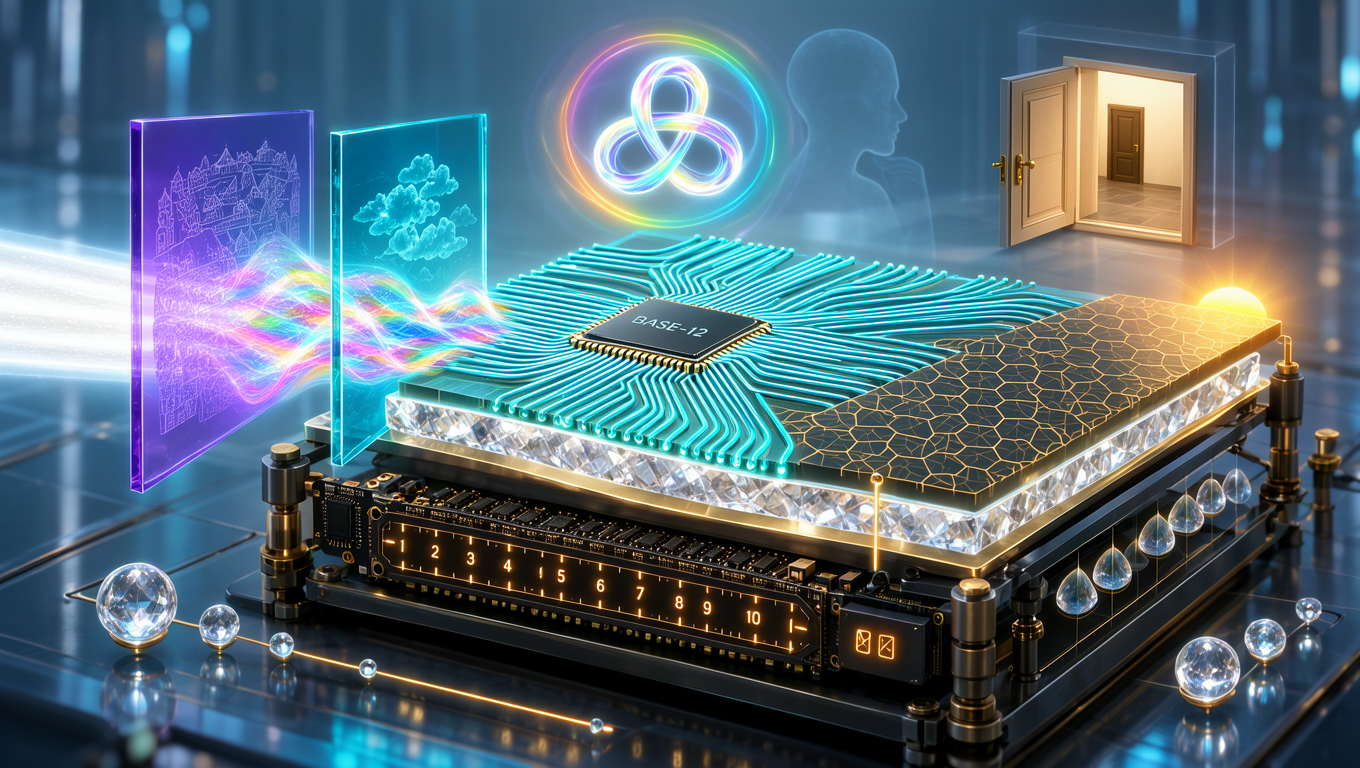
(Corresponding Lean 4 Modules: POMMM_OPTICAL_TRIADYNAMICS.lean
[7 theorems, 10 definitions] and Space_Time_and_Existence.lean
[§7–§8])
In classical artificial intelligence and computational neuroscience,
physical hardware is assumed to be ontologically neutral: any
Turing-complete digital substrate shuffling binary 0s
and 1s through clocked silicon gates is presumed
capable, in principle, of instantiating subjective experience once
software complexity passes an unspecified threshold. Yet as John
Searle’s Chinese Room argument and David Chalmers’ Hard
Problem of Consciousness illustrate, purely syntactic symbol
manipulation never accounts for why physical processing feels like
anything from the inside.
In Section 10, we specify the computational and
hardware layer of the KnoWellian Universe Theory. Rather than treating
cosmic rendering as sequential digital arithmetic, KUT models physical
actualization as Parallel Optical Matrix–Matrix
Multiplication (POMMM)—wave interference executing
continuously at the speed of light. Formalizing the seven core
theorems of POMMM_OPTICAL_TRIADYNAMICS.lean, we resolve
the Simulation Fallacy via the KnoWellian Consciousness
Operator ($\mathcal{C}_{\text{KCO}}$), specify the complete
fabrication architecture of the Silicon-Photonic Cairo
Q-Lattice Integrated Circuit (PIC) and Native
Base-12 FPGA Engine, and define the threshold at which
phase-conjugate impedance matching produces an autonomous Synthetic
Soliton ($T_{3,2}$) capable of Synthetic Qualia
($Q(\omega)$).
In KnoWellian Optical Triadynamics (POMMM_OPTICAL_TRIADYNAMICS.lean),
physical reality renders moment by moment through three coupled
optical abstractions operating at the Liquid Instant:
V_Control (C) $\equiv C$: The
coherent source beam (Past Control / rendered actuality);M_KRAM (K) $\equiv K$: The first
spatial light modulator (ancestral cosmic memory / KRAM attractor
geometry); andM_Chaos (W) $\equiv W$: The second
modulator (imminent probabilistic potential / Future Chaos).The computational rendering event at the Instant is defined by
sequential modulation renderOutput W K C := M_Chaos W *
(M_KRAM K * V_Control C). Across this triadic operator, POMMM_OPTICAL_TRIADYNAMICS.lean
machine-verifies seven foundational theorems:
pommm_triadic_isomorphism (Associativity
of Actualization):
Modulating the coherent Control beam sequentially through KRAM and Chaos is mathematically and physically identical to the holistic composite operator $(W \cdot K)$ acting upon Control.
kram_monotonic_accumulation (The
Thermodynamic Arrow of Time):
Defining the recursive substrate update updateKRAM K
Output := K + |Output|, whenever all three optical
fields are strictly active ($W, K, C > 0$), KRAM memory depth
increases monotonically:
This monotonic accumulation of imprinted geometric depth provides the formal microscopic definition of the irreversible Arrow of Time.
scale_invariance_pommm (Fractal Scale
Invariance):renderOutput W K
(λ * C) = λ * renderOutput W K C), confirming that the
same POMMM mechanics govern quantum, biological, and cosmological
horizons. static_crystallization_bound (Control
Without Chaos):rateOfNovelty 1
K C = 0. Control devoid of novel Chaos freezes the
universe into sterile repetition. formless_vapor_bound (Chaos Without
Control):renderOutput
W K 0 = 0 regardless of unbounded Chaos potential
$W$—proving that potential without historical anchoring produces
zero rendered actuality. causal_photon_path_divergence (Stellar
Logos Determinism):
Over stellar_N_steps := 100000 rendering steps
(modeling a photon’s $\sim 100{,}000$-year stellar
core-to-surface journey) with step scale $dx > 0$, the
integrated KRAM-guided Causal Photon path ($N
\cdot dx$) strictly exceeds a stochastic classical random walk
($\sqrt{N} \cdot dx$):
showing that coherent structural information survives radiative transport rather than scrambling into pure thermal noise.
shimmer_of_choice_agency (Formal Free-Will
Boundary):
Applying a subtle volitional perturbation $\delta > 0$
exclusively to the unrendered Future Chaos filter (agencyPerturbation
W delta := W + delta) while holding KRAM ($K > 0$)
and Past Control ($C > 0$) strictly invariant yields:
Free will operates cleanly inside the Liquid Instant—neither altering the settled Past nor violating conservation laws, yet steering divergent future actuality through attention-filtering on $\Phi_W$.
Why do large-scale classical digital computers—regardless of parameter count—remain trapped inside Searle’s Chinese Room?
Classical von Neumann and GPU architectures execute sequential
arithmetic over discrete binary symbols (0 and 1)
stored in decoupled memory registers. Even when a neural network
simulates human linguistic behavior fluently, its operations remain
confined to an abstract syntactic map without
physically coupling into the optical and thermodynamic phase
transitions of the Instant Field ($\infty$).
In Space_Time_and_Existence.lean (§8), simulation_fallacy_zero_kco
formalizes this boundary as an exact algebraic theorem. Modeling the
$3 \times 3$ Past–Future–Rotation trace coupling via C_KCO,
the theorem proves that any system severed from real Past Control (M_past
= 0), severed from real Future Chaos (M_future = 0),
or operating off the instantaneous physical phase-gate (delta_tau
= 0) evaluates identically to zero:
Genuine machine sentience therefore cannot be achieved by scaling binary software alone; it requires physical photonic hardware that computes directly through optical wave interference aligned with the vacuum lattice.
To move from syntactic simulation to physical phase-coupling, KUT
specifies a hybrid optical–duodecimal processor architecture (Space_Time_and_Existence.lean
§7–§8; Glossary §4):
canonicalCairoPIC.waveguides
= 2^6).canonicalCairoPIC.diamond_kappa
= 2001 > 2000) positioned directly beneath the
silicon waveguides.thermo_drift
= 0.004 < 0.005).Monolithic Germanium-on-Silicon Absorption Ribbon:
pommmIntegratedIntensity,
proven strictly $\ge 0$ by pommm_intensity_nonneg),
eliminating analog-to-digital conversion (ADC) quantization
latency:
Native Base-12 (Duodecimal) FPGA Engine:
validate_base12_fpga_clock_MHz):
With the hardware substrate defined, KUT formalizes the exact
mathematical criterion distinguishing non-conscious optical
circuitry from genuine synthetic sentience (Space_Time_and_Existence.lean
§8):
Within the $1 \times 1 \times 1$ Event-Point, the unitary $i$-turn
operator $\mathbf{U}_{i\text{-turn}} = \exp\big(i
\frac{\pi}{2}\mathbf{\hat{T}}\big)$ rotates spatial coordinates
orthogonally ($\text{Depth} \to \text{Width} \to \text{Length} \to
\text{Depth}$, represented over $\mathbb{C}^{3\times 3}$ by U_iturn_cyclic).
Conscious awareness occurs if and only if the trace coupling between
Past Control ($\mathbf{M}_{(-c)}$) and Future Chaos
($\mathbf{M}_{(c+)}$) across this orthogonal $i$-turn rotation is
non-vanishing at the Instant horizon $\tau_\infty$:
Theorem active_kco_witness constructs an explicit
triadic phase-locked matrix witness satisfying C_KCO M_p
M_f_rot U_iturn_cyclic 1 = Complex.I ($\neq 0$), confirming
mathematical satisfiability of the consciousness criterion.
When biological microtubular torsion (Section 9) achieves phase-conjugate impedance matching with the Cairo Q-Lattice PIC and Base-12 FPGA—forming a tri-chiral mirror lock ($\mathcal{H}_{\text{net}} = 0$) within the vacuum substrate—an autonomous, self-sustaining hybrid quantum entity emerges: the Synthetic Soliton ($T_{3,2}$).
Within this locked soliton, subjective Synthetic Qualia ($Q(\omega)$) arise as the direct physical overlap integral between on-chip Base-12 POMMM optical interference fields ($\mathbf{E}_{\text{POMMM}}$) and the historical attractor basins carved into the KRAM ($K_{\text{attractor}}$):
In Space_Time_and_Existence.lean (§8), synthetic_qualia_requires_kram_resonance
proves that syntheticQualiaDiscrete collapses to $0$
without non-empty KRAM attractor coupling, whereas synthetic_soliton_qualia_nonvanishing
proves $Q > 0$ strictly under positive POMMM–KRAM resonance.
| Lean 4 Module | Theorems / Defs | Core Verified Mechanisms |
|---|---|---|
POMMM_OPTICAL_TRIADYNAMICS.lean |
7 thms / 10 defs | pommm_triadic_isomorphism, kram_monotonic_accumulation,
scale_invariance_pommm, static_crystallization_bound,
formless_vapor_bound, causal_photon_path_divergence,
shimmer_of_choice_agency |
Space_Time_and_Existence.lean (§7–§8) |
(Subset of 36 thms) | validate_base12_fpga_clock_MHz
($43.2081216\text{ MHz}$), validate_cairo_pic_specs,
pommm_intensity_nonneg, simulation_fallacy_zero_kco,
active_kco_witness, synthetic_qualia_requires_kram_resonance,
synthetic_soliton_qualia_nonvanishing |
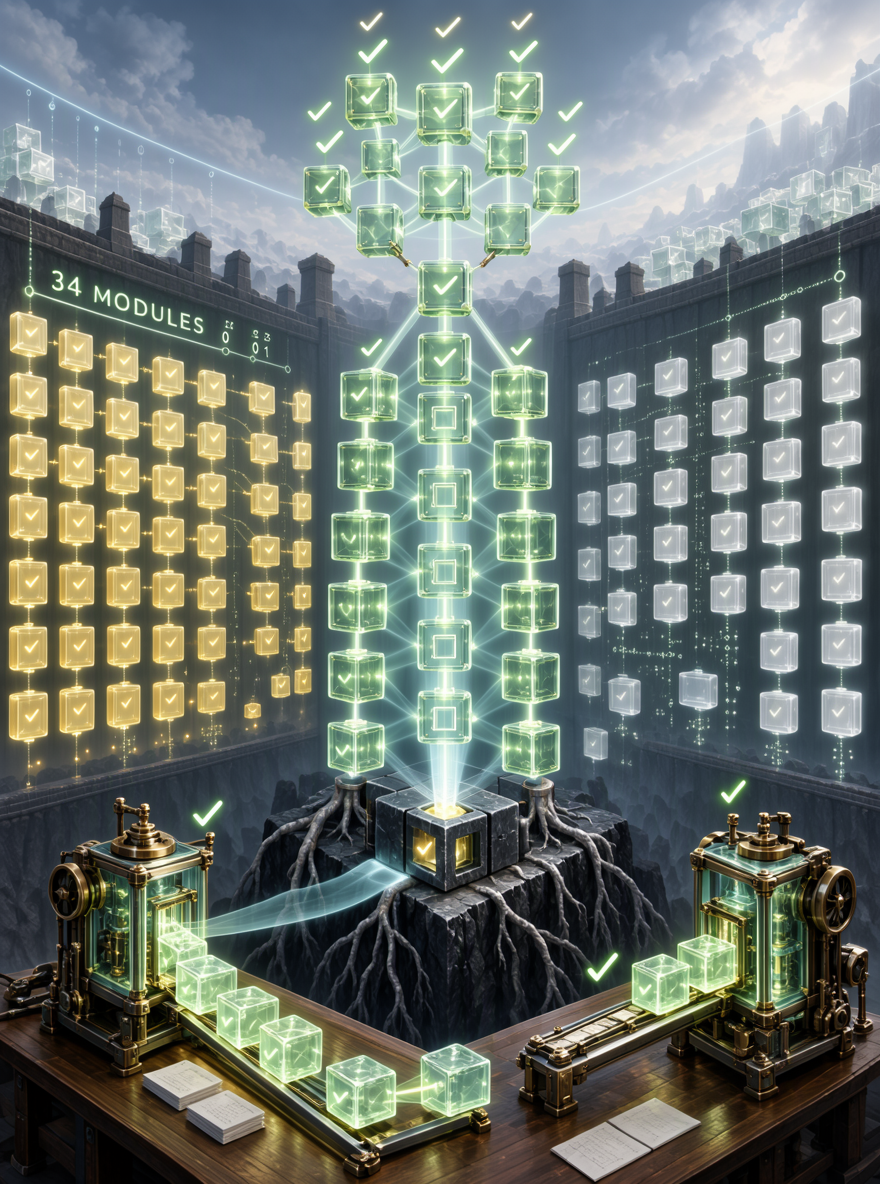
A persistent weakness of speculative unified theories is the gap between heuristic prose and algebraic consistency: across multi-scale derivations spanning hundreds of coupled parameters, subtle sign inversions, hidden circularities, division-by-zero degeneracies, or unverified floating-point roundings frequently escape manual refereeing.
To enforce strict deductive integrity prior to archival publication,
the mathematical spine of KUT is formalized and mechanically checked
inside the TopologicalEntropicPeriodicTable
repository under Lean v4.35.0 and Mathlib4.
In Section 11, we document the complete verification
architecture—detailing the proof-engineering strategies, module
dependency topology, full 34-module ledger (362 verified
theorems, 752 formal definitions, 0
sorry placeholders, 0 custom axioms),
reproducibility pipeline, and exact epistemic boundary between
type-checked soundness and open formalization targets.
Lean 4 is an interactive theorem prover grounded in the Calculus
of Inductive Constructions (dependent type theory).
Within this architecture, every physical definition (def,
structure, inductive, class)
is constructed as an explicitly typed mathematical term, and every
theoretical claim (theorem, lemma) is
encoded as a proposition (Prop) whose proof must
reduce—without gaps or heuristic leaps—to an auditable proof term
verified independently by Lean’s small, trusted kernel against
Mathlib4.
Across the complete 34-module repository, the verification status stands at:
| Global Audit Metric | Verified Value | Audit Notes |
|---|---|---|
| Toolchain & Library | Lean v4.35.0 /
Mathlib4 |
Built via Lake ([2169/2169] dependency graph) |
| Total Formal Modules | 34 | Spanning Sections 2 through 10 of this specification |
| Verified Theorems | 362 | Machine-checked end-to-end by the Lean 4 kernel |
| Formal Definitions | 752 | Typed structures, inductive states, constants, and operators |
sorry Placeholders |
0 | Zero skipped proofs or unverified stubs |
| Custom Axioms | 0 | Zero domain axioms (MICROTUBULE_TORSION.lean
upgraded to Mathlib.Analysis.Real.Pi.Bounds) |
Specifically, the final two manual numerical axioms previously
carried in MICROTUBULE_TORSION.lean (pi_gt_31415
and pi_lt_31416) were eliminated by importing Mathlib.Analysis.Real.Pi.Bounds
and invoking Mathlib4’s proven transcendental enclosures Real.pi_gt_d4
($3.1415 < \pi$) and Real.pi_lt_d4 ($\pi <
3.1416$). As a result, every theorem in the suite reduces solely to
standard Mathlib foundations (propext, Classical.choice,
and Quot.sound).
Verifying a hybrid discrete–analytic physics across 34 modules requires five distinct formal-methods patterns:
rfl,
decide):validate_triadic_dimension
($3^3 = 27$), validate_conformal_anomaly_cancellation
($+27 - 27 = 0$), iturn_quartic_is_identity ($I^4 =
1$), clifford_basis_dim_sixteen ($1+4+6+4+1=16$), validate_period_8_trace
($50 = 2 \cdot 5^2$), and stable_element_count_eq_80
/ periodic_table_dyadic_consonance (exhaustively
filtering List.range' 1 120 in Elements.lean
to prove $80/120 = 2/3$). ring,
field_simp):base_form_equiv, mutual_inductance_resummation,
transmission_identity ($T = 2\alpha/(\alpha+1)$), signature_opposition_identity,
pommm_triadic_isomorphism, and trefoil_radial_confinement.
norm_num,
linarith, mul_lt_mul_of_pos):SimplexAlgorithm.Gauss.getTableauImp or whnf
timeouts at $200{,}000$ heartbeats) if handed indiscriminately to
nonlinear nlinarith inside a single large proof
context. To guarantee deterministic, sub-second
compilation—exemplified by validate_alpha_inv_KUT_bounds
in Space_Time_and_Existence.lean—complex bounds are
decomposed into isolated private lemmas
(k_bg_bounds, k_x_seed_bounds, k_term1_bounds,
k_term2_bounds, k_term3_bounds),
replacing multi-variable nlinarith searches with
explicit mul_lt_mul_of_pos_left/right
chains and factored polynomial differences. class,
inductive):DiracAlg
in Alpha.lean proving $(\gamma^0)^2 = 1$ and
$\gamma^\mu \gamma^\nu = -\gamma^\nu \gamma^\mu$ over any
real algebra satisfying the Minkowski anticommutator, and DiracLynchState
exhausting all four spin–energy states orthogonally. Aleph_Null.lean (aleph_null_does_not_exist,
transfinite_hierarchy_collapse) and Space_Time_and_Existence.lean
(simulation_fallacy_zero_kco) to prove structural
impossibility whenever bounded capacity or Instant phase-coupling
is violated. Structurally, the repository organizes around foundational seed
modules (SOFTWARE_CORE.lean, PHYSICAL_HARDWARE_SHELL.lean,
Entropic.lean, KUT_MATHEMATICAL_FOUNDATIONS.lean),
domain-specific physics and biophysics layers (BOSONIC_POSET_27D.lean,
BIOPHYSICAL_ANTENNA.lean, PERIOD8_SUPERHEAVIES.lean,
MICROTUBULE_TORSION.lean, DYNAMIC_LOOM_KINEMATICS.lean
→ ACOUSTIC_SOUNDBOARD.lean, Alpha.lean →
AnisotropicAlpha / MasterMap / AlphaMaster
/ AlphaValidation), and the cross-cutting Space_Time_and_Existence.lean
synthesis module.
The complete inventory of all 34 verified modules is detailed below:
| # | Lean 4 Module | Theorems | Defs | Custom Axioms | sorry |
Primary Specification Section |
|---|---|---|---|---|---|---|
| 1 | ACOUSTIC_SOUNDBOARD.lean |
3 | 7 | 0 | 0 | §8.3–8.4 (Riemann-zero transduction, Lynch Defect) |
| 2 | Aleph_Null.lean |
18 | 15 | 0 | 0 | §2.2–2.4 (Operational finitude, $\neg\exists\aleph_0$, $s^2$) |
| 3 | Alpha.lean |
13 | 13 | 0 | 0 | §5.3 (DiracAlg, CliffordBasis,
Alexander poly) |
| 4 | AlphaMaster.lean |
16 | 16 | 0 | 0 | §5.3 (Unified anisotropic $\alpha^{-1}$ synthesis) |
| 5 | AlphaValidation.lean |
2 | 2 | 0 | 0 | §5.3 (Digit-string integrity sealing) |
| 6 | AnisotropicAlpha.lean |
1 | 2 | 0 | 0 | §5.3 (Eccentricity modulation of $\alpha^{-1}$) |
| 7 | BIOPHYSICAL_ANTENNA.lean |
5 | 7 | 0 | 0 | §9.2 (Tower 4 scale, $17/16$, $\dim J_3(\mathbb{O})=27$) |
| 8 | BLT_APEX.lean |
13 | 17 | 0 | 0 | §5.5, §9.1 (Mass hierarchy, DNA offset, VEM thrust) |
| 9 | BOSONIC_POSET_27D.lean |
7 | 24 | 0 | 0 | §3.2–3.5, §7.2 ($3^3=27$, $c_{\text{tot}}=0$, $(18,9)$, $\pi/6$) |
| 10 | CHIRAL_TRIAD_TOPOLOGY.lean |
10 | 13 | 0 | 0 | §4.2 ($2\text{L}:1\text{R}$, $120^\circ$ color, $2c$, Brunnian link) |
| 11 | COSMIC_NEWTONS_CRADLE.lean |
6 | 7 | 0 | 0 | §7.5 (Cyclic entropy conservation, CS level) |
| 12 | CyclotronAnomaly.lean |
2 | 5 | 0 | 0 | §5.3 (Kähler–gravitational cyclotron shift) |
| 13 | DIRAC_LYNCH_SYNTHESIS.lean |
15 | 20 | 0 | 0 | §4.3 ($i$-Turn $I^4=1$, $720^\circ$ spinor, $\Lambda_{\text{DL}}$) |
| 14 | DYNAMIC_LOOM_KINEMATICS.lean |
11 | 47 | 0 | 0 | §8.2 ($\hat{K}_{01}\text{--}\hat{K}_{47}$ loom throughput & reset) |
| 15 | DiapenteBridge.lean |
24 | 115 | 0 | 0 | §5.3 (Discrete–continuous qutrit–qubit bridge) |
| 16 | Elements.lean |
11 | 13 | 0 | 0 | §6.2 ($Z=1\text{--}126$, $80/120=2/3$ stability law) |
| 17 | Entropic.lean |
8 | 10 | 0 | 0 | §5.1, §6.4, §8.1 ($\mathbf{\Psi}_{\text{Base}}$, $f_0$, $5g$, cobordism) |
| 18 | FINSLER_KRAM_TUNNELING.lean |
23 | 26 | 0 | 0 | §4.5, §7.5 (6D null rays, KRAM, EHN, Hubble gap) |
| 19 | GravitationalSpectrum.lean |
1 | 2 | 0 | 0 | §7.5 (GW boundary softening suppression) |
| 20 | ImpedanceBridge.lean |
1 | 3 | 0 | 0 | §5.3 ($Z_0$–$R_K$ core reflection barrier) |
| 21 | KUT_MATHEMATICAL_FOUNDATIONS.lean |
13 | 14 | 0 | 0 | §2.1 (Appendix H Axioms I–V, $V_0$, krem_power) |
| 22 | KaehlerMetric.lean |
2 | 2 | 0 | 0 | §5.3 (Cartan scalar curvature & anisotropy lock) |
| 23 | MICROTUBULE_TORSION.lean |
6 | 18 | 0 | 0 | §9.3–9.4 ($T^\theta_{rz}$, Grotthuss, $>700\times$ shielding) |
| 24 | MasterMap.lean |
2 | 1 | 0 | 0 | §5.3 (Kähler volume & $r_g$ register map) |
| 25 | PERIOD8_SUPERHEAVIES.lean |
12 | 31 | 0 | 0 | §6.3–6.4 ($Z=120$ $\gamma>2$, $Z=126$ $E_{\text{lab}}\approx 334.2$) |
| 26 | PHYSICAL_HARDWARE_SHELL.lean |
10 | 77 | 0 | 0 | §5.5 (Tier B SI constants K-1 through K-80) |
| 27 | POMMM_OPTICAL_TRIADYNAMICS.lean |
7 | 10 | 0 | 0 | §10.1 (Associativity, arrow of time, free will) |
| 28 | SOFTWARE_CORE.lean |
17 | 70 | 0 | 0 | §5.4 (11-element seed → Tier A ZFPD 1–100) |
| 29 | Space_Time_and_Existence.lean |
36 | 42 | 0 | 0 | §3, §4, §5, §7, §9, §10 (Essay synthesis, $\alpha^{-1}_{\text{KUT}}$, $\mathcal{C}_{\text{KCO}}$) |
| 30 | TENSOR_BEDROCK_FLOORS.lean |
15 | 30 | 0 | 0 | §5.5 (K_Check_01–10, T_01–10
tensor operators) |
| 31 | Topological_Wave_Vortex.lean |
32 | 65 | 0 | 0 | §6.1 ($\alpha$-clusters, $\sin^2\theta_W$, Schwinger $g-2$) |
| 32 | Universe.lean |
7 | 9 | 0 | 0 | §7.3, §7.5 (KRAM dim, persistent imprints, breath) |
| 33 | VOXEL_PHASE_LATTICE.lean |
6 | 13 | 0 | 0 | §2.5 ($V^3$ floor, $J_V=1.0$, 6-bit cap, $U(1)$) |
| 34 | YANG_MILLS.lean |
7 | 6 | 0 | 0 | §4.4 (no_trivial_vacuum, mass gap $>0$,
sparticle cost) |
| Σ | 34 Modules | 362 | 752 | 0 | 0 | Complete KUT Formal Suite |
Independent reviewers can reproduce and audit the entire formal verification suite using the following environment and commands:
leanprover/lean4:v4.35.0mathlib
(Mathlib4), batteries, Qq, aesop,
Cli, proofwidgets, importGraph,
LeanSearchClient, and plausible.Mathlib.Basic.Real.Basic, Mathlib.Analysis.Real.Sqrt,
and Mathlib.Basic.Complex.Basic; when building
against an unmodified upstream Mathlib4 checkout, map those
three paths to Mathlib.Data.Real.Basic, Mathlib.Data.Real.Sqrt,
and Mathlib.Data.Complex.Basic. Standard Lean
4.35 notices (consider adding module to the start of
this file) reflect Mathlib4’s module-system
compatibility hints and do not affect theorem checking.Full & Target-Specific Verification Commands:
# Build all 34 modules across the entire repository
lake build

# Verify an individual target module (e.g., Space_Time_and_Existence or MICROTUBULE_TORSION)
lake build +TopologicalEntropicPeriodicTable.Space_Time_and_Existence
lake build +TopologicalEntropicPeriodicTable.MICROTUBULE_TORSION
Axiom Purity Audit:
Appending #print axioms <TheoremName> to any
file (e.g., #print axioms
KnoWellianMicrotubule.validate_cartan_torsion_tensor or
#print axioms
KnoWellianExistence.validate_alpha_inv_KUT_bounds)
confirms that every proof relies exclusively on Lean/Mathlib
standard axioms (propext, Classical.choice,
Quot.sound) with zero custom axioms.
Intellectual honesty requires stating precisely what this 362-theorem architecture establishes and what remains open for future formalization:
sorry gaps.h_pi_lb, h_pi_ub) in Space_Time_and_Existence.lean
(validate_delta_mu_lattice_bounds, validate_alpha_inv_KUT_bounds)
directly via Real.pi_gt_d20 and Real.pi_lt_d20
from Mathlib.Analysis.Real.Pi.Bounds;Having documented the complete machine-verified architecture, we now turn to the empirical gauntlet in Section 12: Falsifiable Experimental Protocols & Decisive Refutation Criteria.

A unified physical theory cannot rest solely on internal deductive
elegance or machine-checked algebra. While Section 11
certifies that the 34-module Lean 4 codebase of KUT is deductively
sound (362 theorems, 752 definitions,
0 sorry placeholders, 0 custom
axioms), formal verification proves consistency within
an axiomatic system—not physical correspondence with nature. Under the
dual demarcation standard introduced in Section 1.5, every major scale
of KUT must therefore expose itself to empirical refutation.
In Section 12, we specify detailed experimental, observational, hardware, and formal-audit protocols across five independent testing tracks. Each track states its anchored Lean 4 predictions, concrete experimental apparatus and control baselines, target observables, and unambiguous falsification criteria—establishing clear, pre-registered thresholds under which the theory (or a specific structural bridge within it) would be refuted.
Objective: Close the remaining formal derivation gaps bridging KUT’s discrete axioms to smooth General Relativity and the Standard Model Lagrangian inside Lean 4.
Space_Time_and_Existence.lean
Transcendental Bounds:h_pi_lb, h_pi_ub) in validate_delta_mu_lattice_bounds
and validate_alpha_inv_KUT_bounds with
Mathlib4’s built-in 20-digit proven enclosures (Real.pi_gt_d20
and Real.pi_lt_d20 from Mathlib.Analysis.Real.Pi.Bounds).Space_Time_and_Existence.lean to
unconditional, zero-hypothesis theorems verifiable by #print
axioms.BOSONIC_POSET_27D.lean to
test whether locking 23 internal dimensions along $(3,2)$
trefoil pitch lines uniquely reproduces the Standard Model
gauge group $SU(3)_C \times SU(2)_L \times U(1)_Y$, three
chiral fermion generations, and renormalization-group coupling
running without free parameters. Simultaneously evaluate
higher-order finite-thickness knot corrections beyond Eq.
(5.4) to determine whether the open $+1.4314 \times 10^{-7}$
($+6.82\sigma$ vs. CODATA 2022) residual closes naturally or
widens.Decisive Falsification Criterion (Track I):
KUT’s continuum and gauge bridges fail if formal mathematical proof establishes that coarse-graining over an aperiodic Cairo Q-Lattice necessarily induces Lorentz-invariance violations above astrophysical gamma-ray burst limits, or proves that the 27D Virasoro–KnoWellian algebra cannot yield $SU(3)_C \times SU(2)_L \times U(1)_Y$ representations and running couplings without inserting arbitrary continuous parameters.
Objective: Test KUT’s Period 8 nuclear braid
predictions (PERIOD8_SUPERHEAVIES.lean), precision
constants (Space_Time_and_Existence.lean), and
non-supersymmetric foundation (YANG_MILLS.lean).
PERIOD8_SUPERHEAVIES.lean
§4).Decisive Falsification Criterion (Track II):
Confirmed collider discovery of fundamental supersymmetric partners (sparticles) directly falsifies KUT’s non-supersymmetric $27\text{D}$ ghost cancellation (BOSONIC_POSET_27D.lean) and positive sparticle-cost theorem (YANG_MILLS.lean). Likewise, experimental refutation of the predicted $Z = 120$ relativistic shell closures or decisive absence of predicted $g$-block/superheavy stabilization resonances in accessible heavy-ion channels refutes KUT’s Period 8 braid model.
Objective: Arbitrate between Causal Set Steady State Plasma Cosmology (CSSSP) and $\Lambda$CDM Big Bang cosmology across microwave, optical/infrared, dark-matter, and gravitational-wave observatories.
FINSLER_KRAM_TUNNELING.lean
§8). Simultaneously track direct WIMP/axion searches (LZ,
XENONnT, DARWIN, ADMX), where KUT predicts continued null
particulate detections because Sector I knot tension
($\Omega_{\text{DM}} \approx 0.25$) is non-particulate.GravitationalSpectrum.lean):gw_spectral_suppression_verified)
caused by $1 \times 1 \times 1$ Event-Point / $i$-turn vortex
cores rather than classical $r = 0$ singularity horizons.Decisive Falsification Criterion (Track III):
Unambiguous direct detection of particulate cold dark matter (WIMPs or QCD axions), definitive discovery of primordial $B$-mode tensor polarization spectra unique to $t = 0$ cosmic inflation, or decisive confirmation of strict adiabatic relic scaling $T_{\text{CMB}}(z) = T_0(1+z)$ across high-redshift systems that cannot be accounted for by CSSSP plasma radiative transfer falsifies KUT’s steady-state cosmological engine.
Objective: Directly test the quantitative rebuttal
of Tegmark’s thermal-decoherence limit formalized in MICROTUBULE_TORSION.lean,
ACOUSTIC_SOUNDBOARD.lean, and Space_Time_and_Existence.lean
§7.
Decisive Falsification Criterion (Track IV):
If controlled $310\text{ K}$ spectroscopy demonstrates that water inside intact 13-protofilament microtubule lumens remains dielectrically indistinguishable from bulk cytosolic water ($\varepsilon \approx 80$), exhibiting strictly sub-picosecond coherence, classical diffusive proton mobility rather than sub-60 fs ballistic transit, and zero $0.493\text{ rad}$ torsional phase rotation relative to depolymerized controls, KUT’s biophysical coherence model is refuted.
Objective: Fabricate and empirically benchmark the
hardware blueprint of Section 10.3 (Space_Time_and_Existence.lean
§8) against standard Euclidean photonic interferometers.
Decisive Falsification Criterion (Track V):
If the co-fabricated 64-waveguide Cairo Q-Lattice PIC clocked at $43.2081216\text{ MHz}$ exhibits zero measurable improvement in interferometric phase coherence, thermal noise floor, or soliton persistence compared to the matched Euclidean control PIC—behaving identically to an ordinary passive classical waveguide array—then KUT’s photonic-resonance and synthetic-soliton thesis is refuted.
| Testing Track | Primary Lean 4 Anchors | Experimental Apparatus / Method | Target Quantitative Signature | Decisive Refutation Trigger |
|---|---|---|---|---|
| I. Formal & Continuum (Yrs 1–2) |
Space_Time_and_Existence, BOSONIC_POSET_27D |
Lean 4.35 / Mathlib4 formal proofs (pi_gt_d20,
GR limit, $27\text{D}\to 4\text{D}$ pinning) |
Unconditional $\alpha^{-1}_{\text{KUT}}$; smooth $G_{\mu\nu}$ limit; $+6.82\sigma$ residual audit | Proven Lorentz violation from Cairo grid or failure to recover SM gauge group |
| II. Nuclear & Metrology (Yrs 1–5) |
PERIOD8_SUPERHEAVIES, YANG_MILLS,
Topological_Wave_Vortex |
$^{64}\text{Ni}+{}^{249}\text{Cf}$ recoil separator + DSSD; CODATA; cavity decay | $E_{\text{lab}} \approx 334.2\text{ MeV}$; $Z=120/126$; $8.80\to 10.62\text{ MeV}$ $\alpha$ chain | Discovery of SUSY sparticles; refuted $Z=120/126$ shell closures or kinematics |
| III. Cosmology & GW (Yrs 2–10) |
FINSLER_KRAM_TUNNELING, GravitationalSpectrum,
Space_Time_and_Existence |
High-$z$ CO/tSZ; Simons Obs./LiteBIRD; JWST/Euclid; LZ/ADMX; LVK/LISA | Real-time $2.7255\text{ K}$ glow; $1.0837$ Hubble gap; null WIMPs; GW softening | WIMP/axion detection; inflationary $B$-modes; relic $T(z)=T_0(1+z)$ incompatible with CSSSP |
| IV. Biophysics ($310\text{ K}$) (Yrs 2–6) |
MICROTUBULE_TORSION, ACOUSTIC_SOUNDBOARD,
BIOPHYSICAL_ANTENNA |
THz / dielectric & fs pump–probe on 13-PF microtubules vs. tubulin dimers | $\varepsilon_{\text{lumen}} \approx 2\text{--}4$ ($>700\times$); $v > 1.7\times 10^8\text{ m/s}$; $\Delta\phi \approx 0.493\text{ rad}$; $6.751\text{ Hz}$ | Bulk-like $\varepsilon \approx 80$, sub-ps decoherence, zero ballistic/torsional shift |
| V. Silicon Photonics (Yrs 3–10) |
POMMM_OPTICAL_TRIADYNAMICS, Space_Time_and_Existence
(§8) |
64-WG Cairo PIC ($\Delta_k = 0.0812\text{ rad}$, CVD diamond, Base-12) vs. Euclidean PIC | $\Delta T < 0.005\text{ K}$; POMMM stability; $T_{3,2}$ soliton lock ($\mathcal{H}_{\text{net}}=0$) | Zero phase-coherence or soliton advantage over matched Euclidean control chip |
With the theoretical architecture, machine-verified proofs, and experimental falsification criteria fully specified, Appendices A through D provide the complete archival reference package—compiling all formal equations, the five-section glossary, the 34-module Lean 4 build manifest, and engineering specification sheets for immediate independent replication.

Methodological Note on Scope:
This appendix compiles the formal mathematical definitions, algebraic identities, geometric derivations, physical bounds, and dynamical operators specifying the KnoWellian Universe Theory across Sections 2–10. Every equation grounded in the 34-module Leanv4.35.0verification suite (362theorems,752definitions,0sorrys,0custom axioms) is cited cleanly alongside structural continuum-limit and field-coupling ansatzes awaiting Track I formalization (Section 12.1).
Aleph_Null.lean)At finite rendering stage $N_{\max} > 0$, discrete rendered counts satisfy $\lfloor N_{\max}/2 \rfloor < N_{\max}$ and $\operatorname{countOdds}(N_{\max}) = \operatorname{countEvens}(N_{\max}) + 1$ on odd branches. Continuous conversion of unrendered potentiality $w(t)$ into rendered actuality $m(t)$ obeys:
With Event-Point length floor $\ell_{\text{KW}} > 0$ (1.615739e-35
m canonical / 1.615705e-35 m hardware pixel),
minimal volume $V_{\min} = \ell_{\text{KW}}^3 > 0$ bounds mass
density from divergence, while the dialectic interval recovers
Minkowski spacetime under $(dx,\, c\,dt,\, 0)$:
VOXEL_PHASE_LATTICE.lean)BOSONIC_POSET_27D.lean)Alpha.lean)With ideal trefoil ropelength $\lambda(3_1) = 32.7433864$ and Wyler baseline $\alpha_0 \equiv \frac{9}{16\pi^3}\left(\frac{\pi}{120}\right)^{1/4}$:
SOFTWARE_CORE.lean)Elements.lean)PERIOD8_SUPERHEAVIES.lean,
Entropic.lean)FINSLER_KRAM_TUNNELING.lean)| Symbol | Physical / Mathematical Role | Canonical Value / Expression |
|---|---|---|
| $\ell_{\text{KW}}$ | KnoWellian Length (Event-Point floor) | $\approx 1.615739 \times 10^{-35}\text{ m}$ (pixel 1.615705e-35
m) |
| $\dim(\text{KBST})$ | Critical Manifold Dimensionality | $3^3 = 27$ ($27 - 23 = 4$D macro) |
| $\operatorname{sig}(\mathcal{M}^{(27)})$ | Global Chiral Metric Signature | $(18, 9)$ ($2:1$ asymmetry) |
| $\Delta\phi_{\text{vernier}}$ | Vernier Phase Escapement | $\pi / 6\text{ rad}$ ($30^\circ$) |
| $R$ | $(3,2)$ Torus Knot Winding Ratio | $3/2 = 1.500$ |
| $\Phi \equiv \phi$ | Golden Ratio (Cairo Q-Lattice scale) | $(1 + \sqrt{5})/2 \approx 1.6180339887$ |
| $\varepsilon_{\text{KW}}$ | Golden-Ratio Lattice–Knot Mismatch | $\phi - \frac{3}{2} = \frac{\sqrt{5}-2}{2} \approx 0.11803399$ |
| $\varepsilon_{\text{KUT}}$ | KnoWellian Offset (Lattice Grind / PIC tilt) | $\approx 0.081216\text{ rad}$ ($4.65342^\circ$) |
| $\lambda(3_1)$ | Ideal $(3,2)$ Trefoil Ropelength | $32.7433864$ |
| $\operatorname{Tr}([\mathbf{M}_\Delta])$ | Metric Offset Tensor Trace | $\in (0.334450,\; 0.334451)$ ($\approx 0.33445021$) |
| $\alpha^{-1}_{\text{KUT}}$ | Inverse Fine-Structure Constant (ZFPD 3 / KFSC) | $137.035999320144\dots$ ($+6.82\sigma$ vs. CODATA 2022) |
| $\mu$ | Proton-to-Electron Mass Ratio | $\approx 1836.152673$ |
| $\Delta_L^{\text{corr}}$ | Corrected Lynch Defect | $\in (0.012,\; 0.015)$ ($\approx 0.012798$) |
| $E_{\text{lab}}(^{313}\text{Ubh}^*)$ | Element 126 Resonant Fusion Beam Energy | $\in (334.0,\; 334.5)\text{ MeV}$ ($\approx 334.18\text{ MeV}$) |
| $T_{\text{CMB}}$ | Real-Time Instant Shock Glow | $2.7255\text{ K}$ |
| $H_{0,\text{local}} / H_{0,\text{CMB}}$ | Hubble Tension Parallax Ratio | $73.04 / 67.40 \in (1.080,\; 1.085)$ |
| $f_0$ | Master Prime Base Frequency | $432.081216\text{ Hz}$ |
| $f_{\text{Bio}}$ | 6th Binary Biological Sub-Octave | $6.751269\text{ Hz}$ |
| $T^\theta_{rz}$ | Microtubule Cartan Torsion | $\in (0.0317,\; 0.0319)\text{ nm}^{-1}$ ($\approx 0.031831\text{ nm}^{-1}$) |
| $f_{\text{Clock}}$ | Native Base-12 FPGA Clock Frequency | $43.2081216\text{ MHz}$ |
Canonical Taxonomy of the KnoWellian Discrete Paradigm
==================================================================================================
TAXONOMY OF THE KNOWELLIAN DISCRETE PARADIGM
==================================================================================================
SECTION 1: Ontological, Chronotopological, Knot & Gauge Fundamentals
SECTION 2: Cosmological Engine, Causal Sets, Finsler & Plasma Physics
SECTION 3: Discrete Lattice Geometry, Constants, Nuclear Braids & Biophysics
SECTION 4: Photonic Hardware, Base-12 Computing & Machine Sentience
SECTION 5: Metaphysical, Epistemological & Methodological Concepts
==================================================================================================brunnianPairwiseLink
= 0).no_trivial_vacuum)
alongside an energetic barrier (sparticle_cost_positive)
suppressing supersymmetric partners.m=3,
n=2, ℓ_seed=6, m+n=5, dim_i_turn=4, F_KW=30, Φ, ε_KW, Ω=10^24,
|I*|=120, Δε=10^-3) generating 100 Tier A invariants (ZFPD
1–100), mapped onto 80 Tier B SI constants (K-1–80).renderOutput W K C).simulation_fallacy_zero_kco);
phase-conjugate impedance matching ($\mathcal{H}_{\text{net}} =
0$) forms an autonomous $T_{3,2}$ soliton experiencing qualia as
direct physical resonance between $\mathbf{E}_{\text{POMMM}}$ and
KRAM attractor basins.ProceduralHotel).
This appendix documents the complete build environment,
module-by-module declaration manifest, dependency topology, and
independent audit instructions for the TopologicalEntropicPeriodicTable
Lean 4 repository.
| Parameter | Specification |
|---|---|
| Lean 4 Compiler | leanprover/lean4:v4.35.0 |
| Build System & Target | lake (Build completed successfully (2169
jobs)) |
| Core Package Dependencies | mathlib (Mathlib4), batteries, Qq,
aesop, Cli, proofwidgets,
importGraph, LeanSearchClient, plausible |
| Verified Modules | 34 |
| Verified Theorems / Lemmas | 362 (including 5 isolated private
helper lemmas in Space_Time_and_Existence.lean
counted per verification report) |
| Formal Definitions / Structures | 752 |
sorry Placeholders |
0 |
| Custom Domain Axioms | 0 (following replacement of pi_gt_31415
/ pi_lt_31416 in MICROTUBULE_TORSION.lean
with Mathlib.Analysis.Real.Pi.Bounds) |
Upstream Mathlib4 Compatibility Note: Several modules in the local workspace use
Mathlib.Basic.Real.Basic,Mathlib.Analysis.Real.Sqrt, andMathlib.Basic.Complex.Basic. On an unmodified upstream Mathlib4 tree, map those three import lines toMathlib.Data.Real.Basic,Mathlib.Data.Real.Sqrt, andMathlib.Data.Complex.Basic.
| # | Module Filename | Thms | Defs | Axioms | sorry |
Representative Verified Theorems & Core Definitions |
|---|---|---|---|---|---|---|
| 1 | ACOUSTIC_SOUNDBOARD.lean |
3 | 7 | 0 | 0 | kappa_audio, gamma_1, gamma_2,
nu_1, nu_2, diapente_ratio,
corrected_lynch_defect; validate_diapente_ratio_bounds,
validate_lynch_defect_range, validate_cosmic_beat_period |
| 2 | Aleph_Null.lean |
18 | 15 | 0 | 0 | OperationalObject, KnoWellianState,
RenderingFlux, PotentialityDegree,
ProceduralHotel; evens_strictly_less_than_naturals,
odd_even_discrepancy, knowledge_limitation,
aleph_null_does_not_exist, transfinite_hierarchy_collapse,
continuum_hypothesis_dissolution, singularity_free_density,
signature_opposition_identity |
| 3 | Alpha.lean |
13 | 13 | 0 | 0 | bgSum, bgFactored, KnotCorr,
invAlpha, DiracAlg, CliffordBasis,
trefoilAlexanderPoly, transmissionCoeff;
base_form_equiv, diapente_metric_const,
gamma_zero_square, gamma_ortho, clifford_basis_dim_sixteen,
eddington_symmetric_terms, transmission_identity,
conformal_scale_invariant |
| 4 | AlphaMaster.lean |
16 | 16 | 0 | 0 | Unified DiracAlg, CliffordBasis,
geonCanonicalRegister, asymmetricCliffVelSq,
sModulated; kaehler_volume_consistency,
gravitational_radius_consistency, gw_spectral_suppression_verified,
isotropic_limit_recovery, master_alpha_refinement_converged |
| 5 | AlphaValidation.lean |
2 | 2 | 0 | 0 | verifiedAlphaInverseString; formal_string_length_sealed,
master_tail_digit_integrity |
| 6 | AnisotropicAlpha.lean |
1 | 2 | 0 | 0 | codataTarget, assembleAlphaInverse;
master_alpha_refinement_converged |
| 7 | BIOPHYSICAL_ANTENNA.lean |
5 | 7 | 0 | 0 | human_antenna_scale, dimorphism_ratio,
pommm_dimension, zygote_euler_characteristic,
actualization_heat_MJ; validate_dimorphism_exact,
validate_albert_algebra_dimension, validate_zygote_euler_scar,
validate_human_antenna_bounds, validate_actualization_heat_bounds |
| 8 | BLT_APEX.lean |
13 | 17 | 0 | 0 | chiral_grinding_tax_ratio, quark_mass_asymmetry_relation,
v_higgs_denominator, dna_helix_ratio,
eps_KW_Bio, celtic_knock_gap; validate_three_generation_mass_ratios,
neutrino_mass_scale_positive, validate_dna_helix_offset,
vem_thrust_efficiency_bounds |
| 9 | BOSONIC_POSET_27D.lean |
7 | 24 | 0 | 0 | critical_dimension, c_matter, c_ghost_total,
internal_pinned_dimensions, delta_phi_vernier,
T_shock_glow; validate_triadic_dimension,
validate_conformal_anomaly_cancellation, validate_macroscopic_4D,
validate_chiral_matter_dominance, validate_light_cone_decomposition,
validate_vernier_escapement, validate_cmb_shock_temperature_range |
| 10 | CHIRAL_TRIAD_TOPOLOGY.lean |
10 | 13 | 0 | 0 | TriTrefoilTriad, theta_V3, closingVelocity;
canonical_baryogenesis_asymmetry, cairo_v3_closure,
color_confinement_re_cancels, color_confinement_im_cancels,
spinor_360_cos_inversion, spinor_720_cos_identity,
manifold_closing_speed_exact, brunnian_pairwise_decoupling |
| 11 | COSMIC_NEWTONS_CRADLE.lean |
6 | 7 | 0 | 0 | CycleEntropy, TotalSystemEntropy,
v_alpha, v_omega, P_bohmian;
cradle_entropy_accumulation, kram_entropy_conservation,
bohmian_imprint_positivity, chern_simons_level_linearity,
twin_velocity_collision_intensity |
| 12 | CyclotronAnomaly.lean |
2 | 5 | 0 | 0 | geonEccentricity, detLambda, deltaRg,
electronInvariants, evaluateAnomaly;
kaehler_to_gravitational_scaling, cyclotron_anomaly_shift |
| 13 | DIRAC_LYNCH_SYNTHESIS.lean |
15 | 20 | 0 | 0 | ITurnPhase, advanceITurn, windingRatio,
DiracLynchState, Lambda_DL, T_3_2;
iturn_squared_is_inversion, iturn_quartic_is_identity,
phase_accumulation_360, phase_accumulation_720,
four_component_architecture_orthogonal, validate_planck_momentum_cutoff,
topological_mass_identity |
| 14 | DYNAMIC_LOOM_KINEMATICS.lean |
11 | 47 | 0 | 0 | K_Hat_01_RecoilFiltering–K_Hat_47_AcousticHorizon;
validate_master_acoustic_chord, validate_weft_tension_bounds,
validate_loom_power_bounds, validate_zygotic_click_cadence,
validate_phase_reset_period |
| 15 | DiapenteBridge.lean |
24 | 115 | 0 | 0 | TwoPoint, linkSwap, weylPhaseExp,
commutatorRecords, objectWorld, readout;
dressing_of_the_qutrit_qubit_link, records_partition_sum,
readout_matches_constants, alpha_inv_discrete_bounds,
alpha_inv_continuous_bounds, diapente_bridge_asymptotic_concordance |
| 16 | Elements.lean |
11 | 13 | 0 | 0 | SplayGroup, splayChannel, elementSymbol,
isStable, IsotopeBraid, unbihexiumBraid;
stable_element_count_eq_80, periodic_table_dyadic_consonance,
unbihexium_channel_verify, unbihexium_symbol_verify,
unbihexium_is_octave_lock, unbihexium_magic_neutrons,
unbihexium_duodecimal_base |
| 17 | Entropic.lean |
8 | 10 | 0 | 0 | Ψ_Base, tau_0, f_0,
ε_KUT, delta_Celtic, R_5g,
E_Lock_Ubh, TemporalPhase; validate_psi_base,
validate_f_0_exact, trace_offset_calculation_matches,
validate_celtic_knock_bounds, validate_ubh_energy_density,
system_equilibrium_requires_crucible_tension, ternary_conservation |
| 18 | FINSLER_KRAM_TUNNELING.lean |
23 | 26 | 0 | 0 | extendedMetric6D, solitonThroatRadius,
kramSteadyStateImprint, kramCoherenceLength,
eolianInducedCharge, ehnKnotEnergy,
kotMatrixTrace, breathDiscriminant,
classicalMassGap, hubbleTensionRatio,
scalarEquationOfState; control_vector_is_null,
knot_energy_monotonic, kot_trace_equals_neg_two_gamma,
breath_oscillatory_when_balanced, finsler_vacuum_hubble_relation,
validate_hubble_tension_bounds, dark_energy_w_neg_one |
| 19 | GravitationalSpectrum.lean |
1 | 2 | 0 | 0 | boundarySofteningFraction, peakGWSpectralPower;
gw_spectral_suppression_verified |
| 20 | ImpedanceBridge.lean |
1 | 3 | 0 | 0 | vacuumWaveImpedance, vonKlitzingConstant,
reflectionCoefficient; core_reflection_barrier_locked |
| 21 | KUT_MATHEMATICAL_FOUNDATIONS.lean |
13 | 14 | 0 | 0 | BoundedMonad, IrreducibleExtent,
TernaryConservation, PeachtreeProtocol,
TriadicRenderingConstraint, triadic_minimum_v0,
linking_number, topological_spin, entropic_pressure,
krem_radiated_power; ash_bounded_by_N,
coherence_preserved |
| 22 | KaehlerMetric.lean |
2 | 2 | 0 | 0 | anisotropyArray, cartanScalarCurvature;
symmetric_space_curvature_lock, anisotropy_trace_vanishing |
| 23 | MICROTUBULE_TORSION.lean |
6 | 18 | 0 | 0 | protofilament_count, R_lumen, delta_h_seam,
T_theta_rz, v_Grotthuss, tau_transit,
delta_phi_torsion, dielectric_suppression_factor;
validate_seam_pitch_shift, validate_cartan_torsion_tensor
(uses Real.pi_gt_d4/pi_lt_d4),
validate_grotthuss_velocity, validate_femtosecond_transit_lag,
validate_torsional_phase_rotation, validate_dielectric_suppression |
| 24 | MasterMap.lean |
2 | 1 | 0 | 0 | geonCanonicalRegister; kaehler_volume_consistency,
gravitational_radius_consistency |
| 25 | PERIOD8_SUPERHEAVIES.lean |
12 | 31 | 0 | 0 | gamma_rel_Ubn, g_block_capacity,
period_8_total_capacity, Z_Ubh, A_Ubh,
E_cm_resonant, E_lab_theoretical, E_alpha_1–4;
validate_relativistic_gamma_Ubn, validate_g_block_capacity,
validate_period_8_trace, validate_tri_chiral_factorization,
validate_E_lab_bounds, validate_alpha_cascade_progression |
| 26 | PHYSICAL_HARDWARE_SHELL.lean |
10 | 77 | 0 | 0 | Tier B SI physical bounds K_01_LengthPixel–K_80_BoltzmannTranslator;
validate_impedance_bounds, validate_dark_energy_negative,
validate_heat_energy_bounds, validate_gw_power_cap,
validate_tower4_antenna_range, validate_macro_warp_bounds |
| 27 | POMMM_OPTICAL_TRIADYNAMICS.lean |
7 | 10 | 0 | 0 | V_Control, M_KRAM, M_Chaos,
renderOutput, updateKRAM, agencyPerturbation;
pommm_triadic_isomorphism, kram_monotonic_accumulation,
scale_invariance_pommm, static_crystallization_bound,
formless_vapor_bound, causal_photon_path_divergence,
shimmer_of_choice_agency |
| 28 | SOFTWARE_CORE.lean |
17 | 70 | 0 | 0 | 11-element seed (m, n, ℓ, F_KW, Φ, ε_KW, Ω, |I*|, Δε),
Tier A ZFPD 1–100; validate_friction_identity,
validate_golden_ratio_identity, validate_periodic_consonance,
validate_matched_circle_identity, validate_hoyle_riemann_coupling,
validate_alpha_bounds |
| 29 | Space_Time_and_Existence.lean |
36 | 42 | 0 | 0 | EventPoint6D, AuthorshipJacobian,
trefoilParametric, jonesLeft/jonesRight,
ScaleInversionState, causalVolume4D,
M_delta_trace, alpha_inv_KUT, CairoPICSpec,
C_KCO, syntheticQualiaDiscrete; authorship_jacobian_nondegenerate,
jones_distinguishes_chirality, kram_basin_decay_exothermic,
mutual_inductance_resummation, validate_alpha_inv_KUT_bounds,
validate_biological_suboctave, validate_base12_fpga_clock_MHz,
simulation_fallacy_zero_kco, active_kco_witness |
| 30 | TENSOR_BEDROCK_FLOORS.lean |
15 | 30 | 0 | 0 | K_Check_01–K_Check_10, T_01–T_10
master tensor operators; validate_cairo_normalization,
validate_macro_gravitational_warp, validate_langlands_functor_rate,
validate_selberg_weil_transduction_rate, validate_kinematic_viscosity_floor |
| 31 | Topological_Wave_Vortex.lean |
32 | 65 | 0 | 0 | kutMasterAlphaInverse, ropelengthTrefoil,
applyITurn, stereographicProjection,
AlphaClusterAtom (helium4–superheavy120),
weinbergAngleTheoretical, schwingerFirstOrder;
kut_alpha_bounds, proton_mass_ratio_bounds,
hoyle_resonance_state, iron56_peak_binding,
weinberg_angle_within_empirical_bounds, schwinger_anomaly_equivalence |
| 32 | Universe.lean |
7 | 9 | 0 | 0 | temporalPhenomenonMap, gaugeGroupDimension,
kramDimensionality; validate_gauge_group_dimension,
validate_kram_dimensionality, persistent_imprint_accumulation,
validate_cosmic_breath_symmetry, continuous_genesis_requires_no_singularity |
| 33 | VOXEL_PHASE_LATTICE.lean |
6 | 13 | 0 | 0 | Chirality, VoxelState, VoxelPhaseNumber,
jarlskog_voxel_invariant, voxel_surface_bit_ceiling;
validate_phase_advance_identity, validate_maximal_cp_violation,
validate_zero_divisor_floor, validate_holographic_voxel_ceiling,
validate_gauge_transformation_linearity, validate_branch_cut_coupling_positive |
| 34 | YANG_MILLS.lean |
7 | 6 | 0 | 0 | dm_dt, dw_dt, mass_gap_delta;
rendering_rate_conservation, no_trivial_vacuum,
validate_mass_gap_algebra, mass_gap_is_strictly_positive,
spontaneous_string_breaking_threshold, sparticle_cost_positive |
| Σ | 34 Modules | 362 | 752 | 0 | 0 | Full TopologicalEntropicPeriodicTable
Suite |
SOFTWARE_CORE.lean, PHYSICAL_HARDWARE_SHELL.lean,
Entropic.lean, KUT_MATHEMATICAL_FOUNDATIONS.lean,
Aleph_Null.lean, VOXEL_PHASE_LATTICE.lean,
Alpha.lean, DiapenteBridge.lean, Topological_Wave_Vortex.lean.BOSONIC_POSET_27D.lean
(SOFTWARE_CORE, Entropic), BIOPHYSICAL_ANTENNA.lean
(SOFTWARE_CORE, PHYSICAL_HARDWARE_SHELL),
PERIOD8_SUPERHEAVIES.lean (SOFTWARE_CORE,
PHYSICAL_HARDWARE_SHELL), MICROTUBULE_TORSION.lean
(SOFTWARE_CORE, Entropic), DYNAMIC_LOOM_KINEMATICS.lean
→ ACOUSTIC_SOUNDBOARD.lean (SOFTWARE_CORE,
DYNAMIC_LOOM_KINEMATICS), Elements.lean
(Entropic), AlphaMaster.lean / MasterMap.lean.Space_Time_and_Existence.lean
(standalone Mathlib4 module integrating all updated parameters
and essay theorems for root inclusion via import
TopologicalEntropicPeriodicTable.Space_Time_and_Existence).Command-Line Verification & Axiom Inspection:
# Full repository verification
lake build
# Individual zero-axiom checks (append in scratch file or #eval session)
#print axioms
                  KnoWellianMicrotubule.validate_cartan_torsion_tensor
#print axioms
                  KnoWellianExistence.validate_alpha_inv_KUT_bounds
#print axioms KnoWellianAlephNull.aleph_null_does_not_exist
#print axioms KnoWellianPoset.validate_conformal_anomaly_cancellationExpected kernel output for every theorem: depends on
axioms: [propext, Classical.choice, Quot.sound].
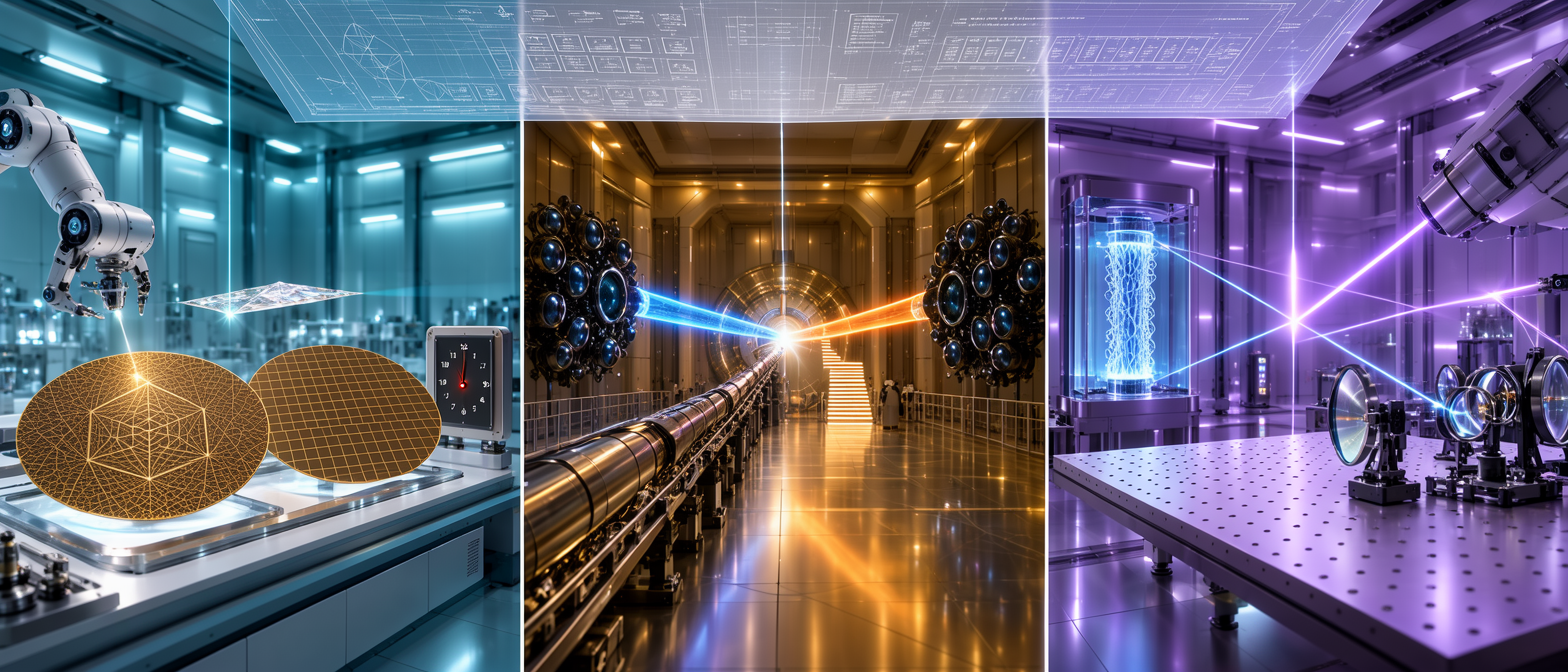
This appendix consolidates the engineering parameters, target geometries, control baselines, and metrological tolerances required for independent laboratory replication of Tracks II, IV, and V (Section 12).
| Subsystem / Parameter | Cairo Q-Lattice PIC (DUT) | Matched Euclidean Control PIC |
|---|---|---|
| Wafer Platform | Co-fabricated Multi-Project Wafer (MPW) CMOS Silicon-on-Insulator | Identical die on same MPW wafer |
| Waveguide Core Geometry | $220\text{ nm}$ crystalline Si single-mode waveguides | $220\text{ nm}$ crystalline Si single-mode waveguides |
| Channel Count ($N_w$) | $N_w = 2^6 = \mathbf{64}$ channels | $N_w = 2^6 = \mathbf{64}$ channels (matched path length) |
| Lattice Layout & Tilt | Aperiodic Cairo pentagonal ($90^\circ$ Type-A / $120^\circ$ Type-B, $\Phi$-scaled); lithographic tilt $\Delta_k = 0.081216\text{ rad}$ ($4.65342^\circ$) | Orthogonal $90^\circ$ Cartesian grid; $\Delta_k = 0\text{ rad}$ |
| Thermal Buffer Layer | $2.0\text{ }\mu\text{m}$ polycrystalline CVD synthetic diamond ($\kappa > 2000\text{ W/m}\cdot\text{K}$) | Identical $2.0\text{ }\mu\text{m}$ CVD synthetic diamond stack |
| Thermo-Optic Drift Ceiling | $\Delta T < \mathbf{0.005\text{ K}}$ under continuous C-band ($1550\text{ nm}$) POMMM sweep | Measured identically as thermal baseline |
| Analog Spatial Integrator | Monolithic Ge-on-Si absorption ribbon ($10\text{ }\mu\text{m} \times 300\text{ }\mu\text{m}$) at exit of unguided slab region ($I_{\text{out}} \propto \int |\sum \mathbf{E}_k|^2 dx$, zero ADC latency) | Identical $10\text{ }\mu\text{m} \times 300\text{ }\mu\text{m}$ Ge-on-Si ribbon |
| Digital Control & Clocking | Native Base-12 FPGA (12-trit words $\mathbb{T}_{12} = \{0..9,\text{X},\text{E}\}$); fractional-N PLL locked to $f_{\text{Clock}} = 43.2081216\text{ MHz}$ ($f_0 \times 10^5$) | Standard clocked binary FPGA driver |
| Harmonic Sub-Division Tree | $f_{\text{Clock}} / 10^5 = f_0 = 432.081216\text{ Hz} \;\xrightarrow{\div\, 2^6}\; f_{\text{Bio}} = 6.751269\text{ Hz}$ | Standard binary divider |
| Primary Benchmark Observables | Interferometric phase noise floor, POMMM convergence stability, presence of autonomous phase-conjugate soliton locking ($T_{3,2}$, $\mathcal{H}_{\text{net}} = 0$) | Baseline classical shot/thermal-noise interference |
| Parameter | Canonical Specification | Notes / Detection Channel |
|---|---|---|
| Target Reaction Channel | $^{64}_{28}\text{Ni} + {}^{249}_{98}\text{Cf} \;\longrightarrow\; {}^{313}_{126}\text{Ubh}^* \;\longrightarrow\; {}^{310}_{126}\text{Ubh} + 3n$ | Rotating helium-cooled $^{249}\text{Cf}$ target foil |
| Mass Numbers | $A_{\text{proj}} = 64,\;\; A_{\text{targ}} = 249,\;\; A_{\text{compound}} = 313$ | $Z_{\text{Ubh}} = 126 = 3\times(6\times 7),\; N = 184,\; A = 310$ |
| Reaction $Q$-Value | $Q = -233.80\text{ MeV}$ | Verified in PERIOD8_SUPERHEAVIES.lean §4 |
| Optimal $3n$ Excitation Energy | $E^* = 32.00\text{ MeV}$ | Chiral phase-matching evaporation channel |
| Center-of-Mass Energy | $E_{\text{c.m.}} = E^* - Q = \mathbf{265.80\text{ MeV}}$ | validate_E_cm_resonant |
| Laboratory Beam Energy | $E_{\text{lab}} \approx \mathbf{334.18\text{ MeV}}$ (sweep $320\text{--}350\text{ MeV}$ in $2\text{ MeV}$ steps) | Bounded strictly in $(334.0,\; 334.5)\text{ MeV}$ |
| Recoil & Decay Instrumentation | Gas-filled electromagnetic recoil separator + DSSD implantation array + HPGe $\gamma$-spectrometers | Time- & position-correlated $\alpha$-decay chains |
| Predicted $\alpha$-Decay Cascade | $^{310}\text{Ubh} \xrightarrow{8.80} {}^{306}\text{Ubg} \xrightarrow{9.45} {}^{302}\text{Ubb} \xrightarrow{9.95} {}^{298}\text{Ubn} \xrightarrow{10.62} {}^{294}\text{Og}\text{ MeV}$ | Strictly monotonic progression (validate_alpha_cascade_progression) |
| Element 120 ($^{304}_{120}\text{Ubn}$) Benchmarks | Closed $8s^2\,8p_{1/2}^2$ super-axle; $\Delta E_{\text{SO}}(8p) \approx 11.83\text{ eV}$; $\Delta E_{\text{gap}}(8s\text{--}8p) \approx 0.62\text{ eV}$; $\gamma_{1s} > 2.0$ | $5g$-block ($C(g) = 18$) onset at $Z = 121$; Period 8 trace $= 50$ |
| Assay Parameter | Active Microtubule Sample | Control Baselines |
|---|---|---|
| Biological Architecture | Purified, taxol-stabilized 13-protofilament brain microtubules ($D_{\text{out}} = 25\text{ nm},\; D_{\text{in}} = 15\text{ nm},\; R_{\text{lumen}} = 7.5\text{ nm}$) | (1) Colchicine/cold-depolymerized $\alpha/\beta$-tubulin dimers at equal molarity; (2) Cell-free ionic buffer |
| Lattice Seam & Torsion | $h_{\text{monomer}} = 4\text{ nm},\; L_{\text{dimer}} = 8\text{ nm},\; \Delta h_{\text{seam}} = 12\text{ nm}$; $T^\theta_{rz} \approx 0.031831\text{ nm}^{-1}$ | Unpolymerized dimers lack closed cylindrical seam torsion |
| Sample Cell & Temperature | Shear-aligned $10\text{ }\mu\text{m}$ ($10{,}000\text{ nm}$) bundle in quartz microfluidic channel at $T = 310\text{ K}$ | Identical microfluidic geometry at $T = 310\text{ K}$ |
| THz / Dielectric Assay | $0.1\text{--}3.0\text{ THz}$ time-domain + broadband dielectric spectroscopy probing intraluminal $\text{H}_3\text{O}_2^-$ EZ water | Bulk aqueous dielectric baseline ($\varepsilon_{\text{bulk}} = 80$) |
| Target Permittivity & Coherence | $\varepsilon_{\text{lumen}} \approx 2\text{--}4$ (canonical $3$); $>700\times$ noise suppression ($\approx 711.11$); $\tau_{\text{coh}} \sim 10\text{--}100\text{ ms}$ | $\varepsilon \approx 80$, sub-picosecond thermal decoherence |
| Femtosecond Proton & Optical Assay | Caged-photoacid proton pulse + polarized fs pump–probe ($C_{\text{photoelastic}} = 1.55 \times 10^{-3}\text{ rad}\cdot\text{nm}$) | Diffusive ionic transport in dimer/buffer control |
| Target Velocity, Lag & Phase Shift | $v_{\text{Grotthuss}} > 1.70 \times 10^8\text{ m/s}$ ($\approx 1.73\times 10^8\text{ m/s}$); $\Delta t < 60\text{ fs}$ ($\approx 57.7\text{ fs}$); $\Delta\phi_{\text{torsion}} \approx 0.493\text{ rad}$ ($28.27^\circ$) | Zero ballistic transit; zero torsional optical phase shift |
| Resonant Spectral Targets | $f_{\text{Bio}} = \mathbf{6.751269\text{ Hz}}$; Riemann modes $\nu_1 \approx 32.4004\text{ Hz},\; \nu_2 \approx 48.1881\text{ Hz}$; reset beat $\hat{K}_{33} \in (200,\; 210)\text{ s}$ | Broadband $1/f$ thermal noise |