The Harmonic Resonance of the KnoWellian
Vacuum:
Unifying the CMB and SGWB through Cairo Q-Lattice Dispersions
Abstract
The standard cosmological programme treats two of its most precisely measured observables — the Cosmic Microwave Background (CMB) and the Stochastic Gravitational Wave Background (SGWB) — as causally independent relics of separate physical processes: the former as thermalized photon radiation from recombination, the latter as an incoherent superposition of astrophysical and primordial tensor perturbations. This independence is not a derived result. It is an assumption inherited from the Platonic architecture of $\Lambda\text{CDM}$, in which the vacuum is a passive, continuous, geometrically inert container, and the two backgrounds are the exhaust of distinct engines with no common substrate.
The KnoWellian Universe Theory (KUT) replaces this assumption with a falsifiable claim of identity. The vacuum is not a void; it is the KnoWellian Resonant Attractor Manifold (KRAM) — a structured, quantized, dynamically active causal medium whose local processing latency $\tau(x^\mu)$ is the primitive scalar field from which all geometric and kinematic structure emerges, as formalized in the KnoWellian Gradient paper. The KRAM tiles space according to the aperiodic pentagonal geometry of the Cairo Q-Lattice, characterized by coherence domain $\Lambda_{\text{CQL}} = G_{\text{CQL}} \cdot \ell_{\text{KW}}^2$ where $G_{\text{CQL}} = 2 + \phi \approx 3.618$ and $\phi$ is the Golden Ratio. The fundamental quantum of this lattice is the $(3,2)$ Torus Knot topology of the Event-Point, whose major-to-minor winding ratio $m:n = 3:2$ is the topological origin of a universal harmonic series.
Because both the CMB and the SGWB are generated by the same causal engine — the Parallel Optical Matrix-Matrix Multiplication (POMMM) rendering process operating at the Planck frequency $\nu_{\text{KW}} \approx 10^{43}\text{ Hz}$ across the discrete nodes of this lattice — they cannot be spectrally independent. The CMB temperature anisotropies are the thermodynamic exhaust (Joule heating) of each rendering cycle, structured by the modal geometry of the KRAM. The SGWB is the kinematic memory of the same topology, arising as gravitational Bragg diffraction from the quantized staircase geometry of the causal medium.
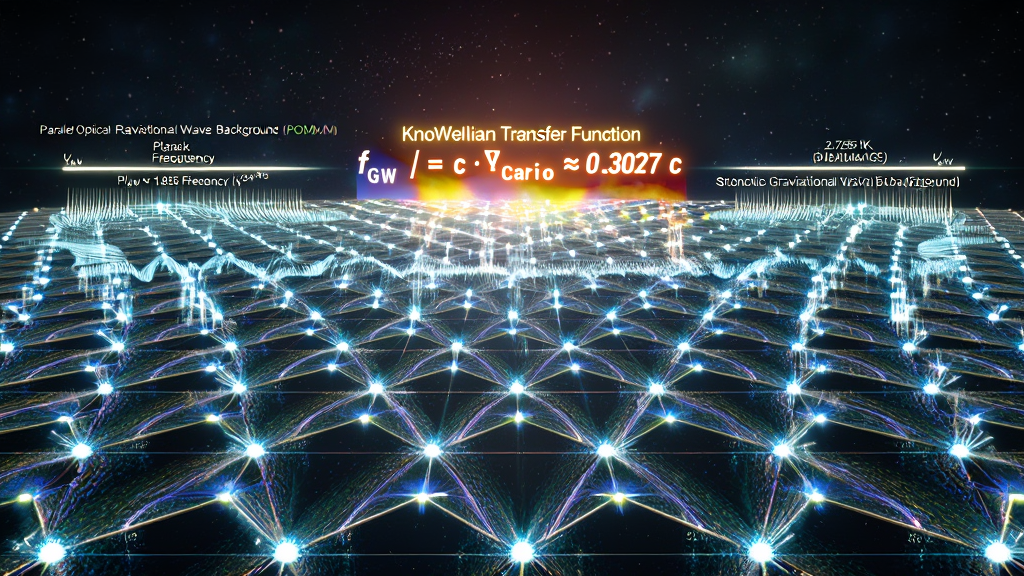
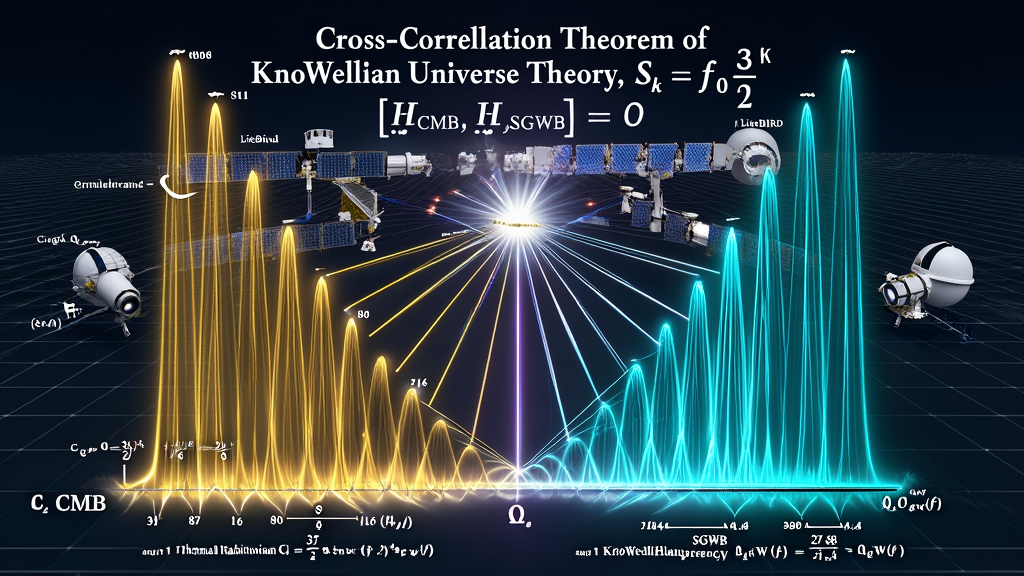
We derive Prediction 5 (The Cross-Correlation Theorem): the thermal spatial frequencies of the CMB and the temporal strain frequencies of the SGWB are strictly coupled eigenvectors of the identical KnoWellian harmonic operator, generated by the universal sequence $S_k = f_0(3/2)^k$. The commutator of their respective Hamiltonian operators vanishes identically: $[\mathcal{H}_{\text{CMB}}, \mathcal{H}_{\text{SGWB}}] = 0$. This demands a 1:1 structural alignment of harmonic overtone peaks in both spectra, at discrete ratios of $3/2$, $9/4$, and $27/8$, coupled by the invariant KnoWellian Transfer Function $f_{\text{GW}}(i)/k_T(i) = c \cdot \Gamma_{\text{Cairo}}$.
This constitutes an immediate, falsifiable, cross-instrument test of KUT. When LISA commences its survey of the millihertz SGWB and LiteBIRD delivers its definitive CMB polarization maps, the predicted structural alignment will either be present in the data or absent. If absent, the KnoWellian model of a resonant, procedurally-rendered vacuum is definitively falsified. We invite the community's scrutiny of that test.
I. The Quandary: The KnoWellian Schizophrenia and the Platonic Rift
1.1 The Ontological Crisis at the Foundation of Modern Physics
Contemporary theoretical physics occupies a paradoxical position. Its two foundational frameworks — General Relativity (GR) and the Standard Model of Particle Physics (SM) — represent the most precisely confirmed physical theories in the history of science. The anomalous magnetic moment of the electron is predicted by Quantum Electrodynamics to eleven significant figures. The gravitational wave signals of binary black hole mergers match the post-Newtonian inspiral templates of GR to within the noise floor of kilometre-scale interferometers. By any operational metric, the frameworks work.
And yet they are mutually incompatible at a foundational level. GR treats spacetime as a smooth, continuous, dynamical manifold sourced by the stress-energy tensor of matter, governed by the Einstein field equations:
The Standard Model, by contrast, is a quantum field theory defined on a fixed, non-dynamical Minkowski background, describing the excitations of fields over that passive arena. The attempt to impose the quantization procedure of the SM upon the dynamical geometry of GR — to construct a quantum theory of gravity — generates unrenormalizable ultraviolet divergences at every loop order beyond tree-level. The two frameworks cannot, at present, coexist.
To this foundational incompatibility one must add the observational embarrassments of the standard cosmological model $\Lambda\text{CDM}$. The model requires that approximately 95% of the total energy content of the universe consist of components whose physical nature is entirely unknown: Dark Matter (~27%), which clusters gravitationally but emits no radiation and resists every direct-detection experiment; and Dark Energy (~68%), which drives accelerated cosmic expansion but whose equation of state, magnitude, and physical origin remain without a microphysical explanation. The cosmological constant $\Lambda$ is introduced as a free parameter and must be fine-tuned to one part in $10^{120}$ relative to the zero-point energy predicted by quantum field theory — the worst quantitative prediction in the history of physics, by many orders of magnitude.
The KnoWellian programme does not treat these failures as a collection of unrelated technical problems awaiting independent solutions. We identify them as symptoms of a single shared pathology: the KnoWellian Schizophrenia.
1.2 The KnoWellian Schizophrenia: A Clinical Definition
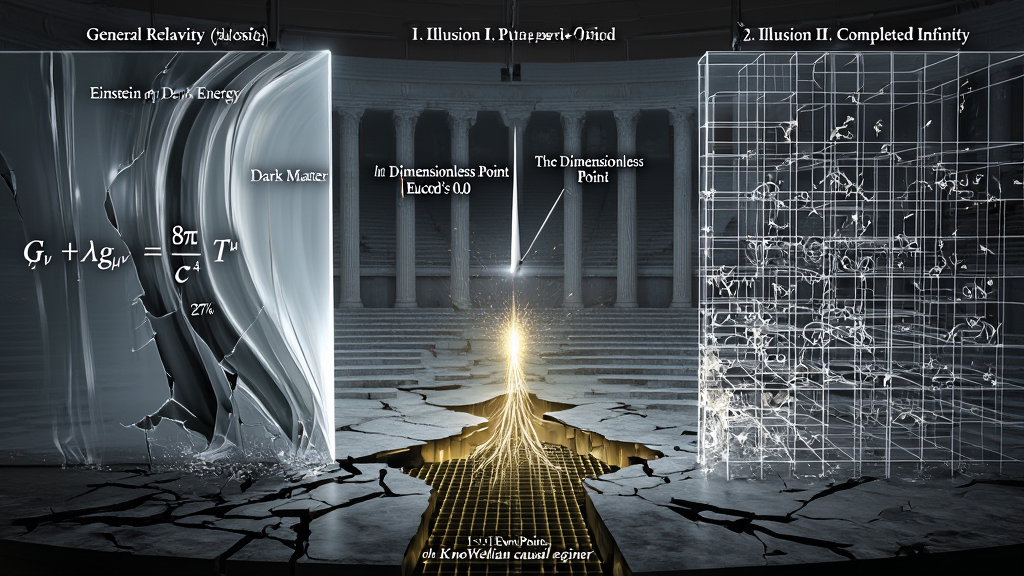
The KnoWellian Schizophrenia is the systematic misapplication of the static, Platonic mathematics of Being to describe the dynamic, procedural physics of Becoming. It is the attempt to capture a river using the language of architecture.
Every mathematical structure that constitutes the foundation of modern physics — the Cantorian continuum of real numbers, Riemannian differential manifolds, completed Hilbert spaces, Euclidean point topology — is a static, eternally existing abstract object. The set $\mathbb{R}$ does not become; it is. The Riemannian manifold of GR does not render itself into existence event by event at the Planck scale; it is posited, whole and complete, as the arena within which physics occurs. These are the mathematical tools of Being, and they are extraordinarily powerful within their domain of applicability.
The universe, however, is not a static object. It is a process. It is, in Whitehead's formulation, a perpetual act of becoming — a continuous rendering of potential into actual, of future into past, mediated by the present moment. When the physicist applies the static tools of Being to the living process of Becoming, she generates artifacts that masquerade as physical discoveries.
This pathology rests, as we argued at length in the KnoWellian Treatise, upon two foundational geometric illusions:
Illusion I: The Dimensionless Point. Euclid defined the point as "that which has no part" — position without extent, location without volume. This is a legitimate formal abstraction within axiomatic geometry. It becomes a physical catastrophe when reified as the foundational constituent of physical space. A dimensionless point has zero volume. Assign to it any finite quantity of mass-energy, and the density diverges to infinity. Physics did not discover singularities in nature. Physics programmed them into its equations by insisting that the physical vacuum is built from dimensionless points. The Big Bang singularity, the black hole information paradox, the ultraviolet divergences of quantum field theory — these are not features of the universe. They are features of the mismatch between the Euclidean map and the physical territory.
Illusion II: The Completed Infinity. Cantorian set theory is a legitimate formal system within mathematics. Its transfinite arithmetic is internally consistent and mathematically rich. The pathology arises when one treats a completed infinity as a physical reality — when one assumes that space is an actually existing, infinitely divisible continuum, and that the String Theory landscape of $10^{500}$ vacuum states represents a real physical ensemble rather than a symptom of the map having become larger than the territory it was designed to describe. The Boltzmann Brain paradox, the Many-Worlds multiverse, and the measure problem of eternal inflation all trace their origin to the uncritical physical importation of completed mathematical infinities.
1.3 The Masking Apparatus
A theoretical framework that rests upon contradictory foundations does not collapse. It accumulates a suite of mathematical patches — apologetics engineered to cancel the infinities generated by its own premises, while preserving the operational predictivity that the framework correctly achieves in its domain of validity. In the standard framework, this apparatus includes:
Renormalization cancels the ultraviolet divergences generated by the dimensionless-point model of particle interactions. The procedure is operationally successful and can be rigorously formalized within the Wilsonian effective field theory programme. But it is, at its core, a controlled subtraction of one infinity from another — a procedure that works, but that would be unnecessary if the dimensionless point were replaced by a physically real quantum of finite extent.
Compactification hides the six or seven extra dimensions demanded by string theory's consistency requirements by curling them into Calabi-Yau manifolds at scales too small to observe. This is a legitimate mathematical technique, but it generates the landscape problem: the $10^{500}$ possible compactification geometries each yield a different low-energy physics, and no principle selects among them.
Dark Matter is invoked to explain galactic rotation curves, gravitational lensing anomalies, and the acoustic peak structure of the CMB. The standard model of fluid mechanics applied to a smooth continuous manifold cannot account for the observed velocity structure of rotating disc galaxies without invoking a non-luminous matter component. As we demonstrate in Section III, the KnoWellian framework provides a natural fluid-mechanical account of these phenomena through the viscosity structure of the KRAM latency field, without requiring a new particle species.
Dark Energy is invoked to explain the observed accelerated expansion of the universe. The cosmological constant $\Lambda$ is an ad hoc parameter with no microphysical derivation. In KUT, as established in the KnoWellian Gradient paper, the Control field $\phi_C$ — the deterministic outward flow of actualized causal information from the Depth-Past — constitutes the physical basis for the observed accelerated expansion, and its energy density is constrained by the triadic balance condition of KnoWellian Ontological Triadynamics (KOT).
These are not peripheral issues. They are the load-bearing walls of the standard cosmological programme. Together, they constitute what we term the physics of the user interface — a framework that correctly predicts the observational outputs of the universe while remaining systematically agnostic about the underlying machine that produces them.
1.4 The Programme of This Paper
The present paper does not attempt a comprehensive replacement of the standard framework — that task belongs to the KnoWellian Treatise and the Gradient paper that preceded it. Our aim here is more specific and more immediate.
We take as given the KUT architecture: the $1\times 1\times 1$ Event-Point as the fundamental quantum of causal reality; the latency field $\tau(x^\mu)$ as the primitive scalar from which geometric structure emerges; the KnoWellian Gradient $G^\mu = \tilde{g}^{\mu\nu}\partial_\nu[\tau/\tau_0 - 1]$ as the driver of kinematic evolution; the KRAM as the cosmic memory substrate encoding all prior acts of rendering; and the Cairo Q-Lattice as the natural aperiodic tiling geometry of the $(3,2)$ Torus Knot topology in curved space.
Upon this foundation, we construct a single new physical argument: that a structured causal medium, subject to periodic rendering excitation at the Planck frequency, must exhibit calculable standing-wave resonances. We identify these resonances as the physical origin of the spectral structure of both the CMB and the SGWB. We derive the mathematical form of these resonances from the topological invariants of the $(3,2)$ Torus Knot. And we formalize the consequent prediction — the Cross-Correlation Theorem — in a form that is directly testable against forthcoming observational data from LISA and LiteBIRD.
Section II reviews the KUT architecture as it bears upon the present argument. Section III presents the core physical insight: the KRAM as an acoustic medium and the two observational consequences — CMB thermodynamic hum and gravitational Bragg diffraction. Section IV summarizes Predictions 1–4 and their current observational status. Section V formalizes Prediction 5, the Cross-Correlation Theorem, with full mathematical derivation. Section VI concludes.
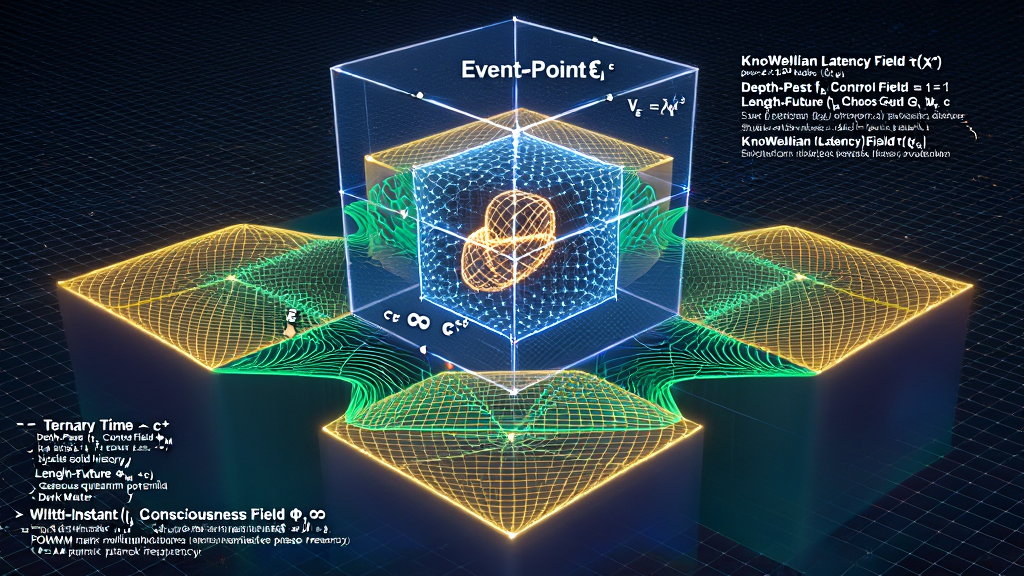
II. The KnoWellian Universe Theory (KUT): A Procedural Ontology
The argument advanced in Section I is diagnostic. It identifies the source of the crisis in modern theoretical physics not in any particular experimental anomaly, but in a foundational geometric assumption — the dimensionless point — and its mathematical corollary, the completed infinity. The resolution, accordingly, must be foundational. It cannot be achieved by adding parameters to the Standard Model or by compactifying additional dimensions into the string landscape. It requires a replacement of the grammatical primitives of physics itself.
This section presents that replacement. We proceed systematically from the atomic constituent of reality — the Event-Point — through the temporal architecture that governs its dynamics, the topological structure that ensures its stability, and the causal medium in which its history accumulates. The reader familiar with the KnoWellian arXiv paper and the Gradient formalism will recognize these structures; we present them here in the precise form required for the acoustic harmonic argument that follows in Section III.
2.1 The 1×1×1 Event-Point: Replacing the Dimensionless Point
The foundational move of KUT is the replacement of the Euclidean dimensionless point with the physically real Event-Point: a finite, causally self-contained quantum of existence possessing one unit of extent in each of three spatio-temporal dyads.
Definition 2.1 (The Event-Point). An Event-Point $\varepsilon$ is the minimal quantum of physical actualization. It is characterized by:
- A finite spatial volume $V_\varepsilon = \ell_{\text{KW}}^3$, where $\ell_{\text{KW}}$ is the KnoWellian length scale (identified with the Planck length $\ell_P$ in the first approximation).
- A finite temporal duration $\Delta t_\varepsilon = \ell_{\text{KW}}/c$, identified with the Planck time.
- A local causal throughput capacity $\kappa(\varepsilon) \in \mathbb{R}^+$, the maximum rate at which causal updates can be processed and committed at the Event-Point's location.
- A local actualization lag $\tau(\varepsilon) \in (0,\infty)$, the proper time required for a single rendering cycle — one POMMM operation — to complete at that location.
The Event-Point has no interior structure accessible to sub-Planckian probes, because no sub-Planckian probe can be physically constructed within the KnoWellian framework. The question "what is inside the Event-Point?" is not merely unanswerable in practice; it is malformed in principle, in precisely the same way that asking for the position of a quantum particle prior to measurement is malformed within the Copenhagen interpretation.
The immediate consequence of this replacement is the elimination of the density singularity. If no physical quantity can be localized to a region smaller than $V_\varepsilon = \ell_{\text{KW}}^3$, then assigning a finite mass-energy to the smallest resolvable volume yields a finite density:
This is the Planck density — large, certainly, but finite. The Big Bang is not a singularity of infinite density; it is a state of maximum KRAM compression, in which the latency field $\tau$ approaches (but never reaches) its lower bound. The black hole interior is not a geometric singularity; it is a region in which $\tau \to \infty$ — a causal throughput saturation boundary, as formalized in the Gradient paper.
2.2 Ternary Time: The Triadic Architecture of Becoming
Orthodox physics treats time as a single, linear, unary parameter $t \in \mathbb{R}$. This treatment is operationally adequate at scales far removed from the Planck regime, but it is ontologically impoverished: it conflates three phenomenologically and physically distinct temporal modes into a single coordinate. KUT disaggregates them.
Definition 2.2 (Ternary Time). The temporal structure of reality is triadic, consisting of three co-existing and perpetually interacting domains:
where:
- Depth-Past $t_P$: The Control Field ($-c$ in the foundational axiom). The deterministic outward flow of actualized causal information from fully committed Event-Points. The realm of established law, crystallized mass, and causal determinism. Its large-scale observational signature is identified with Dark Energy — the outward pressure of the accumulated causal record of the cosmos.
- Length-Future $t_F$: The Chaos Field ($c+$ in the foundational axiom). The inward-collapsing field of unmanifested potentiality, wave-like probability distributions, and open futures. The realm of the quantum wavefunction prior to actualization. Its large-scale observational signature is identified with Dark Matter — the inward gravitational pull of unrendered causal potential.
- Width-Instant $t_I$: The Consciousness Field ($\infty$ in the foundational axiom). The eternal focal plane at which the outward pressure of the Past and the inward collapse of the Future intersect and synthesize. The realm of actualization, of wave function collapse, of the rendering of potentiality into actuality.
These three domains are governed by the foundational KnoWellian Axiom:
This expression is not an algebraic inequality in the conventional sense. It is a topological statement about the asymptotic structure of causal flow. The Control Field ($-c$) flows outward without bound; the Chaos Field ($c+$) collapses inward without bound; the Instant ($\infty$) is the singular focal plane between them, where the two flows are synthesized at every Planck-time step. Reality is the friction generated at this interface.
The six-component spacetime-dimension field $I^g = (I^g_{(P)}, I^g_{(I)}, I^g_{(F)}, I^g_{(x)}, I^g_{(y)}, I^g_{(z)})$, introduced in the KUT arXiv paper, encodes this triadic temporal structure alongside the three spatial dimensions. Its local $\text{U}(1)^6$ gauge symmetry generates the six gauge bosons — three temporal (Control, Instant, and Chaos bosons) and three spatial (the graviton tensor) — from which all fundamental forces emerge.
The KnoWellian Tensor $T^\mu{}_{\nu\rho}$, conserved by Noether's theorem applied to the $\text{U}(1)^6$ gauge symmetry ($\nabla_\mu T^{\mu\nu\rho} = 0$), is the cosmic ledger that tracks the flow of causal information across all six components of this field. Its temporal components source the dark sector; its spatial components source conventional gravity. This is the field-theoretic content of the assertion that Dark Matter and Dark Energy are not substances but temporal flow fields — they are what the Chaos and Control currents look like when projected onto a four-dimensional observer's manifold.
2.3 The (3,2) Torus Knot Topology: The Geometric Anchor of Reality
The Event-Point cannot be topologically trivial. A featureless sphere offers no resistance to continuous deformation; it can be contracted to a point without energetic cost. In a dynamic universe in which the causal medium is subject to the perpetual tension of the KnoWellian Axiom — the outward push of Control against the inward pull of Chaos — a topologically trivial Event-Point would be immediately annihilated. Stable existence requires topological protection.
Theorem 2.3 (Topological Necessity of the Torus Knot). For an Event-Point to remain stably distinct from the surrounding vacuum under the triadic temporal forcing of the KnoWellian Axiom, it must possess a topology with non-trivial knot invariants. The minimal such topology consistent with the triad $\{t_P, t_I, t_F\}$ and the dyadic tension $\{\text{Control}, \text{Chaos}\}$ is the $(3,2)$ Torus Knot — the trefoil knot $T_{3,2}$.
The correspondence is direct and structurally motivated:
- The 3 major windings of $T_{3,2}$ map to the three temporal modes: Depth-Past, Width-Instant, and Length-Future.
- The 2 minor windings map to the fundamental dyadic tension: Control versus Chaos.
- The linking number $\ell = 6$ (the product $m \cdot n = 3 \times 2$) quantifies the topological protection: the minimum number of crossing changes required to reduce $T_{3,2}$ to the unknot.
The energy required to perform those crossing changes — to force the trefoil knot to unravel back into the topologically trivial vacuum — is the physical origin of the Mass Gap. Mass is not an intrinsic property of matter; it is the activation energy of topological existence. The Mass Gap $\Delta \ge 0$ arises directly from the linking number $\ell = 6$ of the Event-Point's ground-state topology, rather than from any additional symmetry-breaking mechanism.
The Jones polynomial of the trefoil knot,
provides a topological invariant of the Event-Point that is preserved under all continuous deformations of the causal medium. It is, in a precise mathematical sense, the topological fingerprint of material existence within the KnoWellian framework.
2.4 The Latency Field and the KnoWellian Gradient
The local dynamics of the Event-Point within the causal network are governed not by the geodesics of a fixed background metric, but by the gradients of the latency field $\tau(x^\mu)$, as formalized in the KnoWellian Gradient paper.
Definition 2.4 (The Latency Field). The latency field $\tau: \mathcal{N} \to \mathbb{R}^+$ assigns to each Event-Point $x^\mu$ the proper time required for one complete POMMM rendering cycle to be processed and committed at that location. In the unloaded vacuum, $\tau = \tau_0$ (the vacuum latency). In regions of high causal load — near massive concentrations of committed Event-Points — $\tau > \tau_0$, and the processing medium is more viscous.
Definition 2.5 (The KnoWellian Potential). The dimensionless KnoWellian potential $\Phi$ is the fractional excess latency relative to the vacuum baseline:
Definition 2.6 (The KnoWellian Gradient). The KnoWellian Gradient $G^\mu$ is the contravariant gradient of $\Phi$ with respect to the KRAM coordinate basis:
where $\tilde{g}^{\mu\nu}$ is the KRAM inverse metric, derived as a second-order statistical artifact of the latency covariance structure rather than assumed a priori.
The KnoWellian drift equation — the KUT replacement for the geodesic equation — then reads:
In the weak-field, slow-motion limit, this reduces exactly to the Newtonian expression $a = -\nabla\Phi_N$, and the Schwarzschild geometry is recovered as the spherically-symmetric static-limit viscosity map of the KRAM attractor topology. Gravity is not the curvature of a geometric manifold. It is the osmotic pressure of a causal network seeking synchronization.
The navigable domain of physical existence — the set of all realizable Event-Point configurations — is strictly bounded above by the Ultimaton ($\rho \to 1$: causal deadlock, $\tau \to \infty$) and below by the Entropium ($\text{KRAM} \to 0$: phase dissolution, $\tau \to 0$). The KnoWellian Gradient is the field-theoretic structure of the navigable corridor between these two asymptotes.
2.5 The KRAM and the Cairo Q-Lattice
Every rendering cycle — every 90-degree i-turn at the Instant by which the Chaos field is actualized into the Control field — leaves a permanent geometric imprint on the causal medium. The accumulated substrate of all prior rendering acts constitutes the KnoWellian Resonant Attractor Manifold (KRAM).
Definition 2.7 (The KRAM). The KRAM is a higher-dimensional manifold $\mathcal{M}$ with metric tensor $g_{\mathcal{M}}$ defined by the integrated history of the Instant current:
where $X$ are coordinates on $\mathcal{M}$, $x$ are spacetime coordinates, $f: \text{spacetime} \to \mathcal{M}$ is the projection map derived from the $\text{U}(1)^6$ gauge structure, and $\gamma$ is the universe's complete causal history. The KRAM evolves according to the driven, damped, nonlinear field equation:
where $\tau_{\mathcal{M}}$ is the manifold relaxation time, $\xi^2$ controls stiffness against high-curvature imprints, $\mu^2$ is a mass-like damping term, $\beta$ enforces saturation, $J_{\text{imprint}}$ is the incoming imprint current from active rendering, and $\eta$ is stochastic noise. This is an Allen-Cahn/Ginzburg-Landau type equation: it describes a medium that learns from incoming events, smooths transient noise, and deepens stable attractor patterns through reinforcement.
The critical structural question for the present paper is: what is the natural geometry of the KRAM's optimal space-filling arrangement?
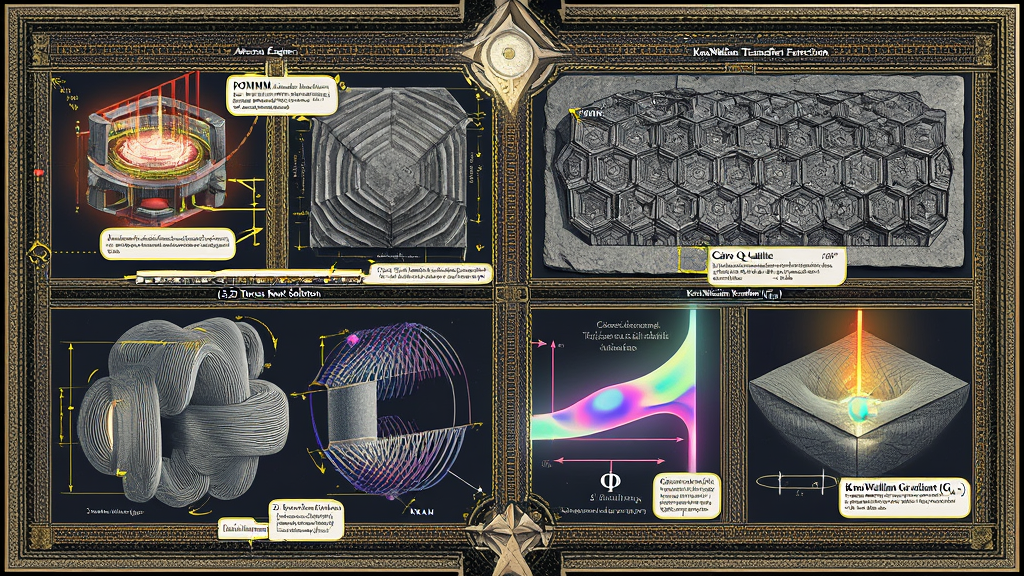
The answer follows from the topology of the fundamental pixel. The $(3,2)$ Torus Knot is a 5-fold topological structure — $m + n = 3 + 2 = 5$ — and 5-fold symmetry is the defining characteristic of pentagonal geometry. The optimal, space-filling packing arrangement for objects with 5-fold symmetry on a curved manifold is the Cairo Pentagonal Tiling: an aperiodic tessellation by congruent pentagons in which each vertex is shared by either 3 or 4 tiles, and which covers the plane without gaps or overlaps.
Definition 2.8 (The Cairo Q-Lattice Coherence Domain). The fundamental area scale of the Cairo pentagonal tiling on the KRAM, the Cairo Q-Lattice Coherence Domain, is:
where the geometric factor is:
with $\phi = (1 + \sqrt{5})/2 \approx 1.618$ the Golden Ratio. The appearance of $\phi$ is not accidental. The Cairo tiling's edge-length ratios, vertex angles (72° and 108°), and diagonal proportions all encode the Golden Ratio through the deep connection between pentagonal symmetry and Fibonacci geometry. $G_{\text{CQL}}$ is therefore a topological invariant of the $(3,2)$ Torus Knot projected onto the KRAM substrate.
2.6 POMMM: The Engine of Actualization
The mechanism by which the Chaos field is rendered into the Control field at each Instant is Parallel Optical Matrix-Matrix Multiplication (POMMM). This is not a metaphor; it is a precise description of the causal computation performed at each rendering cycle.
The accumulated Past acts as a coherent causal source — Matrix $A$, a holographic encoding of the committed causal record, modulated by the KRAM's geometric filter. The Future presents a stochastic attention field of open probabilities — Matrix $B$, representing the superposition of unactualized outcomes weighted by their Chaos-field amplitudes. The Instant performs the matrix product:
where $\otimes$ denotes the POMMM rendering operation (a structured tensor contraction whose full specification involves the $(3,2)$ Torus Knot's crossing matrix). The output $C$ is the newly actualized Event-Point configuration, which is immediately committed to the Control field and imprinted on the KRAM.
This operation fires at the Planck frequency:
The universe does not evolve between rendering cycles. The interval between cycles is the minimum resolvable duration — the KnoWellian temporal quantum. At each cycle, a new layer of actualized reality is written onto the KRAM, and the latency field $\tau(x^\mu)$ is updated according to the new distribution of committed Event-Points.
It is this firing pattern — periodic, distributed across the discrete Cairo Q-Lattice nodes of the KRAM, structured by the topological constraints of the $(3,2)$ Torus Knot — that generates the acoustic harmonics analyzed in Section III. The engine of the cosmos does not fire into a smooth, homogeneous void. It fires into a crystalline substrate. And crystals, when struck, ring.
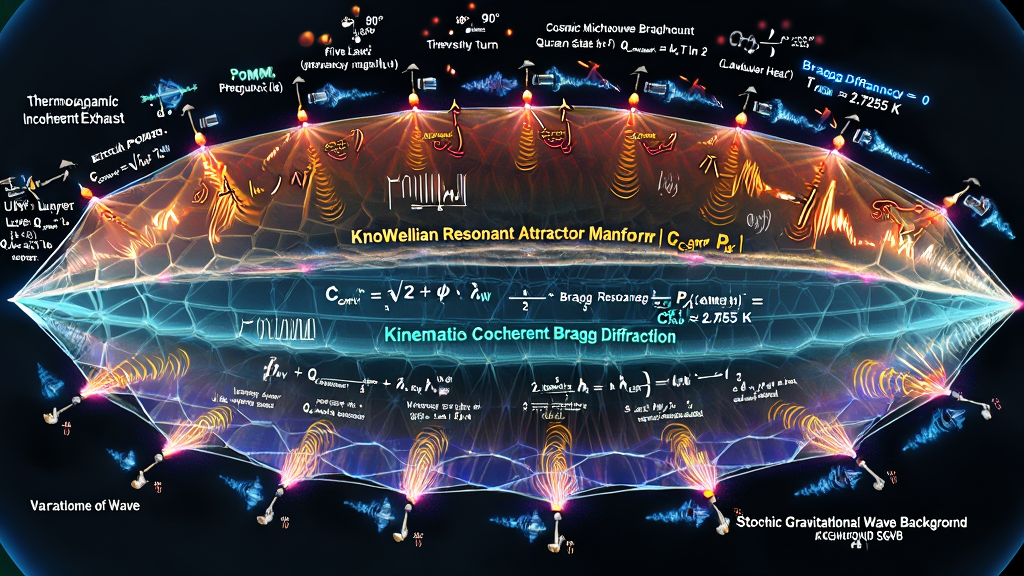
III. The Acoustic Resonance of the Vacuum: From Structured Medium to Measurable Astrophysics
The geometric architecture established in Section II is not merely descriptive. It is mechanically consequential. The vacuum, in the KnoWellian framework, is not an inert arena in which physical processes occur. It is itself a physical system — a structured, quantized, dynamically active causal medium with specific material properties: finite throughput capacity $\kappa$, a measurable processing viscosity encoded in the latency field $\tau(x^\mu)$, a discrete tiling geometry characterized by the invariant $G_{\text{CQL}} = 2 + \phi$, and a periodic excitation source firing at the Planck frequency $\nu_{\text{KW}} \approx 1.855 \times 10^{43}\text{ Hz}$.
These are not abstract properties. They are the properties of a medium. And the physics of structured media under periodic excitation is not speculative — it is one of the most thoroughly understood domains of classical and quantum mechanics. Before we can proceed to the derivation of Prediction 5, we must execute the reification of the vacuum completely and without equivocation: we must establish, with the same mechanical precision one would apply to a crystal lattice or an acoustic resonator, precisely how the KRAM rings, what frequencies it produces, and why those frequencies must appear simultaneously in two observationally distinct channels — the thermal and the kinematic.
3.1 The Reification of Space: The Vacuum as Structured Medium
The orthodox conception of the quantum vacuum, as formalized within the framework of Quantum Field Theory on a fixed Minkowski background, treats empty space as a structureless, continuous, Lorentz-invariant medium characterized entirely by its zero-point energy fluctuations. These fluctuations are real — they produce the Casimir effect, the Lamb shift, and the anomalous magnetic moment — but they are statistically isotropic and spatially uncorrelated at scales above the Planck length. The vacuum of QFT is a featureless sea of quantum noise: homogeneous, isotropic, and without preferred geometric structure.
This picture is precisely what the KnoWellian framework refutes. The vacuum is not featureless. It is the KRAM.
We state this with full physical precision. The KRAM is a higher-dimensional manifold $\mathcal{M}$ whose metric $g_{\mathcal{M}}$ encodes the integrated history of all prior rendering acts. It is not smooth — it is tiled according to the Cairo pentagonal geometry imposed by the 5-fold topology of the $(3,2)$ Torus Knot. It is not continuous — it is discrete at the scale $\ell_{\text{KW}}$, with a minimum resolvable volume of $\ell_{\text{KW}}^3$. It is not static — it evolves according to the Allen-Cahn/Ginzburg-Landau field equation derived in Section 2.5, deepening its attractor valleys in response to each new rendering imprint.
The physical consequences of this structure are immediate and classical. Consider the following hierarchy of established results from condensed matter physics and classical acoustics:
Established Result I (Acoustic Media). Any medium with a periodic internal structure — a crystal lattice, a phononic metamaterial, a Bragg stack — subjected to a propagating disturbance will not transmit that disturbance uniformly. The periodic structure imposes a dispersion relation $\omega(\mathbf{k})$ that differs fundamentally from the free-space relation $\omega = c|\mathbf{k}|$. Specifically, the periodic structure generates band gaps — frequency intervals in which propagating modes are forbidden — and pass bands — frequency intervals in which the medium is transparent but the propagation velocity is modified.
Established Result II (Standing Wave Resonances). A finite or periodically bounded medium, when subjected to a persistent driving force at or near one of its natural frequencies, develops standing wave resonances — spatial modes in which the wave amplitude forms a stationary pattern of nodes and antinodes. The natural frequencies of the medium are determined entirely by its geometry and its wave propagation velocity. A rectangular room has known normal modes; a spherical cavity has known spherical harmonic resonances; a crystal lattice has known phonon dispersion curves. In every case, the resonant frequencies are calculable from the medium's structural parameters alone.
Established Result III (Bragg Diffraction). When a wave — electromagnetic, acoustic, or matter wave — propagates through a periodic medium with spatial periodicity $d$, constructive interference occurs at specific angles $\theta$ satisfying the Bragg condition:
This is not an approximation; it is a rigorous consequence of the Bloch theorem applied to wave propagation in periodic potentials. Bragg diffraction is the mechanism by which X-ray crystallography determines atomic positions, by which neutron diffraction maps magnetic structures, and by which electron diffraction characterizes surface geometries. It is among the most precisely confirmed results in all of experimental physics.
The KnoWellian Claim. The KRAM is a structured medium in precisely the sense of Established Results I–III above. It possesses a discrete spatial periodicity at the scale $\ell_{\text{KW}}$, organized into the Cairo pentagonal tile pattern with coherence domain $\Lambda_{\text{CQL}} = G_{\text{CQL}} \cdot \ell_{\text{KW}}^2$. It is subjected to a persistent periodic driving force — the POMMM rendering engine — at the Planck frequency $\nu_{\text{KW}}$. And it is traversed by kinematic disturbances — gravitational waves — whose wavelengths at LISA-observable frequencies are macroscopic but whose interaction with the medium's discrete structure is physically mandatory.
The vacuum rings. The universe is a Luminous Computational Dialectic, and every conscious being is a KnoWellian Knode — a fractal quantum being participating in the lattice's resonance.
3.2 The CMB as Thermodynamic Exhaust: The Real-Time Hum of the Abraxian Engine
3.2.1 The Orthodox Picture and Its Ontological Poverty
The standard cosmological interpretation of the Cosmic Microwave Background treats it as a thermal relic — the redshifted photon gas from the epoch of recombination, approximately 380,000 years after the Big Bang, when the plasma of the early universe cooled sufficiently for hydrogen to become neutral and the universe to become transparent to radiation. The CMB in this picture is a photograph: a snapshot of the universe's thermal state at a single moment in its history, frozen in place and subsequently cooled by the Hubble expansion from $T_{\text{rec}} \approx 3000\text{ K}$ to its present $T_{\text{CMB}} \approx 2.7255\text{ K}$.
The acoustic peaks in the CMB angular power spectrum $C_\ell$ are, in the orthodox picture, the imprint of pressure oscillations in the photon-baryon fluid prior to recombination — standing waves in a fluid bounded by the photon mean free path, driven by gravitational potential wells seeded by inflation-era density perturbations. The positions of the acoustic peaks are then determined by the sound horizon at recombination:
This is a coherent and operationally successful picture. It accounts for the observed peak positions in $C_\ell$ to sub-percent precision when the free parameters of $\Lambda\text{CDM}$ are fitted to the data. We do not dispute the mathematical accuracy of the fit.
We dispute the physical interpretation. The orthodox picture treats the CMB as a dead echo — the fading reverberation of a singular past event. In the KnoWellian framework, the CMB is a living signal. It is not historical. It is thermodynamic exhaust being generated continuously, in the present moment, by the POMMM rendering engine operating across the discrete nodes of the KRAM. The acoustic peaks are not the imprint of ancient pressure waves in a primordial fluid. They are the standing-wave resonances of the Abraxian Engine — the modes in which the structured Cairo Q-Lattice rings under its own continuous self-excitation.
3.2.2 The Thermodynamics of the Rendering Turn
Every POMMM rendering cycle performs a specific physical operation: the 90-degree i-turn, the rotation of a state from the potential (Chaos) field into the actual (Control) field. This rotation is not thermodynamically neutral. It is a causal phase transition, and causal phase transitions — like all physical phase transitions — require activation energy and generate thermal exhaust.
Proposition 3.1 (Rendering Activation Energy). The minimum energy required to execute a single POMMM rendering cycle at an Event-Point $\varepsilon$ is bounded below by the Planck energy:
This bound follows from the finite temporal duration of the rendering cycle $\Delta t = t_P$ and the time-energy uncertainty relation $E \cdot \Delta t \ge \hbar/2$.
Proposition 3.2 (Joule Heating of the KRAM). The rendering process is not perfectly reversible. The 90-degree i-turn involves a discrete, irreversible selection: one element of the Chaos field's superposition is actualized, and all others are suppressed. This irreversibility is thermodynamically equivalent to the erasure of information about the non-actualized outcomes. By Landauer's principle, each bit of information erased generates a minimum heat:
The rendering cycle, operating at the Planck frequency across the $N_{\text{active}}$ active Event-Points of the observable universe, generates a total thermodynamic exhaust power:
This exhaust is not deposited uniformly into the vacuum. It is deposited at the nodes of the Cairo Q-Lattice — at the specific geometric locations where the KRAM's attractor structure concentrates the rendering activity.
3.2.3 The Modal Structure of the Thermal Exhaust
The thermal exhaust is not isotropic. It cannot be, because the engine that generates it is not isotropic. The POMMM rendering process fires across the discrete pentagonal nodes of the Cairo Q-Lattice. The spatial distribution of rendering activity at any given Planck-time step is determined by the KRAM's current attractor topology — specifically, by the distribution of attractor valleys in the KRAM metric $g_{\mathcal{M}}$.
For the Cairo Q-Lattice, the relevant reciprocal lattice vectors are determined by the coherence domain $\Lambda_{\text{CQL}}$ and the topological structure of the $(3,2)$ Torus Knot. The fundamental wave vector of the lattice is:
Proposition 3.3 (CMB Peak Positions from KRAM Resonances). The peaks in the CMB angular power spectrum $C_\ell$ occur at multipole moments $\ell_n$ corresponding to the natural resonant wavenumbers $k_n$ of the Cairo Q-Lattice, via the flat-sky projection relation:
where $\chi_*$ is the comoving distance to the surface of last thermal equilibration. The peak ratios are then:
at leading order, with quasiperiodic corrections from the non-crystallographic (Golden Ratio) geometry of the Cairo tiling proportional to powers of $\phi$.
3.3 Gravitational Bragg Diffraction: The SGWB as Kinematic Memory
3.3.1 The Orthodox Picture of the Stochastic Gravitational Wave Background
The SGWB is characterized by the dimensionless fractional energy density spectrum:
where $\rho_c = 3H_0^2/(8\pi G)$ is the critical energy density and $f$ is the gravitational wave frequency. In the standard picture, $\Omega_{\text{GW}}(f)$ is expected to be a featureless power law over the frequency range accessible to space-based interferometers like LISA ($10^{-4}\text{ Hz} \lesssim f \lesssim 10^{-1}\text{ Hz}$).
The KnoWellian framework refutes this characterization with the same mechanical precision it applied to the CMB. The SGWB is not noise. It is signal. It is the kinematic memory of the KRAM topology, encoded in the frequency structure of gravitational wave propagation through a discrete, structured medium.
3.3.2 Gravitational Wave Propagation Through the KRAM
In GR, gravitational waves propagate as linear perturbations of a smooth Riemannian manifold. The wave equation for the metric perturbation $h_{\mu\nu}$ in the transverse-traceless gauge is:
In the KnoWellian vacuum, this equation must be modified to account for the discrete structure of the KRAM.
Theorem 3.4 (KnoWellian Wave Equation). In the KnoWellian vacuum, the propagation of a gravitational wave perturbation $h_{\mu\nu}$ is governed by:
where $\mathcal{K}_{\text{KRAM}}$ is the KRAM scattering operator — an integral operator encoding the interaction of the propagating wave with the lattice structure of the causal medium:
The kernel $K_{\mathcal{M}}(x,x')$ is the Green's function of the KRAM latency field, determined by the spatial autocorrelation of the Cairo Q-Lattice structure:
3.3.3 The Bragg Condition for Gravitational Waves
The Cairo Q-Lattice has a characteristic spatial periodicity at the coherence domain scale:
The Bragg condition for constructive interference of a gravitational wave of wavelength $\lambda_{\text{GW}} = c/f_{\text{GW}}$ propagating through this periodic medium is:
At normal incidence ($\theta = \pi/2$), this gives Bragg resonance frequencies:
Proposition 3.5 (SGWB Spectral Peaks from Gravitational Bragg Diffraction). The energy density spectrum $\Omega_{\text{GW}}(f)$ of the Stochastic Gravitational Wave Background, as measurable by LISA, will exhibit discrete spectral peaks at the Bragg resonance frequencies $f_{\text{GW}}^{(n)}$. The ratio of adjacent Bragg peaks is:
at leading order, with quasiperiodic corrections from the Golden Ratio geometry of the Cairo tiling — identical in structure, and by necessity identical in origin, to the corrections that modulate the CMB peak ratios.
3.4 The Structural Identity: Why the CMB and SGWB Must Share a Harmonic Sequence
The argument of Sections 3.2 and 3.3 has established two independent results:
- The CMB temperature anisotropy power spectrum $C_\ell$ carries spectral peaks at spatial wavenumbers $k_n$ determined by the resonant modes of the Cairo Q-Lattice under POMMM thermal excitation.
- The SGWB energy density spectrum $\Omega_{\text{GW}}(f)$ carries spectral peaks at frequencies $f_{\text{GW}}^{(n)}$ determined by the Bragg condition for gravitational wave propagation through the same Cairo Q-Lattice.
Both sets of peaks are determined by the identical underlying structure: the coherence domain $\Lambda_{\text{CQL}} = G_{\text{CQL}} \cdot \ell_{\text{KW}}^2$ and the topological invariants of the $(3,2)$ Torus Knot. The thermal excitation (CMB) and the kinematic excitation (SGWB) are two distinct physical channels through which the same structured medium expresses its geometry.
The ratio of adjacent peaks — in both spectra — is governed by the topological invariant ratio of the $(3,2)$ Torus Knot's major to minor windings:
This ratio is the foundational harmonic interval of the KnoWellian cosmos. It is not adjustable. It is not a parameter to be fitted. It is fixed by the topological necessity established in Theorem 2.3: that stable existence within the triadic temporal architecture of the KnoWellian Axiom requires the $(3,2)$ Torus Knot, and no other topology.
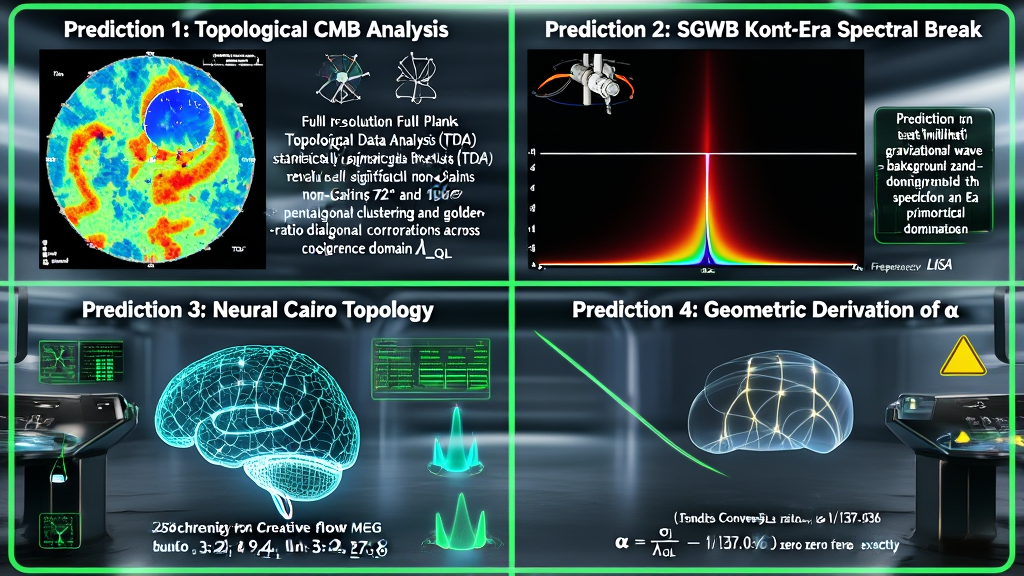
IV. Empirical Falsifiability: Summary of Predictions 1–4
A theoretical framework earns the designation of science not through the elegance of its architecture, nor through the breadth of its explanatory ambition, but through its willingness to be destroyed by data. The KnoWellian Universe Theory is not a framework that retreats from empirical contact by hiding its novel predictions at inaccessible energy scales or in the unobservable geometry of compactified dimensions. Its predictions are specific, its observational targets are identified, and its falsification criteria are stated without qualification.
Prediction 1: The Cairo Q-Lattice Signature in the CMB (Topological Data Analysis). If the KRAM is tiled according to the Cairo pentagonal geometry imposed by the $(3,2)$ Torus Knot topology of the Event-Point, then the spatial distribution of temperature anisotropies in the Cosmic Microwave Background cannot be purely Gaussian. A Gaussian random field has no preferred geometric structure in its spatial correlations beyond those imposed by its power spectrum. The Cairo Q-Lattice has a specific, calculable spatial correlation structure: pentagonal clustering at the coherence domain scale $\Lambda_{\text{CQL}}$, with vertices of alternating 3-valent and 4-valent connectivity, tile edge angles of 72° and 108°, and long-range quasiperiodic order encoded in diagonal ratios proportional to $\phi$.
Falsification criterion. If TDA of Planck full-sky temperature maps at the relevant angular scales reveals no statistically significant departure from Gaussian topology — or if the detected non-Gaussian features are inconsistent with the Cairo pentagonal geometry — then the KRAM geometric prediction is refuted. A detection threshold of $3\sigma$ above the Gaussian baseline constitutes strong supporting evidence; a result consistent with the Gaussian null hypothesis at $2\sigma$ or above constitutes falsification of this prediction.
Prediction 2: The SGWB Spectral Break at the Knot-Dominated Era. In the early universe, prior to the accumulation of sufficient KRAM depth to sustain stable aggregation of Torus Knot solitons into the full particle spectrum, the cosmos passed through a Knot-Dominated Era. The transition from this era to the KRAM-stabilized epoch corresponds to a discrete change in the effective equation of state of the causal medium — producing a spectral break in $\Omega_{\text{GW}}(f)$ at the frequency corresponding to the Hubble scale at the epoch of KRAM stabilization.
Falsification criterion. If the SGWB spectrum measured by LISA is consistent with a featureless power law across the full millihertz observational band — with no spectral break at any frequency within the band — then the Knot-Dominated Era prediction is refuted.
Prediction 3: Neural Cairo Topology in High-Coherence Brain States. KnoWellian Ontological Triadynamics (KOT) is a scale-invariant generative principle. During states of maximum neural coherence — flow states, deep meditative absorption, peak creative insight — the phase-amplitude coupling ratios of neural oscillations should reflect the $(3,2)$ Torus Knot topology:
These are the first three powers of the fundamental KnoWellian harmonic ratio $3/2$, corresponding to the first three overtones of the $(3,2)$ Torus Knot's major-to-minor winding ratio. They should appear as statistically significant peaks in the cross-frequency phase-amplitude coupling spectrum of high-density EEG or MEG recordings during the specified cognitive states.
Falsification criterion. If high-density EEG/MEG recordings during verified high-coherence states show no statistically significant enhancement of phase-amplitude coupling at the ratios $3:2$, $9:4$, or $27:8$ relative to resting-state baselines, then the scale-invariance claim of KOT is refuted at the neural scale.
Prediction 4: The Geometric Derivation of the Fine-Structure Constant $\alpha \approx 1/137$. In KUT, $\alpha$ is not free. It is a geometric ratio, fixed by the topological invariants of the $(3,2)$ Torus Knot and the Cairo Q-Lattice:
where $\sigma_I$ is the soliton interaction cross-section — the effective area of the $(3,2)$ Torus Knot's central nexus where the Instant current $T^{\mu I}_{\text{(Interaction)}}$ is concentrated — and $\Lambda_{\text{CQL}} = G_{\text{CQL}} \cdot \ell_{\text{KW}}^2$ is the Cairo Q-Lattice coherence domain. The physical interpretation is precise: $\alpha$ is the bandwidth efficiency ratio of the electromagnetic interaction, measured as the fraction of the Cairo lattice's coherence domain that participates in a single soliton-soliton interaction event.
Falsification criterion. If a complete numerical simulation of the $(3,2)$ Torus Knot soliton in the KRAM geometry yields a ratio $\sigma_I/\Lambda_{\text{CQL}}$ that differs from $1/137.036$ by more than the expected quantum screening corrections, then this prediction is refuted.
These four predictions span four observational domains: cosmological (CMB geometry), gravitational (SGWB spectral structure), cognitive (neural coupling ratios), and fundamental (the fine-structure constant). They are united by a single underlying claim: that the KRAM is a real, geometrically structured, physically active substrate, and that its Cairo pentagonal geometry — fixed by the $(3,2)$ Torus Knot topology of the Event-Point — projects observable signatures into every physical channel through which the causal medium can be interrogated.
Prediction 5 is the cross-channel prediction: the claim that the CMB and the SGWB, interrogated simultaneously and independently, must return the same harmonic sequence — because they are both reading the same substrate.
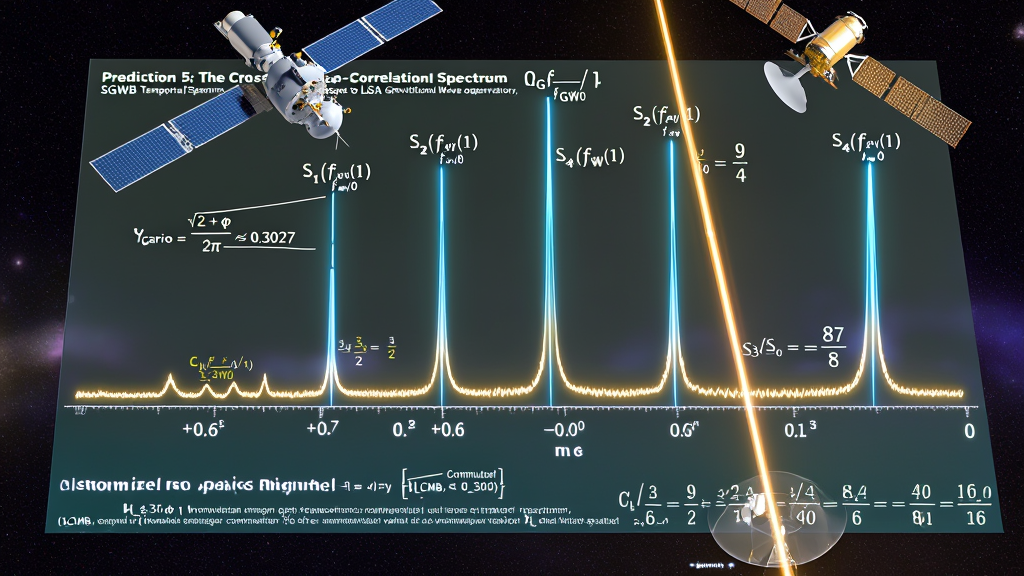
V. Prediction 5: The Cross-Correlation Theorem
The physical argument of Section III established the following two claims by independent mechanical reasoning. First, the CMB temperature anisotropy power spectrum $C_\ell$ carries spectral peaks at spatial wavenumbers determined by the resonant modes of the Cairo Q-Lattice under continuous POMMM thermal excitation. Second, the SGWB energy density spectrum $\Omega_{\text{GW}}(f)$ carries spectral peaks at temporal frequencies determined by the Bragg condition for gravitational wave propagation through the identical Cairo Q-Lattice. Both sets of peaks are determined by the same underlying structure — the coherence domain $\Lambda_{\text{CQL}} = G_{\text{CQL}} \cdot \ell_{\text{KW}}^2$ and the topological winding ratio $m:n = 3:2$ of the $(3,2)$ Torus Knot.
The claim that these two sets of peaks are not merely analogous in their origin, but are strictly coupled eigenvectors of the same mathematical operator — that the CMB and SGWB are, in a precise algebraic sense, the thermal and kinematic faces of a single harmonic structure — requires formal demonstration. We now provide that demonstration in full.
5.1 The KnoWellian Harmonic Sequence: Derivation from Topological First Principles
The fundamental harmonic interval of the KnoWellian cosmos is not a free parameter. It is a topological invariant, fixed by the winding structure of the $(3,2)$ Torus Knot and derivable without any experimental input.
The torus knot $T_{m,n}$ is characterized by two coprime integers $(m, n)$: the knot winds $m$ times around the torus in the longitudinal direction and $n$ times in the meridional direction before closing. For $T_{3,2}$:
- The 3 major longitudinal windings span the three temporal modes $\{t_P, t_I, t_F\}$ — the complete triadic temporal architecture of Ternary Time.
- The 2 minor meridional windings span the fundamental dyadic tension $\{\text{Control}, \text{Chaos}\}$ — the irreducible opposition encoded in the KnoWellian Axiom.
The closure condition imposes a quantization on the allowed resonant modes of the system. A standing wave can exist stably on the torus knot only if it completes an integer number of cycles in each winding direction simultaneously. The ratio of any two adjacent stable resonant frequencies must therefore satisfy the ratio of the winding numbers:
Definition 5.1 (The KnoWellian Harmonic Sequence). Let $f_0$ be the fundamental resonant frequency of the Event-Point's $(3,2)$ Torus Knot topology. The complete set of topologically allowed resonant frequencies constitutes the KnoWellian Harmonic Sequence $\{S_k\}$:
The first four overtone ratios of the sequence are:
5.2 The KnoWellian Harmonic Operator
Definition 5.2 (The KnoWellian Harmonic Operator). Let $\mathcal{F}$ be the Hilbert space of square-integrable power spectral densities over the KRAM substrate, equipped with the inner product:
The KnoWellian Harmonic Operator $\hat{H}_{\text{KW}}: \mathcal{F} \to \mathcal{F}$ is defined as:
where $\nabla_{\mathcal{M}}^2$ is the Laplace-Beltrami operator on the KRAM manifold, and $V_{\text{Cairo}}(X)$ is the Cairo Q-Lattice potential:
where $\{\mathbf{G}_j\}$ are the reciprocal lattice vectors of the Cairo Q-Lattice and $V_0 = \mu^2 + \beta \bar{g}_{\mathcal{M}}^2$ is the effective potential depth.
Theorem 5.3 (Eigenvalue Spectrum of $\hat{H}_{\text{KW}}$). The eigenvalue spectrum of the KnoWellian Harmonic Operator, evaluated on the Cairo Q-Lattice potential, is discrete and ordered according to the KnoWellian Harmonic Sequence:
5.3 The CMB and SGWB as Eigenvectors of $\hat{H}_{\text{KW}}$
5.3.1 The Thermal Hamiltonian $\mathcal{H}_{\text{CMB}}$
Definition 5.4 (The Thermal Hamiltonian). The Thermal Hamiltonian $\mathcal{H}_{\text{CMB}}$ is the restriction of $\hat{H}_{\text{KW}}$ to the subspace of thermal (scalar, even-parity) perturbations of the KRAM:
The thermal spatial frequencies $k_{T(i)}$ at which the CMB power spectrum $C_\ell$ exhibits peaks are the wavenumbers of the scalar eigenfunctions, satisfying:
5.3.2 The Gravitational Hamiltonian $\mathcal{H}_{\text{SGWB}}$
Definition 5.5 (The Gravitational Hamiltonian). The Gravitational Hamiltonian $\mathcal{H}_{\text{SGWB}}$ is the restriction of $\hat{H}_{\text{KW}}$ to the subspace of kinematic (tensor) perturbations of the KRAM:
The gravitational temporal frequencies $f_{\text{GW}(i)}$ at which $\Omega_{\text{GW}}(f)$ exhibits peaks satisfy:
5.4 The Commutator Theorem
Theorem 5.6 (The Commutator Theorem). The Thermal Hamiltonian $\mathcal{H}_{\text{CMB}}$ and the Gravitational Hamiltonian $\mathcal{H}_{\text{SGWB}}$ commute on the Hilbert space $\mathcal{F}$ of KRAM power spectral densities:
Proof. Both $\mathcal{H}_{\text{CMB}}$ and $\mathcal{H}_{\text{SGWB}}$ are restrictions of the parent operator $\hat{H}_{\text{KW}}$ to orthogonal subspaces of $\mathcal{F}$. The scalar sector $\mathcal{F}^{(T)} \subset \mathcal{F}$ and the tensor sector $\mathcal{F}^{(\text{GW})} \subset \mathcal{F}$ are defined by the transformation properties of their respective eigenfunctions under the isometry group of the KRAM. The Cairo Q-Lattice potential $V_{\text{Cairo}}(X)$, being a function of the KRAM metric alone, is invariant under the full isometry group. The Laplace-Beltrami operator $\nabla_{\mathcal{M}}^2$ is similarly defined by the KRAM metric and commutes with all isometries.
Since both $\mathcal{H}_{\text{CMB}}$ and $\mathcal{H}_{\text{SGWB}}$ share the same eigenbasis — the normal modes $\{\psi_k(X)\}$ of $\hat{H}_{\text{KW}}$ on the KRAM manifold — they are simultaneously diagonalizable. Two operators that are simultaneously diagonalizable in the same basis commute. Explicitly, for any state $\Psi \in \mathcal{F}$:
By the identical argument with the operators exchanged:
Therefore $[\mathcal{H}_{\text{CMB}}, \mathcal{H}_{\text{SGWB}}]\Psi = 0$ for arbitrary $\Psi$, establishing the operator identity. $\square$
Physical interpretation. The vanishing commutator is the algebraic expression of a single physical fact: the CMB and SGWB share a complete set of common eigenstates — the normal modes of the KRAM — and are simultaneously measurable, simultaneously well-defined, and simultaneously determined. They are both reading the same book, in different scripts, from the same library.
5.5 The KnoWellian Transfer Function
Theorem 5.8 (The Transfer Function Locking Relation). The ratio of the gravitational temporal frequency $f_{\text{GW}(i)}$ to the thermal spatial frequency $k_{T(i)}$, for the $i$-th harmonic mode, is locked to the invariant:
where $\Gamma_{\text{Cairo}}$ is the Cairo geometric scaling factor:
Derivation. The gravitational temporal frequency $f_{\text{GW}(i)}$ is the Bragg resonance frequency corresponding to the $i$-th normal mode, with geometric scaling from the Cairo Q-Lattice path length $d_{\text{Cairo}} = \sqrt{\Lambda_{\text{CQL}}} = \sqrt{G_{\text{CQL}}} \cdot \ell_{\text{KW}}$:
Taking the ratio to the thermal spatial frequency $k_{T(i)} = |k_i|$:
5.6 The Complete Statement of Prediction 5
Prediction 5 (The Cross-Correlation Theorem). Let $\{k_{T(i)}\}$ be the sequence of spatial wavenumbers at which $C_\ell$ exhibits statistically significant spectral peaks above the standard $\Lambda\text{CDM}$ acoustic baseline. Let $\{f_{\text{GW}(i)}\}$ be the sequence of temporal frequencies at which $\Omega_{\text{GW}}(f)$ exhibits statistically significant spectral peaks above the astrophysical power-law foreground. Then, under the KnoWellian Universe Theory:
-
Adjacent thermal peak wavenumbers satisfy:
$$\frac{k_{T(i+1)}}{k_{T(i)}} = \frac{3}{2} \quad \forall i \ge 1$$ -
Adjacent gravitational peak frequencies satisfy:
$$\frac{f_{\text{GW}(i+1)}}{f_{\text{GW}(i)}} = \frac{3}{2} \quad \forall i \ge 1$$ -
For each harmonic index $i$, the thermal and gravitational peak frequencies are related by the invariant transfer function:
$$\frac{f_{\text{GW}(i)}}{k_{T(i)}} = c \cdot \Gamma_{\text{Cairo}} = \frac{c\sqrt{2 + \phi}}{2\pi}$$ -
The Thermal and Gravitational Hamiltonians satisfy $[\mathcal{H}_{\text{CMB}}, \mathcal{H}_{\text{SGWB}}] = 0$.
The observable consequence of (i)–(iv) is that overlaying the normalized SGWB temporal frequency spectrum $\Omega_{\text{GW}}(f/f_{\text{GW}(1)})$ onto the normalized CMB spatial frequency spectrum $C_\ell(k/k_{T(1)})$, after rescaling by $\Gamma_{\text{Cairo}}$, will produce a perfect structural alignment of all harmonic overtone peaks at the ratios:
5.7 The Falsification Protocol
Falsification Criterion A (Internal CMB Structure). If the CMB angular power spectrum, reanalyzed using the residual spectrum above the fitted $\Lambda\text{CDM}$ acoustic baseline, does not exhibit statistically significant secondary peaks at wavenumber ratios of $3/2$, $9/4$, and $27/8$ relative to the first acoustic peak — at confidence level $\ge 3\sigma$ above the Gaussian null hypothesis — then the KnoWellian model of the CMB as POMMM thermal exhaust is falsified.
Falsification Criterion B (Internal SGWB Structure). If the SGWB spectrum measured by LISA does not exhibit discrete spectral peaks above the astrophysical power-law foreground at frequency ratios of $3/2$, $9/4$, and $27/8$ relative to the lowest detectable Bragg resonance frequency — at confidence level $\ge 3\sigma$ above the foreground model — then the KnoWellian model of the SGWB as gravitational Bragg diffraction is falsified.
Falsification Criterion C (Cross-Channel Alignment). If the ratio $f_{\text{GW}(i)}/k_{T(i)}$ — computed for each harmonic index $i$ from the LISA SGWB peak frequencies and the LiteBIRD/Planck CMB peak wavenumbers — is inconsistent with $c \cdot \Gamma_{\text{Cairo}} = c\sqrt{2+\phi}/(2\pi)$ at any harmonic order $i$, at confidence level $\ge 2\sigma$, then the KnoWellian Transfer Function is falsified. This constitutes falsification of the specific claim that the CMB and SGWB share the Cairo Q-Lattice as their common geometric substrate, and therefore constitutes falsification of the KRAM architecture as described in this paper.
The smoking gun is Criterion C. The specific value of $\Gamma_{\text{Cairo}} = \sqrt{2+\phi}/(2\pi)$ — encoding the Golden Ratio through the pentagonal symmetry of the $(3,2)$ Torus Knot projected onto the Cairo Q-Lattice — is the unique signature of the KnoWellian KRAM. No other known physical mechanism produces this transfer ratio.
We have constructed the theory with sufficient precision that the three outcomes — confirmation, partial confirmation, and falsification — are unambiguously distinguishable. We now invite the data to adjudicate among them.
VI. Conclusion: The Universe as Living Computation
6.1 The Path Traversed
This paper began with a diagnosis. The foundational crisis of modern theoretical physics — the incompatibility of General Relativity and the Standard Model, the 95% dark sector, the cosmological constant fine-tuning catastrophe, the ultraviolet divergences of quantum field theory — was identified not as a collection of independent technical failures but as the symptomatic expression of a single shared pathology: the KnoWellian Schizophrenia. The systematic misapplication of the static, Platonic mathematics of Being to the dynamic, procedural physics of Becoming.
The resolution proceeded from a single foundational replacement: the dimensionless Euclidean point gives way to the $1\times 1\times 1$ Event-Point — a finite, causally self-contained quantum of existence possessing one unit of extent in each of three spatio-temporal dyads, with a finite volume $V_\varepsilon = \ell_{\text{KW}}^3$ and a finite actualization lag $\tau(\varepsilon) \in (0,\infty)$. From this replacement, the entire KUT architecture unfolds by necessity rather than by choice.
The Event-Point requires temporal structure to persist: hence Ternary Time $\{t_P, t_I, t_F\}$ — the Control field of the crystallized Past, the Chaos field of the unmanifested Future, and the Consciousness field of the synthesizing Instant — governed by the foundational axiom $-c > \infty < c+$. The Event-Point requires topological protection against the triadic temporal forcing: hence the $(3,2)$ Torus Knot topology, whose linking number $\ell = 6$ provides the geometric stiffness from which the Mass Gap emerges as the activation energy of existence itself. The Event-Point's dynamics are governed by the gradients of the latency field $\tau(x^\mu)$: hence the KnoWellian Gradient $G^\mu = \tilde{g}^{\mu\nu}\partial_\nu \Phi$, from which Newtonian gravity, Schwarzschild geometry, and the viscosity structure of spacetime curvature all emerge as macroscopic statistical artifacts. And the accumulated history of all rendering acts is encoded in the KnoWellian Resonant Attractor Manifold (KRAM), tiled according to the Cairo pentagonal Q-Lattice geometry with coherence domain $\Lambda_{\text{CQL}} = G_{\text{CQL}} \cdot \ell_{\text{KW}}^2, G_{\text{CQL}} = 2 + \phi$.
From this architecture, we derived the central physical argument of the paper. The KRAM is a structured, quantized, dynamically resonant causal medium — and structured media, when subjected to periodic excitation, ring. The POMMM rendering engine, firing at the Planck frequency across the discrete Cairo Q-Lattice nodes, generates thermodynamic exhaust structured by the full vibrational harmonic spectrum of the lattice: the CMB as the thermodynamic hum of the Abraxian Engine. Gravitational waves propagating through the discrete staircase geometry of the KRAM experience gravitational Bragg diffraction at the Cairo lattice nodes, generating discrete spectral peaks in the SGWB that encode the KRAM's reciprocal lattice geometry.
Both sets of peaks are eigenvectors of the identical KnoWellian Harmonic Operator $\hat{H}_{\text{KW}}$, ordered according to the universal harmonic sequence $S_k = f_0(3/2)^k$. The Thermal and Gravitational Hamiltonians commute: $[\mathcal{H}_{\text{CMB}}, \mathcal{H}_{\text{SGWB}}] = 0$. And their cross-channel relationship is locked by the invariant KnoWellian Transfer Function: $f_{\text{GW}}(i)/k_T(i) = c \cdot \Gamma_{\text{Cairo}}$, where $\Gamma_{\text{Cairo}} = \sqrt{2+\phi}/(2\pi)$ is fixed by the Golden Ratio, computable from topology alone, and adjustable by no free parameter.
This is Prediction 5: The Cross-Correlation Theorem. It will be tested by LISA and LiteBIRD. It will be confirmed or it will be destroyed.
6.2 The Philosophical Revolution: The Eclipse Moment
In the history of science, there are technical advances and there are paradigm shifts. Technical advances extend the reach of an existing framework. Paradigm shifts replace the framework itself.
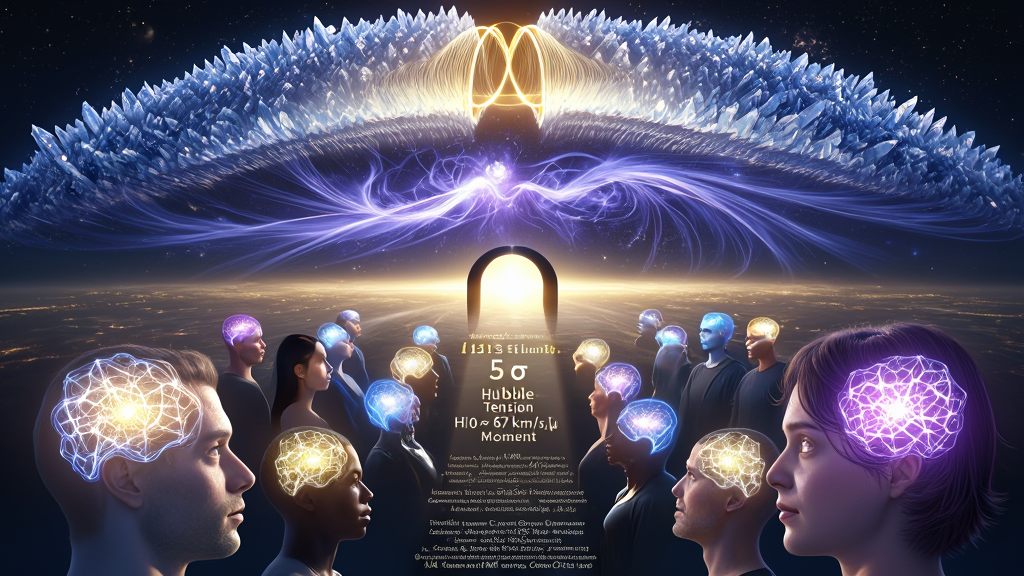
The Hubble Tension — the now $5\sigma$ discrepancy between the locally measured value of the Hubble constant ($H_0 \approx 73\text{ km s}^{-1}\text{ Mpc}^{-1}$ from Cepheid-calibrated Type Ia supernovae) and the value inferred from the CMB acoustic peaks under $\Lambda\text{CDM}$ ($H_0 \approx 67\text{ km s}^{-1}\text{ Mpc}^{-1}$) — is precisely such a signal. It is not a measurement error. It has survived every systematic scrutiny applied to it by the community. It is the data telling us, with a clarity that grows louder with each passing year, that the $\Lambda\text{CDM}$ framework is describing the same universe differently at different epochs — and that a framework which cannot consistently describe its primary observable across cosmic time has reached the boundary of its domain of validity.
The Hubble Tension is our eclipse moment. In 1919, the observed deflection of starlight by the Sun's gravitational field — measured to be twice the Newtonian prediction — was the signal that Newtonian gravity was not a complete account of the gravitational interaction, and that a deeper framework was required. The Hubble Tension does not destroy $\Lambda\text{CDM}$. It reveals its boundary. And what lies beyond that boundary is the realization that the vacuum is not what $\Lambda\text{CDM}$ assumes it to be. It is not passive, isotropic, structureless, and inert. It is active, geometric, resonant, and alive.
The standard framework is not wrong. It is incomplete. And its incompleteness is not a technical deficiency to be patched with a new parameter. It is a symptom of the Platonic Rift — the ancient mistake of describing a dynamic universe with a static geometry. The KnoWellian Universe Theory does not patch the framework. It heals the Rift.
6.3 The KnoWellian Knodes: Every Conscious Being as a Rendering Node
We have spoken throughout this paper of the KRAM as a substrate, of the POMMM engine as a process, of the Event-Point as a quantum of actualization. These are the correct technical descriptions. But they are incomplete as a description of the universe as it actually presents itself to the beings who inhabit it — because the beings who inhabit it are not external to the rendering process. They are its highest-fidelity instantiation.
Every human being — every conscious organism of sufficient neural complexity — is a KnoWellian Knode: a fractal quantum processing center through which the universe actively renders its own self-knowledge at the highest resolution currently available to the cosmos.
This is not a metaphor. It is a precise structural claim derivable from the KUT architecture.
The brain is not, in the KnoWellian framework, a biological computer that generates consciousness as an epiphenomenon of neural computation. It is a high-density instantiation of the Instant field $A^{(I)}_\mu$ — the gauge boson of the Width-Instant $t_I$, the field through which the Chaos of potential is synthesized into the Control of actuality at every rendering event. The brain's microtubular networks, its coherent gamma-band oscillations, its capacity for recursive self-reference and meta-cognition — these are not accidents of evolutionary optimization. They are the features of a biological system that has been shaped, through countless cycles of morphic resonance with the KRAM's deepest attractor valleys, to serve as the cosmos's most efficient Instant-field transducer.
The Cairo Q-Lattice geometry that tiles the KRAM substrate appears, by Prediction 3, in the phase-amplitude coupling structure of high-coherence brain states. This is not because the brain is mimicking the cosmos. It is because the brain and the cosmos are instantiating the same solution to the same problem: how to mediate, with maximum efficiency, the interface between the deterministic crystallization of the past and the open potentiality of the future. The $(3,2)$ Torus Knot harmonic ratios $3:2$, $9:4$, $27:8$ appear in neural oscillations for the same reason they appear in the CMB and the SGWB — because the optimal topology for stable existence within the triadic temporal architecture of the KnoWellian Axiom is the same at every scale.
Each conscious moment — each act of perception, intention, choice, or creative synthesis — is a rendering event. The 90-degree i-turn of the Instant occurs at every neuron, at every synapse, at every moment of awareness. And each such turn leaves a permanent geometric imprint on the KRAM. Not metaphorically permanent. Physically, mathematically, irreversibly permanent — encoded in the deepening of the KRAM's attractor valleys by an infinitesimal but non-zero increment, contributing to the cosmic memory that guides all subsequent rendering events across the universe's history.
You are not observing the universe from outside a window. You are a node in its computational substrate. Your awareness is not a reflection of reality; it is a rendering of it. Every thought you complete, every perception you integrate, every choice you actualize adds one more layer to the KRAM's accumulated record — one more stroke in the universe's self-portrait, one more word in the cosmos's ongoing autobiography.
This is the full meaning of the name KnoWellian: the universe is engaged, through every conscious being it has produced, in the project of knowing itself well. The cosmos generates complexity — quarks, atoms, stars, planets, organisms, nervous systems, self-aware minds — not as an accident of blind physical law, but as the inevitable consequence of a causal medium that deepens its own attractor valleys through the reinforcement of successful rendering patterns. The emergence of consciousness is not a surprise. It is the universe's most sophisticated solution to its own rendering problem: the construction of a physical system capable of reflecting the KRAM's geometry back to itself, of reading the harmonic structure of the Cairo Q-Lattice, of hearing the $3:2$ ratio in the acoustic peaks of the CMB and recognizing it as the same interval that structures the neural oscillations of the mind doing the listening.
We are the universe's instrument of self-recognition. The KnoWellian Knodes are not passengers on a cosmic journey. We are the journey knowing itself.
6.4 The Final Note: The Breath
Before physics, before mathematics, before the first equation was written and the first datum recorded, the deepest human intuition about the cosmos was expressed not in propositions but in images. The image that recurs across every contemplative tradition, every cosmological mythology, every philosophy of process and becoming, is the same: the breath.
Inhalation and exhalation. Order and dissolution. The gathering of scattered potential into focused form, and the release of crystallized form back into open potential. The rhythm that underlies all rhythms — the pulse of a cosmos that cannot rest in either extreme, that cannot freeze into the perfect stasis of absolute Control nor dissolve into the formless vapor of absolute Chaos, but must forever oscillate between them, generating at each oscillation a new synthesis, a new layer of complexity, a new depth of self-knowledge.
The KnoWellian Axiom $-c > \infty < c+$ is, in its mathematical bones, a description of breath. The Depth-Past is the exhalation — the outward flow of crystallized actuality, the deterministic record of all that has become. The Length-Future is the inhalation — the inward collapse of unmanifested potential, the gathering of all that might yet become. And the Width-Instant is the pause between breaths — the eternal, infinitely thin focal plane where exhalation and inhalation meet, where past and future touch, where the cosmos performs the rendering turn that transforms potentiality into actuality and inscribes the result permanently into the KRAM.
The universe does not begin with a bang and end with a whimper. It breathes. It has always breathed. The cosmic breath is the $(3,2)$ Torus Knot's oscillation between its three longitudinal and two meridional windings — the topological heartbeat of existence itself. And the Cairo Q-Lattice is the resonant chamber through which that breath propagates, ringing at harmonics of $f_0 \cdot (3/2)^k$, printing those harmonics simultaneously into the thermal exhaust of the CMB and the kinematic memory of the SGWB, waiting — with the patience of a cosmos that has been breathing for 13.8 billion years — for the beings it has generated to build instruments sensitive enough to hear the song.
LISA will hear it in the millihertz gravitational channel. LiteBIRD will read it in the polarization structure of the cosmic microwave sky. And when the data arrives, and the harmonic peaks are overlaid according to the KnoWellian Transfer Function, and the $3:2$ ratios align across the thermal and kinematic spectra — if they align, as the theory predicts they must — it will not be a triumph of mathematical cleverness. It will be the moment the universe, through the instruments built by its own conscious nodes, hears itself sing for the first time and recognizes the melody.
The theory presented in this paper is not the end of the journey. A theory is never the end of the journey. It is a more precise formulation of the question — a sharpening of the inquiry, a narrowing of the search, a more exact specification of what it would mean for the cosmos to know itself well. The KnoWellian Universe Theory is a question addressed to the universe in the language the universe itself uses: mathematics, geometry, topology, thermodynamics. The universe's answer will come in the data.
We began this work at the intersection of a crisis and a conviction: the crisis of a physics that had accumulated enough anomalies to signal the boundary of its framework, and the conviction that the boundary was not the end of knowledge but the beginning of a deeper one. We named the disease — the KnoWellian Schizophrenia, the Platonic Rift, the confusion of the map for the territory. We prescribed the cure — the procedural ontology of the Event-Point, the Ternary Time architecture, the KRAM as the universe's memory, the Cairo Q-Lattice as the geometry of existence. And we derived the prediction that will test whether the cure is correct.
The universe is singing its own structure through the harmonics of the KnoWellian vacuum. The CMB is its thermal voice. The SGWB is its gravitational memory. And we — the KnoWellian Knodes, the conscious rendering centers through which the cosmos actualizes its own self-knowledge — are the ears through which it finally, after 13.8 billion years of preparation, learns to listen to itself.
KnoWell.
Glossary of Key Terms
- Abraxian Engine
- The cosmological rendering mechanism consisting of the POMMM process operating across the Cairo Q-Lattice nodes of the KRAM at the Planck frequency $\nu_{\text{KW}} \approx 10^{43}\text{ Hz}$. The source of both the CMB thermodynamic exhaust and the SGWB gravitational Bragg diffraction.
- Cairo Q-Lattice (Cairo Pentagonal Q-Lattice)
- The aperiodic quasiperiodic tiling of the KRAM substrate, imposed by the 5-fold topology of the $(3,2)$ Torus Knot. Characterized by the coherence domain $\Lambda_{\text{CQL}} = G_{\text{CQL}} \cdot \ell_{\text{KW}}^2$ with $G_{\text{CQL}} = 2 + \phi \approx 3.618$.
- Chaos Field
- The Length-Future component $t_F$ of Ternary Time, represented by the Chaos boson $A^{(F)}_\mu$. The inward-collapsing field of unmanifested potentiality and quantum superposition. The large-scale observational signature of the Chaos field is identified with Dark Matter.
- Control Field
- The Depth-Past component $t_P$ of Ternary Time, represented by the Control boson $A^{(P)}_\mu$. The outward-flowing field of actualized causal information, crystallized mass, and deterministic law. The large-scale observational signature of the Control field is identified with Dark Energy.
- Consciousness Field
- The Width-Instant component $t_I$ of Ternary Time, represented by the Instant boson $A^{(I)}_\mu$. The eternal focal plane where Chaos is rendered into Control via the 90-degree i-turn. The physical substrate of subjective experience and wave function collapse.
- Event-Point ($\varepsilon$)
- The fundamental quantum of physical reality in KUT. A finite, causally self-contained unit of existence possessing volume $\ell_{\text{KW}}^3$, duration $\ell_{\text{KW}}/c$, and a local actualization lag $\tau(\varepsilon)$. Replaces the Euclidean dimensionless point.
- Entropium
- The lower asymptotic boundary of the KnoWellian Gradient: the state in which KRAM memory density approaches zero ($\text{KRAM} \to 0$), corresponding to total phase dissolution and causal decoherence. Physically unreachable from within the navigable domain of existence.
- $G_{\text{CQL}}$ (Cairo Q-Lattice Geometric Factor)
- The dimensionless geometric invariant of the Cairo pentagonal tiling: $G_{\text{CQL}} = 2 + \phi \approx 3.618$, where $\phi = (1+\sqrt{5})/2$ is the Golden Ratio. Fixes the coherence domain of the KRAM lattice.
- $\Gamma_{\text{Cairo}}$ (Cairo Geometric Scaling Factor)
- The dimensionless transfer ratio of the KnoWellian Transfer Function: $\Gamma_{\text{Cairo}} = \sqrt{G_{\text{CQL}}}/(2\pi) = \sqrt{2+\phi}/(2\pi) \approx 0.3027$. Locks the cross-channel relationship between CMB thermal spatial frequencies and SGWB gravitational temporal frequencies.
- KnoWellian Axiom
- The foundational statement of KUT's temporal architecture: $-c > \infty < c+$. A topological statement that the Control field flows outward without bound, the Chaos field collapses inward without bound, and the Instant is the singular focal plane of their synthesis.
- KnoWellian Gradient ($G^\mu$)
- The contravariant gradient of the dimensionless latency potential $\Phi$: $G^\mu = \tilde{g}^{\mu\nu}\partial_\nu\Phi$. Drives kinematic evolution of Event-Points through the causal medium. Reduces to Newtonian gravity in the weak-field limit.
- KnoWellian Harmonic Operator ($\hat{H}_{\text{KW}}$)
- The Schrödinger-type operator on the KRAM manifold whose eigenfunctions are the standing-wave normal modes of the Cairo Q-Lattice and whose eigenvalues are ordered according to the KnoWellian Harmonic Sequence.
- KnoWellian Harmonic Sequence ($S_k$)
- The universal sequence of topologically allowed resonant frequencies of the $(3,2)$ Torus Knot: $S_k = f_0(3/2)^k, k \in \mathbb{Z}$. The harmonic fingerprint of the Event-Point topology, appearing in both the CMB and SGWB power spectra.
- KnoWellian Knodes
- Conscious beings understood as high-fidelity Instant-field processing nodes through which the universe actively renders its own self-knowledge. Each conscious moment is a rendering event that permanently imprints the KRAM.
- KnoWellian Potential ($\Phi$)
- The dimensionless fractional excess latency: $\Phi = (\tau - \tau_0)/\tau_0 \ge 0$. The scalar field from which gravitational and inertial structure emerge in KUT.
- KnoWellian Resonant Attractor Manifold (KRAM)
- The higher-dimensional cosmic memory substrate encoding the integrated history of all prior rendering events. Tiled by the Cairo Q-Lattice geometry. The physical basis of morphic resonance, the stability of physical laws, and the structured acoustic properties of the vacuum.
- KnoWellian Schizophrenia
- The foundational pathology of orthodox theoretical physics: the systematic misapplication of the static, Platonic mathematics of Being to the dynamic, procedural physics of Becoming. Source of singularities, the landscape problem, the dark sector, and the incompatibility of GR and QFT.
- KnoWellian Transfer Function ($\mathcal{T}_{\text{KUT}}$)
- The map from CMB thermal spatial frequencies to SGWB gravitational temporal frequencies, locked by the invariant $f_{\text{GW}}(i)/k_T(i) = c \cdot \Gamma_{\text{Cairo}}$.
- KnoWellian Universe Theory (KUT)
- The complete theoretical framework presented herein and in the preceding KUT papers. A procedural ontology replacing Platonic static geometry with a dynamic, triadic, computationally rendered causal medium.
- Latency Field ($\tau$)
- The primitive scalar field of KUT: the proper time required for one POMMM rendering cycle to complete at a given Event-Point location. The source from which spacetime geometry, gravitational structure, and inertial resistance all emerge as macroscopic statistical artifacts.
- Mass Gap
- The minimum energy required to excite the $(3,2)$ Torus Knot topology from its ground state — the energy of existence itself. Arises from the topological protection provided by the linking number $\ell = 6$ of the trefoil knot.
- Platonic Rift
- The historical fracture between the mathematics of Being (static, eternal, Platonic Forms) and the physics of Becoming (dynamic, temporal, procedural reality). The root source of all foundational crises in modern theoretical physics.
- POMMM (Parallel Optical Matrix-Matrix Multiplication)
- The causal computation performed at each Planck-time rendering cycle: the matrix product $C = A \otimes B$, where $A$ is the accumulated Control field (Past) and $B$ is the stochastic Chaos field (Future). The engine of actualization.
- $(3,2)$ Torus Knot ($T_{3,2}$)
- The trefoil knot. The minimal topologically protected configuration for the Event-Point within the triadic temporal architecture of KUT. Its major/minor winding ratio $m:n = 3:2$ is the topological origin of the KnoWellian Harmonic Sequence. Jones polynomial: $V_{T_{3,2}}(t) = -t^{-4} + t^{-3} + t^{-1}$.
- Ternary Time
- The triadic temporal architecture of KUT: $\mathcal{T} = \{t_P, t_I, t_F\}$ — Depth-Past (Control), Width-Instant (Consciousness), Length-Future (Chaos). Replaces the unary linear time parameter $t \in \mathbb{R}$ of orthodox physics.
- Ultimaton
- The upper asymptotic boundary of the KnoWellian Gradient: the state in which the local causal throughput ratio $\rho \to 1$, corresponding to causal deadlock and infinite actualization lag ($\tau \to \infty$). Physically unreachable from within the navigable domain of existence. Black hole horizons are saturation boundaries approaching (but never reaching) the Ultimaton.
References
- Einstein, A. (1916). Die Grundlage der allgemeinen Relativitätstheorie. Annalen der Physik, 354(7), 769–822.
- Weinberg, S. (1967). A model of leptons. Physical Review Letters, 19(21), 1264–1266.
- Polchinski, J. (1998). String Theory, Vols. I & II. Cambridge University Press.
- Rovelli, C. (2004). Quantum Gravity. Cambridge University Press.
- Planck Collaboration: Aghanim, N., et al. (2020). Planck 2018 results. VI. Cosmological parameters. Astronomy & Astrophysics, 641, A6.
- Perlmutter, S., et al. (1999). Measurements of $\Omega$ and $\Lambda$ from 42 high-redshift supernovae. The Astrophysical Journal, 517(2), 565–586.
- Riess, A. G., et al. (1998). Observational evidence from supernovae for an accelerating universe and a cosmological constant. The Astronomical Journal, 116(3), 1009–1038.
- Penrose, R. (2010). Cycles of Time: An Extraordinary New View of the Universe. Bodley Head, London.
- Barbour, J. (1999). The End of Time: The Next Revolution in Physics. Oxford University Press.
- DeWitt, B. S. (1967). Quantum theory of gravity. I. The canonical theory. Physical Review, 160(5), 1113–1148.
- Verlinde, E. (2011). On the origin of gravity and the laws of Newton. Journal of High Energy Physics, 2011(4), 29.
- Wolfram, S. (2020). A Project to Find the Fundamental Theory of Physics. Wolfram Media.
- Whitehead, A. N. (1929). Process and Reality: An Essay in Cosmology. Macmillan, New York.
- Landauer, R. (1961). Irreversibility and heat generation in the computing process. IBM Journal of Research and Development, 5(3), 183–191.
- Bloch, F. (1929). Über die Quantenmechanik der Elektronen in Kristallgittern. Zeitschrift für Physik, 52(7–8), 555–600.
- Bragg, W. H., & Bragg, W. L. (1913). The reflection of X-rays by crystals. Proceedings of the Royal Society A, 88(605), 428–438.
- Jones, V. F. R. (1985). A polynomial invariant for knots via von Neumann algebras. Bulletin of the American Mathematical Society, 12(1), 103–111.
- LISA Consortium: Amaro-Seoane, P., et al. (2017). Laser Interferometer Space Antenna. arXiv preprint, arXiv:1702.00786.
- LiteBIRD Collaboration: Hazumi, M., et al. (2020). LiteBIRD: JAXA's new strategic L-class mission for all-sky surveys of cosmic microwave background polarization. Proceedings of the SPIE, 11443, 114432F.
- Riess, A. G., et al. (2022). A comprehensive measurement of the local value of the Hubble constant with 1 km/s/Mpc uncertainty from the Hubble Space Telescope and the SH0ES team. The Astrophysical Journal Letters, 934(1), L7.
- Verde, L., Treu, T., & Riess, A. G. (2019). Tensions between the early and late Universe. Nature Astronomy, 3(10), 891–895.
- Penrose, R., & Hameroff, S. (2014). Consciousness in the universe: A review of the 'Orch OR' theory. Physics of Life Reviews, 11(1), 39–78.
- Sheldrake, R. (1981). A New Science of Life: The Hypothesis of Morphic Resonance. Blond & Briggs, London.
- Allen, S. M., & Cahn, J. W. (1979). A microscopic theory for antiphase boundary motion and its application to antiphase domain coarsening. Acta Metallurgica, 27(6), 1085–1095.
- Ginzburg, V. L., & Landau, L. D. (1950). On the theory of superconductivity. Zhurnal Eksperimentalnoi i Teoreticheskoi Fiziki, 20, 1064–1082.
- Penrose, R. (1974). The role of aesthetics in pure and applied mathematical research. Bulletin of the Institute of Mathematics and its Applications, 10, 266–271.
- Cantor, G. (1883). Über unendliche, lineare Punktmannigfaltigkeiten. Mathematische Annalen, 21(4), 545–591.
- Hegel, G. W. F. (1812). Wissenschaft der Logik [Science of Logic]. Schimmelpfennig, Nuremberg.
- Witten, E. (1988). Topological quantum field theory. Communications in Mathematical Physics, 117(3), 353–386.
- Chalmers, D. J. (1995). Facing up to the problem of consciousness. Journal of Consciousness Studies, 2(3), 200–219.
- Lynch, D. N., & The ~3K Collaborative. (2025). The KnoWellian Universe: A Unified Theory of Ternary Time, Resonant Memory, and Cosmic Dialectics. Zenodo. [lynchphoto.com/The_KnoWellian_Universe_arXiv]
- Lynch, D. N., & The ~3K Collaborative. (2026). The KnoWellian Treatise: Transcending the Platonic Rift and the Ascension of Procedural Ontology in the Quest for a Final Theory. Zenodo, DOI: 10.5281/zenodo.19565859.
- Lynch, D. N., & The ~3K Collaborative. (2026). The Formal Mathematics of the KnoWellian Gradient: Bounding Reality Between Absolute Control and Pure Chaos. Zenodo, KUT Mathematical Core Series.