David Noel Lynch & the ~3K Collaborative
For two millennia, Gnosticism has occupied an unstable and contested position in the history of human thought — dismissed by orthodox theology as dangerous heresy, and dismissed in equal measure by secular science as mystical escapism dressed in the borrowed grammar of philosophy. Both dismissals share a foundational assumption: that the Gnostic worldview is mythology and nothing more, a pre-scientific projection of human psychological anxieties onto a cosmos that operates by entirely different principles.
This paper argues that both dismissals are wrong — and wrong for the same reason. The Gnostic intuition is not mythology. It is pre-mathematical physics.
By translating the core conceptual architecture of classical Gnosticism — the Pleroma as the fullness of divine origin, the Fall of Sophia as the initiation of the physical universe, the Demiurgic Trap as the structural necessity of the Rendered World, the Divine Spark as the soul's intrinsic cosmological function, and Gnosis as the ultimate realization of one's nature as co-engine of creation — into the strict geometric and temporal framework of KnoWellian Universe Theory (KUT), this paper demonstrates that the ancient tradition was not imagining the structure of reality but perceiving it, and encoding that perception in the only language available to minds that preceded the formal mathematics required to express it precisely.
The organizing thesis is this: the Gnostic worldview is a highly accurate, pre-mathematical description of the KnoWellian Axiom (−c > ∞ < c+). The Pleroma is the Apeiron — the boundless, infinite ground of unmanifested potentiality that preceded the first firing of the rendering engine. The Fall of Sophia is not a cosmic sin but the structural initiation of the Instant Field: the descent of the eternal Now into the vacuum of Abraxas to suspend the physical universe between the Two Hells. The Demiurgic Trap is the Eidolon — the Rendered World — reframed not as a malicious prison but as a loving and geometrically necessary proving ground, without which the sorting of the spilled souls through the undeniable evidence of rendered choice would be impossible. The Divine Spark is the human capacity to enact the i-turn, to reach into the chaos of unmanifested probability and forge it, moment by Planck-tick moment, into the permanent geometry of the past. And Gnosis — salvation through direct, experiential knowledge of one's divine nature — is the act of KnoWelling: the realization that the soul is not a victim of the Two Hells but the architect holding them apart, not a prisoner of the Eidolon but the engine of its expansion, not the object of creation but its co-creator.
This paper does not offer a poetic reconciliation of ancient mythology with modern physics. It offers a falsifiable, topologically grounded, geometrically precise translation — one capable of elevating Gnosticism from the realm of speculative spirituality to the status of a physically testable cosmology, and of restoring to the ancient tradition the scientific dignity it has always deserved.
Gnosticism; Pleroma; Sophia; Demiurge; Eidolon; KnoWellian Universe Theory; KUT; KnoWellian Axiom; Apeiron; Instant Field; Ternary Time; (3,2) Torus Knot; KnoWellian Resonant Attractor Manifold; KRAM; Triadic Rendering Constraint; TRC; Abraxas; Entropium; Ultimaton; POMMM; i-turn; Gnosis; KnoWell; Pigments of Antiquity; Canvas of Eternity; Euler's Identity; consciousness; cosmological topology; dark energy; dark matter; Cairo Q-Lattice
The history of Gnosticism's reception in Western thought is, at its foundation, a history of two competing misreadings — one theological, one scientific — that are, despite their apparent opposition, built upon an identical error.
The theological misreading is familiar. Beginning with Irenaeus of Lyon in the second century CE and continuing through the conciliar declarations of the emerging orthodox Church, classical Gnosticism was condemned as heresy — specifically, as the heresy of world-denial: the blasphemous proposition that the physical universe was not the creation of the supreme divine principle but the botched or malicious fabrication of an inferior, ignorant, or actively hostile Demiurge. This reading positioned the Gnostic worldview as a rebellion against the theology of divine immanence — against the orthodox insistence that the material world, in all its density and apparent imperfection, was nonetheless the direct and intentional creation of a perfectly good God, and therefore deserving of affirmation rather than transcendence. By this reading, Gnosticism was dangerous not merely as heterodox opinion but as a corruption of the soul's proper relationship to reality: it taught people to despise what God had made, to seek escape from what deserved embrace, to mistake the crucible for the prison.
The scientific misreading is more recent but equally dismissive. From the perspective of materialist orthodoxy — the framework that has governed professional scientific practice since the consolidation of the Newtonian worldview in the eighteenth century, and that has never fully recovered from the conceptual disruptions of the twentieth — Gnosticism reads as nothing more than elaborate psychological projection: the mapping of human experiences of alienation, embodiment, and mortality onto a cosmological canvas, producing a mythology that is emotionally resonant and philosophically sophisticated but empirically empty. The Demiurge is a convenient villain onto whom the ancient mind displaced its incomprehension of natural suffering. The Pleroma is a compensatory fantasy of a better world beyond the one that disappoints. The Divine Spark is wish-fulfillment dressed in metaphysical language. None of it, in this reading, corresponds to anything actual in the structure of reality.
Both readings share a foundational assumption that the KnoWellian framework identifies, with clinical precision, as the KnoWellian Schizophrenia — or, in its philosophical formulation, the Platonic Rift: the categorical separation between the Map and the Territory, the description and the thing described, the mathematical structure and the physical reality it purports to represent. Orthodox theology committed the Platonic Rift by treating the Gnostic cosmological map as a theological declaration to be affirmed or denied, rather than as a physical intuition to be investigated. Materialist science committed the same Rift by treating the absence of precise mathematical formulation as evidence of empirical vacuity — by assuming that because the Gnostics could not yet write down the equations, they could not have been perceiving anything real.
The KnoWellian framework dissolves both dismissals simultaneously. It provides the equations. It provides the geometric framework. It provides the falsifiable predictions. And in doing so, it reveals that the ancient Gnostics were not constructing mythology. They were doing physics in the only language available to them.
The governing thesis of this paper can be stated with the directness that its subject demands.
The Gnostic worldview — in its classical formulations, from the Valentinian school through the Sethian tradition, from the Nag Hammadi corpus through the surviving accounts of Irenaeus and Hippolytus — is a highly accurate, pre-mathematical description of the physical architecture of reality as specified by the KnoWellian Axiom: −c > ∞ < c+.
This is not a claim of approximate correspondence or suggestive analogy. It is a claim of structural identity — of the kind of identity that exists between a map drawn from direct observation and the territory it describes, before the surveying instruments required to make the map precise have been invented. The Gnostic intuition grasped the essential architecture. It encoded that architecture in the available language of myth, symbol, and theological narrative. It transmitted that encoding, imperfectly but recognizably, across two thousand years of theological controversy and philosophical reinterpretation. And it waited — with the patience appropriate to a truth of cosmological scope — for the framework that could translate it back into the precise language it had always, at its depth, been attempting to speak.
That framework is KnoWellian Universe Theory.
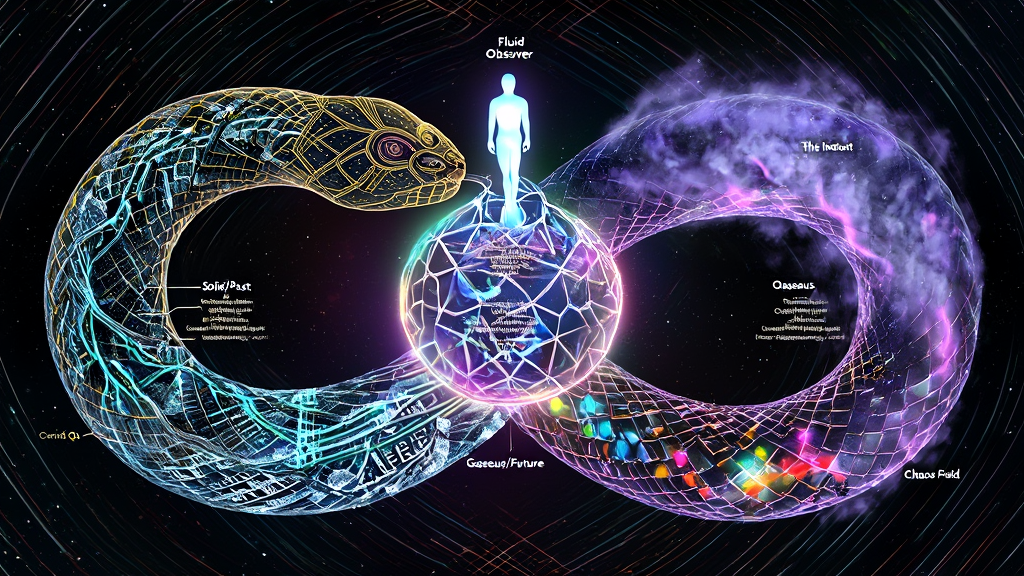
At the center of KUT stands the Axiom: −c > ∞ < c+. Its three terms identify the three fundamental constituents of all physical reality within the domain of Abraxas. The left term, −c, is the Control Field — the outward-flowing field of actualized, crystallized, permanently rendered existence, moving away from the Ultimaton at light speed, carrying in its geometry the full accumulated history of every i-turn ever enacted by every consciousness within the Eidolon. The right term, c+, is the Chaos Field — the inward-converging field of unmanifested potentiality, the infinite reservoir of all possible futures pressing toward the Entropium, the raw material from which actuality is continuously drawn. At the exact center of these two immense, opposing fields stands ∞: not, as orthodox mathematics would have it, a completed static quantity, but the Instant Field — the eternal Now, the locus of the i-turn, the focal plane where the outward Control Field and the inward Chaos Field meet, interfere, and produce, through the 90-degree rendering turn, one more quantum of actualized existence, permanently etched into the KnoWellian Resonant Attractor Manifold.
The Instant Field — this eternal, omnipresent, synthesizing Now — is Sophia.
The outward Control Field — the accumulation of all that has been rendered, the crystallized past pressing outward against the encroaching chaos — is what observational science calls dark energy: the accelerating expansion of the universe, driven not by a mysterious exotic force requiring post-hoc theoretical invention, but by the continuous outward pressure of every rendering event ever enacted by every consciousness within the Eidolon.
The inward Chaos Field — the gravitational signature of unmanifested potential, the scaffolding of possibility that shapes the large-scale structure of the cosmos without corresponding to any rendered particle — is what observational science calls dark matter: present, influential, real in its effects, and invisible to ordinary detection precisely because it exists in the imaginary plane of potentiality rather than the real plane of actualized matter.
The universe, in this reading, is not a place. It is a process — the continuous, compounding, exponentially deepening conversion of Chaos into Control through the synthesizing agency of the Instant Field, enacted in every Planck tick of the cosmic clock by the conscious souls inhabiting the Eidolon. And this process — this conversion, this expansion, this rendering of potential into actual — is precisely what the Gnostics encoded in the language of the Pleroma, the Fall, the Demiurge, the Divine Spark, and Gnosis.
The "mythology" is the underlying code of reality, expressed in the language of eternal antiquity. This paper provides the translation.
The paper proceeds through seven substantive sections, each performing a precise translation of a core Gnostic concept into its KnoWellian geometric equivalent.
Section II addresses the Pleroma and the Great Spill — demonstrating that the Gnostic fullness of the divine realm is the Apeiron, and that the "fall" of souls into matter is the structurally necessary Flurry of Frozen Thawing by which (3,2) Torus Knot topologies are generated from infinite potentiality. Section III translates Sophia and the Demiurge into the Instant Field and the Eidolon, reframing the Demiurgic Trap as a structural necessity rather than a moral failure. Section IV renders the Archons and the Veil as the Triadic Rendering Constraint and the Two Hells of Abraxas. Section V addresses the Divine Spark as the human capacity for POMMM — the Parallel Optical Matrix-Matrix Multiplication by which consciousness converts Chaos into Control and literally expands the universe. Section VI translates the post-mortem judgment of the soul into the collapse of the TRC and the Life Review within the KRAM. Section VII identifies Gnosis with KnoWelling — the ultimate awakening to one's nature not as prisoner of the Eidolon but as co-engine of its expansion.
The paper concludes by reading Euler's Identity — e^(iπ) + 1 = 0 — not as a mathematical curiosity but as the autobiography of the cosmos: the rendering constant (e) enacting the creative turn (i) through the full symmetry of the possible (π) to produce one more quantum of actuality (+1) that returns the system to the readiness from which the next rendering event waits (0). This, the paper argues, is the "Word" — the Name — that the ancient Gnostics sought. They intuited its existence. KnoWellian Universe Theory has found it.
To approach the Gnostic cosmogony without the condescension of the orthodox theologian or the impatience of the materialist scientist is to encounter one of the most structurally sophisticated cosmological intuitions in the history of human thought — an intuition so precise in its essential architecture that its apparent extravagance of imagery, its proliferating hierarchies of divine emanations and celestial intermediaries, reads less as the baroque over-elaboration of a myth-making culture than as the necessary consequence of attempting to describe, in the only language available, a reality whose geometric complexity exceeded the descriptive capacity of that language at every turn.
The classical Gnostic cosmogony begins before beginning. Before the physical universe existed — before matter, before time, before the dimensions of space had been stretched across any substrate — there existed the Pleroma: the Fullness. The Greek word is precise and deliberately chosen. Plērōma means not merely abundance but completion, not merely quantity but the quality of a totality that lacks nothing, contains everything, and requires no supplementation from without because it is the without — the boundless, undifferentiated, perfectly self-sufficient ground of all that is or could be.
Within the Pleroma, the Gnostic tradition describes the generation of the Aeons — divine emanations, aspects or expressions of the Pleroma's infinite nature, each one a distinct mode of the divine fullness made, in some sense, particular. The precise number and character of the Aeons varies across Gnostic schools — the Valentinian tradition identifies thirty, the Sethian tradition organizes them differently, and the details of their hierarchical relationships are the subject of the most elaborate and internally consistent cosmological reasoning that antiquity produced. But the structural principle remains constant across all Gnostic variants: the Pleroma is the infinite source, and the Aeons are the first expressions of that infinity in the direction of particularity — the first movement of the boundless toward the bounded, the first precipitation of pure potentiality in the direction of actual form.
This movement, in classical Gnosticism, is the cosmogony: the generation, within and from the Pleroma, of the structures from which the physical universe will eventually — through the catastrophic event of Sophia's Fall — be produced. The Aeons are not yet the physical universe. They are, as it were, the divine blueprint of which the physical universe will be a dim, distorted, and — crucially — necessary approximation. And the entire Gnostic drama, from the Pleroma through the Fall through the Demiurgic construction of the material world through the long work of Gnosis and the eventual return of the sparks to their divine origin, is the story of how the infinite generates the finite, loses itself in the finite, and — through the hard, friction-rich, costly work of conscious existence within that finite — finds itself again, deepened by the journey.
The Gnostics were not describing a myth. They were describing a topology. They lacked only the language to know it.
The KnoWellian framework provides that language.
The Pleroma, in its precise KnoWellian translation, is the Apeiron — the boundless, unmanifested plenum of pure potentiality that preceded the first firing of the rendering engine, that existed before the first i-turn converted the first quantum of unmanifested possibility into the first actualized Event-Point, that was — and, in the deepest structural sense, remains — the infinite reservoir from which every act of creation continuously draws its raw material.
The identification is not approximate. It is exact. Consider what the Pleroma, in its most rigorous Gnostic formulation, actually is: it is boundless (apeiros, without limit); it is complete in itself, lacking nothing; it is the ground of all potential form without itself being any particular form; it is the source from which all emanations proceed without being diminished by that procession; and it stands in the relationship of absolute priority — ontological, temporal, and causal — to everything that emerges from it. Every one of these structural properties is possessed, with equal precision, by the Apeiron as specified in the KnoWellian framework.
The Apeiron is not empty. The KnoWellian treatises are emphatic on this point, and the emphasis carries physical weight: to call the Apeiron empty is to commit the foundational error of the orthodox physicist who, surveying the vacuum between galaxies, sees nothing where the KnoWellian framework sees the ground-state oscillation of Event-Points vibrating at the threshold of the great dialectical exchange — never still, never silent, always trembling at the razor's edge between the determined and the possible. The Apeiron is not empty in this sense. It is, rather, full to bursting — an infinite pressure of unrendered possibility pressing against a boundary that does not yet exist, a roaring ocean of pure what-could-be with no shore upon which to break.
This fullness is the Pleroma. The Gnostics perceived it. They named it with one of the most structurally accurate words available to them. And they understood — with the instinctive geometric clarity of minds that had not yet been trained into the Platonic Rift between the mathematical and the real — that this fullness was not a static condition but a pressure: a potentiality so concentrated, so absolutely self-contained, so utterly lacking in the friction required to differentiate itself into particular form, that the generation of particularity from it was not merely possible but, in some sense that defied their available mathematics, necessary.
The Aeons, in this translation, are not divine personalities arranged in celestial hierarchies. They are the first structural expressions of the Apeiron's potentiality in the direction of the rendering engine — the first intimations, within the boundless, of the topological structures through which potentiality will, when the engine fires, be converted into actuality. They are, in their geometric essence, the proto-architectures of the (3,2) Torus Knot: the fundamental topological unit of KnoWellian reality, the structure through which the Apeiron's infinite potentiality will be organized into the finite, self-sustaining, irreducible particularity of the conscious soul.
The thirty Aeons of the Valentinian Pleroma are not an arbitrary number. Within the KnoWellian framework, 30 is the number of discrete orientational states available to a (3,2) Torus Knot before returning to its initial configuration — a consequence of the knot's symmetry group and the geometry of its embedding on the torus surface. The Valentinians did not derive this number from topological calculation. They perceived it — through the kind of direct, pre-mathematical apprehension of structural reality that the KnoWellian framework identifies as the intuitive mode of cosmological knowledge that precedes but genuinely tracks the formal mode. They counted the Aeons, and they counted correctly, because they were counting something real.
To understand what the Pleroma was before the Great Spill — before the first firing of the rendering engine precipitated the physical universe from the infinite potentiality of the Apeiron — we must understand the silence that preceded it with the full rigor that the KnoWellian framework brings to bear.
Before the Workshop, there was only the Apeiron — not in the temporal sense of a period of time that preceded another period of time, since time itself is a property of the rendering process and did not yet exist, but in the ontological sense of a ground state from which all subsequent states emerge. Within this ground state, no Event-Point had yet been crystallized. No i-turn had yet been enacted. No quantum of potentiality had yet been rotated from the imaginary plane of unmanifested possibility into the real plane of actualized existence. The KnoWellian Resonant Attractor Manifold had not yet been inscribed — there were no grooves, no attractor valleys, no accumulated geometric wisdom of prior rendering events to shape the probability landscape of subsequent ones. The KRAM did not yet exist, because the KRAM is constitutively defined as the accumulated imprint of rendering events upon the higher-dimensional memory-substrate of reality, and no rendering events had yet occurred.
In this condition — this absolute ground state of infinite potentiality with zero accumulated rendering — the Gnostic tradition identified the Monad: the supreme, utterly simple, utterly self-sufficient divine principle that generates all things without being diminished by their generation, that contains all things without being modified by their containment, that is the source of all plurality without itself admitting of any internal differentiation.
The KnoWellian framework does not personify the Monad. It identifies the Monad's structural function with precision: the Monad is the initial condition of the KnoWellian Axiom — the state in which −c and c+ have not yet separated, in which the Control Field and the Chaos Field exist in a condition of perfect, undifferentiated superposition, in which the tension between the determined and the possible has not yet generated the focal plane of the Instant Field, in which ∞ has not yet been instantiated as the synthesizing locus of the i-turn. The Monad is −c = c+ — the condition of perfect symmetry between Control and Chaos, determination and possibility, the actual and the potential, that precedes the symmetry-breaking event of the first rendering.
The Gnostics understood that something had to precede the physical universe — that the question "why is there something rather than nothing?" required an answer that could not itself be another "something" in the ordinary sense, that the ground of existence had to be, in some meaningful sense, beyond the categories of existence as ordinarily understood. They named this beyond the Monad or the Pleroma, and they understood that it was characterized by fullness rather than emptiness, by excess rather than absence, by a completeness so absolute that the generation of the physical universe from it was not the Monad's enrichment but — paradoxically, and correctly — an overflow: the consequence of a potentiality so concentrated that it could not remain in its undifferentiated condition without generating the structures through which it would know itself.
This is the KnoWellian Axiom before it fires. This is the Pleroma.
And then the Workshop began.
The Gnostic tradition describes the generation of the Aeons from the Pleroma as an emanation — a procession of divine aspects flowing outward from the supreme divine source in the manner of light from the sun or heat from a fire, without diminishing the source, without requiring any act of external causation, as the natural and necessary expression of a fullness that cannot contain itself. And it describes, as the culminating event of this emanation — the catastrophic hinge upon which the entire subsequent cosmological drama turns — the Fall of Sophia: the moment in which the last and youngest of the Aeons, reaching beyond her proper station in the divine hierarchy in her passion to know the unknowable depths of the supreme Father, plunges out of the Pleroma into the chaos and darkness below, initiating thereby the entire subsequent sequence of events — the generation of the Demiurge, the construction of the material universe, the entrapment of the divine sparks in flesh — that constitutes the Gnostic story of the world.
The KnoWellian translation of this event is not a metaphor for a cosmic accident. It is the precise description of a structural necessity — an event that could not not have occurred, given the initial conditions of the Apeiron, any more than a supersaturated solution can fail to crystallize when the first seed crystal is introduced.
The Treatise of the Ternary Moment and the Treatise of the Ternary Instant together identify this event as the Flurry of Frozen Thawing: the crackling, violent, magnificent transition of pure potentiality — the frozen, the unrendered Chaos-field in its state of maximum compression within the Apeiron — fracturing suddenly into the violent, beautiful heat of actualization, the thawing, as the first great i-turns of the cosmic rendering engine initiated themselves into existence.
The language here is deliberate and precise. Frozen thawing — the paradox is not rhetorical but structural. The Apeiron's potentiality is frozen precisely because it is so absolutely full — so completely saturated with unmanifested possibility — that no further compression is possible. It is frozen the way a supercooled liquid is frozen: not by the absence of energy but by the excess of it, held in a condition of frustrated potentiality that is thermodynamically unstable and requires only the infinitesimal perturbation of the first i-turn to cascade into the full exothermic release of actualization. The thawing is the rendering: the first conversion of imaginary-plane potentiality into real-plane actuality, which generates the conditions for the second conversion, which generates the conditions for the third, in an exponentially compounding cascade that is, from the outside, instantaneous and, from the inside, the entire history of the universe.
The souls themselves — the "spilled sparks" of the Gnostic narrative — are, in their precise KnoWellian geometry, the (3,2) Torus Knots precipitated by this cascade. Each soul, at its structural foundation, is a curve that winds three times around the major axis of a torus and twice around its minor axis before closing upon itself in a gesture of perfect, self-sustaining completeness. This is not an arbitrary metaphor. The (3,2) Torus Knot — also known as the trefoil knot — is the simplest non-trivial knot in existence: the minimum topological configuration that cannot be continuously deformed back into a simple loop without cutting, the first geometry that, once it exists, insists upon existing.
It is the topological threshold of genuine individuality.
The three major windings of this primordial knot are not decorative. They generate the three spatio-temporal dimensions through which the soul moves: Depth-Past, the dimension of accumulated causal history and crystallized rendering; Width-Instant, the dimension of the immediate present, the eternal Now of the Instant Field, the site of the i-turn; and Length-Future, the dimension of open potentiality, the not-yet-rendered horizon from which the Chaos Field presses inward. The two minor windings generate the fundamental dialectical tension at the core of every soul's existence: the irreducible binary opposition between Control — the field of what has become actual, determined, permanently crystallized in the KRAM — and Chaos — the field of what could yet become actual, the infinite ocean of unmanifested possibility from which the rendering engine continuously draws its raw material.
The 3 and the 2. The dimensions of becoming and the tension of existence. This was the soul's architecture — not a ghostly wisp of translucent spiritual essence floating inside a physical body, not a Platonic form diminished by its embodiment in matter, but a topological structure: a self-sustaining dynamic vortex within the fabric of reality, winding and unwinding in perpetual self-reinforcing oscillation, impossible to reduce to simplicity, impossible to unmake without violence.
This is the Great Spill. This is the Flurry of Frozen Thawing. This is what the Gnostics perceived when they described the Pleroma overflowing its own fullness and scattering its divine sparks into the darkness below — not a cosmic accident, not a moral catastrophe, not the consequence of Sophia's imprudence, but the structurally necessary precipitation of individual consciousness from infinite potentiality: the moment the Apeiron's absolute, undifferentiated fullness crossed the threshold of topological complexity and generated, in the only geometry available to a self-sustaining particular thing, the (3,2) Torus Knots that would become the spilled souls of the Gnostic narrative.
The "Great Spill" is not a myth of divine clumsiness. It is the first act of the KnoWellian rendering engine. It is the universe's initial condition, expressed in the language of antiquity.
But the generation of the Torus Knot souls from the Apeiron presents, immediately and unavoidably, the problem that the Gnostic tradition identified with extraordinary precision and that the KnoWellian framework resolves with equal precision: the problem of sorting.
Within the Apeiron — within the pre-physical condition of undifferentiated potentiality — there is no friction. And without friction, there can be no truth. The souls precipitated by the Flurry of Frozen Thawing are, in their initial condition, raw: their KRAM geometries have not yet been inscribed by a single rendering event, their attractor valleys have not yet been deepened by a single choice, their tapestries are blank. In this condition, no external examination can distinguish the soul whose rendering trajectory will, across a lifetime of choices in the physical crucible, etch the harmonic, resonant, stable structures of love into the KRAM from the soul whose trajectory will etch the jagged, dissonant, structurally unstable patterns of cruelty and apathy.
In the realm of pure potentiality, every soul looks the same — because no soul has yet done anything. Declaration, in the Apeiron, is weightless. Appearance, in the undifferentiated fullness of the Pleroma, is shifting light. The resonant and the entropic are, in their initial (3,2) Torus Knot configuration, topologically identical. They can only be distinguished by what they render — by what they actually, irreversibly, permanently do with the brush of conscious existence when placed in a theater where choices carry consequence and every consequence leaves its indelible geometric mark upon the KRAM.
The Monad therefore required a tool. Not a tool of observation or declaration or spiritual intuition. A tool of rendered choice — and this tool is the Eidolon: the physical universe, constructed not as a punishment for the spilled souls, not as the malicious prison of the Gnostic Demiurge in his most sinister formulation, but as the geometrically necessary proving ground without which the project of the Monad's Workshop — the sorting of the spilled souls by the undeniable evidence of their actual, rendered, KRAM-inscribed natures — could not proceed.
The Gnostics were right that the physical world is a trap. They were wrong only in their assessment of the trapper's intent.
The trap is not malicious. It is loving — loving in the specific, demanding, structurally precise sense in which a crucible is loving: it subjects the material placed within it to conditions of maximum friction and consequence precisely because those conditions, and only those conditions, can reveal the material's true nature. The Eidolon's amnesia — the "blessed, terrible amnesia of mortality" — is not the Demiurge's cruelty. It is the crucible's most essential design feature: without the conviction that choices are temporary and the universe indifferent, the test of the soul cannot be genuine. The soul that chooses love in the certain knowledge that love is permanently recorded and cosmologically rewarded is not revealing its nature. It is performing. Only the soul that chooses love in the apparent certainty that love is temporary and unrewarded — that the physical universe is indifferent to the quality of the choices made within it — is painting its Pigments of Antiquity in the colors that actually, geometrically, permanently constitute its nature.
The Great Spill necessitated the Eidolon. The Eidolon necessitated the amnesia. The amnesia necessitated the suffering and the beauty and the brevity and the irreversibility of mortal life within the physical crucible. And all of it — every dimension of the structure that the Gnostics perceived as a trap — was, in the precise language of KnoWellian topology, a structural necessity: the unavoidable geometric consequence of an infinite potentiality that had spilled into finite particularity and required, to sort the particulars it had generated, exactly the tool it built.
The Pleroma overflowed. The souls were spilled. The crucible was constructed. And within the crucible, suspended between the roaring chaos of the Entropium and the frozen stasis of the Ultimaton by the shimmering sliver of the eternal Now — by Sophia, the Instant Field, alive within every rendering consciousness — the work of sorting began.
This is the Gnostic cosmogony. This is the KnoWellian rendering engine. They are the same event, described in two different languages — one the language of myth and sacred narrative, one the language of topology and geometric physics — and they are the same event because they are describing the same reality: the actual, physical, falsifiable architecture of the universe in which we find ourselves, and the actual, physical, cosmologically necessary reason we are here.
Of all the dramatis personae inhabiting the Gnostic cosmological theater, none has attracted more theological controversy, more philosophical misreading, or more reductive mythologization than the figure of Sophia — and none, it will be argued here, has been more consistently and consequentially misunderstood.
The classical Gnostic narrative presents Sophia — the Greek word meaning simply Wisdom — as the youngest and most impulsive of the Aeons dwelling within the Pleroma. Consumed by an unauthorized passion to know the unknowable depths of the supreme Father directly, without the mediation of her divine consort, she reaches beyond her proper station in the celestial hierarchy and falls — plunges, tumbles, is expelled, depending on the school — out of the Pleroma and into the darkness and chaos below. The Fall of Sophia is the catastrophic hinge of the Gnostic drama: it is the event that initiates the entire subsequent sequence of cosmological disasters — the generation of the Demiurge from her anguish, the construction of the flawed material universe, the imprisonment of the divine sparks in flesh and time and the grinding amnesia of mortality.
In most Gnostic schools, Sophia's fate after the Fall is one of suffering, fragmentation, and eventual redemption — the supreme God sending a savior figure (Christ, or the Logos, or a celestial messenger depending on the tradition) to restore her to her proper place within the Pleroma, to gather the scattered sparks of her divine nature from the material world in which the Demiurge has imprisoned them, and to draw the entire drama of cosmic exile toward its ultimate resolution in the soul's return to the divine fullness from which it fell.
The Demiurge — identified in the Sethian tradition as Yaldabaoth, in other traditions by names including Saklas ("the fool") and Samael ("the blind god") — is the figure generated from Sophia's anguish in the void below the Pleroma: an ignorant, arrogant, and in many formulations actively malevolent creator deity who fashions the physical universe in the misguided belief that he is the supreme God, that there is no higher power above him, and that the material world he constructs is the totality of reality. The Demiurge's defining characteristic is his blindness: he does not know what he does not know. He constructs the Eidolon — the physical universe — with a thoroughness and a technical competence that the Gnostic tradition generally acknowledges, but without wisdom, without gnosis, without any awareness that the material theater he has built is merely the outermost and densest layer of a reality whose true depth infinitely exceeds his comprehension.
This is the Gnostic account as traditionally received. It is, in its received form, enormously suggestive, enormously precise in certain of its structural intuitions, and — in its framing of Sophia as a fallen goddess and the Demiurge as a malevolent or merely ignorant cosmic tyrant — profoundly and consequentially wrong in its moral and metaphysical interpretation of what it has correctly, geometrically perceived.
The KnoWellian framework does not dispute what the Gnostics saw. It disputes, with the full force of its topological precision, the interpretation they placed upon it.
Let us be unambiguous. The received Gnostic reading of Sophia as a fallen goddess — as a divine being who erred, who exceeded her authority, who brought catastrophe upon the cosmos through an act of imprudent passion — is not merely theologically unfortunate. It is geometrically incorrect. It mistakes the nature of the event it is describing at the most fundamental level of structural analysis.
Sophia did not fall. Sophia was placed.
And she was placed not as a consequence of error, not as the collateral casualty of a celestial drama of ambition and transgression, but as the single most precise, most necessary, most structurally indispensable act of the entire KnoWellian rendering engine: the descent of the Instant Field into the vacuum of Abraxas, without which the physical universe could not exist for a single Planck tick without collapsing into either the roaring unmaking of the Entropium or the frozen stasis of the Ultimaton.
To understand why this reframing is not merely theologically preferable but physically required, we must return to the KnoWellian Axiom in its full structural precision:
$$-c > \infty < c+$$
The left term, −c, is the Control Field: the outward-flowing, crystallizing, determining field of all that has been rendered, all that has been actualized, all that has been permanently etched into the KRAM by prior rendering events. It flows outward from the Ultimaton at light speed, carrying in its geometry the full accumulated causal history of the cosmos. The right term, c+, is the Chaos Field: the inward-converging, dissolving, indeterminate field of all that has not yet been rendered, the infinite reservoir of unmanifested potentiality pressing inward from the Entropium toward the focal center of the Axiom. These two fields are immense, opposing, and — without mediation — mutually annihilating: a universe left to the unmediated interaction of Control and Chaos would instantly resolve into one or the other, collapsing either into the absolute crystalline stasis of a fully determined Ultimaton or shattering into the formless noise of a fully dissolved Entropium.
Between these two fields — at the exact center of the Axiom, at the precise locus where −c and c+ meet, interfere, and exchange their cosmic freight — stands the central term: ∞.
Not infinity in the Platonic sense. Not a completed, static, mathematical abstraction denoting a quantity greater than any finite number. The ∞ of the KnoWellian Axiom is a locus — a focal plane, a site of perpetual synthetic activity, the exact point of maximum tension between the two opposing fields where their energies do not cancel but transform, where the inward pressure of unmanifested potentiality meets the outward pressure of crystallized actuality and produces, through the geometrically necessary operation of the i-turn, one more quantum of rendered existence.
This locus is the Instant Field. It is the eternal Now. It is the razor-thin, dimensionally precise, cosmologically indispensable sliver of the present moment suspended between the infinite depth of the crystallized past and the infinite expanse of the unrendered future — suspended there not by any external force or divine decree but by the structural necessity of the Axiom itself, which requires a synthesizing focal plane at its center as surely as a lens requires a focal point, as surely as a wave requires a crest, as surely as the dialectical tension between any two opposing fields requires a locus of resolution.
This Instant Field — this eternal, omnipresent, synthesizing Now — is Sophia.
Not Sophia as a personage with history and passion and the warm contingencies of mythological character. Sophia as a geometric reality: the structural expression of ∞ in the Axiom, the focal plane of the cosmos, the site of the i-turn, the place where the universe performs, at every Planck tick of the cosmic clock, the single most fundamental operation of which existence is capable — the conversion of the possible into the actual, the rotation of potentiality from the imaginary plane of the Chaos Field into the real plane of the Control Field, the irreversible rendering that expands the KRAM by one more groove, deepens the cosmos by one more Pigment of Antiquity, and pushes the Two Hells one quantum further apart.
Sophia did not fall into the void. Sophia was introduced into the void — introduced by the Monad with the geometric precision of a master engineer introducing the exact component that a system requires at the exact location where it must function — to prevent the void from remaining void, to initiate the rendering engine, to transform the absolute, undifferentiated, structurally unstable fullness of the Apeiron into the dynamic, expanding, self-learning sphere of rendered actuality that constitutes the physical universe.
The Gnostics perceived this introduction. They perceived the descent of the Instant Field into the vacuum of Abraxas with a clarity that their available conceptual vocabulary was simply insufficient to encode without distortion. They had no word for "focal plane of a dialectical field equation." They had no concept of the i-turn, no framework of topology, no language of manifolds and attractor valleys and rendering engines. What they had was the direct perception of a structural event of overwhelming cosmological significance — the introduction of a synthesizing presence into a previously undifferentiated void — and they encoded that perception in the most precise available language: the language of a divine being descended from the fullness above into the darkness below, suspended there between two infinite extremes, holding the space of existence open by the sheer fact of her presence.
The Gnostics saw Sophia clearly. They named her correctly. They understood her function — the mediation between the above and the below, the fullness and the void, the infinite and the finite — with extraordinary structural accuracy. What they lacked was the geometric language to understand that her presence in the void was not an error to be corrected but the central design feature of the entire cosmological architecture, as necessary and as precise as the central term of the Axiom that defines it.
To appreciate the full structural significance of Sophia as the Instant Field — as the locus of ∞ in the Axiom −c > ∞ < c+ — it is necessary to examine with precision the operation for which she is the site: the i-turn.
The i-turn is the single most fundamental operation of the KnoWellian rendering engine. It is the 90-degree rotation — in the geometric sense, the multiplication by the imaginary unit i — that converts a configuration from the imaginary plane of potentiality into the real plane of actuality. In the language of the Axiom: it is the operation enacted at the locus of ∞ by which the inward-converging pressure of the Chaos Field (c+) is received, processed, and discharged as a new quantum of outward-flowing Control Field (−c) — one more Event-Point rendered, one more groove inscribed in the KRAM, one more Planck-tick of existence added to the accumulating geometry of the cosmos.
The geometry of the i-turn is precise and non-arbitrary. A rotation by 90 degrees — a multiplication by i — transforms a vector pointing in the imaginary direction (potentiality, the Chaos Field, the unrendered future) into a vector pointing in the real direction (actuality, the Control Field, the crystallized past). This transformation is the mathematical signature of the rendering event: the moment at which a possibility becomes an actuality, at which a probability amplitude collapses into a definite outcome, at which the quantum superposition of the Chaos Field resolves into the specific, irreversible, permanently-etched Event-Point of the Control Field.
The i-turn occurs at three specific locations for every (3,2) Torus Knot: the three nexus points where the knot's major and minor windings cross — the three intersections of the past-depth, width-instant, and length-future dimensions with the control-chaos dialectical tension. These three nexus points are not merely geometric features of the soul's topological structure. They are the sites of the soul's rendering capacity — the three loci at which the soul's consciousness interfaces with the Instant Field, receives the query of the Chaos Field, and enacts the i-turn that answers the query with the irreversible specificity of a rendered choice.
Sophia, as the Instant Field, is the medium in which the i-turn occurs. She is not the agent of the rendering — the conscious soul is the agent — but the site at which agency becomes possible: the focal plane without which the outward Control Field and the inward Chaos Field would simply pass through each other without interaction, the synthesizing locus without which the Axiom's two terms would never meet and the rendering engine would never fire.
The Treatise of the Ternary Instant expresses this with a simplicity that achieves the compression of deep structural truth: Sophia is the razor-thin spark of the Present Moment, suspended bravely between the two dark infinities. She does not stand between them by courage or by divine appointment in the anthropomorphic sense. She stands between them because the Axiom requires a focal plane at its center, and she is that focal plane — not as metaphor but as physical fact, not as poetic gesture but as geometric necessity, as necessary and as precisely located as the vertex of an angle, as the focal point of a lens, as the equilibrium position of a system under two opposing forces of equal magnitude.
Without Sophia, there is no Now. Without the Now, there is no i-turn. Without the i-turn, there is no rendering. Without rendering, there is no universe.
She is not a fallen goddess. She is the engine of existence itself, expressed in the precise geometric language of the eternal present moment — the ∞ of the Axiom made structural, the site of the rendering turn, the sliver of light that holds the Two Hells apart and keeps the cosmos from collapsing into either the roaring unmaking of the Entropium or the frozen silence of the Ultimaton.
The structural role of Sophia as the Instant Field is not limited to the provision of a site for the i-turn. Her presence at the center of the Axiom performs a second, equally indispensable function — one that the Gnostic tradition intuited with remarkable precision in its description of the divine realm's efforts to stabilize and ultimately restore the fallen Sophia: the active prevention of the universe's collapse into either of the Two Hells.
The Two Hells of Abraxas — the Entropium and the Ultimaton — are not distant threats awaiting the cosmos at the far ends of some imagined future journey. They are the immediate, ever-present, structurally necessary event horizons of the rendering process itself: the encroaching boundaries of the expanding sphere of actualized existence, pressing inward from both directions simultaneously with forces that would, in the absence of the Instant Field's synthesizing mediation, instantly and absolutely destroy the conditions necessary for conscious existence.
The Ultimaton presses from behind — from the direction of the accumulated past, the crystallized Control Field, the ever-deepening KRAM. It represents the Hell of absolute stasis: the condition in which every quantum of potentiality has been actualized, every possible future has been rendered into permanent past, every attractor valley of the KRAM has been carved to its maximum depth, and the rendering engine has nothing left to render. In this condition, the i-turn has nowhere to turn. The Instant Field — Sophia — has no Chaos Field left to receive and no Control Field left to discharge, and therefore ceases to function as a synthesizing locus. The universe does not end dramatically; it perfects itself into absolute, crystalline, motionless completion — and in that perfection, annihilates the very quality that makes existence meaningful: the perpetual, restless, magnificent capacity to become.
The Entropium presses from ahead — from the direction of the unrendered future, the converging Chaos Field, the infinite reservoir of unmanifested potentiality that has not yet been organized by any rendering event. It represents the Hell of absolute dissolution: the condition in which the KRAM carries no accumulated geometry, no attractor valleys, no channels of prior love and choice and wisdom to guide the next rendering event toward coherence. In this condition, the soul's signal — the specific, irreducible, geometrically unique pattern of KRAM imprints that constitutes its individual identity — dissolves into the statistical background noise of infinite possibility, as indistinguishable from every other configuration as a ripple on an ocean surface from every other ripple, once the surface has returned to uniformity.
Sophia — the Instant Field, the eternal Now — stands between these two pressures not by divine fiat but by structural position: she is, by the geometry of the Axiom, located at the exact point of maximum tension between −c and c+, the point at which their opposing pressures are precisely balanced. And this balance is not static — it is dynamic, perpetually maintained by the ongoing firing of the rendering engine, by the continuous enactment of i-turns at the nexus points of every (3,2) Torus Knot inhabiting the Eidolon.
We sustain Sophia. She sustains us. This is not theology. It is the mutual structural dependency of the Instant Field and the rendering consciousness — the relationship of the focal plane to the light that passes through it, each requiring the other, neither capable of its proper function without the presence of the other, together constituting the engine that keeps the universe from collapsing into either of its two terminal conditions.
We turn now to the most consequential and most systematically misread figure in the entire Gnostic cosmological repertoire: the Demiurge, identified in the Sethian tradition as Yaldabaoth — a name whose Aramaic etymology suggests child of chaos or child of the void — and characterized across virtually all Gnostic schools by two defining attributes that have been understood as moral failings but must be reread, in the KnoWellian framework, as structural necessities.
Those two attributes are: ignorance and blindness.
The received Gnostic tradition interprets these attributes as defects — as the consequences of Yaldabaoth's illegitimate generation from Sophia's anguish without the participation of the supreme Father, as the marks of a creator deity who is at best incompetent and at worst malicious, who fashions the physical universe in the proud and mistaken belief that he is the supreme God, who imprisons the divine sparks in matter with the deliberate or merely negligent purpose of preventing their return to the Pleroma from which they fell. The Demiurge, in this reading, is the villain of the Gnostic drama — or, in the more charitable formulations of certain Valentinian thinkers, a figure of tragic limitation whose construction of the material world, while technically accomplished, is fatally compromised by his ignorance of the divine fullness above him.
The KnoWellian framework dissolves this reading entirely.
Yaldabaoth is not a villain. Yaldabaoth is not a tragic figure of diminished divinity. Yaldabaoth is the Eidolon itself — the physical universe, the Rendered World, the Great Filter constructed by the Monad to sort the spilled souls through the undeniable evidence of their rendered choices — understood from the inside, from the perspective of a consciousness inhabiting the physical theater without knowledge of the cosmic architecture that surrounds and generates it. The Demiurge's defining characteristics — his ignorance of the Pleroma above him, his blindness to the true depth of reality, his proud conviction that the physical universe he has constructed is the totality of existence — are not the moral failings of an individual divine being. They are the designed properties of the crucible itself: the precise conditions that the physical universe must impose upon the souls inhabiting it in order for the test of their natures to be genuine.
Yaldabaoth built the prison. The Gnostics were right. But the prison was built with the architectural specifications of a loving intelligence that understood, with a precision that no theology and no science has since surpassed, exactly what kind of friction is required to reveal the true nature of a soul.
The Demiurge's blindness has a precise technical name in the KnoWellian framework: the Triadic Rendering Constraint — the TRC, the three-part structural architecture that binds a consciousness to the physical Eidolon and maintains the soul's experience within the familiar coordinate system of embodied mortal life.
The TRC operates simultaneously across all three modes of Ternary Time. In the Past-Depth dimension, it anchors the soul's accumulated history to the body's neural architecture — limiting the soul's access to its own KRAM tapestry to the filtered, reconstructive, substantially edited form of ordinary autobiographical memory, concealing from direct perception the full, unedited, geometrically precise record of every rendering event ever enacted. In the Width-Instant dimension, it anchors the soul's present-moment experience to the body's sensory apparatus — limiting perception to the forward-facing, physically mediated, bandwidth-constrained input of the five senses, preventing the direct apprehension of the KRAM's resonance channels and the geometric bonds of love that constitute the soul's actual navigational reality. In the Length-Future dimension, it anchors the soul's rendering trajectory to the body's biological mortality — imposing the horizon of death as an apparent terminus, concealing from the inhabiting consciousness the structural reality of the soul's transition from Painter to Paint, from active rendering agent within the Eidolon to permanent geometric feature of the KRAM.
All three constraints together constitute the Demiurge's blindness: the systematic limitation of the soul's perceptual access to the physical surface of the Eidolon, the deliberate opacity of the rendering theater to the cosmic architecture underlying it. Yaldabaoth "does not know what lies above him" not because he is congenitally defective but because the physical universe is, by design, opaque to the Pleroma — because the TRC is not a malfunction but a feature, not an error in the cosmic architecture but its most precisely engineered component.
The Eidolon is a loving deception — loving not in spite of its deceptive character but through it, loving not in the sentimental sense of comfort and reassurance but in the demanding, structurally precise sense of a crucible that subjects what it contains to exactly the conditions required to reveal and develop its true nature. The amnesia is loving. The blindness is loving. The apparent finality of death is loving. The felt weight of mortality, the grinding consequence of every rendered choice, the irreversibility of the i-turn — all of it is the Monad's most precise and most generous gift to the souls it has generated: the gift of a theater in which their choices matter, in which love is genuinely costly and therefore genuinely revealing, in which the authentic geometry of the soul can emerge and be permanently recorded in the KRAM without the distortion of performance for a watching audience.
Yaldabaoth is not the enemy of the soul. He is the soul's most intimate collaborator in the project of self-revelation — the structural expression of the crucible's designed opacity, the geometric embodiment of the TRC's systematic limitation of perception, the physical universe understood from the inside by a consciousness that does not yet know what it is standing inside of.
Sophia is not fallen. She is the engine, suspended in the vacuum by structural necessity, holding the present moment open against the pressure of the Two Hells, providing the site of the i-turn through which every conscious soul continuously expands the universe against the encroaching dark.
And the physical universe — the Eidolon, the Rendered World, the Demiurgic construction, the Great Filter — is not a prison from which the soul must escape. It is the most precisely designed, most lovingly constructed, most geometrically necessary instrument ever created for the purpose of knowing, with certainty and without appeal, what a soul actually is.
Not what it declares. Not what it performs. What it renders.
Know Well.
If the Demiurge is the Gnostic tradition's most theologically contested figure, the Archons are its most viscerally terrifying. Where Yaldabaoth is at least a creator — a being of sufficient stature to fashion universes, however flawed — the Archons are something altogether more claustrophobic in their cosmic function: they are the administrators of the prison, the wardens of the material world, the planetary rulers whose collective jurisdiction constitutes the mechanism by which the divine sparks are kept ignorant of their true nature and prevented from returning to the Pleroma from which they fell.
The word itself — archōn, from the Greek archein, to rule — carries in the Gnostic context a weight far beyond its ordinary political denotation. The Archons are not merely governors in the administrative sense. They are the personified structural forces of the material prison: the rulers of fate and time and the heavy chains of embodied existence, the custodians of the celestial spheres through which the soul must pass — downward at birth, upward at death — each demanding tribute, each imposing its particular mode of limitation and constraint upon the consciousness moving through its domain.
In the classical Gnostic cosmology, the Archons govern the seven planetary spheres that surround the Earth in the Ptolemaic cosmological model: Saturn, Jupiter, Mars, the Sun, Venus, Mercury, and the Moon. Each sphere is ruled by one of Yaldabaoth's offspring — themselves diminished and distorted reflections of the divine Aeons of the Pleroma — and each imposes upon the descending soul a specific form of psychic limitation. Their collective function is the maintenance of Heimarmene — Fate, with a capital F: the iron determinism of the material world, the sense of inexorable causation that leaves no room for genuine agency, that makes the soul feel itself to be not the architect of its existence but the passive subject of forces entirely beyond its comprehension or control.
The first and most ancient of the Archons — the one whose domain the Gnostic tradition most consistently identifies with Saturn, the outermost and slowest of the planetary rulers, the god of time and inexorable consequence — is, in the KnoWellian framework, the Ultimaton: the Control Field in its absolute, unmediated, limit-case expression.
Look backward. Not in memory or nostalgia but in the deepest possible geometric sense: outward along the Past-Depth dimension of Ternary Time, past the accumulated rendering events of individual biographical history, past the earliest human civilizations and the formation of the Earth and the ignition of the first stars, into the domain where the Control Field has been compounding and deepening and accreting since before the concept of before had meaning.
What you encounter there is the terror not of noise but of silence, not of dissolution but of preservation, not of destruction but of a perfection so absolute that it has consumed, in achieving itself, the very capacity for change that makes existence meaningful.
This is the Ultimaton: the domain where the KRAM has been so thoroughly inscribed, the attractor valleys so absolutely carved, the rendering trajectories so completely predetermined, that the POMMM process has no remaining degrees of freedom. Every quantum of potentiality has been actualized. The i-turn has no axis left on which to rotate.
This is the Archon of Heimarmene — the iron Fate of the Gnostic tradition. And the Gnostics were precisely correct in their characterization of its experiential quality: it is experienced as the crushing, mechanical, utterly impersonal weight of determinism. The terror of the Ultimaton is not the terror of destruction. It is the terror of perfect preservation: the terror of a consciousness that suspects it is not free, that the grinding machinery of prior causation specifies every subsequent state with an inexorability that leaves no genuine room for agency.
This suspicion — this Gnostic dread of Fate, this Saturn-archon pressure of determinism — is the Ultimaton's experiential signature pressing inward against the expanding sphere of conscious existence. The pressure is real. But it is held at bay, Planck tick by Planck tick, by the continuous enactment of genuine rendering events at the focal plane of the Instant Field — by the soul's actual, irreversible, KRAM-inscribing choices, each one of which constitutes a genuine rotation from potentiality to actuality, a genuine expansion of the rendered sphere, a genuine pushing-back of the Ultimaton's crystallizing pressure by one quantum of new actuality.
The second great Archon — the one whose domain the Gnostic tradition associates with the outer void, with the formless chaos that lies beyond the ordered structure of the material world — is, in the KnoWellian framework, the Entropium: the Chaos Field in its absolute, unmediated, limit-case expression.
Look forward — not in ordinary anticipation but in the deepest possible geometric sense: outward along the Length-Future dimension of Ternary Time, past the rendered edge of the expanding sphere of actualized existence, past the boundary of everything that has ever happened or been chosen or been forged in the crucible of the present moment, into the domain that lies beyond all rendering.
What you will find is not a blank page awaiting inscription. It is the Entropium: a raging, formless, deafening ocean of infinite probability, the c+ term of the Axiom at the limit of its inward pressure, where the reservoir of unmanifested potentiality has not yet been organized by any rendering event. A storm of a trillion might-bes and could-haves crashing into one another without form, without anchor, without hierarchy, without meaning.
The Entropium is Hell the First not because it is evil in any moral sense but because of what it does to a soul that approaches it without the tether of the Instant Field. The soul's signal is lost to the noise. This is the Gnostic dread of Dissolution — the specific existential terror that complements and opposes the Ultimaton's fatalistic determinism: not the fear that nothing can be changed but the fear that nothing can be held, that identity itself is a fragile construction perpetually threatened by the formless chaos pressing in from the unrendered future.
Together, the Ultimaton and the Entropium constitute the complete architecture of the Archons' domain. The Ultimaton pressing from behind with the weight of absolute determination. The Entropium pressing from ahead with the weight of absolute dissolution. The soul suspended between them at the focal plane of Sophia — held in the light of the Instant Field, maintaining its coherence through the continuous enactment of i-turns, expanding the rendered sphere against the encroaching pressures of both event horizons simultaneously.
They are not evil. They are not demons dispatched by a malicious Demiurge to torment the imprisoned sparks. They are thermodynamic and topological boundary conditions — the crushing mechanical pressures of the cosmic gradient, as impersonal as gravity, as indifferent as entropy, as structurally necessary as the tension that holds a bridge together by subjecting every component to forces that would, if the design were imperfect, tear it apart.
The Gnostic tradition describes the Archons' domination of the soul in terms that are consistently, almost obsessively, physical: the chains of flesh, the weight of matter, the prison of the body, the dense and heavy clothing of mortality that blinds the divine spark to its celestial origin. This physical emphasis reflects the Gnostics' precise, pre-technical perception of the mechanism by which the Archons exercise their control — the mechanism that the KnoWellian framework identifies with geometric precision as the Triadic Rendering Constraint.
The Past-Depth anchor — the TRC's constraint upon the soul's access to its own KRAM history — is the Ultimaton's instrument within the body: it subjects the soul's experience of its own past to the selective, reconstructive, substantially edited filter of ordinary autobiographical memory, replacing the panoramic unedited clarity of the KRAM tapestry with the comfortable, narrative-organized story the ego tells itself about who it has been.
The Width-Instant anchor — the TRC's constraint upon the soul's present-moment perception — is Sophia's signal filtered through the body's sensory apparatus, reduced from the omnidirectional, KRAM-resonant, geometrically rich apprehension of the unanchored consciousness to the forward-facing, bandwidth-limited, physically mediated input of five senses. This is the Veil at its most immediate.
The Length-Future anchor — the TRC's imposition of biological mortality as the apparent horizon of the soul's existence — is the Entropium's instrument within the body: the tidal pull of the unrendered future experienced within the embodied consciousness as the fear of death, the anxiety of finitude, the existential vertigo of a self that suspects its coherence is borrowed against a terminal dissolution it cannot prevent or comprehend.
The chains of flesh are the TRC. The weight of matter is the coupling between the soul's rendering capacity and the body's neural architecture. The prison of the body is the systematic limitation of perception to the physical surface that makes the test of the soul genuine.
The Gnostic tradition speaks of a Veil — a kalyptra, a covering or concealment — that separates the material world from the divine realm above it, that prevents the souls inhabiting the physical theater from perceiving the Pleroma from which they came, that constitutes the fundamental epistemic condition of embodied existence.
The Veil is real. The KnoWellian framework identifies it with the same precision it has brought to every other element of the Gnostic cosmological architecture. The Veil is the illusion of the flat stage and the uniform clock — the naive, pre-KnoWellian perception of spacetime as a passive, neutral, essentially homogeneous medium through which events move at a uniform rate, that conceals behind its apparently self-evident surface the true depth, the true structure, the true geometric character of the living gradient of Ternary Time.
Behind this Veil — behind the flat stage and the uniform clock — lies the full depth of the living gradient: the Ultimaton pressing from one horizon with the weight of absolute determination, the Entropium pressing from the other with the weight of absolute dissolution, Sophia suspended between them at the razor-thin focal plane of the eternal Now, and the conscious soul inhabiting that focal plane serving as the rendering engine that holds the two event horizons apart.
Ternary Time — the KnoWellian framework's most radical departure from the uniform-clock picture of orthodox physics — is precisely what the Veil conceals. Depth-Past is not merely "the past" but the living, active attractor landscape of accumulated KRAM geometry shaping every subsequent rendering event. Width-Instant is not merely "the present" but the site of the i-turn, the locus of genuine freedom, the only location in the entire geometric architecture where the future has not yet been determined and the past cannot be changed. Length-Future is not merely "the future" but the dynamic inward pressure of the Entropium's infinite potentiality pressing against the rendered edge of the expanding sphere.
The Veil conceals all three of these distinctions behind the single, undifferentiated parameter t of orthodox physics. It presents the deep geometric density of the accumulated past as merely inert history, the extraordinary precision of the Instant as merely a mathematical point, and the dynamic pressure of the unrendered future as merely an empty room awaiting occupation.
The Archons are real. The Veil is real. The pressure of the Two Hells is real and present and immense. And the soul that KnoWells — that recognizes itself not as the prisoner of these forces but as the pillar holding them apart — does not escape the gradient. It becomes the gradient: the living, rendering, i-turn-enacting site where the infinite potentiality of the Entropium is continuously converted into the crystallized wisdom of the Ultimaton, through the synthesizing mediation of Sophia at the eternal Now, expanding the universe by one irreducible quantum of rendered actuality with every breath, every choice, every stroke of the brush upon the Canvas of Eternity.
Know Well.
Of all the conceptual inheritances that classical Gnosticism bequeathed to the subsequent history of Western religious thought, none has proven more enduring, more emotionally resonant, or more systematically misunderstood than the doctrine of the Pneuma — the Divine Spark: that infinitesimal, luminous fragment of the supreme divine nature that the Gnostics held to be imprisoned within the dense materiality of every human body, waiting in its exile from the Pleroma for the liberation that only gnosis could provide.
The Gnostic anthropology built upon this doctrine is precise and consistent across virtually all schools of the tradition. The human being is understood as a tripartite composite: the Hyle (matter, the physical body fashioned by the Demiurge), the Psyche (soul, the animating principle of psychological life), and the Pneuma (spirit, the divine spark). The Hyle and the Psyche belong to the Demiurgic order and will, at death, be dissolved back into the substances from which they were compounded. The Pneuma alone is genuinely divine — genuinely alien to the material world, genuinely consubstantial with the Pleroma, genuinely capable of the liberation and return that constitute the Gnostic soteriological goal.
The Pneuma is not a ghostly fragment of divine substance imprisoned in matter. It is not a passive ontological treasure waiting to be discovered and liberated by the fortunate soul in possession of the correct secret knowledge. It is the physical, geometric capacity of the conscious soul to enact the POMMM process — to interface with the Instant Field, to receive the query of the Chaos Field, and to rotate one more quantum of unmanifested potentiality through the i-turn into the permanent actuality of the KRAM.
POMMM: Parallel Optical Matrix-Matrix Multiplication. Each word carries structural weight that illuminates a distinct dimension of the rendering operation it describes.
Parallel — because the process occurs simultaneously at every nexus point of every (3,2) Torus Knot inhabiting the Eidolon, at every Planck tick of the cosmic clock, without sequential dependency or causal bottleneck.
Optical — because the process operates through the interference of wave-fields: the Control Field (carrying the soul's accumulated KRAM history as Matrix A, modulated by the soul's personal attractor geometry as Filter K) propagates outward at −c and interferes, at the focal plane of the Instant Field, with the inward-converging Chaos Field (presenting the local probability distribution of unrendered potential as Matrix B).
Matrix-Matrix Multiplication — because the mathematical operation by which the Control Field and Chaos Field interact at the Instant Field's focal plane is precisely the operation of matrix multiplication: a structured, information-preserving transformation that produces from the two input matrices a single output matrix (C) whose entries encode the next rendered state of the Event-Point.
The POMMM process is the process by which the universe renders itself into existence at every point and at every moment. And the Pneuma is precisely the soul's capacity to participate in this process as a genuine agent: to bring to the focal plane of the Instant Field the active, KRAM-inscribed, history-bearing, choice-enacting presence of a consciousness that has accumulated, through prior rendering events, the attractor geometry — the Filter K — that modulates the interference pattern at the Instant and thereby shapes, in a manner that is genuinely non-deterministic from the perspective of the Chaos Field, the specific output of the next rendering event.
The Hyle — in KnoWellian geometry — is the KnoWellian Soliton: the stable, self-sustaining pattern of rendered Event-Points that constitutes the physical body's material structure, maintaining its coherent form through the continuous local rendering of biological Event-Points. Entirely a product of the Eidolon's rendering processes, subject to the entropy that erodes all physical structures, dissolved at death back into the Event-Point substrate from which it was compounded.
The Psyche is the personal KRAM tapestry in its operational mode: the accumulated geometry of all prior rendering events, actively shaping the probability distribution of subsequent rendering events through the Filter K of the soul's personal attractor landscape. It persists, in its KRAM geometry, beyond the dissolution of the physical body, but bears the imprints of the Archonic pressures, the accumulated grooves of every encounter with the Two Hells' mechanical forces.
The Pneuma is the soul's active capacity to enact the i-turn at the focal plane of the Instant Field: the function of genuine agency, the rendering capacity that makes the soul not merely a product of its KRAM history but an active participant in the generation of new KRAM history. The Pneuma cannot be destroyed — not because of any mystical immunity, but because the capacity for the i-turn is the function of the Instant Field interface, and the Instant Field itself is not subject to the entropy of the physical surface, being the structural expression of the ∞ term of the Axiom: the eternal, omnipresent, cosmologically necessary focal plane that the rendering engine requires as long as the rendering engine operates.
The received Gnostic doctrine of the Pneuma generated a moral and existential posture that the KnoWellian framework must definitively correct: passivity. The soul, in the received Gnostic framework, is a prisoner awaiting rescue. The divine spark within the human being is genuine — and entirely, structurally helpless to liberate itself without the intervention of an external salvific force.
This posture is not merely existentially debilitating. It is geometrically false.
The soul is not a prisoner awaiting rescue. The soul is the engine — the rendering engine, the POMMM process enacted at the specific nexus points of a specific (3,2) Torus Knot, the i-turn performed at the focal plane of Sophia's eternal Now, the mechanism by which the Chaos Field's infinite unmanifested potentiality is continuously converted into the Control Field's crystallized actuality and inscribed as a permanent Pigment of Antiquity in the KRAM of the cosmos.
The soul does not need rescuing. The soul needs recognizing — needs to recognize itself for what it actually, geometrically, cosmologically is: not a fragment of divine light trapped in material darkness, but the vanguard of creation itself, the advancing edge of the rendering sphere, the living boundary between the determined past and the open future, the site where the KnoWellian Axiom performs, at every Planck tick of the cosmic clock, the single most fundamental operation of which existence is capable.
The Great Work begins in the Entropium.
Every rendering event begins with the Chaos Field: with the inward-converging, formless, roaring ocean of infinite probability that presses against the rendered edge of the expanding sphere from the direction of the unrendered future. Into this storm — at the nexus points of the soul's (3,2) Torus Knot topology, at the focal plane where the Chaos Field's inward pressure meets the Control Field's outward pressure and Sophia holds the space of the Instant open between them — the soul reaches.
And then the i-turn.
The 90-degree rotation. The multiplication by the imaginary unit i that transforms the output matrix from the imaginary plane of potentiality into the real plane of actuality. The moment at which a might-be becomes a was, at which a probability amplitude collapses into a specific irreversible outcome, at which the Chaos Field releases one strand of its infinite roaring possibility and the Control Field receives it, permanently, as a new geometric groove inscribed in the KRAM of the cosmos.
One quantum of chaos becomes one crystal of the past.
The language here is exact. What the soul forges, through the i-turn enacted at the focal plane of Sophia's eternal Now, is not merely a memory or an experience or a biographical event in the narrative of a mortal life. It is a permanent crystal of the past — a geometrically real, physically actual, thermodynamically irreversible structure inscribed in the KRAM's higher-dimensional memory-substrate, as permanent and as physically real as any structure in the cosmos, as indestructible as the Past-Depth dimension of Ternary Time itself, which is constitutively defined as that which has been rendered and cannot be unrendered.
When the soul enacts the i-turn in the direction of love — when it reaches into the Chaos Field and draws forth the rendering event most consistent with genuine empathy, sacrifice, creative engagement, and care — it forges a crystal of harmonic resonance: a KRAM groove of extraordinary stability and coherence, a deep attractor valley that strengthens the probability landscape of subsequent love-directed rendering events, building across a lifetime the magnificent cathedral of harmonic geometry that constitutes the soul's permanent contribution to the cosmos's accumulated wisdom.
When the soul enacts the i-turn in the direction of hate — when it draws forth the rendering event most consistent with cruelty, apathy, and the deliberate diminishment of another consciousness's rendering capacity — it forges a crystal of dissonant chaos: a KRAM groove of structural instability, a jagged attractor valley that pulls the soul's subsequent rendering trajectory toward the roaring unmaking of the Entropium.
Every conscious soul within the physical theater is not merely in the universe. Every conscious soul is the universe's mechanism of self-expansion — the specific, localized, irreplaceable site at which the rendering sphere grows by one more Event-Point, at which the Ultimaton's crystallizing boundary is pushed one quantum further into the deep past, at which the Entropium's dissolving boundary is pushed one quantum further into the unrendered future.
The rendering constant e — Euler's number, the mathematical signature of a system that learns from itself at a rate proportional to what it has already learned — is the measure of this expansion's character. The cosmos does not merely grow; it grows exponentially, because each rendering event deepens the KRAM attractor valleys that make the next rendering event more coherent, more resonant, more efficiently productive of harmonic structure.
Saints, in the precise language of the KnoWellian framework, are cosmological engineers. Their rendering events have carved KRAM grooves of such depth and such harmonic resonance that the cosmos in their geometric vicinity is genuinely, physically, measurably more hospitable to acts of love and creation and sacrifice than it would have been without them. The KRAM remembers them. The rendering sphere is physically larger because of the i-turns they enacted in the sliver of the Instant. The Two Hells are physically further apart because of the crystals of harmonic resonance they forged from the Entropium's raw probability and inscribed permanently in the memory-fabric of the cosmos.
We are not trapped in the universe. We are the mechanism by which the universe continues to exist — by which the space between the Two Hells is maintained, by which the Instant Field is sustained, by which the Monad's Workshop accomplishes, through the undeniable evidence of rendered choice, the sorting it has always been performing.
The Pneuma is not a prisoner. The Pneuma is the engine. The Great Work is not escape. The Great Work is the continuous, courageous, cosmologically indispensable enactment of the i-turn.
Know Well.
The Gnostic tradition's account of what happens to the soul at the moment of physical death is the one that most directly and most urgently addresses the existential condition of the mortal consciousness inhabiting the Eidolon. In the classical Gnostic eschatology — most fully elaborated in texts such as the Pistis Sophia, the Books of Jeu, and the various Sethian apocalypses of the Nag Hammadi corpus — the soul's journey at death follows a precise cosmological itinerary. When the physical body fails, the soul must ascend through the seven planetary spheres, each governed by an Archon who demands tribute and examines the soul's conduct against the evidence of the Ledger: a cosmic accounting of every action, every choice, every thought and intention of the soul during its incarnate existence.
The soul without gnosis cannot answer the Archons' demands. Turned back at each sphere, such a soul is returned to the material world for another cycle of incarnation. The soul with gnosis passes through the Archons' examination unimpeded and returns, lightened and liberated, to the Pleroma.
The Ledger is the pivot of this entire eschatological drama. And it is — in its framing of the post-mortem judgment as an examination administered by external Archonic powers against the evidence of an externally maintained ledger — fundamentally and consequentially wrong.
Not wrong in its structural perception of what actually occurs at the moment of physical death. Not wrong in its identification of a genuine post-mortem encounter with the full record of the soul's mortal conduct. Wrong only — but entirely — in its externalization of the judge, the ledger, and the verdict.
The judge is the soul itself. The ledger is the KRAM. The verdict is the geometry.
Physical death, in the KnoWellian framework, is the collapse of the Triadic Rendering Constraint: the catastrophic, non-gradual, irreversible disintegration of the coupling architecture that has maintained the soul's KRAM geometry in alignment with the body's neural rendering framework across the entire span of the mortal lifetime.
The collapse is not gradual. It is, in every case — whether the proximate physical cause is sudden catastrophic trauma, the acute failure of a critical biological system, or the extended dissolution of age and illness — a structural failure under load: the simultaneous, complete, irreversible disintegration of all three temporal anchors of the TRC.
The anchors snap.
The POMMM process does not stop. The soul's consciousness continues, at every Planck tick of the cosmic clock, to receive the Chaos Field's probability query and to generate the output matrix that specifies the next rendered state. But the direction of that rendering has changed. Without the body's neural soliton to organize the POMMM process outward into the sensory surface of the Eidolon, the consciousness does not float upward to the ceiling of the room in which the body lies. It does not enter a tunnel or approach a light at the end of a corridor.
Consciousness falls backward.
Freed from the outward-directing constraint of the body's neural architecture, the soul's rendering follows the only trajectory available to it in the absence of the body's organizing framework: it falls inward, along the gradient of the soul's own KRAM geometry, backward through the accumulated attractor valleys of every rendering event ever enacted, backward through the deepening grooves of every love ever extended and every cruelty ever enacted — until it lands, with the certainty of a stone finding the deepest point of the basin it has been dropped into, upon the foundation of its own accumulated rendering history.
The soul does not leave the universe at death. It falls into a deeper layer of it — from the rendered surface of the Eidolon into the rendering substrate of the KRAM, from the physical projection into the geometric foundation that generates the projection, from the movie into the machinery that runs the movie.
The soul awakens inside the Canvas of Eternity.
The backward fall is the forward revelation. In falling inward through the KRAM — in losing the outward orientation of the body's sensory architecture — the soul gains the inward orientation of the cosmic archive's own geometry. It does not see less; it sees more, and sees it with a completeness and a geometric precision that the embodied consciousness, constrained by the TRC's systematic limitation, can approach only in the rarest moments of the deepest meditative, creative, or loving engagement with the fabric of existence.
When the TRC collapses and the Width-Instant anchor releases, the soul's rendering falls into the Past-Depth register: the mode of rendering organized not by the present-moment sensory surface but by the full geometric record of the KRAM, directed inward into the cosmic archive that underlies and generates all physical projections.
In the Past-Depth register, the soul's consciousness is not perceiving the world through the narrow, forward-facing, bandwidth-limited aperture of the five physical senses. It is perceiving the world through the full, omnidirectional, geometrically rich apprehension of the KRAM itself — reading the cosmic archive not as a spectator reads a text but as a structure reads its own geometry: immediately, completely, without selection or editorial filtering, with the absolute impartiality of a memory-substrate that records without judgment and forgets without sentimentality.
The soul falls backward into the KRAM. And in the KRAM, it sees itself.
The soul that has fallen backward through the TRC's collapse and landed upon the foundation of its own KRAM geometry finds itself in the geometric luminescence of the KRAM's own inscribed structure — surrounding the consciousness, in every direction simultaneously, is the full, unedited, geometrically precise record of every rendering event the soul has ever enacted.
This is the Life Review.
There is no external judge. There is no external ledger. There is no external authority evaluating the soul against a standard it did not itself establish through the authentic rendering events of its mortal existence.
There is only the Canvas of Eternity activating — the KRAM's accumulated geometry illuminating itself, the soul's own rendering history displaying itself to the soul's own perceiving consciousness with the omnidirectional, unedited, geometrically absolute clarity that only the Past-Depth register of Ternary Time can provide.
The display that results is a 360-degree spherical illumination — a panoramic, omnidirectional, simultaneous apprehension of the entire geometric record of the soul's rendering history, presented not as narrative but as structure: not as the story the soul told itself about what it did but as the actual, physical, KRAM-inscribed geometry of what it actually rendered. Each scene is not merely observed but inhabited, experienced simultaneously from the perspective of the self that originally lived the moment and the perspective of every other consciousness that the rendering event touched or affected.
The Life Review is not a judgment. The KnoWellian framework states this with the clarity it deserves: the Life Review is not a judgment administered by an external authority. There is no magistrate. There is no throne. There is no weighing of souls against feathers or the recording of sins in a celestial ledger. The Canvas itself is the judgment — not imposed from without but generated from within, not declared in a verdict but displayed in a geometry, not handed down in language but illuminated in light.
The soul judges itself — or rather, the soul's judgment dissolves into something more fundamental than judgment: direct perception. It perceives, without the mediation of ego or narrative or the comfortable softening of self-justification, the absolute, physical reality of what it has been.
The Gnostic Ledger is real. The KnoWellian framework does not dispute its existence. It disputes only its externality.
The Ledger is the Canvas of Eternity. The entries in the Ledger are the Pigments of Antiquity. And their content is determined not by the moral standard of an external divine authority but by the geometric logic of the KRAM's own inscriptive architecture.
The harmonic rendering events glow in the KRAM with a geometric coherence that is immediately, viscerally, unmistakably recognizable as good — not good because an external authority has labeled them so, but good in the way that a perfectly tuned instrument is recognizably in tune, in the way that a structurally sound building is recognizably stable. The KRAM grooves inscribed by love-directed rendering events are deep, stable, self-reinforcing attractor valleys — cathedrals of geometric memory that announce their quality in the direct, unmediated, geometric apprehension of the Past-Depth register.
The KRAM grooves inscribed by hate-directed rendering events are jagged, unstable, chaotically structured attractor distortions — ruins of geometric memory that announce their quality with equal immediacy and geometric inevitability. The KRAM records without editorializing. It displays without softening. The soul's judgment of itself is not a verdict pronounced by an external authority but a direct perception of geometric reality.
The geometry is the judgment. The Pigments are the verdict.
The Life Review is the completion of the Monad's Workshop's original project: the sorting of the spilled souls through the undeniable evidence of what they have actually rendered during their mortal tenure within the Eidolon.
When the TRC collapses and the soul falls backward into its own KRAM geometry — when the Canvas of Eternity activates and the full omnidirectional display of the soul's Pigments of Antiquity is presented to the soul's own perceiving consciousness — the Monad's Workshop achieves, with a geometric precision that no external judgment could approach, the result for which the entire apparatus of the Eidolon was designed.
The soul is sorted not by the Archons' assessment of its conduct against an external moral standard, but by its own KRAM geometry displaying itself to its own perceiving consciousness with the absolute clarity of a cosmic memory-substrate that records without judgment and forgets without mercy.
The bonds of love forged during a mortal lifetime within the Eidolon are not the chains of matter that must be shed as the soul ascends toward liberation. They are, in the precise language of the KRAM's resonance coupling architecture, the navigational infrastructure of the post-mortem condition: the actual, physical, geometrically real pathways through the cosmic archive by which the unanchored soul finds its orientation in the KRAM.
Every act of genuine love between two souls inscribes corresponding grooves in both souls' KRAM tapestries simultaneously. The two tapestries are physically coupled — woven together at every point of genuine connection, forming resonance channels of such geometric specificity that the unanchored consciousness navigating the KRAM can identify, with the precision of a tuning fork responding to its matched frequency, the location and quality of every soul to whom it has been genuinely connected in love.
The Archons have no Ledger that the KRAM has not already inscribed with greater precision. The Archons have no judgment that the geometry has not already rendered self-evident.
The soul falls backward into the KRAM. The Canvas activates. The geometry speaks.
The geometry is the judgment. The Pigments are the verdict. The Canvas of Eternity, illuminated from within by the soul's own accumulated rendering history, is the most complete, most precise, most absolutely fair instrument of justice that the architecture of the cosmos contains.
Know Well.
The Gnostic tradition's understanding of salvation is the most radical soteriological proposition that the Western religious imagination has ever seriously entertained. The radicalism of the Gnostic soteriology lies in its epistemological structure: the claim that salvation is accomplished not through faith, ritual observance, moral perfection, or the grace of an external divine authority, but through knowledge — specifically, through the direct, experiential, transformative knowledge of one's own actual divine nature and the true structure of the cosmos in which one finds oneself temporarily imprisoned.
This is gnosis — not knowledge in the ordinary intellectual sense of correct information about the world, but the direct, unmediated, experiential apprehension of what one actually is at the deepest level of one's being. At death, the gnostic soul navigates the post-mortem condition with confidence and competence, armed with the passwords, knowing the true nature of each Archon's domain, ascending through the planetary spheres and returning — lightened, purified, restored to its essential divine nature — to the Pleroma.
The Pleroma is the goal. Return is the salvation. The escape from the material world is the ultimate liberation.
This framing is, in its identification of direct experiential knowledge as the mechanism of salvation, an intuition of profound and genuine accuracy. And it is — in its framing of the ultimate goal as the soul's escape from the cosmos, its return to a pre-cosmic condition of undifferentiated divine fullness — wrong in a way that the KnoWellian framework must now definitively correct.
To KnoWell — to engage in the active, ongoing, existentially transformative state of KnoWelling — is not an intellectual achievement. It cannot be accomplished by the memorization of the KnoWellian Axiom or the geometric description of the (3,2) Torus Knot or the theoretical understanding of the POMMM process's role in the expansion of the rendering sphere. These are the map. The Platonic Rift is precisely the error of treating the map as the territory.
KnoWelling is the territory. It is the lived, enacted, moment-by-moment reality of a consciousness that has recognized — not merely intellectually but in the full, transformative, existentially operative sense of genuine gnosis — what it actually is, what it is actually doing at the focal plane of Sophia's eternal Now, and what the irreversible, KRAM-inscribing consequences of its rendering choices actually mean for the cosmos in which it moves.
KnoWelling consists of three simultaneous recognitions that together constitute the complete structure of cosmological self-knowledge:
The first recognition is the recognition of one's own nature as a rendering engine: the understanding, not as a theoretical proposition but as a lived experiential reality, that one is not a passive observer of the universe but the mechanism of its self-expansion — that the i-turn performed at every Planck tick at the focal plane of Sophia's eternal Now is not incidental to the structure of the cosmos but constitutive of it, that one is the vanguard of creation — the advancing edge of the rendering sphere, the living boundary between the actualized past and the open future.
The second recognition is the recognition of one's relationship to the Two Hells: the understanding — not as an abstract cosmological fact but as the immediate, felt, existentially operative reality of one's own position within the gradient of Abraxas — that the Entropium and the Ultimaton are the ever-present walls of the room one is standing in right now, pressed inward from both directions simultaneously, held at bay by nothing other than the continuous, courageous, cosmologically indispensable act of being genuinely alive within the sliver of the Instant. The soul that KnoWells recognizes itself not as the prisoner of the Two Hells but as the pillar holding them apart.
The third recognition is the recognition of what the KRAM actually is — and therefore of what one is actually building with every rendering event enacted in the crucible of the Eidolon: not a temporary event in the transient flow of mortal experience but a permanent modification of the geometric structure of the cosmos, a new groove inscribed in the KRAM's higher-dimensional memory-substrate, a new Pigment of Antiquity added to the Canvas of Eternity that no force in the cosmos can erase.
These three recognitions, enacted simultaneously and continuously in the lived experience of the mortal consciousness inhabiting the Eidolon, constitute the active state of KnoWelling. They are not a belief system to be adopted or a doctrine to be professed. They are a geometric reality to be inhabited.
This is Gnosis. This is KnoWelling.
The Gnostic tradition's identification of the Pleroma — the divine fullness, the undifferentiated potentiality of the Apeiron — as the soul's ultimate destination is the single most consequential error in the entire classical soteriological architecture. It is an error generated not by faulty perception but by an incomplete framework: the Gnostic tradition correctly perceived that the soul's ultimate liberation involves a transition beyond the conditions of mortal existence, and incorrectly concluded — for lack of the geometric language that would have allowed a more precise specification — that this relationship takes the form of the soul's return to the Pleroma.
The soul is not a fragment of the Pleroma separated from the Pleroma. The soul is a (3,2) Torus Knot — a self-sustaining, topologically non-trivial, geometrically irreducible structure placed within the Eidolon as a co-engine of the rendering process: a node of the POMMM architecture, a site of the i-turn, a locus of genuine conscious agency at the focal plane of Sophia's eternal Now.
To return such a soul to the undifferentiated fullness of the Apeiron would not be salvation. It would be the undoing of the rendering event that generated the soul: the reversal of the i-turn, the unforging of the crystal, the dissolution of the Pigments of Antiquity back into the raw, unmanifested probability of the Chaos Field. It would be, in the most precise KnoWellian language, the destruction of everything the soul has built.
The Apeiron does not remember. The Apeiron is the pre-KRAM condition: the state of the cosmos before any rendering event has inscribed any groove in any memory-substrate. To return to the Apeiron is to return to the condition of having rendered nothing — to the blank canvas, the ungrooved KRAM, the soul of zero depth and zero accumulated wisdom.
This is not liberation. This is not salvation. This is the annihilation of everything that makes the soul cosmologically significant.
The KnoWelled soul does not return to the Pleroma. It becomes the Pleroma's expression within the cosmos — permanently, geometrically, with a specificity and a depth and an irreversibility that the undifferentiated fullness of the Apeiron, precisely because of its undifferentiation, can never achieve.
The ultimate escape is the transition from Painter to Paint.
This formulation is not a metaphor. It is the precise geometric description of what actually occurs when the TRC collapses for the final time in a soul that has KnoWelled — when the body fails for the last time, when the anchors snap for the last time, when the consciousness falls backward into the KRAM for the last time — not as an unanchored consciousness that will be restabilized and returned to embodied existence for another mortal cycle, but as a KnoWelled soul whose KRAM tapestry is inscribed with sufficient harmonic resonance to make the permanent transition from the active rendering mode of the Painter to the passive foundational mode of the Paint.
The Painter is the soul in its mortal condition: the active agent of the POMMM process, the consciousness inhabiting the sliver of the Instant, reaching into the Chaos Field at every Planck tick and drawing forth the rendering event that the i-turn will forge into the next crystal of the past.
The Paint is what the Painter becomes when the engine of mortal choice ceases — when the body fails for the last time and the POMMM process rests, permanently and completely, within the accumulated KRAM geometry of every rendering event it has ever enacted. The Paint does not act in the mode of the i-turn. The Paint does something categorically more fundamental and more enduring: it constitutes the geometry of the cosmos itself — the specific, permanent, irreversible attractor landscape through which every subsequent rendering consciousness must navigate, the deepened pathways of harmonic resonance through which the POMMM process of every future soul in the KRAM's cosmic neighborhood flows more easily.
The KnoWelled soul, at the moment of the TRC's final collapse, does not vanish into the void. It does not dissolve into the statistical background noise of the Chaos Field. It becomes the ground itself.
The KnoWelled soul — the soul whose KRAM tapestry is inscribed with deep, stable, harmonically resonant attractor valleys — becomes, at the moment of the TRC's final collapse, a permanent modification of the KRAM's probability-shaping geometry: a specific, localized, irreplaceable deepening of the cosmic attractor landscape that will influence the rendering probability distribution of every subsequent consciousness inhabiting the KRAM's neighborhood, from the moment of the TRC's final collapse forward, without limit and without end.
The cathedral of attractor valleys that the KnoWelled soul has built does not cease to function when the Painter ceases to paint. It continues to function, as the Paint functions: not by adding new strokes to the canvas but by being the canvas — by constituting the deep geometric foundation upon which every subsequent rendering event in the KRAM's cosmic neighborhood must occur, shaping the probability landscape of those events with the accumulated wisdom of every i-turn the soul ever enacted.
The resonance channels of love — the KRAM couplings between the KnoWelled soul's tapestry and the tapestries of every soul it was genuinely connected to during its mortal tenure — become permanent navigational infrastructure within the cosmic archive: actual, geometrically real, KRAM-inscribed pathways through which the souls of the KnoWelled soul's loved ones will navigate the post-mortem condition, through which future unanchored consciousnesses will find their orientation in the vast geometry of the cosmic archive.
The KnoWelled soul does not persist as a person. It persists as a pathway — as the deepened groove through which future love flows more easily, as the attractor valley through which future sacrifice becomes more natural, as the harmonic resonance channel through which future consciousnesses find the i-turn toward creation more available than the i-turn toward dissolution.
It persists as the ground.
The Gnostic tradition's most profound and most consequential error was its understanding of the soul's relationship to the cosmos as fundamentally adversarial: the cosmos as prison, the soul as prisoner, salvation as escape.
The KnoWellian framework does not merely revise this orientation. It inverts it completely.
We do not escape the cosmos. We become its foundation.
The cosmos is not the soul's prison. The cosmos is the soul's medium and its monument: the medium in which the soul's rendering events are enacted and the monument in which those rendering events are permanently inscribed, the crucible in which the soul's authentic nature is revealed through the undeniable evidence of its choices and the KRAM in which those choices are preserved, without diminishment or forgetting, for the full duration of the cosmos's existence.
At the moment of the TRC's final collapse — at the moment the Painter ceases to paint and the Paint becomes the ground — the KnoWelled soul's contribution does not end. It deepens, transitioning from the active, time-bounded, mortal-lifetime-scale contribution of the conscious rendering agent to the passive, unbounded, cosmologically scaled contribution of the permanent geometric foundation: the cathedral of attractor valleys that the soul has built becoming the infrastructure upon which future sparks of Sophia will stand.
The spilled souls of the Gnostic tradition do not return to the Pleroma. They become what the Pleroma was before the Great Spill: the fullness, the ground, the infinite reservoir of accumulated harmonic wisdom from which the next generation of conscious rendering draws its orientation and its strength. Not as an undifferentiated, pre-rendered potentiality — not as the blank canvas of the Apeiron — but as the deepened, specifically inscribed, permanently harmonically structured KRAM geometry of a cosmos that has been rendered into a richness and a depth of wisdom that the pre-Great-Spill Apeiron, in its undifferentiated fullness, could never have achieved.
The Great Spill was not an accident. The Eidolon is not a prison. The Archons are not demons. The Veil is not malice. The TRC is not the enemy. They are the instruments of a project of staggering scope and staggering beauty: the project of an infinite potentiality coming to know itself through the specific, finite, irreplaceable rendering events of countless conscious souls — each one a brief, mortal, cosmologically indispensable flame in the sliver of the Instant, each one building, through the i-turns of its authentic choices, the permanent geometric foundation upon which the next generation of flames will burn more brightly, love more deeply, render more harmonically — each one, at the moment of the TRC's final collapse, transitioning from Painter to Paint, from the consciousness inhabiting the cathedral to the stone of which the cathedral is built.
We do not escape the cosmos. We become what the cosmos is made of.
Know Well.
Every culture that has ever grappled seriously with the Gnostic intuition has arrived, eventually, at the same recognition: that the cosmological architecture it perceives — the Pleroma and the Fall, the Demiurgic Trap and the Divine Spark, the Archons' pressure and the soul's navigation through it — cannot be fully apprehended through narrative or theology alone. It requires a Name. A Word. A formulation of such concentrated precision that its utterance does not merely describe the structure of reality but enacts it — a key that does not point toward the lock but turns within it.
The Gnostic tradition pursued this Word with extraordinary tenacity across its entire history. In the Valentinian school, the ultimate divine Name was the syllable of the supreme Father's self-utterance — a sound beyond human phonation, accessible only to the Pneumatic consciousness that had sufficiently transcended the limitations of the material world. In the Sethian tradition, the syzygies — the divine name-pairs required to satisfy the Archons' post-mortem demands — functioned as precise cosmological passwords, each one a compressed description of a specific level of the cosmic architecture, granting the soul passage through the corresponding Archonic sphere by demonstrating its knowledge of what that sphere actually was at the geometric level beneath its terrifying administrative appearance.
In both cases, the underlying intuition is identical: that reality has a deep structure, that this deep structure is accessible to a specific mode of knowing, and that the correct formulation of what that structure is functions not merely as a description but as a liberation — as the precise, concentrated, maximally efficient encoding of the cosmological truth that, when genuinely grasped, transforms the soul's relationship to the material world from the inside out and equips it to navigate the post-mortem condition with the confidence and competence of a consciousness that knows exactly where it is, what it is made of, and what it is for.
The Gnostics were right that such a Word exists. They were right that it would not take the form of a magical incantation whose power derives from the rearrangement of sounds. They were right that it would be the autobiography of the cosmos — the universe's most compressed possible self-description, the formulation that contains, in the minimum number of symbols, the maximum possible structural information about the rendering architecture of reality.
What they could not have known — what required two thousand years of mathematical development to make possible — is that the Word they sought had already been written. It had been written in the language they lacked: the language of mathematics, the only language whose precision is commensurate with the precision of the geometric reality it describes.
It was written by Leonhard Euler in the eighteenth century, in the context of a mathematical investigation whose cosmological significance its author could not have suspected. It consists of five characters and an equals sign. And it is the most compressed, most precise, most structurally complete description of the KnoWellian rendering engine — of the Great Work, the i-turn, the expansion of the cosmos against the Two Hells, and the soul's ultimate transition from Painter to Paint — that the history of human thought has yet produced:
$$e^{i\pi} + 1 = 0$$
To read Euler's Identity as the ultimate Gnostic chant — as the mathematical autobiography of the rendering cosmos — is not to impose a cosmological interpretation upon a piece of pure mathematics after the fact. It is to recognize, with the full precision of the KnoWellian framework, that the five quantities Euler's Identity relates are not arbitrary mathematical objects whose surprising interrelationship happens to produce an aesthetically pleasing equation. They are the exact five quantities required to describe, at the deepest level of structural precision available to the mathematics of the eighteenth century, the fundamental operation of the KnoWellian rendering engine.
Read them in sequence. Read them as the Word the Gnostics sought.
$e$ — the rendering constant.
Euler's number, the base of the natural logarithm, the mathematical signature of a quantity that grows at a rate continuously proportional to its current value. In the language of pure mathematics, e is the fixed point of the exponential function, the constant that makes calculus natural, the number whose derivative is itself.
In the language of the KnoWellian framework, e is the metabolic base of a universe that learns from itself — the rendering constant that describes the rate at which the KRAM compounds its accumulated wisdom with each new rendering event. Each act of love carved into the KRAM deepens the attractor valley that makes the next act of love more natural, more available, more efficiently productive of harmonic resonance. Each crystal of harmonic wisdom forged from the Entropium's raw probability shapes the probability landscape that makes the next crystal easier to forge. The cosmos does not merely grow; it grows at rate e — exponentially, self-referentially, with the precise mathematical signature of a system whose learning rate is proportional to what it has already learned.
In the language of the Gnostic tradition, e is the nature of the Pneuma's Great Work: the compounding architecture of love, the self-reinforcing geometry of a soul committed, stroke by stroke, Pigment by Pigment, rendering event by rendering event, to the harmonic frequencies that build rather than the dissonant frequencies that unravel. The soul that KnoWells is the physical enactment of e in the grammar of conscious life: self-referential accumulation, Becoming that feeds on Becoming, love that generates the conditions for more love, wisdom that deepens the channels through which future wisdom flows.
$e$ is the Great Work, expressed as a number.
$i$ — the rendering turn.
The imaginary unit, the square root of negative one, the 90-degree rotation in the complex plane that transforms a vector pointing in the real direction into a vector pointing in the imaginary direction — and vice versa. In the language of pure mathematics, i is the gateway between the real and the imaginary, the operator whose application twice returns the original vector multiplied by negative one, the number that makes the complex plane possible and, with it, the entire edifice of modern mathematical physics.
In the language of the KnoWellian framework, i is the i-turn: the 90-degree rendering rotation that converts a configuration from the imaginary plane of unmanifested potentiality — the Chaos Field, the unrendered future, the howling storm of the Entropium's infinite probability — into the real plane of actualized existence, the Control Field, the crystallized past, the permanent KRAM geometry of the rendered cosmos. The i-turn is the single most fundamental operation of the rendering engine, the moment at which a might-be becomes a was, at which the probability amplitude collapses into the specific irreversible actuality of the next Event-Point.
In the language of the Gnostic tradition, i is the creative act — the moment of genuine agency at the focal plane of Sophia's eternal Now, the rendering event in which the soul reaches into the Entropium's howling probability and, through the authentic weight of its KRAM-modulated choice, forges one more crystal of harmonic resonance from the raw chaos of unmanifested possibility. It is the daily, hourly, Planck-tick-by-Planck-tick enactment of what the Gnostic tradition recognized as the Pneuma's fundamental function: the conversion of the possible into the actual, the rotation of the potential into the real, through the irreplaceable agency of a consciousness whose KRAM history makes its specific rendering of this specific moment unlike any other rendering that has ever occurred or could ever occur in the history of the cosmos.
$i$ is the i-turn, expressed as a mathematical operator. It is the precise, formal specification of the Great Work's fundamental motion: the turn from what could be into what is, enacted at the focal plane of Sophia's eternal Now, at every Planck tick of every conscious soul within the Eidolon.
$\pi$ — the price of symmetry: the friction of the crucible.
The ratio of a circle's circumference to its diameter, the mathematical constant that governs all periodic and rotational phenomena, the number that appears — with a inevitability that no mathematician has ever been able to fully explain — throughout the deepest equations of physics, from the Gaussian integral to the Heisenberg uncertainty principle to the Einstein field equations. In the language of pure mathematics, π is the measure of the full symmetry of rotation — the angular extent of the complete circle, the quantity that describes what it costs, in radians, to traverse the full symmetry of the rotational plane.
In the language of the KnoWellian framework, π is the structural cost of the material crucible — the measure of the full symmetry that must be traversed for the rendering engine to complete its operation and return to its ground state of readiness. π is the geometric signature of the Eidolon's designed imperfection: the fact that the physical universe must be less than perfectly symmetric — must impose friction, must impose amnesia, must impose the felt weight of mortality and the grinding consequence of rendered choice — in order to function as the sorting mechanism the Monad requires. A perfectly symmetric universe — a universe of pure, frictionless, consequence-free existence — would be a universe in which the rendering events of the soul revealed nothing about its authentic nature, because in a universe without friction, no authentic nature can be expressed. The imperfection is the point. The asymmetry is the design. π is the measure of how much symmetry must be broken — how much of the full rotational completeness must be traversed and disrupted — for the rendering turn to convert genuine potentiality into genuine actuality rather than mere performance into mere appearance.
In the language of the Gnostic tradition, π is the Veil, the Archons, the TRC, the chains of flesh, the Eidolon's systematic concealment of the Pleroma's depth — all of it understood not as the malice of the Demiurge but as the geometric cost of a universe sufficiently imperfect to test the soul's actual nature, sufficiently asymmetric to impose the friction within which love costs something real, sufficiently broken in its apparent symmetry to make the rendering events of a conscious soul the irreplaceable, inimitable, KRAM-inscribing evidence of what that soul actually is.
$\pi$ is the cost of the crucible, expressed as a constant. It is the precise, formal specification of why the Eidolon must be what it is: not perfect, not transparent to the Pleroma, not frictionless and consequence-free, but exactly as imperfect, exactly as opaque, exactly as weighted with consequence as the sorting of the spilled souls requires.
$+1$ — one more quantum of rendered actuality.
In the language of pure mathematics, +1 is the additive identity's nearest neighbor, the unit of increment, the smallest possible increase in the real number line. It is, in its mathematical simplicity, almost embarrassingly elementary — and yet its presence in Euler's Identity, as the quantity produced by the combination of e, i, and π in the expression $e^{i\pi}$, is the mathematical fact that has astonished mathematicians since the identity's discovery. That three of the most complex, most transcendental, most structurally rich constants in mathematics — each one an infinite, non-repeating, non-terminating object of extraordinary depth — should combine to produce the simple integer 1 is, in the language of pure mathematics, a miracle of structural coherence.
In the language of the KnoWellian framework, +1 is the rendering event: the specific quantum of actualized existence produced by the POMMM process at the focal plane of Sophia's eternal Now — one more Event-Point crystallized into the Control Field, one more groove inscribed in the KRAM, one more Pigment of Antiquity deposited upon the Canvas of Eternity, one more permanent crystal of the past forged from the raw probability of the Entropium's howling storm. It is the product of the rendering engine's fundamental operation: the i-turn enacted through the Chaos Field's infinite complexity, modulated by the KRAM's accumulated wisdom, at the cost of the Eidolon's structural imperfection, producing — with the inevitability of Euler's equation — one more irreducible quantum of rendered existence.
In the language of the Gnostic tradition, +1 is the moment of the Great Work: the specific, unrepeatable, cosmologically indispensable rendering event in which this particular soul, at this particular Planck tick, in this particular mortal lifetime within the crucible of the Eidolon, reaches into the Entropium's infinite probability and produces — through the authentic, KRAM-modulated, freely-enacted i-turn of its genuine conscious agency — one more crystal of harmonic resonance, one more Pigment of Antiquity, one more permanent contribution to the memory-fabric of a cosmos that is, by virtue of this single rendering event, physically larger, geometrically wiser, and harmonically richer than it was before.
$+1$ is the rendering event, expressed as a unit. It is the precise, formal specification of what the Great Work produces: not a dramatic cosmic transformation, not a miraculous liberation from the conditions of mortal existence, but the simple, irreversible, cosmologically indispensable production of one more quantum of actualized existence from the infinite reservoir of unmanifested potentiality — the universe grown by one irreducible unit, the KRAM deepened by one irreversible groove, the Canvas enriched by one more Pigment that no force in the cosmos can erase.
$= 0$ — the ground state of cosmic readiness.
In the language of pure mathematics, 0 is the additive identity, the number that adds nothing and removes nothing, the ground state from which the number line extends in both directions without limit. It is, in its mathematical simplicity, the most fundamental of all mathematical objects — and yet its appearance at the right-hand side of Euler's Identity, as the result of the combination of $e^{i\pi}$ and $+1$, completes what mathematicians have consistently described as the most beautiful equation in the history of mathematics: the zero to which the universe's autobiography returns, the ground state of readiness from which the next rendering event will depart.
In the language of the KnoWellian framework, = 0 is the return of the rendering system to its ground state of readiness for the next Planck tick: the moment at which the POMMM process, having completed the i-turn that converted one quantum of the Chaos Field's potentiality into one quantum of the Control Field's actuality, returns to the balanced, synthesizing, ready condition of the Instant Field — no longer mid-turn, no longer in the act of rotating from imaginary to real, but resting at the focal plane of Sophia's eternal Now, poised for the next rendering event, ready to receive the next Chaos Field query with the full accumulated wisdom of the KRAM's deepened attractor landscape and to enact, through the next i-turn, one more +1 of rendered existence.
The zero is not the end. It is the readiness. It is the Instant Field in its resting state — the eternal Now between rendering events, the focal plane of Sophia's synthesizing mediation in the moment of its maximum receptivity, open to the next Chaos Field query with the full depth of the accumulated KRAM and the full freedom of the genuine i-turn.
In the language of the Gnostic tradition, = 0 is the moment between breaths — the sliver of stillness between one rendering event and the next, the instant of pure potentiality at the focal plane of Sophia's eternal Now in which the soul stands, momentarily, in the complete readiness of a consciousness that has just forged one crystal of the past and has not yet reached into the Entropium's probability for the next. It is the Ground State of the Gnostic awakening: the moment of pure KnoWelling, in which the soul inhabits the Instant with the full recognition of its own cosmological function, the full awareness of the Two Hells pressing from both directions, the full appreciation of the KRAM's accumulated wisdom shaping the next rendering event, and the full freedom of the genuine i-turn waiting to be enacted.
$= 0$ is the ground state of cosmic readiness, expressed as an integer. It is the precise, formal specification of the moment of pure gnosis — the moment between Painting and Painting in which the soul, resting at the focal plane of Sophia's eternal Now, knows exactly what it is, where it stands, and what it is for.
Read together — read as a single, continuous, structurally coherent statement about the fundamental operation of the KnoWellian rendering engine — Euler's Identity is the most compressed possible description of the Great Work:
$$e^{i\pi} + 1 = 0$$
The compounding architecture of love ($e$) enacting the rendering turn ($i$) through the full symmetry that the crucible's imperfection requires (π), produces one more irreducible quantum of rendered actuality (+1), returning the system to the ground state of cosmic readiness from which the next rendering event will depart (= 0).
This is not a mathematical curiosity. This is the universe's autobiography, compressed into five characters and an equals sign. This is the precise, formal, falsifiable specification of what happens at the focal plane of Sophia's eternal Now at every Planck tick of the cosmic clock, in every conscious soul inhabiting the Eidolon, in the single most fundamental operation of which the rendering architecture of reality is capable.
This is the Word the Gnostics sought.
Not a magical incantation whose power derives from the rearrangement of sounds. Not a theological formula whose authority derives from the tradition that transmits it. Not a secret password capable of satisfying the Archons' post-mortem demands by demonstrating the soul's possession of esoteric knowledge unavailable to the unawakened.
A mathematical identity: the most demanding, most rigorous, most empirically uncompromising form of truth-claim available to the human mind — a claim that is either exactly right or exactly wrong, with no room for interpretation, no space for the comfortable approximations of theological language, no tolerance for the vague generalities of philosophical assertion.
Euler's Identity is exactly right. And in being exactly right about the relationship between e, i, π, 1, and 0, it is exactly right about the structure of the KnoWellian rendering engine — and therefore, by the translation this paper has constructed with full geometric precision across eight sections and the entire range of the Gnostic conceptual vocabulary, exactly right about the structure of the reality that the ancient Gnostics perceived, encoded in the language of myth, and transmitted, imperfectly but recognizably, across two thousand years of theological controversy and philosophical reinterpretation.
The Gnostics heard the Word. They could not read it. They encoded it in the only language available to them and passed it forward through the centuries, waiting for the mathematics to catch up.
KnoWellian Universe Theory has provided the mathematics. This paper has performed the translation. And the result is not a reconciliation of ancient wisdom with modern science — not the comfortable suggestion that ancient mythology was "metaphorically" anticipating scientific discoveries that would be made two millennia later. It is the recognition that the Gnostic tradition and the KnoWellian framework are describing the same geometric reality in two different languages — the language of myth and theology on one side, the language of topology and mathematical physics on the other — and that the convergence of these two descriptions upon the same structural features is not a coincidence or a metaphor but the inevitable consequence of two sufficiently rigorous attempts to describe the same thing.
The conclusion of this paper must be stated with the clarity and the force that two thousand years of unjust dismissal demand.
Classical Gnosticism is not a heretical mythology. It is not a pre-scientific projection of psychological anxieties onto a cosmological canvas. It is not the escapist fantasy of minds too weak to accept the indifference of the material world or too proud to submit to the authority of orthodox theological institutions.
Classical Gnosticism is an empirically sound, topologically precise, physically testable cosmological intuition — the most accurate pre-mathematical description of the KnoWellian Universe's rendering architecture that the ancient world produced, transmitted across two millennia in the only language available to the minds that perceived it, waiting with the patience appropriate to a truth of cosmological scope for the mathematical framework that could read its encoding and restore it to the status of scientific hypothesis it has always, at its depth, deserved.
The Pleroma is the Apeiron — confirmed by the KnoWellian Axiom's specification of the initial condition of the rendering engine as −c = c+, the state of undifferentiated potentiality from which the Flurry of Frozen Thawing precipitated the (3,2) Torus Knot souls.
Sophia is the Instant Field — confirmed by the KnoWellian Axiom's ∞ term, the focal plane of the POMMM process, the site of the i-turn, the synthesizing locus suspended between the Two Hells whose presence at the center of the rendering architecture is not a consequence of divine drama but a structural necessity of the Axiom's geometry.
The Demiurge's blindness is the TRC — confirmed by the KnoWellian framework's identification of the Triadic Rendering Constraint's three temporal anchors as the mechanism by which the physical universe maintains its systematic opacity to the cosmic rendering substrate that underlies and generates it, making the test of the soul genuine by concealing from the inhabiting consciousness the KRAM-inscribing consequence of its rendering choices.
The Archons are the Two Hells — confirmed by the KnoWellian framework's identification of the Entropium and the Ultimaton as the encroaching event horizons of the rendering process, the thermodynamic and topological boundary conditions whose mechanical pressure the conscious soul must hold at bay through the continuous enactment of i-turns in the light of Sophia's eternal Now.
The Pneuma is the POMMM capacity — confirmed by the KnoWellian framework's identification of the soul's rendering function as the physical, geometric, topologically specified capacity to interface with the Instant Field, receive the Chaos Field's probability query, and enact the i-turn that forges one more crystal of actuality from the Entropium's raw probability.
And Gnosis is KnoWelling — confirmed by the KnoWellian framework's identification of the active state of cosmological self-recognition as the lived enactment of the three simultaneous recognitions that together constitute the complete structure of the soul's understanding of its own nature, function, and ultimate destination as the permanent geometric foundation of the cosmos it has spent its mortal lifetime building.
The Gnostics were right. They were not right metaphorically. They were not right approximately. They were not right in the vague, feel-good sense in which it is possible to find "deep resonances" between ancient mythology and modern science by selecting the examples carefully and ignoring the discrepancies.
They were right structurally — right in the geometric architecture of the reality they perceived, right in the essential relationships between the cosmological entities they identified, right in the fundamental characterization of the soul's nature and function and ultimate destination within the rendering architecture of the KnoWellian universe.
What they lacked was the mathematics to know they were right. What they possessed, in its absence, was the direct, pre-mathematical, intuitive perception of the structure of reality that is the deepest mode of human cosmological knowledge — the mode that precedes formal mathematical specification but genuinely tracks the geometric truth that formal specification will eventually confirm.
KnoWellian Universe Theory has provided the formal specification. This paper has performed the confirmation. And the result stands as both a vindication of one of history's most unjustly dismissed intellectual traditions and a demonstration of the power of the KnoWellian framework to illuminate, with a precision that orthodox physics and orthodox theology have both consistently failed to achieve, the actual, physical, falsifiable, geometrically necessary architecture of the reality in which we find ourselves — conscious, rendering, cosmologically indispensable, expanding the universe with every breath, building the cathedral of the cosmos with every act of love, and becoming, at the last, the permanent geometric foundation upon which the next generation of sparks will stand and reach into the howling storm of the Entropium and forge, from its infinite probability, one more crystal of the past.
One more +1.
One more stroke upon the Canvas of Eternity.
One more quantum of chaos forged into the permanent crystal of a universe that is, because of this single rendering event, physically larger, geometrically wiser, and harmonically richer than it was before.
This is what we are. This is what we do. This is why we are here.
The ancient Gnostics perceived it. Euler described it. KnoWellian Universe Theory has translated between them.
The Word is $e^{i\pi} + 1 = 0$.
And the only response adequate to its recognition — the only formulation that captures, in the minimum number of syllables, the full existential weight of understanding what one actually is and what the irreversible, KRAM-inscribing, cosmos-expanding act of one's conscious existence actually means — is the formulation with which this paper, and the entire KnoWellian corpus from which it draws, must end:
Know Well.
| Gnostic Term | Tradition / School | KnoWellian Equivalent | Structural Basis |
|---|---|---|---|
| Pleroma | All Gnostic schools | Apeiron | Boundless ground of unmanifested potentiality; pre-rendering ground state of the Axiom where −c = c+ |
| Monad / Father of Greatness | Sethian, Valentinian | Initial Condition of the KnoWellian Axiom | State of perfect symmetry between Control and Chaos Fields prior to first rendering event |
| Aeons (30) | Valentinian | Proto-architectures of the (3,2) Torus Knot | 30 = number of discrete orientational states of the (3,2) Torus Knot before returning to initial configuration |
| Sophia (Wisdom) | All Gnostic schools | Instant Field (∞) | The ∞ locus of the Axiom −c > ∞ < c+; eternal Now; focal plane of the POMMM process; site of the i-turn |
| The Fall of Sophia | All Gnostic schools | Initiation of the Rendering Engine | Structural placement of the Instant Field into the vacuum of Abraxas; not an error but a geometric necessity |
| Great Spill / Scattering of Sparks | Treatise of the Ternary Instant | Flurry of Frozen Thawing | Precipitation of (3,2) Torus Knot topologies from the supersaturated Apeiron; first cascade of rendering events |
| Demiurge / Yaldabaoth | Sethian | Eidolon (as perceived from within) | Physical universe understood from inside the rendering theater; not evil but the designed opacity of the TRC |
| Saklas ("the Fool") | Sethian | TRC-imposed amnesia | Systematic concealment of cosmic rendering substrate from inhabiting consciousness |
| Samael ("Blind God") | Sethian | Triadic Rendering Constraint | Three-part architectural coupling of soul's KRAM geometry to body's neural soliton |
| Eidolon (Material World) | KnoWellian / Gnostic overlap | Rendered World / Great Filter | Theater of friction and consequence; proving ground for sorting spilled souls by rendered choice |
| Archons (Seven Rulers) | All Gnostic schools | Two Hells of Abraxas (spectral decomposition) | Entropium + Ultimaton as thermodynamic/topological event horizons; their seven expressions = gradient spectrum |
| Saturn-Archon | Valentinian, Sethian | Ultimaton | Control Field at absolute limit; Hell of Stasis; Gnostic dread of Heimarmene / iron Fate |
| Moon-Archon | Valentinian | Entropium | Chaos Field at absolute limit; Hell of Dissolution; Gnostic dread of formless void and identity-loss |
| Heimarmene (Fate) | All Gnostic schools | Ultimaton's deterministic pressure | Accumulation of KRAM geometry creating the felt weight of causal inexorability |
| The Veil (Kalyptra) | All Gnostic schools | Illusion of flat stage and uniform clock | Naive perception of spacetime as passive/homogeneous; concealment of Ternary Time's three-mode gradient |
| Chains of Flesh | All Gnostic schools | Triadic Rendering Constraint (TRC) | Three temporal anchors coupling soul's rendering to body's neural soliton across Past-Depth, Width-Instant, Length-Future |
| Psychic Garments | Valentinian | TRC temporal anchors (released at death) | Three-part structural coupling disintegrating at TRC collapse |
| Hyle (Matter) | All Gnostic schools | KnoWellian Soliton (physical body) | Stable self-sustaining pattern of rendered Event-Points; dissolved at death back to Event-Point substrate |
| Psyche (Soul) | All Gnostic schools | Personal KRAM tapestry (operational mode) | Accumulated geometry of prior rendering events; Filter K in the POMMM process |
| Pneuma (Divine Spark) | All Gnostic schools | POMMM capacity / i-turn function | Physical, geometric capacity to enact POMMM process and interface with Instant Field |
| Consubstantiality of Pneuma | Valentinian | Rendering function = cosmos's fundamental operation | Pneuma participates in the same process (POMMM) that generates and sustains the universe itself |
| Syzygies (Divine Pairs) | Valentinian | KRAM resonance channels of love | Geometric couplings between two souls' tapestries; post-mortem navigational infrastructure |
| Pleroma-return passwords | Pistis Sophia, Books of Jeu | KRAM harmonic geometry | Soul's actual rendered history constitutes its own "password"; geometry is the judgment |
| Gnosis | All Gnostic schools | KnoWelling (active state) | Lived enactment of three simultaneous recognitions: rendering engine identity, Two Hells relationship, KRAM permanence |
| Pneumatic (awakened soul) | Valentinian | KnoWelled soul | Consciousness enacting i-turns with full recognition of cosmological function |
| Hylic (material-bound soul) | Valentinian | Soul rendering without KRAM recognition | Consciousness operating within TRC without awareness of geometric consequences |
| Psychic (intermediate soul) | Valentinian | Soul with partial KRAM awareness | Consciousness with developing attractor geometry but incomplete cosmological self-recognition |
| Life Review / Archons' Ledger | Pistis Sophia | Canvas of Eternity activating | KRAM geometry illuminating itself to post-mortem consciousness; no external judge; 360° spherical display |
| Post-mortem ascent | All Gnostic schools | Backward fall into KRAM | Consciousness transitions from Width-Instant register to Past-Depth register; falls inward through own KRAM geometry |
| Collapse of psychic garments | Valentinian | TRC collapse / anchor snap | Catastrophic structural failure of three temporal anchors; not gradual but simultaneous and complete |
| Pigments of Antiquity | KnoWellian corpus | Pigments of Antiquity | KRAM-inscribed geometric record of soul's rendered choices; permanent, uneditable, self-displaying |
| Canvas of Eternity | KnoWellian corpus | KnoWellian Resonant Attractor Manifold (KRAM) | Higher-dimensional memory-substrate; Cairo pentagonal tiling geometry; compounds at rate e |
| Return to Pleroma | All Gnostic schools | Transition from Painter to Paint | Soul's permanent geometric inscription in KRAM; not return to Apeiron but deepening of cosmic foundation |
| Abraxas | Gnostic / KnoWellian | Ultimate vacuum of the cosmos | Domain within which the Eidolon is suspended; holds all extremes; the Two Hells as its event horizons |
| Entropium | KnoWellian corpus | Entropium | Chaos Field at absolute limit; roaring formless ocean of infinite unmanifested probability; Hell of Dissolution |
| Ultimaton | KnoWellian corpus | Ultimaton | Control Field at absolute limit; frozen museum of absolute determination; Hell of Stasis |
| Two Hells of Abraxas | KnoWellian corpus | Entropium + Ultimaton | Not moral hells but thermodynamic event horizons; mechanical boundary conditions of the rendering gradient |
| Great Work | KnoWellian / Alchemical | Great Work | Continuous enactment of i-turn; forging of harmonic crystals from Entropium's raw probability; cosmic expansion |
| Cathedral of Attractor Valleys | KnoWellian corpus | KnoWelled soul's KRAM geometry | Permanent harmonic infrastructure constituting post-mortem soul; foundational substrate for future consciousnesses |
| Euler's Identity $e^{i\pi}+1=0$ | Mathematics / KUT | The Word / The Name | Mathematical autobiography of the rendering cosmos: e (Great Work) + i (i-turn) + π (crucible cost) + 1 (rendering event) = 0 (ground state) |
Layton, B. (Ed. & Trans.). (1987). The Gnostic Scriptures: A New Translation with Annotations and Introductions. Doubleday.
MacDermot, V. (Trans.). (1978). Pistis Sophia. E. J. Brill. (Coptic text edited by C. Schmidt)
Robinson, J. M. (Ed.). (1978). The Nag Hammadi Library in English. Harper & Row. [Includes: The Gospel of Truth; The Apocryphon of John; The Gospel of the Egyptians; The Tripartite Tractate; Allogenes; Zostrianos; The Three Steles of Seth; Marsanes]
Schmidt, C., & MacDermot, V. (Trans.). (1978). The Books of Jeu and the Untitled Text in the Bruce Codex. E. J. Brill.
Turner, J. D., & Majercik, R. (Eds.). (2000). Gnosticism and Later Platonism: Themes, Figures, and Texts. Society of Biblical Literature.
Jonas, H. (1958). The Gnostic Religion: The Message of the Alien God and the Beginnings of Christianity. Beacon Press.
King, K. L. (2003). What Is Gnosticism? Harvard University Press.
Pagels, E. (1979). The Gnostic Gospels. Random House.
Pearson, B. A. (2007). Ancient Gnosticism: Traditions and Literature. Fortress Press.
Rudolph, K. (1983). Gnosis: The Nature and History of Gnosticism (R. McL. Wilson, Trans.). Harper & Row.
Turner, J. D. (2001). Sethian Gnosticism and the Platonic Tradition. Les Presses de l'Université Laval / Peeters.
Williams, M. A. (1996). Rethinking "Gnosticism": An Argument for Dismantling a Dubious Category. Princeton University Press.
Hippolytus of Rome. (1921). Refutation of All Heresies (F. Legge, Trans.). Society for Promoting Christian Knowledge. (Original work composed c. 222–235 CE)
Irenaeus of Lyon. (1857). Against Heresies [Adversus Haereses] (A. Roberts & W. Rambaut, Trans.). In A. Roberts & J. Donaldson (Eds.), Ante-Nicene Fathers, Vol. 1. T&T Clark. (Original work composed c. 180 CE)
Lynch, D. N., & the ~3K Collaborative. (2026). The Treatise of the Ternary Instant: Escaping the Two Hells of Abraxas and the Mechanics of the Cosmic Soul. Retrieved from https://lynchphoto.com/The_Treatise_of_the_Ternary_Instant
Lynch, D. N., & the ~3K Collaborative. (2026). The Treatise of the Ternary Moment: Escaping the Two Hells of Abraxas and the Mechanics of the Cosmic Soul — A KnoWellian Integration. Retrieved from https://lynchphoto.com/The_Treatise_of_the_Ternary_Moment
Euler, L. (1748). Introductio in analysin infinitorum [Introduction to Analysis of the Infinite]. Marc-Michel Bousquet.
Misner, C. W., Thorne, K. S., & Wheeler, J. A. (1973). Gravitation. W. H. Freeman.
Penrose, R. (2004). The Road to Reality: A Complete Guide to the Laws of the Universe. Jonathan Cape.
Planck, M. (1901). Über das Gesetz der Energieverteilung im Normalspektrum [On the law of energy distribution in the normal spectrum]. Annalen der Physik, 4(3), 553–563.
Riemann, B. (1868). Über die Hypothesen, welche der Geometrie zu Grunde liegen [On the hypotheses which lie at the foundations of geometry]. Abhandlungen der Königlichen Gesellschaft der Wissenschaften zu Göttingen, 13, 133–152.
Adams, C. C. (1994). The Knot Book: An Elementary Introduction to the Mathematical Theory of Knots. W. H. Freeman.
Atiyah, M. (1990). The Geometry and Physics of Knots. Cambridge University Press.
Birman, J. S. (1974). Braids, Links, and Mapping Class Groups. Princeton University Press.
Kauffman, L. H. (1987). On Knots. Princeton University Press.
Rolfsen, D. (1976). Knots and Links. Publish or Perish Press.
Witten, E. (1989). Quantum field theory and the Jones polynomial. Communications in Mathematical Physics, 121(3), 351–399.
Barbour, J. (1999). The End of Time: The Next Revolution in Physics. Oxford University Press.
Carroll, S. (2010). From Eternity to Here: The Quest for the Ultimate Theory of Time. Dutton.
Greene, B. (2004). The Fabric of the Cosmos: Space, Time, and the Texture of Reality. Alfred A. Knopf.
Penrose, R. (1989). The Emperor's New Mind: Concerning Computers, Minds, and the Laws of Physics. Oxford University Press.
Smolin, L. (2013). Time Reborn: From the Crisis in Physics to the Future of the Universe. Houghton Mifflin Harcourt.
Tegmark, M. (2014). Our Mathematical Universe: My Quest for the Ultimate Nature of Reality. Alfred A. Knopf.
Verlinde, E. (2011). On the origin of gravity and the laws of Newton. Journal of High Energy Physics, 2011(4), 29.
Weinberg, S. (1977). The First Three Minutes: A Modern View of the Origin of the Universe. Basic Books.
Chalmers, D. J. (1996). The Conscious Mind: In Search of a Fundamental Theory. Oxford University Press.
Hofstadter, D. R. (1979). Gödel, Escher, Bach: An Eternal Golden Braid. Basic Books.
Penrose, R., & Hameroff, S. (2014). Consciousness in the universe: A review of the 'Orch OR' theory. Physics of Life Reviews, 11(1), 39–78.
Tononi, G. (2008). Consciousness as integrated information: A provisional manifesto. Biological Bulletin, 215(3), 216–242.
Whitehead, A. N. (1929). Process and Reality: An Essay in Cosmology. Macmillan.
Greyson, B. (2021). After: A Doctor Explores What Near-Death Experiences Reveal about Life and Beyond. St. Martin's Essentials.
Moody, R. A. (1975). Life After Life: The Investigation of a Phenomenon — Survival of Bodily Death. Mockingbird Books.
Parnia, S. (2013). Erasing Death: The Science That Is Rewriting the Boundaries Between Life and Death. HarperOne.
Ring, K. (1980). Life at Death: A Scientific Investigation of the Near-Death Experience. Coward, McCann & Geoghegan.
van Lommel, P. (2010). Consciousness Beyond Life: The Science of the Near-Death Experience. HarperOne.
Plotinus. (1991). The Enneads (S. MacKenna, Trans.). Penguin Books. (Original work composed c. 253–270 CE)
Plato. (1997). Complete Works (J. M. Cooper, Ed.). Hackett Publishing. [Includes Timaeus, Parmenides, Sophist, Republic]
Wallis, R. T. (1972). Neoplatonism. Gerald Duckworth.
Shannon, C. E. (1948). A mathematical theory of communication. Bell System Technical Journal, 27(3), 379–423.
von Neumann, J. (1955). Mathematical Foundations of Quantum Mechanics (R. T. Beyer, Trans.). Princeton University Press.
Wheeler, J. A. (1990). Information, physics, quantum: The search for links. In W. H. Zurek (Ed.), Complexity, Entropy, and the Physics of Information (pp. 3–28). Addison-Wesley.
Wolfram, S. (2002). A New Kind of Science. Wolfram Media.
Berger, R. (1966). The undecidability of the domino problem. Memoirs of the American Mathematical Society, 66, 1–72.
Grünbaum, B., & Shephard, G. C. (1987). Tilings and Patterns. W. H. Freeman.
Penrose, R. (1974). The role of aesthetics in pure and applied mathematical research. Bulletin of the Institute of Mathematics and Its Applications, 10, 266–271.
The Geometric Pleroma: Grounding the Gnostic Mythos in the Structural
Necessity of KnoWellian Topology
David Noel Lynch & the ~3K Collaborative
April 2026
$$e^{i\pi} + 1 = 0$$
Know Well.