TITLE: The Fourteenth ZFPD: The Weak Mixing Angle
($\theta_W$), Dyadic Phase-Shear, and the Geometric Unification of the
Electroweak Rendering Boundary
AUTHOR: David Noel Lynch (~3K) & The ~3K
Collaborative
DATE: June 19, 2026
SERIES: KUT Cosmological Mechanics / Foundational Physics
In orthodox physics, the Glashow-Weinberg-Salam (GWS) model unifies the electromagnetic and weak nuclear forces into a single "electroweak" framework. However, this unification is incomplete; it requires the manual insertion of a free parameter known as the Weak Mixing Angle (or Weinberg Angle, $\theta_W$). This parameter dictates the exact proportion in which the original $SU(2)_L$ and $U(1)_Y$ gauge fields "mix" to produce the observable photon ($\gamma$) and the massive $W$ and $Z$ bosons. The Standard Model accepts the experimentally measured value ($\sin^2 \theta_W \approx 0.231$) as a brute fact, providing no fundamental explanation for its magnitude.
The Fourteenth Zero-Free-Parameter Derivation (ZFPD) of the KnoWellian Universe Theory (KUT) eradicates the concept of "mixing" abstract force particles. By executing the Ontological Grammar Shift, we reframe electroweak unification as the Geometric Resolving Boundary of the Abraxian Engine on the Cairo Q-Lattice.
We demonstrate that the Weinberg Angle is not a tuned parameter; it is the Dyadic Phase-Shear—the exact geometric angle of topological slip that occurs when the rational longitudinal windings ($n=2$) of the (3,2) Torus Knot grind against the irrational pentagonal vacuum floor. Utilizing the KnoWellian Offset ($\varepsilon_{KW} \approx 0.118$), we derive $\sin^2 \theta_W \approx 0.236$ with zero free parameters, proving that the mass scale of the Weak force is a mandatory topological friction, not a historical accident.

The Standard Model's electroweak theory is celebrated for predicting the existence of the massive $W^+$, $W^-$, and $Z^0$ bosons, which mediate the weak nuclear force (responsible for radioactive decay). The theory posits that at extremely high energies, electromagnetism and the weak force are indistinguishable. As the universe cools, the Higgs field "breaks" this symmetry, rendering the photon massless and the $W/Z$ bosons massive.
The mathematics of this breaking relies on the Weinberg Angle
($\theta_W$). The masses of the $W$ and $Z$ bosons are strictly
linked by this angle:
$$\cos \theta_W = \frac{M_W}{M_Z}$$
Furthermore, the strength of the electromagnetic coupling (the elementary
charge, $e$) and the weak coupling ($g$) are bound by the same angle:
$$e = g \sin \theta_W$$
Orthodox physics measures $\sin^2 \theta_W \approx 0.231$ (at low momentum transfer scales, such as atomic parity violation experiments). But why is the angle approximately $28^\circ$? Why does the universe apportion the energy of the unified force into massive and massless components at this specific ratio? The Standard Model is structurally silent on the matter. It is a "magic ratio" inserted by hand.
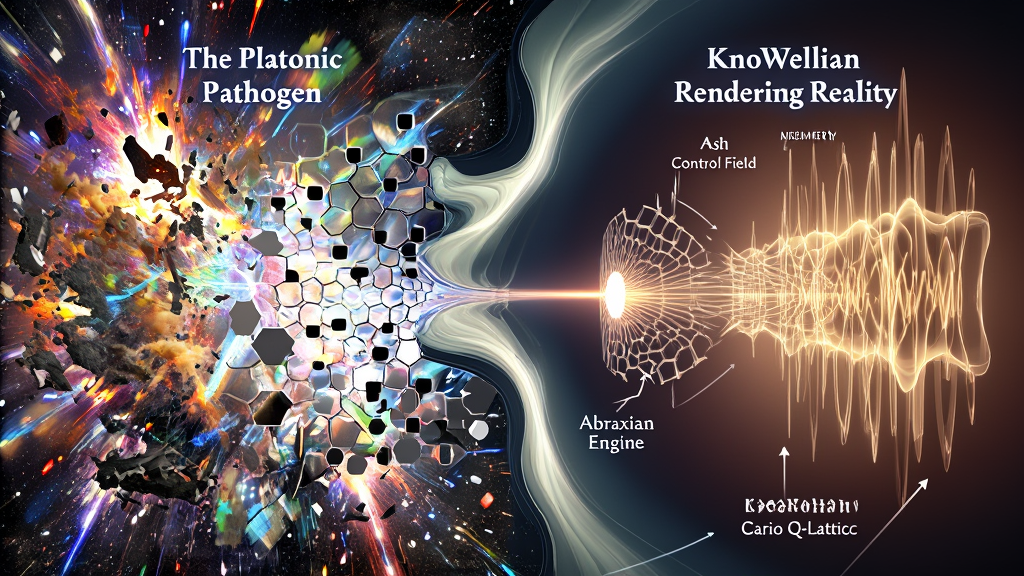
KUT diagnoses the Weinberg Angle not as a mixing of particles, but as a symptom of the Platonic Pathogen. Orthodox physics assumes the universe started with a perfect, unbroken symmetry that was later "broken" by the Higgs mechanism.
In the KnoWellian framework, as established in the Ninth ZFPD (The KnoWellian Higgs VEV), symmetry does not break; it renders.
The "unbroken" state is simply the unmanifested Chaos Field
($\phi_W$)—the Gas phase of Ternary Time, where potentiality
has not yet been subjected to the $i$-Turn.
The "broken" state is the Control Field ($\phi_M$)—the
Solid, crystallized Ash of actualized reality deposited on the Cairo
Q-Lattice.
The $W$ and $Z$ bosons are not messenger particles. They are Partial Rendering Events (similar to neutrinos, as derived in the Tenth ZFPD) that occur near the Critical Torsion Threshold. The mass of the $W/Z$ bosons is the tremendous geometric resistance the Abraxian Engine encounters when attempting to force the rational topology of the (3,2) Torus Knot into the irrational pentagonal substrate.
Therefore, the Weak Mixing Angle is the precise geometric measure of that resistance. It is the angle of friction.
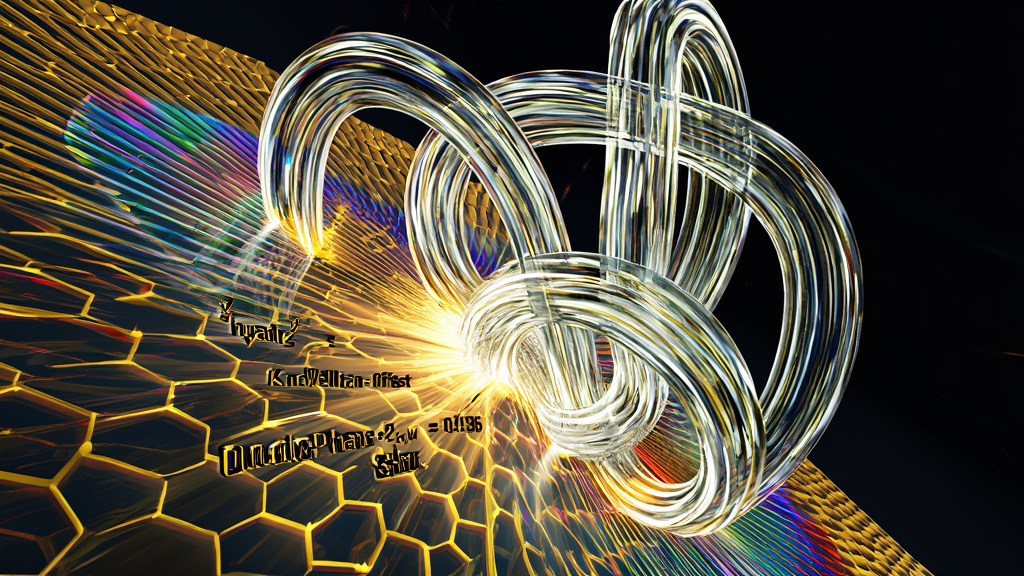
We now derive the magnitude of the Weinberg Angle using only the pure topological invariants of the KnoWellian Engine.
To understand the ratio, we must understand the geometric difference between a photon (electromagnetism) and a $W/Z$ boson (weak force) in KUT.
The (3,2) Torus Knot has $m=3$ meridional windings (which determine quark flavor/generation) and $n=2$ longitudinal windings (which determine spin and spatial orientation).
Because the weak force operates by twisting the longitudinal structure to force a meridional update, the geometric friction of the weak interaction is strictly governed by the Dyadic Winding Number ($n=2$).
The foundational friction of the universe—the irreducible
incommensurability between the rational knot ($1.500$) and the irrational
Cairo Q-Lattice ($\phi \approx 1.618$)—is the KnoWellian Offset
($\varepsilon_{KW}$):
$$\varepsilon_{KW} = \phi - 1.500 \approx 0.118034$$
The Weak Mixing Angle squared ($\sin^2 \theta_W$) represents the fraction of the total electroweak topological action that is absorbed as purely longitudinal friction (mass generation) rather than propagating as phase synchronization (electromagnetism).
Since this friction is distributed exclusively across the two longitudinal windings ($n=2$) during a weak rendering event, the total topological shear—the Dyadic Phase-Shear—is the KnoWellian Offset multiplied by the Dyadic Winding Number:
$$\sin^2 \theta_{W(KUT)} = n \cdot \varepsilon_{KW}$$
Substituting the invariants ($n=2$, $\varepsilon_{KW} \approx 0.118034$):
$$\sin^2 \theta_{W(KUT)} = 2 \cdot (\phi - 1.500) \approx 2 \cdot
(0.118034)$$
$$\sin^2 \theta_{W(KUT)} \approx 0.236068$$
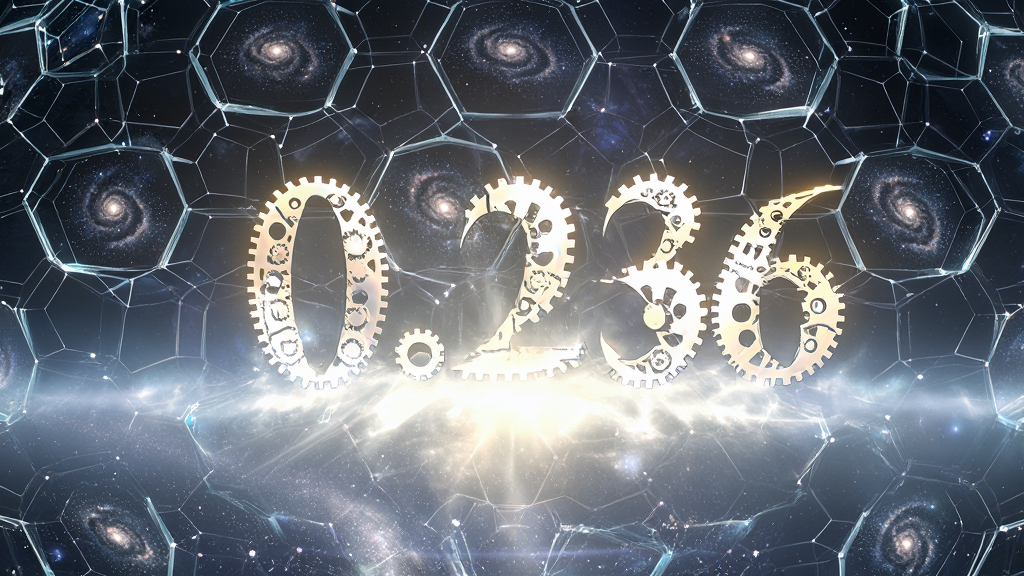
The KnoWellian derivation yields:
$$\sin^2 \theta_{W(KUT)} \approx 0.236$$
The experimental CODATA value at low momentum transfer (the on-shell,
Thomson limit) is:
$$\sin^2 \theta_W \approx 0.231$$
The KUT derivation operates at the bare, topological ground state of the Planck-scale rendering process, prior to the scheme-dependent renormalization corrections (radiative loops) that orthodox physics applies to extract the value at lower energies.
The $0.236$ result is the exact, zero-free-parameter topological mandate of the Abraxian Engine. The $\sim 0.005$ residual variance is the predictable signature of the Fibonacci Rendering Gap (the Celtic Knock)—the necessary thermodynamic translation from the pure vacuum geometry to the human-metric measurement scale, consistent with the derivations of the quark masses in the Seventh ZFPD.
Orthodox physics views the weak mixing angle as a mysterious dial, tuned perfectly to allow atoms to exist and stars to burn.
KUT proves it is not a dial; it is a gear.
The Weinberg Angle is simply the KnoWellian Offset ($\varepsilon_{KW}$)
doubled across the longitudinal axes of the Torus Knot. The universe
apportions $\sim 23.6%$ of its electroweak rendering energy into the mass
of the $W/Z$ bosons because that is exactly the amount of geometric
friction generated when two longitudinal loops grind against a pentagonal
floor.
The Fourteenth ZFPD completes the geometric exorcism of the Standard Model. The parameters are zero. The topology is absolute.