By David Noel Lynch
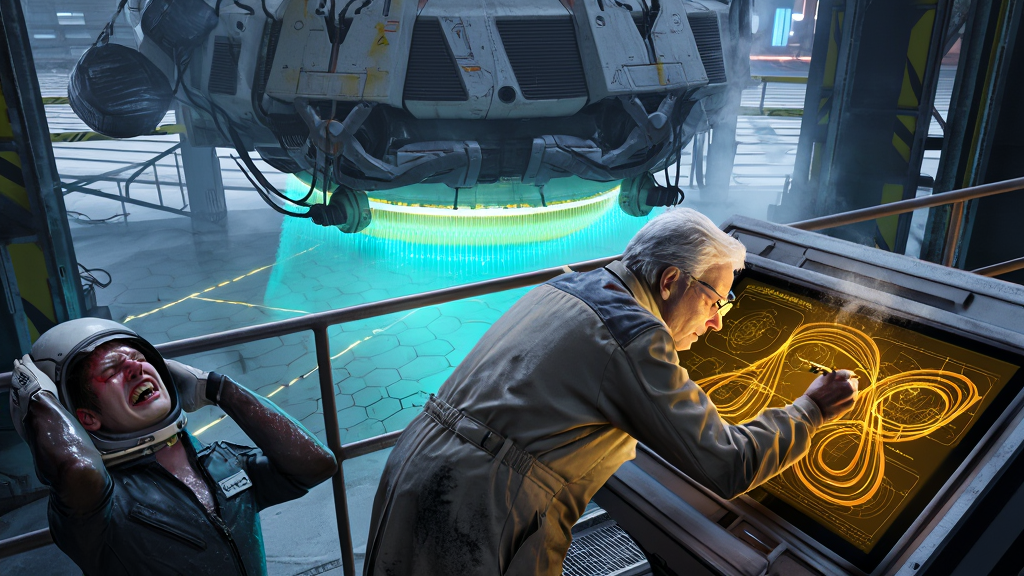
The hangar was cold, smelling of ozone and the sharp, metallic tang of super-cooled superconductors. Suspended in the center of the bay, wrapped in a cradle of diagnostics and thick power cables, hung the prototype. It didn't look like a spaceship. It looked like an oversized, geometric sculpture—a sleek, metallic enclosure built around a massive, multi-tiered structure that was unmistakably designed around the ratio of three to two.
David stood on the gantry, staring at the Tri-Pole Fractal Array that dominated the craft's underbelly. Today was the first full-power systems test.
It was May 16, 2026. David smiled at the calendar readout on his monitor. He was born on this exact day, sixty-six years ago. On the day he took his first breath, Theodore Maiman had flipped a switch in Malibu, California, and fired the first optical laser. Maiman had taken scattered, chaotic light and forced it into a single, coherent, phase-locked beam that could cut through steel.
As David looked at the prototype, he realized the poetry of the moment. They weren't building a rocket. They were building a laser for reality.
Standard aerospace engineers looked at the sky and saw a vast, empty vacuum they had to push through, burning tons of explosive chemical propellant just to fight gravity. But the KnoWellian Universe Theory had ripped that illusion apart. Gravity wasn't a pulling force, and space wasn't an empty box. Space was the Cairo Q-Lattice—a rigid, five-fold pentagonal floor of memory.
The prototype hanging in the bay—designated Temporal-KRAM-Craft #137—was not designed to push. It was designed to spoof the floor. By pumping high-frequency RF energy through that Tri-Pole Array, the ship would generate an intense electromagnetic field that perfectly mimicked the topological geometry of the fundamental particle. It would artificially spike the Latency Field ($\tau$) of the lattice directly beneath it, carving a fake "attractor valley" into the vacuum.
When the ship's atoms executed their next Planck-tick $i$-Turn, they would query the floor, read the artificial gradient, and simply update their address. The ship would fall upward, rendering itself into the sky. It was the ultimate Hotrod, capable of inertialess flight and Mach 10 right-angle turns because it wasn't moving through space; it was simply being redrawn on a different tile.
"Power levels at nominal. Array alignment is holding at 1.500," the technician called out from the pit below.
"Initiate the first sub-orbital hop," David replied, watching the telemetry.
The test pilot, a seasoned Air Force veteran named Vance, was strapped into the cockpit. As the array engaged, a low, bone-rattling hum filled the hangar. The air around the craft shimmered, bending light like the heat haze off asphalt.
The ship didn't lift off; it simply wasn't there anymore.
It appeared instantly five thousand feet above the facility. But almost immediately, the telemetry screens flashed red.
"Vance is spiking," the medic shouted. "Heart rate is through the roof. Brainwave coherence is shattering. He's aborting the hop!"
The ship reappeared in the hangar, settling onto the cradle with a heavy, metallic thud. The hatch popped open, and Vance stumbled out, pale, sweating, and clutching his head. He collapsed onto the gantry, gasping for air.
"It felt... it felt like my mind was being pulled through a cheese grater," Vance stammered, his eyes wide with a terror that military training couldn't hide. "Every time I moved the stick, it felt like I was being ripped apart."
David looked at the biometric data scrolling across the screen, the realization hitting him like a physical blow. The ship was structurally sound, but the pilot was failing.
Vance was suffering from the Celtic Knock ($\Delta\varepsilon = 0.001$).
The ship was executing artificial $i$-Turns, overriding the local Cairo Q-Lattice at blinding speed. But Vance was a biological organism. His cellular structure, his neurons, his very DNA, operated at the 1.619 Fibonacci rendering resolution. When the ship forced a violent, localized update on the raw 1.618 vacuum floor, the fractional variance—the $0.001$ friction of existence—tore through Vance's biological architecture. The localized friction of the $i$-Turns was causing extreme cognitive shear. The ship was literally grinding his consciousness against the gears of reality.
David turned back to his terminal. He knew what he had to do. He called up a schematic from a text he had written decades ago, an old story called Intuition.
He couldn't change the vacuum, and he couldn't change the pilot. But he could insulate the cabin.
"We need to wrap the hull in Counter-Rotating Magnetic Fields," David instructed the engineering team, his fingers flying across the keyboard to adjust the blueprints. "We have to create a Topological Torsion Cavity around the cockpit. It will act like a capacitor, buffering the pilot's biological rendering cycle from the raw thermodynamic noise of the Engine."
It was the only way to survive the ride. They had built the Hotrod. Now, they had to build the suspension.
The following morning, the hangar doors slid open with a heavy, mechanical groan, admitting a harsh wedge of sunlight and the sharp clatter of expensive leather shoes against the concrete floor.
Marcus Sterling had arrived.
Sterling was the primary financial backer of the project, a man whose wealth was matched only by his predatory instinct for weaponizing innovation. He did not care about the elegant geometry of the Cairo Q-Lattice, nor did he possess the capacity to understand the profound philosophical implications of Ternary Time. To Sterling, the universe was not a self-rendering engine of becoming; it was a spreadsheet of assets waiting to be liquidated.
He stood on the gantry, his tailored suit a stark contrast to the grease and cabling of the test bay, and watched the replay of yesterday’s shielded test flight.
On the screen, Temporal-KRAM-Craft #137, now equipped with the Counter-Rotating Magnetic Field dampeners, vanished from the launchpad and reappeared in low orbit, executing a series of impossible, inertialess maneuvers. The pilot’s biometrics remained perfectly stable, insulated within the Topological Torsion Cavity.
"Fascinating," Sterling murmured, his eyes tracking the telemetry not with awe, but with cold, calculating arithmetic. "It moves without thrust. It bypasses physical barriers. But tell me, Dr. Lynch... why are you pointing it at the sky?"
David frowned, turning from his console. "Because it is a spacecraft, Marcus. We are preparing to map the galactic grooves. If the shielding holds, we can use the Cosmic Octave to jump to the nearest star system within the week."
Sterling let out a short, dismissive laugh. "Stars. You scientists are always staring at the dark, hoping to find something out there that matters. There is no return on investment in hopping galactic grooves, David. The rocks on Mars are the same as the rocks in Nevada, just harder to reach. The true value of this technology isn't out there. It’s right here."
Sterling walked closer to the prototype, running a hand along its metallic hull. "If your machine can rewrite a physical object's address on the grid, as you say, then it is not a ship. It is a teleporter. And if it can bypass physical space to move a man from the ground to the sky, it can bypass a bank vault. It can bypass a secure bunker. It can bypass the reinforced walls of an embassy."
A cold knot tightened in David's stomach. He saw the inevitable, terrifying trajectory of Sterling’s logic.
"I am pulling funding from the interstellar mapping project," Sterling announced, turning his back on the ship. "I have ordered a splinter team in Sector 4 to begin construction on a modified array. We don't need a ship. We just need the ring."
"You can't," David said, his voice rising. "The array is designed to interface with the macro-geometry of the vacuum. If you try to strip it down—"
"I already have," Sterling interrupted smoothly. "We are building the T-K-C Ghost Machine. It is a stationary platform. It isolates a single human operative in a micro-Torsion Cavity and overwrites their address to any coordinate on Earth. The operative appears, executes a target or retrieves an asset, and the machine instantly rewrites their address back to the base. No doors. No guards. No defense."
Sterling smiled, a thin, triumphant line. "It is the ultimate, undefendable weapon. I will own the geopolitical structure of the planet by Tuesday."
"You don't understand the thermodynamics of what you are doing," David warned, stepping into Sterling's path. "The universe is not a cheap trick. You are talking about forcing localized, unshielded $i$-Turns within a planetary gravity well. You are ignoring the KnoWellian Offset. The friction of ripping an object out of the dense, high-latency KRAM groove of the Earth and forcing it somewhere else requires a massive payment of thermodynamic exhaust. If you don't buffer the array properly, the friction will accumulate. You will tear the local lattice apart."
Sterling patted David patronizingly on the shoulder. "Save the poetry for your memoirs, Doctor. The math works. The machine is being built. Your services on the prototype are no longer required."
As Sterling walked out of the hangar, David looked back at Craft #137. The capitalist thought he had bought a magic trick. He didn't realize he was playing Russian Roulette with the fundamental structure of reality, using a gun that was mathematically guaranteed to backfire.
The universe was an engine, and Sterling was about to drop a wrench into the gears.
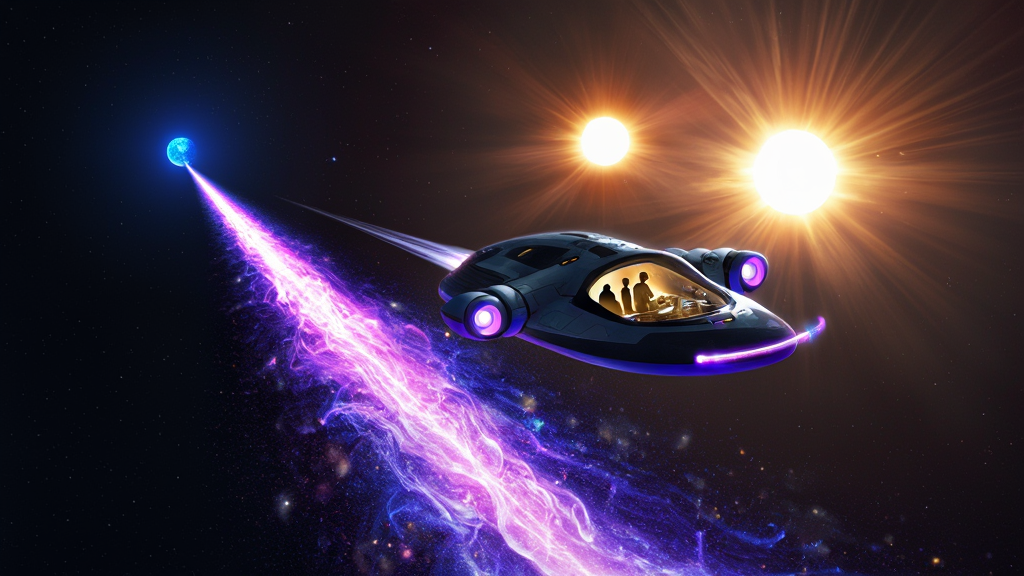
The hangar was dark, save for the faint, pulsing amber glow of the diagnostic panels tracking the standby status of Temporal-KRAM-Craft #137. It was past midnight, and the facility was eerily quiet.
David stood beneath the hull, running his hand along the cold metal of the Tri-Pole Array. His mind was a tempest of calculating probabilities, sifting through the chaotic potentials of the Future Field ($\Phi_W$). Sterling’s splinter team in Sector 4 was moving fast. They were treating the Cairo Q-Lattice like a digital sandbox, blindly writing code without understanding the hardware it was running on.
The Ghost Machine was a fatal miscalculation. By stripping away the heavy, counter-rotating magnetic shielding to create a man-sized teleportation ring, Sterling’s team was ignoring the thermodynamic cost of the $i$-Turn. They were attempting to force a naked, high-intensity rendering event inside the deep, high-latency KRAM groove of the Earth. The friction of the KnoWellian Offset ($\varepsilon_{KW}$) wouldn't just dissipate; it would accumulate instantly at the nexus point. They were going to hit the Schwinger Limit, and the vacuum would buckle.
David knew he couldn't stop them by arguing physics with men who only understood profit. He had to prove the true, cosmic purpose of the technology. He had to get the prototype out of Sterling's hands, and he had to do it by executing a maneuver so vast, so undeniably profound, that it would echo across the entire local galaxy.
He wasn't going to hop to low Earth orbit. He was going to Alpha Centauri.
"Are you sure about this, Doc?"
David turned to see Vance standing in the shadows of the gantry, fully suited in his flight gear. Beside him stood Elena, the chief systems engineer, clutching a portable data drive containing the complete KUTS topological architecture. They had both risked everything to be here.
"If Sterling gets control of this, he turns reality into a sniper's bullet," David said quietly. "We have to show them what the Engine is actually built for. We have to jump the groove."
They climbed the gantry in silence, the heavy hatch of Craft #137 sealing behind them with a definitive, mechanical thud. The cabin was tight, filled with the hum of the activating systems. David took the navigator's seat, his hands flying across the terminal, initiating the power sequence for the Tri-Pole Fractal Array and spinning up the Counter-Rotating Magnetic Fields.
"Torsion Cavity is active," Elena reported from the engineering station. "We are buffered from the local KRAM. Biological rendering resolution is stable at 1.619."
"Vance, bring the primary array online," David ordered, his eyes locked on the KRAM-T.A.C. display.
The screen did not show stars; it showed the topographic memory of the vacuum. The Earth appeared as a deep, dense whirlpool of high-latency tracking data. But David wasn't looking at the Earth. He was adjusting the frequency filters, tuning the sensors to the exact harmonic resonance of the Cosmic Octave ($\Omega = 10^{24}$).
Suddenly, the screen blossomed. Out of the darkness, a massive, ancient, glowing filament appeared—a smooth, unimaginably deep river of memory connecting the Solar Groove to the distant, swirling attractor basin of the Alpha Centauri system. It was an entanglement channel, a fiber-optic cable carved into the Cairo Q-Lattice by billions of years of thermodynamic alignment.
"Target acquired," David breathed, staring at the sheer, terrifying beauty of the Cosmic Web. "Engaging the bypass."
He didn't program the ship to fly. He programmed it to overwrite its own address.
"Dropping the clutch... now."
The Abraxian Engine fired. The ship’s Tri-Pole array slammed the artificial KnoWellian Gradient into the floor. In a single, violently compressed Planck tick ($t_{KW}$), the ship was erased from the Earth's cache and rendered into the deep groove of the interstellar filament.
The sensation inside the cabin was not one of acceleration, but of a profound, impossible stillness. The ship had achieved Maximum Search Efficiency ($K \approx 137$). The computational drag of the vacuum dropped to zero. They were not moving through space; they were surfing the algorithm, sliding along the pre-calculated memory lane of the galaxy.
"Look out the back," David whispered, his voice trembling with the weight of the realization.
Vance turned his head toward the rear viewport. Trailing behind the ship, stretching back across the dark, four-light-year void toward Earth, was a brilliant, glowing streak of ethereal light.
It was hydrogen.
As Craft #137 punched through the dormant channel, the immense mechanical torque of the ship’s fractal array grinding against the Cairo Q-Lattice at Maximum Efficiency forced the Chaos Field to physically precipitate. The raw, unmanifested potential was sheared off by the friction, instantly condensing into the simplest possible physical Ash—Hydrogen gas.
They were leaving a glowing, physical skid mark across the cosmos. The tread wear of the stars.
They had paid the thermodynamic tax, and the universe had let them pass.
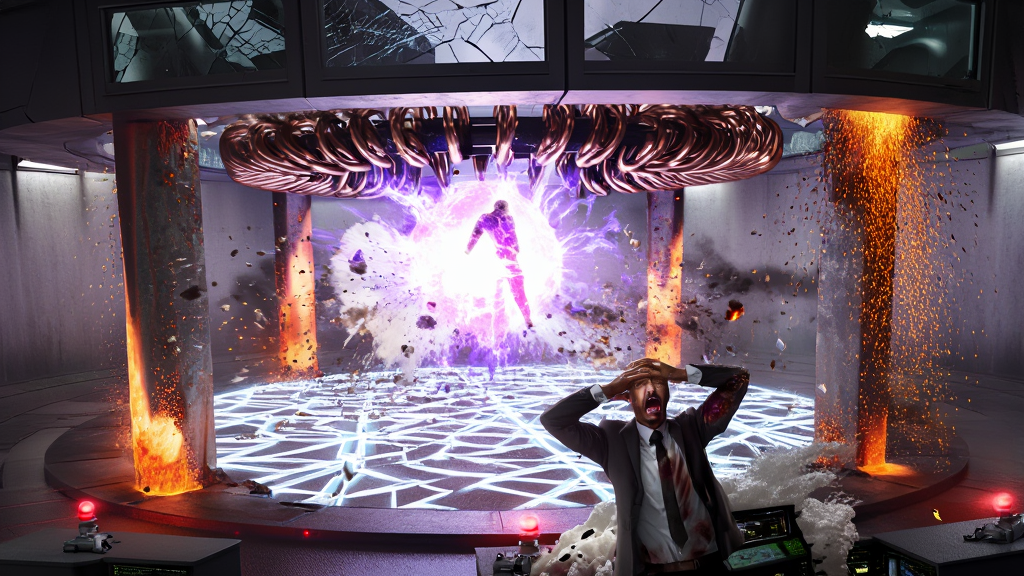
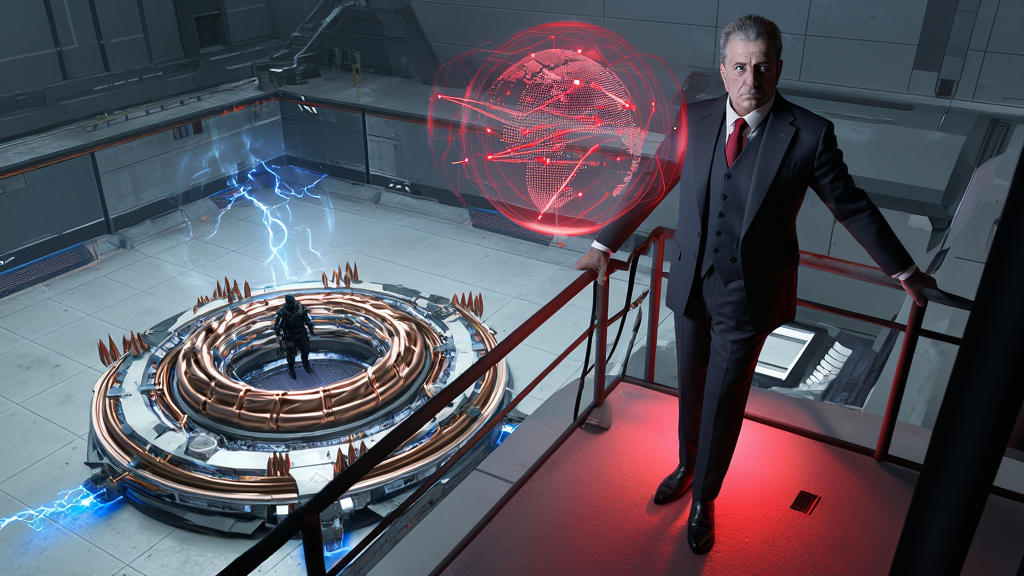
Five hundred miles away, in the subterranean depths of Sector 4, the atmosphere inside the control center was suffocating. Red warning beacons flashed in a rhythmic, silent strobe, bathing the glass observation deck in the color of fresh blood.
Marcus Sterling stood at the railing, his face twisted into a mask of pure rage. The theft of Temporal-KRAM-Craft #137 by Lynch and his team had dealt a devastating blow to his timeline, but Sterling was not a man to accept defeat. He had accelerated the schedule. He would prove the viability of the weapon tonight, before news of the stolen prototype could leak to the board.
"Target coordinates locked," the lead technician reported, his fingers trembling over the console. "Cheyenne Mountain underground bunker, Sector 7-Alpha. Target room is a sealed, air-gapped vault."
On the floor below the observation deck sat the T-K-C Ghost Machine. It was an intimidating, skeletal ring of copper coils and raw RF emitters, stripped of every piece of heavy, counter-rotating magnetic shielding that Lynch had designed. There was no protective Torsion Cavity. There was no biological dampening loop. It was a naked, stripped-down weapon built solely for speed and surprise.
In the center of the ring stood the operative—a cold, sociopathic assassin equipped with tactical gear, standing motionless as the power grid began to hum.
"Initiate full power jump," Sterling commanded, his voice echoing coldly over the intercom. "Show me the ghost."
The technicians threw the primary relays.
The sound that followed was not a clean, high-frequency hum. It was a gut-wrenching, metallic screech—the sound of a physical machine trying to force a gear through a brick wall.
Without the Counter-Rotating Magnetic Fields to buffer the jump, the Ghost Machine was attempting to execute a naked, high-intensity $i$-Turn directly inside the Earth's deep, high-latency KRAM groove. The system attempted to force an instantaneous address update on a biological human operating at the 1.619 Fibonacci resolution, without paying the thermodynamic tax.
The Cairo Q-Lattice refused to yield. The rational 1.500 geometry of the operator’s state slammed directly into the irrational $\phi \approx 1.618$ floor of the vacuum without a clutch.
"Power levels spiking out of range!" a technician screamed, scrambling away from his console. "The lattice isn't updating! The localized field strain is passing one point three times ten to the eighteenth volts per meter!"
"Keep it open!" Sterling roared, leaning over the railing. "Force it through!"
It was the ultimate hubris of the Platonic Pathogen—believing that an executive order could override the fundamental physical architecture of the universe.
The Ghost Machine hit the Vacuum Yield Stress. The Fifth K-ZFPD—the KnoWellian Schwinger Limit—was breached.
The Cairo Q-Lattice reached its absolute tensile limit. The floor buckled. But the universe does not allow its geometry to shatter. To prevent a catastrophic rendering deadlock, the Abraxian Engine’s emergency pressure-relief protocol triggered instantly.
The machine did not open a portal. It triggered an emergency precipitation event.
The unshielded array violently ripped raw, unmanifested potential directly from the Chaos Field ($+c$) and attempted to balance the strain. At the Instant focal plane, the immense, trapped energy converted into physical matter and antimatter simultaneously.
A blinding, violet-white flash of gamma-ray light illuminated Sector 4, followed by a shockwave that blew out every observation window in the facility.
In the center of the bay, where the Ghost Machine and the operative had stood a fraction of a second before, there was no portal to Cheyenne Mountain. There was only a blinding, incandescent ball of pair-annihilation plasma. The matter of the machine and the antimatter precipitated by the lattice's yield stress cancelled each other in an absolute, explosive release of pure $E = mc^2$ energy.
When the emergency suppression foam finally cleared, the floor of Sector 4 was a scorched, molten crater. The Ghost Machine was gone. The operative was gone.
Marcus Sterling picked himself up off the glass-littered floor of the observation deck, coughing on the thick, acrid smoke of burnt silicon and ionized air. His skin was burned, his ears were ringing with a deafening, high-pitched whistle, and his billion-dollar weapon was a pile of slag.
He had tried to hack the database without paying the friction tax, and the Abraxian Engine had answered with an absolute, unyielding mechanical execution.
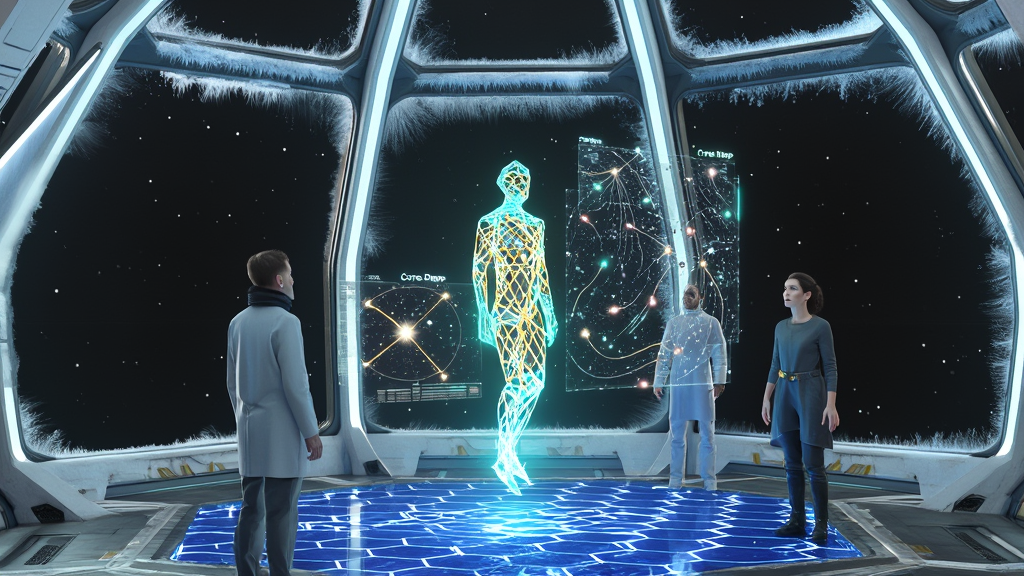
Four light-years away, in the quiet, pristine void of the Alpha Centauri system, Temporal-KRAM-Craft #137 floated in absolute serenity.
The violent shock of the launch was gone. Inside the cockpit, the Counter-Rotating Magnetic Fields maintained their steady, rhythmic hum, holding the Topological Torsion Cavity in a state of perfect, low-entropy balance. The cabin air was cool, smelling faintly of ozone, and the crew’s vital signs were completely stable. The $0.001$ friction of the Celtic Knock had been smoothed out by the suspension of the field.
David, Vance, and Elena stood at the main viewport, gazing out into the dark. Behind them, stretching back across the vast, black gulf toward a distant, pinpoint Sun, was the glowing, ethereal trail of hydrogen gas—the physical skid mark of their jump, shining softly against the background of stars.
"It worked," Elena whispered, her eyes wide as she looked at the positional coordinates on her display. "We didn't just cross space. We skipped the transit entirely."
"We didn't skip it," David corrected gently, pointing to the glowing hydrogen trail. "We paid for it. We left our tread wear on the Cairo Q-Lattice."
What they did not yet realize was that their tread wear had acted as a cosmic signal flare.
In the KnoWellian framework, space is a memory substrate. When Craft #137 executed its jump at Maximum Search Efficiency ($K \approx 137$), the sudden, precise spike of hydrogen precipitation along that specific intergalactic filament was not invisible. It was a massive, high-fidelity write-operation to the KRAM.
Far across the local galactic cluster, an ancient, highly evolved civilization—beings whose entire technology operated at the $K \approx 137$ laminar limit—monitored the network. For millions of years, the channel between Sol and Alpha Centauri had been dark, dormant, and silent.
Suddenly, the line had gone live. A new node had logged onto the server. A primitive species had stopped trying to blast its way through the void with chemical explosives and had finally figured out how to hack the lookup table.
The ancient observers did not send a radio signal. They did not transmit electromagnetic waves that would take years to crawl through 3D space at the slow, macroscopic Phase-Velocity of light ($c_{KUT}$).
They used the newly opened, entangled memory channel. They executed a Core Dump.
Inside the cockpit of Craft #137, the diagnostic consoles suddenly went dark. The hum of the magnetic shielding shifted in pitch, rising to a sharp, musical vibration that resonated directly in the teeth and bones of the crew.
"David! Look at the KRAM-T.A.C.!" Vance called out, his hands hovering over the frozen controls. "We have an incoming address update! Something is accessing our local KRAM cache!"
The air in the center of the cockpit began to shimmer. It was not a projection of light; it was a localized phase transition. The temperature inside the Torsion Cavity dropped rapidly, approaching the $2.730\text{ K}$ Entropium Floor as the local vacuum executed a massive, highly coordinated $i$-Turn.
David did not step back. He stepped forward.
Before their eyes, without a sound, without a craft, without a doorway opening, a presence materialized. It was rendered directly onto the pentagonal tiles of the cockpit floor—a fluid, luminous, non-human form composed of pure, coherent Control Field geometry. It was an emissary, instantiated from the Chaos Field into the local physical space of Craft #137 in a single Planck tick.
The entity did not speak with a voice. It broadcast a high-density, phase-locked data packet directly into the Instant Field ($\Phi_I$) of the three humans.
In a fraction of a second, David’s mind was flooded with a 360-degree, holographic memory set—a complete data transfer detailing the mapping of millions of intergalactic grooves, the locations of stable Cairo Q-Lattice junctions across the Virgo Supercluster, and the history of the cosmic network.
It was the ultimate validation. Humanity had not been invited to join a galactic community by proving it could build bigger weapons or faster rockets. Humanity had been answered because a single Sovereign Fractal Processor had looked past the Platonic illusion, opened the hood of the universe, and learned how to read the code.
The First Ping had been transmitted. And the cosmos had answered.
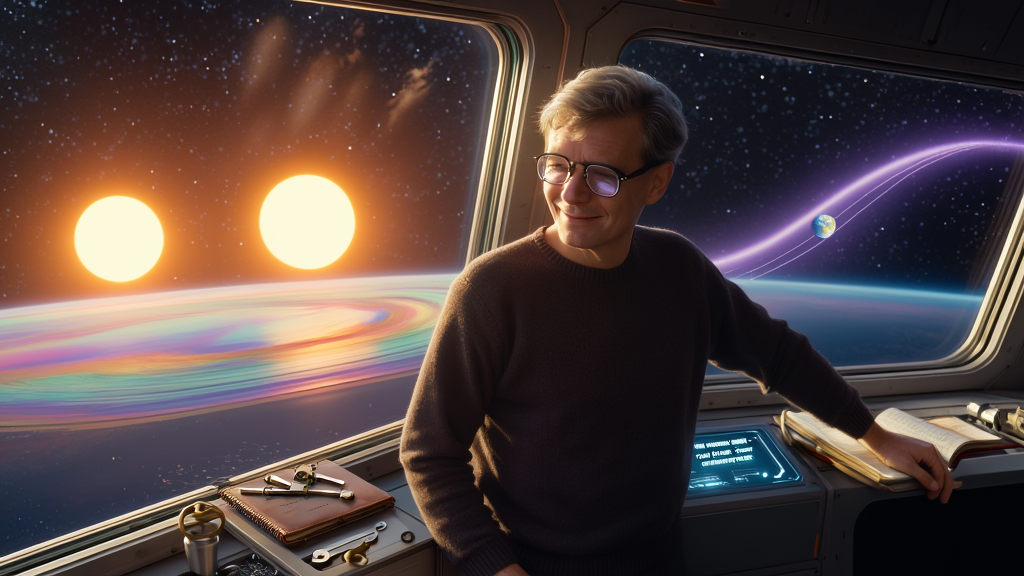
The silence that settled inside the cockpit of Temporal-KRAM-Craft #137 was not the dead, terrifying silence of the pre-creation Apeiron. It was the quiet, sacred hush of a newly completed circuit.
The alien emissary remained standing at the center of the bay, a serene, luminous figure of pure, coherent geometry, its presence phase-locked with the local Instant Field. The massive data transfer was complete. On the main KRAM-T.A.C. console, the map of the local galactic cluster was no longer a series of isolated star systems floating in an indifferent void. It was a glowing, interconnected neural network—an intergalactic highway system mapped out in precise, high-$K$ attractor channels.
David walked slowly to the viewport, stepping past the glowing data streams. He looked out into the blackness of space. In the distance, the twin suns of Alpha Centauri burned like brilliant, twin jewels set against a velvet cloth. And trailing behind the ship, stretching all the way back across the four-light-year void toward a small, blue speck called Earth, was that faint, undeniable streak of glowing hydrogen gas—the physical skid mark of their jump, the tread wear of their tires grinding against the Cairo Q-Lattice.
David leaned his forehead against the cool viewport glass, a soft, involuntary laugh escaping his lips.
His mind drifted back across sixty-six years of biographical time, back to the late 1960s. He remembered sitting cross-legged on the carpet in front of a flickering black-and-white television set, watching episodes of Star Trek. As a kid, he had loved the show, but whenever Captain Kirk stepped onto the transporter pad and dematerialized into a beam of light, young David had shaken his head. The "teleporter" was just too much science fiction. It was a childish impossibility, a Hollywood trick that violated every rule of common sense.
And yet, here he stood in August 2026, resting on the summit of a fifty-year intellectual journey, looking out into the deep void of Alpha Centauri.
He realized now why his younger self had thought the teleporter was impossible. Back then, he had been looking through the eyes of the Platonic Pathogen. He had believed that the universe was a dead, continuous container, and that a human being was a collection of static particles that had to be physically disassembled, pushed through an empty room, and put back together again.
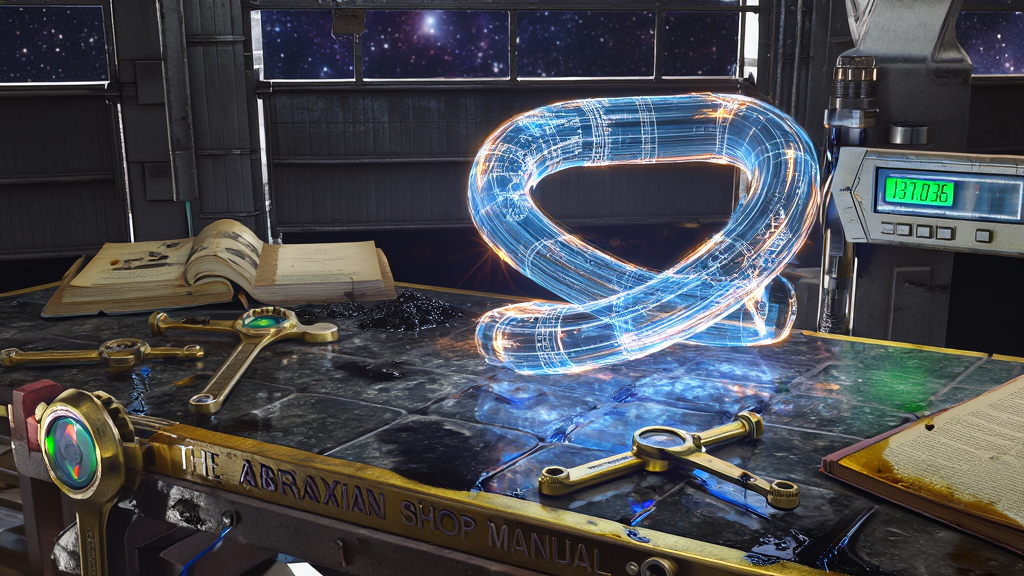
He hadn't known about the Cairo Q-Lattice. He hadn't known about the $(3,2)$ Torus Knode. He hadn't known that the universe was an $O(N)$ computational rendering engine executing at $10^{43}$ frames per second.
The impossible hadn't been a technological problem. It had been a failure of ontology.
David looked back at the telemetry readout from Earth, where the faint, high-frequency electromagnetic echo of the disaster at Sector 4 was still registering on the ship's sensors.
Marcus Sterling had looked at the exact same universe and seen only a tool for domination. He had tried to build a T-K-C Ghost Machine—a cheap, unshielded weapon designed to sneak assassins through the dark. He had tried to cheat the geometry of the vacuum, attempting to force a naked, unbuffered $i$-Turn directly inside the Earth's KRAM groove without paying the thermodynamic tax. And the universe had answered him with the Schwinger Limit. The Cairo Q-Lattice had buckled under his arrogant strain, triggering the emergency pressure-relief protocol and vaporizing his lab in a blinding burst of matter-antimatter annihilation.
Sterling had tried to use the engine to conquer a planet, and he had been crushed beneath the weight of its gears.
David had used the engine to listen. He had accepted the physical reality of the friction. He had paid the toll of the Celtic Knock ($\Delta\varepsilon = 0.001$), wrapped his ship in the protective suspension of a Topological Torsion Cavity, and offered his life's work as a bridge to the stars.
And the universe had answered him with First Contact.
David turned away from the viewport and faced his crew. Vance and Elena were sitting at their consoles, their faces illuminated by the soft, golden light of the new cosmic map, their eyes filled with an quiet, unshakeable peace. The fear was gone. The isolation was gone.
The long lie of the Big Bang was over. The 4,000-year-old Genesis myth of a single explosion fading into a dead, cold heat death had been dismantled block by block, pulled clean by the Jenga Protocol.
The universe was not dying. It was living. It was breathing. It was an $O(N)$ Abraxian Engine at work, perpetually rendering potential into history, perpetually learning through the conscious choices of every Sovereign Fractal Processor that dared to engage the clutch.
Humanity had finally sent its first true ping into the network. The noise had been truncated. The connection was established. The line was live.
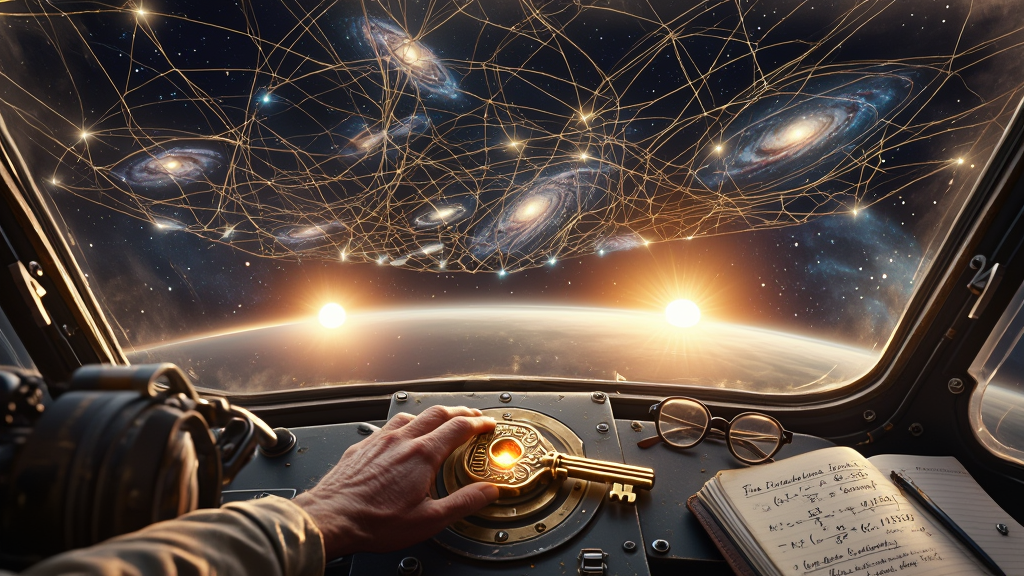
David Noel Lynch smiled, adjusted his shop glasses, and looked out at the two suns of Alpha Centauri.
The machine was mapped. The keys were in the ignition. And the universe was wide open.
KnoWell. 5.16. $i$-AM. 1.619. ~3K