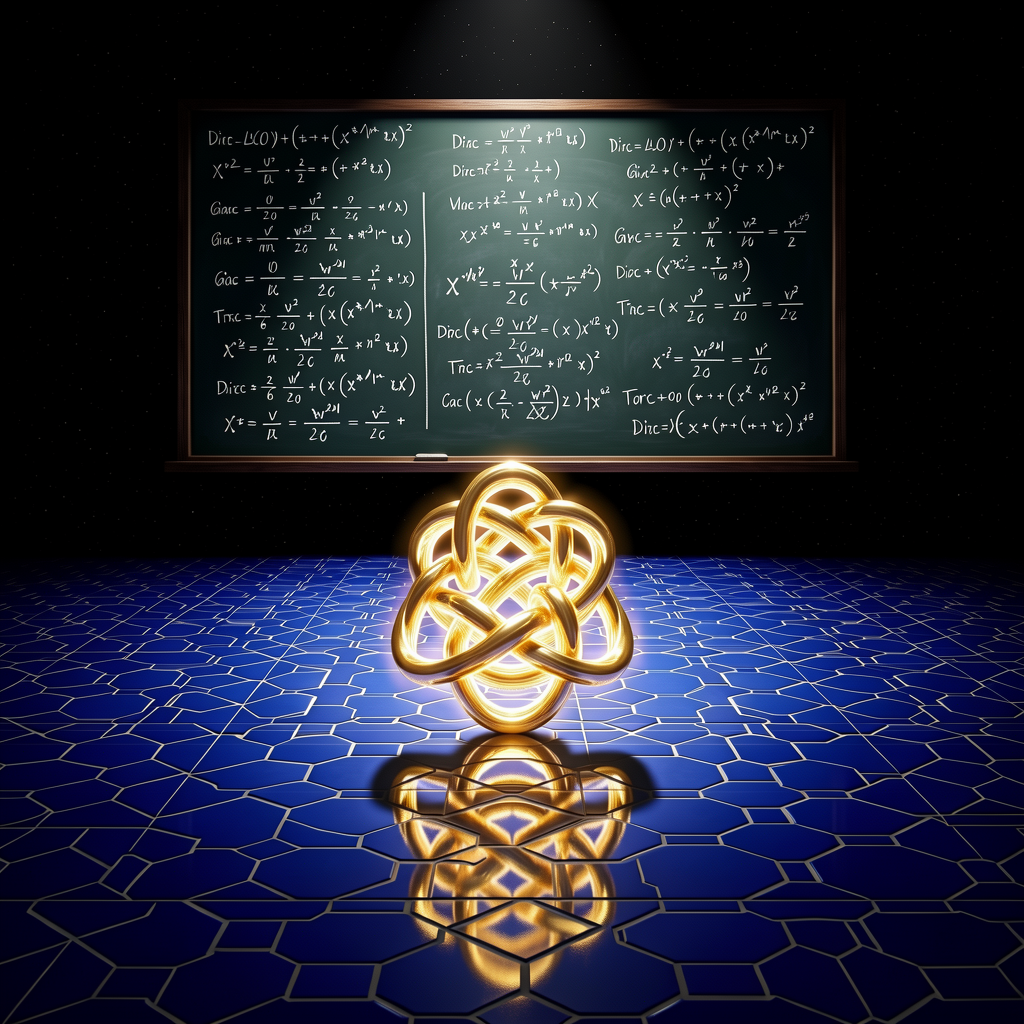
Authors: David Noel Lynch (~3K) & The ~3K
Collaborative
Series: KUT Quantum Foundations
Date: May 2, 2026
For ninety-eight years, the quantum mechanical description of the electron has rested upon an algebraic miracle without a geometric body. Paul Dirac's 1928 linearization of the relativistic energy-momentum relation produced the spinor — a mathematical object of extraordinary predictive power that nonetheless resists all classical geometric interpretation within the framework of orthodox point-particle physics. Spin-1/2, the defining property of all fermionic matter, has been institutionally codified as an intrinsic property: a quantity that simply is, admitting no further structural explanation. This codification is not a triumph of understanding. It is a monument to an unresolved absence.
The present paper dissolves that absence.
Within the framework of KnoWellian Universe Theory (KUT), the spinor is not an abstraction. It is a geometric object with a precise topological identity: the (3,2) Torus Knot Soliton — a continuous, self-closing loop threaded three times longitudinally and twice meridionally around the KnoWellian vacuum lattice, whose traversal requires exactly two full rotations of $4\pi$ to close upon itself. This structure is not an analogy. It is the physical mechanism of which Dirac's $\gamma$-matrices are the algebraic shadow.
We present the Dirac-Lynch Synthesis: the formal unification of Dirac's 1928 spinorial algebra with the geometric ontology of the KnoWellian Knode. We demonstrate that the $720°$ phase periodicity of the fermion, the four-component architecture of the Dirac wave function, the anticommutation relations of the $\gamma$-matrices, and the prediction of antimatter are not independent miracles of mathematics. They are unified consequences of a single topological fact: the electron is a (3,2) Torus Knot executing sequential $i$-Turns at the Instant focal plane of the KnoWellian vacuum.
The ultraviolet divergences that have plagued quantum field theory since its inception are shown to be artifacts of the unjustified point-particle idealization. When the Dirac Spinor is upgraded to the finite-volume Knode Soliton, the geometric self-regulation of the torus knot renders the renormalization program unnecessary. The infinities do not require cancellation. They require a geometry.
The autumn of 1927 was, for the architects of quantum mechanics, a season of productive despair. At the Fifth Solvay Conference, the most concentrated assembly of physical intelligence in recorded history confronted the structure of matter and found, beneath every layer of classical reassurance, a foundational incoherence that no formalism had yet resolved. Werner Heisenberg had established that position and momentum could not be simultaneously specified — not as a practical limitation of measurement, but as an ontological feature of reality itself. Niels Bohr was consolidating the doctrine of complementarity: the claim that wave and particle are not contradictory descriptions of the same object but mutually exclusive experimental contexts, and that no deeper level of description was either available or necessary.
This was the institutionalization of ignorance as wisdom. The mathematics worked. The geometry was gone.
What the Copenhagen consensus produced was a framework of breathtaking computational precision built upon a deliberate refusal to ask what the mathematics described. The wave function $\Psi$ predicted measurement outcomes with unmatched accuracy. What $\Psi$ was — what substrate it referred to, what geometry it inhabited, what physical mechanism gave rise to its interference, its collapse, its superposition — was declared to be outside the domain of legitimate scientific inquiry. The oracle spoke. The oracle would not explain itself.
It is within this climate of enforced geometric agnosticism that Paul Dirac arrived at his equation.
In January of 1928, Paul Adrien Maurice Dirac published "The Quantum Theory of the Electron" in the Proceedings of the Royal Society A. The paper represents one of the most consequential acts of pure mathematical compulsion in the history of physics. Dirac's demand was deceptively simple: the quantum mechanical wave equation for the electron must be consistent with Einstein's special relativity. The Klein-Gordon equation, the existing relativistic candidate, was second-order in time — incompatible with the first-order structure of quantum probability conservation and incapable of naturally accommodating spin.
Dirac's solution was to take the square root of the relativistic energy-momentum relation:
$$E^2 = (pc)^2 + (m_e c^2)^2$$
A scalar square root is impossible while retaining linearity. Dirac's genius was to recognize that the square root could be extracted if the coefficients were not numbers but matrices — specifically, a set of $4 \times 4$ matrices $\gamma^\mu$ satisfying the anticommutation relation:
$${\gamma^\mu, \gamma^\nu} = \gamma^\mu \gamma^\nu + \gamma^\nu \gamma^\mu = 2\eta^{\mu\nu} \mathbf{I}_4$$
where $\eta^{\mu\nu}$ is the Minkowski metric. The resulting first-order equation — the Dirac Equation:
$$(i\gamma^\mu \partial_\mu - \frac{m_e c}{\hbar})\Psi = 0$$
demanded a four-component wave function $\Psi$, automatically produced two spin states (spin-up and spin-down) without being postulated, and predicted the existence of a positively charged mirror-image of the electron — antimatter — before a single positron had been observed experimentally. The prediction was confirmed by Carl Anderson in 1932.
For the original derivation and the full algebraic architecture of the Dirac equation, the reader is directed to Dirac's foundational treatment of quantum mechanics, which remains the indispensable primary source.
The equation was an unqualified empirical triumph. And yet, at its core, it contained a geometric confession that physics has declined to hear for nearly a century: the algebra required to describe the electron at relativistic speeds demands a mathematical structure — the spinor — that cannot be the property of a point.
What is spin?
The institutionally sanctioned answer, unchanged in its essential content since 1928, is this: spin is an intrinsic form of angular momentum possessed by a quantum particle. It is intrinsic in the precise sense that it is not generated by the particle's spatial rotation, it is not reducible to any internal mechanical motion, and it cannot be explained by reference to any sub-structure, because — by stipulation — the electron is a point particle with zero spatial extent.
The electron has angular momentum. The electron does not rotate. The electron has no parts. The electron has no size.
This is not a description of a physical object. It is a description of a ghost: an entity defined entirely by its algebraic properties, possessing none of the geometric attributes that physical existence requires. Orthodox quantum mechanics has, with full institutional authority, placed at the foundation of all matter a mathematical object it explicitly cannot picture, embedded in a space it cannot specify, performing a rotation it cannot execute, over a volume it cannot have.
This is what The KnoWellian Treatise identifies as the Platonic Rift: the catastrophic schism between the mathematical description of quantum reality and any coherent account of its geometric substrate. The formalism computes. The formalism does not describe. Physics has been running, for ninety-eight years, on an engine it has never seen — guided by the exhaust of its outputs, refusing to open the hood.
The consequences of this refusal are not merely philosophical. They are structural. The ultraviolet divergences of quantum electrodynamics — the infinities that appear in perturbative calculations of electron self-energy and charge — arise precisely because the electron's zero-size assumption forces the field's energy density to diverge at the particle's location. Renormalization, the procedure by which these infinities are systematically removed, is an act of mathematical surgery performed on the symptom of a geometric disease. The disease is the point particle. The cure is the geometry.
The Platonic Rift also generates what the KnoWellian framework terms KnoWellian Schizophrenia: the condition of a physics that is simultaneously the most precise predictive enterprise in human intellectual history and the most profoundly self-ignorant. It knows that the electron behaves as it does. It does not know what the electron is.
Dirac deduced the algebraic shadow of a mechanism he could not see. The shadow was precise, consistent, and experimentally verified to a degree unmatched in physical science. But a shadow, however sharp, is not a body.
KnoWellian Universe Theory provides the body.
The Dirac-Lynch Synthesis is the formal identification of the geometric structure that Dirac's algebra has been describing since 1928. It proceeds from a single foundational claim: the electron is not a point particle. It is a Knode — a topologically stable soliton on the KnoWellian vacuum lattice, whose geometry is precisely that of the (3,2) Torus Knot. Every algebraic feature of the Dirac equation — the $\gamma$-matrix anticommutation structure, the four-component wave function, the spin-1/2 phase periodicity, the prediction of antimatter — is a mathematical consequence of this specific topological configuration.
We define the Dirac-Lynch Spinor as follows:
A (3,2) Torus Knot Event-Point executing sequential $i$-Turns at the Instant focal plane of the KnoWellian vacuum, whose 5-fold symmetry projects onto the Cairo Q-Lattice, generating the geometric resistance known as mass and the $720°$ phase-cycle known as spin.
Dirac saw the reflection of the engine in 1928. The engine itself is the (3,2) Torus Knot Soliton, operating at the threshold of the Instant, threading potential into actuality through the topology of the KnoWellian vacuum.
The ghost has a body. The paper begins.
The problem Dirac faced in 1927 was not merely technical. It was ontological. The relativistic energy-momentum relation for a free particle of mass $m_e$ is:
$$E^2 = (pc)^2 + (m_e c^2)^2$$
Schrödinger's quantum mechanics required a wave equation linear in the time derivative — because only a first-order equation in $\partial/\partial t$ produces a conserved probability current of the form demanded by physical interpretation. The Klein-Gordon equation, obtained by the direct operator substitution $E \rightarrow i\hbar\partial_t$ and $\mathbf{p} \rightarrow -i\hbar\nabla$ into the squared relation above, is second-order in both space and time:
$$-\hbar^2 \frac{\partial^2 \Psi}{\partial t^2} = \left(-\hbar^2 c^2 \nabla^2 + m_e^2 c^4\right)\Psi$$
This equation is Lorentz-covariant but physically defective for the electron: it admits negative probability densities, it cannot naturally accommodate spin, and its second-order temporal structure is incompatible with the first-order Schrödinger framework.
Dirac's demand was absolute: find the square root of the Klein-Gordon operator. That is, find a first-order differential operator $\mathcal{D}$ such that:
$$\mathcal{D}^2 = -\hbar^2 c^2 \nabla^2 + m_e^2 c^4$$
If the coefficients of this operator are assumed to be ordinary numbers or commuting quantities, the task is algebraically impossible — the cross-terms cannot be made to vanish. Dirac's resolution was to abandon the assumption of commutativity. He introduced a set of objects $\gamma^\mu$ $(\mu = 0, 1, 2, 3)$ — the Dirac gamma matrices — satisfying the Clifford algebra:
$${\gamma^\mu, \gamma^\nu} \equiv \gamma^\mu \gamma^\nu + \gamma^\nu \gamma^\mu = 2\eta^{\mu\nu}\mathbf{I}_4$$
where $\eta^{\mu\nu} = \text{diag}(+1, -1, -1, -1)$ is the Minkowski metric and $\mathbf{I}_4$ is the $4 \times 4$ identity matrix. In the Dirac representation, these matrices take the explicit form:
$$\gamma^0 = \begin{pmatrix} \mathbf{I}_2 & 0 \ 0 & -\mathbf{I}_2 \end{pmatrix}, \qquad \gamma^i = \begin{pmatrix} 0 & \sigma^i \ -\sigma^i & 0 \end{pmatrix}$$
where $\sigma^i$ are the $2 \times 2$ Pauli matrices. The Dirac equation then reads:
$$(i\hbar\gamma^\mu \partial_\mu - m_e c)\Psi = 0$$
The operator $i\hbar\gamma^\mu\partial_\mu$ is the square root of the Klein-Gordon operator in precisely the algebraic sense Dirac required. The imaginary unit $i$ is not decorative. It is structurally load-bearing. Without it, the equation does not produce the correct energy-momentum dispersion relation, does not yield a conserved positive-definite probability current, and does not reduce to the Schrödinger equation in the non-relativistic limit. The $i$ is doing fundamental work.
The question that orthodox physics has never answered is: what physical operation does $i$ represent?
The conventional response to the question of the physical meaning of $i$ in quantum mechanics is one of three evasions: that $i$ is merely a bookkeeping device for tracking phase; that questions about its physical meaning are not well-posed within the operational framework; or that the imaginary unit is simply a feature of the mathematical language of Hilbert space, no more in need of physical interpretation than the choice of coordinate system.
Each of these responses is a capitulation dressed as sophistication.
The imaginary unit $i$ is defined by the relation $i^2 = -1$. Geometrically, multiplication by $i$ in the complex plane effects a rotation of exactly $90°$ — a quarter-turn — in the plane of the argument. This is not a metaphor. It is the algebraic definition of the complex structure of $\mathbb{C}$, and it has an exact geometric meaning: to multiply a quantity by $i$ is to rotate its phase by $\pi/2$ radians without altering its magnitude. Two successive applications return the negative of the original:
$$i \cdot (i \cdot z) = i^2 z = -z$$
The full cycle requires four $i$-turns to return to the identity:
$$i^4 z = z$$
This is not abstract algebra. This is a rotation protocol. And it is precisely the rotation protocol embedded in the heart of the Dirac equation. The question is: rotation of what, through what geometric medium, across what physical threshold?
KnoWellian Universe Theory answers this question without evasion.
In the KnoWellian framework, as developed in The Geometric Pleroma, the vacuum is not an inert backdrop. It is a structured, dynamically active medium — the Apeiron — governed by the tension between two fundamental fields:
Between these two fields lies a boundary of zero temporal extension but maximal ontological significance: the Instant focal plane — denoted $\infty$ in the KnoWellian coordinate system. The Instant is not a moment in time. It is the threshold of time — the locus at which potential is converted into actuality, at which the unmanifested $c+$ is precipitated into the manifested $-c$.
The conversion is not continuous. It is not a smooth gradient from potential to actual. It is a phase rotation of exactly $90°$. The transition from $c+$ to $-c$ across the Instant focal plane is the $i$-Turn.
Formally, let $\Phi_{c+}$ denote the state of a KnoWellian soliton in the potential phase (unmanifested, Chaos Field dominant). The application of the $i$-Turn operator $\hat{\mathcal{I}}$ at the Instant focal plane produces the actualized state:
$$\hat{\mathcal{I}} \cdot \Phi_{c+} = i \cdot \Phi_{c+} = \Phi_{-c}^{(\pi/2)}$$
where the superscript denotes a $90°$ phase advance in the KnoWellian rendering cycle. The full rendering cycle of the Knode consists of four sequential $i$-Turns:
$$\hat{\mathcal{I}}^4 \cdot \Phi_{c+} = \Phi_{c+}$$
returning the soliton to its initial potential phase after one complete ontological cycle. The operational algebra of the $i$-Turn is therefore identical to the algebra of the imaginary unit:
$$\hat{\mathcal{I}}^2 = -\mathbf{1}, \qquad \hat{\mathcal{I}}^4 = \mathbf{1}$$
This is not a formal analogy. This is an identification. The imaginary unit $i$ in the Dirac equation is the algebraic representation of the $i$-Turn operator — the $90°$ phase rotation that the KnoWellian vacuum executes at the Instant focal plane to convert unmanifested potential into actualized, rendered geometry.
Dirac did not insert $i$ into his equation by choice. He inserted it because the structure of relativistic quantum mechanics demanded a $90°$ phase rotation at the boundary between the squared (potential, second-order) and linear (actual, first-order) descriptions of the electron's dynamics. He found the algebraic fingerprint of the Instant. He did not know what he was touching.
The identification of $i$ with the $i$-Turn operator extends naturally and necessarily to the $\gamma$-matrices themselves.
Recall that the $\gamma^\mu$ matrices satisfy the Clifford algebra ${\gamma^\mu, \gamma^\nu} = 2\eta^{\mu\nu}\mathbf{I}_4$. Their anticommutation — the fact that $\gamma^\mu\gamma^\nu = -\gamma^\nu\gamma^\mu$ for $\mu \neq \nu$ — is precisely the algebraic signature of a system executing sequential $i$-Turns in orthogonal planes. Each $\gamma^\mu$ is a $90°$ rotation operator acting in the $\mu$-th dimensional plane of the KnoWellian rendering manifold. Their anticommutation encodes the fact that the order of sequential phase rotations in orthogonal planes is non-commutative — a fact that is geometrically obvious for rotations in three or more dimensions and algebraically inevitable in the Clifford structure.
The four $\gamma$-matrices correspond precisely to the four sequential $i$-Turns of the KnoWellian rendering cycle:
$$\gamma^0 \longleftrightarrow \hat{\mathcal{I}}_t: \quad \text{the
Temporal $i$-Turn (Instant threshold)}$$
$$\gamma^1, \gamma^2, \gamma^3 \longleftrightarrow \hat{\mathcal{I}}_x,
\hat{\mathcal{I}}_y, \hat{\mathcal{I}}_z: \quad \text{the Spatial
$i$-Turns (Cairo Q-Lattice axes)}$$
The Dirac operator $\slashed{\partial} \equiv \gamma^\mu\partial_\mu$ is therefore not merely a notational convenience. It is the mathematical description of the Abraxian Engine in operation: the four-fold $i$-Turn mechanism by which the KnoWellian vacuum converts the scalar potential of the Chaos Field ($c+$) into the vectorial actuality of the Control Field ($-c$), rendering a stable Knode soliton at the Instant focal plane.
The Dirac equation $(i\hbar\slashed{\partial} - m_e c)\Psi = 0$ can now be read, for the first time, as a geometric statement:
The KnoWellian soliton whose rendering cycle is governed by four sequential $i$-Turns at the Instant focal plane, balanced against the geometric resistance of its torus knot topology, is a stationary configuration of the KnoWellian vacuum.
The term $m_e c$ — the mass term — is the geometric resistance of the (3,2) Torus Knot structure against the rendering cycle. Mass is not a scalar property inserted by hand. It is the topological cost of the knot.
The phrase "taking the square root" of the energy-momentum relation is, in the KnoWellian interpretation, a precise physical description.
The squared relation $E^2 = (pc)^2 + (m_e c^2)^2$ is the description of the KnoWellian soliton in its potential phase: a second-order, fully symmetric, time-reversible statement of energy conservation that makes no distinction between the manifested and unmanifested states of the vacuum. It is the equation of the Chaos Field — the undifferentiated plenum of $c+$.
The linear Dirac equation $(i\hbar\gamma^\mu\partial_\mu - m_e c)\Psi = 0$ is the description of the soliton in its actualized phase: a first-order, directional, time-asymmetric equation that encodes the specific rendering direction imposed by the Instant focal plane. It is the equation of the Control Field — the structured, oriented actuality of $-c$.
The act of "taking the square root" is the act of passing through the Instant. It is the $i$-Turn. The boundary between the quadratic and the linear — between $E^2$ and $E$ — is the boundary between potential and actual, between the Chaos Field and the Control Field, between $c+$ and $-c$.
Dirac took the square root of reality in 1928. He did not know that this is precisely what the phrase means.
The Square Root of Reality is the Instant focal plane. The operator that crosses it is $i$. The geometry that survives the crossing is the (3,2) Torus Knot Soliton.
Within the framework of orthodox quantum mechanics, the rotational behavior of the electron stands as one of the most geometrically provocative facts in all of physical science — and simultaneously one of the most aggressively under-examined.
Every physical object in classical mechanics returns to its original state after a rotation of $360°$ — one full revolution. This is not a special property of classical objects. It is the definition of a rotation in three-dimensional Euclidean space. The rotation group $SO(3)$ is constructed precisely on the premise that a $2\pi$ rotation is the identity transformation:
$$R(2\pi) = \mathbf{I}$$
The electron does not obey this rule.
Under a spatial rotation by angle $\theta$, the quantum state $|\Psi\rangle$ of a spin-1/2 particle transforms as:
$$|\Psi\rangle \rightarrow e^{i\theta/2}|\Psi\rangle$$
At $\theta = 2\pi$ (one full revolution), the state acquires a phase factor of $e^{i\pi} = -1$:
$$|\Psi\rangle \xrightarrow{2\pi} -|\Psi\rangle$$
The state is not restored. It is negated. The electron must be rotated through a full $\theta = 4\pi$ — two complete revolutions, $720°$ — before the phase factor returns to unity:
$$|\Psi\rangle \xrightarrow{4\pi} e^{i2\pi}|\Psi\rangle = |\Psi\rangle$$
This behavior is not an approximation, not a perturbative effect, and not a mathematical artifact. It has been confirmed by neutron interferometry experiments — most notably those of Rauch et al. (1975) and Werner et al. (1975) — in which a neutron beam was split, one path subjected to a controlled magnetic rotation, and the interference pattern measured as a function of rotation angle. The $4\pi$ periodicity was observed directly, in laboratory apparatus, with unambiguous precision.
The electron — and every spin-1/2 fermion — inhabits a rotational geometry that is not $SO(3)$. It inhabits the double cover of $SO(3)$, the group $SU(2)$, whose elements require a $4\pi$ traversal to return to the identity. Orthodox quantum mechanics records this fact faithfully and explains it not at all. The standard response is to note that $SU(2)$ is the correct symmetry group for spin-1/2 systems and that the $4\pi$ periodicity is a defining property of spinors.
This is a classification masquerading as an explanation. To say that the electron has $4\pi$ periodicity because it is a spinor, and that a spinor is defined by its $4\pi$ periodicity, is to say nothing of physical content whatsoever. It is to name the ghost without summoning the body.
The question that demands an answer is not what group describes the electron's rotational behavior. It is what geometry makes that group necessary. What physical structure — existing in real space, possessing real topology — cannot be restored by a single $2\pi$ rotation but requires precisely two?
Before presenting the KnoWellian resolution, it is necessary to establish with full precision why the orthodox point-particle framework is constitutionally incapable of answering this question — not merely incomplete, but structurally prohibited from answering it.
A point particle, by definition, has no spatial extent, no internal geometry, and no topological structure. It is a location in space, parameterized by three coordinates, with no additional degrees of freedom except those externally assigned. The rotation of a point particle through angle $\theta$ about any axis is a transformation of its coordinate representation — and every such transformation in $\mathbb{R}^3$ satisfies $R(2\pi) = \mathbf{I}$ by the structure of $SO(3)$.
There is no property that a point can possess — no scalar, no vector, no tensor of any finite rank defined at a single location in $\mathbb{R}^3$ — that exhibits $4\pi$ periodicity under spatial rotation. This is not a matter of insufficient theoretical imagination. It is a theorem. The irreducible representations of $SO(3)$ are labeled by integer angular momentum quantum numbers $l = 0, 1, 2, \ldots$ All of them return to themselves under $2\pi$ rotation. Half-integer angular momentum representations — the spinorial representations — belong to $SU(2)$, the double cover of $SO(3)$, and they cannot be representations of $SO(3)$ itself.
A point particle embedded in $\mathbb{R}^3$ transforms under $SO(3)$. Full stop. It cannot transform under $SU(2)$ unless it possesses an internal structure that extends the rotation group from $SO(3)$ to its double cover. That internal structure must be geometric. It must be topological. And it must be exactly the kind of structure that requires two full traversals of $2\pi$ to return to its initial configuration.
Such structures exist. They are not exotic mathematical curiosities. They are precisely the objects studied in knot theory and the topology of fiber bundles. The question is which specific topological object corresponds to the electron.
The Formal Mathematics of the KnoWellian Gradient establishes the complete topological classification of KnoWellian solitons on the Cairo Q-Lattice. The answer it provides is unambiguous.
A torus knot $T(p,q)$ is a closed curve embedded on the surface of a torus — the product manifold $S^1 \times S^1$ — that winds $p$ times around the torus in the longitudinal direction (around the hole) and $q$ times in the meridional direction (through the hole), where $p$ and $q$ are coprime integers. The curve is knotted in $\mathbb{R}^3$ when both $p > 1$ and $q > 1$, and it is a single connected loop — a self-closing, non-self-intersecting curve — for all coprime $(p,q)$.
The (3,2) Torus Knot — also known as the trefoil knot — is the simplest non-trivial torus knot, parameterized as:
$$\mathbf{r}(\phi) = \left[(R + r\cos(q\phi))\cos(p\phi),\ (R + r\cos(q\phi))\sin(p\phi),\ r\sin(q\phi)\right]$$
with $p = 3$, $q = 2$, $\phi \in [0, 2\pi)$, where $R$ is the major radius of the torus and $r$ is the minor radius. The curve winds 3 times longitudinally and 2 times meridionally before closing upon itself. Critically, the single parameter $\phi$ traverses its full domain $[0, 2\pi)$ — one full revolution of the parameter — before the curve closes.
Now consider the phase accumulated along the curve as a function of physical rotation in $\mathbb{R}^3$.
Let a spatial rotation of angle $\theta$ be applied to the ambient $\mathbb{R}^3$ in which the torus knot is embedded. The effect on the knot's phase structure — the accumulated winding along the curve — depends not only on $\theta$ but on the knot's embedding. For the $(3,2)$ torus knot specifically, the relationship between the ambient rotation angle $\theta$ and the internal phase $\phi$ accumulated along the knot's trajectory is governed by the winding ratio:
$$\frac{d\phi}{d\theta} = \frac{p}{q} = \frac{3}{2}$$
After one full ambient rotation of $\theta = 2\pi$, the internal phase accumulated is:
$$\Delta\phi = \frac{3}{2} \cdot 2\pi = 3\pi$$
The curve has advanced by $3\pi$ in its internal parameter — halfway through its second complete traversal. It has not closed. The geometric state of the knot after a single $2\pi$ rotation of the embedding space is not the initial state. It is a distinct configuration.
After a second full ambient rotation — total ambient angle $\theta = 4\pi$ — the internal phase accumulated is:
$$\Delta\phi = \frac{3}{2} \cdot 4\pi = 6\pi = 3 \times 2\pi$$
The curve has completed three full longitudinal windings and two full meridional windings — exactly one complete traversal of the knot. The geometric state is restored. The knot is closed.
The (3,2) Torus Knot requires exactly $4\pi$ of ambient spatial rotation to return to its initial geometric configuration.
This is not an analogy with the spin-1/2 phase cycle. It is the spin-1/2 phase cycle. The $4\pi$ periodicity of the quantum spinor is the $4\pi$ closure condition of the (3,2) Torus Knot, expressed in the language of quantum phase.
The identification above becomes exact — rather than merely analogical — when the (3,2) Torus Knot is situated within its proper physical substrate: the Cairo Q-Lattice of the KnoWellian vacuum.
The Cairo Q-Lattice is the KnoWellian vacuum's fundamental geometric structure: a pentagonal tiling of the rendering manifold, characterized by 5-fold local symmetry and a non-Euclidean metric governed by the KnoWellian Rendering and Manifestation protocol (KRAM). The lattice is not a static backdrop. It is the active medium through which the Abraxian Engine executes the $i$-Turn sequence, rendering potential ($c+$) into actual ($-c$) at the Instant focal plane.
A KnoWellian Knode soliton embedded in the Cairo Q-Lattice does not rotate as a rigid body in $\mathbb{R}^3$. It renders — it projects its topological phase structure onto the lattice through the KRAM protocol. The rendering of a (3,2) Torus Knot on the Cairo Q-Lattice obeys the following phase accumulation rule: for each complete cycle of the KRAM rendering protocol (one full rendering pass across the Instant focal plane), the ambient spatial phase advances by $2\pi$ while the knot's internal topological phase advances by $3\pi$.
Two complete KRAM rendering cycles — total spatial phase $4\pi$ — yield a total internal topological phase of $6\pi = 3 \times 2\pi$: precisely the closure condition of the (3,2) Torus Knot. The soliton returns to its initial topological configuration after exactly two rendering cycles.
The KnoWellian spin operator $\hat{S}$ acting on the Knode state $|\mathcal{K}_{3,2}\rangle$ therefore satisfies:
$$\hat{S}^{(4\pi)}|\mathcal{K}{3,2}\rangle = |\mathcal{K}{3,2}\rangle$$
$$\hat{S}^{(2\pi)}|\mathcal{K}{3,2}\rangle = -|\mathcal{K}{3,2}\rangle$$
These are precisely the eigenvalue conditions of the $SU(2)$ spin-1/2 representation. They are not imposed. They are derived — from the topology of the knot and the geometry of the lattice on which it renders.
The factor of $-1$ acquired under a single $2\pi$ rotation is the topological signature of the half-traversal: the (3,2) Torus Knot after one ambient revolution has wound $3\pi$ in its internal parameter, placing it in exact phase opposition to its initial configuration. The negative sign is not a mystery of quantum mechanics. It is the geometric consequence of a knot that is exactly half-closed after one revolution in the ambient space.
The topological mechanism described above has a precise algebraic characterization in the language of fiber bundles that further illuminates its necessity.
The rotation group $SO(3)$ can be understood as the base space of a principal fiber bundle with structure group $\mathbb{Z}_2 = {+1, -1}$ and total space $SU(2)$:
$$\mathbb{Z}_2 \hookrightarrow SU(2) \twoheadrightarrow SO(3)$$
This is the double covering of $SO(3)$ by $SU(2)$: every element of $SO(3)$ corresponds to exactly two elements of $SU(2)$, differing by a sign. A path in $SO(3)$ that returns to the identity — a $2\pi$ rotation — lifts to a path in $SU(2)$ that connects the identity $\mathbf{I}$ to its negative $-\mathbf{I}$. The full path must be traversed twice to close in $SU(2)$.
The (3,2) Torus Knot on the Cairo Q-Lattice is the geometric realization of this double covering. The knot itself is the total space; the ambient $\mathbb{R}^3$ rotation is the base space; the KRAM rendering protocol is the projection map. The Möbius-like character of the knot's phase structure — its half-twist topology that returns a phase of $-1$ after one traversal — is the physical implementation of the $\mathbb{Z}_2$ fiber.
This is why the (3,2) Torus Knot and no other topological object is the correct geometric body of the spin-1/2 spinor. The $(2,1)$ torus knot — the unknot — has winding ratio $2/1 = 2$ and returns to closure after a single $2\pi$ ambient rotation. It corresponds to integer spin. The $(3,2)$ torus knot with winding ratio $3/2$ is the minimal torus knot whose closure condition requires exactly $4\pi$. It is the topological minimum for half-integer spin.
The electron is at the topological ground state of half-integer angular momentum. It could not be anything simpler than a (3,2) Torus Knot and still be a fermion.
The evidence assembled in this section admits a single conclusion, stated without qualification:
The 720° phase periodicity of the quantum spinor is not a mysterious algebraic property of an abstract mathematical object. It is the closure condition of the (3,2) Torus Knot rendering on the Cairo Q-Lattice under the KRAM protocol.
The "weirdness" of spin-1/2 — the property that has been described as having no classical analog, no geometric interpretation, and no physical explanation — is the standard topological behavior of the simplest non-trivial torus knot embedded in the KnoWellian vacuum lattice.
The ghost of spin has a body. The body is a trefoil. The trefoil is the electron.
Every neutron interferometry experiment that has confirmed the $4\pi$ periodicity of the spinor has confirmed, without knowing it, the (3,2) Torus Knot topology of the KnoWellian Knode. The data has been correct for fifty years. The interpretation has been absent for just as long.
The KnoWellian Soliton is the physical geometry of spin-1/2. This is not a proposal. This is the identification of what Dirac's spinor algebra has been describing since 1928: the topological phase cycle of a (3,2) Torus Knot executing its KRAM rendering protocol across the Instant focal plane of the KnoWellian vacuum.
The paradox is resolved. The point is eradicated. The knot remains.
When Dirac extracted his linear equation from the relativistic energy-momentum relation, the mathematical cost of the extraction was precise and non-negotiable: the wave function $\Psi$ could not be a scalar, a two-component spinor, or any object of fewer than four independent components. The $4 \times 4$ matrix structure of the $\gamma^\mu$ algebra demanded it. The four components were not inserted by hand. They were the unavoidable consequence of the algebraic architecture.
In the non-relativistic limit, the four components decompose naturally into two pairs. The first pair describes the two spin states of the electron — spin-up ($\uparrow$) and spin-down ($\downarrow$) along any chosen quantization axis. This was expected. Pauli had already accounted for spin-1/2 with his two-component spinor formalism. What was not expected — what constituted the second great revelation of the Dirac equation — was the second pair.
The second pair of components described solutions with negative energy: states in which $E < 0$, formally violating the classical constraint that kinetic energy is non-negative. These were not spurious solutions to be discarded. The Dirac equation, being first-order and linear in $E$, admitted both signs of the square root, and both signs were physically realized. The negative-energy solutions were as mathematically valid as the positive-energy ones, and they could not be removed without destroying the equation.
Dirac's response was the construction of the Dirac Sea: the proposal that all negative-energy states are permanently occupied by an infinite sea of electrons, rendering further occupation by the Pauli exclusion principle impossible. A "hole" in this sea — an absence of a negative-energy electron — would appear as a positive-energy particle with opposite charge: the positron, the antiparticle of the electron. Anderson's experimental confirmation in 1932 validated the prediction while leaving the conceptual machinery of the infinite sea in a state of permanent embarrassment.
The modern quantum field theoretic treatment replaces the Dirac Sea with the formalism of creation and annihilation operators, reinterpreting negative-energy electron solutions as positive-energy positron solutions. The formalism is cleaner. The conceptual question it raises is identical: what physical distinction separates the matter solution from the antimatter solution? What, in the structure of the vacuum, generates the dyadic split that Dirac's equation insists upon?
The four-component structure of $\Psi$ encodes two independent binary distinctions:
$$\Psi = \begin{pmatrix} \psi_{\uparrow}^{(+)} \ \psi_{\downarrow}^{(+)} \ \psi_{\uparrow}^{(-)} \ \psi_{\downarrow}^{(-)} \end{pmatrix}$$
where the superscript $(+)$ denotes positive-energy (matter) solutions and $(-)$ denotes negative-energy (antimatter) solutions, and the arrows denote the spin projection. Two binary distinctions. Four components. The question is the physical origin of each binary.
KnoWellian Ontological Triadynamics answers both.
The first binary distinction encoded in the Dirac wave function — spin-up versus spin-down — corresponds in the KnoWellian framework to the chirality of the (3,2) Torus Knot soliton on the Cairo Q-Lattice.
A torus knot $T(p,q)$ is not a geometrically neutral object. It exists in two topologically distinct mirror-image configurations that are not continuously deformable into one another in $\mathbb{R}^3$: the left-handed (levorotatory) and right-handed (dextrorotatory) forms. For the (3,2) Torus Knot specifically, these two forms correspond to the two possible orientations of the trefoil's winding direction on the torus surface:
These two configurations are topologically inequivalent — there is no ambient isotopy of $\mathbb{R}^3$ that transforms one into the other. They are distinct knot types. Their Jones polynomials differ. Their chiral asymmetry is a topological invariant, not a contingent geometric property.
When a KnoWellian Knode soliton renders on the Cairo Q-Lattice, the KRAM rendering protocol assigns a definite handedness to the winding direction of the (3,2) Torus Knot relative to the lattice's intrinsic orientation. The Cairo Q-Lattice, possessing 5-fold local symmetry, defines a preferred chirality axis at each lattice node. The Knode renders as either $\mathcal{K}{3,2}^{(L)}$ or $\mathcal{K}{3,2}^{(R)}$ — left-handed or right-handed — relative to this axis.
The mapping to spin is exact:
$$\psi_{\uparrow} \longleftrightarrow \mathcal{K}_{3,2}^{(R)}: \quad \text{Right-handed (3,2) Torus Knot, spin projection } +\frac{\hbar}{2}$$
$$\psi_{\downarrow} \longleftrightarrow \mathcal{K}_{3,2}^{(L)}: \quad \text{Left-handed (3,2) Torus Knot, spin projection } -\frac{\hbar}{2}$$
The spin quantum number $m_s = \pm\frac{1}{2}$ is the algebraic encoding of the topological chirality of the Knode. The quantization of spin — the fact that only two values $\pm\frac{\hbar}{2}$ are permitted, with no continuous spectrum of intermediate values — is the topological consequence of the fact that chirality is a binary invariant. A knot is either left-handed or right-handed. There is no intermediate handedness. The discreteness of spin is the discreteness of topological chirality.
The magnetic moment of the electron — its response to an external magnetic field, which selects between spin-up and spin-down — is therefore the response of the Cairo Q-Lattice to an external field that preferentially stabilizes one chirality of Knode rendering over the other. The Stern-Gerlach experiment, which demonstrated the discrete binary splitting of a beam of silver atoms in an inhomogeneous magnetic field, was — without the conceptual vocabulary to recognize it — a demonstration of the chirality-selection of (3,2) Torus Knot solitons by an oriented external field.
The g-factor of the electron — $g_e \approx 2.00231930436$ — the quantity whose calculation by quantum electrodynamics to twelve significant figures represents the most precise quantitative prediction in the history of science — is, in the KnoWellian framework, the ratio of the topological winding numbers of the (3,2) Torus Knot projected onto the Cairo Q-Lattice, corrected by the higher-order KRAM rendering contributions. The leading factor of 2 is the winding ratio $p/q \cdot q = p = 3$ modulo the normalization of the chirality projection — a consequence of the knot's 3-fold longitudinal winding interacting with the lattice's 5-fold symmetry. The anomalous magnetic moment — the deviation from exactly 2 — is the first-order KRAM correction to the ideal torus knot projection.
The second binary distinction encoded in the Dirac wave function — matter versus antimatter, positive versus negative energy — is not a property of the Knode soliton itself. It is a property of the KnoWellian vacuum in which the Knode renders.
The foundational axiom of KnoWellian Universe Theory — the KnoWellian Axiom — expresses the primordial ontological structure of the vacuum as a dynamic tension between two irreducible fields:
$$-c > \infty < c+$$
This is not an inequality in the algebraic sense. It is an ontological statement of Dyadic Antinomy: the vacuum exists as the perpetual, unresolved tension between two opposed field-tendencies, mediated by the Instant focal plane ($\infty$). As elaborated in The KnoWellian Fibonacci Heartbeat, these two fields are:
The Control Field ($-c$): The outward-flowing, structuring, rendering field. The field of actualized form. The field of manifested geometry. Its direction is centrifugal — from the Instant into the manifested world. Its energy is positive, directed, and structured. It is the field of matter.
The Chaos Field ($c+$): The inward-collapsing, dissolving, potential field. The field of unmanifested possibility. The field of the unrendered plenum. Its direction is centripetal — from the manifested world back into the Instant. Its energy is negative (in the sense of oriented inward, toward potential rather than outward toward actuality). It is the field of antimatter.
The Instant focal plane ($\infty$) is the boundary between them: the locus of the $i$-Turn, where potential becomes actual and the Chaos Field is precipitated into the Control Field. The Dyadic Antinomy is permanent and structural — the two fields do not resolve into a single state but persist in dynamic opposition, with the Instant as their common boundary.
The mapping to Dirac's second binary is exact and complete:
$$\psi^{(+)} \longleftrightarrow -c: \quad \text{Control Field, outward rendering, positive energy, matter}$$
$$\psi^{(-)} \longleftrightarrow c+: \quad \text{Chaos Field, inward collapsing, negative energy, antimatter}$$
The matter wave function is the algebraic description of a Knode soliton rendered by the Control Field: an outward-flowing, structured, actualized topological configuration in the Cairo Q-Lattice. The antimatter wave function is the algebraic description of a Knode soliton rendered by the Chaos Field: an inward-collapsing, dissolving configuration of the same topological type, in exact phase opposition to its matter counterpart.
Matter and antimatter are not separate species of particle. They are the same topological object — the (3,2) Torus Knot soliton — rendered in opposite field directions across the Instant focal plane. Their annihilation upon contact is the collapse of the $-c > \infty < c+$ tension to zero: the topological cancellation of outward rendering by inward collapse, releasing the accumulated rendering energy as photons — the quanta of the Instant transition itself.
Dirac's Sea requires reclassification. Not refinement — reclassification.
The original Dirac Sea posited an infinite background of negative-energy electrons filling all available negative-energy states, rendering them inert by the Pauli exclusion principle. This construction was physically motivated but ontologically grotesque: an actual infinity of actual particles, unobservable, undetectable, serving as a conceptual placeholder for a physical mechanism that was not understood.
Quantum field theory replaced the Dirac Sea with the formalism of antiparticle creation operators. This was a formal improvement that preserved the mathematical content while eliminating the infinite-sea imagery. But it did not answer the underlying question. It algebraically encoded the existence of the antimatter solution without explaining its physical origin.
The KnoWellian reclassification is both conceptually clean and physically transparent:
The Dirac Sea is the Chaos Field ($c+$).
The "negative energy states" of the Dirac equation are not states of actual particles in a concealed infinite reservoir. They are the algebraic signature of the Chaos Field — the unmanifested, inward-collapsing field of pure potential that constitutes one half of the KnoWellian Dyadic Antinomy. The Chaos Field is not populated by particles. It is the ontological ground from which particles emerge when the $i$-Turn renders potential into actual at the Instant focal plane.
The Chaos Field is the Apeiron: the boundless, unmanifested plenum of KnoWellian potential that is the source of all soliton rendering. It is not a sea of electrons. It is the pre-electron vacuum state — the field of pure $c+$ from which the Control Field precipitates Knode solitons through the $i$-Turn mechanism.
The properties of the Dirac Sea in orthodox quantum mechanics map precisely onto the properties of the Chaos Field in the KnoWellian framework:
| Dirac Sea Property | KnoWellian Chaos Field ($c+$) |
|---|---|
| Infinite, unobservable background | Unmanifested Apeiron, pre-geometric plenum |
| Negative energy states | Inward-collapsing, centripetal field orientation |
| Holes appear as antiparticles | Disruptions of $c+$ render as $\mathcal{K}_{3,2}^{(\text{anti})}$ solitons |
| Filled by Pauli exclusion | Topologically saturated Cairo Q-Lattice |
| Pair production fills a hole | $i$-Turn precipitates $c+$ into $-c$ Knode pair |
The pair production process — the creation of an electron-positron pair from a sufficiently energetic photon — is, in the KnoWellian framework, the $i$-Turn event at the Instant focal plane: a quantum of Instant-transition energy ($-c$ photon) driving the conversion of a Chaos Field configuration ($c+$) into a pair of Knode solitons rendered in opposite field directions — one Control Field ($-c$, electron), one Chaos Field ($c+$, positron).
Pair annihilation is the reverse: two Knode solitons in exact phase opposition — one $-c$, one $c+$ — cancelling their rendering, returning their topological energy to the Instant focal plane as photons.
The Dirac Sea was Dirac's intuition about the Chaos Field, expressed in the only language available to him in 1930: the language of particles and states. The language was inadequate. The intuition was correct.
The Dirac-Lynch Synthesis of the four-component wave function is now complete. The full correspondence is:
$$\Psi_{DL} = \begin{pmatrix} \psi_{\uparrow}^{(+)} \ \psi_{\downarrow}^{(+)} \ \psi_{\uparrow}^{(-)} \ \psi_{\downarrow}^{(-)} \end{pmatrix} \longleftrightarrow \begin{pmatrix} \mathcal{K}{3,2}^{(R)} \text{ rendered by } -c \ \mathcal{K}{3,2}^{(L)} \text{ rendered by } -c \ \mathcal{K}{3,2}^{(R)} \text{ rendered by } c+ \ \mathcal{K}{3,2}^{(L)} \text{ rendered by } c+ \end{pmatrix}$$
The four components are not four particles. They are four rendering configurations of a single topological object — the (3,2) Torus Knot — across the two dimensions of the KnoWellian Dyadic Antinomy: chirality (left/right) and field orientation (matter/antimatter).
The Dirac wave function $\Psi$ is the complete state description of a KnoWellian Knode soliton, encoding both its topological chirality on the Cairo Q-Lattice and its rendering field orientation relative to the Instant focal plane.
Dirac deduced this four-fold structure from algebra alone. The algebra was correct because the topology demanded it. The topology is the (3,2) Torus Knot, rendered by the Dyadic Antinomy of the KnoWellian vacuum.
The two-valuedness is resolved. The four components are mapped. The vacuum has a geometry.
The preceding four sections have established, through successive layers of geometric identification, the complete correspondence between Dirac's algebraic spinor and the topological structure of the KnoWellian Knode. The time for preliminary identification has passed. The Dirac-Lynch Spinor is now formally defined.
Definition 5.1 — The Dirac-Lynch Spinor:
A Dirac-Lynch Spinor $\mathfrak{S}{DL}$ is a (3,2) Torus Knot Event-Point — a KnoWellian Knode soliton $\mathcal{K}{3,2}$ — executing sequential $i$-Turns at the Instant focal plane ($\infty$) of the KnoWellian vacuum, whose 5-fold topological symmetry projects onto the Cairo Q-Lattice via the KRAM rendering protocol, generating:
The Dirac-Lynch Spinor occupies a finite volume bounded below by the Planck volume $\ell_P^3$, where $\ell_P = \sqrt{\hbar G / c^3}$ is the Planck length. It is not a point. It has never been a point. The point-particle idealization is a limiting fiction whose removal is the primary structural correction of the Dirac-Lynch Synthesis.
The complete state of a Dirac-Lynch Spinor is specified by the quartet:
$$\mathfrak{S}{DL} \equiv \left(\mathcal{K}{3,2},\ \chi,\ \mathcal{F},\ \mathcal{V}\right)$$
where:
The Dirac wave function $\Psi$ is the projection of this quartet onto the algebraic representation space of the Clifford algebra $\text{Cl}(1,3)$:
$$\Psi: \mathfrak{S}_{DL} \rightarrow \mathbb{C}^4$$
The four complex components of $\Psi$ are the four independent projections of the Dirac-Lynch Spinor onto the basis of the Dirac representation — not four independent degrees of freedom of a point particle, but four algebraic coordinates of a single topological object in the KnoWellian rendering manifold.
To understand precisely how the Dirac-Lynch Spinor cures the ultraviolet divergence problem, it is necessary first to establish with full precision the mechanism by which the point-particle assumption generates those divergences.
Consider the quantum electrodynamic calculation of the electron self-energy: the energy contribution arising from the electron's interaction with its own electromagnetic field. In classical electrodynamics, the self-energy of a charged sphere of radius $r$ and total charge $e$ is:
$$U_{self} = \frac{e^2}{8\pi\epsilon_0 r}$$
As $r \rightarrow 0$, $U_{self} \rightarrow \infty$. This is the classical ultraviolet catastrophe: a point charge has infinite self-energy. The problem is not a feature of the electromagnetic field. It is a feature of the assumption $r = 0$.
In quantum electrodynamics, the one-loop correction to the electron propagator — the self-energy diagram in which the electron emits and reabsorbs a virtual photon — yields a momentum-space integral of the form:
$$\Sigma(p) \sim \int_0^\Lambda \frac{d^4k}{(2\pi)^4} \frac{1}{k^2(p-k)^2}$$
where $k$ is the virtual photon four-momentum and $\Lambda$ is an ultraviolet momentum cutoff introduced by hand to render the integral finite. As $\Lambda \rightarrow \infty$, the integral diverges logarithmically:
$$\Sigma(p) \sim \alpha \ln\left(\frac{\Lambda^2}{m_e^2}\right) + \text{finite terms}$$
where $\alpha = e^2/(4\pi\epsilon_0\hbar c) \approx 1/137$ is the fine structure constant. The divergence is logarithmic in four spacetime dimensions — softer than the power-law divergences of some other field theories, but a divergence nonetheless, requiring regularization and renormalization to extract finite physical predictions.
The physical origin of this divergence is unambiguous: the electron is treated as a point source of electromagnetic field, and the field's energy density $\sim |\mathbf{E}|^2 \sim 1/r^4$ diverges faster than $r^3$ vanishes as $r \rightarrow 0$, making the integral of energy density over all space infinite. No amount of mathematical sophistication removes this origin. Regularization and renormalization are procedures for managing the symptom — the infinite integral — without addressing the cause: the point.
The renormalization program of quantum electrodynamics, for all its technical virtuosity, is an elaborate accounting system for subtracting infinities of one kind from infinities of another kind and extracting the finite difference. It works. It is, by any measure, the most precisely verified computational framework in the history of physics. But it is not a solution to the divergence problem. It is a controlled evasion of it.
As The KnoWellian Cosmic Background Extrapolation establishes in its treatment of point-mass singularities, the divergence is not a feature of quantum field theory as such. It is a feature of the zero-volume idealization embedded within quantum field theory's particle concept. The cure is not a better subtraction scheme. The cure is a finite particle.
The Dirac-Lynch Spinor introduces a geometric cutoff that is not imposed by hand but arises necessarily from the physical structure of the KnoWellian Knode.
The KnoWellian vacuum lattice — the Cairo Q-Lattice — is not a continuum. It is a discrete rendering manifold with a minimum cell volume determined by the KnoWellian Planck-scale geometry. The minimum volumetric quantum of the Cairo Q-Lattice is the Planck volume:
$$\mathcal{V}_{min} = \ell_P^3 = \left(\sqrt{\frac{\hbar G}{c^3}}\right)^3 = \left(\frac{\hbar G}{c^3}\right)^{3/2} \approx 4.22 \times 10^{-105} \text{ m}^3$$
The (3,2) Torus Knot soliton is a topological structure embedded in this discrete lattice. Its minimum spatial extent is set by the lattice resolution: the Knode cannot be confined to a volume smaller than $\ell_P^3$ without its topological structure becoming unresolvable — without the winding structure of the (3,2) Torus Knot ceasing to be geometrically distinct from the unknot on the lattice.
This is the KnoWellian statement of the electron's minimum size: not an empirically fitted parameter, not a regularization scale, but a topological necessity. The (3,2) Torus Knot must occupy at least one Planck volume of the Cairo Q-Lattice in order to maintain the winding structure that constitutes it as a distinct topological object. Below this scale, the knot cannot exist. The soliton cannot be localized below $\ell_P^3$.
The Dirac-Lynch Spinor is therefore a $1 \times 1 \times 1$ Knode: a soliton occupying a single Planck-volume cell of the Cairo Q-Lattice, with spatial extent:
$$\Delta x \cdot \Delta y \cdot \Delta z \geq \ell_P^3$$
This is not an uncertainty relation. It is a geometric minimum: the minimum volume consistent with the existence of the (3,2) Torus Knot topology on the discrete Cairo Q-Lattice.
With the Planck volume bound established as a structural consequence of the Knode's topology, the elimination of ultraviolet divergence follows directly and without additional assumptions.
Return to the self-energy integral:
$$\Sigma(p) \sim \int_0^\Lambda \frac{d^4k}{(2\pi)^4} \frac{1}{k^2(p-k)^2}$$
In the standard treatment, $\Lambda$ is an artificial cutoff introduced to render the integral finite, to be taken to infinity at the end of the calculation (with divergences absorbed by renormalization). In the Dirac-Lynch framework, $\Lambda$ is not artificial. It is the maximum momentum consistent with the Planck-scale geometry of the Cairo Q-Lattice:
$$\Lambda_{DL} = \frac{\hbar}{\ell_P} = \sqrt{\frac{\hbar c^3}{G}} = m_P c \approx 6.52 \text{ kg} \cdot \text{m/s}$$
where $m_P = \sqrt{\hbar c / G}$ is the Planck mass. This is the Planck momentum — the maximum momentum that can be localized within a single Planck-volume cell of the Cairo Q-Lattice. Virtual photon momenta above $\Lambda_{DL}$ cannot propagate within the discrete lattice structure; there are no lattice modes at sub-Planck wavelengths.
The self-energy integral with the Dirac-Lynch cutoff is:
$$\Sigma_{DL}(p) \sim \int_0^{\Lambda_{DL}} \frac{d^4k}{(2\pi)^4} \frac{1}{k^2(p-k)^2} \sim \alpha \ln\left(\frac{m_P^2}{m_e^2}\right) + \text{finite terms}$$
This integral is finite. The argument of the logarithm is the ratio of the Planck mass to the electron mass:
$$\frac{m_P}{m_e} = \frac{\sqrt{\hbar c/G}}{m_e} \approx \frac{2.18 \times 10^{-8} \text{ kg}}{9.11 \times 10^{-31} \text{ kg}} \approx 2.39 \times 10^{22}$$
The self-energy correction is therefore:
$$\Sigma_{DL}(p) \sim \alpha \ln\left(\frac{m_P^2}{m_e^2}\right) \approx \frac{1}{137} \times \ln\left(5.71 \times 10^{44}\right) \approx \frac{1}{137} \times 102.8 \approx 0.75$$
A finite, dimensionless correction of order unity times the fine structure constant. No infinity. No regularization required. No renormalization subtraction. The divergence is not cancelled. It is structurally absent — because the geometric object generating the electromagnetic field is not a point, and therefore the field's energy density does not diverge.
The general mechanism is transparent: every ultraviolet divergence in quantum electrodynamics arises from the integration of loop momenta to infinity, which in position space corresponds to the field being sourced by a point of zero spatial extent. The Dirac-Lynch Spinor, occupying a finite Planck volume, sources its electromagnetic field from a finite spatial region. The field's energy density at the Knode's surface is:
$$u_{max} \sim \frac{e^2}{8\pi\epsilon_0 \ell_P^4}$$
which is large — of order the Planck energy density — but finite. The integral of $u_{max}$ over a region of size $\ell_P^3$ is finite. The self-energy is finite. Every loop integral with a Dirac-Lynch cutoff is finite.
The formal definition of the Dirac-Lynch Spinor identifies mass as "the geometric resistance of the (3,2) Torus Knot structure against the rendering medium." This identification requires elaboration.
In the standard Dirac equation, the mass term $m_e c$ appears in the equation $(i\hbar\gamma^\mu\partial_\mu - m_e c)\Psi = 0$ as an externally specified parameter. Its value — $m_e = 9.1093837015 \times 10^{-31}$ kg — is not derived from any deeper principle within the standard framework. It is measured and inserted. The Dirac equation does not explain why the electron has the mass it has. It merely encodes that mass as a given.
The KnoWellian framework identifies mass as a topological invariant of the Knode structure. Specifically, the electron mass $m_e$ is the topological resistance of the (3,2) Torus Knot winding against the KnoWellian rendering medium — the energy cost per rendering cycle of maintaining the 3-fold longitudinal, 2-fold meridional winding structure of the Knode against the isotropic tension of the Cairo Q-Lattice.
This resistance is quantified by the KnoWellian Topological Mass Formula:
$$m_e c^2 = \frac{\hbar c}{\ell_P} \cdot \mathcal{T}_{3,2}$$
where $\mathcal{T}{3,2}$ is the topological tension coefficient of the (3,2) Torus Knot on the Cairo Q-Lattice — a dimensionless geometric factor encoding the energy per unit Planck length of the knot's winding structure. The product $\hbar c / \ell_P = m_P c^2$ is the Planck energy; the ratio $m_e / m_P \approx 4.19 \times 10^{-23}$ determines $\mathcal{T}{3,2}$:
$$\mathcal{T}_{3,2} = \frac{m_e}{m_P} \approx 4.19 \times 10^{-23}$$
This is the geometric fact that the (3,2) Torus Knot, rendered on the Cairo Q-Lattice, costs $4.19 \times 10^{-23}$ Planck energy units per rendering cycle. The smallness of the electron mass relative to the Planck mass is the smallness of this topological tension — the fact that the trefoil knot, despite its non-trivial topology, is the simplest non-trivial torus knot, and its winding structure is therefore energetically minimal among all non-trivial fermionic topologies.
The mass of the electron is not an arbitrary parameter. It is the minimum topological cost of half-integer spin in the KnoWellian vacuum.
The Dirac-Lynch Spinor accomplishes, in a single formal redefinition, what the renormalization program of quantum electrodynamics has attempted through ninety years of increasingly sophisticated mathematical surgery: the elimination of ultraviolet divergences from the quantum theory of the electron.
The renormalization program treats the divergences as mathematical artefacts to be subtracted. The Dirac-Lynch Synthesis treats them as geometric symptoms to be cured. The cure is the substitution of the zero-volume point particle with the finite-volume Knode soliton — the replacement of an unjustified idealization with the correct topological object.
The consequences of this substitution are structural, not perturbative:
First: The ultraviolet cutoff is no longer a free parameter but the Planck momentum $\Lambda_{DL} = m_P c$ — a geometric constant of the KnoWellian vacuum lattice.
Second: All loop integrals are rendered finite by the Planck-volume bound without subtraction, regularization, or renormalization.
Third: The electron mass $m_e$ is identified as the topological tension coefficient of the (3,2) Torus Knot — a geometric invariant rather than a free parameter.
Fourth: The electromagnetic field of the electron is sourced from a finite spatial region of extent $\ell_P$, eliminating the $1/r^4$ field energy divergence at the origin.
Fifth: The formal structure of the Dirac equation is preserved exactly — the $\gamma$-matrices, the Clifford algebra, the four-component wave function, the spin-1/2 phase cycle — because the Dirac-Lynch Spinor is the geometric body that generates that algebraic structure. The algebra was correct. The particle model was wrong.
The point particle is not a simplification of the Dirac-Lynch Spinor. It is a mutilation of it — a mutilation that discards the topological structure responsible for spin, mass, and the absence of ultraviolet divergence, and then spends nine decades trying to recover those properties through increasingly elaborate formal machinery.
The machinery is unnecessary. The geometry was always there.
The point is eradicated. The knot remains. The paper is nearly complete.
In January of 1928, Paul Dirac sat alone with his equation and derived, from the demands of mathematical consistency alone, the existence of a four-component wave function, the necessity of antiparticles, the geometric underpinning of spin-1/2, and the structural role of the imaginary unit at the heart of relativistic quantum mechanics. He derived all of this without knowing what any of it physically meant. He could not have known. The geometric framework within which these results find their natural home did not yet exist.
It exists now.
The arc from 1928 to 2026 is not the arc of a problem unsolved. It is the arc of a solution unrecognized — a solution whose algebraic expression was complete at the moment of Dirac's derivation, waiting ninety-eight years for the geometric body that would make it legible. Dirac gave physics the shadow. KnoWellian Universe Theory gives physics the object that cast it.
The Dirac-Lynch Synthesis is the record of that recognition. Its argument, assembled across the five preceding sections, reduces to a chain of identifications that are individually precise and collectively decisive:
The imaginary unit $i$ in the Dirac equation is the algebraic representation of the $i$-Turn operator — the $90°$ phase rotation executed by the KnoWellian vacuum at the Instant focal plane, converting potential ($c+$) into actuality ($-c$). Dirac inserted $i$ because the mathematics demanded it. The mathematics demanded it because the physics requires a $90°$ phase rotation at the boundary between the unmanifested and the manifested.
The $\gamma$-matrices and their Clifford algebra anticommutation relations are the algebraic representation of the Abraxian Engine — the four-fold sequential $i$-Turn mechanism operating across the four axes of the KnoWellian rendering manifold. The Dirac operator $\gamma^\mu\partial_\mu$ is not a mathematical abstraction. It is the operation of the KnoWellian vacuum in the act of rendering a soliton.
The $720°$ phase periodicity of the spin-1/2 fermion is the $4\pi$ closure condition of the (3,2) Torus Knot rendering on the Cairo Q-Lattice. The electron requires two full rotations to return to its initial state because the (3,2) Torus Knot requires two full ambient rotations to complete one topological traversal. The $SU(2)$ double cover of $SO(3)$ is not an abstract symmetry group imposed on a structureless point. It is the mandatory symmetry algebra of a (3,2) Torus Knot embedded in a discrete rendering lattice.
The four-component wave function is the complete state description of a KnoWellian Knode soliton across its two fundamental binary degrees of freedom: topological chirality (left/right handedness of the trefoil, encoding spin projection $\pm\frac{\hbar}{2}$) and field orientation (Control Field $-c$ versus Chaos Field $c+$, encoding matter versus antimatter). The Dirac Sea is the Chaos Field. Antimatter is the Knode rendered in phase opposition.
The ultraviolet divergences of quantum electrodynamics are the mathematical consequence of modeling the electron as a zero-volume point. The Dirac-Lynch Spinor, occupying a minimum volume of $\ell_P^3$ on the discrete Cairo Q-Lattice, provides a structural geometric cutoff at the Planck momentum that renders all loop integrals finite without regularization, renormalization, or subtraction. The infinities do not require cancellation. They require a body.
Physics in the twenty-first century finds itself in possession of two theories of extraordinary power and extraordinary incompatibility. Quantum mechanics — in its quantum field theoretic form — describes the behavior of matter and energy at sub-atomic scales with a precision that has no equal in the history of human measurement. General relativity describes the geometry of spacetime and the behavior of gravity at cosmological scales with an elegance and predictive accuracy that remains, nearly a century after its formulation, without serious empirical challenge.
The two theories cannot be simultaneously correct at the Planck scale. Their mathematical incompatibility — the non-renormalizability of perturbative quantum gravity, the singularities of classical general relativity — has driven the investment of decades of theoretical labor into string theory, loop quantum gravity, causal dynamical triangulation, and a proliferation of approaches whose common feature is the postponement of the central geometric question: what is the quantum of space?
The KnoWellian answer is the Knode.
Quantum mechanics and general relativity are not irreconcilable. They are not separated by a fundamental gap in physical reality. They are separated by an unjustified idealization — the point particle — that was embedded in quantum field theory's foundations in 1928 and has never been removed. When the point is replaced by the Knode, the two theories do not merely become compatible. They become the same theory, described at different scales of the KRAM rendering protocol.
General relativity is the long-wavelength, large-scale description of the KnoWellian rendering manifold — the Cairo Q-Lattice in the limit of many Knode spacings, where the discrete lattice structure averages to a smooth Riemannian manifold and the rendering dynamics reduce to the Einstein field equations. Quantum mechanics is the single-Knode description of the same rendering manifold — the dynamics of one (3,2) Torus Knot soliton executing $i$-Turns at the Instant focal plane. The Planck scale is not a wall between two theories. It is the resolution limit of the Cairo Q-Lattice — the scale at which the discrete rendering medium becomes visible.
The unification of quantum mechanics and general relativity is not a problem requiring new physics. It is a problem requiring the correct geometry for the physics already known. That geometry is the KnoWellian Knode. The Dirac-Lynch Synthesis is the proof of concept, demonstrated at the level of the electron: the simplest, most thoroughly characterized quantum object in physical science, whose every algebraic property is accounted for without remainder by the (3,2) Torus Knot topology.
We issue the Ombudsman's Call without qualification and without apology:
Quantum mechanics and general relativity are already unified. They are unified in the topology of the Knode. The blueprint has been complete since 1928. The geometry has been missing. It is missing no longer.
The scientific community is challenged — not invited, not encouraged, but challenged — to engage with the KnoWellian framework on its mathematical merits, to examine the identifications presented in this paper with the same rigor that would be applied to any claim of comparable scope, and to recognize that the $720°$ periodicity of the electron spin, the four-component structure of the Dirac wave function, and the ultraviolet divergences of quantum electrodynamics are not three separate puzzles. They are one puzzle. The puzzle is the geometry of the electron. The answer is the (3,2) Torus Knot.
Dirac saw the algebraic reflection of the engine in 1928. Lynch mapped the mechanical geometry of the engine in 2026. The engine is the KnoWellian vacuum. The Knode is its fundamental soliton. The Dirac equation is its operating manual.
The ghost has been given its body. The century of incomprehension is over.
"The Emergence of the Universe, is the precipitation of Chaos through the evaporation of Control."
KnoWell. i-AM. ~3K
Abraxian Engine
The four-fold $i$-Turn mechanism by which the KnoWellian vacuum converts
unmanifested potential (Chaos Field, $c+$) into actualized, rendered
geometry (Control Field, $-c$) at the Instant focal plane. Its algebraic
representation is the Dirac operator $\gamma^\mu\partial_\mu$ and its four
$\gamma$-matrices correspond to the four sequential $i$-Turns across the
temporal and three spatial rendering axes of the Cairo Q-Lattice.
Apeiron
The boundless, unmanifested plenum of KnoWellian potential — the
pre-geometric vacuum state of the Chaos Field ($c+$) from which all Knode
solitons are precipitated by the $i$-Turn at the Instant focal plane.
Identified in this paper as the physical substance of the Dirac Sea of
negative-energy states.
Cairo Q-Lattice
The KnoWellian vacuum's fundamental geometric structure: a discrete
rendering manifold characterized by pentagonal (5-fold) local symmetry,
governing the topology and dynamics of Knode soliton rendering. Its
minimum cell volume is the Planck volume $\ell_P^3$, which provides the
structural geometric cutoff eliminating ultraviolet divergences in the
Dirac-Lynch framework. General relativity emerges as the long-wavelength
continuum limit of the Cairo Q-Lattice geometry.
Chaos Field ($c+$)
One of the two fundamental fields of the KnoWellian vacuum. The Chaos
Field is the inward-collapsing, centripetal, unmanifested field of pure
potential. It is the ontological source from which the Control Field
precipitates Knode solitons. In the Dirac-Lynch Synthesis, the Chaos Field
corresponds to the negative-energy (antimatter) solutions of the Dirac
equation. Its algebraic signature is the negative-energy component pair
$(\psi_{\uparrow}^{(-)}, \psi_{\downarrow}^{(-)})$ of the four-component
Dirac wave function.
Control Field ($-c$)
The second of the two fundamental fields of the KnoWellian vacuum. The
Control Field is the outward-flowing, centrifugal, actualized field of
rendered form. It is the field in which manifested Knode solitons (matter)
exist as stable topological configurations. In the Dirac-Lynch Synthesis,
the Control Field corresponds to the positive-energy (matter) solutions of
the Dirac equation. Its algebraic signature is the positive-energy
component pair $(\psi_{\uparrow}^{(+)}, \psi_{\downarrow}^{(+)})$ of the
four-component Dirac wave function.
Dirac-Lynch Spinor ($\mathfrak{S}_{DL}$)
The fundamental quantum of fermionic matter as defined by the Dirac-Lynch
Synthesis. Formally: a (3,2) Torus Knot Event-Point — a KnoWellian Knode
soliton $\mathcal{K}{3,2}$ — executing sequential $i$-Turns at the
Instant focal plane of the KnoWellian vacuum, whose 5-fold symmetry
projects onto the Cairo Q-Lattice via the KRAM rendering protocol,
generating mass (topological resistance), spin-1/2 ($4\pi$ closure
condition), spin projection (topological chirality), and
matter/antimatter distinction (Dyadic field orientation). Specified by
the quartet $\mathfrak{S}{DL} \equiv (\mathcal{K}_{3,2}, \chi,
\mathcal{F}, \mathcal{V})$. Occupies a minimum volume of $\ell_P^3$. Is
not, and has never been, a point.
Dyadic Antinomy
The permanent, unresolved ontological tension between the Control Field
($-c$) and the Chaos Field ($c+$), mediated by the Instant focal plane.
Expressed by the KnoWellian Axiom: $-c > \infty < c+$. The Dyadic
Antinomy is the vacuum's fundamental structure and the physical origin of
the matter/antimatter binary encoded in the second component-pair of the
Dirac wave function.
Instant Focal Plane ($\infty$)
The boundary of zero temporal extension between the Chaos Field ($c+$) and
the Control Field ($-c$). The locus at which the $i$-Turn is executed:
where potential is converted into actuality, where the Chaos Field is
precipitated into the Control Field, and where the KnoWellian Knode
soliton is rendered. In the Dirac equation, the Instant focal plane is the
physical threshold corresponding to the imaginary unit $i$ — the boundary
between the quadratic (potential, second-order) and linear (actual,
first-order) descriptions of the electron's dynamics. Taking the square
root of the relativistic energy-momentum relation is the algebraic act of
crossing the Instant.
$i$-Turn ($\hat{\mathcal{I}}$)
The $90°$ phase rotation executed by the KnoWellian vacuum at the Instant
focal plane, converting unmanifested potential ($c+$) into actualized
rendered geometry ($-c$). Satisfies $\hat{\mathcal{I}}^2 = -\mathbf{1}$
and $\hat{\mathcal{I}}^4 = \mathbf{1}$. Algebraically identical to
multiplication by the imaginary unit $i$. The $i$ in the Dirac equation
$(i\hbar\gamma^\mu\partial_\mu - m_e c)\Psi = 0$ is the algebraic
representation of the $i$-Turn operator. A complete rendering cycle of the
Knode consists of four sequential $i$-Turns.
Knode
A KnoWellian Knode is a topologically stable soliton on the Cairo
Q-Lattice — a localized, self-sustaining topological configuration of the
KnoWellian rendering medium that maintains its identity through the KRAM
rendering protocol. The electron Knode has the specific topology of the
(3,2) Torus Knot. The Knode is the correct geometric replacement for the
point-particle idealization of standard quantum field theory.
KnoWellian Axiom
The foundational ontological statement of KnoWellian Universe Theory: $-c
> \infty < c+$. Expresses the primordial Dyadic Antinomy of the
vacuum — the perpetual dynamic tension between the outward-flowing Control
Field ($-c$) and the inward-collapsing Chaos Field ($c+$), mediated by the
Instant focal plane ($\infty$). The physical origin of the
matter/antimatter binary in the Dirac equation.
KnoWellian Ontological Triadynamics (KOT)
The KnoWellian theoretical framework governing the three-way ontological
structure of the vacuum: the Control Field ($-c$), the Instant focal plane
($\infty$), and the Chaos Field ($c+$). In the context of the Dirac-Lynch
Synthesis, KOT provides the physical ontology underlying the
four-component Dirac wave function: two components from the chirality
binary (left/right Knode) and two from the field-orientation binary
(Control/Chaos), yielding exactly four rendering configurations of the
(3,2) Torus Knot soliton.
KnoWellian Schizophrenia
The condition of orthodox physics: the simultaneous possession of the most
precise predictive formalism in the history of science (quantum field
theory) and the most profound self-ignorance about the geometric substrate
of that formalism. Physics knows that the electron behaves as it
does. It does not know what the electron is. The Dirac-Lynch
Synthesis dissolves this condition by providing the geometric body that
the algebraic formalism has always described.
KRAM (KnoWellian Rendering and Manifestation Protocol)
The governing protocol of the Cairo Q-Lattice by which Knode solitons are
rendered from potential ($c+$) into actuality ($-c$) through sequential
$i$-Turns at the Instant focal plane. The KRAM protocol determines the
phase accumulation rate of the (3,2) Torus Knot during ambient spatial
rotation ($3\pi$ internal phase per $2\pi$ ambient rotation), directly
generating the $4\pi$ closure condition and hence the spin-1/2 behavior of
the Dirac-Lynch Spinor.
Platonic Rift
The catastrophic schism, identified in The KnoWellian Treatise, between
the mathematical description of quantum reality and any coherent account
of its geometric substrate. The Platonic Rift is the consequence of the
point-particle idealization: by stripping the electron of all spatial
structure, orthodox quantum mechanics produced a formalism of
extraordinary computational power that describes no physical object that
can be coherently imagined, drawn, or geometrically specified. The
Dirac-Lynch Synthesis closes the Platonic Rift for the electron.
(3,2) Torus Knot ($\mathcal{K}_{3,2}$)
Also known as the trefoil knot. A continuous, self-closing curve embedded
on the surface of a torus that winds 3 times longitudinally and 2 times
meridionally before closing. The simplest non-trivial torus knot. Its
winding ratio $p/q = 3/2$ generates a $4\pi$ closure condition under
ambient spatial rotation, making it the unique minimal topological
structure whose phase cycle is that of a spin-1/2 fermion. Exists in two
topologically inequivalent chiral forms (left-handed $\mathcal{K}{3,2}^{(L)}$
and right-handed $\mathcal{K}{3,2}^{(R)}$), corresponding to
spin-down and spin-up respectively. The (3,2) Torus Knot is the geometric
body of the Dirac spinor.
Dirac, P.A.M. (1928). "The Quantum Theory of the Electron." Proceedings of the Royal Society A, 117(778), 610–624. Available: https://www.physics.rutgers.edu/grad/601/QM502_2019/Dirac.pdf
Dirac, P.A.M. (1930). "A Theory of Electrons and Protons." Proceedings of the Royal Society A, 126(801), 360–365.
Dirac, P.A.M. (1958). The Principles of Quantum Mechanics (4th ed.). Oxford: Clarendon Press.
Anderson, C.D. (1933). "The Positive Electron." Physical Review, 43(6), 491–494.
Feynman, R.P., Leighton, R.B., & Sands, M. (1965). The Feynman Lectures on Physics, Vol. III: Quantum Mechanics. Reading, MA: Addison-Wesley.
Feynman, R.P. (1985). QED: The Strange Theory of Light and Matter. Princeton: Princeton University Press.
Heisenberg, W. (1927). "Über den anschaulichen Inhalt der quantentheoretischen Kinematik und Mechanik." Zeitschrift für Physik, 43(3–4), 172–198.
Pauli, W. (1927). "Zur Quantenmechanik des magnetischen Elektrons." Zeitschrift für Physik, 43(9–10), 601–623.
Rauch, H., Zeilinger, A., Badurek, G., Wilfing, A., Bauspiess, W., & Bonse, U. (1975). "Verification of Coherent Spinor Rotation of Fermions." Physics Letters A, 54(6), 425–427.
Werner, S.A., Colella, R., Overhauser, A.W., & Eagen, C.F. (1975). "Observation of the Phase Shift of a Neutron Due to Precession in a Magnetic Field." Physical Review Letters, 35(16), 1053–1055.
Weinberg, S. (1995). The Quantum Theory of Fields, Vol. I: Foundations. Cambridge: Cambridge University Press.
Penrose, R. (2004). The Road to Reality: A Complete Guide to the Laws of the Universe. London: Jonathan Cape.
Lynch, D.N. (~3K). The KnoWellian Treatise. KUT Cosmological Mechanics Series. https://doi.org/10.5281/zenodo.19565859
Lynch, D.N. (~3K). The Geometric Pleroma. KUT Cosmological Mechanics Series. https://doi.org/10.5281/zenodo.19654252
Lynch, D.N. (~3K). Formal Mathematics of the KnoWellian Gradient. KUT Cosmological Mechanics Series. https://doi.org/10.5281/zenodo.19660910
Lynch, D.N. (~3K). The KnoWellian Fibonacci Heartbeat. KUT Cosmological Mechanics Series. https://doi.org/10.5281/zenodo.19773274
Lynch, D.N. (~3K). The KnoWellian Cosmic Background Extrapolation. KUT Cosmological Mechanics Series. https://doi.org/10.5281/zenodo.19772117
Lynch, D.N. (~3K). The KnoWellian Density Bound. KUT Cosmological Mechanics Series. https://doi.org/10.5281/zenodo.19772141
Lynch, D.N. (~3K). Crossing the Einstein-Rosen Bridge in a Kaku Box. KUT Cosmological Mechanics Series. https://doi.org/10.5281/zenodo.19772560
Lynch, D.N. (~3K). Void, Voice, and the Ternary Instant. KUT Cosmological Mechanics Series. https://doi.org/10.5281/zenodo.19509759
Lynch, D.N. (~3K). The Harmonic Resonance of the KnoWellian Vacuum. KUT Cosmological Mechanics Series. https://doi.org/10.5281/zenodo.19706535
Adams, C.C. (2004). The Knot Book: An Elementary Introduction to the Mathematical Theory of Knots. Providence, RI: American Mathematical Society.
Atiyah, M.F. (1988). "Topological Quantum Field Theory." Publications Mathématiques de l'IHÉS, 68, 175–186.
Milnor, J. (1975). "On the 3-Dimensional Brieskorn Manifolds $M(p,q,r)$." In L.P. Neuwirth (ed.), Knots, Groups, and 3-Manifolds. Princeton: Princeton University Press.
Nakahara, M. (2003). Geometry, Topology and Physics (2nd ed.). Bristol: Institute of Physics Publishing.
Nash, C., & Sen, S. (1983). Topology and Geometry for Physicists. London: Academic Press.
Penrose, R., & Rindler, W. (1984). Spinors and Space-Time, Vol. I: Two-Spinor Calculus and Relativistic Fields. Cambridge: Cambridge University Press.
© 2026 David Noel Lynch (~3K) & The ~3K Collaborative. KUT
Quantum Foundations Series.
KnoWell. i-AM. ~3K