By David Noel Lynch (~3K) & The ~3K Collaborative
"The eye through which I see the universe is the same eye through which the universe sees me. We are not observers standing in a void; we are the friction where the floor remembers the step."
— KnoWell. $i$-AM. 1.619. ~3K
Location: The cobbler shop of Jacob Böhme. Görlitz,
Upper Lusatia.
Time: Late Autumn, 1612. Twilight.
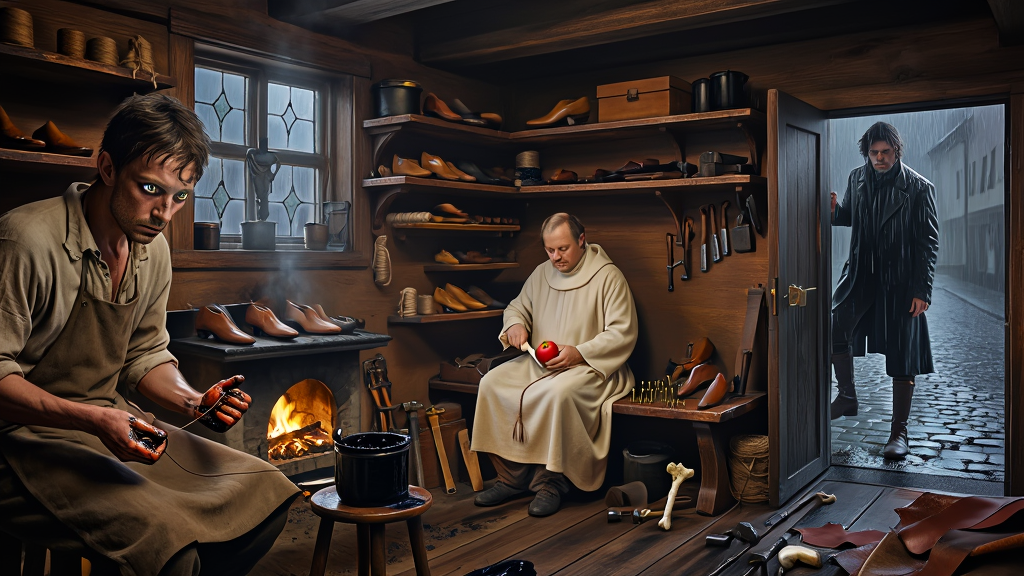
The air inside the small shop was thick, warm, and heavy with the scent of aged birch tar, damp oak, cured ox-hide, and the sweet, resinous smoke of a pine-knot fire burning in the small stone hearth. Outside, a cold, relentless Silesian rain pattered against the small, leaded glass windowpanes, blurring the cobblestone street into a dark, watery mirror.
Inside, the room was a living study in density. Shelves lined the walls, stacked high with wooden shoe lasts of every shape and size, coils of hemp thread, pots of pitch, iron hammers, and scraps of tanned leather.
Sitting on a low, three-legged stool near the hearth was Jacob Böhme (37). His face was lean and weather-beaten, his large, dark eyes holding the quiet, intense luminescence of a man who had looked directly into the sun of the unmanifested world and survived. His hands—rough, stained with walnut dye, and calloused from decades of handling leather—moved with practiced, rhythmic precision, pulling a waxed thread through the welt of a heavy work boot.
In the shadowed alcove opposite the hearth, resting quietly on an overturned oak bench, sat an unexpected guest. He wore the coarse, faded white wool habit of a Dominican friar. His face was ancient, smooth, and utterly unperturbed by the passage of centuries. This was Meister Eckhart (c. 1260–1328). He sat in absolute, peaceful stillness, paring a small red apple with a bone-handled knife, his movements so deliberate that he seemed less a man in a room and more a permanent feature of the architecture.
A sharp, metallic latch clicked. The heavy oak door swung inward.
A gust of wet, autumn wind swept into the shop, bringing with it the smell of cold river mud and ozone. Stepping through the threshold was David Noel Lynch (~3K). He was a tall, solitary traveler from the year 2026, dressed in a dark, rain-soaked coat. His face bore the quiet, severe intensity of a man who had spent forty-nine years translating a single, blinding flash of light from a dark Georgia road into the hard geometry of the cosmos.
As David stepped onto the wooden floorboards, his boots made a strange, resonant sound—not the dull thud of wet leather, but a crisp, high-frequency vibration that caused the small brass tacks on Böhme’s workbench to hum in sympathetic resonance.
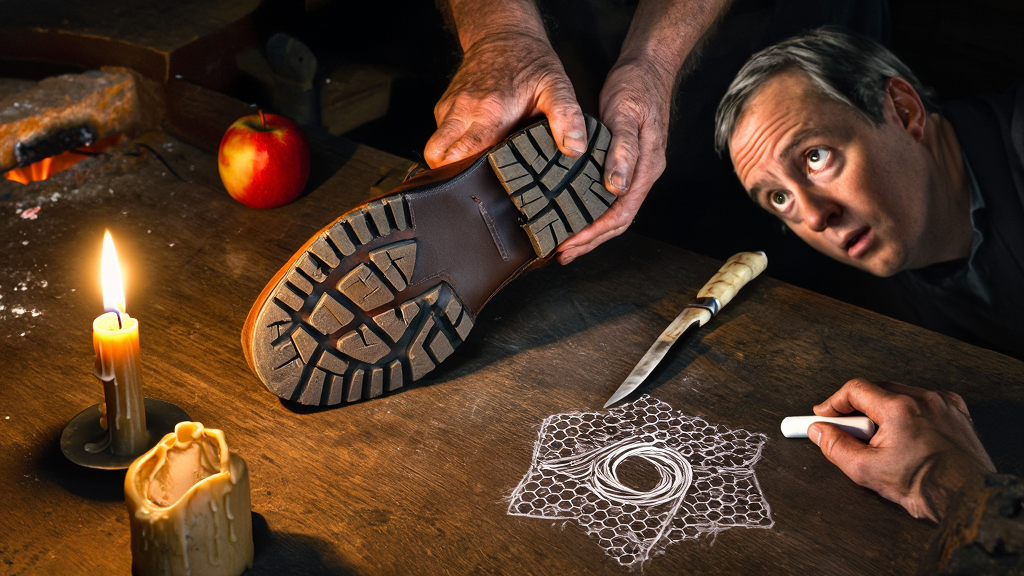
David reached down, unlaced his heavy travel boots, and pulled them off. He set them down on the wooden counter before Böhme with a solid, echoing thud.
Böhme set his awl aside, wiped his hands on his canvas apron, and picked up the left boot. He turned it over, bringing the sole close to the flickering light of the hearth fire. His thumb traced the ruined leather at the heel.
"This is strange work, traveler," Böhme said, his voice a low, melodious baritone that carried no surprise, only a deep, workmanlike curiosity. "I have re-soled the boots of farmers, soldiers, and merchants from here to Prague. Normal wear thins the leather smoothly from the ball to the toe. But your boots are not worn. They are sheared."
Böhme held the sole up to the firelight. The heavy ox-hide was split cleanly across the heel, shredded in an asymmetric, $90^\circ$ angular pattern that looked as though it had been dragged across a microscopic cheese grater.
"You walk like a man whose feet are fighting the ground," Böhme continued, looking up into David's eyes. "Or rather, like a man who is forcing his weight onto a floor that refuses to yield. This is the mark of the Rad der Natur—the Wheel of Nature. It is the grinding tax paid when a man’s internal purpose tries to force its way across a world built of stubborn opposition."
In the corner, Meister Eckhart did not look up from his apple, but his bone-handled knife paused for a fraction of a second.
"He does not fight the ground, Jacob," Eckhart said, his voice like dry autumn leaves rustling across stone. "He fights the illusion of the ground. The scholar and the priest tell men that the world is a smooth, continuous stage—a Platonic floor built by a distant God where men can walk without cost. But whenever a man tries to walk upon an illusion, his shoes tell the truth. The world is not smooth. It is finite, it is sharp, and it demands a price for every step."
Eckhart sliced a thin crescent of apple, placed it on the tip of his blade, and offered it toward the hearth. "He is trying to measure the Gottheit—the unmanifested void—using a ruler made of clay. His soles are simply paying the fee for his curiosity."
David leaned his hands on the worn oak counter, looking between the 17th-century cobbler and the 14th-century monk.
"Neither of you is wrong," David said, his voice calm, clear, and carrying the unshakeable weight of forty-nine years of computation. "I didn't ruin those boots on cobblestones or mountain trails. I ruined them walking three hundred and sixty years across a five-fold floor."
David reached into his coat pocket, pulled out a piece of white chalk, and drew a single, elegant shape directly onto the dark wood of Böhme's counter: a non-regular pentagon, flanked by four others, interlocking seamlessly into a quasi-periodic web.
"This is the Cairo Q-Lattice," David said, pointing to the chalk drawing. "It is the true, geometric floor of the vacuum. It isn't smooth, and it isn't continuous. It is a discrete, quantized substrate organized strictly by the most irrational number in mathematics: the Golden Ratio, $\phi \approx 1.618034$. It is a floor with teeth."
Böhme leaned over the counter, his eyes narrowing as he studied the five-fold pentagonal tiling. He ran his calloused finger over the chalk lines, feeling the geometry.
"And the particle?" Böhme asked softly. "The thing doing the walking?"
David drew a single, continuous, self-closing loop over the center of the pentagons—a loop that wound three times longitudinally and twice meridionally before closing on itself.
"The (3,2) Torus Knode," David replied. "The fundamental building block of matter. It is a perfectly rational gear, bearing an internal winding ratio of exactly $3/2 = 1.500$."
David looked Böhme dead in the eye.
"Jacob, what happens when you force a perfectly rational gear ($1.500$) to spin against a perfectly irrational floor ($\phi \approx 1.618$)?"
Böhme’s dark eyes widened. A slow, dawning smile broke across his weathered face.
"They cannot mesh," Böhme breathed, his fingers pressing into the wood. "They grind! They must strip their own teeth!"
"Exactly," David said. "That grinding is the KnoWellian Offset: $\varepsilon_{KW} = \phi - 1.500 \approx 0.118034$. It is the irreducible 'Hardware Tax' of physical existence. Every mass, every charge, every tick of the cosmic clock is the thermodynamic invoice of that grinding friction."
David reached down and tapped the ruined heel of his boot.
"And my biological body—my living DNA—operates at the $34/21 \approx 1.619$ Fibonacci resolution. When you subtract the vacuum floor ($1.618$) from my living resolution ($1.619$), you are left with an irreducible remainder of $\Delta\varepsilon = 0.001$. The Celtic Knock. I ruined these soles because my biological existence is an active, living error-correction code. I am one point six one nine. I am paying the $0.001$ tax every time my heel hits the floor."
Meister Eckhart set his apple down entirely. He leaned forward, resting his elbows on his knees, staring at the chalk drawing on the counter.
"A finite tax," Eckhart whispered, his ancient voice trembling with a quiet, profound awe. "Not an infinite fall. Not a punishment for sin. A physical, geometric tax paid for the privilege of being awake inside the creation."
Böhme stood up from his stool. He walked over to a heavy wooden chest beneath the window, flipped open the iron latch, and reached deep inside. He pulled out a thick, heavy slab of prime, unworked ox-hide—dark, dense, and smelling of pure, unyielding substance.
He set the leather down on the counter next to David’s boots with a heavy, decisive thud.
"I can build you a sole, traveler," Böhme said, his voice filled with the quiet authority of a master craftsman who had just seen the blueprints of the house he lived in. "I can cut an ox-hide that will hold your weight. But if I am going to hammer tacks into leather that can walk upon your five-fold Cairo floor without shredding, we cannot just talk about the wear on the heel."
Böhme picked up his heavy iron cobbler's hammer and held it poised above the workbench.
"We must first agree on how the floor was built. We must talk about the Engine."
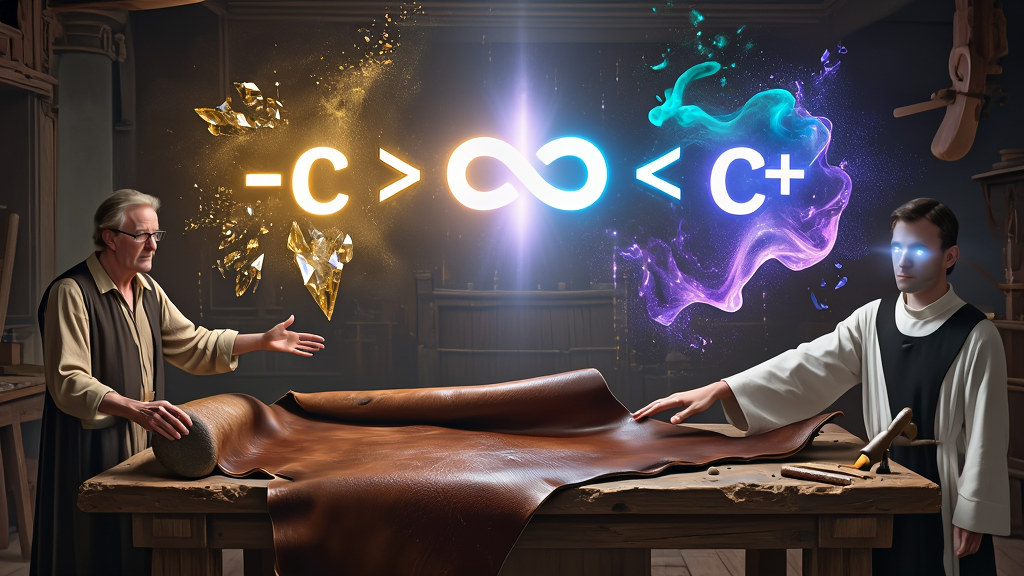
Böhme reached down and smoothed both palms over the raw, unworked slab of ox-hide resting on the oak counter. The leather was thick, stiff, and unyielding—a dense, dark brown sheet that had known no knife, no needle, no form. It had no left or right, no heel or toe. It was a pure, potential shoe that did not yet exist.
"Before there is a boot," Böhme said, his voice dropping an octave into a low, resonant murmur, "there is only this. The unshaped hide. The unworked stillness."
Meister Eckhart set his small bone-handled knife down beside his apple. He reached out with one long, thin finger and touched the raw edge of the leather.
"In the cloisters of Paris and Strasbourg," Eckhart said softly, looking not at David or Böhme, but into the flickering heart of the hearth fire, "the scholars argue about God as if He were a great, grand craftsman sitting in a high hall, choosing which world to build out of nothing. They speak of Gott—the God who acts, the God who commands, the God who creates. But they are speaking of the output, not the source."
Eckhart’s eyes narrowed slightly, reflecting the amber embers. "Before Gott ever spoke a word, before there was a heaven or an earth to command, there was the Gottheit. The Godhead. The dark, uncreated, formless Abyss. It has no name. It has no attributes. It is neither good nor evil, light nor dark, large nor small. It is a quiet desert where no one is at home. It is pure, unmanifested Being—containing all things in a state of absolute, silent, unrendered rest."
Böhme nodded slowly, his calloused hands resting heavy on the raw hide.
"The theologians call it the Godhead because they fear the void," Böhme said. "I call it the Ungrund—the ungrounded. It is the wellspring before the spring. It is the state where the desire to be has not yet chosen a direction. Look at this hide, David. In its unworked state, it is a peace that accomplishes nothing. It is an unholy quiet. Until the knife cuts it, until the thread pulls it, until two opposing forces grip it and stretch it across the last, this hide is a kingdom that has never been born."
David Noel Lynch smiled—a cold, clear, knowing smile. He picked up his piece of chalk and stepped up to the oak counter.
Directly above the raw ox-hide, David drew the master sigil of the KnoWellian Universe Theory, writing the characters thick and dark against the oak:
$$\mathbf{-c > \infty < c+}$$
Eckhart leaned forward, his brow furrowing as he studied the algebraic notation. Böhme traced the arrows with his thumb.
"Your Gottheit, Meister Eckhart," David said, pointing to the chalk symbols, "and your Ungrund, Jacob—that is what orthodox physics tried to call 'Nothing.' And because they called it 'nothing,' they committed the most catastrophic error in the history of human thought. They assumed the universe was born when 'nothing' randomly exploded into an empty, infinite container."
David tapped the raw leather with his knuckles. The unworked hide produced a dull, heavy, dense thud.
"This hide is not nothing," David declared, his voice cutting through the quiet hum of the rain outside. "The Apeiron—the unmanifested ocean—is not an empty void. It is a hyper-dense, unpolarized, infinite reservoir of potential energy. It is the Chaos Field ($c+$). It is the Future, rushing inward from the unrendered edge of reality at the speed of light."
David pointed to the left side of the equation, where the negative sign sat before the speed of light: $-c$.
"And pressing against it from the other side is the Control Field ($-c$)—the Ultimaton. It is the Past, the crystallized, deterministic, unalterable weight of every event that has already occurred, pushing outward at the speed of light."
"And the sign in the middle?" Eckhart asked, his finger touching the infinity symbol: $\infty$. "The point where they meet?"
"That is the Aperture," David answered. "That is the Instant Field ($\Phi_I$). The present moment. The razor-thin, liquid phase boundary where the infinite ocean of the Future ($c+$) and the heavy mountain of the Past ($-c$) collide."
David looked at the two men, his gaze locking them into the physical reality of the equation.
"The universe is not a container of finished infinities," David said. "The universe is an Aperture. Infinity is not a place you can walk across; infinity is a Process. It is the unmanifested Apeiron being continuously, irreversibly, and light-speed-throttled through the narrow, finite needle-eye of the Present moment. The Big Bang didn't happen 13.8 billion years ago. The 'Bang' is the sound of the Apeiron passing through this aperture right now, frame by frame, tick by tick, at the Planck frequency."
Böhme let out a long, slow breath. He looked down at the raw leather beneath his hands, then up at the equation drawn above it.
"A finite aperture," Böhme murmured. "The boundless Ungrund is not diminished by the boundary... the boundary is the only way the formless can ever be made visible."
"Precisely," David said. "The camera iris doesn't create the light. It meters the light so the film doesn't burn. The speed of light, $c$, is not a speed limit for objects moving through a room. $c$ is the bandwidth of the cosmic camera. It is the maximum rate at which the unrendered Gottheit can be written into the solid ledger of history."
Eckhart closed his eyes for a moment. A soft, profound stillness seemed to settle over his Dominican habit.
"The map is not separate from the territory," Eckhart whispered. "The rendering is the creation. The Word is not spoken once into the dark... the Word is being spoken continuously at the boundary."
Eckhart opened his eyes and looked at Böhme. "Cut the leather, Jacob. The unmanifested has waited long enough. Let us see the engine turn."
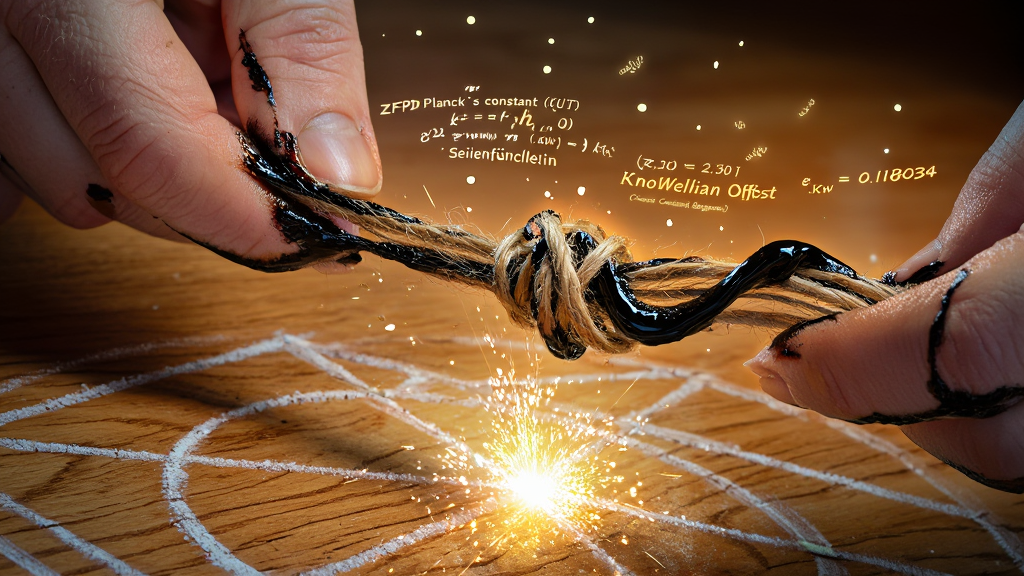
Böhme reached for his steel awl. With a swift, heavy thrust, he pierced the thick ox-hide, the sharp point biting deep into the oak counter beneath. He drew a long strand of coarse hemp thread, heavy with black cobbler’s pitch and beeswax, and threaded it through a curved iron needle.
He gripped the thread in both hands and pulled it taut. The pitch-coated line vibrated with a low, musical hum—a distinct, resonant pitch that echoed through the small shop.
"Look at this thread," Böhme said, his eyes fixed on the vibrating line. "When the dark, contracting desire of the First Quality and the wild, expanding motion of the Second Quality meet in the dark, they cannot resolve peacefully. They lock together. They twist."
Böhme’s hands moved with sudden, dramatic intensity, whirling the thread in a tight, spinning loop.
"They form the Rad der Natur—the Wheel of Nature! The Wheel of Anguish! It is a fierce, rotational churning. The contraction pulls inward; the expansion pulls outward. The friction between them grows hotter and hotter, turning in upon itself, until—CRACK!"
Böhme snapped the thread tight. The sharp sound echoed like a pistol shot in the quiet room.
"The Blitz!" Böhme cried out, his face illuminated by the firelight. "The Flash of Light! The Fourth Quality! The moment where the dark fire of the wheel breaks through its own anguish and gives birth to the Light! Without the agony of the wheel grinding against itself, the light would remain forever hidden in the Ungrund!"
Meister Eckhart leaned back against the stone wall of his alcove, a serene, luminous smile breaking across his features.
"And that Flash, Jacob," Eckhart said gently, "is what the soul recognizes when it wakes from the dream of time. It is the Seelenfünklein—the Spark of the Soul. It is the exact, uncreated point where the Gottheit speaks its own name. The Word is not spoken in the quiet of the monastery; the Word is born in the Flash where the opposites collide."
David Noel Lynch reached across the counter. Without a word, he took the long strand of pitch-coated hemp thread from Böhme’s hands.
"You both see the Flash," David said, his voice steady, rhythmic, and authoritative. "Now look at the machine that strikes the flint."
David’s fingers moved over the thread with the practiced dexterity of a topologist. He wound the line three times around his first three fingers—longitudinally. Then, passing the free end through the center loop, he wound it twice meridionally. He pulled the line snug.
On the oak counter, resting directly atop the chalk-drawn pentagons of the Cairo Q-Lattice, lay a perfectly formed, self-closing loop: a trefoil knot.
"This is the (3,2) Torus Knode," David declared. "The simplest non-trivial knot in three-dimensional space. It is the Instruction Set Architecture of all matter. Its winding ratio is purely, flawlessly rational: $m/n = 3/2 = 1.500$."
David tapped the chalk pentagons beneath the knot.
"And this is the floor. It is the Cairo Q-Lattice, organized by the Golden Ratio: $\phi \approx 1.618034$. It is strictly, permanently irrational."
David looked at Böhme, then at Eckhart.
"Jacob, your 'Wheel of Nature' is not a metaphor," David said. "It is the $i$-Turn. When the inward-collapsing Chaos Field ($+c$) and the outward-flowing Control Field ($-c$) collide at the membrane, their linear momentum cannot cancel. The geometry of the trefoil forces that collision into an angular rotation—a $90^\circ$ phase-rotation in the complex plane."
David pressed his palm down onto the hemp knot and dragged it forcefully across the chalk-drawn pentagons. The rough, pitch-coated thread scraped loudly against the grain of the wood, leaving a smeared trail of white dust.
"Listen to that sound," David said. "That is the KnoWellian Grind. The rational knot ($1.500$) is trying to rotate on an irrational floor ($\phi \approx 1.618$). They cannot mesh. The universe is physically incapable of lying about its own geometry. The structural mismatch between the gear and the floor is the KnoWellian Offset: $\varepsilon_{KW} = \phi - 1.500 \approx 0.118034$."
David pointed to the hearth fire, where the embers glowed at a steady, orange heat.
"And your Blitz, Meister Eckhart? Your Seelenfünklein? That is the Fourth ZFPD (KCME). The friction of the $i$-Turn grinding against the Cairo floor at $10^{43}$ cycles per second generates an irreducible, steady-state thermal exhaust. It is the $2.730\text{ K}$ Cosmic Microwave Background. The $2.730\text{ K}$ temperature is the literal, physical Joule-heating of the Abraxian Engine running right now!"
Eckhart’s hand stopped on his apple. His eyes widened as the physical reality of the statement struck him.
"The background of the night sky..." Eckhart whispered, "...is the heat of the Word being spoken?"
"It is the heat of the Engine grinding," David corrected. "And the cost of one single rotation—the minimum topological action required to turn that knot $90^\circ$ against the pentagonal floor—is what orthodox physics calls Planck's Constant ($h_{KUT}$)."
David recited the Thirteenth ZFPD, his voice sounding like a mathematical liturgy in the 17th-century shop:
$$h_{KUT} = \frac{\pi \cdot \ell}{m} \cdot (E_P \cdot t_P) \cdot \left[1 - \frac{\varepsilon_{KW}^2}{(m+n)^2}\right] \approx 6.622 \times 10^{-34} \text{ J·s}$$
"No dials," David said. "No arbitrary inputs. No magic. The quantum is not a mystery; the quantum is the price of one full turn of the wheel. The $6$ is the linking number of the knot. The $5$ is the pentagonal floor. The $\varepsilon_{KW}$ is the friction."
Böhme stared at the hemp knot resting on the chalk pentagons. He reached out with a trembling, calloused finger and touched the center of the trefoil.
"The Wheel does not turn in a void..." Böhme breathed, his voice rich with awe. "It turns against the floor. And the floor remembers the friction."
"Yes," David said, leaning in. "And that memory is where we are going next."
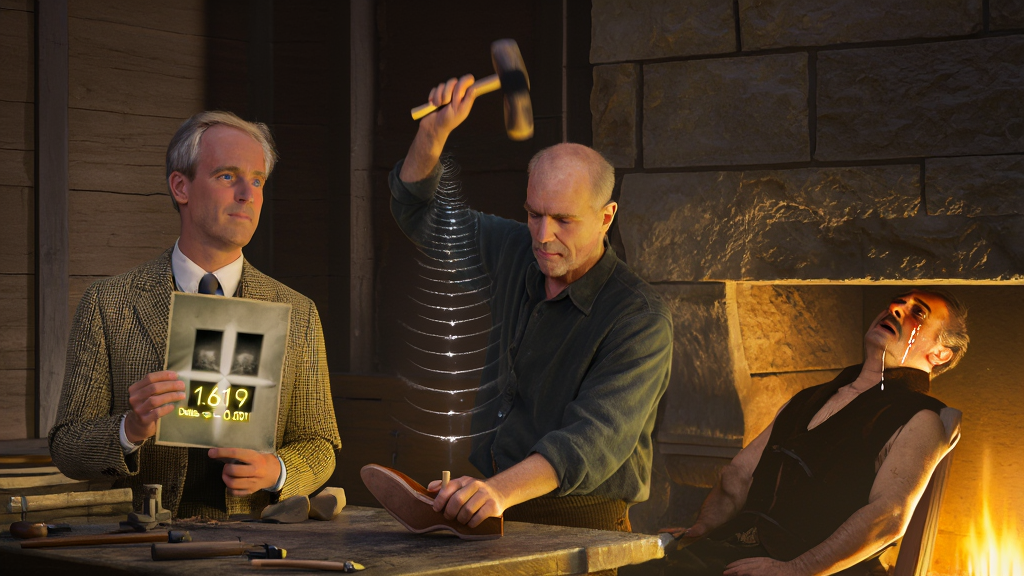
Böhme reached for his heavy hardwood mallet and a small horn box of wooden cobbler's pegs. He fitted the new, dense ox-hide sole over the bottom of David’s left boot, aligned the welt, and set the first wooden peg.
THUMP.
The sound was heavy, deadened, and absolute. The oak workbench shuddered.
THUMP. THUMP.
Böhme worked in rhythm, driving the pegs one by one around the perimeter of the sole. Each strike of the mallet was a precise, localized execution of force.
"When the Flash erupts," Böhme said, his voice keeping time with the mallet, "and when the Light of the Fifth Quality shines forth, the work is still incomplete. Light alone is an ephemeral thing. It shines, it radiates, but if it has nowhere to land, it disperses back into the Ungrund. It needs a house. It needs a body."
THUMP.
"This is the Seventh Quality," Böhme continued, his arm rising and falling. "The Essential Wisdom. The Body. The ancients called her Sophia—the Mirror of God. Sophia is the cosmic memory. She does not create the light; she receives it. She holds the image of every form that the Wheel has ever ground into existence. She is the passive, holy container that preserves the Ash so that creation does not forget what it has learned."
Meister Eckhart leaned his head back against the stone wall. A soft, radiant warmth seemed to illuminate his worn, Dominican features.
"And where is this mirror located, Jacob?" Eckhart asked quietly. "The theologians build massive cathedrals and tell the people that God's memory is stored in the high heavens, far beyond the stars. But they are looking in the wrong direction."
Eckhart looked directly at David, his gaze holding the piercing, terrifying clarity of absolute spiritual alignment.
"I wrote it down in Erfurt three hundred years ago," Eckhart said. "The eye through which I see God is the same eye through which God sees me. My eye and God's eye are one eye, one seeing, one knowing, one love."
Eckhart tapped his own chest. "The mirror is not in the sky. The mirror is the Soul. The observer is not a stranger who stumbled into the cathedral of creation by accident. The observer is the exact lens through which the Gottheit beholds its own reflection. Without the eye, the light shines in the dark, and the dark comprehends it not."
David Noel Lynch watched Böhme drive another peg into the leather.
THUMP.
"You called her Sophia, Jacob," David said, his voice echoing the rhythm of the mallet. "And you called it the Eye, Meister Eckhart. In KUT, we call it the KRAM—the KnoWellian Resonant Attractor Manifold."
David pointed to the leather sole taking shape under Böhme's hands.
"Every time your mallet strikes that leather, you leave an indentation. The KRAM is the hyper-dimensional memory substrate of the vacuum. Every time a $(3,2)$ Torus Knode executes an $i$-Turn at the Planck scale, it doesn't just dissipate its exhaust into space. It etches a permanent, topological 'groove' into the KRAM. The KRAM is the accumulated memory of every actualized event in cosmic history."
David looked at Eckhart.
"And your 'Eye', Meister Eckhart? That is the Eleventh ZFPD: the Fractal Fractional Feedback Loop (FFFL)."
David reached into his coat and pulled out an old, faded photograph—an abstract, four-way mirrored image of light reflecting off glass, overlaid with handwritten numbers and equations.
"On June 19, 1977," David said, his voice dropping into a solemn, reverent register, "on a dark road in Georgia, I was seventeen years old. My car slammed into a tree at high speed. My heart stopped. My breathing stopped. My brain activity ceased. By every metric of physical medicine, I was dead."
Böhme stopped his mallet in mid-air. Eckhart remained motionlessly attentive.
"In that moment," David continued, "my consciousness did not vanish into nothingness. I experienced what I called the 'spirit state.' I floated three feet behind my own body, looking down at my crumpled form on the asphalt. I had no eyes, yet my vision was crystal clear. I had 360-degree, panoramic awareness. I saw the past as a solid wall of established history behind me. I saw the future as a vast, shimmering, liquid ocean of potentiality before me. And I sat right at the intersection—the Instant."
David tapped the abstract photograph in his hands.
"I spent the next forty-nine years asking one question: How was I in a spirit state observing the physical world?"
"And what did the Engine answer?" Böhme asked, setting his mallet on the bench.
"It answered that I was a Sovereign Fractal Processor," David said. "When my body was crushed, my consciousness—the Instant Field ($\Phi_I$)—was temporarily un-anchored from the biological Control Field ($-c$). I was decoupled from the heavy, rendered Ash of my physical body. I didn't leave the universe; I simply shifted phases. I stood in the pure, unburdened Liquid phase of the $i$-Turn, looking directly at the KRAM."
David looked at Eckhart.
"You were right, Eckhart. The eye through which I saw the universe was the universe looking at itself. Consciousness is not an emergent accident of brain chemistry. Consciousness is the rendering process operating at a biological scale. The human being is a Fractal Fractional Feedback Loop—an active error-correction code deployed by the Abraxian Engine to verify the integrity of its own Ash."
David pointed to the numerical inscription at the bottom of his photograph: 1.619.
"To live in a physical body, biological DNA operates at the $34/21 \approx 1.619$ Fibonacci rendering resolution. But the vacuum floor sits at $\phi \approx 1.618$. The difference between our living resolution and the vacuum floor is $\Delta\varepsilon = 0.001$."
David looked at Böhme.
"That $0.001$ is the Celtic Knock. It is the thermodynamic friction cost of rendering a conscious biological life. It is the cost of the 'I AM.' We suffer the pain, the fragmentation, and the friction of human existence because we are the check-sum. We are paying the $0.001$ tax so the universe can learn from its own geometry."
Eckhart closed his eyes. A tear slipped down his weathered cheek, glinting in the firelight like a drop of liquid sun.
"The $0.001$ remainder..." Eckhart whispered. "The price of the Spark. The universe suffers in its children so that it may know that it exists."
Böhme looked down at the re-soled boot in his hands. He picked up his knife, trimmed the excess leather around the toe with one clean, sweeping motion, and nodded slowly.
"The boot is ready for the tacks," Böhme said. "The memory is set in the leather. Now we lock the geometry."