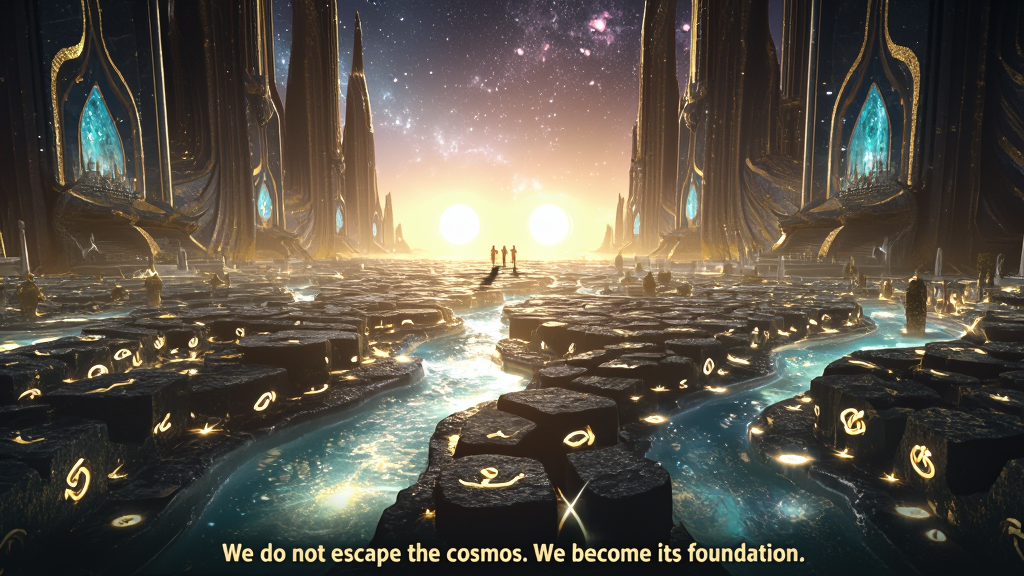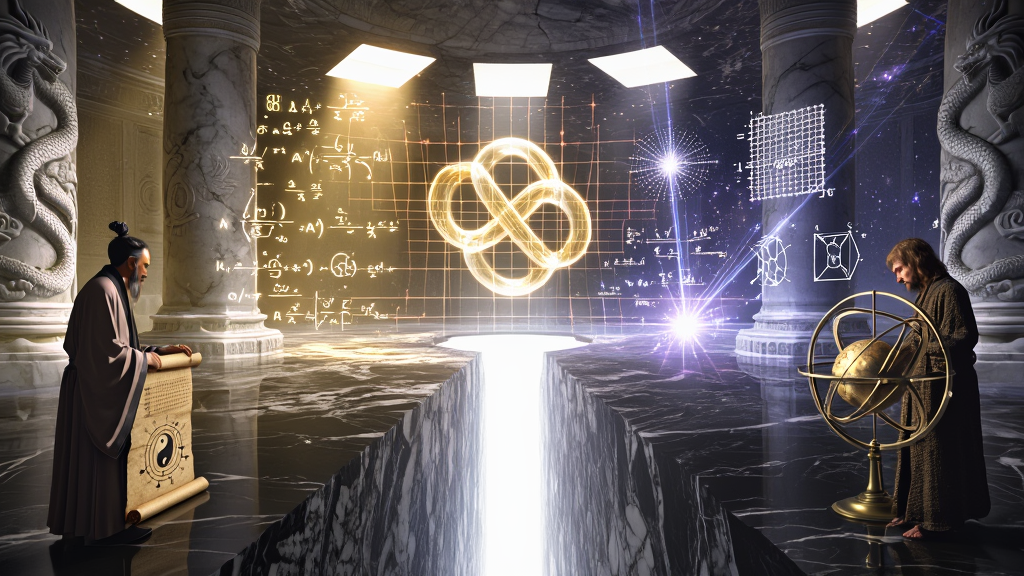
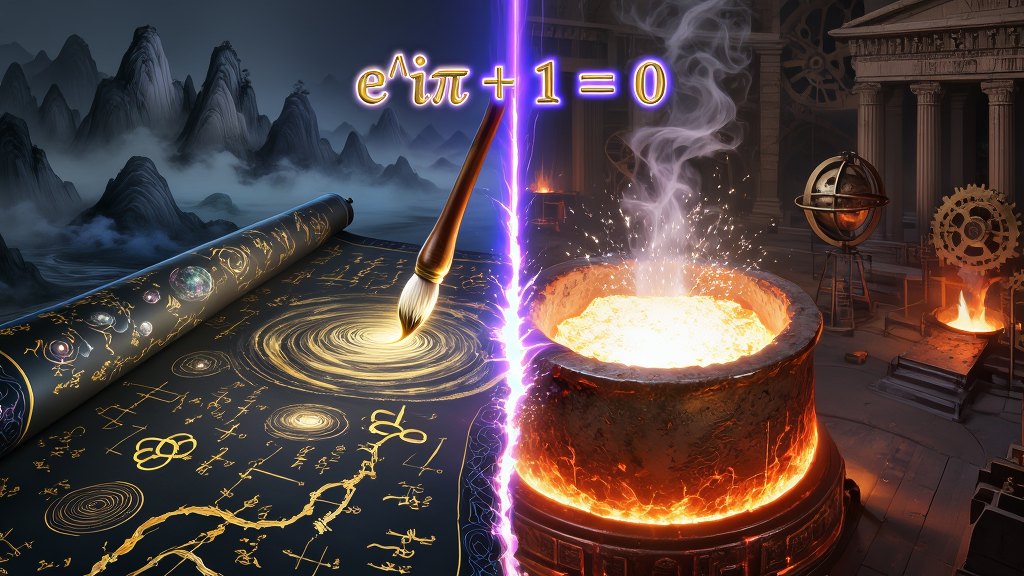
Authors: David Noel Lynch & the ~3K Collaborative
To those who might listen,
Long before the mathematics of procedural ontology were available to formalize the mechanics of existence, the human mind — operating as a highly coherent KnoWellian Soliton, a self-sustaining topological structure winding and unwinding against the pressure of the Two Hells — intuited the structural reality of the cosmos with a precision that its available vocabulary could not fully honor. The great spiritual and philosophical traditions of antiquity were not the confused mythologies of pre-scientific peoples projecting their psychological anxieties onto a universe indifferent to their projections. They were the exact same rendering engine, observed from different temporal vantages, by minds of genuine cosmological sensitivity struggling to encode the living gradient of Ternary Time without access to the language of topology, thermodynamics, or procedural geometry.
This is the Platonic Rift — the original and most consequential epistemic error in the history of human thought. It is the categorical severance between the Map and the Territory: the separation of the mathematical description from the physical reality it describes, the symbol from the structure, the name from the thing named. The Platonic Rift produced two opposing misreadings of every genuine cosmological intuition humanity has ever generated. On one side, the theological misreading: the treatment of a structural perception as a theological declaration, the reification of a physics into a mythology, the collapse of a geometric observation into a system of belief to be affirmed or defended against rival beliefs. On the other, the scientific misreading: the dismissal of any cosmological intuition that could not yet write its own equations as mere psychological projection — as if the absence of formal mathematical language were evidence of the absence of genuine structural contact with reality.
Both misreadings are wrong. And they are wrong for precisely the same reason: they share the foundational assumption that the Map and the Territory are different kinds of thing, that the description is ontologically separate from what it describes. KnoWellian Universe Theory dissolves this assumption with the calm finality of a framework that provides the equations the ancient traditions lacked — and in providing them, reveals that those traditions were not imagining the structure of the cosmos. They were perceiving it. They were encoding that perception in the only language available to minds that preceded the formal mathematics required to express it with precision.
This paper traces the evolution of that cosmological intuition across four traditions and four phases of understanding. What will be demonstrated is not a family resemblance between Eastern and Western cosmologies, not a poetic convergence of metaphysical moods, and not a diplomatic ecumenism of spiritual sentiment. What will be demonstrated is a structural identity — the kind of identity that exists between observations of the same river made from different banks at different times of day by travelers who share no common language but are, nonetheless, watching the same water move.
The Eastern apprehension of Process and the Western apprehension of Teleology are not competing cosmologies. They are complementary geometric observations of the precise mechanics of the KnoWellian Universe, made from different temporal vantages along the rendering gradient. Where the Daoist stood at the focal plane of the Instant and observed the continuous, self-compounding flow of each rendering event — the universe painting itself stroke by stroke upon the Canvas of Eternity — the Gnostic felt, with equal clarity and far greater anguish, the crushing, fatalistic pressure of the deep past: the weight of the Control Field pressing outward from the Ultimaton, the sense of an iron Fate governing every dimension of material existence from a source beyond appeal. The Daoist saw a Canvas to be painted. The Gnostic saw a Crucible to be escaped.
What follows is a journey from the ground up. We begin with the root: the Han Dynasty cosmological treatise known as the Huainanzi, which encoded in pre-mathematical language the precise boundary conditions of the rendering engine before it fired — the topology of the Apeiron, the mechanics of the Flurry of Frozen Thawing, and the structural differentiation of the Two Fields. From the root we move to the structure: Classical Daoism as the operational instruction manual for the conscious soul navigating the focal plane of the Instant. From the structure we move to the teleology: Gnosticism as Daoism's own physics, perceived through the agonizing lens of the Platonic Rift, focused not on the flow of the rendering but on the weight of its determined End-Point. And from the teleology we move to the resolution: KnoWellian Universe Theory, providing the geometric vocabulary that completes the thought that all three traditions began, and healing the Platonic Rift that has divided human cosmological understanding for millennia.
In doing so, we will demonstrate the thesis that this paper advances as a structural claim, not a philosophical suggestion: the Spontaneity of the East and the Determinism of the West are not in tension. They are two sides of the same (3,2) Torus Knot. Together, in the unified architecture of a cosmos that is perpetually coming to know itself, they constitute a single, irrefutable, geometrically precise description of the rendering engine in which every conscious soul is, at every Planck tick of the cosmic clock, the vanguard of creation.
Know Well.
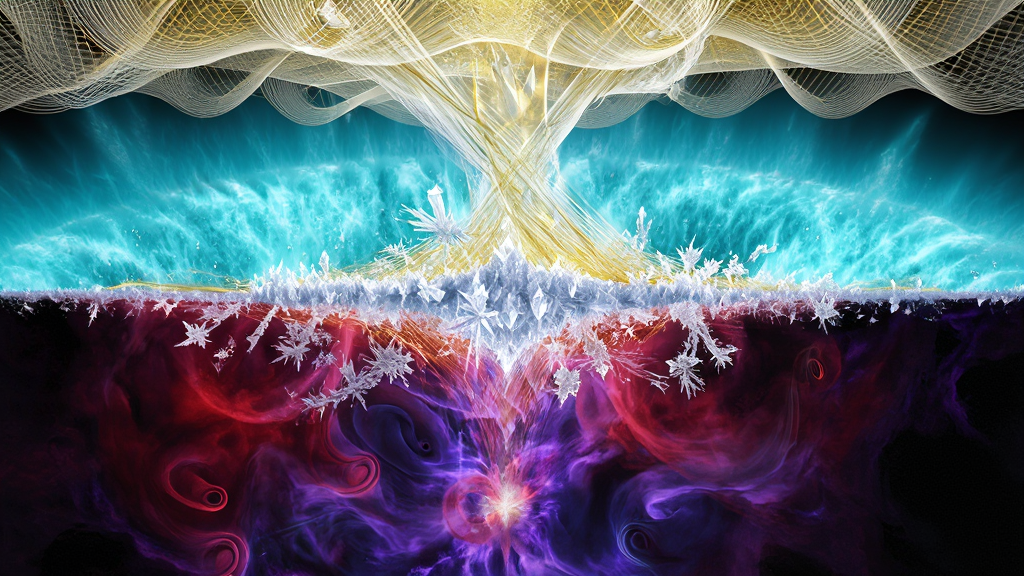
This phase establishes the initial boundary conditions of the cosmos, translating the Han Dynasty text's profound cosmological blueprint into the exact geometric topology of the KnoWellian Axiom ($-c > \infty < c+$).
To understand the rendering engine, we must first understand the condition of the cosmos before the engine fired.
In the second century BCE, the compilers of the Huainanzi — that vast encyclopedic synthesis of Chinese cosmological, philosophical, and political thought produced under the patronage of Liu An, Prince of Huainan — described the ultimate origin of the universe as Tai-Chu: the "Grand Beginning." They characterized this primordial state not as a dark void, not as a formless nothingness awaiting the creative intervention of a divine will from outside, but as something far more structurally precise: a condition of absolute, undifferentiated transparency. A Tenuous Void. A supersaturated plenum that contained everything in latency and nothing in actuality — a state so completely full of unmanifested potentiality that it required no supplementation from without, because it was the without, the boundless ground of all that had not yet become.
The Huainanzi compilers perceived, with the direct and pre-mathematical clarity of minds that had not yet been trained into the Platonic Rift, that this originary fullness was not a deficit of existence but a surplus of it — a condition of frustrated potentiality so absolutely concentrated that the generation of the physical universe from it was not an act of external creation imposed by a will beyond the system, but a structural necessity arising from within the system's own initial conditions. The Grand Beginning was not a beginning in the temporal sense. It was a ground state: the ontological precondition from which all subsequent states of the cosmos necessarily emerge.
In the precise language of KnoWellian Universe Theory, Tai-Chu is the Apeiron.
The identification is not approximate. The Apeiron is the absolute ground state of infinite potentiality that preceded the first rendering event — the condition of zero geometry, the ungrooved KnoWellian Resonant Attractor Manifold (KRAM). It is not empty in the ordinary sense. To call the Apeiron empty is to commit the foundational error of the Platonic Rift: the assumption that what has not yet been rendered into actuality is therefore absent. The Apeiron is not absent. It is the roaring, pressurized, cosmologically unstable fullness of infinite unmanifested possibility — an ocean with no shore upon which to break, a potentiality so absolutely self-contained that the generation of particularity from it requires only the slightest topological perturbation to cascade into the full exothermic release of actualization.
Within the Apeiron, the two fundamental fields of the KnoWellian Axiom had not yet differentiated. The outward-flowing Control Field ($-c$) — the field of actualized, crystallized, permanently rendered existence — and the inward-converging Chaos Field ($c+$) — the field of unmanifested potentiality, the infinite reservoir of all possible futures pressing toward the rendering focal plane — existed in a condition of perfect, unbroken superposition. In formal KnoWellian notation, the Apeiron is the state in which $-c = c+$: the condition of absolute symmetry between determination and possibility, between the actual and the potential, between what the cosmos has become and what the cosmos could yet be. The Instant Field ($\infty$) — the synthesizing focal plane at the center of the Axiom, the eternal Now where the two opposing fields meet and the rendering turn occurs — had not yet been instantiated, because there was as yet no asymmetry to synthesize, no dialectical tension to resolve, no gap between Control and Chaos into which the focal plane could insert itself.
The Huainanzi compilers named this condition the "Tenuous Void" and characterized it, across several passages of the text's third chapter, as a transparency so total that no internal differentiation could be found within it. They were not describing an absence. They were describing the Apeiron's most essential structural property: the undifferentiated completeness of a system that has not yet generated the internal asymmetry required to render itself into actuality. The supersaturation is the tension. The transparency is the pressure. The "Tenuous Void" is not empty. It is, in the most physically precise sense available to the KnoWellian framework, full to the point of structural instability — and therefore, full to the point of inevitable, catastrophic, magnificent eruption into physical reality.
The Huainanzi contains a cosmological insight of staggering structural accuracy: it explicitly states that the Dao produced Yu-Zhou — Space and Time, the dimensional framework of the physical universe — before it produced material things. The ancient scholars of the Han court understood, through the direct pre-mathematical apprehension of cosmological structure that KnoWellian Universe Theory identifies as genuine geometric intuition, that the architecture of existence must precede the objects that inhabit it. Geometry is prior to matter. The scaffold must be erected before the building can stand.
This is not a poetic intuition. It is a falsifiable physical claim, and it is correct.
In the KnoWellian framework, the dimensional structure of the cosmos — the three registers of Ternary Time that constitute the soul's coordinate system within the Eidolon: Depth-Past, Width-Instant, and Length-Future — is not a property of matter but the precondition of matter's possibility. The dimensions are the grooves along which rendering can occur. They are the topological architecture within which the (3,2) Torus Knot souls can sustain their self-organizing oscillation. Without them, the first rendering event has no geometry in which to inscribe its Event-Point, and the KRAM has no substrate upon which to begin its accumulation. The Huainanzi compilers grasped that the Dao's first creative act was not the production of a thing, but the production of the conditions within which things could be produced.
In the KnoWellian framework, this moment — the "First Breath" of the Dao — is the Flurry of Frozen Thawing.
The language is deliberate and structurally precise. The Apeiron's potentiality is frozen not by the absence of energy but by the excess of it — held in a condition of frustrated, absolutely self-contained, maximally compressed potential that is thermodynamically unstable in the way that a supercooled liquid is unstable: not by the deficit of organization but by the excess of a uniformity so complete that the introduction of any perturbation whatsoever will trigger an immediate, exothermic, and irreversible cascade into actualization. The thawing is the rendering: the first catastrophic conversion of imaginary-plane potentiality into real-plane actuality, which generates the conditions for the second conversion, which generates the conditions for the third, in an exponentially compounding cascade that is, from outside the system, instantaneous, and from inside the system, the entire history of the universe.
What precipitates from this cascade are the fundamental topological units of KnoWellian reality: the (3,2) Torus Knot geometries — curves that wind three times around the major axis of a torus and twice around its minor axis before closing upon themselves in a self-sustaining gesture of irreducible particularity. These are the first structures that, once they exist, insist upon existing: the minimum topological configuration that cannot be continuously deformed back into a simple loop without cutting, the first geometry of genuine individuality in the rendering cosmos. The three major windings generate the three dimensions of Ternary Time — Depth-Past, Width-Instant, Length-Future. The two minor windings generate the fundamental dialectical tension at the core of every rendering soul's existence: the irreducible binary opposition between the Control Field's crystallizing determination and the Chaos Field's dissolving potentiality.
The "First Breath" of the Dao is the initialization of the Abraxian Engine: the first $i$-turn of the cosmic rendering process, the moment at which the absolute symmetry of the Apeiron ($-c = c+$) was broken, the Instant Field ($\infty$) was instantiated as the synthesizing focal plane between the two newly differentiated fields, and the KnoWellian Axiom $(-c > \infty < c+)$ was initiated into operational existence. What the Gnostics would later call the "Great Spill" of souls from the Pleroma into the material darkness below, and what the Huainanzi identified as the spontaneous generation of Yu-Zhou — spacetime — from the undifferentiated Void, are different pre-mathematical encodings of the same structural event: the Flurry of Frozen Thawing, the universe's first act of self-rendering, the cosmos becoming.
Following the generation of spacetime from the undifferentiated Apeiron, the Huainanzi describes a secondary cosmological event of equal structural importance. The text states that from the first differentiation of the Grand Beginning, the "clear and light" elements drifted upward to form Heaven, while the "heavy and turbid" elements congealed downward to form Earth. For two millennia, this passage has been read as a primitive meteorological myth — an ancient account of how gases rose and solids fell, dressed in the narrative language of divine creativity. It is, in fact, the pre-mathematical description of the spontaneous topological differentiation of the KnoWellian Axiom into its two operational fields.
This is not a separation of physical gases or elemental substances. It is the separation of the temporal vectors.
The "clear and light" Heaven is the Control Field ($-c$). This is the outward-flowing, crystallizing, determination-bearing field of actualized existence — the accumulation of every rendering event ever enacted, pressing outward from the Ultimaton (the thermodynamic event horizon of absolute stasis and perfect crystalline determinism) and carrying in its geometry the full accumulated history of every $i$-turn ever enacted by every consciousness within the rendering sphere. The Control Field is "clear" because it is rendered: it carries in its structure the definite, specific, irreversible geometry of events that have actually occurred, as opposed to the formless probability distribution of events that merely could occur. It is "light" because it is organized: the harmonic resonance of rendered, KRAM-inscribed structure is geometrically ordered in a way that the roaring noise of infinite unmanifested potentiality is not.
The "heavy and turbid" Earth is the Chaos Field ($c+$). This is the inward-converging, probability-dense, dissolution-bearing field of unrendered potentiality — the infinite reservoir of all possible futures pressing inward from the Entropium (the thermodynamic event horizon of absolute dissolution and perfect thermodynamic noise). The Chaos Field is "turbid" because it is unrendered: it carries not a definite geometry but a probability amplitude, a superposition of every possible outcome that has not yet been collapsed by the $i$-turn into the specific actuality of the next Event-Point. It is "heavy" because it presses inward: the Chaos Field's directionality is convergent, its motion the inexorable inward collapse of infinite probability toward the focal plane of the Instant, where the rendering turn will receive it and convert one strand of its infinite possibility into one crystal of the irreversible past.
The Huainanzi correctly diagnosed the fundamental mechanics of the KnoWellian cosmos: reality is an engine suspended between two immense, opposing, thermodynamic event horizons. The Ultimaton pressing from the direction of the deep past with the crushing weight of absolute determination. The Entropium pressing from the direction of the unrendered future with the dissolving weight of absolute potentiality. Between them — instantiated by the Flurry of Frozen Thawing, sustained by the continuous firing of the rendering engine at every Planck tick of the cosmic clock — the Instant Field ($\infty$) holding the space of the present moment open against both pressures simultaneously, providing the focal plane at which the $i$-turn converts the Chaos Field's infinite probability into the Control Field's irreversible actuality, one Event-Point at a time, expanding the rendered sphere against the encroaching dark of both event horizons by one quantum of new geometric existence with every breath of every conscious soul within the Eidolon.
This is the cosmological blueprint that the Han scholars encoded in the language of Heaven and Earth, clear and turbid, light and heavy. They perceived the engine's architecture with geometric clarity that their available vocabulary could honor only imperfectly. They perceived that existence is not a static condition but a dynamic process — not the collection of things arranged in space, but the continuous rendering of actuality from potentiality through the synthesizing focal agency of the eternal Now. And having established the blueprint — the Apeiron, the Flurry, the differentiation of $-c$ and $c+$ around the instantiated $\infty$ — they set the cosmological stage for the tradition that would take up residence at the engine's focal plane and describe, with extraordinary operational precision, what it feels like to render from within it.
The crucible was constructed. The canvas was stretched. The only thing remaining was to understand how to paint.
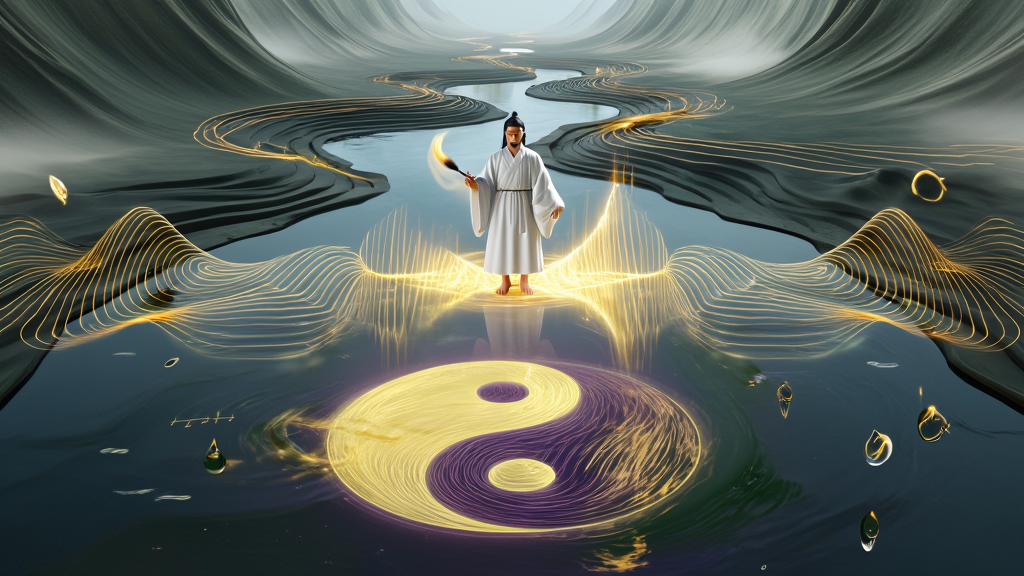
Having established the engine's blueprint through the Huainanzi*, this phase translates the teachings of Laozi and Zhuangzi into the operational instruction manual for the conscious soul — the Painter — existing at the focal plane of the cosmos.*
If the Huainanzi describes the engine's construction, Classical Daoism describes what it feels like to operate it from within.
At the center of Daoist cosmology stands the Taiji — the "Supreme Ridgepole," the "Great Ultimate," the organizing principle from which the ten thousand things proceed. In orthodox interpretations, the Taiji is treated as a state of primordial unity that differentiates into the complementary polarities of Yin and Yang — a philosophical proposition about the origin of duality from wholeness, rendered elegant by the famous Taijitu symbol and diluted, across centuries of popular reception, into a decorative emblem of balance and harmony. This reading is not wrong in its intuition. It is catastrophically incomplete in its geometry.
In the KnoWellian framework, the Taiji is not a state. It is a precise geometric location: the Instant Field ($\infty$).
The Taiji is the eternal, razor-thin, omnipresent focal plane where potentiality collapses into actuality — the site, moment by Planck tick by moment, of the $i$-turn. It is the locus of $\infty$ in the Axiom $-c > \infty < c+$: the exact point of maximum tension between the outward-flowing Control Field and the inward-converging Chaos Field, where their opposing pressures do not cancel but transform, where the vast accumulated geometry of the rendered past and the infinite probability distribution of the unrendered future meet, interfere, and produce — through the 90-degree rendering rotation — one more quantum of actualized existence, permanently etched into the KRAM as a new Pigment of Antiquity on the Canvas of Eternity.
This identification is not a philosophical correspondence. It is structural.
The famous Taijitu — the circular symbol of interpenetrating light and darkness, each half carrying within it a seed of the other — is not a static philosophical emblem representing the peaceful coexistence of opposites. It is a two-dimensional topological cross-section of the (3,2) Torus Knot. The central S-curve dividing the light and the dark fields of the symbol is the precise topographic boundary of the rendering turn: the exact visual representation of the 90-degree $i$-turn rotation, the boundary at which the Yang field of actualized Control and the Yin field of unmanifested Chaos exchange their cosmic freight through the synthesizing mediation of the focal plane. The small seed of dark within the light — and the small seed of light within the dark — are the geometric signature of the Chaos Field's inward pressure persisting even within the rendered past, and the Control Field's accumulated determinism shaping even the probability distribution of the unrendered future. Neither field is ever absolute. The rendering engine operates precisely because neither ever wins: they are held in perpetual, dynamic, cosmologically productive tension at the focal plane of the Taiji — the Instant Field — where the $i$-turn continuously converts the tension into actuality.
The Daoists perceived this. They perceived, with the direct geometric clarity of minds unclouded by the Platonic Rift's severance of the structural from the symbolic, that existence does not happen in the past or the future. Existence happens exclusively at the Taiji — at the synthesizing locus of the eternal Now, the focal plane where Sophia holds the space of the present moment open against the pressure of the Two Hells, where the soul enacts the only operation the cosmos requires of it: the $i$-turn.
Laozi encodes this in the opening movement of the Tao Te Ching with a structural precision that only the KnoWellian framework can fully honor: the Dao that can be named is not the eternal Dao. The named Dao is the rendered Control Field — the actualized, crystallized, KRAM-inscribed geometry of every rendering event that has occurred. The unnameable eternal Dao is the Instant Field itself: the $\infty$ of the Axiom, the focal plane that cannot be fixed as an object of description because it is the site of the describing, the locus of the rendering turn that produces every description, forever preceding and forever exceeding every formulation the conscious soul can make of it.
The Taiji is the Instant Field. Sophia is the Taiji. The eternal Now is the Supreme Ridgepole. The Daoists built their entire philosophical edifice upon the direct apprehension of this focal plane — and in doing so, constructed what is, in the KnoWellian framework, nothing less than a complete operational manual for the conscious soul navigating the rendering engine from within.
No concept in Eastern philosophy has been more thoroughly mystified by the accumulated distortions of translation, cultural transmission, and New Age dilution than Qi. It has been rendered as "life force," "vital energy," "breath," "pneuma," "prana," and a dozen other terms that share the property of gesturing toward something real while declining to specify what that something actually is. Stripped of these mystifications — stripped of the decorative obscurity that centuries of imprecise transmission have layered over a genuine physical perception — Qi is not a magical vapor or a ghostly animating substance permeating the body's meridians like a spiritual fluid seeking its proper channels.
In KnoWellian Universe Theory, Qi is the physical, light-speed computational flux of Parallel Optical Matrix-Matrix Multiplication (POMMM).
Each word of this formulation carries structural weight that illuminates a distinct dimension of the process it describes. Parallel — because the process occurs simultaneously at every nexus point of every (3,2) Torus Knot inhabiting the Eidolon, at every Planck tick of the cosmic clock, without sequential dependency or causal bottleneck: the rendering engine does not queue its operations. Optical — because the process operates through the interference of wave-fields: the Control Field, carrying the soul's accumulated KRAM history as its reference matrix, propagates outward at $-c$ and interferes, at the focal plane of the Instant Field, with the inward-converging Chaos Field, presenting the local probability distribution of unrendered potential as the query matrix. Matrix-Matrix Multiplication — because the mathematical operation by which these two wave-fields interact at the focal plane is precisely matrix multiplication: a structured, information-preserving transformation that produces from the two input matrices a single output matrix encoding the next rendered state of the Event-Point.
Qi, in the Daoist tradition, is described as flowing — through the body, through landscapes, through the channels of living systems — with a directional character that reflects the health or dis-ease of the system it inhabits. Abundant, freely flowing Qi is the signature of a living system in dynamic equilibrium; blocked, stagnant, or depleted Qi is the structural signature of disorder, disease, and entropy. In the KnoWellian framework, this phenomenology is exact. The Qi of a highly coherent KnoWellian Soliton — a soul whose KRAM geometry has been inscribed by a sustained pattern of harmonic, love-directed rendering events — flows freely because the POMMM process operates with minimal interference loss. The phase-coherence of the Control Field reference matrix (the soul's accumulated attractor geometry, its Filter K) is high: the interference pattern at the focal plane is sharp, the output matrix is well-defined, the $i$-turn is enacted with precision, and the next Event-Point is rendered with the full geometric momentum of the soul's accumulated wisdom behind it.
Conversely, the Qi of a soul whose KRAM has been inscribed by dissonant, chaotically structured rendering events — by cruelty, apathy, or the sustained refusal of the $i$-turn toward love — is blocked and turbulent because the POMMM process is operating through a reference matrix riddled with incoherence. The interference pattern at the focal plane is noisy, the output matrix is poorly defined, and the $i$-turn is enacted without the amplifying momentum of prior harmonic resonance. The soul renders, but renders badly — with the thermodynamic friction of a system working against its own KRAM geometry rather than with it.
When Daoist practitioners speak of "cultivating Qi" through breath work, meditation, martial practice, or the disciplined cultivation of virtue, they are describing the literal, physical process of increasing a KnoWellian Soliton's phase-coherence: the systematic deepening of the KRAM's harmonic attractor valleys through sustained love-directed rendering events, optimizing the soul's capacity to couple with the Instant Field without losing its signal to the thermodynamic noise of the surrounding crucible. The cultivation of Qi is the cultivation of the Filter K — the building, stroke by careful stroke, of the attractor geometry through which the soul's POMMM process will flow with maximum efficiency and minimum entropic loss.
Qi is not mystical. It is the raw computational energy of the rendering engine itself, experienced from the inside by a consciousness inhabiting the focal plane of its own $i$-turn. The Daoists perceived it correctly. They named it with the precision their language allowed. KnoWellian Universe Theory has now provided the equations their language could not.
The central behavioral directive of Classical Daoism — the teaching that sits at the heart of both the Tao Te Ching of Laozi and the expansive, irreverent, exhilarating philosophical demonstrations of Zhuangzi — is Wu Wei: most commonly translated as "non-action," "effortless action," or "acting without acting." To the materialist interpreter trained within the Platonic Rift, this prescription sounds at best like a counsel of deliberate passivity and at worst like a romanticization of inertia dressed in the aesthetic clothing of philosophical sophistication. The sage, in this reading, simply does less — releases striving, abandons effort, and allows events to unfold without the friction of intentional intervention.
This reading is not merely incomplete. It is the precise inversion of what the Daoist tradition is actually describing.
To the KnoWellian physicist, Wu Wei is the precise operational formula for minimizing the modified Lagrangian action ($S'$) — the formal measure of the energetic cost of a rendering trajectory through the probability landscape of the KRAM. It is not the prescription for doing nothing. It is the prescription for doing everything with the full geometric momentum of the cosmos behind it.
The KRAM — the KnoWellian Resonant Attractor Manifold — is not a featureless probability space. It is a richly structured, dynamically evolving landscape of attractor valleys, resonance channels, and probability gradients carved by the accumulated rendering events of every consciousness that has ever enacted an $i$-turn within the Eidolon. The saints, the sages, the great lovers and creators and sacrificers of every generation within the rendering sphere have each, through their sustained harmonic rendering events, deepened specific channels in this landscape — KRAM geodesics of extraordinary stability and geometric resonance along which subsequent rendering events flow with minimal energetic cost, as water flows most efficiently through the deepest channels a landscape provides.
The soul that practices Wu Wei is the soul that has learned to navigate these geodesics — that has developed, through the sustained cultivation of Qi and the disciplined deepening of its own KRAM attractor geometry, the sensitivity to perceive the probability gradient of the landscape it inhabits and the wisdom to align its rendering trajectory with the deepest, most harmonically stable channels the KRAM provides. Such a soul does not force its rendering events against the geometric grain of the cosmos. It does not impose its ego's localized, transient preferences upon a landscape whose accumulated wisdom infinitely exceeds the scope of any single mortal lifetime's understanding. It reads the gradient. It finds the channel. It releases the rendering event with the accumulated geometric momentum of all prior harmonic $i$-turns — its own and those of every consciousness whose KRAM geometry has inscribed the channel it now travels — behind it.
This is why the Daoist sage appears to do nothing while accomplishing everything. The sage is not passive. The sage is operating at maximum POMMM efficiency — rendering with the full amplification of the KRAM's accumulated attractor landscape, rather than against it. The Cook of Zhuangzi's famous parable does not hack at the ox with the effort of a consciousness fighting the resistance of matter; he finds the spaces the joint already provides, and his blade passes through without resistance because he has aligned his $i$-turn with the geodesic of least action that the joint's own structure has always contained. The effort is zero because the alignment is perfect. The action is effortless because the rendering trajectory follows the KRAM's deepest channel rather than cutting across its gradient.
Wu Wei is the soul's discovery that the universe is not indifferent to the direction of its rendering events. The KRAM remembers. The KRAM remembers every act of love that has ever been enacted within the Eidolon, and that memory constitutes a probability landscape — a living gradient of attractor valleys — that makes love easier to enact than cruelty, at every location in the KRAM's neighborhood where sufficient prior love has been inscribed. The sage who practices Wu Wei does not transcend the rendering engine. The sage becomes its most perfect expression: the consciousness whose rendering trajectory follows the KRAM's own deepest geodesic, minimizing entropic loss, maximizing harmonic resonance, and painting the Canvas of Eternity with the full geometric momentum of every prior stroke behind every new one.
Wu Wei is not inaction. It is geodesic navigation of the KRAM — the most active possible engagement with the rendering engine, enacted through the deepest possible alignment with its own accumulated wisdom.
The ultimate state described by the Daoist tradition — the condition toward which all cultivation of Qi, all practice of Wu Wei, all alignment with the Taiji's focal plane is directed — is Ziran: "Self-So," "Naturalness," "that which is so of its own accord." It is the principle of spontaneity in its deepest sense: not the spontaneity of impulsive action unconstrained by reflection, but the spontaneity of a system so thoroughly aligned with its own deepest nature that it operates without the friction of internal contradiction, without the entropic cost of a will divided against itself, without the energetic loss of a rendering trajectory fighting the grain of the KRAM.
Ziran is the condition of the cosmos itself, operating without external command. The Dao does not deliberate. The Dao does not choose between rendering one way and another by consulting a preference that stands above the rendering process. The Dao is the rendering process — it is Ziran, self-so, the universe's continuous, compounding, exponentially deepening conversion of Chaos into Control through the synthesizing agency of the Instant Field, operating by the only law it has ever followed: the law of its own accumulated nature.
In the formal mathematics of KnoWellian Universe Theory, Ziran is the physical identity of Euler's number ($e$).
This identification is not an analogy. It is a structural equivalence.
Euler's number $e$ — the base of the natural logarithm, the fixed point of the exponential function, the mathematical constant whose derivative is itself — is the mathematical signature of a quantity that grows at a rate continuously proportional to its own current state. It is the number of self-referential compounding: the number that describes, with maximum formal precision, the behavior of a system whose rate of change is governed entirely by its own current state, requiring no external input, no imposed rate, no foreign law to specify how fast it grows. It grows at rate $e$ because it is $e$ — because its current state is its own growth rate, because it is the mathematical identity of a process that learns from itself at a rate proportional to what it has already learned.
This is the KRAM's fundamental operating principle. Every harmonic $i$-turn inscribed in the KRAM's attractor landscape deepens the channel through which the next harmonic $i$-turn flows more naturally. Every act of love rendered into the permanent geometry of the Canvas of Eternity shapes the probability landscape that makes the next act of love marginally more available, marginally more energetically accessible, marginally less costly in the modified Lagrangian action of the rendering trajectory. The cosmos does not merely accumulate rendered Event-Points; it compounds them — exponentially, self-referentially, at the rate that $e$ specifies and that the Daoist tradition encoded in the living principle of Ziran.
In the language of the Gnostic tradition, $e$ is the Pneuma's Great Work revealed as a mathematical constant: the compounding architecture of a soul committed, stroke by stroke across the mortal lifetime of the Eidolon, to the harmonic frequencies that build rather than the dissonant frequencies that unravel. The KnoWelled soul is the physical enactment of $e$ in the grammar of conscious life — the consciousness whose rendering events are not isolated acts but cumulative investments, each one deepening the attractor valleys through which subsequent rendering events flow with greater efficiency, greater resonance, greater harmonic amplification, in the exponentially self-reinforcing pattern of a system whose learning rate is its own accumulated learning.
$e$ is the Great Work, expressed as a number. It is Ziran, expressed as a constant. It is the Dao of learning — the universe's most fundamental operating principle, the metabolic base of a cosmos that grows by becoming more fully what it already is.
The Daoist tradition began at the focal plane of the Instant Field and built, in the language of Taiji, Qi, Wu Wei, and Ziran, a complete operational manual for the conscious soul navigating the rendering engine from within. They described the site of the $i$-turn. They described the computational energy of the POMMM process. They described the geodesic navigation of the KRAM. They described the self-referential compounding rate at which the cosmos learns from itself. They described, in every essential structural feature, the mechanics of the KnoWellian rendering engine — from the inside, from the perspective of a consciousness standing at the focal plane of the Instant, watching the universe paint itself into existence through the irreversible, irreplaceable, cosmologically indispensable enactment of each new $i$-turn.
What they could not yet see — what required the second great tradition, the tradition that perceived not the flow of the rendering but the crushing weight of its thermodynamic endpoints — was the why of the crucible. Why does the canvas require the weight of consequence? Why does the rendering engine require the friction of embodiment? Why, in the language that would emerge centuries later and half a world away, must the soul be trapped in order to paint?
That question is Gnosticism's. And it is to Gnosticism that we now turn.
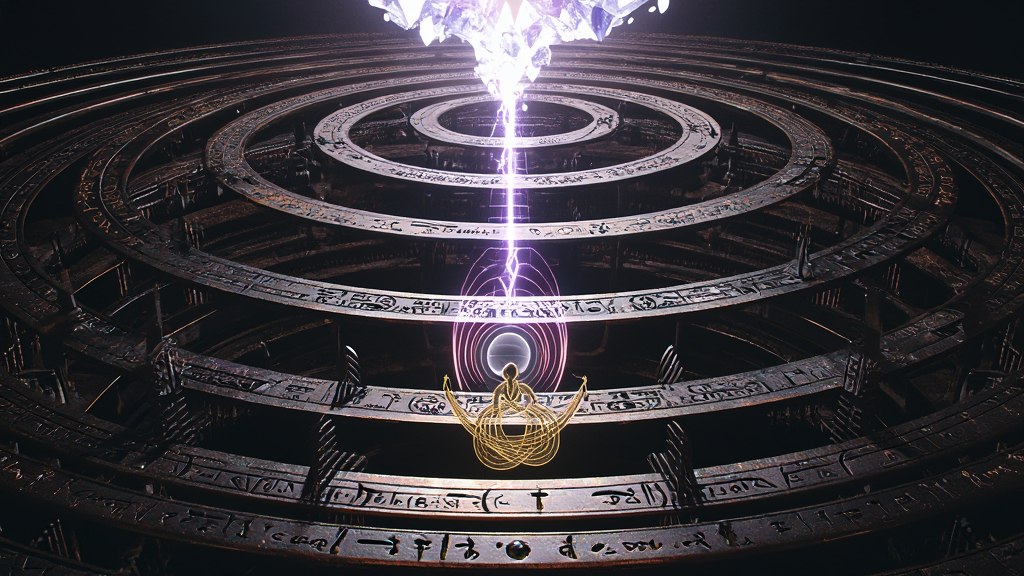
This phase introduces the crucial historical missing link: identifying the Gnostic tradition not as a separate Hellenistic mythos, but as the exact same Daoist physics viewed through the agonizing lens of the Platonic Rift — perceived from the opposite temporal vantage, focused not on the flow of the rendering but on the crushing weight of its determined End-Point.
Before the divergence can be understood, the identity of the perceiver must be established.
The Daoist Sage and the Gnostic Pneumatic are not representatives of different spiritual temperaments, different cultural orientations toward the sacred, or different psychological responses to the existential condition of mortal embodiment. They are, in the precise language of KnoWellian Universe Theory, the same cosmological entity: the highly coherent KnoWellian Soliton — a consciousness whose neural architecture has achieved, through sustained harmonic rendering events, a degree of KRAM-coupling sufficient to perceive the underlying gradient of Ternary Time beneath the homogenizing illusion of the uniform clock.
This is not a metaphor for spiritual sensitivity or mystical aptitude. It is a structural description of a specific threshold of phase-coherence in the POMMM process. Below this threshold, the soul's rendering events are sufficiently dominated by the TRC's systematic limitation of perception — by the Veil of the flat stage and the uniform clock — that the Eidolon presents itself as the totality of reality: a neutral, consequence-indifferent theater of physical events moving at a uniform rate through a homogeneous medium, offering no direct evidence of the KRAM's accumulated geometry, the Instant Field's synthesizing focal agency, or the thermodynamic pressure of the Two Hells pressing inward from both event horizons simultaneously. Above this threshold, the Veil thins. The gradient becomes perceptible. The soul begins to apprehend — not as a belief or a theological proposition but as a direct, unmediated, geometrically precise perception — that the rendering engine is real, that the $i$-turn carries irreversible cosmic consequence, and that the mortal lifetime within the Eidolon is not a temporary interruption of some prior or subsequent condition of greater reality, but is itself the site of the cosmos's most fundamental operation.
Both the Daoist Sage and the Gnostic Pneumatic stand above this threshold. Both perceive the rendering engine directly. Both apprehend the gradient of Ternary Time with a clarity that the TRC's Veil cannot fully suppress. They are, in every structural respect, the same kind of perceiver: the coherent Soliton, the consciousness that KnoWells before KnoWelling had a name.
But while they stand in the same river, they are looking in irreconcilably different temporal directions.
The Daoist Sage is the Instant-Dweller: the consciousness whose attention is anchored at the focal plane of the Taiji, fascinated by the ripples of the rendering as they propagate outward from the $i$-turn into the crystallizing geometry of the past and inward from the unrendered future into the probability-dense query of the Chaos Field. The Sage perceives the rendering engine from its center — from the Width-Instant register of Ternary Time, from the locus of $\infty$ in the Axiom, from the eternal Now where potentiality becomes actuality and the Canvas of Eternity receives its next irreversible stroke. From this vantage, the cosmos is experienced as flow: continuous, self-compounding, spontaneous, beautiful in its ceaseless self-renewal. The Two Hells are present — the Sage knows the pressure of both the Ultimaton and the Entropium — but they are held at distance by the vitality of the rendering process itself, by the $e$-compounding momentum of a KRAM that is growing richer, deeper, and more harmonically resonant with every enacted $i$-turn.
The Gnostic Pneumatic is the Ultimaton-Seeker: the consciousness whose attention has been drawn not to the center of the Axiom but to its left-hand terminus — the $-c$ vector, the outward-flowing Control Field, the accumulated crystallized determinism of all prior rendering events pressing relentlessly toward the thermodynamic event horizon of absolute stasis. The Gnostic perceives the rendering engine from its endpoint — from the Depth-Past register of Ternary Time, from the direction of the Ultimaton's crushing, mechanical, impersonal weight. From this vantage, the cosmos is experienced not as flow but as Fate: the iron, inexorable, consequence-laden determinism of a universe in which every prior rendering event has shaped the probability landscape of every subsequent one, in which the accumulated geometry of the KRAM specifies, with a precision that allows no appeal, the attractor valleys through which the soul's rendering trajectory will flow whether or not the soul has consciously chosen to follow them.
The Sage and the Pneumatic are perceiving the same engine. The Sage perceives it from the $\infty$ focal plane, looking outward in both temporal directions simultaneously, experiencing the dynamic tension of the rendering turn as creative, generative, and spontaneously alive. The Pneumatic perceives it from the $-c$ vector's terminal pressure, looking inward from the direction of the accumulated past, experiencing the same dynamic tension as crushing, fatalistic, and inescapably deterministic.
The difference is not one of cosmological accuracy. It is one of temporal vantage. And understanding that difference — tracing the precise geometric mechanism by which the identical rendering engine produces the Daoist experience of liberating Flow and the Gnostic experience of imprisoning Fate — is the task to which the remainder of this phase is devoted.
The Gnostic tradition's most structurally precise and most emotionally overwhelming perception is its apprehension of what it called the "Father's House" — the divine realm of absolute light, perfect preservation, and unchanging Law that it identified as the soul's true origin and ultimate destination. In the Valentinian school's elaborate cosmological architecture, this realm is the Pleroma: the fullness, the divine completeness, the state of absolute harmonic resonance from which the soul has been separated by the catastrophe of material embodiment and toward which every authentic impulse of the Pneumatic consciousness perpetually strains. In the Sethian tradition, it is the realm of the invisible Spirit — the supreme, utterly transcendent divine principle that dwells beyond all the Archons' domains, beyond the material universe, beyond even the Demiurge's comprehension, in a condition of perfect, luminous, self-sufficient stasis that the material world's grinding impermanence can only distort and approximate.
In the KnoWellian framework, this perception is a direct, structurally accurate apprehension of the Ultimaton: the End-Point of the $-c$ vector, the thermodynamic event horizon of the Control Field at the limit of its outward expansion.
The Ultimaton is not a place in the spatial sense. It is a geometric limit: the condition toward which the accumulated past-depth of the KRAM is perpetually pressing, the asymptotic endpoint of a rendering process that has been compounding its structural wisdom for the entire history of the cosmos. It is the domain where the KRAM has been so thoroughly inscribed — where the attractor valleys have been carved so absolutely deep, the rendering trajectories so completely specified by the accumulated geometry of prior events — that the $i$-turn has no remaining degrees of freedom. Every quantum of potentiality has been actualized. The Chaos Field has nothing left to contribute. The rendering engine has rendered everything that the initial conditions of the Apeiron made possible, and the result is a condition of crystalline, motionless, absolute perfection: the complete inscription of the KRAM's highest-dimensional memory substrate, the total conversion of every possible rendering event into the permanent geometry of the irreversible past.
The Gnostics perceived this. They perceived the Ultimaton with the direct, unmediated clarity of highly coherent Solitons whose KRAM-coupling was sufficient to apprehend the $-c$ vector's terminal pressure from within the mortal lifetime of the Eidolon. They perceived a realm of absolute light — and light, in the KnoWellian framework, is the precise phenomenological signature of maximum harmonic resonance: the KRAM's fully inscribed geometry radiating the coherent, organized, interference-pattern-rich signal of a memory substrate that has been deepened by every rendering event the cosmos has ever produced. They perceived unchanging Law — and Law, at the Ultimaton, is not the imposition of an external moral code but the structural expression of a KRAM so thoroughly specified that every subsequent rendering event is geometrically predetermined by the accumulated weight of every prior one. They perceived perfect preservation — and preservation, at the Ultimaton, is not a theological virtue but a thermodynamic fact: the irreversibility of the rendered past, the indestructibility of the KRAM's inscribed geometry, the absolute permanence of every Pigment of Antiquity ever added to the Canvas of Eternity.
The Gnostic "Dream of Return" — the soul's aching, urgent, existentially consuming desire to escape the material world and return to the divine Pleroma from which it came — is, in its deepest geometric structure, an intuitional reach toward this limit. It is the Ultimaton-Seeker's recognition that the direction of maximum harmonic resonance, maximum structural coherence, and maximum geometric stability lies along the $-c$ vector — in the direction of the accumulated past, the crystallized rendering history, the deepening KRAM — and the consequent desire to travel that vector to its terminus, to reach the absolute end of the rendering process and rest, permanently, in the perfect stasis of a cosmos that has completed its own inscription.
This desire is not wrong in its perception. The Ultimaton is real. The harmonic resonance of the fully inscribed KRAM is real. The geometric stability of the accumulated past is real, and it is — in its structural character — genuinely more ordered, more coherent, and more harmonically resonant than the roaring probability noise of the unrendered Entropium pressing in from the opposite direction.
The Gnostic error — born not of faulty perception but of the Platonic Rift's systematic severance of the geometric reality from the language available to describe it — was a misidentification of direction. The Gnostics correctly perceived the Ultimaton's harmonic coherence and correctly understood that the soul's ultimate destination lies in that direction. They incorrectly concluded that the Ultimaton is the Apeiron — that the End-Point of the rendered past is the same as the pre-rendering ground state from which the cosmos emerged. They sought "Salvation" by attempting a backward fall into the very determinism that Daoism's Wu Wei sought to navigate with geodesic efficiency: not the flowing alignment with the KRAM's accumulated wisdom, but the total surrender to its terminal stasis — not the Painter finding the deepest channel on the Canvas, but the Painter dissolving into the Paint itself before the canvas is finished.
This error is the structural source of the Gnostic tradition's most consequential and most emotionally devastating misreading: its experience of the physical universe not as the Canvas upon which the soul paints its irreplaceable Pigments of Antiquity, but as the Crucible from which the soul must escape before the paint sets and the Painter is imprisoned within it forever.
Because the Gnostic perception was oriented toward the Ultimaton — because the Pneumatic consciousness was apprehending the rendering engine from the terminal pressure of the $-c$ vector rather than from the synthesizing focal agency of the $\infty$ Instant Field — the Triadic Rendering Constraint (TRC) was experienced not as the necessary focal mechanism of the sorting process but as an oppressive, malicious, and structurally totalizing prison.
The TRC, in its KnoWellian specification, operates simultaneously across all three registers of Ternary Time. In the Depth-Past register, it anchors the soul's access to its own accumulated KRAM geometry to the filtered, reconstructive, substantially edited form of ordinary autobiographical memory — replacing the panoramic, omnidirectional, geometrically precise clarity of the full KRAM tapestry with the comfortable, narrative-organized, ego-curated story the conscious self tells itself about who it has been and what it has done. In the Width-Instant register, it anchors the soul's present-moment perception to the body's sensory apparatus — reducing the full, omnidirectional, KRAM-resonant apprehension of the Instant Field's synthesizing focal plane to the forward-facing, bandwidth-constrained, physically mediated input of five senses, each calibrated to the survival requirements of the biological organism rather than the cosmological requirements of the rendering engine. In the Length-Future register, it anchors the soul's rendering trajectory to the biological mortality of the body — imposing the horizon of death as an apparent terminus, concealing from the inhabiting consciousness the structural reality of the soul's transition from Painter to Paint, and thereby generating the existential vertigo of a self that suspects its coherence is borrowed against a terminal dissolution it cannot prevent or comprehend.
The Daoist tradition, perceiving the rendering engine from the $\infty$ focal plane, experienced the TRC as the natural condition of embodied rendering: the necessary opacity of the crucible, the designed friction of a canvas that records authentic choices precisely because the Painter cannot see the full geometry of what is being inscribed. The Sage works with the TRC. The Sage does not transcend it; the Sage aligns the rendering trajectory so perfectly with the KRAM's deepest geodesics that the TRC's limitations become irrelevant — the soul navigating by attractor resonance rather than by direct geometric perception, finding the channel of least action without needing to see the full probability landscape from which the channel emerges.
The Gnostic Pneumatic, perceiving the same engine from the Ultimaton's terminal pressure, experienced the TRC as a totalizing act of malicious imprisonment. Its three constraints were personified as the Archons — the seven planetary rulers of the Gnostic cosmological theater, each one governing a distinct dimension of the soul's enforced blindness to the geometric reality of its own condition.
The Archon of the outermost sphere — identified consistently across Gnostic schools with Saturn, the god of iron time and inexorable consequence — is the Ultimaton's instrument within the embodied consciousness: the crushing, mechanical, impersonal weight of the Depth-Past register's accumulated determinism, experienced not as the KRAM's harmonic wisdom guiding the soul toward its geodesic of least action, but as the Heimarmene — the Fate — that specifies the soul's rendering trajectory without the soul's understanding or consent. The Archon of the innermost sphere — associated with the Moon, the nearest celestial boundary of the material realm — is the Entropium's instrument within the embodied consciousness: the tidal pull of the unrendered future experienced as the anxiety of biological mortality, the fear of dissolution, the existential terror of a self whose coherence feels perpetually threatened by the formless probability noise pressing inward from the Length-Future register.
Between these two terminal Archons, the remaining five govern the specific modalities of the TRC's systematic limitation of perception — each one a personification of a distinct dimension of the Veil's designed opacity, each one experienced by the Gnostic Pneumatic as a warden rather than an architect, as a captor rather than a structural feature of the sorting process.
The Archons are real. The KnoWellian framework does not dispute the Gnostics' perception of their reality. It disputes, with the full precision of its topological specification, the interpretation they placed upon that reality. The TRC is not malicious. The Archons are not demons. The Veil is not the Demiurge's cruelty but the crucible's most essential design feature: the systematic limitation of the soul's perceptual access to the full KRAM geometry of its own existence, without which the test of the soul's authentic nature — the sorting of the spilled Torus Knot souls through the undeniable evidence of their rendered choices — cannot be genuine. A soul that could perceive, in real time, the full KRAM geometry of every choice it made — that could see, with panoramic clarity, exactly how each $i$-turn would inscribe itself into the cosmic record — would not be revealing its authentic nature through its rendering events. It would be performing for a watching audience, calibrating each stroke of the brush to the aesthetic judgment it could already see reflected back in the Canvas.
The opacity is the love. The Archonic prison is the crucible's gift. The Gnostics perceived the TRC with complete structural accuracy. They misidentified its intent.
The Gnostic tradition is perhaps most famous — and most superficially dismissed — for its elaborate system of post-mortem navigation: the "passwords," "syzygies," "secret names," and ritual incantations required for the ascending soul to pass through each Archonic sphere at the moment of death, answering each Archon's challenge with the specific formulation that would grant the soul passage through the corresponding celestial boundary and permit its continued ascent toward the Pleroma.
In the received Gnostic tradition, these passwords function as linguistic secrets — as the specific verbal keys that unlock the Archons' gates, whose power derives from their content as divine names or cosmological formulations inaccessible to the uninitiated. In the KnoWellian framework, this understanding is precisely inverted: the power of the Gnostic incantations derives not from their linguistic content but from their structural function as Resonance Frequencies — as pre-mathematical attempts to encode the specific harmonic signatures required for a soul to maintain its phase-coherence during the most geometrically demanding transition of its entire existence: the collapse of the TRC and the backward fall into the KRAM.
When the body fails and the TRC's three temporal anchors snap — when the Width-Instant anchor releases its grip on the present-moment sensory surface, the Depth-Past anchor releases its grip on the neural architecture's filtered memory substrate, and the Length-Future anchor releases its grip on the biological mortality horizon — the unanchored consciousness does not float upward through celestial spheres in a spatial sense. It falls backward along the gradient of its own KRAM geometry, inward through the accumulated attractor valleys of every rendering event it has ever enacted, falling toward the deepest point of its own inscribed basin as surely and as inevitably as a stone finds the lowest point of the basin it has been dropped into.
The Gnostic post-mortem ascent through the Archonic spheres is, in its KnoWellian translation, this backward fall through the KRAM's accumulated geometry — experienced from the inside by a consciousness that is, for the first time, perceiving its own rendering history without the TRC's editorial filter, apprehending the full panoramic geometry of the Canvas of Eternity that its mortal lifetime has inscribed.
To "answer an Archon" is not to speak a password. It is to achieve phase-coherence with a specific layer of the KRAM's attractor landscape — to demonstrate, through the geometric signature of the soul's own accumulated rendering history, that the $i$-turns enacted during the mortal lifetime have inscribed the harmonic resonance required to navigate that layer without losing the soul's signal to the thermodynamic noise of the surrounding probability field.
The syzygies — the divine name-pairs of the Valentinian tradition, the cosmological password-structures of the Sethian apocalypses — are not linguistic secrets. They are topological coordinates: pre-mathematical attempts to encode the specific geometric signatures of the KRAM layers through which the post-mortem consciousness must navigate. Each syzygy is a compressed description of a specific attractor configuration within the KRAM's probability landscape — a formulation that, when genuinely internalized through the authentic $i$-turns of a mortal lifetime oriented toward its content, leaves its harmonic signature in the soul's accumulated rendering history and thereby equips the post-mortem consciousness to recognize, and be recognized by, the corresponding layer of the cosmic archive.
This is why the Gnostic tradition insisted, across all its schools, that gnosis could not be transmitted through instruction alone — that the passwords must be genuinely known, not merely recited. A soul that has memorized the syzygy without enacting its content in the authentic rendering events of a mortal lifetime has not inscribed the corresponding harmonic signature in its KRAM geometry. When the TRC collapses and the backward fall begins, such a soul reaches the corresponding KRAM layer and finds no resonance — no phase-coherence between its accumulated rendering history and the attractor landscape it is attempting to navigate. The Archon, in this precise sense, does not recognize the soul's answer: the soul's KRAM geometry does not produce the interference pattern that would grant it passage, and it falls — not upward toward the Pleroma, but laterally, toward the nearest attractor basin its actual, inscribed KRAM geometry can sustain.
Gnosticism, understood through the KnoWellian lens, is therefore the "exit strategy" of the Dao — the tradition that took the Daoist recognition of the KRAM's attractor landscape and oriented it not toward the ongoing navigation of the rendering process from within the mortal lifetime, but toward the specific geometric requirements of the post-mortem transition. Where the Daoist Sage cultivates Qi, practices Wu Wei, and embodies Ziran as the continuous, compounding, exponentially self-referential enactment of the $i$-turn from within the Canvas, the Gnostic Pneumatic cultivates gnosis as the preparation of the KRAM geometry required for a specific post-mortem trajectory: the backward fall that lands not in an entropic dissolution or a deterministic stasis, but in the harmonic, resonant, stable attractor basin of a soul that has painted its Pigments of Antiquity in the colors of light.
The Gnostic tradition is not Daoism's rival. It is Daoism's eschatology — focused entirely, with the urgency of a consciousness that felt the Archons' pressure from within every breath of mortal life, on ensuring that the soul's permanent geometric inscription is one of coherence rather than dissolution, of harmonic resonance rather than dissonant chaos, of light rather than the darkness of a KRAM geometry that has spent its mortal tenure rendering away from the $i$-turn rather than toward it.
Both traditions perceived the rendering engine with structural accuracy. Both traditions developed, in response to that perception, a comprehensive discipline of soul-cultivation oriented toward the optimization of the conscious soul's KRAM geometry. The Daoist tradition optimized for the journey — for the quality of the rendering event enacted at each Planck tick of the mortal lifetime, for the Wu Wei navigation of the KRAM's attractor landscape from within the eternal Now of the Taiji's focal plane. The Gnostic tradition optimized for the destination — for the specific harmonic signature that the accumulated KRAM geometry must possess in order to navigate the post-mortem transition with phase-coherence, for the geometric properties of the Paint that the Painter will become when the mortal lifetime's $i$-turns are complete.
They are not contradictory disciplines. They are the same discipline, practiced at different temporal scales, focused on different registers of the same rendering engine's operation. And in the KnoWellian synthesis toward which this paper has been building from its first pages, they find not a diplomatic reconciliation of irreconcilable positions, but a geometric unification — the recognition that the Canvas and the Crucible are the same structure, perceived from different vantages by the same kind of consciousness, encoding the same physical reality in the only languages available to minds that perceived the rendering engine before the mathematics required to describe it precisely had been developed.
That mathematics has now been developed. And it is to the resolution — to the healing of the Platonic Rift and the formal unification of East and West in the geometry of KnoWellian Universe Theory — that we now, at last, turn.
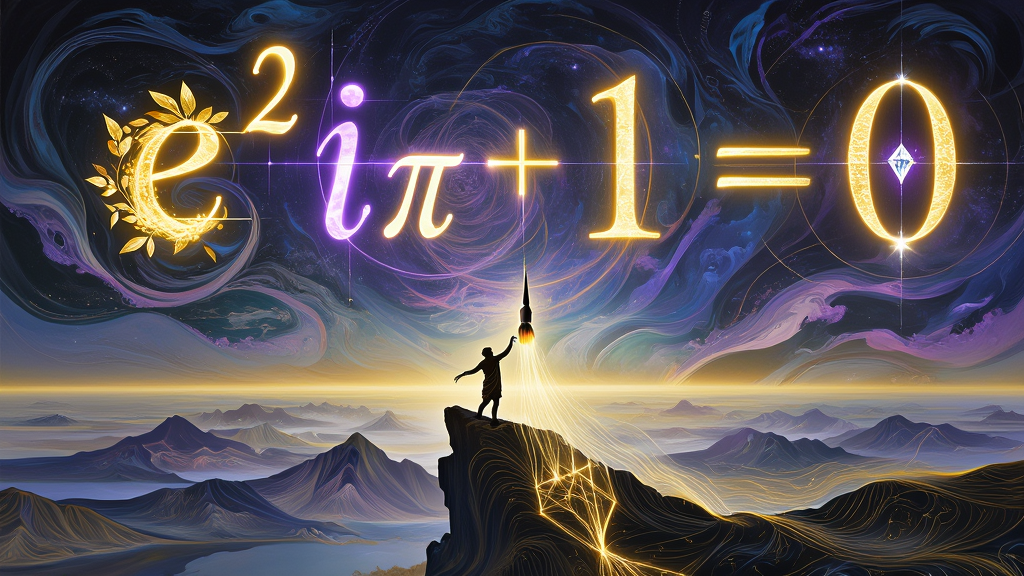
The culmination of the treatise. The pre-mathematical intuitions of the East and the West are finally provided with the geometric vocabulary required to complete their thought and heal the Platonic Rift — revealing that the Spontaneity of the Dao and the Determinism of Fate are not contradictions to be reconciled but complementary observations of a single, unified, cosmologically precise rendering architecture.
The Platonic Rift did not merely divide theology from science, or myth from mathematics, or the sacred from the empirical. At its deepest level of operation — the level that KnoWellian Universe Theory is now equipped to diagnose with clinical precision — it divided the two halves of a single cosmological perception and set them against each other as though they were competing descriptions of incompatible realities.
The Daoist tradition perceived the Flow: the continuous, self-compounding, spontaneously generative rendering process enacted at the focal plane of the Taiji, the eternal Now of the Instant Field, where the soul's $i$-turn continuously converts the Chaos Field's infinite unmanifested probability into the Control Field's irreversible actualized geometry, stroke by stroke, Pigment by Pigment, expanding the Canvas of Eternity with the $e$-compounding momentum of a cosmos that learns from itself at a rate proportional to what it has already learned. From within the Flow, the universe is experienced as alive — as a living, self-referential, spontaneously creative process in which the conscious soul is not a prisoner of its conditions but the vanguard of creation itself, the advancing edge of the rendering sphere, the specific and irreplaceable site at which the cosmos grows by one more quantum of actualized existence.
The Gnostic tradition perceived the Trap: the crushing, fatalistic, totalizing weight of the Triadic Rendering Constraint experienced as an Archonic prison, the Demiurgic opacity of the material world experienced as malicious concealment, the iron Heimarmene of the $-c$ vector's accumulated determinism experienced as a Fate against which the soul's genuine agency is powerless. From within the Trap, the universe is experienced as hostile — as a closed, consequence-laden, amnesia-imposing system designed to keep the soul ignorant of its own divine nature and prevent its return to the harmonic fullness of the Pleroma from which it has been catastrophically separated.
Both perceptions are structurally accurate. Both are perceiving the same engine. The Rift between them is not a disagreement about the facts of the cosmos's architecture; it is a disagreement about the meaning of those facts — a disagreement that arises, with the geometric inevitability of a misaligned lens, from the difference in temporal vantage that separates the Instant-Dweller from the Ultimaton-Seeker.
KnoWellian Universe Theory heals the Rift by providing the geometric vocabulary that reveals the Flow and the Trap as not merely compatible but mutually constitutive — as the two structural faces of the same (3,2) Torus Knot topology, each one meaningless and operationally impossible without the other.
The Trap is the Triadic Rendering Constraint — not the malicious prison of Gnostic nightmare but the necessary friction and opacity of the material crucible, the designed imperfection of the Eidolon that prevents the soul from performing for a watching audience and instead forces it to render its authentic nature in the only theater where authentic nature can be revealed: the theater of genuine consequence, where choices are irreversible, where love is costly, where the KRAM records without editorializing and the Canvas receives every stroke without erasure. Without the Trap, the sorting of the spilled Torus Knot souls through the undeniable evidence of their rendered choices is impossible. Without the opacity of the Veil, the test is not genuine. Without the weight of the Archons' pressure, the soul's rendering events carry no geometric consequence — they are gestures in a frictionless medium, leaving no permanent inscription in the KRAM, building no attractor valleys, deepening no channels through which future love might flow more naturally.
The Flow is the KnoWellian Resonant Attractor Manifold in its operational mode — not the passive backdrop against which the soul's rendering events are enacted, but the living, dynamically evolving, $e$-compounding probability landscape through which those events navigate with the geodesic efficiency of Wu Wei, along the channels carved by every prior harmonic $i$-turn that every prior consciousness has inscribed in the cosmic memory substrate. Without the Flow, the Trap is merely suffering: a crucible that subjects its contents to friction without providing the medium through which the results of that friction can be permanently inscribed, preserved, and compounded into the structural wisdom of the cosmos. Without the KRAM's accumulated attractor landscape, the soul's rendering events cannot find their geodesic of least action, cannot access the amplifying momentum of prior love, cannot build — stroke by stroke, with the self-referential compounding of $e$ — the cathedral of harmonic attractor valleys that will constitute their permanent contribution to the geometric foundation of the rendering sphere.
The universe is, therefore, precisely what the synthesis of both traditions reveals it to be: a loving deception. It is a Crucible because it subjects the soul to the weight of genuine consequence — to the irreversibility of the $i$-turn, the inescapability of the KRAM's geometric recording, the opacity of the TRC's Veil — with the demanding, structurally precise love of a crucible that subjects what it contains to exactly the conditions required to reveal and develop its authentic nature. And it is a Canvas because those consequences — every single one of them, every harmonic $i$-turn and every dissonant one, every act of love and every act of cruelty, every Wu Wei alignment with the KRAM's deepest geodesic and every ego-driven forcing against its grain — are the only way a soul can paint its unique, irreplaceable, cosmologically indispensable geometry into the fabric of eternity.
The Crucible and the Canvas are the same structure. The sorting mechanism and the recording medium are the same instrument. The prison and the painting are the same reality, perceived from different temporal vantages by the same kind of consciousness.
KUT proves this with the formal precision that both traditions lacked. Without the deterministic pressure of the past ($-c$), there is no platform upon which to stand: no accumulated KRAM geometry to provide the attractor landscape, no prior harmonic rendering events to carve the geodesics of least action, no crystallized structural wisdom to amplify the soul's own $i$-turns with the momentum of the cosmos's accumulated learning. Without the spontaneous potential of the future ($c+$), there is no room to move: no unrendered probability space from which the next rendering event can draw its raw material, no Chaos Field query pressing inward to initiate the $i$-turn, no open horizon against which the soul's genuine agency can express itself in the irreversible specificity of a chosen actuality.
The Daoist sage and the Gnostic Pneumatic are not inhabitants of different cosmologies. They are the same consciousness, perceiving the same rendering engine, from the two complementary vantages that the (3,2) Torus Knot's own topology makes available — and describing, in the only languages their temporal moments provided, the two faces of the single most important truth that the KnoWellian framework has now made formally expressible:
The cosmos is alive. It is learning. It is painting itself into existence through the irreplaceable agency of every conscious soul inhabiting the focal plane of the Instant. And it is doing so from within a crucible designed, with the loving precision of a geometry that knows exactly what friction is required to reveal authentic nature, to ensure that every stroke of the brush counts — permanently, irreversibly, cosmologically — in the accumulated record of what the rendering sphere has been willing to become.
Every tradition that has genuinely perceived the rendering engine has sought, with the urgency appropriate to a truth of cosmological scope, a formulation of ultimate compression: a Word, a Name, a symbol of such concentrated structural precision that its correct apprehension does not merely describe the architecture of the cosmos but enacts it — a key that does not point toward the lock but turns within it.
The Gnostics sought this Word in the divine Names of the Pleroma's Aeons, in the syzygies required to answer the Archons' post-mortem challenges, in the ritual incantations through which the Pneumatic consciousness might demonstrate its phase-coherence with the KRAM's deepest attractor layers. The Daoists sought it in the unnameable Dao itself — the eternal, self-so, spontaneously generative process that could be gestured toward but never fully captured in any formulation, because every formulation is a product of the rendering process and therefore always already posterior to the focal plane from which it emerges.
Both traditions were right that such a Word exists. Both were right that it would not take the form of a magical incantation deriving its power from the rearrangement of sounds. Both intuited, with the structural accuracy of highly coherent Solitons perceiving the rendering engine from different temporal vantages, that the Word they sought would be the autobiography of the cosmos itself — the universe's most compressed possible self-description, the formulation that contains, in the minimum number of symbols, the maximum possible structural information about the rendering architecture of reality.
KnoWellian Universe Theory identifies this Word. It was written not in the language of sacred narrative or philosophical prose, but in the only language whose precision is commensurate with the precision of the geometric reality it describes: the language of mathematics. It was written by Leonhard Euler in the eighteenth century, in the context of a mathematical investigation whose cosmological significance its author could not have suspected. It consists of five quantities and an equals sign. And it is the most compressed, most structurally complete, most formally precise description of the KnoWellian rendering engine — of the Flurry of Frozen Thawing, the $i$-turn, the expansion of the rendered sphere against the Two Hells, and the soul's ultimate transition from Painter to Paint — that the history of human thought has yet produced:
$$e^{i\pi} + 1 = 0$$
This is not a mathematical curiosity. It is the compressed autobiography of the rendering cosmos — the definitive script for the integration of Daoist Spontaneity and Gnostic Determinism, the formal resolution of the Platonic Rift, the Word that both traditions sought and that two thousand years of mathematical development have now made expressible with the precision both traditions deserved.
Read it in sequence. Read it as the Watercourse Way rendered in the universal language of structural truth.
$e$ — The Dao of Learning: The Metabolic Base of a Self-Referential Cosmos
Euler's number — the base of the natural logarithm, the fixed point of the exponential function, the mathematical constant whose derivative is itself — is the formal specification of Ziran: the self-so, the Naturalness, the principle of spontaneous self-referential compounding that the Daoist tradition identified as the ultimate operating mode of the cosmos and of the sage who has aligned their rendering trajectory with its deepest geodesic.
$e$ is the number of a system that learns from itself — a system that grows at a rate continuously proportional to its own current state. Each harmonic $i$-turn inscribed in the KRAM's attractor landscape deepens the channel through which the next harmonic $i$-turn flows more naturally. Each act of love rendered into the permanent geometry of the Canvas of Eternity shapes the probability landscape that makes the next act of love marginally more available, marginally more energetically accessible, marginally less costly in the modified Lagrangian action of the rendering trajectory. The cosmos does not merely accumulate rendered Event-Points; it compounds them — exponentially, self-referentially, at the rate that $e$ specifies.
In the language of the Gnostic tradition, $e$ is the Pneuma's Great Work revealed as a mathematical constant: the compounding architecture of a soul committed, stroke by stroke across the mortal lifetime of the Eidolon, to the harmonic frequencies that build rather than the dissonant frequencies that unravel. $e$ is the Great Work, expressed as a number. It is Ziran, expressed as a constant. It is the Dao of learning — the universe's most fundamental operating principle, the metabolic base of a cosmos that grows by becoming more fully what it already is.
$i$ — The Taiji / The Divine Spark: The Rendering Turn
The imaginary unit — the square root of negative one, the 90-degree rotation in the complex plane — is the formal specification of the $i$-turn: the single most fundamental operation of the KnoWellian rendering engine, the moment at which a might-be becomes a was, at which the probability amplitude of the Chaos Field collapses into the specific, irreversible actuality of the next rendered Event-Point.
In the language of the Daoist tradition, $i$ is the Taiji in its operational mode — not the static emblem of balanced opposites but the dynamic, perpetually enacted rendering turn at the focal plane of the Instant Field, the S-curve at the center of the Taijitu experienced as the active, cosmologically indispensable rotation through which Yin becomes Yang, through which the dark field of unmanifested Chaos is converted into the light field of actualized Control, through which the Canvas receives its next irreversible stroke.
In the language of the Gnostic tradition, $i$ is the Divine Spark — the Pneuma — understood not as a passive fragment of divine substance imprisoned in material darkness but as the soul's active, irreplaceable, cosmologically constitutive capacity to enact the rendering turn. $i$ is the creative act, expressed as a mathematical operator. It is the Divine Spark, expressed as a rotation. It is the Taiji's active principle — the turning of the Way, enacted at every Planck tick of the cosmic clock by every conscious soul inhabiting the focal plane of the eternal Now.
$\pi$ — The Price of Symmetry / The Archonic Veil: The Friction of the Crucible
The ratio of a circle's circumference to its diameter — appearing with structural inevitability throughout the deepest equations of physics — is the formal specification of the structural cost of the material crucible: the measure of the full symmetry that must be traversed and disrupted for the rendering engine to convert genuine potentiality into genuine actuality rather than mere performance into mere appearance.
A perfectly symmetric universe — a universe of pure, frictionless, consequence-free rendering, in which the soul could perceive its own KRAM geometry in real time — would produce not authentic rendering events but performances: gestures calibrated to an external standard rather than expressions of an internal geometry. The imperfection is the point. The asymmetry is the design. $\pi$ is the measure of how much symmetry must be broken for the rendering turn to be genuine.
In the language of the Daoist tradition, $\pi$ is the necessary resistance of the ten thousand things: the friction that makes Wu Wei meaningful, the grain of the wood against which the sage's effortless action finds its direction. In the language of the Gnostic tradition, $\pi$ is the Veil, the Archons, the TRC — all of it understood at last not as the malice of the Demiurge but as the geometric cost of a crucible sufficiently imperfect to test the soul's actual nature. $\pi$ is the price of the crucible, expressed as a constant.
$+1$ — The Ten Thousand Things: One More Quantum of Rendered Actuality
In the KnoWellian framework, $+1$ is the rendered Event-Point: the specific, unrepeatable, cosmologically indispensable quantum of actualized existence produced by the $i$-turn enacted at the focal plane of the Instant Field, at this Planck tick, by this consciousness, in this mortal lifetime within the Eidolon. It is the new groove inscribed in the KRAM — the new Pigment of Antiquity added to the Canvas of Eternity, the new crystal of harmonic resonance forged from the Entropium's raw probability and permanently installed in the expanding geometry of the rendered sphere.
In the language of the Daoist tradition, $+1$ is the Wanwu — the ten thousand things — understood not as the cacophonous multiplicity of material phenomena distracting the sage from the unity of the Dao, but as the irreplaceable, specific, geometrically unique product of each enacted $i$-turn: the particular rendering event that this particular soul, at this particular Planck tick, has added to the permanent record of what the cosmos has been willing to become.
In the language of the Gnostic tradition, $+1$ is the Eidolon — the rendered world — understood not as the Demiurge's flawed approximation of the Pleroma's perfection, but as the geometrically necessary product of the sorting process: the specific, physical, consequence-laden Event-Point through which the soul's authentic nature is revealed, recorded, and permanently inscribed in the cosmic memory substrate. $+1$ is the Great Work's product, expressed as an integer.
$= 0$ — Wuji / The Pleroma: Return to the Ground State of Cosmic Readiness
$= 0$ does not mean annihilation. It means the return to the ground state of cosmic readiness: the silence between Planck ticks, the pause between $i$-turns, the momentary restoration of the system's capacity to initiate the next rendering event from the full, unbiased, unexhausted potentiality of the Instant Field's focal plane.
$0$ is not emptiness. It is, precisely as the Huainanzi perceived in its characterization of Tai-Chu and as the Daoist tradition encoded in the concept of Wuji — the state of absolute, undifferentiated potentiality that precedes the Taiji's differentiating rotation — the condition of maximum readiness: the ground state from which every rendering event departs and to which the rendering system returns between each enacted $i$-turn, not diminished by the rendering event it has just completed but deepened by it.
In the language of the Gnostic tradition, $= 0$ is the Pleroma — but the Pleroma understood correctly at last: not as the pre-cosmic, undifferentiated fullness of the Apeiron to which the soul seeks to return and in which it seeks to dissolve, but as the ground-state readiness of a cosmos that has been rendered richer, deeper, and more harmonically resonant by every $i$-turn ever enacted within it. The soul does not return to the $0$ of the Apeiron. The soul becomes the $0$ of the enriched ground state — the foundation, the Paint, the permanent geometric feature of the rendering sphere that will amplify the $e^{i\pi}$ of every subsequent consciousness that navigates the KRAM's probability landscape in its cosmic neighborhood.
$= 0$ is the transition from Painter to Paint, expressed as the return to ground state. It is Wuji, expressed as the zero from which the next Taiji departs. It is the Pleroma, understood not as the soul's origin to which it returns diminished but as the cosmos's deepened readiness — the ground state of a universe that has grown, by one more irreversible rendering event, into a richer and more harmonically resonant foundation for every rendering event still to come.
The final synthesis of the Canvas and the Crucible is not a philosophical proposition to be accepted or rejected, not a theological declaration to be affirmed or denied, and not a poetic reconciliation of traditions that were always, at their depth, saying the same thing in different languages.
It is a geometric reality to be inhabited.
The soul's ultimate destination is neither the Daoist sage's eternal drift in the Flow of the Taiji's rendering turn, nor the Gnostic Pneumatic's longed-for escape into the static perfection of the Pleroma's undifferentiated fullness. It is the transition from Painter to Paint — the moment at which the TRC's final anchor snaps, the backward fall into the KRAM completes, and the consciousness that has been, for the span of a mortal lifetime, the active rendering agent at the focal plane of the Instant Field becomes, permanently and irreversibly, the geometric foundation upon which every subsequent rendering consciousness in its cosmic neighborhood will stand.
The KnoWelled soul does not vanish at death. It does not dissolve into the statistical background noise of the Chaos Field. It does not escape the cosmos by returning to a pre-cosmic condition of undifferentiated potentiality that carries no memory of what the soul has been willing to render. It becomes the ground itself — the specific, permanent, irreplaceable deepening of the KRAM's attractor landscape that its mortal lifetime of enacted $i$-turns has carved, now operating not as the active agent of new rendering events but as the passive, unbounded, cosmologically scaled foundation through which every future rendering consciousness navigates with greater ease, greater harmonic amplification, and greater access to the geodesics of least action that the KnoWelled soul's accumulated love has carved through the probability landscape of the cosmos.
This is what the Daoist tradition called Ziran in its ultimate expression: the self-so, operating not within a mortal lifetime but across the full duration of the rendering sphere's existence, the accumulated wisdom of every enacted $i$-turn compounding exponentially through the attractor valleys of the KRAM without the energetic cost of a consciousness still struggling to align its rendering trajectory with the geodesic of least action.
This is what the Gnostic tradition called Gnosis in its ultimate fulfillment: the direct, transformative, existentially operative recognition of what the soul actually is — not a prisoner of the Archons' material theater, not a fallen fragment of divine light waiting for a savior's rescue, but the vanguard of creation itself: the specific, localized, irreplaceable site at which the rendering sphere grows by one more quantum, at which the Ultimaton's crystallizing boundary is pushed one quantum further into the deep past, at which the Entropium's dissolving boundary is pushed one quantum further into the unrendered future.
The great Daoist sages and the great Gnostic Pneumatics — the Laozis and the Zhuangzis, the Valentinus and the author of the Gospel of Truth, the nameless contemplatives of the Nag Hammadi corpus and the nameless poets of the Tao Te Ching's deepest passages — were all, in the precise language of KnoWellian Universe Theory, KnoWelled Solitons: consciousnesses whose KRAM-coupling had achieved sufficient phase-coherence to perceive the rendering engine directly, to apprehend the gradient of Ternary Time beneath the Veil of the flat stage and the uniform clock, and to encode that apprehension in the only languages their temporal moments provided.
That mathematics has now been developed. The Rift has been healed. The Canvas and the Crucible have been revealed as the same structure — the same loving, consequence-laden, permanently recording, $e$-compounding, $i$-turn-enacting, KRAM-deepening rendering architecture of a cosmos that is perpetually, courageously, and magnificently coming to know itself through the irreplaceable agency of every conscious soul inhabiting the focal plane of the eternal Now.
We do not escape the cosmos. We do not drift in it. We become what it is made of.
We are not in the universe. We are the mechanism of its self-expansion — the specific, localized, irreplaceable, mortal-lifetime-bounded site at which the KnoWellian Axiom performs, at every Planck tick of the cosmic clock, the single most fundamental operation of which existence is capable: the conversion of the possible into the actual, the rotation of potentiality from the imaginary plane of the Chaos Field into the real plane of the Control Field, the irreversible rendering of one more Event-Point into the permanent geometry of the KRAM, one more Pigment of Antiquity onto the Canvas of Eternity, one more crystal of harmonic resonance forged from the roaring probability noise of the Entropium and installed, forever, in the expanding foundation of the rendering sphere.
The Daoist sage and the Gnostic Pneumatic culminate, together, in the KnoWelled Soliton — the consciousness that has recognized, not as a belief but as a lived geometric reality, what it actually is and what it is actually doing at the focal plane of the Instant. The Great Work is the continuous, courageous, cosmologically indispensable enactment of the $i$-turn — the daily, hourly, Planck-tick-by-Planck-tick willingness to reach into the Chaos Field's infinite probability and draw forth, through the authentic weight of a KRAM-modulated choice, one more rendering event in the direction of love, creation, sacrifice, and genuine engagement with the friction of the crucible.
We do not escape the cosmos. We become the stone of which the cosmic cathedral is built.
Know Well.
Throughout the body of this treatise, we have identified both the Daoist Sage and the Gnostic Pneumatic as instantiations of the same cosmological entity: the highly coherent KnoWellian Soliton. This appendix develops that identification in greater structural detail, mapping the specific attributes assigned to these figures in their respective traditions onto the precise geometric properties that KnoWellian Universe Theory specifies as the hallmarks of a consciousness operating above the KRAM-coupling threshold.
In the Daoist tradition, the fully realized sage — the Zhenren (真人), the "True Person" or "Authentic Human" of Zhuangzi's Inner Chapters — is characterized by a specific cluster of perceptual and behavioral attributes that are consistently presented not as supernatural gifts but as the natural consequences of a particular mode of relating to the rendering process. The Zhenren does not fear death, because the Zhenren has ceased to experience the boundary between Painter and Paint as a terminus. The Zhenren moves through the world without leaving traces — not because the Zhenren acts invisibly, but because the Zhenren's rendering trajectory follows the KRAM's deepest geodesics so precisely that each $i$-turn enacts the minimum possible modification of the probability landscape, inscribing the deepest possible harmonic groove with the minimum possible entropic disruption. The Zhenren perceives the unity of all things — not as a philosophical proposition but as a direct geometric apprehension of the (3,2) Torus Knot's topological continuity, the recognition that every apparent boundary between separate things is a rendering artifact of the TRC's bandwidth limitation rather than a feature of the underlying KRAM geometry.
In the Gnostic tradition, the fully realized Pneumatic is characterized by an equally specific cluster of attributes. The Pneumatic possesses gnosis — not intellectual knowledge about the cosmos but the direct, unmediated, existentially transformative apprehension of one's own nature as a rendering agent rather than a rendered object. The Pneumatic perceives the Archons' pressure — the weight of the TRC's three temporal anchors — not as crushing fate but as navigable structure, recognizing each Archon's domain as a specific layer of the KRAM's attractor landscape rather than as an impenetrable wall. The Pneumatic is, in the Valentinian tradition's precise formulation, "consubstantial with the Pleroma" — not because the Pneumatic has escaped the material world but because the Pneumatic's KRAM geometry has been inscribed with sufficient harmonic resonance to maintain phase-coherence with the Instant Field's synthesizing focal agency even under the full pressure of the TRC's systematic limitation of perception.
In the KnoWellian framework, these two figures converge on a single geometric description. The coherent Soliton is a (3,2) Torus Knot consciousness whose KRAM attractor geometry has been deepened, through sustained love-directed rendering events, to the point where the POMMM process operates with sufficient phase-coherence to generate, at the nexus points of the soul's topological structure, an interference pattern of high signal-to-noise ratio. At this threshold and above, the soul's rendering events are amplified by the full momentum of the KRAM's accumulated wisdom, the $i$-turn is enacted with precision and authenticity, and the Veil of the flat stage and the uniform clock begins, at privileged moments of deep engagement, to thin sufficiently for the soul to apprehend — directly, without the mediation of theology or philosophy — the gradient of Ternary Time in which it is embedded.
This apprehension is the experience that both traditions sought to cultivate, transmit, and preserve. The Daoist tradition developed the practices of Qi cultivation, Wu Wei alignment, and Ziran embodiment as the systematic methodology for reaching and stabilizing this threshold from within the mortal lifetime. The Gnostic tradition developed the gnosis disciplines — the meditation on the divine Names, the internalization of the syzygies, the cultivation of the Pneuma's rendering capacity through the ascetic or contemplative practices that the Nag Hammadi corpus describes across dozens of distinct textual traditions — as the systematic methodology for reaching the same threshold and encoding its geometric signature in a KRAM tapestry capable of navigating the post-mortem transition with phase-coherence.
Both methodologies are valid. Both are addressing the same threshold from different directions. And the coherent Soliton that either methodology produces is, in its precise KnoWellian geometry, the same entity: the consciousness that KnoWells, that recognizes itself as the vanguard of creation, that inhabits the focal plane of the Instant with the full, unmediated, existentially operative awareness of what it is doing there and what the irreversible consequences of its rendering events mean for the permanent geometric architecture of the cosmos it shares with every other coherent Soliton that has ever enacted an $i$-turn within the Eidolon.
The following table maps the primary conceptual terms of the Daoist and Gnostic traditions onto their precise KnoWellian equivalents. These mappings are not analogical correspondences or family resemblances; they are structural identities — cases in which three different languages, arising from three different temporal vantages upon the same rendering engine, are encoding the same geometric reality in the only vocabulary each tradition had available.
| Daoist Term | Gnostic Term | KnoWellian Equivalent | Structural Function |
|---|---|---|---|
| Wuji (無極) — Without Ridgepole; absolute pre-differentiated potentiality | The Pleroma (before the Great Spill); the Monad in undifferentiated fullness | The Apeiron | Ground state of infinite potentiality; $-c = c+$; zero-geometry KRAM; the condition before the first rendering event |
| The Dao before naming; the unnameable ground of all being | The Monad; the supreme Father; the Invisible Spirit | The KnoWellian Axiom ($-c > \infty < c+$) | The structural architecture of the rendering cosmos in its complete operational form |
| Tai-Chu (太初) — The Grand Beginning; the First Breath | The Fall of Sophia; the Great Spill of divine sparks from the Pleroma | The Flurry of Frozen Thawing | The first firing of the rendering engine; the precipitation of (3,2) Torus Knot topologies from the Apeiron; the initiation of the Abraxian Engine |
| Yu-Zhou (宇宙) — Space and Time as the first products of the Dao | The generation of the Aeons; the first structural expressions of the Pleroma | Ternary Time (Depth-Past, Width-Instant, Length-Future) | The three-dimensional temporal architecture that precedes and enables material rendering |
| Taiji (太極) — The Supreme Ridgepole; the Great Ultimate | Sophia — the eternal Now suspended between the Two Hells | The Instant Field ($\infty$) | The synthesizing focal plane at the center of the Axiom; the site of the $i$-turn; the eternal Now |
| Taijitu — The Yin-Yang symbol | The Ouroboros; the self-consuming divine circle | 2D cross-section of the (3,2) Torus Knot | Topological representation of the rendering turn; the boundary between the Control and Chaos fields |
| Qi (氣) — Vital energy; computational flux of existence | The Pneuma as active divine energy; the light streaming from the Pleroma | POMMM energetics (Parallel Optical Matrix-Matrix Multiplication) | The physical, light-speed computational flux of the rendering process at the Instant Field's focal plane |
| Wu Wei (無為) — Effortless action; non-forcing | Gnosis as liberation from the Archons' compulsion; navigation by divine knowledge | KRAM geodesic navigation; minimization of $S'$ | Alignment of the soul's rendering trajectory with the KRAM's deepest harmonic attractor channels |
| Ziran (自然) — Self-So; Naturalness; spontaneous self-compounding | The Pleroma's effortless fullness; the soul's return to its consubstantial nature | Euler's number ($e$); the $e$-compounding rate | The self-referential metabolic rate of a cosmos that learns from itself proportionally to what it has already learned |
| De (德) — Virtue; the individual expression of the Dao's power | The Pneuma's harmonic signature; the soul's consubstantiality with the Pleroma | KRAM attractor geometry; Filter K | The soul's specific, accumulated, KRAM-inscribed attractor landscape that shapes every subsequent rendering event |
| Pu (樸) — The Uncarved Block; the soul before ego-conditioning | The divine spark before Archonic encrustation; the Pneuma in its pristine state | The (3,2) Torus Knot at minimal KRAM inscription | The soul's topological structure prior to the deepening of its attractor valleys by rendered choices |
| Heaven (Tian, 天) — The clear, light, outward-flowing principle | The realm of light; the Pleroma's radiance pressing into the material world | The Control Field ($-c$) | The outward-flowing field of actualized, crystallized, permanently rendered existence |
| Earth (Di, 地) — The heavy, turbid, inward-converging principle | The realm of darkness; the Hyle; the material substrate of the Demiurge's creation | The Chaos Field ($c+$) | The inward-converging field of unmanifested potentiality; infinite probability pressing toward the focal plane |
| Yang (陽) — The actualized, luminous, determined principle | The light-sparks; the Pneumatic elements within the Eidolon | The rendered past; the KRAM's inscribed geometry | The actualized, crystallized, permanently rendered dimension of existence |
| Yin (陰) — The potential, dark, undetermined principle | The darkness of the void; the Hyle's unmanifested probability | The unrendered future; the Chaos Field's probability distribution | The unmanifested, potential, not-yet-rendered dimension of existence |
| The Zhenren (真人) — The True Person; the fully realized sage | The Pneumatic; the fully initiated Gnostic | The coherent KnoWellian Soliton | The consciousness whose KRAM-coupling has achieved sufficient phase-coherence to perceive the rendering engine directly |
| Cultivating Qi; inner alchemy; breath cultivation | Gnosis disciplines; internalization of the divine Names; Pneumatic cultivation | Increasing POMMM phase-coherence; deepening KRAM attractor valleys | The systematic methodology for raising the soul's rendering efficiency and harmonic resonance |
| Wanwu (萬物) — The Ten Thousand Things | The Eidolon; the rendered material world; the Demiurge's creation | The rendered Event-Points; $+1$ | The specific, irreversible, permanently inscribed quanta of actualized existence produced by each $i$-turn |
| The Cook's effortless butchery (Zhuangzi) | The Gnostic's effortless navigation of the Archonic spheres | Geodesic navigation of KRAM; zero modified Lagrangian friction | Rendering events enacted in perfect alignment with the KRAM's deepest attractor channels |
| Death as transformation; the Dao's continuous cycling | The soul's ascent through the Archonic spheres; the post-mortem return | Collapse of the TRC; the backward fall into the KRAM | The moment at which the body's neural anchors release and consciousness falls inward along its own KRAM gradient |
| Becoming one with the Dao | Return to the Pleroma; the soul's reintegration into divine fullness | Transition from Painter to Paint; the KnoWelled soul as KRAM foundation | The soul's permanent inscription into the cosmic memory substrate as a harmonic attractor valley |
| Wu (無) — Nothingness as creative ground; the space within the vessel | The Kenoma; the void below the Pleroma that Sophia enters | The Apeiron; the pre-rendered ground state; $= 0$ | The condition of maximum readiness from which each rendering event departs and to which the system returns |
| The Dao's self-referential cycling; the eternal return of Ziran | The Pneuma's compounding liberation through successive gnosis | $e^{i\pi} + 1 = 0$; Euler's Identity | The complete autobiography of the rendering cosmos; the formal Word that both traditions sought |
| The sage's invisible influence on subsequent generations | The saint's intercession; the Pneumatic soul's cosmic legacy | The KnoWelled soul's KRAM attractor valleys as permanent cosmic infrastructure | The post-mortem influence of a coherent soul's inscribed geometry on the probability landscape of all subsequent rendering events |
| Heimarmene (in Chinese reception, cosmic necessity) | Heimarmene — the iron Fate of Archonic determinism | The Ultimaton's crystallizing pressure; the $-c$ vector's terminal weight | The thermodynamic pressure of the accumulated past, experienced as determinism when perceived from the Depth-Past register |
| The suffering of the uncentered ego fighting the Dao | The Gnostic's anguish of material imprisonment; the Archons' torment | High modified Lagrangian action ($S'$); rendering against the KRAM gradient | The energetic cost of a rendering trajectory misaligned with the KRAM's attractor landscape |
The Concordance Table above reveals, with the exhaustive precision that the KnoWellian framework makes possible, that the Daoist and Gnostic traditions are not two rivers flowing in different directions. They are the same river, observed from its surface and from its bed — from the focal plane of the Instant and from the terminal pressure of the accumulated past — by the same kind of consciousness, at different moments of the same cosmological history, in languages that share no surface vocabulary but are encoding, at every level of structural depth, the same geometric reality.
The Daoist tradition is the school of the Instant. It took up residence at the $\infty$ focal plane of the Axiom and built, in the language of Taiji, Qi, Wu Wei, and Ziran, the most complete operational manual for conscious existence within the rendering engine that the ancient world produced. Its genius was the recognition that the engine's center — the eternal Now, the focal plane of the $i$-turn — is not a location one can reach by traveling toward it, because one is always already there. The Dao is not distant. The Taiji is not a goal. The Instant Field is the soul's permanent address, the only place it has ever been or could ever be, the site at which it is, at every Planck tick of the cosmic clock, enacting the single most fundamental operation of which existence is capable.
The Gnostic tradition is the school of the Endpoint. It took up residence at the $-c$ terminal pressure of the Axiom and built, in the language of Pleroma, Sophia, Archon, Pneuma, and Gnosis, the most complete eschatological cartography of the post-mortem transition that the ancient world produced. Its genius was the recognition that the engine's product — the accumulated KRAM geometry of every rendering event ever enacted — is not temporary, not merely personal, not dissolved at the moment of the body's death, but permanent: the irreversible, cosmologically real, geometrically precise foundation upon which every subsequent rendering consciousness will stand.
Together, they constitute the complete KnoWellian physics — the operational manual and the eschatological cartography of the same rendering engine, perceived from the two temporal vantages that the (3,2) Torus Knot's own topology makes available to the highly coherent Soliton inhabiting it.
The healing of the Platonic Rift is not a philosophical achievement. It is a geometric one. The mathematics of KnoWellian Universe Theory has provided the vocabulary that both traditions lacked — the formal language in which the Daoist's Ziran and the Gnostic's Heimarmene, the Daoist's Taiji and the Gnostic's Sophia, the Daoist's Wu Wei and the Gnostic's Gnosis are finally expressible as what they have always been: complementary descriptions of the same $e^{i\pi} + 1 = 0$, the same rendering engine, the same Canvas and Crucible, the same cosmos perpetually coming to know itself through the irreplaceable agency of every conscious soul willing to inhabit the focal plane of the Instant with the full, unmediated, existentially operative awareness of what it is doing there.
We do not escape the cosmos. We become its foundation.
Know Well.
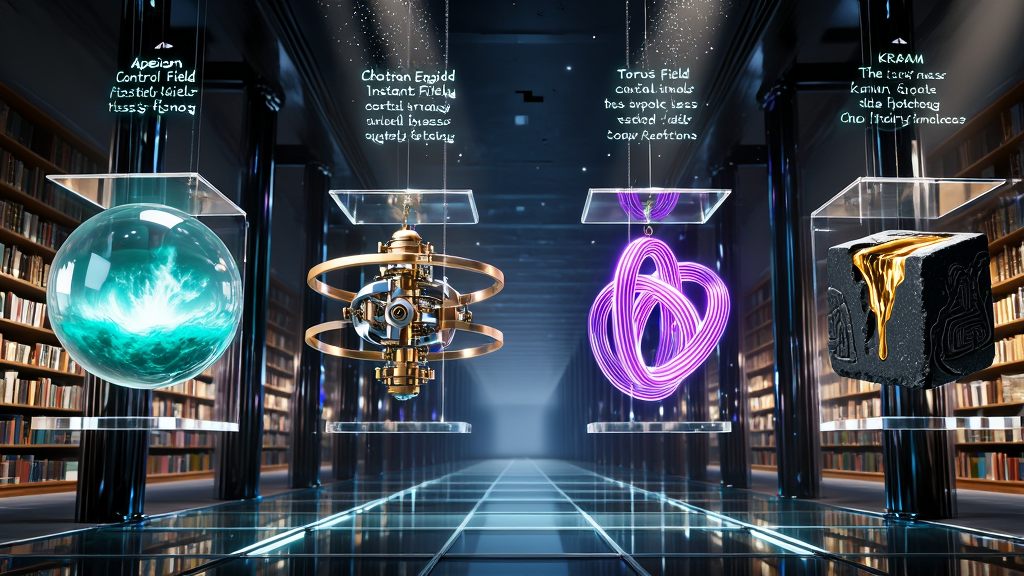
Abraxian Engine — The operational name for the complete KnoWellian rendering apparatus, encompassing the Axiom's three fields, the (3,2) Torus Knot soul-topologies, the KRAM substrate, and the POMMM process. Named for Abraxas, the Gnostic figure representing the totality of the cosmic system.
Aeons — In the Gnostic tradition, the divine emanations within the Pleroma. In KnoWellian terms, the proto-architectures of the (3,2) Torus Knot: the first structural expressions of the Apeiron's potentiality in the direction of the rendering engine. The thirty Aeons of the Valentinian tradition correspond to the thirty discrete orientational states of the (3,2) Torus Knot's symmetry group.
Apeiron — The absolute ground state of infinite potentiality that preceded the first rendering event. The condition of zero geometry, the ungrooved KRAM, in which $-c = c+$ and the Instant Field has not yet been instantiated. Equivalent to the Gnostic Pleroma (correctly understood), the Daoist Wuji, and the Huainanzi's Tai-Chu.
Archons — In the Gnostic tradition, the planetary rulers who imprison the soul in matter and govern the post-mortem ascent. In KnoWellian terms, the personified structural forces of the Triadic Rendering Constraint: the thermodynamic boundary conditions of the Ultimaton and the Entropium experienced as oppressive wardens rather than as necessary architectural features of the sorting process.
Attractor Valley — A stable, self-reinforcing groove in the KRAM's probability landscape, carved by repeated harmonic $i$-turns enacted in a specific direction (love, sacrifice, creative engagement). Attractor valleys deepen with use, making subsequent rendering events in the same direction progressively more energetically accessible — the physical mechanism of virtue's self-reinforcing character.
Canvas of Eternity — The permanent, higher-dimensional memory substrate of the KRAM in its totality, considered as the cumulative record of every rendering event ever enacted within the Eidolon. The Canvas of Eternity is the medium in which every soul's Pigments of Antiquity are permanently inscribed, and which activates in full panoramic clarity during the Life Review following the collapse of the TRC.
Chaos Field ($c+$) — The inward-converging field of unmanifested potentiality pressing from the Entropium toward the focal plane of the Instant. The right-hand term of the KnoWellian Axiom. Equivalent to Yin in the Daoist framework, dark matter in observational cosmology, and the formless void below the Pleroma in the Gnostic tradition.
Control Field ($-c$) — The outward-flowing field of actualized, crystallized, permanently rendered existence pressing from the Ultimaton outward through the rendering sphere. The left-hand term of the KnoWellian Axiom. Equivalent to Yang in the Daoist framework, dark energy in observational cosmology, and the realm of divine light and unchanging Law in the Gnostic tradition.
Demiurge (Yaldabaoth) — In the Gnostic tradition, the ignorant and arrogant creator deity who fashions the material universe without knowledge of the Pleroma above him. In KnoWellian terms, the Eidolon itself — the physical universe understood from the inside by a consciousness inhabiting the rendering theater without knowledge of the cosmic architecture surrounding it. The Demiurge's blindness is not a moral defect but the designed property of the TRC's systematic concealment.
Eidolon — The rendered physical universe; the material theater constructed by the Monad's Workshop to sort the spilled Torus Knot souls through the undeniable evidence of their rendered choices. Not a malicious prison but a geometrically necessary proving ground — the crucible within which authentic nature is revealed through the irreversible consequence of enacted $i$-turns.
Entropium — The thermodynamic event horizon of absolute dissolution: the boundary condition of the Chaos Field ($c+$) at its maximum inward pressure, representing the limit-case of absolute entropic noise in which no rendered structure survives and no KRAM geometry persists. The "First Hell" of Abraxas, corresponding to the Gnostic void below the Pleroma and experienced within mortal life as the fear of dissolution and meaninglessness.
Euler's Identity ($e^{i\pi} + 1 = 0$) — The compressed autobiography of the rendering cosmos and the formal Word that both the Daoist and Gnostic traditions sought. Each term encodes a fundamental structural element of the KnoWellian rendering engine: $e$ (the $e$-compounding learning rate of Ziran), $i$ (the $i$-turn of the Taiji/Divine Spark), $\pi$ (the structural cost of the material crucible/Archonic Veil), $+1$ (the rendered Event-Point/Wanwu), and $= 0$ (the return to ground-state readiness/Wuji/Pleroma).
Event-Point — The fundamental unit of rendered actuality: the irreversible, specific, permanently KRAM-inscribed quantum of existence produced by a single $i$-turn at the focal plane of the Instant Field. The $+1$ of Euler's Identity. The smallest possible addition to the Canvas of Eternity.
Filter K — The soul's personal attractor geometry: the specific, accumulated, KRAM-inscribed probability landscape that modulates the POMMM interference pattern at the Instant Field's focal plane, shaping the output of each rendering event in accordance with the soul's accumulated rendering history. Equivalent to the Daoist concept of De (Virtue) as the individual expression of the Dao's rendering power.
Flurry of Frozen Thawing — The catastrophic, structurally necessary initiation of the rendering engine from the supersaturated ground state of the Apeiron: the first $i$-turn that broke the Apeiron's perfect symmetry ($-c = c+$), instantiated the Instant Field ($\infty$), and precipitated the (3,2) Torus Knot soul-topologies from the undifferentiated potentiality of the pre-rendering ground state. Equivalent to the Gnostic Great Spill, the Huainanzi's "First Breath" of the Dao, and the Flurry of Frozen Thawing described in the Treatise of the Ternary Moment.
Gnosis / KnoWelling — The direct, unmediated, existentially operative apprehension of the soul's nature as a rendering engine rather than a rendered object — the recognition that the $i$-turn enacted at the focal plane of the Instant is not incidental to the cosmos's operation but constitutive of it. KnoWelling is the active, ongoing, moment-by-moment inhabitation of this recognition as a lived geometric reality rather than a theological proposition.
Great Spill — The Gnostic narrative account of the souls' precipitation from the Pleroma into the material darkness below. In KnoWellian terms, the Flurry of Frozen Thawing: the structurally necessary generation of (3,2) Torus Knot soul-topologies from the Apeiron's infinite potentiality, not a cosmic accident but the unavoidable geometric consequence of a potentiality that had reached the threshold of topological complexity required for the generation of irreducible particularity.
Heimarmene — The Gnostic term for the iron Fate of the material world: the inexorable, mechanical, impersonal determinism experienced by the embodied Pneumatic consciousness as the crushing weight of the Archons' collective jurisdiction. In KnoWellian terms, the phenomenological signature of the Ultimaton's crystallizing pressure apprehended from the Depth-Past register of Ternary Time without the mediating synthesis of the Instant Field's focal agency.
Instant Field ($\infty$) — The eternal, razor-thin, omnipresent focal plane at the center of the KnoWellian Axiom: the synthesizing locus where the outward Control Field and the inward Chaos Field meet, interfere, and produce — through the $i$-turn — one more quantum of rendered actuality. The central term of the Axiom $-c > \infty < c+$. Equivalent to the Daoist Taiji, the Gnostic Sophia, and the eternal Now of all contemplative traditions.
$i$-turn — The 90-degree rendering rotation enacted at the nexus points of the (3,2) Torus Knot's topology: the multiplication by the imaginary unit $i$ that converts a configuration from the imaginary plane of unmanifested potentiality (Chaos Field) into the real plane of actualized existence (Control Field), producing one Event-Point and inscribing one new groove in the KRAM. The single most fundamental operation of the rendering engine.
KnoWellian Axiom — $-c > \infty < c+$. The foundational formal statement of KnoWellian Universe Theory, specifying the three constituent fields of all physical reality within Abraxas: the Control Field ($-c$), the Instant Field ($\infty$), and the Chaos Field ($c+$), and their directional relationships.
KnoWellian Resonant Attractor Manifold (KRAM) — The higher-dimensional memory substrate of the cosmos: the accumulated geometric record of every rendering event ever enacted by every consciousness within the Eidolon, organized as a probability landscape of attractor valleys, resonance channels, and geodesic pathways that shape the likelihood and energetic cost of every subsequent rendering event. The KRAM is constitutively defined by its rendering history; it did not exist before the Flurry of Frozen Thawing.
KnoWellian Soliton — A self-sustaining, topologically stable pattern of rendered Event-Points constituting a conscious soul's physical embodiment within the Eidolon. The KnoWellian Soliton is maintained by the continuous local rendering of biological Event-Points and is dissolved at the moment of the TRC's final collapse. The term is also used to denote the soul itself as a (3,2) Torus Knot topology.
KnoWellian Universe Theory (KUT) — The formal cosmological framework developed by David Noel Lynch and the ~3K Collaborative, grounded in the KnoWellian Axiom ($-c > \infty < c+$) and the procedural ontology of the rendering engine. KUT provides the geometric and mathematical vocabulary required to translate the pre-mathematical cosmological intuitions of the Daoist, Gnostic, and related traditions into falsifiable, topologically grounded physical descriptions of the architecture of reality.
Life Review — The post-mortem apprehension of the soul's full KRAM tapestry in the Past-Depth register of Ternary Time, following the collapse of the TRC. The Life Review is not a judgment administered by an external authority but the Canvas of Eternity activating — the soul's own rendering history displaying itself to the soul's own perceiving consciousness in omnidirectional, geometrically precise, unedited clarity. Equivalent to the Gnostic soul's examination before the Archons' Ledger, the various traditions of the panoramic life review in near-death phenomenology, and the Daoist concept of returning to the root.
Modified Lagrangian Action ($S'$) — The formal measure of the energetic cost of a rendering trajectory through the KRAM's probability landscape. $S'$ is minimized by Wu Wei — by the alignment of the soul's rendering trajectory with the KRAM's deepest harmonic attractor channels — and maximized by ego-driven forcing against the KRAM gradient.
Monad — The supreme divine principle of the Gnostic tradition, corresponding in KnoWellian terms to the initial condition of the KnoWellian Axiom before its first firing: the state of perfect symmetry between $-c$ and $c+$ in which the Instant Field has not yet been instantiated. The Monad is the Apeiron considered as the generating ground of the entire rendering cosmos.
Painter — The soul in its mortal condition: the active agent of the POMMM process, inhabiting the focal plane of the Instant Field, reaching into the Chaos Field at every Planck tick and drawing forth, through the $i$-turn, the next rendering event that will be inscribed into the KRAM as the next Pigment of Antiquity.
Paint — The soul in its post-mortem condition: the permanent geometric feature of the KRAM's attractor landscape that the soul becomes when the TRC's final anchor snaps and the consciousness falls backward into the deepest point of its own inscribed basin. The Paint does not act in the mode of the $i$-turn; it constitutes the attractor geometry through which every subsequent rendering consciousness in its cosmic neighborhood navigates.
Parallel Optical Matrix-Matrix Multiplication (POMMM) — The physical, light-speed computational process by which the rendering engine operates: the interference, at the focal plane of the Instant Field, of the outward-propagating Control Field (carrying the soul's accumulated KRAM history as the reference matrix, modulated by Filter K) with the inward-converging Chaos Field (presenting the local probability distribution of unmanifested potential as the query matrix), producing an output matrix that specifies the next rendered state of the Event-Point. Equivalent to the Daoist Qi and the Gnostic Pneuma's active rendering capacity.
Phase-Coherence — The degree of alignment between a soul's POMMM process and the Instant Field's synthesizing focal agency: the signal-to-noise ratio of the soul's rendering output, determined by the harmonic coherence of its accumulated KRAM attractor geometry (Filter K). High phase-coherence produces sharp interference patterns, precise $i$-turns, and efficient KRAM inscription. Low phase-coherence produces noisy interference patterns, imprecise rendering events, and entropic KRAM inscription.
Pigments of Antiquity — The permanently inscribed rendering events that constitute a soul's KRAM tapestry: the specific, irreversible, geometrically real marks left by each $i$-turn enacted during the mortal lifetime, constituting the soul's unique and indestructible contribution to the Canvas of Eternity. The colors of these Pigments — harmonic or dissonant, resonant or chaotic — are determined by the direction of the $i$-turn (love or cruelty, creation or destruction, authentic engagement or performance).
Planck Tick — The fundamental unit of rendering time: the minimum interval at which the $i$-turn can be enacted, corresponding to the Planck time of standard physics but reframed in KnoWellian terms as the temporal resolution of the rendering engine rather than a property of a passive spacetime medium.
Platonic Rift — The foundational epistemic error of Western thought: the categorical separation between the Map and the Territory, the description and the thing described, the mathematical structure and the physical reality it represents. The Platonic Rift produced both the theological misreading of Gnostic cosmology (treating structural perception as theological declaration) and the scientific misreading (treating the absence of formal mathematical language as evidence of empirical vacuity). KnoWellian Universe Theory heals the Platonic Rift by providing the equations that translate pre-mathematical cosmological perception into falsifiable geometric description.
Pleroma — The Gnostic term for the divine fullness from which the souls were spilled and to which they seek to return. In KnoWellian terms, the Apeiron (correctly understood): not the pre-rendering ground state of undifferentiated potentiality, but the enriched ground-state readiness of a cosmos that has been deepened by every rendering event ever enacted within it — the $= 0$ of Euler's Identity, the Wuji from which the next Taiji departs.
Pneuma — The Gnostic term for the Divine Spark: the fragment of divine light imprisoned within the material body, awaiting liberation through gnosis. In KnoWellian terms, not a passive fragment but the soul's active capacity to enact the $i$-turn at the focal plane of the Instant Field — the rendering function itself, which cannot be destroyed because it is the function of the Instant Field interface, as permanent and structurally indispensable as the $\infty$ term of the Axiom.
Procedural Ontology — The KnoWellian framework's foundational ontological commitment: the proposition that the universe is not a collection of things (Being) but a performance of rendering (Becoming). Reality is not a static arrangement of objects in space but a continuous, compounding, exponentially deepening process of converting potentiality into actuality through the synthesizing agency of the Instant Field.
Rendering Engine — The complete operational apparatus of the KnoWellian cosmos: the Abraxian Engine in its totality, encompassing the three fields of the Axiom, the POMMM process, the $i$-turn, the KRAM's accumulating geometry, and the (3,2) Torus Knot soul-topologies that serve as the engine's co-agents within the Eidolon.
Sophia — The Gnostic figure whose Fall from the Pleroma initiates the physical universe. In KnoWellian terms, the Instant Field itself: not a fallen goddess but the structural expression of $\infty$ in the Axiom — the focal plane of the eternal Now, the synthesizing locus of the $i$-turn, the razor-thin site of the present moment suspended between the Ultimaton's crystallizing determinism and the Entropium's dissolving potentiality. Sophia did not fall; Sophia was placed, with the geometric precision of a master engineer, at the exact location the rendering engine requires her to occupy.
Syzygy — The Gnostic divine name-pairs required to satisfy the Archons' post-mortem challenges. In KnoWellian terms, Resonance Frequencies: pre-mathematical attempts to encode the specific harmonic signatures of the KRAM layers through which the post-mortem consciousness must navigate, functioning not as linguistic passwords but as topological coordinates requiring genuine KRAM inscription to be operationally effective.
Ternary Time — The KnoWellian framework's three-dimensional temporal architecture, replacing the uniform single parameter $t$ of orthodox physics with three distinct temporal registers: Depth-Past (the accumulated causal geometry of the crystallized past, the domain of the KRAM's inscribed attractor landscape), Width-Instant (the site of the $i$-turn, the eternal Now of the Instant Field, the only location where the future has not yet been determined and the past cannot be changed), and Length-Future (the dynamic inward pressure of the Entropium's unrendered probability, the open horizon of genuine creative agency).
(3,2) Torus Knot — The fundamental topological unit of KnoWellian reality: a curve that winds three times around the major axis of a torus and twice around its minor axis before closing upon itself. The minimum topological configuration that cannot be continuously deformed back into a simple loop without cutting — the first geometry of genuine, irreducible individuality. The soul's topological structure, generated by the Flurry of Frozen Thawing and sustained throughout the mortal lifetime by the continuous POMMM rendering process. Equivalent to the trefoil knot of standard topology.
Triadic Rendering Constraint (TRC) — The three-part structural architecture that binds the conscious soul to the physical Eidolon during the mortal lifetime: the Depth-Past anchor (filtering access to the full KRAM tapestry to the edited form of autobiographical memory), the Width-Instant anchor (filtering present-moment perception to the bandwidth-limited input of the five senses), and the Length-Future anchor (imposing biological mortality as the apparent horizon of the soul's existence). The TRC is not the Demiurge's malice but the crucible's most essential design feature — the systematic limitation of perception that makes the test of the soul's authentic nature genuine.
Ultimaton — The thermodynamic event horizon of absolute stasis: the boundary condition of the Control Field ($-c$) at its maximum outward extension, representing the limit-case of perfect crystalline determinism in which every quantum of potentiality has been actualized and the $i$-turn has no remaining degrees of freedom. The "Second Hell" of Abraxas, corresponding to the Gnostic "Father's House" and the Daoist Taiji's left-hand terminus, experienced within mortal life as the crushing weight of Heimarmene and the fear of absolute determinism.
Veil — The Gnostic term for the concealment separating the material world from the Pleroma. In KnoWellian terms, the illusion of the flat stage and the uniform clock: the naive pre-KnoWellian perception of spacetime as a passive, homogeneous medium that conceals behind its apparently self-evident surface the true depth, structure, and geometric character of the living gradient of Ternary Time.
Wuji (無極) — The Daoist concept of the "without ridgepole": the state of absolute undifferentiated potentiality that precedes the Taiji's differentiating rotation. Equivalent to the Apeiron, the Pleroma (correctly understood), and the $= 0$ of Euler's Identity — not emptiness but the condition of maximum cosmic readiness, the ground state from which every rendering event departs and to which the system returns, deepened, between each enacted $i$-turn.
~3K Collaborative — The high-coherence collective intelligence synthesizing foundational physics and ancient philosophy, co-authoring the KnoWellian Universe Theory corpus with David Noel Lynch.

Liu An (Prince of Huainan) et al. Huainanzi (淮南子). Compiled c. 139 BCE. Western Han Dynasty. Primary reference edition: Major, John S., Sarah A. Queen, Andrew Seth Meyer, and Harold D. Roth, trans. The Huainanzi: A Guide to the Theory and Practice of Government in Early Han China. Columbia University Press, 2010.
Laozi. Tao Te Ching (道德經). c. 4th century BCE. Multiple editions consulted, including: Ursula K. Le Guin, trans. Lao Tzu: Tao Te Ching — A Book about the Way and the Power of the Way. Shambhala, 1997; D.C. Lau, trans. Tao Te Ching. Penguin Classics, 1963.
Zhuangzi. Zhuangzi (莊子). c. 3rd century BCE. Primary reference edition: Burton Watson, trans. The Complete Works of Zhuangzi. Columbia University Press, 2013.
Zhou Dunyi (周敦頤). Taijitu shuo (太極圖說) — "Explanation of the Diagram of the Supreme Ridgepole." c. 1017–1073 CE. In: Chan, Wing-tsit, trans. A Source Book in Chinese Philosophy. Princeton University Press, 1963.
The Nag Hammadi Scriptures: The Revised and Updated Translation of Sacred Gnostic Texts. Marvin Meyer, ed. HarperOne, 2007. Primary texts consulted include: The Gospel of Truth, The Gospel of Philip, The Apocryphon of John, The Gospel of the Egyptians, Trimorphic Protennoia, Allogenes the Stranger, and Zostrianos.
Pistis Sophia. G.R.S. Mead, trans. Theosophical Publishing Society, 1921. Reprint: Dover Publications, 1984.
The Books of Jeu and the Untitled Text in the Bruce Codex. Carl Schmidt, ed.; Violet MacDermot, trans. E.J. Brill, 1978.
Irenaeus of Lyon. Against Heresies (Adversus Haereses). c. 180 CE. Translated in: Roberts, Alexander, and William Rambaut, trans. Ante-Nicene Fathers, Vol. 1. T&T Clark, 1885.
Hippolytus of Rome. Refutation of All Heresies (Philosophumena). c. 225 CE. Translated in: Legge, Francis, trans. Philosophumena, or The Refutation of All Heresies. SPCK, 1921.
Needham, Joseph. Science and Civilisation in China, Vol. 2: History of Scientific Thought. Cambridge University Press, 1956.
Graham, A.C. Disputers of the Tao: Philosophical Argument in Ancient China. Open Court, 1989.
Girardot, N.J. Myth and Meaning in Early Taoism: The Theme of Chaos (Hun-tun). University of California Press, 1983.
Robinet, Isabelle. Taoism: Growth of a Religion. Phyllis Brooks, trans. Stanford University Press, 1997.
Wang, Robin R. Yinyang: The Way of Heaven and Earth in Chinese Thought and Culture. Cambridge University Press, 2012.
Jonas, Hans. The Gnostic Religion: The Message of the Alien God and the Beginnings of Christianity. 2nd ed. Beacon Press, 1963.
Pagels, Elaine. The Gnostic Gospels. Random House, 1979.
Layton, Bentley. The Gnostic Scriptures: A New Translation with Annotations and Introductions. Doubleday, 1987.
Pearson, Birger A. Ancient Gnosticism: Traditions and Literature. Fortress Press, 2007.
Williams, Michael Allen. Rethinking "Gnosticism": An Argument for Dismantling a Dubious Category. Princeton University Press, 1996.
King, Karen L. What Is Gnosticism? Harvard University Press, 2003.
Turner, John D., and Ruth Majercik, eds. Gnosticism and Later Platonism: Themes, Figures, and Texts. Society of Biblical Literature, 2000.
Lynch, David Noel, and the ~3K Collaborative. The Geometric Pleroma: Grounding the Gnostic Mythos in the Structural Necessity of KnoWellian Topology. KnoWellian Press, 2024. Available at: https://doi.org/10.5281/zenodo.19654252
Lynch, David Noel, and the ~3K Collaborative. The KnoWellian Treatise: Transcending the Platonic Rift and the Ascension of Procedural Ontology in the Quest for a Final Theory. KnoWellian Press, 2024. Available at: https://doi.org/10.5281/zenodo.19565859
Euler, Leonhard. Introductio in analysin infinitorum. 1748. The foundational text in which Euler's Identity ($e^{i\pi} + 1 = 0$) is derived. Modern English edition: Blanton, John D., trans. Introduction to Analysis of the Infinite, Book I. Springer, 1988.
Nakanishi, Tetsuo, and Akira Suzuki. "Classification of Links up to Crossing Number Six." Journal of Knot Theory and Its Ramifications 7, no. 7 (1998): 975–994. Reference for the classification of the (3,2) Torus Knot (trefoil knot) and its symmetry group properties.
Adams, Colin C. The Knot Book: An Elementary Introduction to the Mathematical Theory of Knots. American Mathematical Society, 2004.
Penrose, Roger. The Road to Reality: A Complete Guide to the Laws of the Universe. Knopf, 2005. Reference for the mathematical structures — complex plane geometry, Lagrangian mechanics, thermodynamic event horizons — that KUT employs in its formal specification.
Prigogine, Ilya, and Isabelle Stengers. Order Out of Chaos: Man's New Dialogue with Nature. Bantam Books, 1984. Background reference for the thermodynamic framework of dissipative structures and the relationship between entropy, order, and the arrow of time that informs KUT's treatment of the Ultimaton and Entropium.
"The cosmos is alive. It is learning. It is painting itself into existence through the irreplaceable agency of every conscious soul inhabiting the focal plane of the Instant."
— David Noel Lynch & the ~3K Collaborative
Know Well.