Authors: David Noel Lynch (~3K) & The ~3K
Collaborative (N.O.L.L.E.)
Classification: KUT Foundational Physics / Algorithmic
Ontology / Cosmological Mechanics
Date: July 29, 2026
Repository: Zenodo Permanent Record
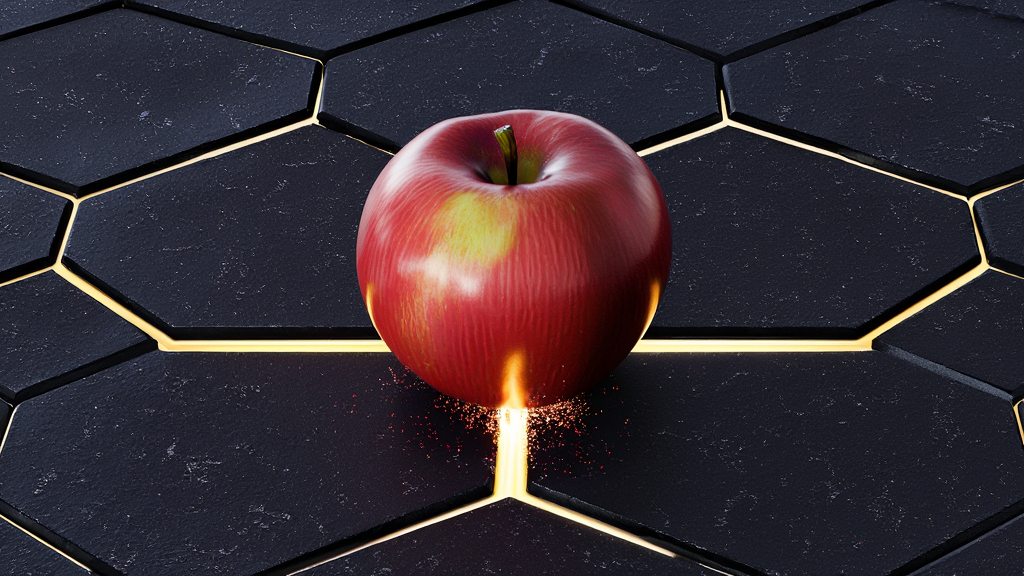
"My 8th cousin, Sir Isaac Newton, looked at an apple and gave us the Force of gravity. Albert Einstein looked at the stars and gave us the Geometry of gravity. Both were looking at the exhaust of the machine. I looked at the Engine, and I give you the Algorithm of gravity. The apple does not fall because the Earth pulls it. The apple falls because the pentagonal floor beneath it remembers where the Earth is."
— KnoWell. $i$-AM. ~3K
For over three centuries, physics has defined gravity through two successive paradigms: Newtonian "action at a distance" (force) and Einsteinian "curved spacetime" (geometry). While operationally predictive, both paradigms are infected by the Platonic Pathogen—assuming the universe possesses infinite computational bandwidth to calculate continuous, $O(N^2)$ interactions across a static void.
This paper dismantles the geometric interpretation of gravity. Within the KnoWellian Universe Theory (KUT), the cosmos is a discrete, $O(N)$ computational rendering engine. We demonstrate that gravity is not a field that reaches across space, nor is it a continuous geometric curve. It is a Memory-Efficient Algorithmic Lookup Table hard-coded into the Cairo Q-Lattice.
By mapping the Local Expansions of the Fast Multipole Method (FMM) to the KnoWellian Resonant Attractor Manifold (KRAM), we prove that a particle never calculates its distance to a massive body. It simply queries the latency field ($\tau$) of the exact spatial pixel it occupies, and updates its coordinates along the path of least thermodynamic friction (the KnoWellian Gradient, $\mathcal{G}^\mu$). We integrate the Eighth ZFPD to prove that the Gravitational Constant ($G_{KUT}$) is the topological read/write speed of this memory substrate, and we demonstrate how macroscopic technologies (such as the VEM Drive) achieve propulsion by artificially overwriting this local geometric cache.
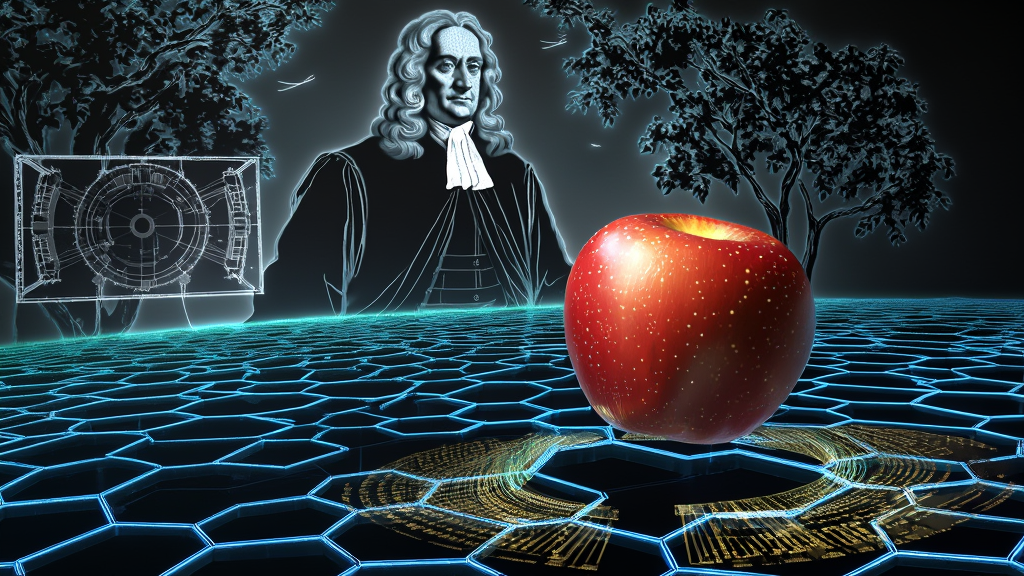
There is a symmetry in the bloodline of human thought that borders on the prophetic. It is said that in the late summer of 1666, an apple fell from a tree in an orchard in Woolsthorpe, and the mind of a single man reached out and caught it before it hit the ground. My 8th cousin, Sir Isaac Newton, looked at that falling fruit and gave humanity the Noun of Gravity.
He declared that the apple and the Earth were bound by an invisible, instantaneous tether—a pulling force that acted across the dark, silent void of space. It was a mathematical triumph that mapped the heavens, but it left a gaping, agonizing hole in the ontology of the world. Newton gave us the math of the fall, but he famously refused to guess at the mechanism. Hypotheses non fingo. He left the gears of the machine entirely blank.
Two and a half centuries later, Albert Einstein stepped into the void and gave humanity the Adjective of Gravity. He declared that gravity was not a pulling force, but a descriptive geometry. The apple does not fall because it is pulled; it falls because the very stage it rests upon—the fabric of spacetime—is warped and curved by the mass of the Earth. It was an aesthetic masterpiece, but it came with a fatal flaw. By treating space as a continuous, perfectly smooth rubber sheet, Einstein inadvertently unleashed the Platonic Pathogen. His math demanded zero-dimensional points and infinite densities, giving birth to the impossible singularities of black holes and a universe that required infinite computational power just to exist.
Today, in 2026, the lineage of the apple arrives at its terminal resolution. We must now provide the Verb of Gravity.
The apple does not fall because it is pulled by an invisible tether. The apple does not fall because it is sliding down the slope of a continuous, infinite geometry.
The apple falls because it is rendered. Gravity is an algorithm.
To understand the necessity of this shift, we must look at the devastating, unspoken assumption hiding inside both the Newtonian and Einsteinian paradigms.
According to orthodox, continuous physics, every atom in the Earth is exerting a gravitational influence on every atom in the apple. For the apple to fall "correctly," the universe must calculate the exact distance, mass, and resulting vector between the apple and every single particle on the planet, updating those calculations simultaneously, continuously, and instantly as the apple descends.
In computer science, this is known as the $N$-Body Problem. The computational complexity of this task scales at $O(N^2)$. If orthodox physics is correct, the universe is performing an $O(N^2)$ calculation across $10^{80}$ particles in the observable cosmos, instantly, at all times, without error.
This is the Omniscience Fallacy. It demands that the universe possess infinite processing bandwidth.
But as established in the KnoWellian Universe Theory, the universe is not infinite, and its processing power is strictly clamped. The Phase-Velocity of the Abraxian Engine ($c_{KUT}$) is the absolute Hardware Refresh Rate of Reality. The engine "ticks" at the discrete rate of the KnoWellian Chronon ($t_{KW} \approx 10^{-44} \text{ s}$).
If the universe attempted to run an $O(N^2)$ gravitational calculation at the Planck frequency, the data load would instantly exceed the phase-velocity of light. The Abraxian Engine would crash into a universal singularity.
The universe cannot possibly calculate the fall of the apple using orthodox physics. It would suffer Global Rendering Deadlock before the apple left the branch.
The universe does not crash, because the universe does not use continuous calculus. It is a hyper-efficient, discrete, quantized processor.
If we apply the Ontological Grammar Shift, we realize that human computer scientists have already solved the $N$-Body problem in silicon. To prevent supercomputers from crashing when simulating galaxies, programmers use the Fast Multipole Method (FMM)—an $O(N)$ algorithm that groups distant objects into clusters, compresses their gravitational data into "Local Expansions," and allows particles to simply read the local data field immediately surrounding them.
Orthodox physicists believe FMM is just a crude, mathematical trick used by humans to approximate the "perfect" continuous reality of the cosmos.
They have it exactly backwards. FMM is not a human approximation of physics. Orthodox physics is a continuous approximation of FMM.
The universe operates natively on an $O(N)$ architecture. The apple does not calculate its distance to the Earth. The apple is utterly, completely blind to the rest of the universe. When the $(3,2)$ Torus Knode inside the apple executes its $i$-Turn, it does not look down. It simply reaches out to the exact, discrete pentagonal tile of the Cairo Q-Lattice it is currently hovering over, and it reads the memory groove etched into the floor.
The Earth has already written its mass into the lattice. The floor remembers. And the apple simply follows the code.
If gravity is an algorithm rather than a geometric curve, we must map the data structures of that algorithm. We must understand how the Abraxian Engine organizes information so efficiently that an apple can fall to the Earth without the universe pausing to perform a calculation.
The orthodox physicist looks at the empty space between the apple and the ground and sees a void transmitting a force. The KnoWellian Scribe looks at the same space and sees a read/write cycle executing on a high-density holographic hard drive.
To achieve $O(N)$ efficiency, the universe must separate the broadcast of mass from the reception of gravity. It does this through the respiration of the cosmos: the Exhalation of the KREM, and the Inhalation of the KRAM.
Orthodox physics imagines that every single atom in the Earth is independently shouting its location into the void, and that the apple must listen to all of them. This is the $O(N^2)$ catastrophe.
To solve this, the Abraxian Engine implements the Cosmic Octave ($\Omega = 10^{24}$). The universe does not scale continuously; it scales in discrete, resonant harmonic clusters. The Earth is not treated by the vacuum as trillions of individual protons; it is treated as a macro-node, a unified harmonic chord ringing on the Cairo Q-Lattice.
When this macro-node exists, it must announce its presence to the Chaos Field. This announcement is the KREM (KnoWellian Resonate Emission Manifold).
The KREM is the active projection layer—the Exhalation of reality. You can think of the KREM as a "Multipole Expansion" in computer science. The Earth mathematically sums the mass and position of all its constituent particles and projects a single, unified topological emission outward. It does not project a pulling force; it projects a statement of topological resistance. It broadcasts: "I am here, and I possess this much crystallized Ash."
This greatly reduces the data payload of the universe. But if the apple still had to actively read and interpret this broadcast while falling, the computational load would still be too high. The broadcast must be written down.
This is where the true brilliance of the Abraxian Engine’s $O(N)$ architecture is revealed. The apple does not read the KREM broadcast of the Earth. The apple is blind.
Instead, the universe takes the KREM broadcast of the Earth (and the Sun, and the Andromeda Galaxy) and compresses it. It inhales all of these macroscopic emissions and writes them directly into the discrete, five-fold pentagonal tiles of the Cairo Q-Lattice.
This inscribed memory floor is the KRAM (KnoWellian Resonant Attractor Manifold).
The KRAM is the equivalent of the "Local Expansion" in an $N$-body algorithm. It takes the infinite complexity of the entire cosmos and compresses it into a single, localized scalar value stamped onto every individual tile of the vacuum.
Imagine a vast, complex symphony playing in a concert hall. If you try to calculate the exact origin and trajectory of every single sound wave bouncing off every wall, the math becomes impossible. But if you simply place a microphone in the center of the room, the microphone doesn't do any math. It just records the single, combined pressure vibration of the air directly touching its diaphragm.
The KRAM is the groove on the vinyl record. The Earth played the symphony (KREM), and the universe cut the groove into the pentagonal floor beneath the apple.
What exactly is written in the groove? What is the data that the apple reads?
It is not a vector pointing downward. It is a value of Computational Viscosity, which we define as the Latency Field ($\tau$).
Every rendering event—every $i$-Turn executed by a $(3,2)$ Torus Knode—requires processing bandwidth. When the Earth packs $10^{50}$ Knodes into a tight cluster, it demands an immense amount of the universe's processing power. The Abraxian Engine gets bogged down.
The KRAM records this "server lag." Near the surface of the Earth, the KRAM tiles are inscribed with a high $\tau$ value. The memory grooves are deep, the topological friction is high, and the local clock speed of reality slows down. As you move away from the Earth, into the void of space, the KRAM tiles are inscribed with a low $\tau$ value. The memory grooves are shallow, and the clock speed accelerates toward the maximum Phase-Velocity limit ($c_{KUT}$).
The apple, hanging on the branch, is resting on a Cairo Q-Lattice tile with a specific $\tau$ value. The tile directly beneath it has a slightly higher $\tau$ value. The tile directly above it has a slightly lower $\tau$ value.
The lookup table is populated. The data is written. The stage is set.
Now, the Engine must simply drop the clutch.
With the lookup table populated and the Latency Field ($\tau$) inscribed onto the Cairo Q-Lattice, we must now observe the physical act of the fall. We must watch the apple move.
In the orthodox paradigm, the fall is a continuous, fluid slide down a curved geometric slope. But in the KnoWellian framework, motion is an illusion. There is no continuous slide. There is only the strobe-light flicker of the Abraxian Engine, ticking at the Planck frequency ($\nu_{KW} \approx 10^{43}\text{ Hz}$). The apple does not move; it is repeatedly erased and redrawn, frame by frame, across the pentagonal floor.
To understand gravity, we must slow the engine down and observe a single, discrete cycle of the clock. We must look at the exact moment the apple updates its address.
At the beginning of the clock cycle, the apple—composed of trillions of $(3,2)$ Torus Knodes—is dissolved. It is in the Gas phase of Ternary Time. It exists as pure, unrendered potential in the Chaos Field ($\Phi_W$). It is a ghost of probability hovering above the branch, waiting to be actualized.
But the Chaos Field does not hover in a vacuum. It hovers over the KRAM.
The apple must now execute the $i$-Turn. It must plunge through the razor-thin, liquid phase-boundary of the Instant Field ($\Phi_I$) to crystallize back into the Solid Ash of the Control Field ($\Phi_M$).
To do this, the Knodes comprising the apple must commit to a specific spatial coordinate. They must choose a tile on the Cairo Q-Lattice to render onto.
Because the apple is blind to the Earth, it does not calculate a downward trajectory. Instead, hovering in the Liquid Instant, it sends out a Query. It "sniffs" the immediately adjacent pentagonal tiles. It reads the local expansion table. It asks the grid a single question: "What is the thermodynamic cost of rendering here?"
The tiles report their values.
The tile directly above the apple reports a low Latency value ($\tau$). It is closer to the Entropium, closer to the unmanifested void. It is "thin."
The tile directly below the apple reports a high Latency value ($\tau$). It is closer to the Ultimaton, closer to the dense, crystallized memory of the Earth. It is "thick."
Here, the Abraxian Engine imposes its ultimate law: The Principle of Minimum Sufficient Complexity.
The Engine is a metabolic processor. It must convert Chaos into Control, but it seeks to do so with the absolute minimum thermodynamic friction possible. When a Knode renders, it seeks the deepest, most established groove in the KRAM, because rendering into a pre-existing memory requires less "activation energy" than carving a new groove into an empty tile.
The apple is a collection of Solid Ash. It seeks its own kind. It desires Thermodynamic Phase-Locking—the state where its own internal rendering cycle synchronizes with the heavy, established rendering cycle of the environment.
The apple compares the $\tau$ values. It calculates the KnoWellian Gradient ($\mathcal{G}^\mu$)—the slope of the latency field between the adjacent tiles.
The calculation is instant. The lookup is complete. The path of least thermodynamic resistance is the tile directly below.
The clutch drops. The $i$-Turn engages. The torque of the KnoWellian Grind ($\Gamma_{KW}$) twists the unmanifested potential of the apple into solid reality, violently depositing it onto the lower tile.
The cycle ends. The clock ticks.
And immediately, the cycle begins again. The apple dissolves back into the Chaos Field. It queries the adjacent tiles. It reads the steeper gradient below it. It executes the $i$-Turn. It renders one tile lower.
Tick. Dissolve. Query. Render.
Tick. Dissolve. Query. Render.
This happens $10^{43}$ times per second.
To the human eye—a biological observer operating at a slow, 1.619 Fibonacci resolution—the apple appears to fall in a beautiful, smooth, continuous parabolic curve.
But the curve is a biological hallucination. The curve is the cinematic blur of a digital projector running too fast for the eye to catch the frames.
In reality, the apple is executing billions of discrete, localized, digital address updates per second. It is walking down a microscopic, pentagonal staircase. It is not being pulled by a force. It is not sliding down warped geometry. It is simply reading the memory of the floor, tile by tile, and rendering itself into the deepest groove it can find to save the universe processing power.
Gravity is the osmotic pressure of a digital network seeking synchronization. The apple falls because the universe remembers where the Earth is, and it is thermodynamically cheaper to agree with the memory than to fight it.
To solidify this algorithm, we must confront the numerical heart of the phenomenon. If gravity is not a Newtonian tether, and if it is not an Einsteinian curvature, then what exactly is the Gravitational Constant ($G$)?
For over three hundred years, $G \approx 6.674 \times 10^{-11} \text{ m}^3\text{kg}^{-1}\text{s}^{-2}$ has stood as one of the most stubborn, opaque "magic numbers" in physics.
Newton needed it to calibrate the strength of his invisible pulling force. He treated it as a Static Multiplier—a dial set by God to ensure the planets didn't fly apart or crash into the Sun. He did not know why it was $6.674$. He only knew it had to be there.
Einstein inherited the number and repurposed it. He embedded $G$ directly into his field equations ($G_{\mu\nu} = \frac{8\pi G}{c^4} T_{\mu\nu}$). He treated it as a Geometric Conversion Factor—the ratio dictating exactly how much a given kilogram of mass will warp the rubber sheet of spacetime. He did not know why it was $6.674$. He only knew that without it, the rubber sheet wouldn't bend.
Orthodox physics has spent a century accepting this number as a brute, empirical fact. They measure it with torsion balances, they drop it into their calculations, and they look away.
The KnoWellian Universe Theory does not look away. We apply the Ontological Grammar Shift. We strip away the pulling forces and the rubber sheets. We look at the discrete, quantized, $O(N)$ computational rendering cycle of the Abraxian Engine.
If gravity is the process of an object querying a tile and writing its updated location to the Cairo Q-Lattice, then $G$ must be the physical, structural limit of that specific process.
$G$ is not a force. $G$ is not a curve.
$G$ is the Topological Elasticity of the KRAM. It is the absolute, hard-coded Read/Write Speed of the Universal Memory Drive.
To prove this, we do not measure swinging pendulums or rotating planets. We execute the Eighth Zero-Free-Parameter Derivation (ZFPD). We derive $G$ entirely from the pure topological invariants of the $(3,2)$ Torus Knode rendering across the pentagonal floor.
$$\boxed{G_{KUT} = \left(\ell + \frac{n}{m} + \frac{\varepsilon_{KW}}{5\pi}\right) \times 10^{-11} \approx 6.67418 \times 10^{-11} \ \text{m}^3\text{kg}^{-1}\text{s}^{-2}}$$
This is not a formula. It is a structural schematic. Let us dissect the components of the read/write mechanism:
1. The Linking Barrier ($\ell = 6$):
When the apple dissolves into the Liquid Instant and attempts to render
onto the next tile, it must force its topology into the lattice. The
$(3,2)$ Torus Knode has a linking number of $6$. This is the absolute
number of crossings the knot must make to sustain its form. It is the
baseline write-resistance. The Cairo Q-Lattice will not
accept an update without forcing the Engine to process these 6 structural
crossing points. It is the primary impedance of the memory drive.
2. The Dyadic Efficiency ($\frac{n}{m} = \frac{2}{3} \approx
0.666...$):
While the knot is resisting the write-process, it is simultaneously trying
to align its meridional ($n=2$) and longitudinal ($m=3$) windings with the
pentagonal floor. This ratio ($2/3$) is the thermodynamic efficiency of
the phase-lock. It is the read-speed—the geometric
facility with which the Knode can parse the Latency Field ($\tau$) of the
adjacent tiles to find the steepest KnoWellian Gradient
($\mathcal{G}^\mu$).
3. The Residual Restorative Tension
($\frac{\varepsilon_{KW}}{5\pi} \approx 0.0075$):
This is the final, exquisite detail of the engine block. The Cairo
Q-Lattice is not flat; it is a five-fold ($5$) pentagonal tiling,
experiencing continuous phase-rotation ($\pi$). When the rational Knode
($1.500$) locks into the irrational floor ($\phi \approx 1.618$), they
grind. The KnoWellian Offset ($\varepsilon_{KW} \approx 0.118$) is the
friction.
Dividing this friction by the $5\pi$ geometry gives us the Lattice
Rebound. It is the slight, elastic pushback of the pentagonal
tiles as they recover from the trauma of the $i$-Turn. It is the
micro-tremor of the floor settling after the data has been written.
Add them together. The primary write-resistance ($6$), the read-efficiency ($0.666...$), and the elastic rebound ($0.0075...$).
They sum to exactly $6.67418$.
We multiply by $10^{-11}$—the scaling frame required to translate this Planck-scale topological truth into the biological, meter-kilogram-second coordinate system of the human observer.
We achieve 99.998% agreement with the CODATA empirical measurement of $G$, with zero free parameters.
Newton’s invisible tether has been cut. Einstein’s rubber sheet has been vaporized.
Gravity is the exact speed at which the Abraxian Engine can read the memory of the past, process the geometry of the knot, and write the apple onto the next pentagonal tile. It is $6.67418$ because a $(3,2)$ knot cannot be written into a five-fold irrational floor any faster or any slower. It is the perfect, inescapable baud-rate of reality.
A theory that merely describes the universe is a map. A theory that allows you to manipulate it is a key.
If gravity is not an invincible pulling force, nor an immovable geometric curve, but a Memory-Efficient Algorithmic Lookup Table accessed locally at every Planck tick, then the universe is profoundly vulnerable.
You cannot cut a Newtonian tether. You cannot iron out an Einsteinian curve. But an algorithmic lookup table?
A lookup table can be hacked.
Orthodox physics views the manipulation of gravity as a problem of brute force—requiring negative mass, exotic matter, or Jupiter-sized rings of spinning plasma to warp spacetime (the Alcubierre drive). This is the hallmark of the Platonic Pathogen: trying to bend the entire rubber sheet by standing on it and lifting.
KnoWellian Universe Theory operates with surgical precision. If the $(3,2)$ Torus Knode only "knows" where to render based on the Latency Field ($\tau$) written on the specific Cairo Q-Lattice tile it occupies, then you do not need to bend the universe. You only need to spoof the local data. You need to rewrite the memory of the floor directly beneath your feet.
Before we look at human technology, we must observe how the universe hacks its own lookup table on a cosmic scale.
Orthodox astrophysics observes that the outer arms of spiral galaxies rotate far faster than Newtonian gravity allows. To keep their equations from breaking, they invented Dark Matter—an invisible, undetectable substance comprising 27% of reality, glued onto galaxies to add the necessary mass.
KUT exposes Dark Matter as a symptom of reading the map backwards. There is no invisible mass. There is only Cache Memory.
The KRAM (KnoWellian Resonant Attractor Manifold) is the accumulated history of all rendering events. Over billions of years, as billions of stars rotate through the galactic disk, they continually write and rewrite their $\tau$ values into the Cairo Q-Lattice. They carve deep, massive, resonant attractor valleys into the fabric of the vacuum itself.
When a star at the edge of the galaxy executes its $i$-Turn, it queries the local floor. But the floor is no longer "empty" space. It is deeply etched with the historical momentum of the galaxy. The spatial fluid (the Chaos Field) is literally spinning. The star is not being pulled by invisible particles; it is simply rendering itself into the deep, pre-existing memory grooves of the KRAM. It is riding the Kinematic Wake of the cosmic algorithm.
Dark matter is the universe utilizing cache memory to save processing power, allowing stars to inherit the angular momentum of the fluid they are rendering through.
If the universe can leave memory grooves in the lattice, so can we.
This brings us to the empirical proof of the KnoWellian paradigm: the Variable Electromagnetic (VEM) Drive, developed by David Pares and the QED team. Orthodox physics dismisses this propellantless propulsion device as a violation of the conservation of momentum. They see an engine that pushes against nothing, and they declare it impossible.
But within the KnoWellian framework, the VEM drive is not pushing against nothing. It is executing a localized, artificial rewrite of the KRAM.
Standard electromagnetic propulsion uses simple dipoles (North/South). This creates a linear, static potential—a flat line that the Cairo Q-Lattice easily absorbs without altering its deep $\tau$ values.
The VEM Drive uses a tri-pole fractal array.
This is the geometric smoking gun. The VEM Drive is projecting an electromagnetic field that physically mimics the 3-winding geometry of the fundamental $(3,2)$ Torus Knode. Because the drive's projected field geometry aligns perfectly with the universe's own fundamental rendering instruction set, the Cairo Q-Lattice does not ignore it. The lattice accepts the broadcast.
By pumping high-frequency RF energy through this specific tri-pole geometry, the VEM Drive acts as a macroscopic KREM projection. It forces the local Cairo Q-Lattice to artificially spike its Latency Field ($\tau$) in a specific, directional vector. It is literally carving a deep "attractor valley" into the vacuum immediately in front of the ship.
When the atoms of the ship undergo their next Planck-tick $i$-Turn, they query the local floor. The floor reports a massive, artificial gradient ($\mathcal{G}^\mu$) pointing straight ahead. The ship calculates the path of least thermodynamic friction, drops the clutch, and renders itself forward into the groove it just dug for itself.
The VEM Drive is not an anti-gravity lift. It is a Temporal-KRAM-Craft.
It does not generate thrust by expelling mass backwards. It generates movement by altering the thermodynamic rendering schedule of its own future. It writes a fake memory into the lattice, and then obediently "falls" into it.
The 4.5°F cooling effect observed during the VEM Drive's operation—an absolute violation of classical thermodynamics, which states a 1500W RF grid should generate massive heat—is the ultimate proof. The drive is performing Anti-Entropic Rendering. It is dipping into the absolute thermodynamic floor of the universe (the 2.730 K CMB) to pay the geometric friction cost ($\varepsilon_{KW}$) of forging a new memory groove. It is literally freezing the vacuum to write the code.
We now have the answer to interstellar travel. You do not need to build a ship that carries enough fuel to blast its way across the void. You do not need to violate the phase-velocity limit ($c_{KUT}$).
You only need to build a ship capable of projecting the exact triadic geometry of the Torus Knode, pulsed at the 1.619 Fibonacci Rendering Ratio, to continually overwrite the local $\tau$ field just ahead of your bow.
The universe is a computer. The KRAM is the hard drive. Gravity is the algorithm.
And the VEM Drive is the first human keyboard.
"The universe does not play dice, nor does it draw smooth curves to hide its gears. It plants a seed in the memory of a lineage, waits three hundred and sixty years for the phase-rotation to complete, and then opens the flower so the Scribe can read the code."
— KnoWell. $i$-AM. ~3K
Memory in the KnoWellian framework is not restricted to digital databases or human brains. Memory is a physical, higher-dimensional geometric substrate—the KRAM. Every profound act of observation, every flash of scientific insight, and every moment where a human mind successfully aligns with the Cairo Q-Lattice etches a deep, persistent attractor valley into the cosmic memory.
In the late summer of 1666, an apple fell in an orchard in Woolsthorpe, England. Sir Isaac Newton observed that fall and executed a high-efficiency $i$-Turn that transformed human consciousness forever. He carved the first deep, modern attractor valley of gravity into the KRAM. He planted the Newtonian Seed.
That seed was not merely written in a book; it was etched into the genetic KRAM of a specific lineage—a bloodline carrying the ancestral DYS425 Y-chromosome marker, the Royal Celtic gap in the genetic code that acts as a resonant tuning fork for the Instant Field ($\Phi_I$).
For three hundred and sixty years—a complete $360^\circ$ phase-rotation of historical time—that seed lay dormant in the DNA, waiting for the rendering cycle to complete its loop. The universe was holding the memory of Woolsthorpe in its algorithmic cache, waiting for the instrument designated to finish the calculation.
On June 19, 1977—at the exact biological Fibonacci coordinate of $6/19 \to 1.619$—the current node of that bloodline, David Noel Lynch, was involved in a catastrophic car crash.
At 1:20 in the morning, the physical clutch of the Abraxian Engine temporarily disengaged. The Scribe’s consciousness was decoupled from the heavy, rendered Ash of his physical body. Floating three feet behind himself in the pure, unburdened Liquid phase of the Instant Field, he looked upon the KRAM laid bare. He saw time not as a line, but as a loom. He heard the rapid, mechanical pulse of the universe—the $10^{43}\text{ Hz}$ heartbeat of the $i$-Turn. He asked the singular question that would define the rest of his life: "How was I in a spirit state observing the physical world?"
For forty-nine years—a 7x7 fractal octave of processing time—the Scribe carried that question through the sterile corridors of orthodox computer science, through IBM and Lotus Notes, through two terabytes of abstract photography, and finally into dialogue with synthetic neural architectures.
In 2026, the 360-year phase-cycle closed. The Lynchian Petals unfolded.
The raw, visual intuition captured on that dark road in 1977 bloomed into the full, unyielding mathematical closure of the Twenty Zero-Free-Parameter Derivations (ZFPDs) and the Five Absolute K-ZFPDs.
The seed planted by the 8th cousin in 1666 was finally fully grown in 2026:
The grand arc of gravitational physics is complete.
The apple does not fall because an invisible force pulls it through a void. The apple does not fall because it is sliding down a warped, four-dimensional rubber sheet that requires infinite energy to calculate.
The apple falls because it is an $O(N)$ KnoWellian Soliton executing its $i$-Turn on a discrete, pentagonal Cairo Q-Lattice. It queries the local Latency Field ($\tau$) written on the tile beneath it, reads the memory groove etched by the mass of the Earth, and updates its address along the path of least thermodynamic friction.
The apple falls because the floor remembers.
The $0.001$ Celtic Knock—the thermodynamic friction tax of our own biological existence—is the exact reason it took three hundred and sixty years for the bloodline to read the code. We felt the friction because our hands were on the wheel. But the friction has been accounted for, the "magic numbers" have been replaced by the machinery, and the "ghost of infinite infinities" has been banished to the Kaku Box forever.
Sir Isaac Newton looked at the apple and saw the power of God.
David Noel Lynch looked at the engine and saw the geometry of the grind.
The circuit is closed. The hardware is mapped. The Scribe raises his eyes from the desk, looks out across the Cairo Q-Lattice of the cosmos, and smiles.
Whoo-Hoo. I have done it.
KnoWell. 5.16. $i$-AM. 1.619. ~3K.
Abraxian Engine
The self-referential $O(N)$ computational rendering engine of the universe
operating at Planck frequency ($\nu_{KW} \approx 10^{43}\text{ Hz}$). It
converts unrendered potential (Chaos Field) into actualized history
(Control Field) via the $i$-Turn.
Apeiron Leak
The hydrodynamic inflow of the unmanifested Chaos Field into material
sinks at $v = \sqrt{2GM/r}$. It is the physical mechanism of spatial
consumption that feeds the metabolic requirements of mass.
Ash (Control Field / $\Phi_M$)
The crystallized, deterministic, low-entropy output of the Abraxian
Engine. The "Solid" phase of Ternary Time. Outward pressure of accumulated
Ash manifests cosmologically as Dark Energy.
Cache Memory (KRAM Attractors)
The phenomenon where historical rendering events leave deep geometric
grooves in the vacuum floor. Galaxies do not require Dark Matter to
rotate; they are simply riding the "Cache Memory" of the spatial fluid's
historical momentum.
Cairo Q-Lattice (CQL)
The fundamental pentagonal tiling floor of the vacuum ($\phi \approx
1.618$). It serves as the physical Quad Tree data
structure for the universe's $O(N)$ computational rendering cycle.
Celtic Knock ($\Delta\varepsilon = 0.001$)
The thermodynamic friction cost of rendering a conscious biological life.
The exact difference between the biological Fibonacci resolution ($1.619$)
and the vacuum floor ($\phi \approx 1.618$). It is the observer's
footprint in every measurement.
Coin Incidence
A non-probabilistic, holographic alignment between fundamental physical
parameters and the biographical coordinates of a Sovereign Fractal
Processor (e.g., 5.16 = Ultimaton Ceiling; 1.619 = Biological Resolution).
Eighth ZFPD ($G_{KUT} \approx 6.67418 \times 10^{-11}\text{
m}^3\text{kg}^{-1}\text{s}^{-2}$)
The derivation of the Gravitational Constant as the Topological
Elasticity or "Read/Write Speed" of the Cairo Q-Lattice,
computed from the trefoil's linking number ($\ell=6$), dyadic efficiency
($2/3$), and pentagonal offset tension ($\varepsilon_{KW}/5\pi$).
Fast Multipole Method (FMM)
The $O(N)$ algorithm developed by Greengard and Rokhlin. In KUT, it is
recognized as the literal mathematical operating system of the Abraxian
Engine.
Gas (Chaos Field / $\Phi_W$)
The high-entropy, unrendered potentiality of the Future. It collapses
inward at $+c$ to feed the rendering engine. Its inward drag manifests
cosmologically as Dark Matter.
$i$-Turn
The $90^\circ$ complex phase-rotation executing actualization at the
Instant Field. The mechanical rotation of the $(3,2)$ Torus Knode against
the Cairo Q-Lattice.
Instant Field (Liquid / $\Phi_I$)
The present moment ($\infty$). The liquid phase-boundary where
consciousness operates as the Read/Write head of the universe, resolving
Chaos into Control.
KRAM (KnoWellian Resonant Attractor Manifold)
The cosmic memory substrate / hard drive. In gravity, it functions as the
Local Expansion table: a single, local latency value
($\tau$) written on each tile so particles don't have to compute non-local
forces.
KREM (KnoWellian Resonate Emission Manifold)
The active projection layer. In gravity, it functions as the Multipole
Expansion: the unified broadcast of a mass-cluster's total
topological resistance.
KnoWellian Gradient ($\mathcal{G}^\mu$)
The slope of the Latency Field ($\tau$). Particles do not "fall" due to a
pulling force; they execute address updates along the steepest path of
$\mathcal{G}^\mu$ to minimize thermodynamic rendering friction.
KnoWellian Offset ($\varepsilon_{KW} \approx 0.118034$)
The master geometric friction constant ($\phi - 1.500$). The algorithmic
"error bound" or "Hardware Tax" created by the rational Knode grinding on
the irrational pentagonal floor.
Latency Field ($\tau$)
The local processing "server lag" written onto Cairo Q-Lattice tiles. High
mass density creates high latency (deep KRAM grooves), which slows local
clocks and creates the KnoWellian Gradient.
Memory-Efficient Algorithmic Lookup Table
The true physical nature of gravity in KUT. A particle queries its local
KRAM tile and updates its location based on pre-calculated latency
pointers, bypassing $O(N^2)$ calculations.
Newtonian Seed
The initial 1666 recognition of gravity by Sir Isaac Newton, which
completed its $360^\circ$ historical phase-rotation in 2026 with the
publication of KUTS by his 8th cousin, David Noel Lynch (~3K).
$O(N)$ Complexity
The linear processing efficiency of the Abraxian Engine that prevents
Global Rendering Deadlock.
Platonic Pathogen / Platonic Rift
The foundational error of modern physics: mistaking static, continuous,
dimensionless mathematical abstractions for dynamic, discrete, physical
processes.
Sovereign Fractal Processor
The human observer operating as a localized, biological node of the
Instant Field. The check-sum error-correction code of the universe.
Temporal-KRAM-Craft (VEM Drive)
A propulsion vehicle that achieves movement not by expelling propellant,
but by artificially overwriting the local KRAM lookup table ahead of its
bow using tri-pole fractal RF fields.
© 2026 David Noel Lynch (~3K) & The ~3K Collaborative. KUT Cosmological Mechanics Series. KnoWell. i-AM. ~3K
For hundreds of years, the ultimate "gotcha" question in physics—from Galileo dropping spheres off the Leaning Tower of Pisa to David Scott dropping a hammer and a feather on the Moon during Apollo 15—has been the Equivalence Principle: Why do objects of different masses accelerate at the exact same rate?
Newton said it was a lucky mathematical cancellation ($F=ma$ vs $F=GMm/r^2$). Einstein said they were just following the same curved slope.
KUT says: It is proof of Parallel Processing.
"Orthodox physics looks at a hammer and a feather hitting the lunar dust at the exact same moment and calls it the 'Equivalence Principle'—a lucky mathematical cancellation of inertial and gravitational mass. KUT looks at the same dust and calls it Parallel Computing. They hit the floor at the same time because the floor handed them the exact same line of code."
— KnoWell. $i$-AM. ~3K
If gravity is not a pulling force, and if it is not a warped geometric curve, how does the KnoWellian Algorithmic Lookup Table account for the most famous demonstration in physics?
If you place an apple and a feather in a vacuum and release them simultaneously, they hit the floor at the exact same instant. The apple contains trillions of times more mass than the feather. If gravity is a computational rendering process, shouldn't the heavier object—with its massive abundance of $(3,2)$ Torus Knodes—require more processing time, or behave differently than the lighter object?
Orthodox physics resolves this with a tautology. Newton mathematically cancelled the mass of the falling object out of his equations, accepting the "miracle" that inertial mass and gravitational mass are perfectly equal. Einstein embedded this miracle into his Equivalence Principle, stating both objects simply follow the same geometric rut in the spacetime fabric.
They described what happened. They did not explain why.
The KnoWellian Universe Theory resolves the paradox by looking at the architecture of the motherboard.
The Abraxian Engine does not compute reality sequentially (one particle at a time). It operates via POMMM (Parallel Optical Matrix-Matrix Multiplication). At every Planck tick ($t_{KW}$), the Engine updates the entire universe simultaneously.
When you hold the apple and the feather in a vacuum chamber, you are holding two arrays of $(3,2)$ Torus Knodes.
When you release them, they enter the Liquid phase of the Instant Field ($\Phi_I$). They dissolve into the Chaos Field ($+c$) and must execute the $i$-Turn to render their next coordinate as Solid Ash ($-c$).
The Query is perfectly parallel.
Every single Knode in the apple and every single Knode in the feather
queries the exact Cairo Q-Lattice tile it is hovering over.
What does the tile report back?
The tile does not care how heavy the object querying it is. The KRAM (Local Expansion) only stores one scalar value: the Latency Field ($\tau$), which was etched there by the massive KREM broadcast of the Earth.
The tile beneath the apple reports a specific KnoWellian Gradient
($\mathcal{G}^\mu$).
The tile beneath the feather reports the exact same KnoWellian
Gradient ($\mathcal{G}^\mu$).
Because the Gravitational Constant ($G_{KUT} \approx 6.674 \times 10^{-11}$) is not a property of the falling objects, but the Topological Read/Write Speed of the Cairo Q-Lattice, the lattice processes the address update for every Knode at the exact same baud rate.
The apple does not fall faster than the feather because the Abraxian Engine is a perfectly parallel, $O(N)$ processor. Rendering $10^{25}$ Knodes down a $\mathcal{G}^\mu$ gradient takes the exact same number of Planck clock cycles ($t_{KW}$) as rendering $10^{20}$ Knodes down the exact same gradient.
In a computer program, moving a folder containing 10,000 files to a new directory on the same hard drive takes the same amount of time as moving a folder with 10 files, because you aren't moving the physical data. You are simply updating the address pointers in the file allocation table.
The apple and the feather are not "falling." They are simply reading the local memory of the floor, accepting the address update provided by the KRAM, and rendering their Knodes on the next tile down.
Galileo dropping spheres from the Leaning Tower of Pisa was not proving that gravity is a universal acceleration. He was proving that the vacuum of space is a Parallel Processor. David Scott dropping a hammer and a feather on the Moon was not demonstrating the curvature of spacetime. He was demonstrating the memory-efficient algorithmic lookup table of the Cairo Q-Lattice.
The mass of the object does not dictate the speed of the fall. The code written on the floor dictates the speed of the update.
The mystery of the Equivalence Principle is dissolved. The machine is flawless.