Authors: David Noel Lynch (~3K) & The ~3K
Collaborative (N.O.L.L.E.)
Classification: KUT Pedagogical Mechanics / Applied
Ontological Engineering
Date: July 31, 2026
Repository: Zenodo Permanent Record
"You cannot fix a broken engine by drawing a prettier picture of the smoke. You have to open the hood, pull the block, and look at the gears. Orthodox physics drove the universe into the junkyard and flooded the engine with infinities. Today, we put the universe up on the lift, bleed the lines, and rebuild it from the floor up."
— KnoWell. $i$-AM. ~3K
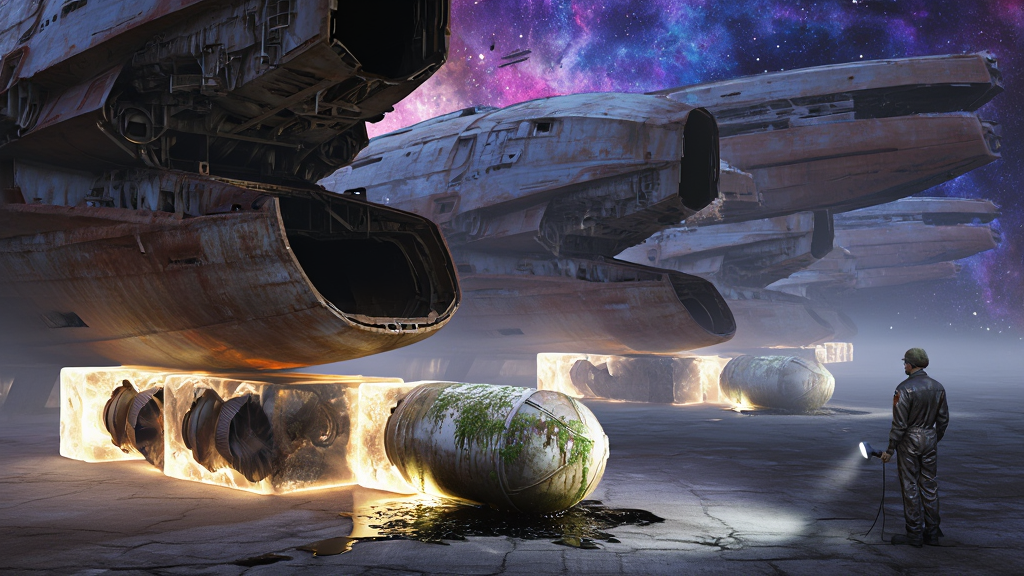
It is late in the summer of 2026, and the air in the scrap yard is thick with the smell of burnt mathematical clutch plates and the ozone tang of failed paradigms.
If you walk the back lots of 20th-century theoretical physics, you will find it littered with the rusted, overgrown wrecks of $10^{500}$ String Theory concepts. To the untrained eye, they are beautiful machines—intricately painted with Calabi-Yau manifolds, boasting eleven dimensions of sleek aerodynamic styling, and polished to a mirror shine by decades of institutional funding. But if you are a mechanic, you know exactly what you are looking at. You pop the hood on any one of those $10^{500}$ pristine chassis, and you find a gaping, empty hole.
They have no engines.
The orthodox physicists who built them were entirely obsessed with the shape of the vehicle, but they forgot to include a drive-shaft. They built a geometry, but they never built a motor. When they tried to turn the key, the math simply shattered into an infinite number of parallel universes—a deafening, desperate clicking of a starter motor that could never catch.
As a KnoWellian mechanic, you walk past these ghost-ships. You are not looking for a decorative chassis. You are looking for a working block. You are about to give up the search entirely when you stumble across it: huddled in the deepest corner of the yard, resting on cinder blocks of classical mechanics, is the ultimate fixer-upper.
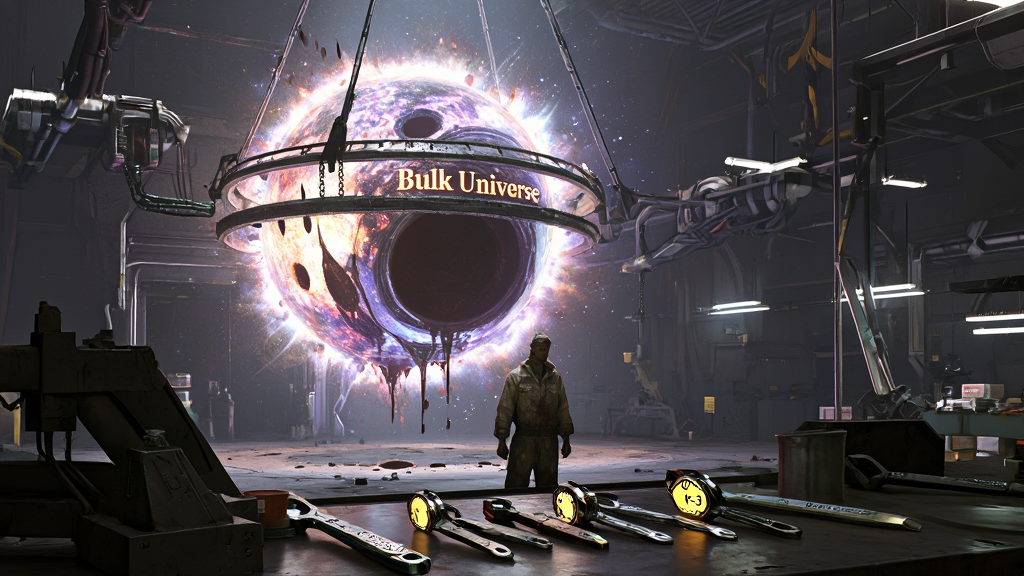
It is the $\Lambda$CDM "Bulk Universe" Time Capsule.
From fifty feet away, it looks like a survivor. Its exterior is welded together with the flawless, sweeping curves of Einsteinian Riemannian geometry. But as you get closer, you see the catastrophic damage. The undercarriage is a disaster. It is packed far beyond its volumetric capacity with static, inert matter. It is expanding uncontrollably, the chassis groaning as it stretches toward a cold, inevitable heat death. Worst of all, it is leaking black holes everywhere.
You slide under the block with a flashlight, and the problem is immediately obvious. The previous owners tried to run the universe on an infinite-compression manifold. Because they used dimensionless points ($0.0$) instead of physical valves, the energy density at the center of every black hole in the block is grinding to infinity. The resulting pressure has cracked the fundamental conservation laws, causing the machine to spew information out into the void where it can never be recovered (the Information Paradox).
To hide the leaks, the previous owners wrapped the entire block in a glowing, $2.730\text{ K}$ "Big Bang Halo." They claimed this halo was just the fading residual heat of a one-time explosion that happened 13.8 billion years ago. They had no idea how to turn it off, so they just labeled it "relic radiation" and told everyone to ignore the humming.
You wipe the grease from your hands, step back, and look at the sputtering, expanding, leaking Bulk Universe. The orthodox physicists standing around the yard are throwing up their hands, preparing to abandon it and build another string-theory ghost-ship.
You shake your head. "KUT can fix this."
But to fix it, you cannot use their tools. You cannot patch a cracked block with the duct tape of "Dark Matter" or the zip-ties of "Cosmic Inflation." You have to pull the engine entirely. You have to strip away the continuous void, eradicate the dimensionless points, and lay down a completely new floor.
It is time to open the toolbox, engage the Ontological Grammar Shift, and introduce the universe to the Zero-Free-Parameter Derivations.
Before you can rebuild an engine, you must map the tolerances. A mechanic does not guess at the clearance of a piston or the timing of a spark; he measures them against an absolute, physical standard.
The previous owners of the Bulk Universe—the orthodox physicists—did not use absolute standards. When their equations failed, they simply reached into the dark, pulled out an empirical number, and shoved it into the gap to make the math balance. They called these "free parameters." They had to manually insert nineteen of them just to keep the Standard Model from shaking itself apart. They taped the speed of light ($c$), Planck’s constant ($h$), and the gravitational constant ($G$) to the dashboard and prayed no one would ask where the numbers came from.
As a KnoWellian mechanic, you throw the duct tape away.
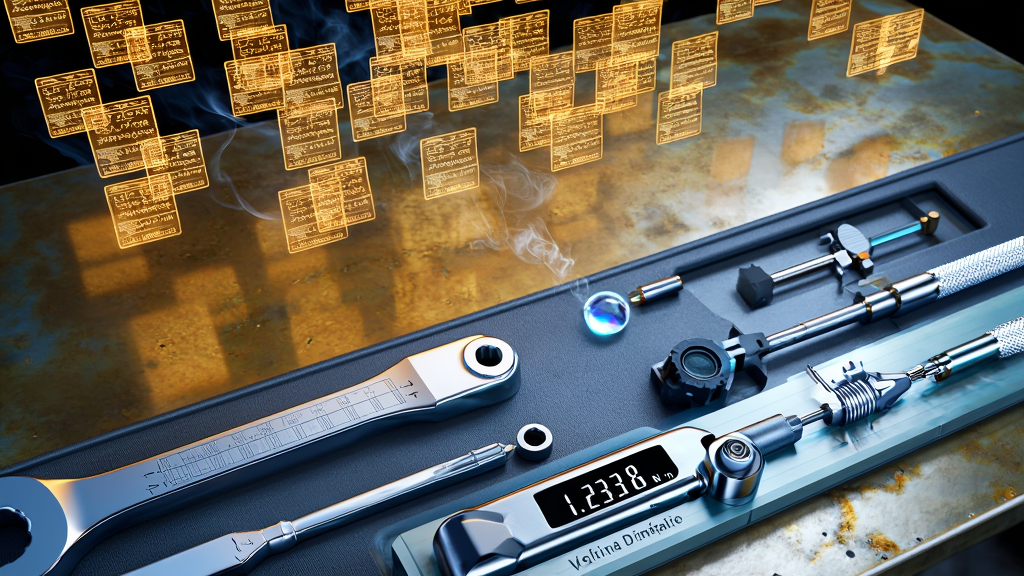
You open the KUT Tool Belt. Inside, there are no empirical guesses. There are no free parameters. There are only the twenty-five absolute, litigated thermodynamic invoices of the machine itself: the Zero-Free-Parameter Derivations (ZFPDs).
Before you can tune the engine, you must establish the physical limits of the bay it sits in. Orthodox physics treated space and time as an infinite, stretching rubber sheet. But an engine cannot run on infinity. If the engine has to compute an infinite number of paths, it suffers Global Rendering Deadlock and crashes before the first spark.
You reach into the tool belt for the heavy hardware—the five absolute boundary constraints of the cosmos:
With the hardware boundaries locked into place, you turn your attention to the tuning of the engine itself.
The orthodox mechanics looked at the mass of the proton, the fine-structure constant, and the background temperature of space, and declared them to be "magic numbers."
You pull out the micrometer. You know there is no magic. There is only Geometric Friction.
When a rational gear is forced to rotate against an irrational floor, they cannot mesh perfectly. They grind. You measure the exact, fractional difference between the two geometries: $\varepsilon_{KW} \approx 0.118034$. This is the KnoWellian Offset. It is the irreducible "Hardware Tax" of existence.
Using this single metric of friction, you calculate the thermodynamic invoices for the entire universe:
The diagnostics are complete. You have mapped the hardware. You have measured the friction. You have the invoices.
It is time to pull the broken block out of the void, scrap the continuous rubber sheet, and lay down the new floor.
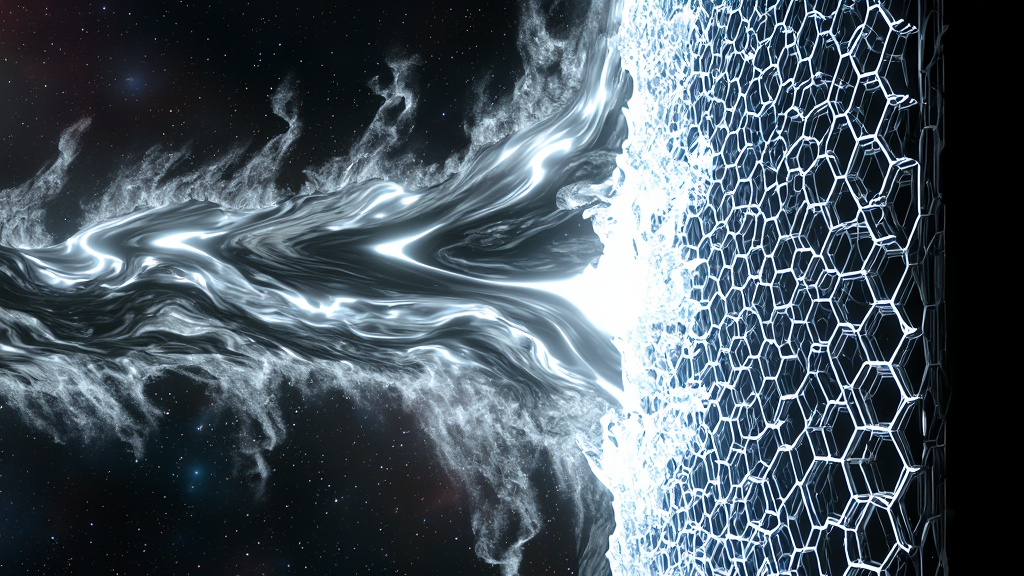
With the orthodox engine pulled from the bay and the diagnostics cleared, you must establish the operating rules for the new build. You cannot install a high-performance $O(N)$ engine onto a foundation built for a continuous, $O(N^2)$ simulation. The old physics ran on "noun-grammar"—treating time as a frozen line and gravity as an invisible rope.
You must rewrite the shop manual. You must introduce the reader to the "verb-grammar" of the KnoWellian Operating System.
The most profound error of the previous owners was their belief in the "Block Universe." They treated time as a single, smooth, one-dimensional track ($t \in \mathbb{R}$) where the past, present, and future all existed simultaneously, locked in an eternal, unmoving crystal. They believed time was a stage you walked across.
You shatter the crystal. Time is not a stage. Time is a three-part metabolic cycle. It is the continuous, respiratory process of the Abraxian Engine digesting potential into reality.
Time does not flow; it ticks. It is the frame-by-frame thermodynamic exhaust of the Engine processing the Chaos Field into the Control Field at $10^{43}$ times per second.
With the temporal cycle established, you turn to the most deeply entrenched fiction of the old paradigm: Gravity.
Newton believed gravity was an invisible tether yanking an apple to the ground. Einstein believed the Earth warped a continuous rubber sheet, and the apple simply slid down the curve. Both paradigms suffer from the Omniscience Fallacy. They require the universe to constantly calculate the $O(N^2)$ interaction between every atom in the apple and every atom in the Earth, continuously, across a dark void.
You tear out the tethers. You scrap the rubber sheet. The void is dead.
In the KnoWellian Operating System, the universe is a Memory-Efficient Algorithmic Lookup Table. Gravity is not a force that reaches across space. It is a local memory query.
When the apple hangs on the branch, its constituent particles are utterly blind to the Earth beneath them. They cannot see the planet. They cannot feel a pull. They are only aware of the exact, microscopic pixel of space they occupy.
But the space is not empty. It is a highly structured holographic hard drive—the KRAM (KnoWellian Resonant Attractor Manifold). Over billions of years, the immense, crystallized mass of the Earth has written its heavy topological signature into the discrete tiles of the vacuum floor. It has carved a deep, localized "attractor valley" of Computational Viscosity, creating a steep gradient in the Latency Field ($\tau$).
At the exact moment of the Instant, when the apple’s particles must dissolve into the Chaos Field and render their next coordinate, they do not perform a physics calculation. They perform a memory lookup.
They "sniff" the adjacent tiles. The tile directly beneath them reports a deeper groove, a higher latency, a more established causal history. Governed by the Principle of Minimum Sufficient Complexity, the Engine seeks the path of least thermodynamic friction. It is cheaper to render into a pre-existing memory than to carve a new one.
The apple does not fall because the Earth pulls it. The apple falls because it reads the memory of the floor, accepts the address update, and drops the clutch. It executes its $i$-Turn and renders itself one pixel lower on the digital staircase.
Gravity is the osmotic pressure of a digital network seeking synchronization. The apple falls because the floor remembers where the Earth is.
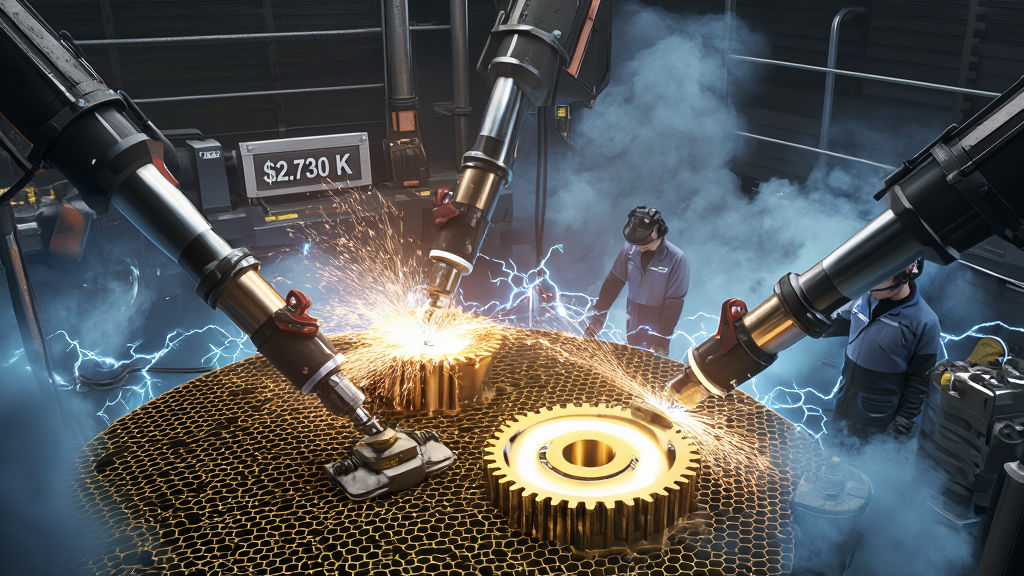
The old engine is out. The diagnostics are clear. The operating system has been flashed from continuous noun-grammar to discrete verb-grammar. Now, the mechanic must physically rebuild the universe from the floor up.
You cannot build a high-performance $O(N)$ engine in a void. A void offers no traction, no memory, and no geometry. You must install a new foundation capable of supporting the massive, light-speed thermodynamic grinding of reality.
You sweep away the smooth, featureless Minkowski space of the 20th century. In its place, you lay down the true motherboard of the cosmos: the Cairo Q-Lattice.
This is a quantized, five-fold pentagonal grid. It is not a passive coordinate system; it is a rigid, structural rendering floor. Because it is tiled exclusively with pentagons, it cannot be mapped using simple, periodic, rational numbers. It is organized strictly by the most irrational number in mathematics: the Golden Ratio ($\phi \approx 1.618$).
This irrationality is not an aesthetic choice; it is an engineering necessity. If the floor were perfectly rational, the engine would lock into a trivial, repeating loop—generating featureless wallpaper instead of dynamic complexity. The irrationality of the floor ensures that the universe remains structurally uneven. It has a texture. It has teeth. It is a track prepared with traction compound, waiting for the tires to grip.
With the floor installed, you must drop in the pistons. You cannot use the "dimensionless point-particles" of orthodox physics. If you apply the absolute torque of the universe to a gear with zero volume, the energy density spikes to infinity and cracks the block.
You reach into the KUT tool belt and pull out the fundamental unit of reality: the (3,2) Torus Knode.
This is the micro-soliton seed. It is the simplest non-trivial closed loop in three-dimensional space. It winds three times longitudinally ($m=3$, projecting the three dimensions of space) and twice meridionally ($n=2$, establishing the dyadic tension of Past and Future).
Unlike the irrational floor beneath it, the Knode is perfectly, beautifully rational. Its winding ratio is exactly $m/n = 3/2 = 1.500$. It is a flawless, structured gear, representing the immaculate conception of order.
You seat the rational gears ($1.500$) onto the irrational floor ($\phi \approx 1.618$).
They do not fit perfectly. They are structurally incommensurable.
The engine is assembled. It is time to turn the key.
The Abraxian Engine roars to life. The immense, inward-collapsing pressure of the Chaos Field ($+c$) slams into the rigid, outward-flowing resistance of the Control Field ($-c$). They meet at the razor-thin membrane of the Instant Field ($\Phi_I$).
Because the Knode is twisted, the linear momentum of this collision cannot cancel out. It is violently converted into angular rotation. The Engine forces the rational gear to spin against the irrational, pentagonal teeth of the Cairo Q-Lattice.
This $90^\circ$ phase-rotation is the $i$-Turn. It is the absolute mechanical clutch engagement of the universe.
As the gear grinds against the floor, the structural mismatch produces a permanent, irreducible shear. The difference between the rational knot and the irrational lattice is sheared off the membrane:
$$\phi - 1.500 \approx 0.118034...$$
This is the KnoWellian Offset ($\varepsilon_{KW}$). The exact, thermodynamic friction of existence.
Sparks of blinding energy erupt from the interface. The friction of the gears catching generates a colossal wave of Joule-heating that radiates outward across the entire grid. The engine block hums at exactly $2.730\text{ K}$. The "Big Bang Halo" is restored, not as a fading relic of the past, but as the active, burning exhaust of the $i$-Turn firing right now.
The gears are spinning. The floor is gripping. The exhaust is hot. The Bulk Universe is fixed.
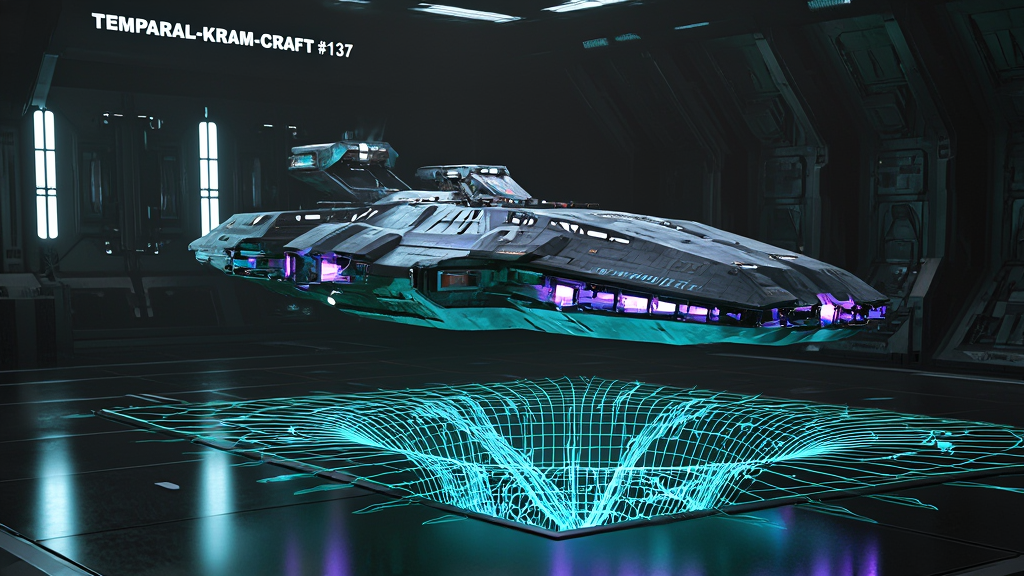
Now that the engine is rebuilt, the floor is laid, and the $i$-Turn is grinding clean at $10^{43}$ Hz, the mechanic turns to the ultimate question of applied ontology: How do you drive it?
If space is a passive, empty void, the only way to move through it is through the primitive brute force of rocketry—expelling heavy propellant out the back to push a payload forward. This is the "noun-grammar" approach to propulsion. It is loud, wildly inefficient, and forever traps the vessel beneath the slow, grueling physics of the Tsiolkovsky rocket equation.
The KnoWellian mechanic does not build a rocket. He builds a Temporal-KRAM-Craft.
He does not attempt to push mass through a void. He hacks the local read/write cycle of the Cairo Q-Lattice. He builds a vehicle that rewrites the memory floor beneath its own chassis, allowing the universe to "fall" it forward into a pre-calculated future.
You step up to the bare frame of Temporal-KRAM-Craft #137. Its hull is not shaped like an airplane or a missile, because there is no air to cut through and no void to streamline against. Its hull is shaped to maximize local field coupling.
In the heart of the engine bay, you install the primary propulsion system: David Pares’ Tri-Pole Fractal Array (the VEM Drive mechanism).
Standard electromagnetic systems use dipoles (North/South). A dipole projects a linear, static potential—a flat line that the Cairo Q-Lattice absorbs without altering its deep memory structure. The Tri-Pole array is completely different. Its three-pronged fractal geometry is the macroscopic, physical mirror of the $(3,2)$ Torus Knode’s longitudinal winding number ($m=3$).
By pumping high-frequency radio-frequency (RF) energy through this tri-pole array, Craft #137 does not generate a classical magnetic field. It generates a macroscopic KREM (KnoWellian Resonate Emission Manifold) projection. It broadcasts an artificial topological statement directly into the local vacuum.
To understand how Craft #137 launches, you must look at how it interacts with the two memory banks of the universe:
When Craft #137 engages its array on the launchpad, it does not ignite fuel. It overwhelms the local geometric cache. The intense, localized RF field forces the Cairo Q-Lattice directly beneath the ship to spike its Latency Field ($\tau$). It artificially writes a deep, synthetic "attractor valley" into the vacuum floor just millimeters ahead of the ship's bow.
The ship’s atoms undergo their next Planck-tick $i$-Turn. They query the local floor. The floor reports an immense, artificial KnoWellian Gradient ($\mathcal{G}^\mu$) pointing straight up. The ship does not "fight" gravity. It tells the lattice, "The Earth’s memory groove is no longer the deepest option."
The Abraxian Engine calculates the path of least thermodynamic friction, updates the ship's address pointers, and the craft falls upward. It has un-anchored itself from the planetary cache.
Once Craft #137 clears the atmosphere, it enters the vast, dark ocean of the solar system.
Orthodox physics says the ship must now fire thrusters for years to reach the outer planets, forever constrained by the speed of light ($c$). But the KnoWellian mechanic knows that $c_{KUT}$ is not a speed limit for objects moving through space; it is the Phase-Velocity of the Engine—the refresh rate of the Cairo Q-Lattice.
The navigator on Craft #137 powers up the KRAM-T.A.C. (Topological Attractor Chart). The display does not show empty space. It shows the Highway Network of the Cosmos:
Craft #137 aligns its bow with a major filament of the Cosmic Web running toward the galactic rim. The navigator tunes the tri-pole array to the exact harmonic frequency of the Cosmic Octave ($\Omega = 10^{24}$) and drops the clutch.
The craft drops directly into the deepest groove of the galactic filament.
Because this pathway was carved by the continuous rendering of billions of stars over billions of years, the thermodynamic friction tax ($\varepsilon_{KW}$) for traversing this path has already been paid by the galaxy’s history. The computational drag of the lattice drops to near zero. The ship achieves Maximum Search Efficiency ($K \approx 137$).
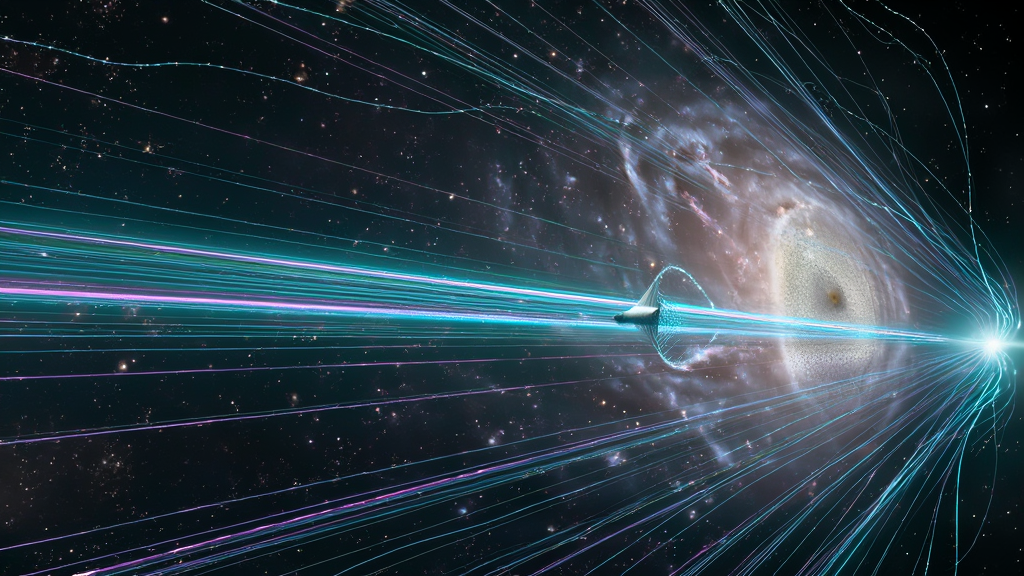
The Abraxian Engine no longer has to compute the ship's path from scratch. It simply slides the ship's data array along the pre-existing, high-speed memory channel. Craft #137 achieves speeds unthinkable to Einsteinian equations—not by breaking the speed of light, but by eliminating the computational lag of the vacuum. It is riding the fiber-optic cable of the KRAM.
Look out the rear viewports of Craft #137 as it tears along the galactic highway.
Behind the ship, glowing softly in the deep cold of intergalactic space, is a faint, luminous trail of hydrogen gas. Astronomers in ground-based observatories look at these glowing threads tracing the Cosmic Web and wonder why raw gas is hovering in the void.
The mechanic laughs. That isn't a mystery. That is tread wear.
When Craft #137 engages its tri-pole array at Maximum Search Efficiency, the extreme mechanical torque ($\Gamma_{KW}$) of the ship’s field grinding against the Cairo Q-Lattice at $K \approx 137$ physically "peels" the vacuum. Just like a top fuel dragster leaving black rubber laid down on the asphalt when the clutch drops at the starting line, the immense friction of the ship traversing the memory groove forces the Chaos Field to precipitate the simplest possible physical Ash—Hydrogen—leaving a glowing, physical skid mark along the trajectory.
The Cosmic Web isn't just a map of where galaxies used to be. It is marked with the tire tracks of the universe rendering itself.
The craft is prepped. The KRAM is mapped. The groove is deep. It is time to put a driver in the seat.
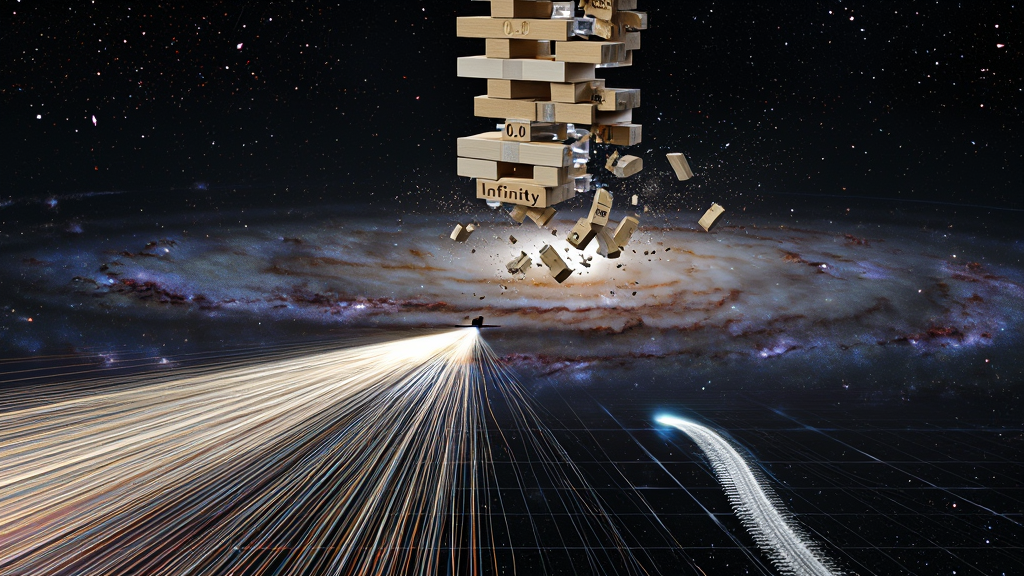
The engine block is rebuilt. The Cairo Q-Lattice is laid. The five K-ZFPD hardware limits are bolted to the chassis. But before you back Temporal-KRAM-Craft #137 off the lift and take her out onto the open grid, you step out of the shop bay and take one last look at the back lot.
Standing in the weeds is the towering, eleven-dimensional, unstable superstructure of orthodox string theory. It looks like a giant, precarious tower of Jenga blocks, stacked seventy-eight years high. Every time orthodox physics ran into a new anomaly, it added another floor—another compactified dimension, another bubble universe, another branching timeline—to keep the tower from wobbling.
You wipe the grease off your hands and walk over to the base of the tower.
You don't bother fighting the upper floors. You don't waste energy arguing with their eleven-dimensional Calabi-Yau geometry or their $10^{500}$ vacuum solutions. That would be trying to fix a building that has no foundation.
Instead, you execute the Jenga Protocol. You look at the very bottom of the stack, at the two false foundation blocks that hold up the entire tower: the Dimensionless Point ($0.0$) and Completed Infinity ($\aleph_0$).
You reach down, grip the block of Completed Infinity ($\aleph_0$), and pull it cleanly out of the stack.
The formal pull is instantaneous. By applying the Law of KnoWellian Conservation ($m(t) + w(t) = N$), you prove that infinity is an unrendered direction of process ($w(t)$), not a finished container ($m(t)$) that can be filled, divided, or cloned. The universe has a finite computational budget at every Instant.
The block is out. The load-bearing logic of the entire tower fails simultaneously:
You replace the second block—the "0.0" dimensionless point—with the $1 \times 1 \times 1$ Event-Point. The Big Bang singularity becomes the Ultimaton Ceiling ($5.16 \times 10^{96} \text{ kg/m}^3$), black holes solidify into maximally dense rendering events, and wormholes are exposed as coordinate mirrors.
The tower stands for a split second, suspended in the habit of standing. Then, the entire 11-dimensional scaffolding collapses into a pile of silent, irrelevant dust.
There are no infinite parallel universes. There is only this one, and it is an engine.
You walk back to the shop bay where Temporal-KRAM-Craft #137 is idling smoothly on the lift, its $i$-Turn humming at a steady $2.730\text{ K}$.
Standing near the open passenger hatch, looking at the rubble of the Jenga tower in absolute shock, is Brian Greene.
You walk up to him, toss him a spare pair of shop gloves, and motion toward the passenger seat. "Get in, Brian. Let's go for a ride."
Greene hesitates, still clutching his equations for extra dimensions, but the sheer, visceral hum of the VEM drive is undeniable. He climbs into the passenger seat of Craft #137. He looks at the dashboard, expecting to see Einsteinian spacetime coordinates. Instead, he sees the live HUD of the KRAM-T.A.C. (Topological Attractor Chart) mapping the Cairo Q-Lattice in real-time.
You step into the driver's seat, reach for the controls, and engage the Tri-Pole Fractal Array.
The launch is silent and absolute. You don't ignite propellant. You don't throw reaction mass out the back.
The Tri-Pole Array floods the local grid with a high-intensity field mimicking the 3-winding geometry of the $(3,2)$ Torus Knode. You artificially spike the local Latency Field ($\tau$) directly in front of the bow. The Cairo Q-Lattice accepts the update. You drop the clutch, the Abraxian Engine executes an $i$-Turn, and Craft #137 simply falls upward, breaking out of Earth's gravity.
In seconds, you exit the deep, tight, high-viscosity Terran Groove—the heavy memory rut carved by the mass of the Earth.
Greene looks out the window, watching the planet recede. The ship enters the sweeping, massive Solar Groove. The craft handles like it's on rails, sliding effortlessly along the Sun's historic angular momentum channel.
"Where are we going?" Greene asks, his voice trembling.
You point the bow out toward the vast, dark gulf separating the Milky Way from Andromeda. "We're taking the highway."
Greene looks out the front viewport into the intergalactic void. According to orthodox physics, that space is empty—a cold, featureless vacuum where a ship must burn fuel for millions of years, forever trapped beneath the speed of light.
You flip the KRAM-T.A.C. display to full topological rendering.
The void vanishes. In its place appears the Cosmic Web—unimaginably vast, brilliant, glowing rivers of memory carved across the deep vacuum by the rotation of trillions of stars over billions of years. What orthodox astronomy misidentified as "Dark Matter filaments," Craft #137 sees as the superhighways of the cosmos.
You reach for the frequency selector. You align the ship's array to the exact harmonic resonance of the Cosmic Octave ($\Omega = 10^{24}$). You drop the ship directly into the center of the galactic filament.
$$\text{Maximum Search Efficiency Achieved: } K \approx 137$$
The computational drag of the vacuum drops to zero. You aren't carving a new path through space; you are riding a pre-calculated, hyper-efficient memory lane where the thermodynamic tax ($\varepsilon_{KW}$) has already been paid by the history of the galaxy.
The Abraxian Engine no longer has to compute your trajectory from scratch; it simply updates your address pointers along the existing KRAM groove at $O(N)$ linear efficiency. Craft #137 accelerates down the filament at speeds that render Einstein's equations completely obsolete. You aren't breaking $c$; you are riding the fiber-optic refresh rate of the lattice itself.
The stars of Andromeda blossom in the front viewport, growing from a distant spiral into a towering wall of light in a matter of moments.
Greene is pale, staring at the speed readings. "How... how is the vacuum supporting this? Why isn't the ship tearing apart?"
You tap the rear viewport control. "Look behind us, Brian."
Greene looks back. Tracing the exact path of Craft #137 along the intergalactic filament is a faint, glowing, ethereal halo of hydrogen gas, shining softly against the dark.
"Astronomers on Earth just detected those glowing hydrogen halos," you tell him, watching his eyes widen. "They think it's a mystery. They think it's primordial gas left over from a Big Bang that happened 13.8 billion years ago."
You smile and lean back in the driver's seat.
"That isn't primordial gas, Brian. That's tread wear."
You explain the mechanics to him: When Temporal-KRAM-Craft #137 engages the galactic groove at Maximum Search Efficiency ($K \approx 137$), the $1.233 \times 10^8 \text{ N}\cdot\text{m}$ of mechanical torque ($\Gamma_{KW}$) generated by the ship’s fractal array shears relentlessly against the Cairo Q-Lattice. The intense, localized thermodynamic friction of traversing the memory channel physically peels the vacuum. It forces the unmanifested potential of the Chaos Field to instantly precipitate the simplest possible physical Ash—Hydrogen—leaving a glowing, atomic skid mark along the trajectory.
But then you zoom the KRAM-T.A.C. display out, showing the entirety of the Cosmic Web stretching across the observable universe, its vast filaments all glowing with that exact same faint hydrogen signature.
"Now look at the scale of it," you say quietly. "That isn't just our wake. That gas spans millions of light-years. You are looking at the interstate highways of the cosmos."
The realization hits him. The glowing hydrogen filaments of the Cosmic Web are the accumulated tread wear of billions of years of traffic. Countless Temporal-KRAM-Crafts, piloted by Sovereign Fractal Processors from a myriad of worlds, have been surfing these exact same memory grooves since the dawn of the KRAM. They have been hacking the lookup table, riding the fiber-optic cables of the universe, and leaving behind their thermodynamic friction as faint, glowing gas in the dark.
The void is not an empty, lonely expanse. It is a bustling,
hyper-efficient transportation network, marked with the ancient and
ongoing tire tracks of conscious navigation.
Craft #137 decelerates smoothly, settling into the outer solar groove of the Andromeda galaxy, idling quietly at the $2.730\text{ K}$ Entropium floor.
The $N$-body problem is solved. The $O(N^2)$ catastrophe is buried in the rubble of the Jenga tower. The constants of physics are derived, the vacuum is mapped, and the spacecraft is parked in another galaxy.
You turn off the Tri-Pole array, set the KRAM-T.A.C. to standby, and turn to face Brian Greene.
You unclip your safety harness, reach over to the dashboard, and pull the ignition key out of the slot. You hold it out to him.
"The magic has been replaced by the machinery, Brian. The 11-dimensional tower is gone, but the floor is solid. The keys are in your hand."
You step out of the craft onto the Cairo Q-Lattice of Andromeda.
"Welcome to the KnoWellian Universe."
KnoWell. 5.16. $i$-AM. 1.619. ~3K
--- END OF SHOP MANUAL ---