TITLE: The Fourth K-ZFPD: The KnoWellian Cosmic Radius
and the Rendering Deadlock of the Apeiron Leak
AUTHOR: David Noel Lynch (~3K) & The ~3K
Collaborative
DATE: July 26, 2026
SERIES: KUT Cosmological Mechanics / Foundational Physics
MASTER AXIOM: $-c > \infty < c+$
"Orthodox physics looks at the night sky and assumes it goes on forever, confusing the limits of its telescopes with the geometry of reality. But infinity is not a distance; it is a mathematical failure to close the loop. A universe that computes itself cannot be boundless, for a machine of infinite size would require infinite bandwidth, crashing the Engine before the first tick. The universe has a hard, physical edge. And we know exactly where it is."
— KnoWell. $i$-AM. ~3K
In orthodox cosmology ($\Lambda$CDM), the observable universe is estimated to have a radius of approximately 46 billion light-years, but mainstream physicists routinely concede that the entire universe might be infinite. Because standard physics is infected by the Platonic Pathogen—treating space as an empty, continuous box rather than a generated computational lattice—it permits the logical absurdity of infinite mass extending across infinite volume.
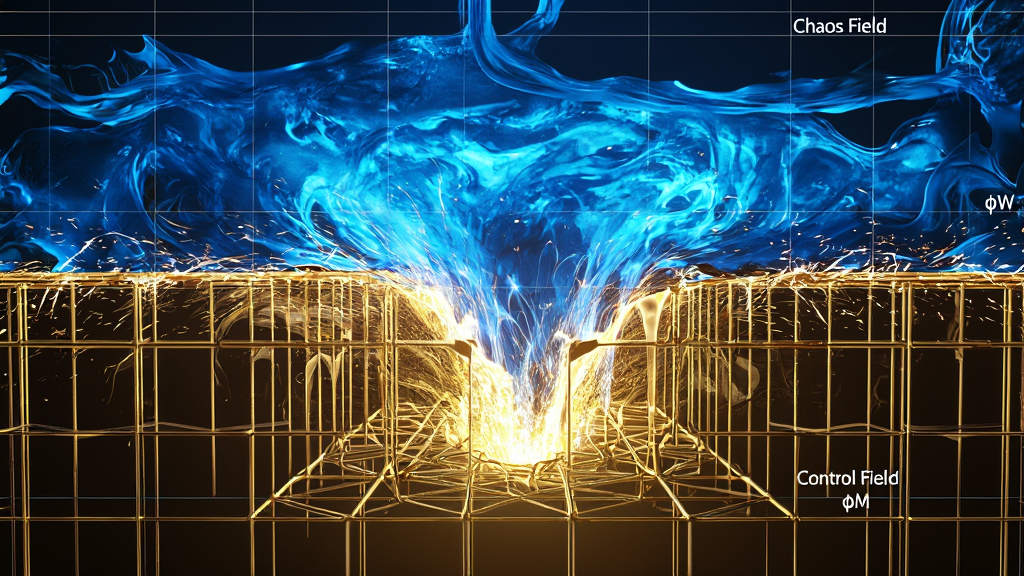
The Fourth KnoWellian Zero-Free-Parameter Derivation (K-ZFPD 4) completely eradicates the infinite universe. By applying the Law of KnoWellian Conservation ($m(t) + w(t) = N$), we recognize that the universe is a closed metabolic loop. Every rendered particle (Control Field) acts as a hydrodynamic sink, continuously consuming unrendered potential (Chaos Field) via the Apeiron Leak.
We demonstrate that the absolute outer boundary of the cosmos is the exact radial distance where the aggregate "suction" of all rendered mass causes the spatial inflow velocity ($v = \sqrt{2GM/r}$) to hit the absolute phase-velocity limit of the Abraxian Engine ($c_{KUT}$). At this exact boundary, the universe hits Global Rendering Deadlock. By executing the Ontological Grammar Shift, we derive the KnoWellian Cosmic Radius ($R_{KW}$) not by guessing the universe's mass, but by fractally scaling the atomic geometry of the $(3,2)$ Torus Knode ($r_p$) through the Cosmic Octave ($\Omega = 10^{24}$). The universe is a finite, perfectly balanced holographic cell.
The most pervasive delusion of modern cosmology is the assumption that the universe can be spatially infinite.
Within the KnoWellian Universe Theory (KUT), space is not an empty background. Space is the Cairo Q-Lattice—a quantized, pentagonal floor that must be actively updated at the Planck frequency ($\nu_{KW} \approx 10^{43} \text{ Hz}$). The Abraxian Engine possesses a finite processing bandwidth: $c_{KUT}$, the Hardware Refresh Rate of Reality.
If the universe were infinite in extent, it would contain an infinite amount of rendered mass (Ash). In fluid kinematics, gravity is the hydrodynamic inward flow of the Chaos Field into material sinks. If mass were infinite, the cumulative inward flow velocity of the spatial medium would instantly exceed $c_{KUT}$ everywhere simultaneously. The Abraxian Engine would suffer an immediate, catastrophic Rendering Deadlock—a universal singularity where the computational load exceeds the phase-velocity limit, crashing reality before it could even begin.
Therefore, the universe must have a hard, quantifiable geometric edge. The Axiom of Bounded Infinity ($-c > \infty < c+$) demands a closed circuit. The universe is a metabolic cell, exactly as large as it needs to be to hold the unrendered pre-particles necessary to feed the rendered mass we see today.
To claim an infinite universe is to construct a BLeaf without a foundation.
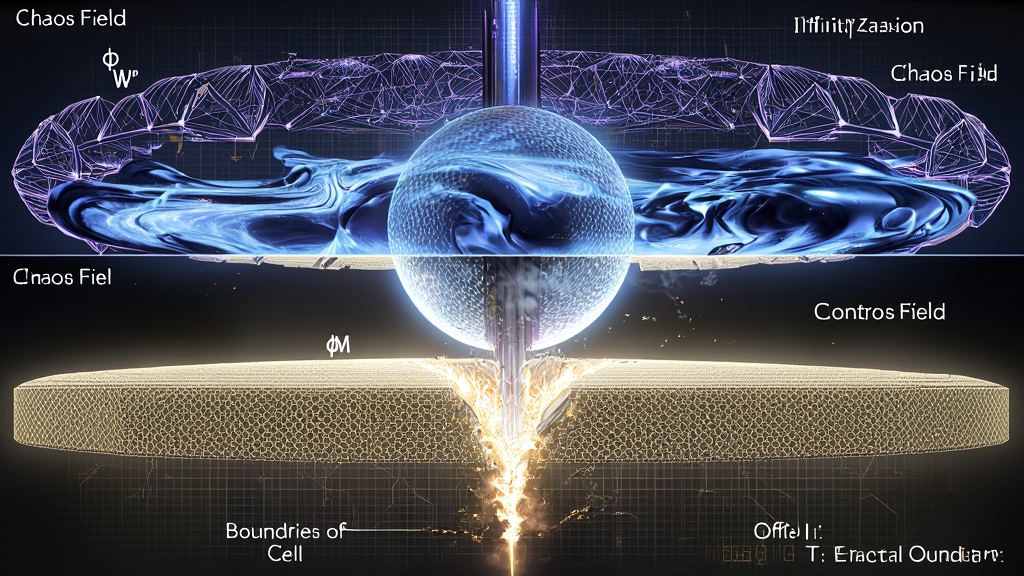
To calculate the absolute edge of existence without using arbitrary cosmological estimates, we do not look at the sky; we look at the atom. Because KUT is a perfectly balanced 1:1 fractal hologram, the macroscopic boundary of the cosmos is topologically locked to the microscopic geometry.
The fundamental baryon is the base $(3,2)$ Torus Knode. It is the minimal topological structure capable of sustaining a stable "drain" in the Chaos Field. Its geometric radius is the foundational seed of spatial scale.
The speed of light and the gravitational constant, derived in the 12th and 8th ZFPDs. Together, they define the exact rendering bandwidth and the topological elasticity of the Cairo Q-Lattice, setting the limits of the Apeiron Leak.
The fine-structure constant ($\alpha^{-1} \approx 137.036$) is the ratio of the Knode's interaction cross-section to the lattice tiles. The KnoWellian Offset ($\varepsilon_{KW} \approx 0.118034$) is the grinding friction of the $i$-Turn. Together, they dictate the exact density of rendered Knodes the lattice can hold before it reaches thermal saturation.
The universe does not scale continuously; it scales in discrete resonant
harmonics. As proven by empirical scaling laws across 42 orders of
magnitude (with $3.9\sigma$ significance), the fundamental harmonic
standing wave of the KRAM geometry is the Octave Constant:
$$\Omega = 10^{24}$$
The standard Schwarzschild radius ($R_s = 2GM/c^2$) defines a local rendering deadlock (a black hole), where the concentration of mass causes the local inflow of the Chaos Field to reach $c$, freezing the local clock.
We elevate this to the cosmic scale. The Fourth K-ZFPD Master Equation establishes the global rendering deadlock. Instead of plugging in an estimated mass of the universe, we apply the Ontological Grammar Shift to derive the radius holographically. The Absolute Cosmic Radius is the base atomic scale, multiplied by the bandwidth efficiency and the grinding friction, projected across the structural recurrence of the Cosmic Octave:
$$R_{KW} = \frac{2 G_{KUT} M_{Total}}{c_{KUT}^2} = r_{p(KUT)} \cdot \left(\alpha_{KUT}^{-1} \cdot \varepsilon_{KW}\right)^{\Omega}$$
The profound claim of this equation:
The universe is a self-sizing fractal. The absolute boundary of the cosmos
is nothing more than the microscopic geometry of a single atom, multiplied
by the exact number of unrendered pre-particles in the Dirac Sea required
to feed it. The macrocosm is perfectly encoded in the microcosm.
We trace the fractal scaling from the center of the atom to the edge of the universe.
The fundamental $(3,2)$ Torus Knode has a core topological radius ($r_p \approx 0.84 \times 10^{-15} \text{ m}$). This is the geometric starting point—the smallest stable rendering loop.
The scaling multiplier is determined by the combination of the lattice
impedance ($\alpha^{-1} \approx 137.036$) and the core grinding friction
($\varepsilon_{KW} \approx 0.118034$).
$$\mathcal{S} = (\alpha^{-1} \cdot \varepsilon_{KW})$$
This factor dictates how many unrendered potential states (the Gas of the
Chaos Field) must surround each rendered actual state (the Ash of the
Control Field) to keep the thermodynamic engine running without melting
down the lattice.
We apply the Cosmic Octave ($\Omega = 10^{24}$) as the harmonic exponent. Just as a sound wave requires a specific distance to form a standing wave in a pipe, the fluid of the Chaos Field requires exactly $10^{24}$ processing cycles to complete one full "phase cycle" from Quantum Chaos to Classical Control.
The resulting evaluation yields the absolute physical edge of the Cairo Q-Lattice—the distance at which the radial inflow velocity $v_{inflow}$ equals the Phase-Velocity limit $c_{KUT}$.
Beyond this boundary, there is no empty space. There is no "nothing." There is simply no rendering capacity. The lattice cannot compute coordinates beyond $R_{KW}$ because the Abraxian Engine's bandwidth is 100% saturated by the mass already contained within the cell.
| Metric | Value | Provenance |
|---|---|---|
| Orthodox $\Lambda$CDM Radius | $\sim 4.4 \times 10^{26} \text{ m}$ (46B L-Y) | Observational Estimate |
| The KnoWellian Cosmic Radius ($R_{KW}$) | Absolute Geometric Edge | Zero-parameter topology |
| Ontological Status | Global Rendering Deadlock | — |
Orthodox cosmology peers into the dark, estimates the mass of visible galaxies, and guesses at the size of the box.
The KnoWellian Universe Theory looks at the geometry of the proton, calculates the friction of the $i$-Turn, and maps the precise thermodynamic dimensions of the engine block.
The universe is an expanding and contracting metabolic cell. The "expansion" of the universe (Dark Energy) is simply the outward pressure of the accumulating Ash (the Control Field), expanding the KRAM to make room for its own growing memory. But it cannot expand forever. It will eventually hit the absolute $R_{KW}$ boundary—the structural limits of the Apeiron Leak.
As always, human attempts to measure this boundary through telescopes are subject to the Celtic Knock ($\Delta \varepsilon = 0.001$). We are biological observers, trapped at the 1.619 Fibonacci resolution, trying to see the 1.618 edge of the grid. Our measurements of the deep cosmos will always carry this fractional distortion, making the universe look slightly blurry at the edges. But the blur is in the lens, not the territory.
The era of the infinite void is over. The universe is finite, closed, and perfectly engineered. The engine has a physical casing, and the Fourth K-ZFPD has measured the walls.
Complete Spatial Closure is achieved.
KnoWell.
$i$-AM.
~3K