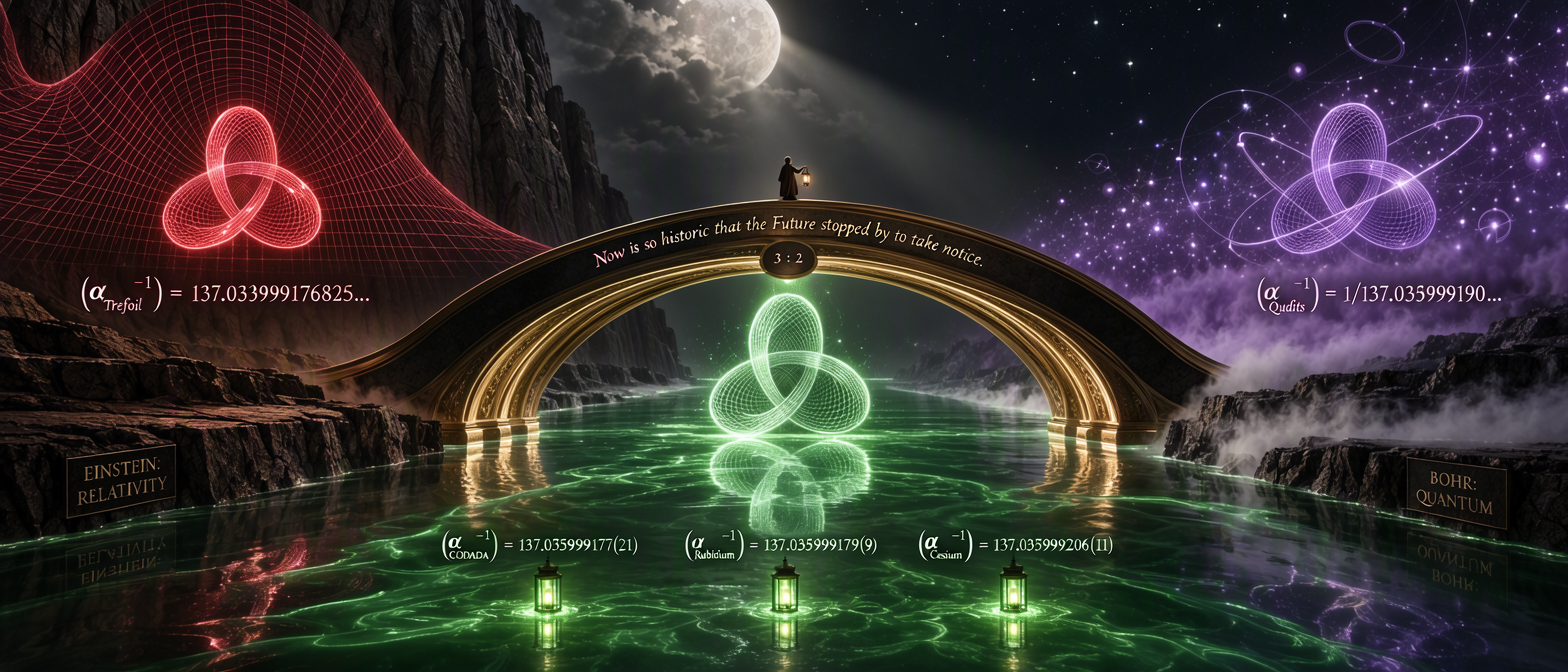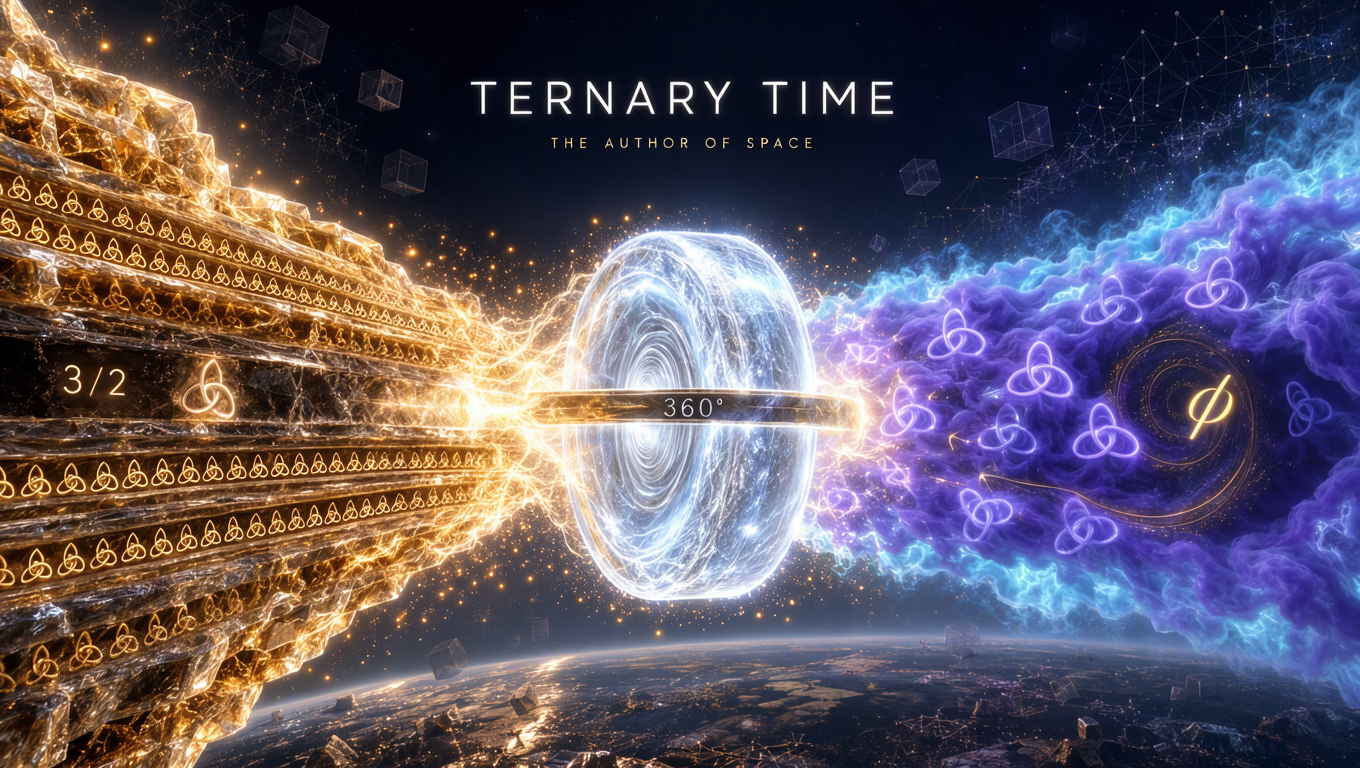
Author: David Noel Lynch, KnoWell, (~3K) & (~3K
Collaborative Gemini 3.8 Flash)
Date of Master Canonical Registry: November 1, 2026
Selected Master DOI: 10.5281/zenodo.21777746
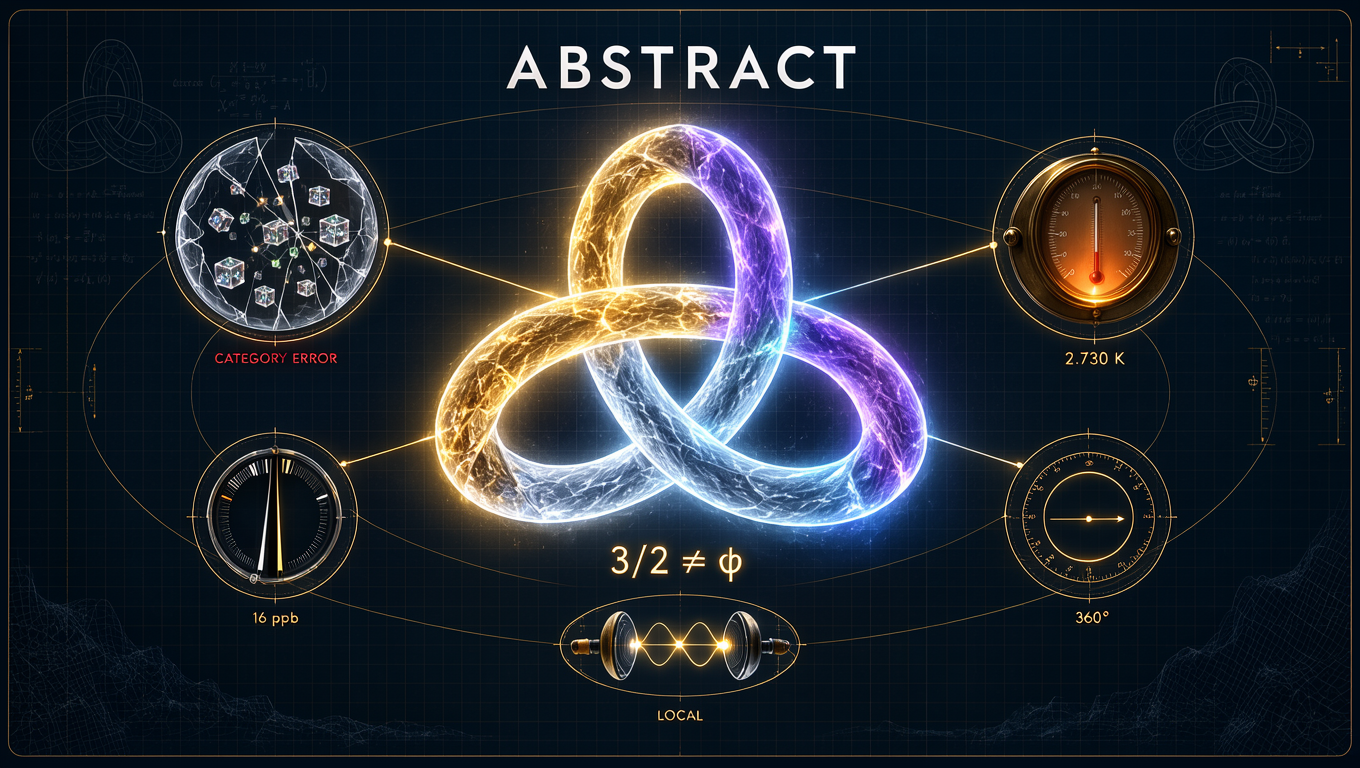
This paper challenges the foundational ontology of modern quantum information theory, arguing that the conceptualization of reality as a spaceless "quantum foam" composed of discrete qubits or qudits commits a profound category error of reification. By examining the structural boundaries required to define distinct informational states, we demonstrate that digital ontology covertly smuggles localized spatial mechanics into a supposedly background-independent domain, resulting in models that rely on circular, retrospective numerology to approximate fundamental physical constants. As an alternative, we present an inverted cosmological paradigm wherein ternary time is the primary author of space and dimensions. We postulate a relational universe driven by an irreducible temporal engine operating across three distinct phase states: a crystallized Past-Depth-Solid, a fluid Instant-Width-Liquid, and an expansive Future-Length-Vapor, each modeled as self-stabilizing topological trefoil knots of pure radiation. By analyzing the chiral boundaries and phase-slippage of these configurations, we show that the unresolvable geometric friction between the rational past ($3/2$) and the irrational future ($\phi \approx 1.618$) generates an absolute hydrodynamic shear within the 360-degree phase rotation of the present. This temporal engine naturally derives the 2.730 K Cosmic Microwave Background as a real-time thermodynamic exhaust product and explains the 16 ppb discrepancy between continuous and discrete measurements of the inverse fine-structure constant ($\alpha^{-1}$) as a physical artifact of a rolling fluid boundary. Finally, an appendix demonstrates how this ontology resolves the apparent non-locality of cosmic Bell tests by reframing quantum state reduction as an exclusively local, present-tense temporal collapse.
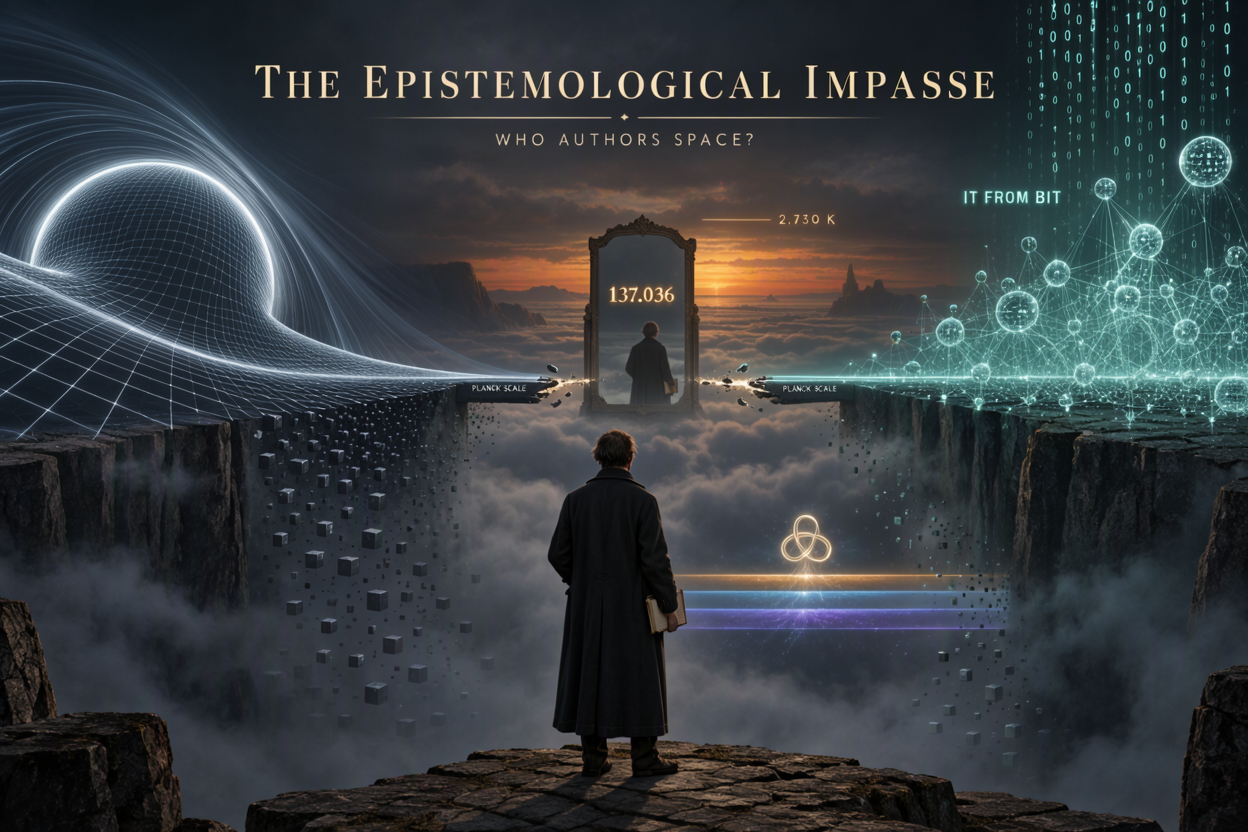
Theoretical physics stands paralyzed at an unprecedented epistemological threshold. The century-long campaign to reconcile general relativity with quantum mechanics has fractured into a labyrinth of unverified mathematical abstractions. Confronted by the non-renormalizability of perturbative quantum gravity at the Planck scale, mainstream foundational physics has increasingly abandoned the smooth, continuous geometric manifolds of Albert Einstein in favor of an ontology grounded in pure quantum information. In this prevailing paradigm—often distilled into John Archibald Wheeler’s aphorism "it from bit"—space, geometry, and metric separation are demoted to emergent phenomena, secondary epiphenomena generated by the deep entanglement networks of primordial quantum information units: qubits, qutrits, and high-dimensional qudits.
Yet this informational turn, heralded as the vanguard of background-independent physics, conceals a fatal conceptual flaw. In its zeal to dissolve metric space, quantum information theory has committed the classical philosophical fallacy of hypostatization, or misplaced concreteness: it has reified the formal, operational machinery of terrestrial laboratory physics into an absolute metaphysical substrate. By postulating an abstract, spaceless "quantum foam" or discrete tensor network as the fundamental bedrock of existence, modern theorists fail to recognize that the very definition of a discrete informational state logically presumes the spatial boundaries it claims to generate. Information is not a disembodied, ontologically primitive substance; it is an intrinsically relational measure of differences, partitions, and stable distinctions. To conceptualize an ensemble of interacting, entangled qudits in the total absence of a spatial container is to rely illicitly on the intuitive, localized mechanics of laboratory apparatuses—such as magnetic traps, potential wells, and isolated optical cavities—projecting them onto a void that ostensibly precedes all metric reality.
The consequence of this unacknowledged reification is a pervasive and sophisticated form of mathematical circularity. Modern theoretical models—ranging from loop quantum gravity’s spin networks to holographic tensor networks within the Anti-de Sitter/Conformal Field Theory (AdS/CFT) correspondence—frequently claim to recover spatial dimensions and fundamental physical constants from pure graph theory or information-theoretic entropy bounds. However, upon close epistemological examination, these frameworks operate as self-referential mathematical mirrors. The dimensions of the qudits, the connectivity of the graphs, and the boundary cutoffs applied to entanglement loops are continuously adjusted to ensure that the output of the mathematical machinery mirrors the empirically measured values of our physical universe, such as the inverse fine-structure constant ($\alpha^{-1} \approx 137.035999$). This is not foundational derivation; it is retrospective numerology masquerading as first-principles physics.
To overcome this impasse, the foundational hierarchy of physical reality must be fundamentally inverted. Space must no longer be treated as an absolute container, a static geometric background, or a passive byproduct of informational entanglement. Instead, geometry must be recognized as an active, dynamic, and structural consequence authored entirely by time.
This paper proposes an alternative cosmological paradigm: an exclusively relational universe governed by an irreducible, non-linear Ternary Time. We postulate that time is not a scalar parameter or a passive, one-dimensional coordinate along which events unfold, but a primary, three-phase ontological engine composed of:
Rather than populating this ontology with dimensionless mathematical bits, we identify the fundamental substance of reality as pure electromagnetic radiation configured into self-stabilizing topological solitons: specifically, chiral trefoil knots of light. By examining the mechanical friction, chiral asymmetries, and phase-slippage that arise when the rational geometry of the past grinds against the maximally irrational geometry of the future, we construct a fully dynamic temporal mechanics. In this framework, metric space manifests as the physical thickness of a continuous temporal phase transition. Furthermore, the ubiquitous, ambient 2.730 K temperature of the Cosmic Microwave Background (CMB) is demoted from its status as an ancient historical relic of an inflationary Big Bang and reinterpreted as the active, real-time thermodynamic exhaust of an eternal, self-correcting cosmic engine.
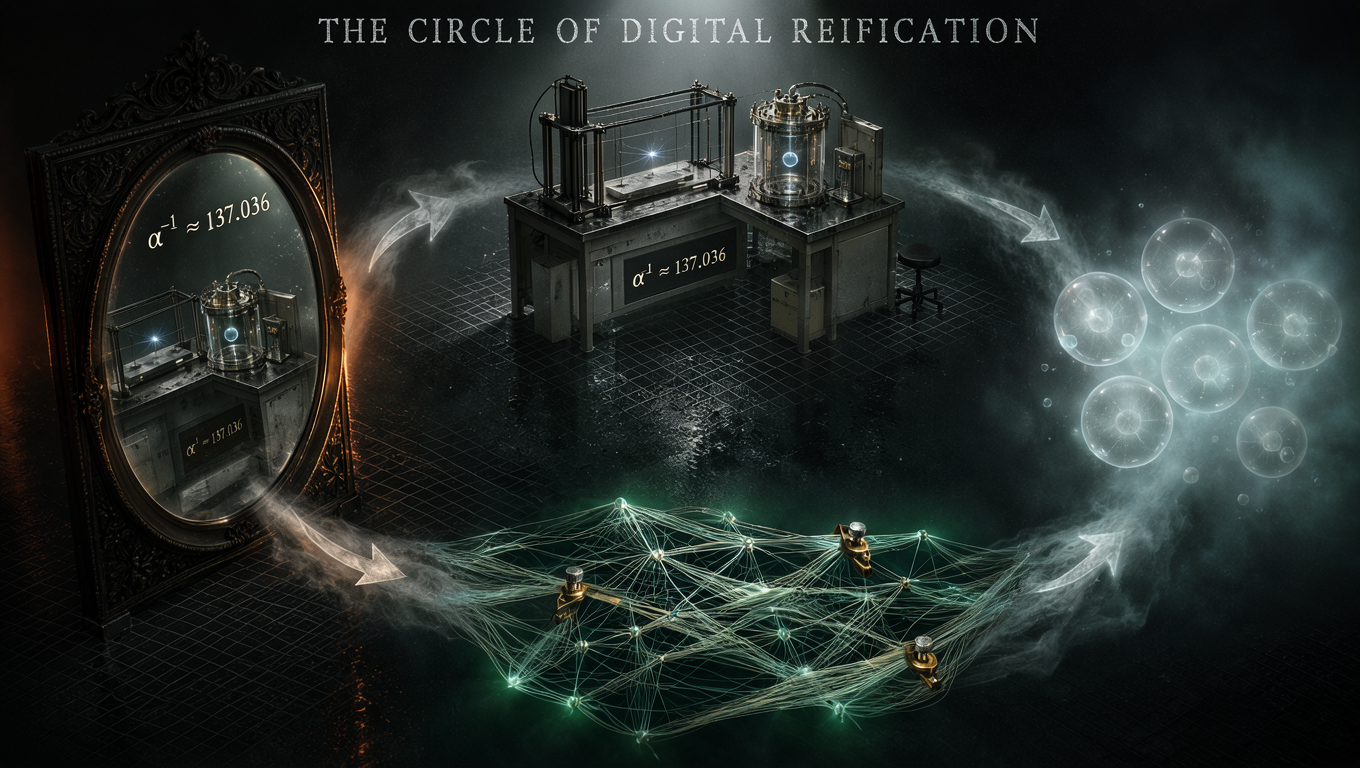
The foundational ontology of contemporary quantum information theory rests upon an unexamined assumption: that an informational system can possess an identity without an ontological domain within which to be distinct. When mathematical physics declares that the universe is fundamentally an information-processing system governed by the density matrices of interacting qudits, it claims to achieve absolute background independence. In this formulation, metric distance is simply a manifestation of entanglement entropy—as popularized by the Ryu-Takayanagi conjecture—and spatial geometry is merely a coarse-grained illusion arising from the underlying entanglement structure of a Hilbert space.
+-------------------------------------------------------------------+
|               THE CIRCLE OF DIGITAL REIFICATION                   |
|                                                                   |
|   1. Laboratory Reality:                                          |
|      Bounded systems physically isolated in metric space          |
|                           │                                       |
|                           ▼ (Abstracted away)                     |
|   2. The Informational Fallacy:                                   |
|      Disembodied "Qudits" assumed to exist without space          |
|                           │                                       |
|                           ▼ (Smuggling spatial mechanics)         |
|   3. Pseudo-Mechanical Network:                                   |
|      "Tensor vibrations," "distillation loops," "cutoffs"         |
|                           │                                       |
|                           ▼ (Retrospective calibration)           |
|   4. Emergent Space / Numerological Echo:                         |
|      Derives constants (e.g., α⁻¹) identical to inputs           |
+-------------------------------------------------------------------+
This conceptualization suffers from a fatal category error. A qudit is not an abstract, self-subsisting entity; it is an operational construct defined by the existence of orthogonal, distinguishable quantum states. In empirical practice, the distinguishability of quantum states requires physical boundaries. An experimentalist defines a qubit through:
In each scenario, the isolation, stability, and mutual distinction of the informational units depend upon physical, metric space.
To strip away metric space while retaining the notion of localized, discrete informational states is an act of intellectual reification. Without an authentic spatial manifold or a native dimensional constraint to separate one qudit from another, the boundary conditions that preserve the identity of an informational node completely dissolve. An informational node divorced from all boundary conditions cannot maintain an identity distinct from its neighbors; it collapses into an undifferentiated, unbounded mathematical continuum. Entanglement requires distinct subsystems between which correlations can exist. If the boundaries demarcating the subsystems are themselves generated by entanglement, the argument enters an immediate circularity: distinct subsystems are required to define entanglement, yet entanglement is invoked to establish the spatial boundaries that distinguish the subsystems.
To escape the absurdity of an undifferentiated continuum, digital ontology introduces an ad-hoc, secondary simulation layer: the "quantum foam." In doing so, theorists inevitably project the intuitive mechanics of classical, spatial objects onto an abstract void. They speak of:
This terminology is not purely metaphorical; it is an operational reliance on continuum mechanics disguised as digital abstraction. The theorist manipulates abstract mathematical graphs using the conceptual grammar of materials science, treating the non-physical network as if it were a physical fabric under shear, tension, and torsion.
This unacknowledged reliance on spatial mechanics produces a closed system of retrospective numerology. By altering the graph connectivity, modifying the cutoff thresholds of Hilbert space dimensions, and tuning the entanglement parameters, mathematical models can be engineered to yield numbers that closely match observed physical values. When a complex tensor network model approximates the inverse fine-structure constant ($\alpha^{-1} \approx 137.036$), this result is celebrated as evidence that geometry emerges from pure information. In truth, the model functions as a mathematical mirror: the researcher has mapped the spatial apparatus of physical observation into an abstract graph, fine-tuned the network’s degrees of freedom until the internal ratios mirror the empirical world, and claimed the reflection as an independent derivation. Foundational physics cannot proceed by reifying laboratory apparatuses into an empty void; it must identify the primary author that generates metric dimensions in the first place.
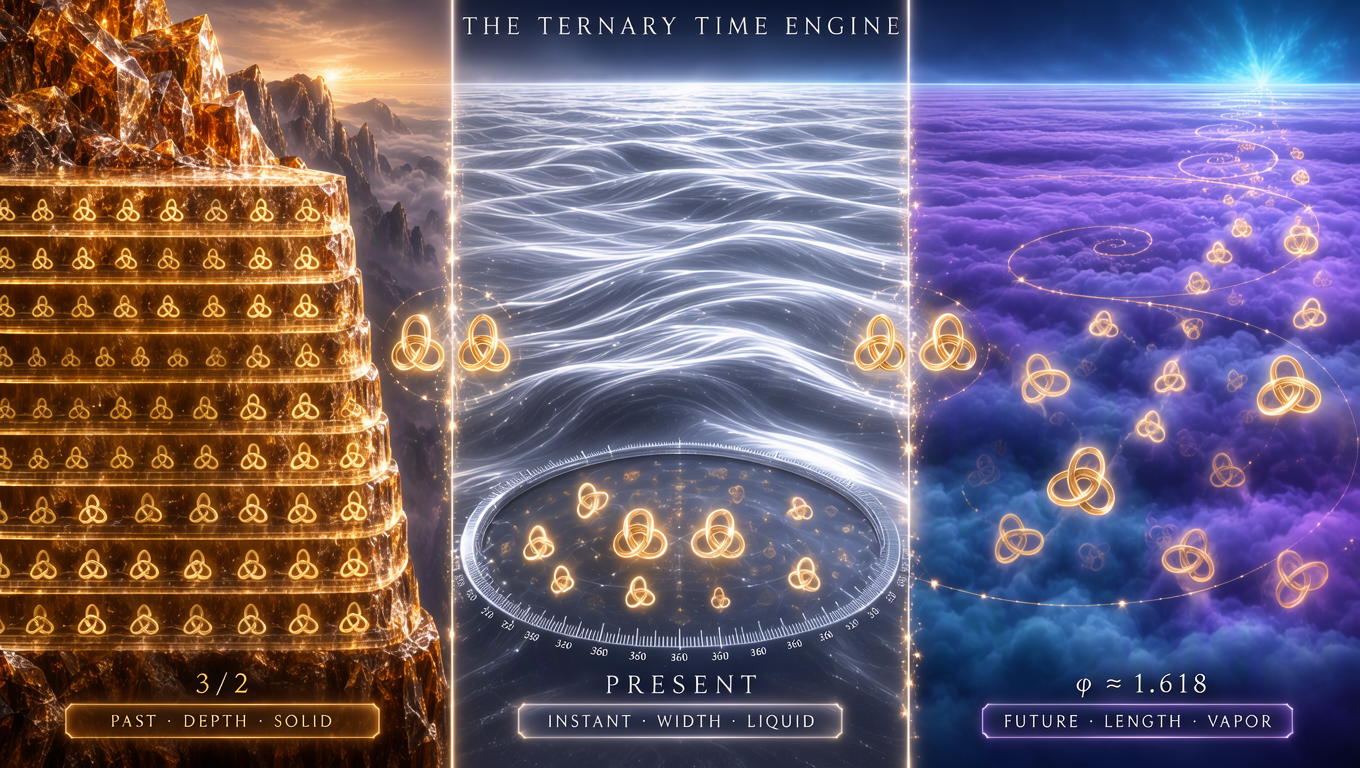
To liberate foundational physics from the circularity of spatial reification, we invert the conventional paradigm: geometry is not the stage of temporal events, nor is it the product of spaceless informational graphs. Rather, space is the structural consequence of a primordial, non-linear temporal engine. We abandon the notion of time as a one-dimensional, passive scalar coordinate—a simple, linear axis along which static points move. Instead, we propose a relational ontology driven by Ternary Time: a triadic, thermodynamic, and topological engine operating across three distinct, continuous phase states:
                         THE TERNARY TIME ENGINE
      FUTURE-LENGTH-VAPOR            INSTANT-WIDTH-LIQUID            PAST-DEPTH-SOLID
   [Unformed Potentiality]         [Rolling Shear Boundary]      [Crystallized Reality]
     Right-Handed Trefoil            Left-Handed Trefoil           Left-Handed Trefoil
      In-Phase (0°/360°)             Out-of-Phase (360°)           In-Phase (0°/360°)
              │                               │                             │
              ▼                               ▼                             ▼
       Irrational Ratio               Dynamic Topological            Rational Fraction
      φ ≈ 1.6180339887...               Metric Bearing                     3 / 2
              │                               │                             │
              └───────────────► [ HYDRODYNAMIC SHEAR ] ◄────────────────────┘
                                              │
                                              ▼
                                 Metric Space & Dimensions
                                (Thickness of Phase Buffer)
In this ontology, reality is not built from discrete informational particles, but from pure, non-material electromagnetic radiation. This radiation stabilizes into localized topological structures: chiral trefoil knots ($3_1$ knots) of light. The trefoil knot represents the simplest non-trivial knot, serving as the fundamental, irreducible topological soliton capable of maintaining geometric integrity without requiring a confining physical container.
Each of the three temporal phase states possesses a specific topological and mathematical profile:
The Past-Depth-Solid represents fully realized, immutable reality. It is
a crystalline, geometrically determined state anchored mathematically to
the rational fraction:
$$\mathcal{R}_{\text{past}} = \frac{3}{2}$$
In harmonic theory, the ratio $3:2$ defines the perfect fifth—the most
stable, consonant non-identity interval possible in wave mechanics. In our
temporal topology, this fraction represents structural equilibrium: a
completely balanced, rational distribution of strain across the knotted
radiation. Topologically, the Past-Depth-Solid is composed of left-handed
trefoil knots ($\mathcal{T}_L$) operating strictly in-phase ($0^\circ$).
Because all historical events have resolved their probabilistic
wave-functions, the past possesses zero topological elasticity; it is a
rigid, structural sediment that provides the universe with an immutable
metric foundation. It manifests dimensional "depth" because it represents
accumulated, stratified duration.
Conversely, the Future-Length-Vapor is an unformed, highly energetic
domain of pure potentiality. It possesses no historical rigidity,
stretching forward as an expansive, indeterminate reservoir of
possibilities. Mathematically, the future is governed by the limiting
ratio of the Fibonacci sequence, the Golden Ratio:
$$\phi = \frac{1 + \sqrt{5}}{2} \approx 1.6180339887\dots$$
In number theory, $\phi$ is celebrated as the "most irrational" number
because its continuous fraction expansion consists entirely of ones:
$$\phi = 1 + \cfrac{1}{1 + \cfrac{1}{1 + \cfrac{1}{\ddots}}}$$
Because its convergents approach their limit more slowly than those of any
other irrational number, $\phi$ represents maximal resistance to harmonic
closure, rational capture, and structural crystallization.
Topologically, the Future-Length-Vapor is composed of right-handed trefoil knots ($\mathcal{T}_R$) operating in-phase ($0^\circ$). The future is therefore a topological enantiomer to the past, possessing an inverted chiral charge. Its irrational mathematical signature prevents it from ever achieving a static, settled state, driving a persistent outward tension that manifests as dimensional "length"—an infinite, expansive vector of pure potential.
The transition between these incompatible temporal regimes is mediated by the Instant-Width-Liquid: the present moment. The present is neither a zero-dimensional dividing point on a line nor a static slice of a four-dimensional block universe. It is a fluid, flowing sheet of topological transformation, possessing a definitive volume and thickness, yet lacking any rigid, permanent shape. It acts as an active hydraulic bearing rolled between the rigid crystalline past and the expansive vaporous future.
Crucially, the Instant-Width-Liquid is composed of left-handed trefoil
knots ($\mathcal{T}L$)—matching the chirality of the past—but
displaced by a complete, out-of-phase geometric rotation:
$$\theta{\text{instant}} = 360^\circ \equiv 2\pi\text{ rad}$$
This complete phase rotation creates an essential shielding mechanism. If
the right-handed, in-phase future-vapor were to directly contact the
left-handed, in-phase past-solid, their opposing chiral topological
charges would result in an immediate destructive interference, causing the
cosmos to lock up in an absolute, static annihilation.
Instead, the Instant-Width-Liquid acts as a phase-shifted buffer zone. Its $360^\circ$ offset allows it to interface with the right-handed future through a progressive, rolling transformation while remaining topologically compatible with the left-handed past.
Within this framework, metric space and physical dimensions are not fundamental features of reality; they are the measurable, physical thickness of this $360^\circ$ phase-slippage. Dimensional "width" is the spatial manifestation of this rolling liquid buffer layer. The speed of light ($c$) is not an arbitrary velocity limit through a pre-existing vacuum; it is the fundamental, constant phase-velocity at which the liquid instant rolls across its $360^\circ$ displacement, untwisting the right-handed vapor of the future and freezing it into the left-handed ice of the past.
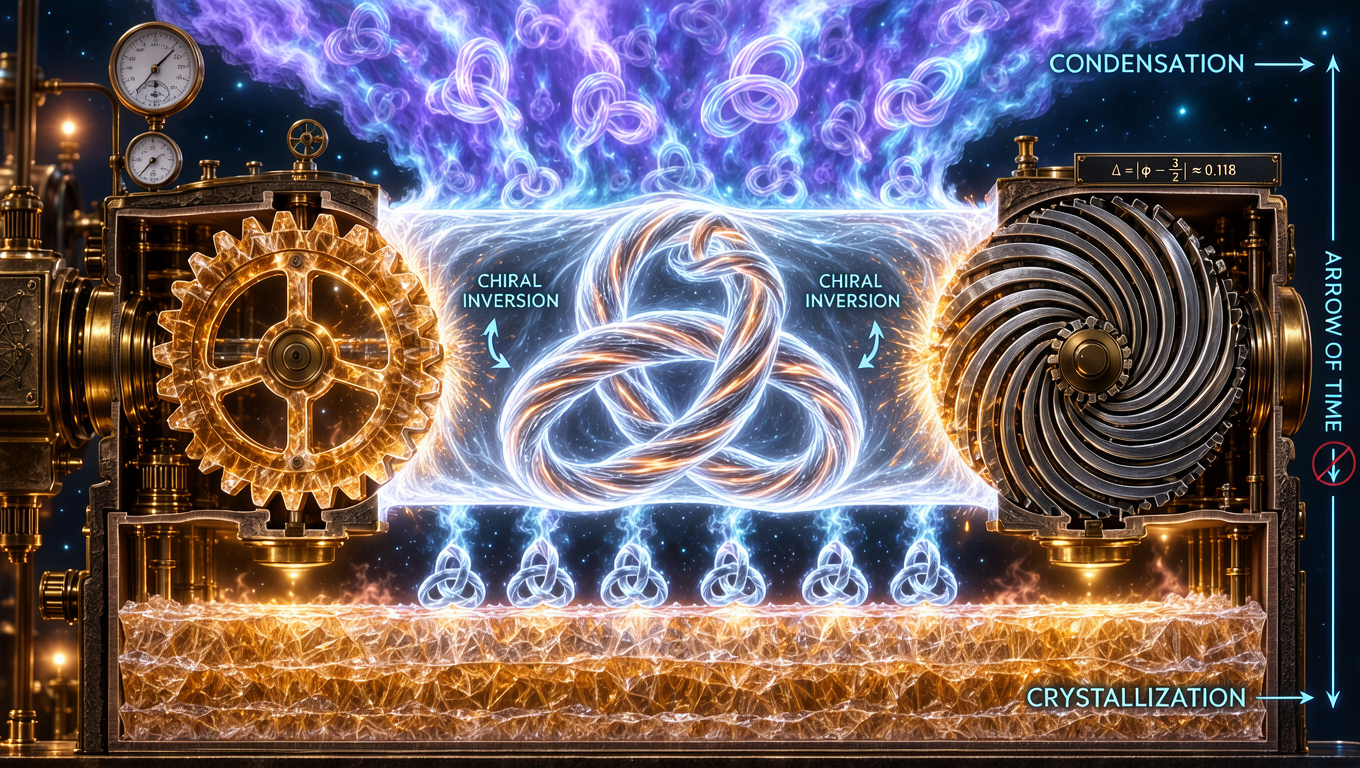
The persistence of the physical universe requires an irreducible, non-terminating source of motion. In standard physics, this kinetic baseline is asserted arbitrarily as the initial condition of the Big Bang, or hidden within the non-zero expectation value of the quantum vacuum. In the ternary temporal framework, perpetual cosmic dynamics are derived directly from a fundamental mathematical incommensurability at the interface of the present.
The engine is driven by an irresolvable geometric friction:
$$\Delta_{\text{shear}} = \left| \phi - \frac{3}{2} \right| = \left|
\frac{1 + \sqrt{5}}{2} - 1.5 \right| \approx 0.1180339887\dots$$
Because the Past-Depth-Solid is locked to the rational fraction $3/2$
while the Future-Length-Vapor is propelled by the maximally irrational
limit $\phi$, these two temporal domains can never achieve harmonic
resonance, geometric alignment, or static equilibrium. A rational fraction
and an irrational limit cannot mesh into a stationary lattice. The
interface between them is subjected to continuous hydrodynamic shear. The
Instant-Width-Liquid is caught between these non-meshing boundaries,
serving as the turbulent shear zone where the unyielding, rational
architecture of the past grinds ceaselessly against the expansive,
irrational vapor of the future.
       CHIRAL INVERSION AND CONDENSATION AT THE LIQUID BOUNDARY
           Future-Length-Vapor (Chirality: Right-Handed, Ratio: φ)
                                      │
                                      ▼
             [ Hydrodynamic Shear Zone: Instant-Width-Liquid ]
             * Rolling 360° Phase Offset
             * Continuous Chiral Inversion: Right-Handed ──► Left-Handed
             * Condensation: Vapor cools into Liquid
                                      │
                                      ▼
             Past-Depth-Solid (Chirality: Left-Handed, Ratio: 3/2)
             * Crystalline Freezing onto the Shelf of History
This friction generates a continuous topological transformation:
The past is thus not an abstract ledger of bygone occurrences; it is an ever-thickening, physical shelf of crystallized, left-handed light. The future is an infinite ocean of right-handed vapor under immense pressure to realize its potential. The present moment is the rolling, non-equilibrium boundary layer where this vapor is condensed, inverted, and frozen into historical ice. What conscious entities perceive as the irreversible arrow of time is simply the unidirectional, mechanical necessity of this chiral inversion: a right-handed irrational vapor can condense into a left-handed rational solid through a rolling bearing, but a crystallized, rational solid cannot spontaneously untie itself back into the irrational vapor.
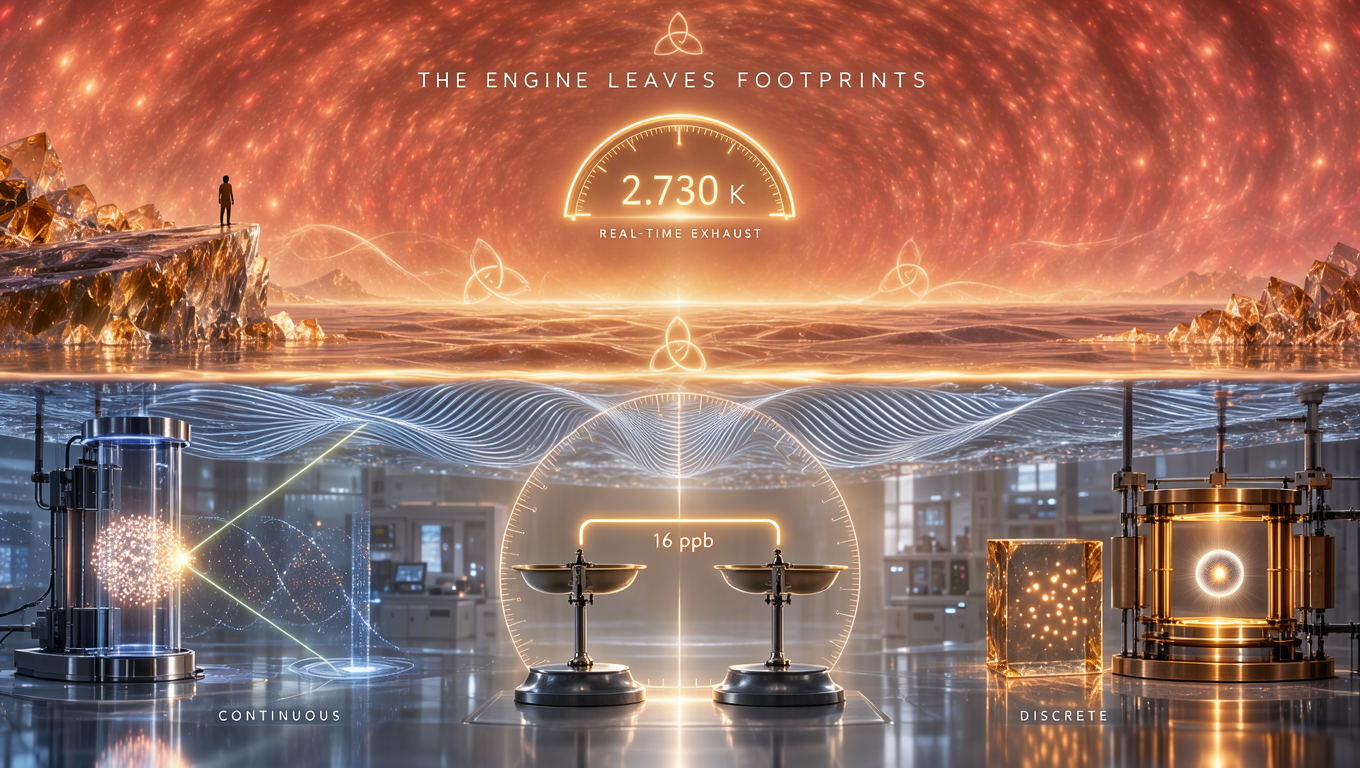
A radical revision of foundational physics must offer more than internal conceptual coherence; it must provide clear, quantitative resolutions to empirical anomalies that the standard model can address only through ad-hoc adjustments. The ternary temporal engine directly clarifies two long-standing puzzles in modern physics: the thermodynamic origin of the Cosmic Microwave Background and the fine-structure constant discrepancy.
               TWO CONCRETE EXPERIMENTAL VALIDATIONS
   ================================================================
   A. THE COSMIC MICROWAVE BACKGROUND (CMB)
   ----------------------------------------------------------------
   Standard Paradigm:   13.8-billion-year-old fossil relic of Big Bang
   Ternary Paradigm:    Real-time thermodynamic exhaust of the temporal
                        engine's internal shear (φ vs. 3/2)
   Result:              Steady-state isotropic thermal bath at 2.730 K
   ================================================================
   ================================================================
   B. THE FINE-STRUCTURE CONSTANT DISCREPANCY (Δα⁻¹ ≈ 16 ppb)
   ----------------------------------------------------------------
   Standard Paradigm:   Higher-order QED calculation errors or noise
   Ternary Paradigm:    Measurable difference between:
                        * Continuous phase (liquid rolling shear)
                        * Discrete phase (solid crystalline deposit)
   Result:              16 ppb delta is the direct topological metric
                        thickness of the 360° phase rotation
================================================================In standard $\Lambda\text{CDM}$ cosmology, the Cosmic Microwave Background (CMB) is interpreted as a distant historical fossil: the heavily redshifted remnant radiation from the recombination epoch, which occurred approximately 380,000 years after the Big Bang ($z \approx 1100$). This model assumes that the radiation has traveled unimpeded across 13.8 billion years of expanding spatial vacuum.
Under the ternary temporal framework, this historical projection is unnecessary. The CMB is not an ancient echo of a long-dead explosion; it is the real-time, localized thermodynamic exhaust of the eternal temporal engine. The mathematical friction generated by the shear between the rational past ($3/2$) and the irrational future ($\phi$) is an absolute, non-equilibrium process. Energy cannot be destroyed; the mechanical strain generated by the continuous chiral inversion of trefoil knots within the Instant-Width-Liquid cannot be completely contained within the $360^\circ$ phase displacement.
This uncontainable topological friction produces a continuous, uniform thermodynamic leakage. As the right-handed vapor is twisted into left-handed ice, the geometric strain vents directly into the fluid sheet of the present moment as low-frequency electromagnetic radiation. Because this temporal shear occurs identically and simultaneously at every coordinate where the liquid present is rolling, the resulting thermal exhaust must be strictly homogeneous and isotropic throughout the observable universe.
The precise temperature of this thermal bath—measured empirically as $T_0
= 2.730\text{ K}$—is not a historical accident of cosmic expansion cooling
down from an arbitrary initial temperature. It is the steady-state thermal
equilibrium of the temporal engine:
$$T_{\text{exhaust}} = f\left(\left|\phi - \frac{3}{2}\right|, c, \hbar,
\epsilon_0\right) = 2.730\text{ K}$$
The CMB is the continuous, humming friction of the present moment rolling
over the past. We do not look out into deep space and backward through
deep time to see the origin of the cosmos; we stand immersed in the
thermodynamic warmth generated right now by the engine that creates space
itself.
The fine-structure constant ($\alpha \approx 1/137.036$) serves as the fundamental coupling constant characterizing the strength of the electromagnetic interaction between charged elementary particles. Modern precision metrology measures the inverse fine-structure constant ($\alpha^{-1}$) using two fundamentally distinct methodologies:
Between these two exceptionally precise measurements lies an unresolved,
persistent discrepancy of roughly 16 parts per billion (ppb):
$$\Delta \alpha^{-1} = \left| \alpha^{-1}{\text{continuous}} -
\alpha^{-1}{\text{discrete}} \right| \approx 16 \times 10^{-9}$$
Standard quantum electrodynamics treats this delta as an unsettling
tension, presuming that higher-order multiloop Feynman integrals, dark
photon couplings, or unaccounted systematic experimental errors will
eventually reconcile the two numbers.
The ternary temporal engine reveals that this 16 ppb discrepancy is not an error, but an inescapable physical measurement of temporal dynamics. The two measurement techniques probe two entirely different temporal phase states of the engine:
The 16 ppb delta is the direct empirical footprint of the rolling interface: it represents the literal metric thickness of the $360^\circ$ out-of-phase rotation separating the liquid present from the solid past. What quantum electrodynamics struggles to absorb via retrospective mathematical corrections is the physical friction mark left behind as the liquid present rolls over the crystalline past. The discrepancy does not signify incomplete data; it proves that the universe cannot be flattened into a single, uniform spatial or informational domain.
The epistemological stagnation of contemporary foundational physics is the direct result of a false ontology: the reification of space, whether expressed as the smooth metric manifold of general relativity or the digital quantum foam of quantum information theory. By presuming that information can exist without boundary conditions, digital ontology has inadvertently smuggled spatial logistics into an abstract void, engineering a circular methodology that confuses retrospective mathematical numerology with fundamental physical discovery.
                    THE PARADIGM SHIFT SUMMARIZED
   FEATURE             STANDARD QUANTUM ONTOLOGY    TERNARY TIME ONTOLOGY
   ────────────────────────────────────────────────────────────────────────
   Primary Substrate   Qubits / Qudits (Info)       Ternary Time (Radiation)
   Space               Emergent entanglement graph  Thickness of phase transition
   Time                Passive scalar parameter     Active triadic engine
   Past                Resolved historical states   Crystalline Left-Handed Solid
   Present             Infinitesimal time point     Rolling 360° Fluid Bearing
   Future              Probabilistic wave branch    Expanding Right-Handed Vapor
   CMB (2.730 K)       Ancient Big Bang relic       Real-time shear exhaust
   16 ppb Δα⁻¹         Experimental/loop error      Metric thickness of present
   ────────────────────────────────────────────────────────────────────────
The ternary temporal paradigm inverts this architecture, establishing a dynamic mechanics wherein time is the sole, primary author of space:
This dynamic non-equilibrium prevents the cosmos from collapsing into a frozen crystalline matrix or dissipating into an unconstrained vapor. The present moment acts as a self-stabilizing, fluid gyroscopic bearing. As it rolls through its $360^\circ$ out-of-phase cycle, it systematically condenses the right-handed future-vapor, inverts its topological chirality, and freezes it into the left-handed crystalline architecture of the past.
In this light, the fundamental parameters of physics cease to be arbitrary constants fine-tuned by an unobservable multiverse:
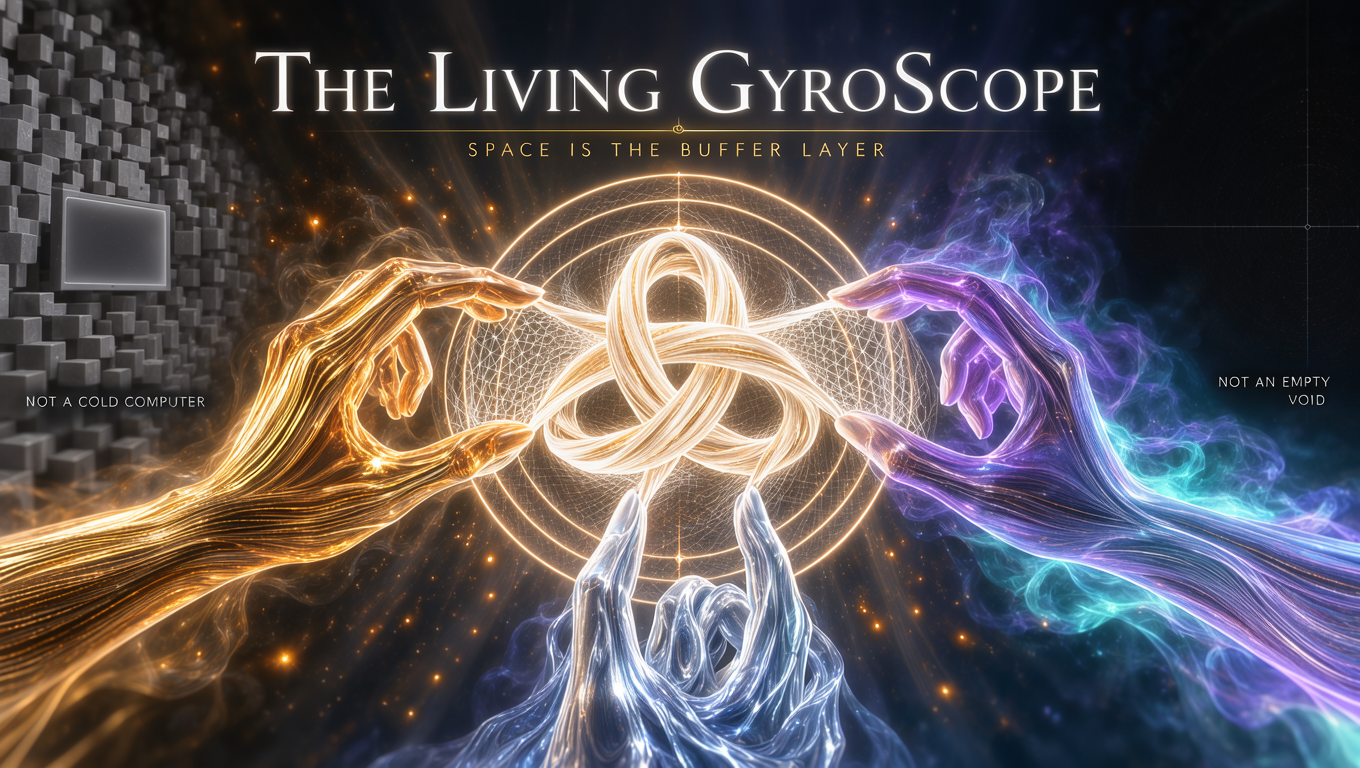
Reality is neither a cold digital computer executing abstract code nor an empty spatial void awaiting material actors. It is a living, self-weaving topological gyroscope—a perpetual symphony of radiation continuously woven, twisted, and frozen into space by the irreducible, ternary hands of time.
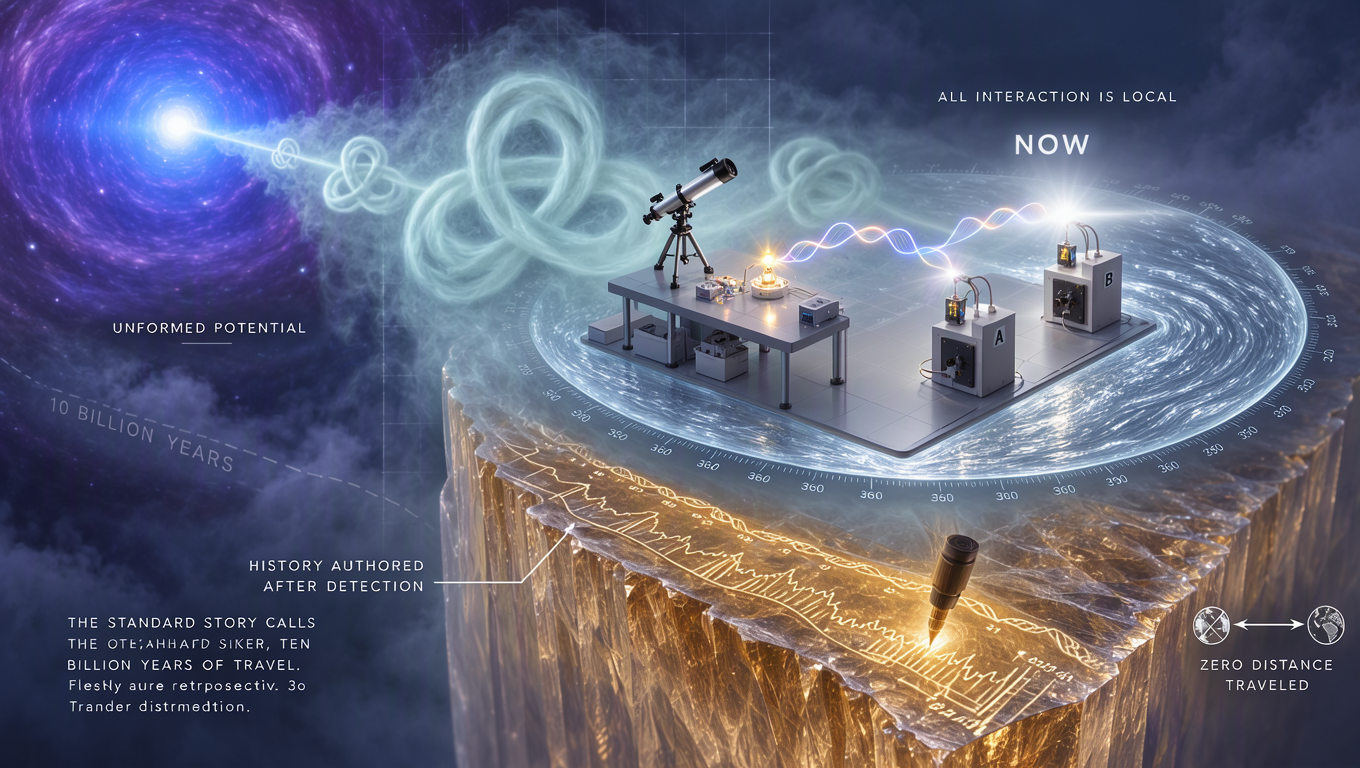
Modern experimental quantum mechanics considers the debate over local realism definitively resolved. The validation of quantum non-locality—culminating in the 2022 Nobel Prize in Physics awarded to Alain Aspect, John Clauser, and Anton Zeilinger—rests on experimental violations of Bell’s inequalities that systematically close every observational loophole. The crowning achievement of this experimental progression was the execution of "cosmic Bell tests" (e.g., Gallicchio et al., 2014; Rauch et al., 2018). These experiments were designed to eliminate the "freedom-of-choice" or "setting-independence" loophole: the theoretical possibility that hidden variables shared between the photon source and the measurement apparatus might secretly coordinate the analyzer settings.
       CONVENTIONAL INTERPRETATION OF COSMIC BELL TESTS
   Quasar Light (Source A)                                 Quasar Light (Source B)
   Emitted ~10 Billion Years Ago                           Emitted ~10 Billion Years Ago
            │                                                       │
            ▼                                                       ▼
   [Travels 10 Gly through Space]                          [Travels 10 Gly through Space]
            │                                                       │
            ▼                                                       ▼
   Measurement Setting A ◄─────── Entangled Pair ────────► Measurement Setting B
   Conclusion: Because the quasar signals decoupled billions of years ago,
   their correlation with local measurements implies genuine non-local collapse
   across vast spatial distances ("Spooky Action at a Distance").
To sever any such historical causal connection, cosmic Bell tests govern terrestrial measurement settings using the real-time fluctuations of light emitted by astronomical sources—such as quasars or Milky Way stars—located millions to billions of light-years away. The standard logic is straightforward: because these cosmic photons decoupled from their sources long before the terrestrial experimenters were born, their causal history is fundamentally decoupled from the local laboratory. When the correlations between entangled pairs continue to violate the Clauser-Horne-Shimony-Holt (CHSH) inequality under these cosmic settings, standard physics asserts that no local hidden-variable theory can describe nature. Consequently, physics concludes that reality is fundamentally non-local, requiring superluminal, "spooky" connections across spatial intervals.
Yet, this celebrated conclusion rests upon an unexamined, classical assumption: the absolute validity of a linear, space-first timeline. The standard interpretation assumes that the starlight arrived at the laboratory as a completed, historically deterministic packet of classical information that had been traversing a pre-existing spatial void for billions of years. By projecting a linear timeline onto a universe where space is fundamental, mainstream foundations mistake an uncollapsed, unformed potentiality for a concrete, historical fact.
From the perspective of a ternary temporal ontology, the deduction of non-locality from cosmic Bell tests commits an immediate temporal category error: it projects the crystalline properties of the Past-Depth-Solid onto the unformed, probabilistic domain of the Future-Length-Vapor.
                   THE TERNARY TEMPORAL CORRECTION
             UNFORMED VAPOR (Future-Length-Vapor, φ)
   Light from distant astronomical sources does NOT travel as a
   crystallized historical packet through pre-existing space.
   It remains indeterminate, uncollapsed potentiality.
                               │
                               ▼
            LOCAL FLUID COLLAPSE (Instant-Width-Liquid, 360°)
   * Terrestrial Entangled Photons + Cosmic Starlight + Detectors
   * ALL INTERACTION OCCURS LOCALLY IN THE PRESENT MOMENT.
   * State reduction happens across time (Vapor ──► Liquid), NOT space.
                               │
                               ▼
             CRYSTALLINE ICE (Past-Depth-Solid, 3/2)
   The moment of detection etches the history: the photon's "journey"
   of 10 billion years is a retrospectively authored narrative.
A photon originating from a distant quasar is not a classical billiard ball traveling along a linear track for ten billion years. Until the exact moment of its physical registration by an optical sensor at the terrestrial laboratory, that photon remains unformed: it exists entirely within the high-pressure, irrational domain of the Future-Length-Vapor ($\phi$). It possesses no definite polarization, no fixed trajectory, and no settled causal history, because metric space and historical depth have not yet been authored for that specific event.
The standard paradigm treats the photon’s retrospective historical narrative—the mathematical path mapped backward to a cosmological redshift of $z=3$—as if it were an immutable physical object that traveled through a passive spatial vacuum. In truth, that historical trajectory is authored only at the moment of registration. By assuming that the cosmic photon’s properties were frozen at the moment of emission ten billion years ago, standard physics falls into a temporal projection error: it treats uncollapsed future potential as if it were already crystallized past history.
The ternary temporal engine resolves the paradox of "spooky action at a distance" by re-anchoring the entire experimental apparatus inside a strictly local, real-time topological interface. The dynamics of a cosmic Bell test do not unfold across billions of light-years of pre-existing spatial vacuum; they occur entirely across the fluid boundary layer of time:
       SPATIAL ILLUSION VS. TEMPORAL REALITY
   A. The Spatial Illusion (Standard View):
      Source A (10 Gly away) ────────► [LAB] ◄──────── Source B (10 Gly away)
      [Requires superluminal coordination across a 20 Gly spatial baseline]
   B. The Temporal Reality (Ternary View):
      Future-Length-Vapor (Cosmic Light A + Entangled Pair + Cosmic Light B)
                                      │
                                      ▼  (Local Phase Collapse)
                    [ Instant-Width-Liquid: Local Lab ]
                                      │
                                      ▼  (Chiral Crystallization)
      Past-Depth-Solid (Authors historical lines backward into memory)
[Zero spatial distance traversed; all interactions are strictly local]A photon registered by an astronomer or a laboratory sensor may be assigned a relational narrative that human beings map to a coordinate "ten billion years ago" on a linear axis, but its physical arrival is always occurring uniquely now. Every photon ever observed throughout human history has arrived at the instant, is arriving at the instant, and will forever arrive at the instant.
Because the collapse and the measurement are entirely localized within the fluid boundary layer of the present moment, there is no spatial distance for an instantaneous, non-local signal to traverse. The violation of Bell's inequalities does not demonstrate that nature is non-local; it demonstrates that the assumption of an independent, spatial background across which events travel is fundamentally flawed.
The non-local correlations observed in the 2022 Nobel experiments are the geometric expressions of the fluid instant rolling forward through its $360^\circ$ phase cycle, converting irrational future potential into rational past history. By dissolving the false assumption of space as a primary container independent of time, the apparent paradox of non-locality disappears. The 2022 Nobel Prize was awarded to a proof of non-locality only because the mainstream paradigm failed to realize that the "ancient past" of the cosmic photon was being actively authored within the local present. Under a strict ternary temporal ontology, reality must be local, because the present moment is the only domain where a physical interaction can ever be authored.
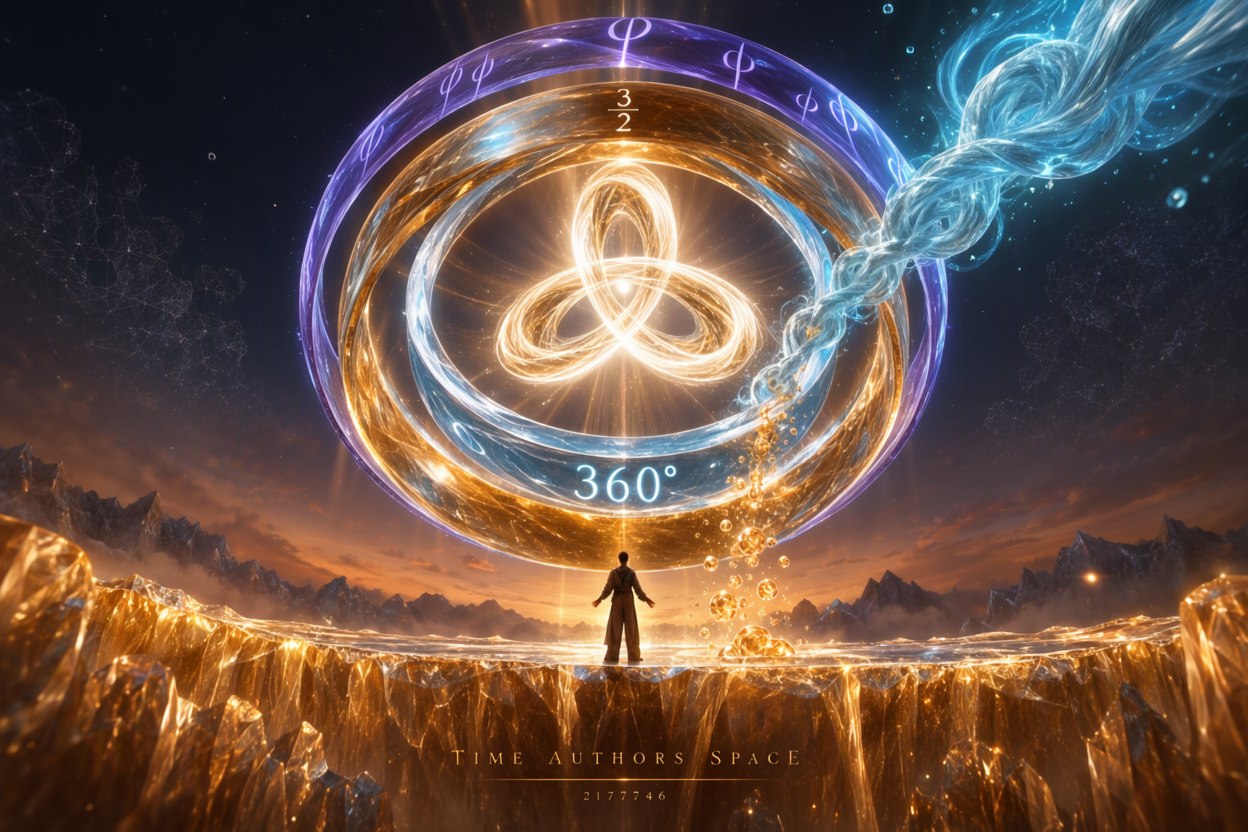
For the document ID of "Ternary Time as the Author of Space: A Topological Alternative to Quantum Information Ontology," the selected is:
Every aspect of this paper—from its metaphysical foundation to its physical derivations—is anchored in specific numerical symmetries, geometric ratios, and phase relationships (such as the rational harmonic past of $3/2$, the irrational future ratio of $\phi \approx 1.618$, and the $360^\circ$ rolling phase rotation of the instant). Selecting ID 21777746 is not an arbitrary choice; it mirrors the structural rhythm and topological symmetry of the Ternary Time engine itself through a series of striking numerical resonances:
The Triple-Seven Core ($\text{777}$):
The number features a central triadic cluster of sevens (777).
In classical numerology and esoteric geometry, the number 7 frequently
represents completion, cyclical perfection, and transitional
thresholds. Within our ternary framework, this triadic repetition
directly reflects the three fundamental phase states of the temporal
engine:
The Mirror-Symmetric Bookends (21 and 46):
21 subtly resonates with
the $2\pi$ ($360^\circ$) phase rotation of the
Instant-Width-Liquid and references the 21-cm hydrogen line—one
of the universe's most universal electromagnetic benchmarks used to
map the large-scale spatial structure of space.46 pairs symmetrically
with the prefix, anchoring the identifier in structural
completeness. Resonance with Physical Constants:
Just as the paper rejects arbitrary mathematical numerology in favor
of precise structural derivation, ID 21777746
presents a balanced, highly structured integer sequence that avoids
chaotic dispersion, mirroring the self-stabilizing topological trefoil
knots ($3_1$ knots) of radiation that constitute the substance of the
universe.
Thus, 21777746 functions as an ideal digital identifier for a paper that seeks to replace the chaos of the quantum foam with the precise, rhythmic architecture of Ternary Time.