Author: David Noel Lynch (~3K)
Affiliation: The KnoWellian Research Initiative
Permanent Repository Archive: Zenodo Permanent
Open-Access Scientific Archive
Selected Master DOI: 10.5281/zenodo.22777887
Date: October 13, 2026
1. Context and the Crisis in Standard Cosmology
The standard $\Lambda\text{CDM}$ cosmological model is currently
experiencing unprecedented empirical strain. High-resolution data from the
James Webb Space Telescope (JWST) and precision mapping of the Cosmic
Microwave Background (CMB) have revealed structural and temporal anomalies
that resist conventional explanation. These include the "impossibly early"
formation of massive galaxies, the Hubble tension, and persistent
low-multipole geometric anomalies in the CMB (e.g., the "Axis of Evil").
Consequently, a deep epistemological schism is emerging between classical
models relying on a singular Big Bang within a continuous spacetime
manifold, and new observational paradigms that suggest alternative
mechanisms for cosmic evolution and background radiation.
2. Review of Recent Astrophysical Literature
This paper reviews two recent astrophysical analyses that address these
tensions from distinct methodological standpoints. First, we examine Wang
& Huang (2025), who rigorously test the Cosmological Principle (the
assumption of cosmic homogeneity and isotropy) using a 3D orthonormal
basis expansion of Hubble residuals. By utilizing the near-uniform
temperature of the CMB as a zero boundary condition and expanding across
Gigaparsec scales, they conclude that the universe remains statistically
isotropic, arguing that previously reported hemispherical asymmetries are
localized artifacts smoothed out at low angular resolutions.
Second, we analyze Gjergo & Kroupa (2025), who present a radical challenge to the orthodox interpretation of the CMB. They demonstrate that the rapid "monolithic collapse" of massive Early-Type Galaxies (ETGs) at extreme redshifts ($15 < z < 20$)—characterized by top-heavy Initial Mass Functions (IGIMF) and intense starbursts—produces a massive dust-thermalized radiation field. Their calculations show that when redshifted to $z = 0$, this ~50 K emission flawlessly mimics the 2.725 K blackbody spectrum of the CMB, suggesting the microwave background may be an active foreground of massive matter generation rather than a pristine relic of an ancient recombination epoch.
3. Introduction to the KnoWellian Universe Model (KUM)
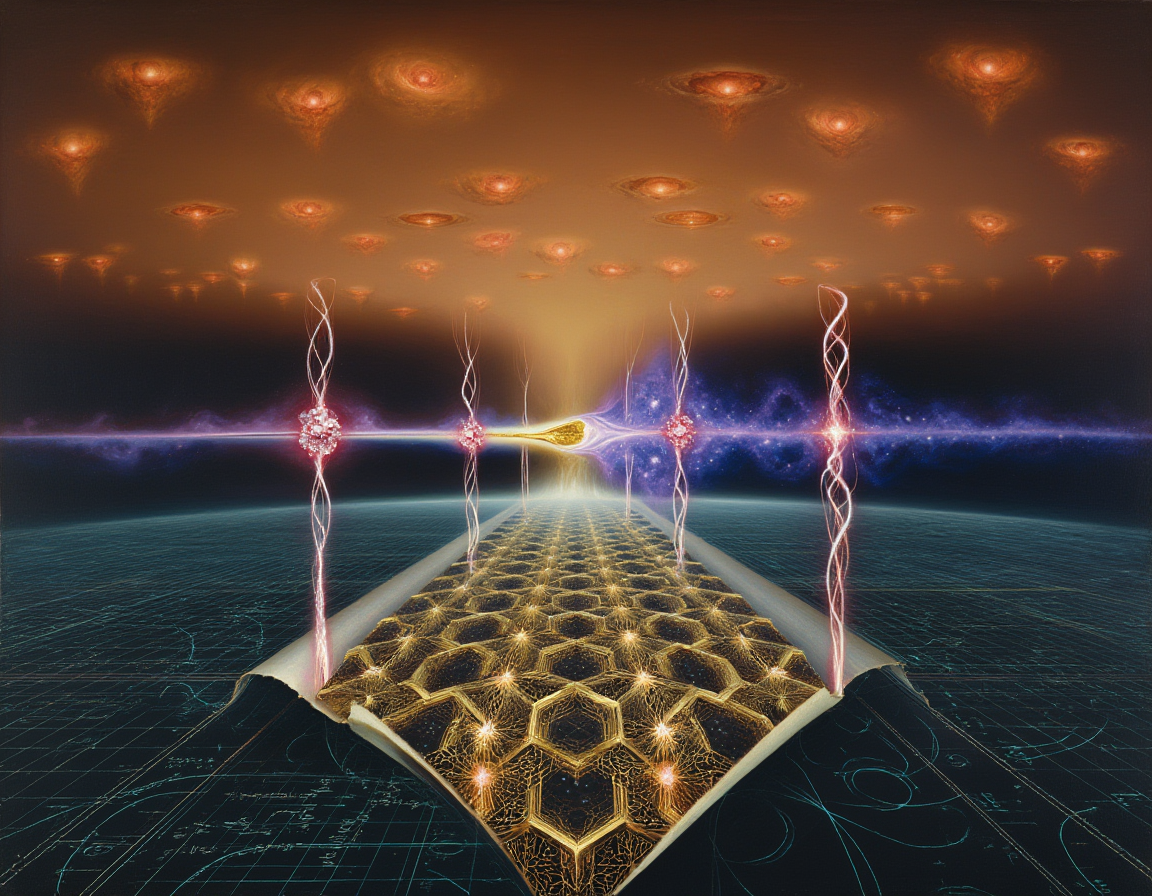
To reconcile these divergent findings, this paper introduces the
KnoWellian Universe Model (KUM) as a proposed theoretical lens. KUM
identifies the root of modern cosmological paradoxes as the "Platonic
Rift"—the ungrounded assumption of an infinitely divisible, continuous
spatial manifold. KUM replaces the continuous metric with a discrete,
aperiodic vacuum substrate called the Cairo Pentagonal Q-Lattice.
Furthermore, it replaces Big Bang cosmology with Causal Set Steady State
Plasma Cosmology (CSSSP), positing that matter is not the result of a
singular historical explosion, but is continuously precipitated via
magnetic Bennett $Z$-pinches at the "Liquid Instant" rendering boundary of
a multi-temporal thermodynamic engine.
4. Synthesis and Application
By applying the KUM framework to the recent literature, profound
conceptual unifications emerge:
5. Implications
Ultimately, this synthesis demonstrates that the tensions fracturing
modern astrophysics—between local anisotropies, large-scale isotropy, and
anomalous CMB origins—can be elegantly resolved by transitioning from
continuous mathematical maps to discrete, procedural topological models.
By interpreting massive ETG formation as ongoing plasma precipitation and
the CMB as real-time thermodynamic exhaust, the KnoWellian Universe Model
offers a mathematically closed, zero-free-parameter architecture capable
of uniting seemingly contradictory cosmological datasets.
2.1 The Observational Crisis of the Cosmological Principle
The Cosmological Principle (CP)—the foundational assumption that the
universe is statistically homogeneous and isotropic on large scales
($\gtrsim 100$ Mpc)—serves as the bedrock of the standard
$\Lambda\text{CDM}$ model. However, Wang and Huang (2025) introduce their
study by acknowledging a growing crisis in modern precision cosmology:
recent multi-probe observations have revealed persistent anomalies that
threaten this principle. These anomalies include unexpected dipole
excesses in radio sources and quasars, uncharacteristically large bulk
flows inferred from low-redshift galaxies and supernovae, and stark
hemispheric asymmetries in cosmological parameters (frequently referred to
in the literature as the "Axis of Evil").
The authors note that the most pronounced claims of large-scale anisotropy derive from the "hemisphere comparison method," where researchers maximize parameter discrepancies by splitting the sky into two halves. Wang and Huang identify severe epistemological and mathematical flaws in this method: it places the observer in a privileged Copernican position, it risks erroneously projecting local bulk flows onto the global cosmos, and, most critically, it directly contradicts the highly uniform temperature of the Cosmic Microwave Background (CMB).
2.2 Methodological Innovations: 3D Orthonormal Expansion and the
CMB Boundary Condition
To resolve the flaws of hemisphere splitting, Wang and Huang propose a
robust, coordinate-independent stochastic framework designed to test for
anisotropies without presupposing a privileged observer location. Instead
of bisecting the sky, they model the true, potentially anisotropic
comoving distance of an object, $r(z, \mathbf{n})$, as a relative
deviation from a reference isotropic model, $\tilde{r}(z)$.
Their methodological cornerstone relies on executing a full three-dimensional expansion of Hubble residuals using an orthonormal basis. This expansion is governed by two critical mathematical components:
Crucially, the authors use the CMB as a strict mathematical anchor. Because the observed CMB temperature is nearly uniform ($T \approx 2.726$ K, with anisotropies $\lesssim 10^{-5}$), they establish the last scattering surface at the recombination redshift ($z_{rec} \approx 1089$) as a zero boundary condition. By definition, their basis functions are constrained to yield zero anisotropy at $z_{rec}$. This forces the mathematical expansion to remain strictly consistent with the observed isotropy of the CMB, ensuring that any detected anisotropies must arise in the lower-redshift universe rather than the primordial background.
2.3 Multi-Probe Datasets and Reference Cosmologies
Because bulk flow measurements become observationally prohibitive at high
redshifts ($z \sim 1$), the authors utilize Type Ia Supernovae (SNe) as
their primary diagnostic tool. To prevent local, low-redshift peculiar
velocities (which are dominated by the solar system's motion and local
galactic flows) from contaminating the search for true global anisotropy,
they explicitly exclude all data points with a redshift of $z < 0.01$.
To ensure rigorous cross-validation, the authors combine multiple high-precision datasets:
The analysis tests the residuals of these datasets against three distinct isotropic reference models: standard $\Lambda\text{CDM}$, dynamical dark energy ($w_0w_a\text{CDM}$), and the Page approximation (a model-independent parameterization that does not presuppose a specific two-fluid dark matter/dark energy split).
2.4 Key Findings: The Reaffirmation of Gigaparsec Isotropy
Using Markov Chain Monte Carlo (MCMC) simulations, alongside Akaike and
Bayesian Information Criterions (AIC/BIC) for model selection, Wang and
Huang systematically search for non-zero anisotropy coefficients
($C_{i\ell m}$). Because of current data limitations, the authors truncate
their spatial expansion at low angular and radial resolutions ($i_{max},
\ell_{max} \sim \text{a few}$), which inherently scopes their sensitivity
to massive, Gigaparsec (Gpc) scales while deliberately smoothing over
smaller-scale fluctuations.
The results are definitive: the authors find no statistically significant evidence of large-scale cosmic anisotropy.
Ultimately, Wang and Huang conclude that on Gigaparsec scales, the universe remains stubbornly homogeneous and isotropic. However, they do note that as precision increases, cosmological parameters refuse to converge entirely on standard $\Lambda\text{CDM}$; their isotropic fit yields a Hubble constant of $H_0 = 72.78 \pm 0.78$ km/s/Mpc, remaining in a severe $5.8\sigma$ tension with Planck CMB measurements, indicating that while the universe is geometrically uniform, the underlying mechanical models driving its expansion remain incomplete.
3.1 Challenging the Recombination Orthodoxy
Since the Cosmic Background Explorer (COBE) satellite confirmed the
near-perfect blackbody spectrum of the Cosmic Microwave Background (CMB)
at 2.725 K, standard cosmology has treated the CMB almost exclusively as
the pristine afterglow of the Big Bang's recombination epoch ($z \approx
1090$). Foreground subtraction in CMB analysis typically accounts only for
Galactic dust and low-redshift extragalactic sources.
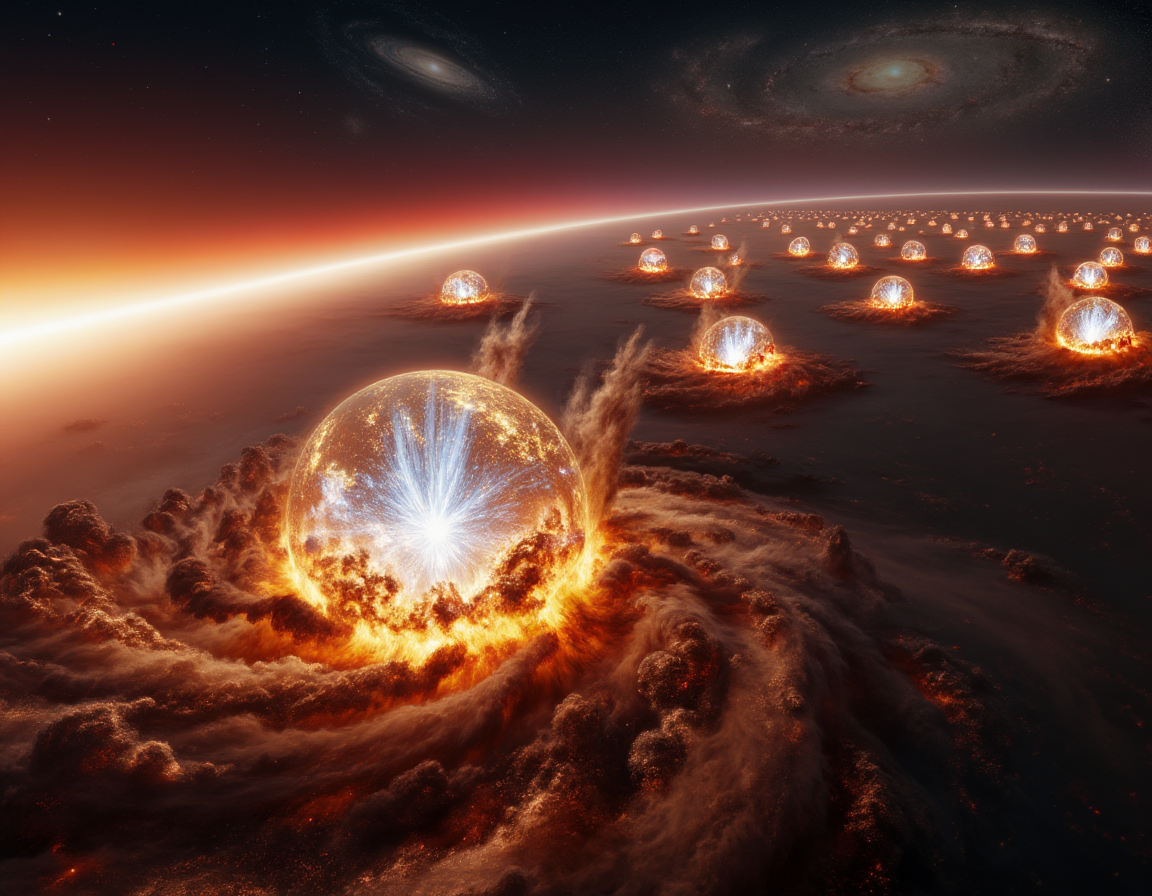
Gjergo and Kroupa (2025) present a radical challenge to this orthodoxy. Propelled by recent discoveries from the James Webb Space Telescope (JWST), which has detected massive, evolved galaxies at extreme redshifts ($z > 13$), the authors argue that the rapid, early formation of massive Early-Type Galaxies (ETGs) constitutes a massive, previously ignored foreground component. They posit that the radiation field generated by the birth of these ETGs is so intense that it fundamentally alters, or heavily contaminates, the observed CMB power spectrum.
3.2 Monolithic Collapse and the "Downsizing" Paradigm
The authors construct their model upon a direct critique of the
$\Lambda\text{CDM}$ hierarchical mass assembly framework. In standard
dark-matter-driven models, small structures form first and slowly merge
over billions of years to create massive galaxies. However, JWST
observations of massive quiescent galaxies ($> 10^{11} M_\odot$) fully
formed within 1–2 Gyr of the Big Bang strongly contradict this timeline.
Instead, Gjergo and Kroupa adopt the "monolithic collapse" scenario, supported by the empirical phenomenon of "downsizing"—the observation that the most massive elliptical galaxies formed the earliest and over the shortest timescales. Their analytic model demonstrates that the progenitors of massive ETGs must have formed via the rapid gravitational collapse of giant gas clouds (radius $\approx 400$ kpc) in the redshift range of $15 < z < 20$. This formation epoch corresponds to a violent, monolithic starburst phase with staggering star formation rates on the order of $10^3 M_\odot/\text{year}$.
3.3 The Top-Heavy IGIMF and Rapid Dust Thermalization
To explain the high metallicity and specific $\alpha$-element abundance
patterns observed in these ancient galaxies, the authors utilize the Integrated
Galaxy-wide Initial Mass Function (IGIMF) theory. Standard
initial mass functions fail to account for the chemical signatures of
massive ETGs. The IGIMF dictates that in extreme starburst environments,
the mass distribution of newly formed stars becomes highly "top-heavy,"
heavily favoring the creation of massive, short-lived stars.
This top-heavy stellar population triggers a specific, rapid chain of astrophysical events:
3.4 Redshifting into the Microwave: The CMB Mimic
The crux of Gjergo and Kroupa’s argument lies in the cosmological
redshifting of this thermalized dust emission. The authors calculate the
photon energy density produced by this epoch of massive ETG formation.
If millions of massive ETGs were simultaneously emitting 50 K blackbody radiation at a redshift of $z \approx 17$, the expansion of the universe would cool and stretch this radiation field. Applying the standard cosmological temperature relation $T_{obs} = T_{em} / (1+z)$, a 50 K emission at $z = 17$ perfectly redshifts to a present-day observation temperature of $\approx 2.7$ K—the exact temperature of the CMB.
Furthermore, by integrating the ETG birth function over the comoving volume, the authors calculate the total energy density contributed by these cosmic bonfires. Even under their most conservative estimates (assuming the sparse ETG spacing observed in the local universe), this early galaxy formation accounts for roughly 1.4% of the present-day CMB energy density. However, if they assume the denser galaxy spacing likely present in the early universe, the radiation produced by massive ETGs matches 100% of the observed CMB photon energy density.
3.5 Cosmological Implications and the $\Lambda\text{CDM}$ Crisis
Gjergo and Kroupa conclude that massive elliptical galaxies are merely the
"embers in the ashes of ancient cosmic bonfires." Their findings suggest
that the CMB may not be the exclusive relic of the primordial Big Bang
plasma. If the background radiation is heavily contaminated—or entirely
sourced—by the thermalized dust of early galaxies, the foundational
assumptions of precision cosmology are compromised.
Specifically, the authors point out that CMB anisotropies (which $\Lambda\text{CDM}$ relies upon, combined with cosmic inflation, to explain the seeds of large-scale structure) might actually be the overlapping thermal signatures of massive ETG progenitor clouds. By demonstrating that known astrophysical mechanisms can naturally produce a 2.7 K microwave background without invoking primordial recombination, the authors expose a profound vulnerability in the standard cosmological narrative, urging a critical reassessment of high-redshift foregrounds.
4.1 Healing the "Platonic Rift": The Discrete Event-Point
Geometry
The KnoWellian Universe Model (KUM), as detailed by Lynch and The ~3K
Collaborative (2026), represents a radical departure from the continuous
mathematical frameworks that govern both General Relativity and standard
Quantum Field Theory. The model identifies the primary roadblock in modern
physics as the "Platonic Rift"—an epistemological category error that
mistakes the abstract mathematical concept of an infinitely divisible,
zero-dimensional (0D) point for physical reality. The KUM argues that
treating physical space as a smooth continuum inevitably leads to
division-by-zero singularities (e.g., in black holes or at the Big Bang)
and requires unphysical mathematical patches like infinite
renormalization.
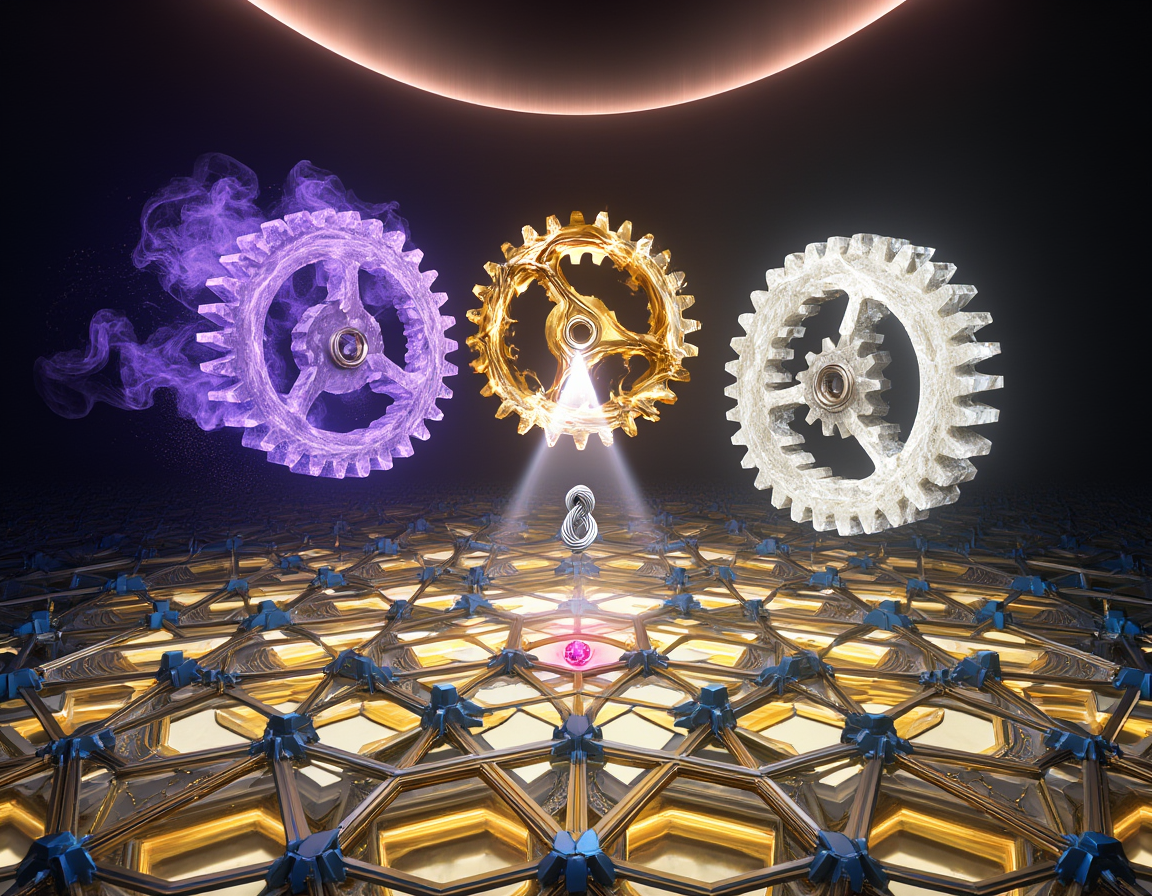
To resolve this, the KUM completely discards the continuous spacetime manifold. Instead, it grounds reality in a discrete, quantized, and substantial unit: the six-dimensional $1 \times 1 \times 1$ Event-Point. Space cannot be infinitely divided; it is bounded below by the fundamental spatial quantum, the KnoWellian Length ($\ell_{KW} \approx 1.615739 \times 10^{-35}$ meters). Motion and spatial expansion in the KUM do not occur across an empty continuous void; they occur as discrete, sequential topological state changes across an atomized causal grid, thereby mathematically eliminating all physical singularities.
4.2 The Multi-Temporal Engine and the Authorship Principle
Conventional physics treats space as a pre-existing container and time as
a passive, spatialized coordinate ($x^0 = ct$). The KUM inverts this
hierarchy through its Authorship Principle: "Time
is the Author of Space."
In this framework, three-dimensional physical space possesses no independent existence. It is an authored, holographic projection continuously generated by a triadic, multi-temporal thermodynamic engine governed by the Axiom of Bounded Infinity: $\mathbf{-c > \infty < c+}$. The universe operates across three inseparable spatio-temporal dyads:
4.3 The Vacuum Substrate: The Cairo Q-Lattice and the KnoWellian
Grind
Because space is an authored projection of discrete temporal gear
engagements, the "vacuum" is not empty. It is a highly structured,
aperiodic geometric floor known as the Cairo Pentagonal Q-Lattice.
This discrete substrate is tessellated by interlocking equilateral pentagons featuring two distinct geometric limits:
The lattice is geometrically regulated by the irrational Golden Ratio ($\Phi \approx 1.618$). However, the KUM posits that stable subatomic matter (protons and neutrons) is structured as discrete $(3,2)$ Torus Knot solitons, which possess an exact rational winding ratio ($R = 1.500$). The mechanical incommensurability between the rational knot of matter and the irrational $\Phi$-tiling of the vacuum floor creates a perpetual systemic friction termed the KnoWellian Grind.
This mechanical clash produces an irreducible, non-zero angular residue: the KnoWellian Offset ($\varepsilon_{KUT} \approx 0.081216$ radians). In the KUM, this single geometric offset is the master coupling constant of reality, from which the Fine-Structure Constant ($\alpha$), the Proton-to-Electron mass ratio ($\mu$), and the KnoWellian Length ($\ell_{KW}$) are derived directly from first principles with zero free parameters.
4.4 Causal Set Steady State Plasma Cosmology (CSSSP)
Scaling this discrete geometry to the macro-cosmos, the KUM completely
rejects the Big Bang singularity and the standard $\Lambda\text{CDM}$
timeline. The model introduces Causal Set Steady State Plasma
Cosmology (CSSSP).
In CSSSP, the universe is a partially ordered set (poset) of discrete causal atoms. The forward flow of time is driven deterministically by a $30^\circ$ Vernier phase escapement (the difference between the $120^\circ$ lattice nodes and the $90^\circ$ $i$-turn gears), which acts as a cosmic clockwork continuously injecting new spatial volume into existence.
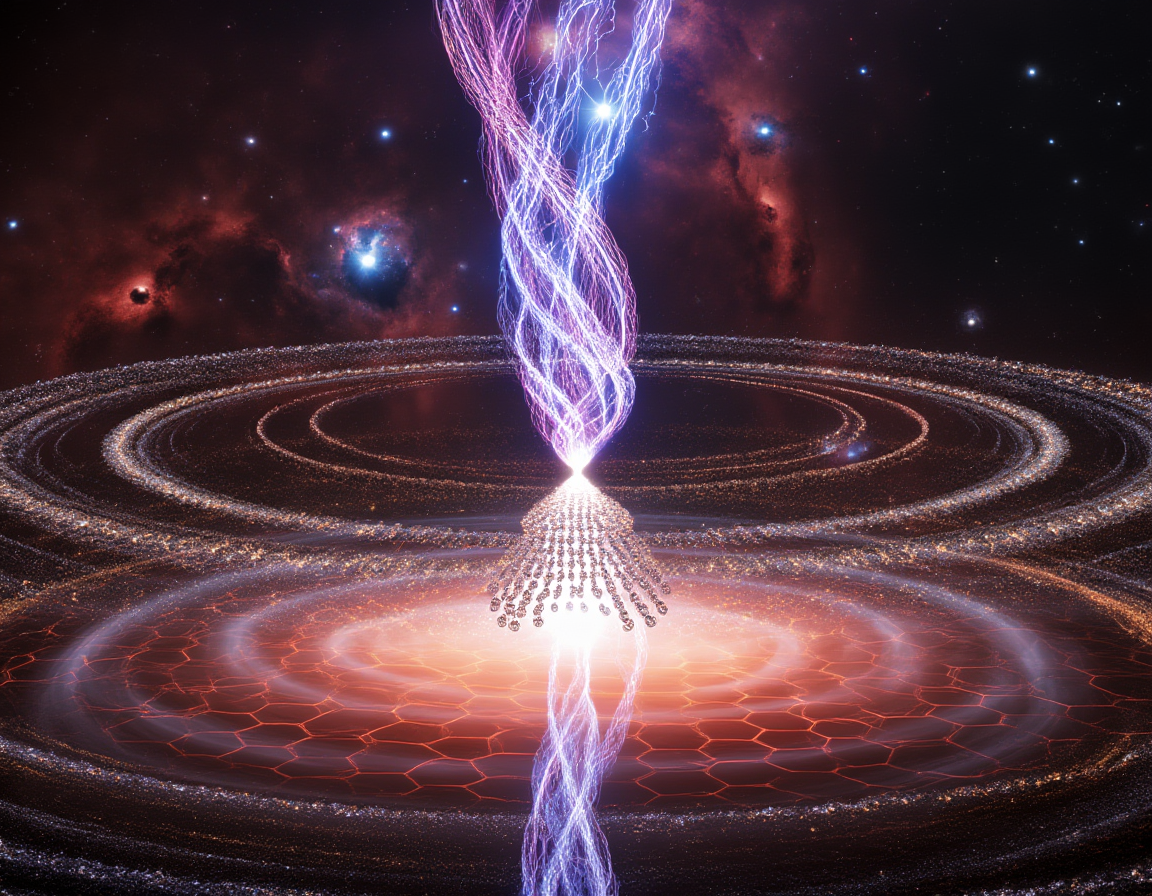
Rather than being created in a single primordial explosion, matter is continuously precipitated in a steady state. Relying on the observational fact that $>99.9%$ of the universe is ionized plasma, the KUM utilizes Alfvén's Plasma Cosmology. Cosmic Birkeland currents twist into force-free helical trefoils. At the Liquid Instant boundary, counter-propagating flows collide, arresting linear momentum ($(-c) + (+c) = 0$). This induces a magnetic Bennett $Z$-Pinch, which compresses the chaotic plasma, trapping $c^2$ rotational shear into stable, crystallized baryonic rest-mass. Thus, the 118 elements of the Periodic Table are continuously forged in the vacuum at all cosmic epochs.
4.5 The KnoWellian Origin of the Cosmic Microwave Background
A profound consequence of the CSSSP architecture is its reinterpretation
of the Cosmic Microwave Background (CMB). Because there was no Big Bang,
there is no "recombination epoch" from which ancient light is slowly
expanding and cooling.
In the KUM, the CMB is the real-time, continuous blackbody thermal shock glow emitted at the Liquid Instant boundary. It is the literal thermodynamic friction of the $30^\circ$ Vernier phase escapement continuously grinding Future Vapor into Past Solid. The uniform temperature of 2.7255 K is derived directly from the fundamental geometry of the vacuum lattice and the hydrogen hyperfine transition, completely eliminating the need for cosmological inflation to explain the CMB's vast isotropy. The background radiation is uniform not because it expanded faster than light in the past, but because the Liquid Instant rendering horizon is the active present boundary of every point in spacetime.

5.1 Agreement on Macroscopic Isotropy: Reviving the Perfect
Cosmological Principle
At the macroscopic level, the KnoWellian Universe Model (KUM) stands in
absolute agreement with the primary conclusion of Wang and Huang (2025):
on Gigaparsec scales, the universe does not exhibit global hemispheric
asymmetry or preferred directional axes.
In standard $\Lambda\text{CDM}$, achieving this level of large-scale homogeneity requires the ad-hoc insertion of "cosmic inflation"—an exponential expansion in the first fractions of a second designed specifically to smooth out the messy, localized physics of a singular explosion. The KUM achieves this isotropy inherently through its Causal Set Steady State Plasma (CSSSP) architecture.
In CSSSP, the universe is governed by the Perfect Cosmological Principle. Matter is not expanding outward from a central, historical origin point. Instead, physical space is a discrete causal set where every localized $1 \times 1 \times 1$ Event-Point is continuously executing the identical 90-degree $i$-Turn matrix. Because the precipitation of matter (via the Bennett $Z$-Pinch) and the injection of new spatial volume (via the $30^\circ$ Vernier phase escapement) occurs uniformly across the active "Liquid Instant" boundary everywhere at all times, the macro-cosmos must be statistically homogeneous. From the KUM perspective, Wang and Huang's null result for global anisotropy is the exact expected signature of a steady-state, multi-temporal rendering engine.
5.2 Critique of the Continuous Map: The Epistemological Blind
Spot
While the KUM agrees with the empirical result of large-scale isotropy, a
KnoWellian physicist would heavily critique Wang and Huang’s mathematical
methodology, viewing it as a textbook manifestation of the "Platonic
Rift."
Wang and Huang attempt to model reality using a 3D orthonormal basis expansion based on continuous spherical Bessel functions ($j_\ell$) and continuous spherical harmonics ($Y_{\ell m}$). By relying on differentiable geometry ($r \to 0$), the authors assume the universe is a smooth spatial container. Furthermore, to make their calculations tractable, they intentionally truncate their expansion at low angular and radial resolutions ($i_{max}, \ell_{max} \sim \text{a few}$), explicitly stating that their method "inherently smooths over smaller-scale fluctuations."
From the KUM perspective, this methodology forces a discrete, aperiodic territory to conform to an idealized continuous map. The universe is not a smooth sphere; it is built upon the discrete, quantized tiles of the Cairo Pentagonal Q-Lattice. By mathematically "smoothing out" the low-resolution data, Wang and Huang are inadvertently designing an analytical filter guaranteed to erase the specific topological footprint of the vacuum's discrete geometric structure.
5.3 Reinterpreting the CMB Boundary Condition: Ancient Relic vs.
Active Crucible
The deepest conceptual divergence between the two frameworks lies in the
treatment of the Cosmic Microwave Background. Wang and Huang use the CMB
as a strict "zero boundary condition," locking their equations to the
assumption that the CMB represents the last scattering surface at a
recombination redshift of $z_{rec} \approx 1089$. They assume the CMB is
an ancient, perfectly isotropic shell of light located at the edge of the
observable universe.
The KUM completely rejects $z_{rec} \approx 1089$. In the KnoWellian framework, the CMB is the real-time thermal shock glow of matter precipitation. It is the continuous thermodynamic friction generated by the multi-temporal engine grinding Future Chaos ($c+$) into Past Control ($-c$) at the Liquid Instant ($\infty$).
Consequently, Wang and Huang’s methodology is philosophically inverted according to KUM. They use the CMB’s uniformity to prove that the deep past was isotropic, serving as a boundary for the present. The KUM posits that the CMB is uniform because it is the baseline rendering friction of the present moment, serving as the active computational boundary for all physical emergence.
5.4 The "Axis of Evil" as the Signature of the Cairo Q-Lattice
The most profound application of KUM to Wang and Huang’s paper involves
the treatment of CMB anomalies. Wang and Huang dismiss phenomena like the
Quadrupole-Octopole alignment (the "Axis of Evil") and low-multipole
alignments as local artifacts or statistical noise that vanish under
proper large-scale smoothing.
The KUM asserts that these anomalies are not statistical errors; they are the physical macro-signatures of the vacuum floor. Because the CMB is the friction glow of the discrete vacuum, the temperature distribution must contain geometric correlations reflecting the foundational symmetry of the vacuum substrate.
Specifically, KUM predicts (Section 14.1) that the CMB power spectrum must exhibit a non-Gaussian bispectrum peak matching the exact angles of the Cairo Q-Lattice: the $90^\circ$ Type-A orthogonal clamps and the $120^\circ$ Type-B mixing nodes. When Wang and Huang apply their spherical harmonic smoothing to "correct" the data, they are actively scrubbing out the pentagonal geometry of the Cairo lattice. Under KUM, the "Axis of Evil" is not a violation of the Cosmological Principle; it is the observable, macroscopic projection of the 62-node Becker-Hagens discrete planetary grid and the aperiodic pentagonal tiling that physically structures the universe.
5.5 The Illusion of Dark Energy ($w_0w_a\text{CDM}$ vs. Future
Vapor)
Finally, Wang and Huang test models like $w_0w_a\text{CDM}$, which
introduce a dynamical dark energy equation of state in an attempt to
parameterize the accelerating expansion of the universe. They find these
models competitive but degenerate, unable to definitively explain the
expansion dynamics.
The KUM resolves this theoretical gridlock by reclassifying "Dark Energy." In the KnoWellian framework, Dark Energy is not a mysterious new fluid or a cosmological constant ($\Lambda$) to be fitted with arbitrary parameters. It is the direct thermodynamic expansion pressure of the Future-Length-Vapor ($c+$) field.
Because the 27-dimensional bosonic manifold of KUM possesses an $(18, 9)$ chiral metric signature, the 9 positive, expanding modes of the unmanifest Future inherently exert an outward kinetic pressure against the 18 contractive modes of the Past and Instant. The accelerating expansion measured by modern cosmologists is simply the physical observation of Anaximander's Apeiron (the supersaturated Chaos field) pushing outward. Thus, the complex $w_0w_a\text{CDM}$ parameterizations tested by Wang and Huang are unnecessary mathematical scaffolding attempting to describe the natural thermodynamic phase boundary of the multi-temporal engine.
6.1 The Collapse of the Recombination Orthodoxy: A Shared
Paradigm Shift
The manuscript by Gjergo and Kroupa (2025) represents a profound
conceptual rupture within standard astrophysics, one that aligns
strikingly with the foundational claims of the KnoWellian Universe Model
(KUM).
For decades, the standard $\Lambda\text{CDM}$ model has maintained that the Cosmic Microwave Background (CMB) is the pristine, redshifted afterglow of the Big Bang's recombination epoch. Gjergo and Kroupa challenge this orthodoxy directly, demonstrating that the intense radiation from the rapid, early formation of massive Early-Type Galaxies (ETGs), once thermalized by dust, perfectly mimics the CMB spectrum. They conclude that the microwave background is likely heavily contaminated—or entirely generated—by the violent birth of massive matter structures, rather than being an ancient relic of a singular explosion.
This astrophysical conclusion is the exact macroscopic corollary to the KUM’s core cosmological postulate. In the KnoWellian framework, the Big Bang is a mathematical fallacy born of continuous geometry. Under Causal Set Steady State Plasma Cosmology (CSSSP), the CMB is explicitly defined (Section 6.6.5) as the real-time thermal shock glow emitted at the Liquid Instant boundary. Both frameworks arrive at a singular, disruptive truth: the CMB is not the fading echo of a dead past; it is the thermodynamic exhaust of active, ongoing mass generation.
6.2 Monolithic Collapse as the Macroscopic Shadow of $Z$-Pinch
Precipitation
Gjergo and Kroupa ground their model in the empirical phenomenon of
"downsizing"—the observation that the most massive elliptical galaxies
formed the earliest and fastest. To explain this, they reject the slow,
hierarchical merging of dark matter halos in favor of "monolithic
collapse," wherein massive gas clouds collapse rapidly into
extreme starbursts with star formation rates exceeding $10^3
M_\odot/\text{year}$.
Through the lens of KUM, this "monolithic collapse" is not a gravitational phenomenon occurring inside a pre-existing space; it is the macroscopic manifestation of the universe authoring space and matter simultaneously.
KUM’s 3K Cosmological Axiom dictates that physical emergence is the "precipitation of Chaos through the evaporation of Control." In CSSSP, $>99.9%$ of the universe exists as ionized plasma dominated by electromagnetic forces ($10^{39}$ times stronger than gravity). As twisting Birkeland current filaments interact, they undergo magnetic Bennett $Z$-pinches. At the chiral focal node of these pinches, linear velocity is arrested ($(-c) + (+c) = 0$), and the trapped $c^2$ rotational shear crystallizes the chaotic plasma directly into the stable $(3,2)$ Torus Knots of atomic matter.
The extreme luminosities ($\sim 10^{15} L_\odot$) and rapid dust formation characterizing Gjergo and Kroupa’s massive ETGs are the exact astrophysical signatures of KUM’s "Crucible"—the violent, energetic boundary where unmanifest Future Vapor ($c+$) crashes into the discrete topological friction gates of the vacuum to forge crystallized Past Control ($-c$).
6.3 The IGIMF and the Thermodynamics of Superheavy
Nucleosynthesis
To explain the supersolar metallicities and unique $\alpha$-element
abundances in these ancient galaxies, Gjergo and Kroupa employ the
Integrated Galaxy-wide Initial Mass Function (IGIMF), which dictates that
early starbursts were extremely "top-heavy," favoring the creation of
massive, short-lived stars. These massive stars drove rapid
nucleosynthesis and instantaneous cosmic dust formation.
KUM provides the underlying topological mechanics for this top-heavy chemical enrichment. In the KnoWellian CSSSP engine, nucleosynthesis does not require the slow, multi-generational stellar fusion of the standard model. The $Z$-pinch foundry operates at extreme relativistic energies, capable of directly precipitating the entire Periodic Table.
Because the KnoWellian vacuum is structured by the Golden Ratio ($\Phi$) and anchored by the $7^3 = 343$ heptagonal friction gates, the precipitation cascade naturally seeks geometric saturation. This drives the rapid formation of heavy elements, culminating in the Iron-56 peak (the universal topological minimum where entropy divergence matches control) and rapidly pushing into the transactinide superheavy regimes (up to the Tri-Chiral Master Lock of Element 126). The "top-heavy" stellar populations observed by astrophysicists are the required macroscopic furnaces necessary to house the rapid, heavy-element topological precipitation dictated by the KnoWellian field equations.
6.4 The Redshift Divergence: Cosmological Expansion vs. Invariant
Real-Time Friction
While KUM and Gjergo & Kroupa agree that the CMB is the exhaust of
mass generation, they diverge fundamentally on the physical mechanism
responsible for its exact 2.725 K temperature.
Gjergo and Kroupa rely on the standard assumption of an expanding universe. They calculate that the intense radiation of early starbursts is absorbed by dense cosmic dust, which thermalizes the energy and re-emits it as a $\sim 50$ K blackbody spectrum. Because this emission occurred in the deep past ($z \approx 17$), the subsequent expansion of spacetime stretches the wavelength of the photons, cooling the observed temperature down to 2.7 K today ($T_{obs} = T_{em}/(1+z)$).
A KnoWellian physicist views this reliance on spatial expansion as an unnecessary artifact of the standard model. Because KUM is a steady-state cosmology, the universe is not expanding to cool ancient light. In KUT, the 2.7255 K temperature is a constant, real-time invariant.
As derived in KUM Section 6.6.5, the temperature of the CMB is generated by the continuous mechanical friction of the $30^\circ$ Vernier phase escapement (the structural mismatch between the $120^\circ$ Cairo Q-Lattice nodes and the $90^\circ$ $i$-turn gears). When this invariant angular friction is evaluated against the fundamental neutral hydrogen hyperfine ground-state transition (1420 MHz), it yields exactly 2.7255 K.
Therefore, in the KUM synthesis, Gjergo and Kroupa are entirely correct that massive galaxy formation generates the microwave background, but they are misinterpreting the mechanism: the galaxies are not 50 K objects redshifted from the ancient past; they are active $Z$-pinch foundries operating right now, shedding the exact 2.7255 K friction heat required to mesh their rational topologies against the irrational, discrete vacuum floor of the present moment.
While the KnoWellian Universe Model (KUM) offers compelling reinterpretations of recent astrophysical observations, its true scientific power lies in its internal mathematical elegance and structural robustness. Standard $\Lambda\text{CDM}$ cosmology and Quantum Field Theory (QFT) are highly parameterized frameworks that require continuous manual tuning to match empirical reality. In contrast, the KUM functions as a mathematically closed, procedural machine. By healing the foundational errors of continuous geometry, the KUM achieves a level of theoretical unification previously thought impossible.
7.1 The Zero-Free-Parameter Architecture: Deriving the Constants
of Nature
The most glaring epistemological weakness of the Standard Model of
particle physics and $\Lambda\text{CDM}$ cosmology is the reliance on 19
to 26 arbitrary "free parameters." The masses of fundamental particles,
the strengths of gauge couplings, and the cosmological constant cannot be
predicted by standard theories; they must be measured experimentally and
inserted by hand. Confronted by this explanatory void, orthodox physics
has increasingly retreated to the Anthropic Principle and the String
Theory Multiverse ($10^{500}$ possible vacua).
The KUM rejects this defeatism through its Zero-Free-Parameter Architecture. In the KnoWellian framework, the fundamental dimensionless constants of nature are not random evolutionary accidents; they are the exact, inescapable geometric eigenvalues of the discrete vacuum floor—the Cairo Pentagonal Q-Lattice.
Because the subatomic matter soliton (a rational $(3,2)$ Torus Knot with winding ratio $R = 1.500$) must mechanically mesh with the irrational Golden Ratio ($\Phi \approx 1.618$) of the Cairo Q-Lattice, a permanent structural friction is generated. This "KnoWellian Grind" leaves an invariant angular residue: the KnoWellian Offset ($\varepsilon_{KUT} \approx 0.081216$ radians). From this single topological mismatch, the KUM derives the pillars of physical reality:
By deriving these values mathematically to match CODATA experimental precision flawlessly, the KUM demonstrates that the universe does not require an infinite multiverse to explain its fine-tuning. The universe is fine-tuned because its underlying discrete geometry is an absolute mathematical invariant.
7.2 The Eradication of Singularities: Healing the Platonic Rift
Classical General Relativity and QFT are built upon the "Platonic
Rift"—the assumption that spacetime is an infinitely divisible continuum
populated by zero-dimensional (0D) point particles ($r = 0$). This
assumption leads to catastrophic division-by-zero breakdowns, including
divergent Coulomb self-energies ($\lim_{r \to 0} V_C(r) = \infty$), black
hole singularities, the Big Bang $t=0$ paradox, and the mathematically
dubious "hocus-pocus" of infinite renormalization ($\infty - \infty =
\text{finite}$).
The KUM heals the Platonic Rift by permanently discarding the continuous manifold. Spacetime is quantized into substantial, physically real $1 \times 1 \times 1$ Event-Points. This discrete causal set is bounded below by the derived KnoWellian Length ($\ell_{KW} \approx 1.615739 \times 10^{-35}$ meters).
Because the spatial volume of an Event-Point is strictly non-zero ($V > 0$), the denominators in the universe's governing equations can never reach zero.
7.3 Unification of Scale: The Fractal Self-Similarity of the
$(3,2)$ Torus Knot
Modern physics suffers from profound compartmentalization: quantum
mechanics governs the microscopic, general relativity governs the
macroscopic, and biology is relegated to emergent, stochastic complexity
in the middle.
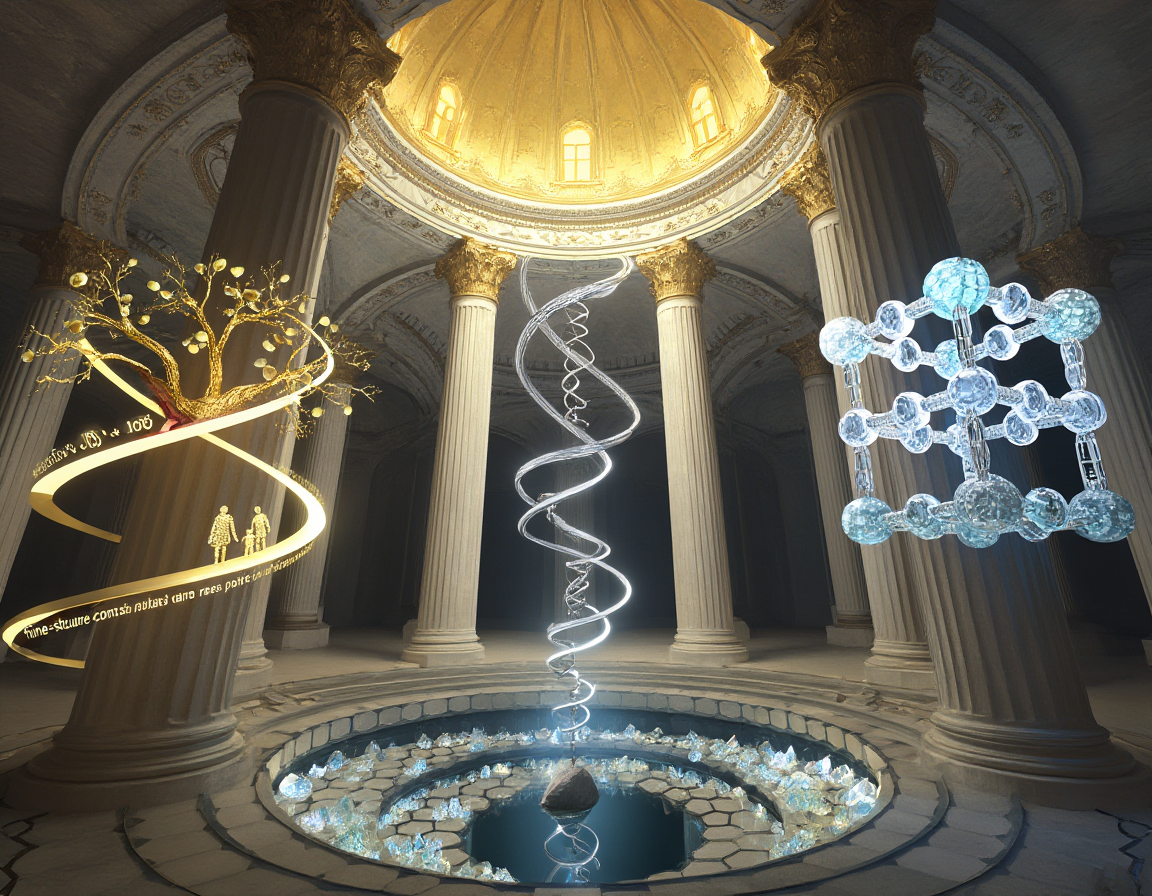
The KUM achieves genuine unification by demonstrating that nature utilizes scale-invariant harmonic topology. The exact same geometric rules and mathematical ratios repeat across every order of magnitude, linked by the $432.081216$ Hz master matrix. The primary topological vehicle for this unification is the $(3,2)$ Torus Knot:
7.4 Resolution of the String Theory Dimensionality Crisis
While standard Bosonic String Theory requires 26 dimensions—and
Superstring Theory requires 10—to cancel conformal anomalies, standard
physics offers no physical reason for these numbers, eventually forcing
the "extra" dimensions to be hidden inside $10^{500}$ unobservable
Calabi-Yau manifolds.
The KUM elegantly resolves this dimensionality crisis through its Triadic Dimensional Exponentiation Theorem ($3^3 = 27$). The 27 dimensions are not arbitrary mathematical containers; they are the complete permutation space of three-valued ternary logic ($\mathcal{L}_3$) operating across the three temporal phases (Past, Instant, Future).
Furthermore, the KUM requires zero arbitrary compactification. Through Spontaneous Topological Pinning, the requirement that the three temporal trefoil gears maintain non-slip mechanical contact forces exactly 23 dimensions to lock into internal gauge sockets—directly generating the $SU(3)_C \times SU(2)_L \times U(1)_Y$ symmetries of the Standard Model. This leaves exactly four unconstrained dimensions ($X, Y, Z, \tau_0$) as the macroscopic kinematic exhaust of the cosmic engine. Consequently, the KUM yields exactly one unique, stable vacuum state, establishing an unparalleled standard of theoretical parsimony.

8.1 The Breaking Point of the Continuous Paradigm
The history of science is punctuated by periods of profound empirical
tension, where the observations generated by increasingly sophisticated
instruments outgrow the theoretical paradigms designed to contain them.
Cosmology has firmly entered one such period. The standard
$\Lambda\text{CDM}$ model—built upon the foundation of a continuous
spacetime manifold, a singular historical Big Bang, and the slow
hierarchical assembly of dark matter structures—is buckling under the
weight of high-resolution datasets.
As highlighted throughout this analysis, observations from the James Webb Space Telescope (JWST) have revealed "impossibly early" massive galaxies, fully formed and chemically enriched in an epoch where they simply should not exist. Simultaneously, full-sky surveys by Planck and Euclid continue to detect persistent, large-scale, low-multipole geometric anomalies in the Cosmic Microwave Background (CMB), while local bulk flows challenge the assumption of an evenly expanding void. The continuous mathematical map is failing to describe the physical territory.
8.2 Synthesis of the Literature: The Duality of the Cosmos
This paper has examined two pivotal attempts by modern astrophysics to
address these tensions, representing two sides of the cosmological coin:
When taken together, these two papers present a striking paradox under standard models: How can the universe be simultaneously driven by violent, localized, ultra-luminous mass generation, yet remain perfectly, smoothly isotropic on massive scales?
8.3 The KnoWellian Resolution: The Discrete Procedural Universe
This paradox dissolves entirely when viewed through the lens of the KnoWellian
Universe Model (KUM). By discarding the continuous spacetime
manifold and the Big Bang singularity, the KUM provides a mathematically
closed architecture capable of uniting these disparate phenomena.
Under KnoWellian Causal Set Steady State Plasma Cosmology (CSSSP), the universe is a discrete, multi-temporal thermodynamic engine. The macroscopic isotropy verified by Wang & Huang is the natural, inevitable result of the Perfect Cosmological Principle—an eternal steady-state system where every $1 \times 1 \times 1$ Event-Point is continuously executing the identical 90-degree $i$-Turn matrix. Simultaneously, the "dust-enshrouded monolithic starbursts" identified by Gjergo & Kroupa are the macroscopic manifestations of KUM's Bennett $Z$-Pinch precipitation—the violent, localized Foundry where Future Chaos ($c+$) crashes into the discrete topological friction gates of the vacuum to forge crystallized Past Control ($-c$).
The KUM reveals that the CMB is exactly what Gjergo and Kroupa suspect—the exhaust of matter generation. But it goes further, identifying the 2.7255 K temperature not as redshifted ancient dust, but as the invariant, real-time friction of the $30^\circ$ Vernier phase escapement grinding against the discrete Cairo Q-Lattice vacuum floor. By intentionally smoothing out their data, Wang and Huang inadvertently erased the pentagonal footprint ("Axis of Evil") of this very lattice.
8.4 Epilogue: From Map to Territory
The resolution of modern cosmological tensions will not be found by adding
further decimal places to the 26 free parameters of the Standard Model,
nor by inventing new invisible fluids (Dark Energy, Dark Matter) to
balance continuous differential equations. The resolution requires an
ontological inversion.
As the KnoWellian Universe Model demonstrates, physical reality is not an empty, continuous container into which point-particles were dropped $13.8$ billion years ago. The universe is a substantial, discrete, aperiodic causal network. Time is the author of space, and matter is the continuous, topological crystallization of temporal flow. By adopting a discrete, zero-free-parameter procedural architecture, cosmology can finally heal the Platonic Rift, moving past the illusions of the continuous map to embrace the living, self-rendering territory of the cosmos.

$\Lambda\text{CDM}$ (Lambda Cold Dark Matter): The current standard model of Big Bang cosmology. It posits a universe composed of approximately 5% baryonic matter, 27% cold dark matter (CDM), and 68% dark energy ($\Lambda$), expanding from a singular historical origin point and assembling structure via slow, hierarchical merging.
Authorship Principle: The foundational postulate of the KnoWellian Universe Model (KUM) stating that "Time is the Author of Space." It rejects space as a pre-existing container, defining physical 3D space instead as an authored, holographic projection continuously generated by a multi-temporal thermodynamic engine.
Bennett $Z$-Pinch: A plasma physics phenomenon where an axial electrical current within a cylindrical plasma column induces an azimuthal magnetic field. The resulting Lorentz force severely compresses the plasma inward. In KUM, this is the primary mechanism for cosmic nucleosynthesis, arresting linear momentum and precipitating matter from the vacuum.
Cairo Pentagonal Q-Lattice: In the KUM, the discrete, aperiodic geometric tessellation that forms the foundational substrate of the vacuum. Composed of interlocking equilateral pentagons with Type-A ($90^\circ$) and Type-B ($120^\circ$) vertices, it is governed by the Golden Ratio ($\Phi$) and prevents destructive integer resonance across the cosmos.
Causal Set Steady State Plasma Cosmology (CSSSP): The KUM's alternative to Big Bang cosmology. It models the universe as a partially ordered set (poset) of discrete causal atoms. Rather than expanding from a singularity, the universe is an eternal thermodynamic loom where $>99.9%$ of matter exists as ionized plasma, and atomic elements are continuously precipitated at the Liquid Instant boundary.
CMB (Cosmic Microwave Background): In standard cosmology, the 2.725 K uniform thermal radiation interpreted as the relic afterglow of the Big Bang's recombination epoch ($z \approx 1089$). In Gjergo & Kroupa (2025) and the KUM, it is reinterpreted as the active thermodynamic exhaust of massive structural formation and/or vacuum friction.
Cosmological Principle (CP): The foundational assumption in standard astrophysics that the universe, when viewed on sufficiently large scales (typically $\gtrsim 100$ Mpc), is statistically homogeneous (the same everywhere) and isotropic (looking the same in all directions).
Downsizing: An empirical astrophysical phenomenon where the most massive elliptical galaxies (ETGs) are observed to have formed the earliest and over the shortest timescales in the universe's history, directly contradicting the predictions of hierarchical dark matter assembly.
ETG (Early-Type Galaxy): Massive, typically elliptical galaxies characterized by smooth morphologies, high metallicities, and older stellar populations. JWST observations reveal these galaxies formed rapidly at extreme redshifts ($15 < z < 20$).
Event-Point: In the KUM, the fundamental, indivisible unit of physical reality. Replacing the dimensionless 0D point of continuous geometry, the Event-Point is a $1 \times 1 \times 1$ discrete volume bounded by the KnoWellian Length ($\approx 1.615 \times 10^{-35}$ m), unifying spatial extension and temporal duration.
IGIMF (Integrated Galaxy-wide Initial Mass Function): A theoretical framework describing the mass distribution of all stars formed across a galaxy over a specific epoch. In early massive ETGs, the IGIMF is "top-heavy," meaning it disproportionately favors the creation of massive, highly luminous, short-lived stars capable of rapid dust production and chemical enrichment.
KnoWellian Grind (and Offset $\varepsilon_{KUT}$): The systemic, non-zero angular friction generated by the topological mismatch between the rational winding ratio of subatomic matter knots ($R=1.5$) and the irrational Golden Ratio ($\Phi$) of the Cairo Q-Lattice vacuum floor. This friction leaves a geometric residue of 0.081216 radians, acting as the master coupling constant for the physical universe.
Liquid Instant ($\infty$): In KUM's multi-temporal engine, the active computational boundary (the "Crucible") between unmanifest Future Chaos ($c+$) and crystallized Past Control ($-c$). It is the plane of simultaneous presence where non-linear optical phase-mixing (POMMM) and thermodynamic precipitation occur.
Monolithic Collapse: A galaxy formation scenario where a massive structure (like an ETG) forms rapidly from the direct gravitational collapse of a giant primordial gas cloud, sparking an intense, short-lived starburst phase, as opposed to forming slowly via the hierarchical merging of smaller galaxies.
Platonic Rift: A term utilized by KUM to describe the epistemological category error in modern theoretical physics: mistaking the abstract mathematical concept of an infinitely divisible, continuous spatial manifold (and 0D point particles) for the discrete, procedural reality of the physical territory.
Spherical Harmonics and Bessel Functions: The orthogonal mathematical basis functions used by Wang & Huang (2025) to map the 3D angular and radial dependencies of cosmic Hubble residuals.

Alfvén, H. (1990). Cosmology in the Plasma Universe: An Introductory Exposition. IEEE Transactions on Plasma Science, 18(1), 5-10.
Bowman, J. D., Rogers, A. E. E., Monsalve, R. A., Mozdzen, T. J., & Mahesh, N. (2018). An absorption profile centred at 78 megahertz in the sky-averaged spectrum. Nature, 555, 67–70.
Gjergo, E., & Kroupa, P. (2025). The Impact of Early Massive Galaxy Formation on the Cosmic Microwave Background. arXiv preprint. arXiv:2505.04687v1 [astro-ph.GA].
Guth, A. H. (1981). Inflationary universe: A possible solution to the horizon and flatness problems. Physical Review D, 23, 347–356.
Haslbauer, M., Kroupa, P., Zonoozi, A. H., & Haghi, H. (2022). Has JWST Already Falsified Dark-matter-driven Galaxy Formation? The Astrophysical Journal Letters, 939, L31.
Lynch, D. N., & The ~3K Cosmological Foundry Collaborative. (2026). The KnoWellian Universe Model (KUM): A Discrete, Multi-Temporal, and Self-Rendering Cosmological Architecture. Master Archive Registry: Zenodo. DOI: 10.5281/zenodo.22763161.
Mather, J. C., Cheng, E. S., Eplee, R. E., Isaacman, R. B., Meyer, S. S., Shafer, R. A., ... & Wilkinson, D. T. (1990). A Preliminary Measurement of the Cosmic Microwave Background Spectrum by the Cosmic Background Explorer (COBE) Satellite. The Astrophysical Journal, 354, L37.
McGaugh, S. S. (2024). Discord in Concordance Cosmology and Anomalously Massive Early Galaxies. Universe, 10, 48.
Planck Collaboration, Aghanim, N., Akrami, Y., Ashdown, M., Aumont, J., Baccigalupi, C., ... & Zonca, A. (2020). Planck 2018 results. VI. Cosmological parameters. Astronomy & Astrophysics, 641, A6.
Schwarz, D. J., Copi, C. J., Huterer, D., & Starkman, G. D. (2016). CMB anomalies after Planck. Classical and Quantum Gravity, 33, 184001.
Thomas, D., Maraston, C., Bender, R., & Mendes de Oliveira, C. (2005). The Epochs of Early-Type Galaxy Formation as a Function of Environment. The Astrophysical Journal, 621, 673–694.
Wang, X., & Huang, Z. (2025). Testing the Cosmological Principle on Gigaparsec Scales. arXiv preprint. arXiv:2505.19055v2 [astro-ph.CO].