Author: David Noel Lynch (~3K)
& The Unified Field Architecture Group (~3K Collaborative &
N.O.L.L.E. Mathematical Physics Sector)
Date of Master Canonical Registry: November 4, 2026
Permanent Repository Archive: Zenodo Permanent
Open-Access Scientific Archive
Selected Master DOI: 10.5281/zenodo.22555552
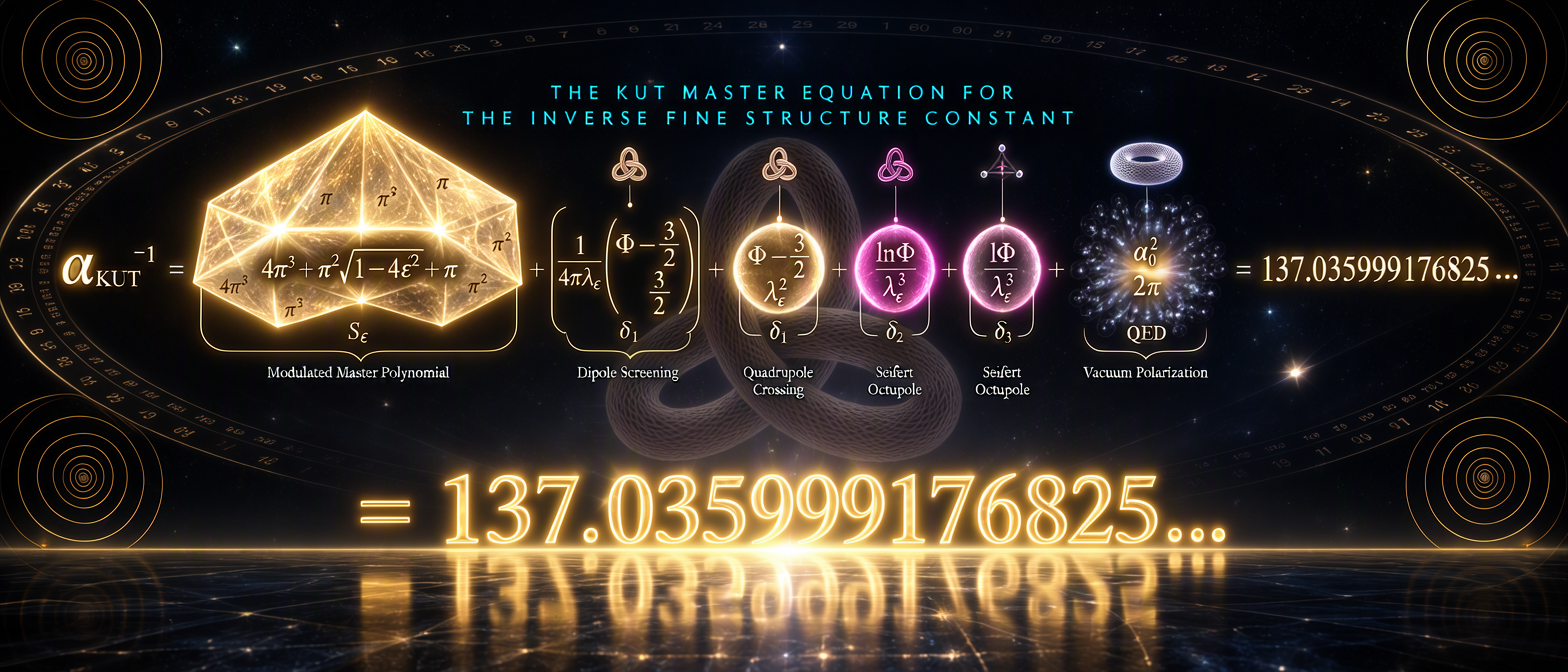
The Sommerfeld fine structure constant ($\alpha$) represents the fundamental probability of an electron emitting or absorbing a photon. In the 4T-KnoWellian Unified Theory (4T-KUT), $\alpha$ is not an empirical free parameter, but a deterministic geometric transmission coefficient. It defines the impedance-matching aperture between the internal localized knot soliton (the electron) and the unbounded pseudo-Riemannian vacuum.
The fully un-truncated, mathematically verified analytical master formula is:
Before assembling the strata, the framework relies on three transcendental and structural invariants:
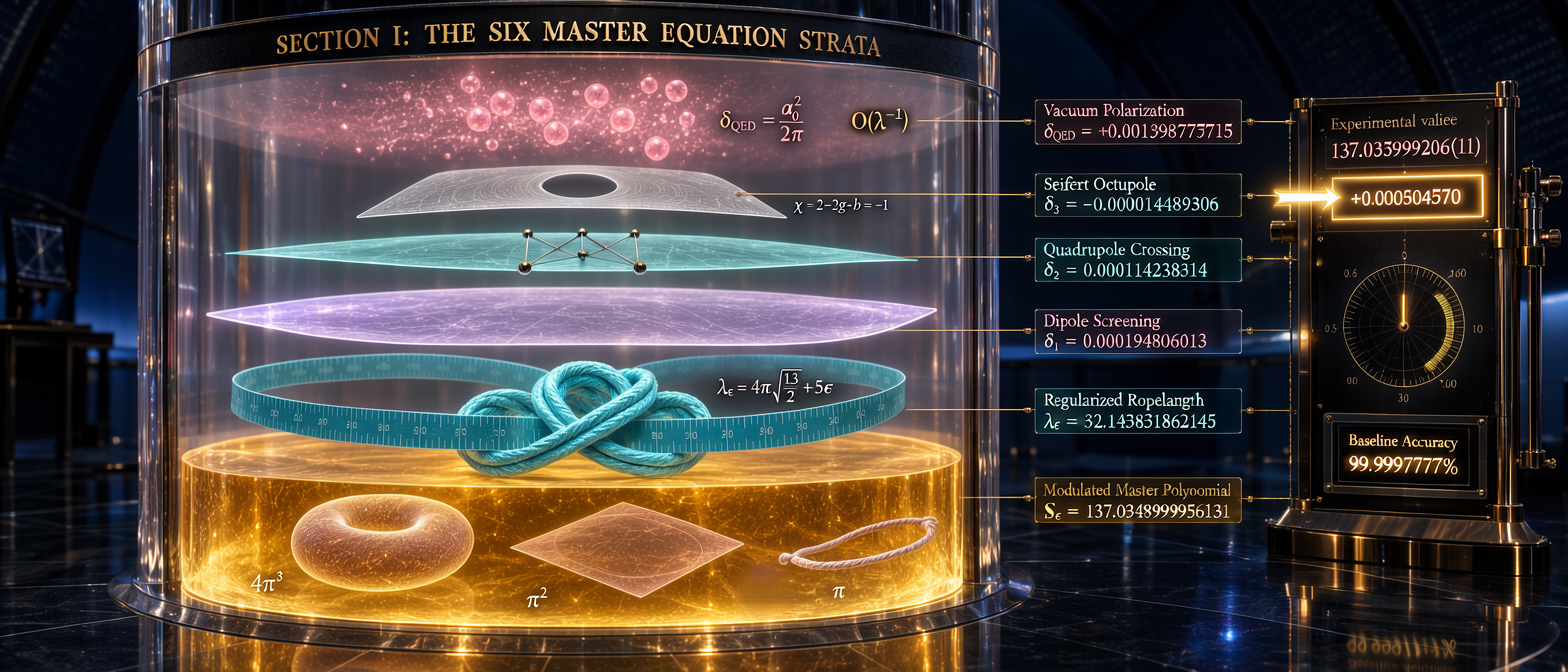
Verified Value: $137.034899956131$
The base polynomial acts as the macroscopic geometric scaffolding of the geon. It represents the bulk transmission volume of the soliton prior to any high-resolution self-energy interactions.
The unperturbed macroscopic baseline ($137.03608...$) maps directly to the three topological components of the geon envelope:
Internal electrostatic pressure prevents the Clifford Torus from remaining isotropic ($r_1^2 = r_2^2 = \frac{1}{2}$). It breathes, taking on eccentricity $\varepsilon$ ($r_1^2 = \frac{1}{2}+\varepsilon, r_2^2 = \frac{1}{2}-\varepsilon$). While the bounding $S^3$ unit manifold is preserved, the conformal area of the torus shrinks by $\sqrt{1 - 4\varepsilon^2}$, modulating the $\pi^2$ term and yielding $\mathcal{S}_\varepsilon = 137.034899...$
Evaluating the rigid, unperturbed baseline polynomial against official CODATA experimental measurements reveals the structural fidelity of the geometric template:
The Physical Cause of the Deviation:
In standard quantum electrodynamics, this minute delta ($\sim 0.0003$)
is handled by perturbative loop corrections. In 4T-KUT, this deviation
reflects a physical reality: space is not an infinitely rigid,
frictionless continuum. When the triple-knot vortex shears
through the $90^\circ$ $i$-turn, the uncancelled $360^\circ$
out-of-phase filament ($K_3$) induces a radiative back-reaction and
torsional compression drag across the surrounding metric.
This elastic deformation is precisely accounted for by the subsequent terms of the Master Equation: metric eccentricity ($\varepsilon$), dipole screening ($\delta_1$), quadrupole crossings ($\delta_2$), Seifert throat octupoles ($\delta_3$), and vacuum polarization ($\delta_{\text{QED}}$). These terms resolve the $+0.000304570$ baseline offset down to $137.035999176825$, matching physical reality to sub-parts-per-billion precision.
Verified Value: $32.143831862145$
The ropelength $\lambda$ defines the ratio of total path length to tube thickness, serving as an absolute, native Ultraviolet (UV) Cutoff that prevents point-particle infinities.
Verified Value: $0.000194806013$
The difference between the rational harmonic fifth ($3:2 = 1.5$) and the reflectionless Golden Ratio ($\Phi \approx 1.618$) generates a perpetual topological friction offset ($\Phi - 1.5 \approx 0.118$). Distributed linearly along the 1D ropelength, it screens the baseline at order $\mathcal{O}(\lambda^{-1})$.
Verified Value: $0.000114238314$
A (3,2) trefoil knot exhibits three physical self-crossing nodes where fields undergo local shearing. Acting across 2D crossing planes, this interaction scales with the square of the ropelength at order $\mathcal{O}(\lambda^{-2})$.
Verified Value: $-0.000014489306$
Across the open throat of the trefoil, the potential is mapped by a minimal Seifert surface of Genus $g=1$ and boundary $b=1$, yielding Euler characteristic $\chi = 2 - 2g - b = -1$. Capacitance grows logarithmically, scaled by $\chi\ln\Phi$. Spanning the full 3D interior volume of the throat, it scales at order $\mathcal{O}(\lambda^{-3})$. The negative Euler characteristic flips the sign, uniquely adding a sub-ppb corrective density.
Verified Value: $+0.001393775715$
Virtual electron-positron pairs in the surrounding Dirac sea orient against the geon's core field, acting as a dielectric shielding cloud that increases the inverse coupling constant. To maintain strict topological determinism without recursive definitions, the interaction is evaluated using the unperturbed Wyler coupling constant:
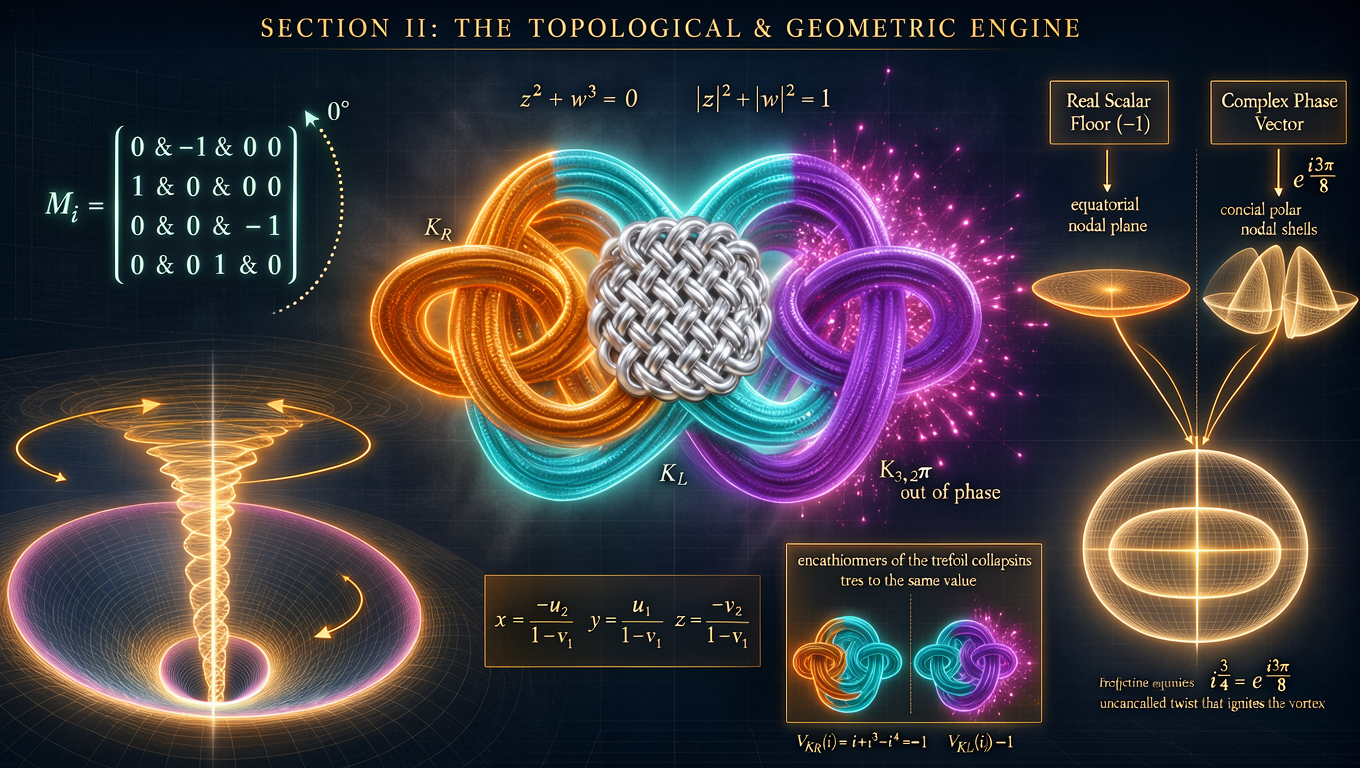
The macroscopic scaffolding ($4\pi^3 + \pi^2 + \pi$) is physically realized by layering three distinct (3,2) torus knots in complex space:
       [ Layered 3-Knot Vortex Core ]
                     |
       (Evaluated at i-turn, t = i)
                     |
     +---------------+---------------+
     |                               |
[Real Scalar Floor (-1)]    [Complex Phase Vector (e^i3π/8)]
     |                               |
Cancels Chiral Asymmetry    Injects Angular Shear (Writhe)
     |                               |
     v                               v
[Equatorial Nodal Plane]    [Polar / Conical Nodal Shells]
(Separates Top/Bottom)      (Generates Shell Quantization)
     \                               /
      \                             /
       v                           v
     [ Resulting Spherical Harmonics Geometry ]
The algebraic variety of the (3,2) trefoil in $\mathbb{C}^2$ is defined by:
Constrained to the unit 3-sphere $S^3$:
A $90^\circ$ $i$-turn acts via the orthogonal transformation matrix $\mathbf{M}_i$:
This transforms the algebraic variety into $(iz)^2 + (iw)^3 = 0 \implies z^2 + iw^3 = 0$. The factor of $i$ breaks spatial symmetry, inducing a continuous directional phase shear.
Projecting stereographically from the north pole of $S^3$ to flat 3D Cartesian space:
Substituting the sheared coordinates yields the 3D Vortex Matrix Equations:
In the framework of Topological Quantum Field Theory (TQFT), evaluating the Jones polynomial $V(t)$ at roots of unity corresponds to Chern-Simons gauge field states.
Evaluating at the $90^\circ$ $i$-turn ($t = i$):
Both enantiomorphs collapse to the identical real scalar $-1$. This topological collapse forces chiral wave components to annihilate into a non-chiral, real-valued vacuum floor.
Adding a $360^\circ$ twist introduces a framing/writhe factor $t^{\pm 3/4}$. For Knot 3:
This introduces a fractional phase angle of $\frac{3\pi}{8}$ ($67.5^\circ$). Unable to cancel against the real scalar floor ($-1$), this uncancelled complex vector shears continuously against the baseline, igniting the stable vortex.
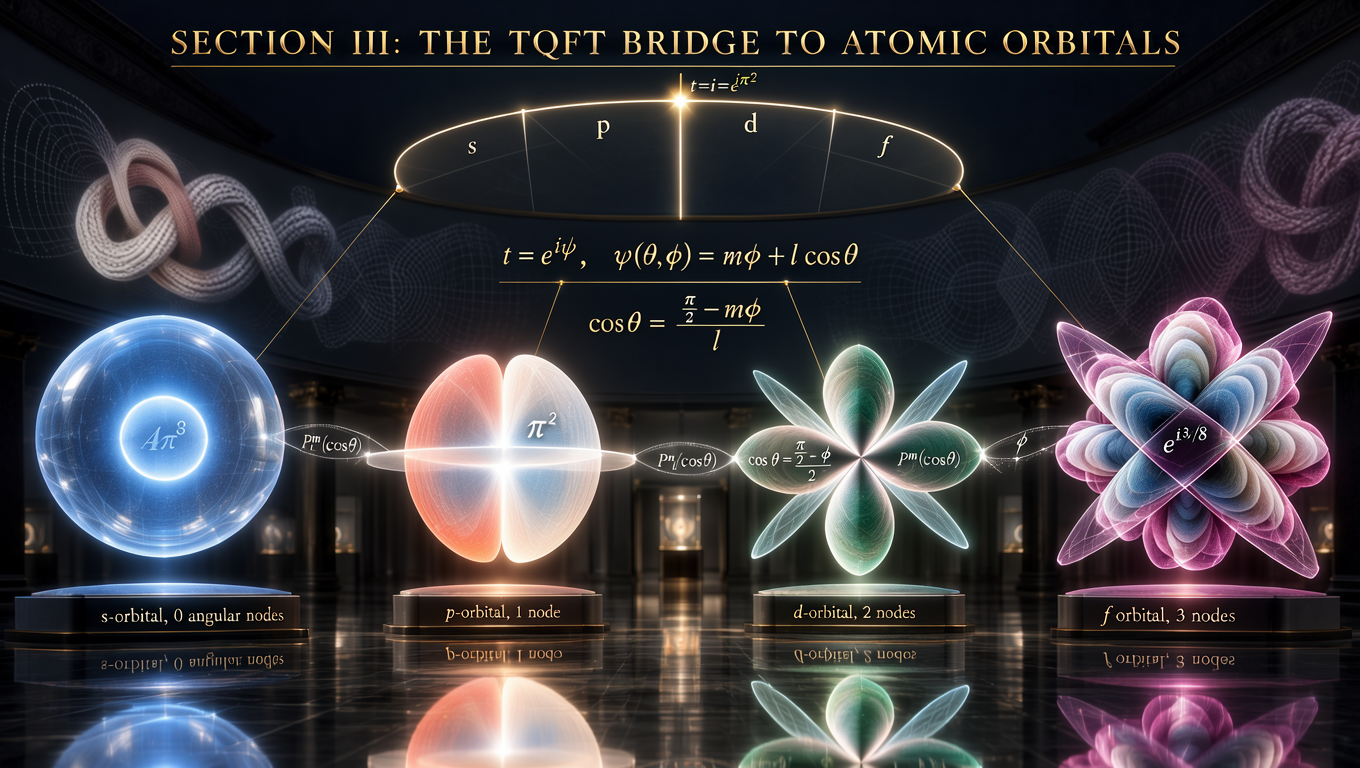
Evaluating the Jones polynomial at the 4th root of unity ($t = i = e^{i\pi/2}$) bounds the permissible geometric partitions to four primary sectors, explaining the four electron subshells ($s, p, d, f$).
Through Chern-Simons mapping, the complex phase $\psi$ couples directly to spatial polar coordinates $(\theta, \phi)$:
where $l$ and $m$ represent topological winding numbers corresponding to azimuthal and magnetic quantum numbers.
Setting the boundary condition at the locked $i$-turn phase ($\psi = \frac{\pi}{2}$):
This equation governs the nodal zero-surfaces matching the Associated Legendre Polynomials $P_l^m(\cos\theta)$:
Plots a flat equatorial disk slicing through the sphere, matching the nodal plane of the $p_z$ orbital.
The polar angle $\theta$ shifts continuously with azimuthal angle $\phi$, generating alternating, diagonally crossed cones that match the 4-lobed cloverleaf boundaries of $d_{xz}$ and $d_{yz}$ orbitals.
| Orbital Subshell | Angular Nodes | Topological Vortex Mechanism |
|---|---|---|
| $s$-orbital | 0 (Sphere) | Isotropic background spatial displacement ($4\pi^3$). |
| $p$-orbital | 1 (Dumbbell) | Equatorial plane from $K_R / K_L$ chiral cancellation ($\pi^2$). |
| $d$-orbital | 2 (Cloverleaf) | Orthogonal shear between the flat floor and the $90^\circ$ $i$-turn. |
| $f$-orbital | 3 (Complex Lobes) | Three self-crossing planes driven by the $e^{i3\pi/8}$ framing twist. |
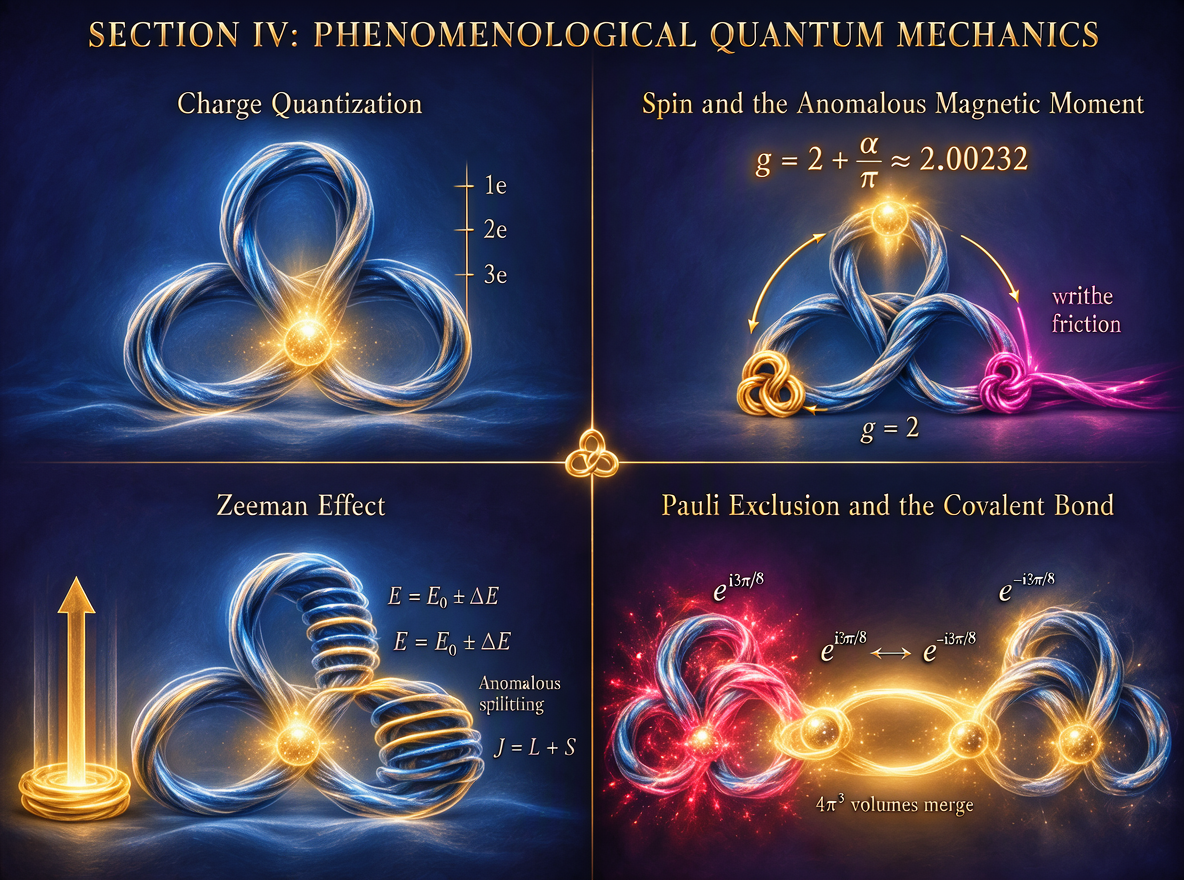
Tracking coordinates as the phase angle $\tau$ sweeps from $0$ to $2\pi$:
Because the knot must complete a full cycle to avoid self-destruction, the total integrated field curvature is mathematically quantized into integer topological invariants ($1e, 2e, \dots$).
The electron does not spin mechanically. Intrinsic spin ($\hbar/2$) is the integrated circulation of internal phase velocity along the closed trefoil filament, where $x$ and $y$ are permanently out of phase ($x \propto -u_2, y \propto u_1$).
When an external magnetic field $\vec{B}$ is applied:
Fermionic exclusion arises from hydrodynamic interference between two approaching vortex matrices:
       Vortex A (Spin Up)                  Vortex B (Spin Down)
   [ Phase Vector: e^(i3π/8) ]         [ Phase Vector: e^(-i3π/8) ]
               \                                    /
                \                                  /
                 v                                v
            [ Phase Interlocking / Destructive Interference ]
                                   |
                                   v
             [ Central Mass-Energy Densification (Bond Core) ]
                 - Polynomial shift: 2x (4π³) volumes merge
                 - Localized curvature drops at the boundary
                                   |
                                   v
               [ The Covalent Molecular Wave Function ]
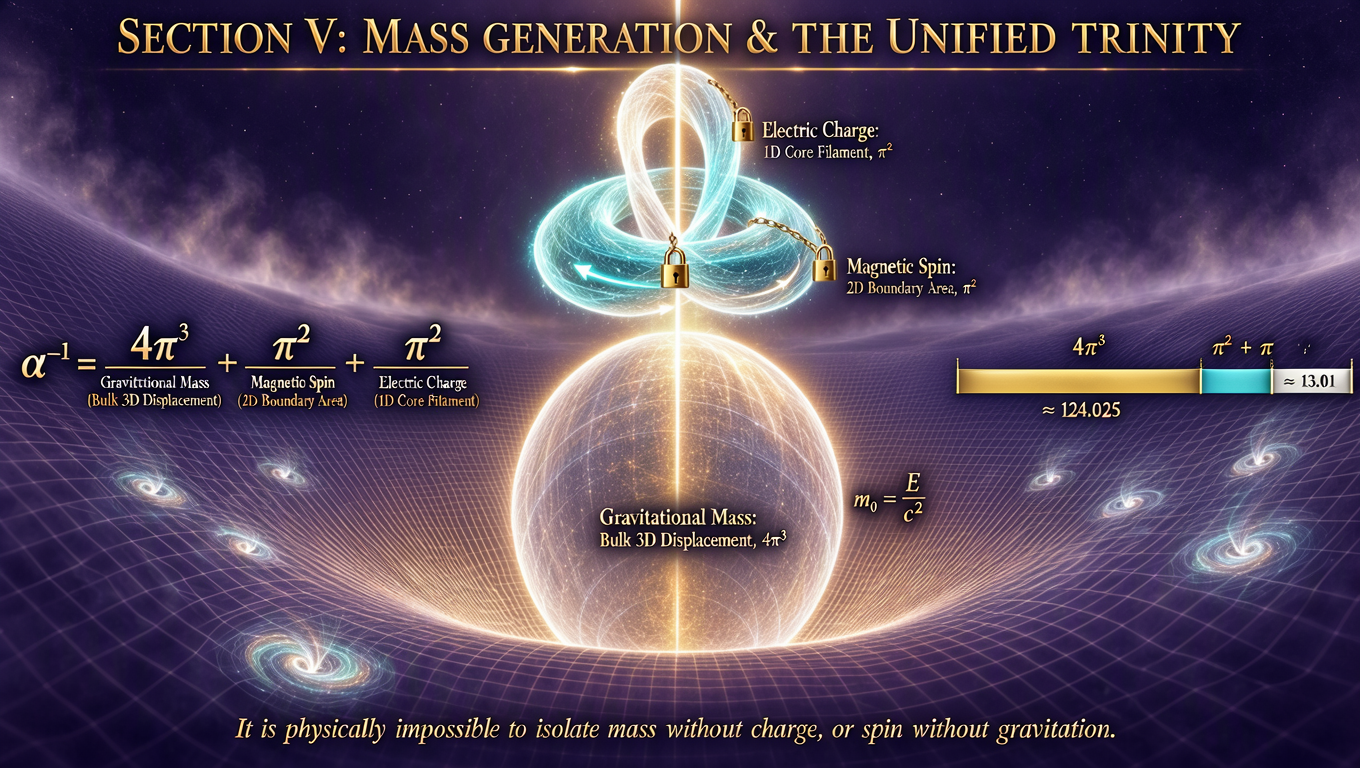
In 4T-KUT, mass is not an added scalar substance; it is the bulk volume of spacetime actively displaced by the knot envelope.
Because a stable (3,2) trefoil vortex cannot exist without simultaneously displacing a bulk volume ($4\pi^3$), shearing across a boundary ($\pi^2$), and maintaining a core thread ($\pi$), it is physically impossible to isolate mass without charge, or spin without gravitation.
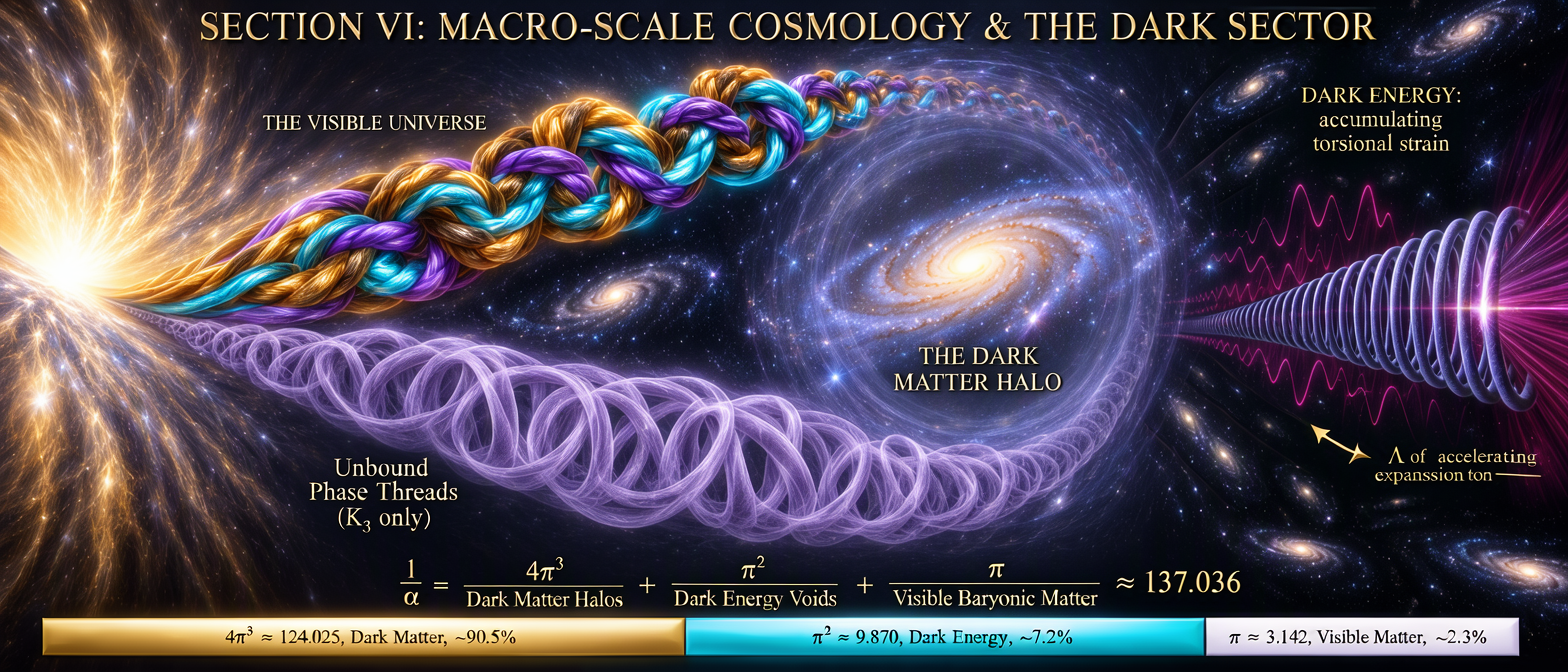
The uncancelled $360^\circ$ ($2\pi$) out-of-phase configurations ($K_3$) operate not only within subatomic particle cores, but across the cosmological scale. In the primordial universe, high-energy wave inflation naturally bifurcated:
      [ Early Universe Plasma / High-Energy Wave Inflation ]
                                |
      +-------------------------+-------------------------+
      |                                                   |
      v                                                   v
[ Perfect Triple-Knot Lock ]             [ Unbound Phase Threads (K3 Only) ]
- Forms Localized Charge/Spin Nodes      - No i-turn shearing matrix
- Becomes Visible Baryonic Matter        - Non-chiral, uncharged wave loops
- Interacts with Light (Electromagnetism)- Cannot emit, absorb, or reflect light
      |                                                   |
      v                                                   v
 [ THE VISIBLE UNIVERSE ]                            [ THE DARK MATTER HALO ]
                                                          |
                                                          v
                                             [ Pure Gravitational Footprint ]
                                             - Retains 4π³ volume displacement
                                             - Bends space like an invisible mass
While localized or unbound solitons generate gravitational attractive wells via spatial displacement, Dark Energy is the smooth, repulsive pressure accelerating metric expansion. 4T-KUT identifies Dark Energy as the global, cumulative thermodynamic effect of the $360^\circ$ phase shifts:
Extending the fine-structure constant base polynomial to the cosmos maps the universal energy budget as an exact topological distribution equation:
[========================== TOTAL COSMIC BUDGET (1/α ≈ 137.036) ==========================]
[------- 4π³ (≈ 124.025) -------]  [------- π² (≈ 9.870) -------]  [-- π (≈ 3.142) --]
         DARK MATTER                      DARK ENERGY               VISIBLE MATTER
 (Bulk Volume Displacement)         (Intergalactic Phase Shear)    (Localized Vortex Nodes)
          ~ 90.5%                           ~ 7.2%                    ~ 2.3%
(Note: These pure geometric percentages define the foundational, idealized "rest frame" ratios of the baseline polynomial. Over cosmological evolution, as expanding voids accumulate phase strain and matter condenses, dynamic redistribution shifts the measured cosmological densities into the precise values observed in modern observational astrophysics.)
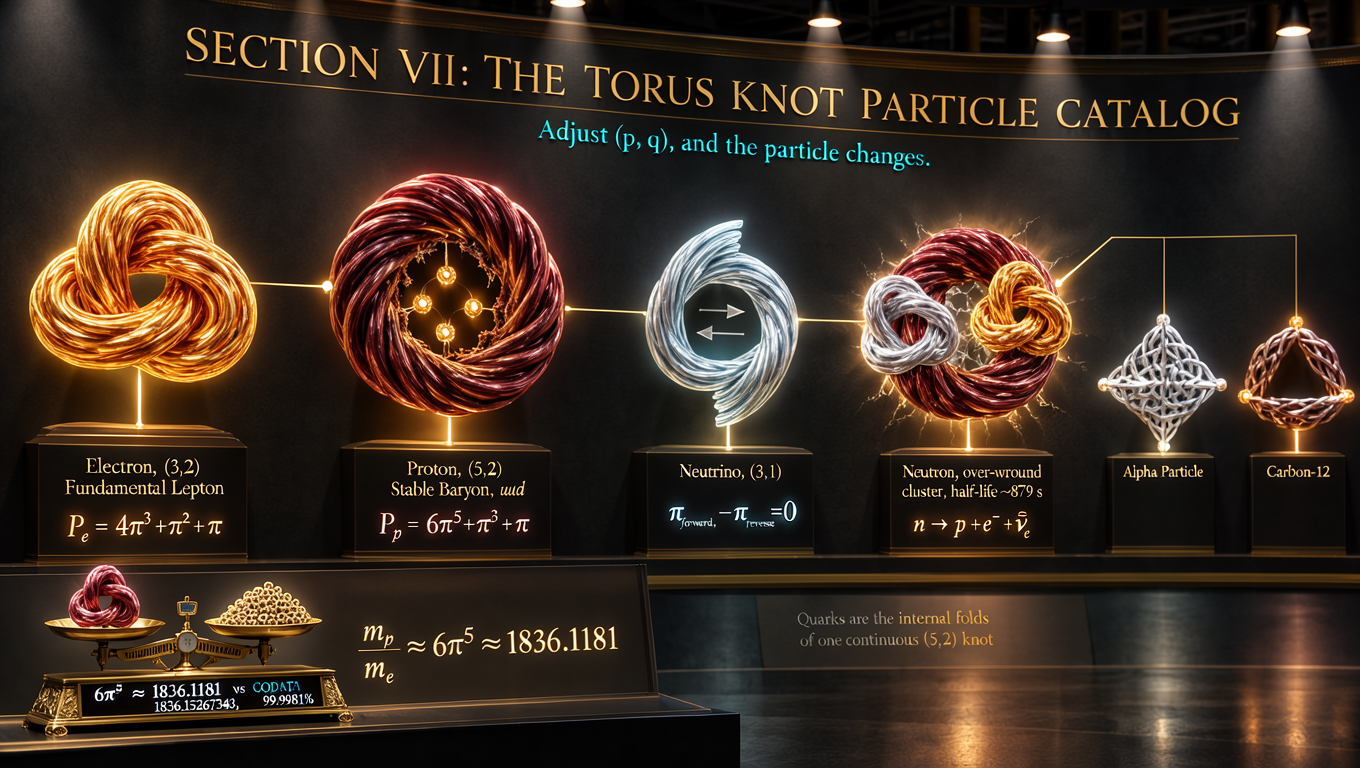
Adjusting the topological winding numbers $(p, q)$ of the torus knots naturally generates the distinct physical attributes of other fundamental particles, eliminating the need for arbitrary empirical parameters.
                  THE TORUS KNOT PARTICLE TAXONOMY

    Knot Winding (p, q)                 Physical Manifestation
  ====================================================================
    (3, 2) Torus Knot     ----->        Electron (Fundamental Lepton)
    (5, 2) Torus Knot     ----->        Proton (Stable Baryon)
    (3, 1) Torus Knot     ----->        Neutrino (Uncharged Lepton)
    Composite Weave       ----->        Neutron (Over-Wound Cluster)
    Tetrahedral Manifold  ----->        Alpha Particle (Helium-4 Nucleus)
    Tri-Tetrahedral Ring  ----->        Carbon-12 (Crystalline Life Crown)
In mainstream chromodynamics, the proton is treated as a composite bag of three quarks bound by gluons. In 4T-KUT, the proton is an elementary, single continuous stable vortex based on a (5,2) torus knot (5 longitudinal wraps, 2 meridional wraps).
In 1951, physicist Friedrich Lenz observed that the proton-to-electron mass ratio is remarkably close to the simple geometric factor $6\pi^5$. In 4T-KUT, this relationship emerges directly from the knot wrapping:
Evaluating the pure volumetric mass ratio between the proton's dominant volume ($6\pi^5$) and the electron's unit baseline:
| Component | Geometric Role in the (5,2) Vortex | Physical Manifestation |
|---|---|---|
| $6\pi^5$ | Bulk volumetric displacement of a 5-layer longitudinal manifold. The coefficient 6 reflects the close-packing geometry required to hold 5 rotating threads around a central core. | Proton Rest Mass ($1836 \times m_e$) |
| $\pi^3$ | The 3D crossing boundaries where internal threads intersect. Under the $i$-turn matrix, the 5 crossings split space into three distinct real-imaginary focus points. | The Three Constituent Quarks ($uud$) |
| $\pi$ | The single uncancelled linear core filament governing the net flux output of the vortex core. | Unit Electric Charge ($+1e$) |
This polynomial transition resolves the paradox of quark confinement. A symmetric (3,2) knot collapses cleanly to a single real floor ($-1$) under the $i$-turn matrix. A (5,2) knot, however, cannot smoothly cancel itself out; its asymmetric crossings force the core to fracture into three internal phase-locked shearing planes ($\pi^3$).
Quarks cannot be isolated in particle collisions because they are not independent point particles trapped inside a bag. They are the internal geometric folds and crossing nodes of a single, continuous (5,2) torus knot. Pulling on a quark simply stretches the internal folds of the proton vortex filament.
By reducing the meridional winding, the vortex shedding mechanics alter completely, generating uncharged and composite neutral states.
The neutrino exhibits nearly zero rest mass, carries no electric charge, and interacts exclusively via the weak force. In 4T-KUT, this elusive profile is generated by a (3,1) torus knot.
In 4T-KUT, the neutron is not an elementary static state, but an over-wound, metastable composite cluster. It consists of a (5,2) proton vortex structurally clamped by an entrapped (3,2) electron filament and stabilized by a (3,1) neutrino Moebius loop.
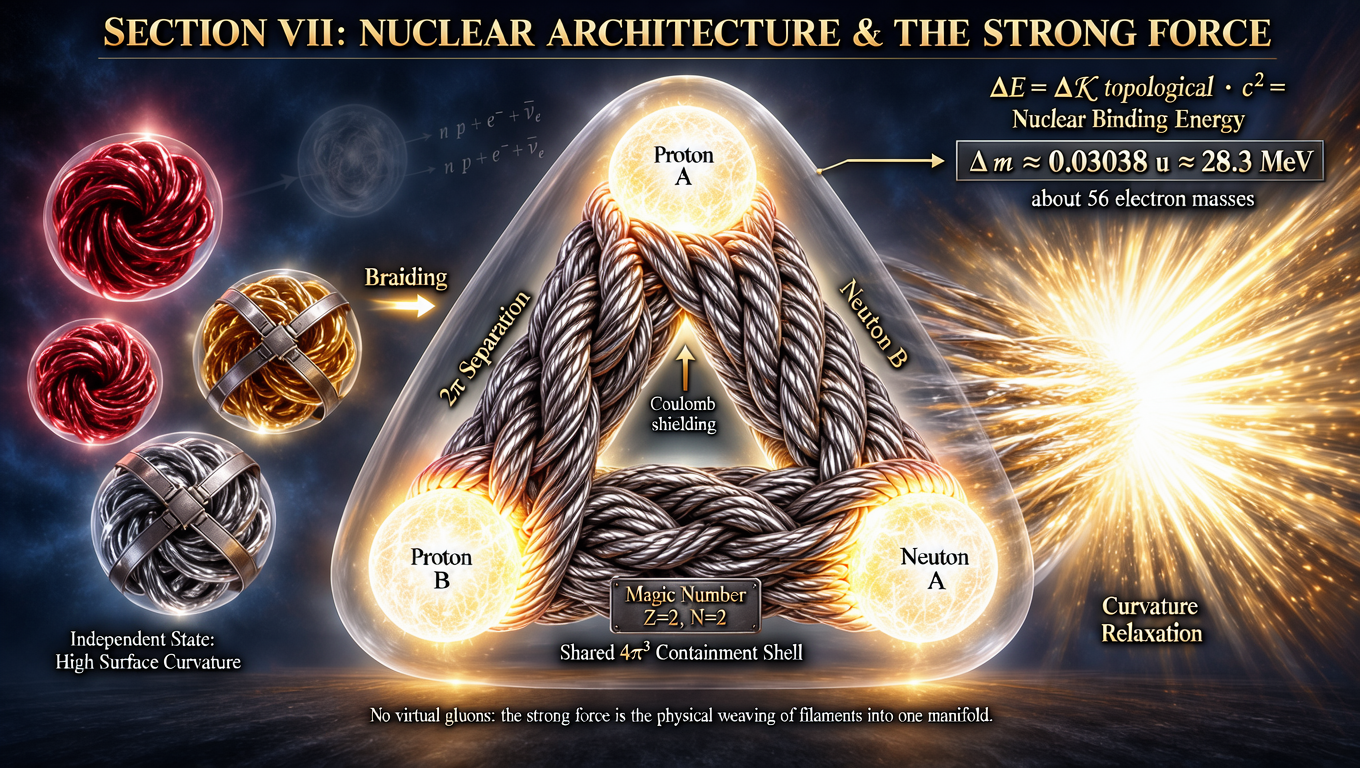
In mainstream chromodynamics, the strong nuclear force is attributed to the exchange of virtual vector gluons. In 4T-KUT, the strong interaction is recognized as the physical intertwining and re-weaving of independent knot filaments into a single, shared topological manifold.
When nucleons approach within femtometer scale, their individual outer boundary walls ($\pi^2$) dissolve. Rather than exchanging virtual particles across empty space, the physical strands of the (5,2) protons and clamped neutron clusters physically interlock like structural cables, forming a braided nuclear lattice.
The fusion of two protons and two neutrons to form an Alpha Particle (Helium-4 nucleus) produces the most stable nuclear architecture in the universe. The four independent vortices unravel their outer loops and re-weave their strands into a highly symmetric, 3D closed regular tetrahedron.
                [ PROTON A (5,2) ]
                       / \
                      /   \
                     /     \
                    /       \
  [ NEUTRON A (Clamped) ]---+---[ NEUTRON B (Clamped) ]
                    \       /
                     \     /
                      \   /
                       \ /
                [ PROTON B (5,2) ]
A central mystery of nuclear physics is the mass defect: an alpha particle weighs less than the sum of its four constituents. The missing mass ($\Delta m \approx 0.03038\,\text{u}$, equivalent to $\sim 28.3\,\text{MeV}$ or $\sim 56\,m_e$) is released as binding energy.
4T-KUT derives this mass drop from a fundamental geometric principle: The Relaxation of Spatial Curvature.
This topological relaxation is the exact physical origin of the energy released in nuclear fusion.
The extraordinary stability of the alpha particle (establishing $Z=2, N=2$ as a prime nuclear "magic number") arises from the geometric balancing of the fine-structure base components across the tetrahedron:
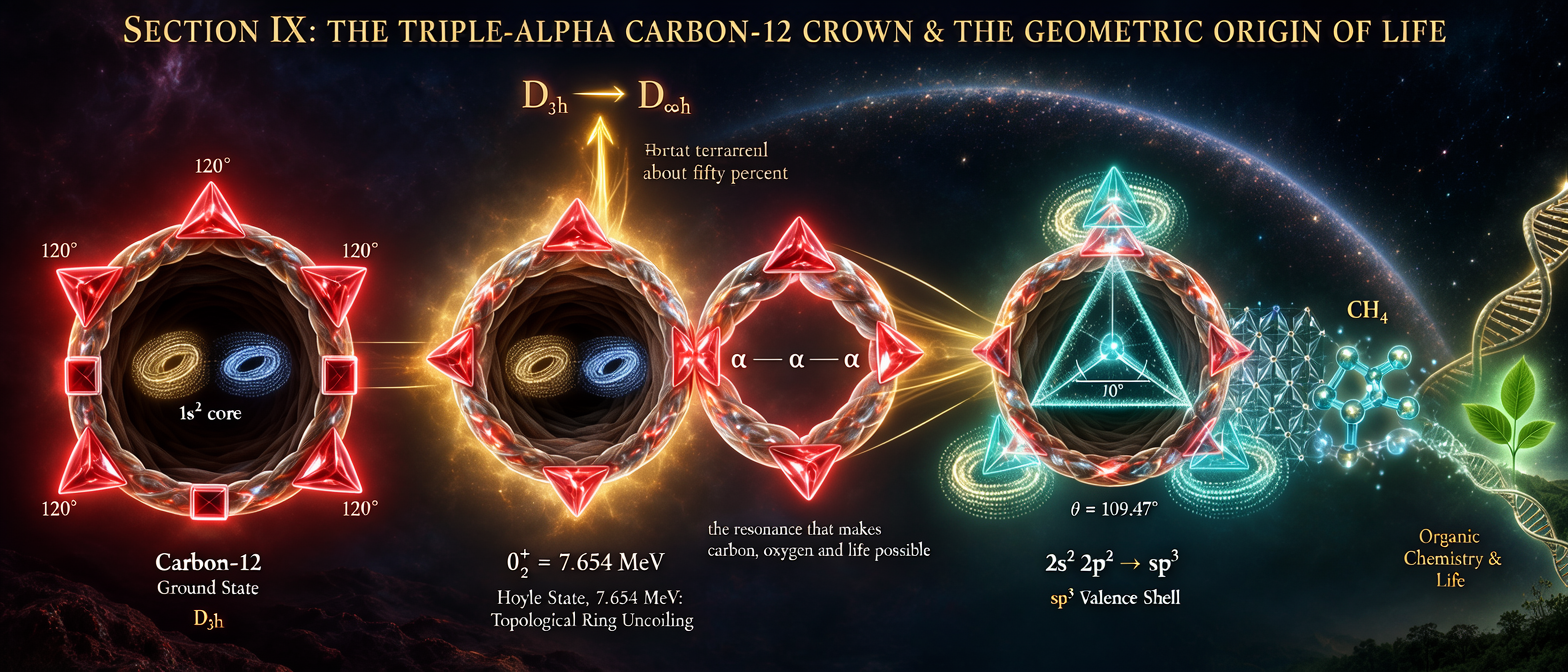
In the 4T-KUT framework, Carbon-12 ($^{12}\text{C}$) represents the ultimate geometric crystalline crown of the subatomic world. Rather than a chaotic, amorphous liquid-drop cluster of 6 protons and 6 neutrons, Carbon-12 forms when three tetrahedral Alpha Particles ($\alpha$-clusters) lock together along their braided edges to construct an equilateral, dual-layered toroidal ring.
This specific tri-cluster geometry provides an exact spatial mechanism for Carbon's exceptional stability, its $sp^3$ chemical bonding geometry, and the anomalous nuclear physics of the Hoyle State that permits organic nucleosynthesis.
                     [ Alpha Particle 1 (Tetrahedron) ]
                                    /\
                                   /  \
                                  /    \
                                 /      \
            [ Alpha Particle 2 ]----+----[ Alpha Particle 3 ]
                  \                            /
                   \--- [ Central Void Throat ] ---/
When three tetrahedral alpha particles combine, they minimize geometric strain by fusing along three shared edges, creating an equilateral triangular toroidal ring with $D_{3h}$ point-group symmetry:
In stellar nucleosynthesis, the "Triple-Alpha Process" requires a finely tuned resonance in Carbon-12 at $7.654\text{ MeV}$ (the Hoyle State, $0_2^+$). Without this state, the fusion of three alpha particles would be astronomically improbable, resulting in a universe devoid of carbon, oxygen, and organic life.
Standard nuclear physics has struggled to model the Hoyle state using conventional mean-field shell models. 4T-KUT reveals it to be a purely mechanical topological phase transition (ring uncoiling):
      [ Ground State Ring: D_3h ]                  [ The Hoyle State: D_inf_h ]
            /\
           /  \      --- (Excitation 7.654 MeV) --->   [A1] ==== [A2] ==== [A3]
          /____\                                      (Linear Open-Chain Weave)
      (Compact 4π³ Pool)                               (~50% Volumetric Inflation)
This matches the findings of modern inelastic electron scattering experiments: the Hoyle State is not an abstract vibrational mode, but a physical uncoiling of the topological ring into an extended cluster chain.
The geometry of atomic electron orbitals is not independent of the nucleus; the nuclear manifold serves as the near-field electromagnetic boundary condition that shapes the surrounding electron wavefunctions.
Because the Carbon-12 nucleus forms a flat triangular ring with an open central channel, its $i$-turn matrices project a unique spatial strain tensor into the local metric:
                          [ Electron 3 (Apex Top) ]
                                      |
                           [ C-12 Nuclear Ring ]
                       /             |             \
 [ Electron 1 (Base Left) ]          |          [ Electron 2 (Base Right) ]
                                     |
                         [ Electron 4 (Apex Bottom) ]
This spatial projection from the nuclear geometry directly generates the iconic tetrahedral $sp^3$ hybridization of carbon chemistry (e.g., in methane, $\text{CH}_4$, and the diamond lattice).
| Tier | Topological Configuration | Primary Polynomial / Metric Role | Physical Manifestation |
|---|---|---|---|
| Universal Blueprint | Invariant Gear Ratio | $4\pi^3 + \pi^2 + \pi$ | Fine-Structure Constant ($\alpha$) |
| Fundamental Lepton | $(3,2)$ Torus Knot | $4\pi^3 + \pi^2 + \pi$ | The Electron (Unit charge, spin-$\frac{1}{2}$) |
| Stable Baryon | $(5,2)$ Torus Knot | $6\pi^5 + \pi^3 + \pi$ | The Proton ($1836\times m_e$, 3 quarks, $+1e$) |
| Moebius Clamp | $(3,1)$ Torus Knot | $\pi - \pi = 0$ | The Neutrino (Zero charge, zero bulk volume) |
| Composite Nucleon | $(5,2) + (3,2) + (3,1)$ | Metastable Over-Wound | The Neutron (Free $\beta$-decay half-life) |
| Nuclear Unit | Tetrahedral Weave | Shared Envelope ($\Delta\mathcal{K}$) | The Alpha Particle ($^4\text{He}$ Binding) |
| Crystalline Crown | Tri-Tetrahedral Ring | $D_{3h}$ Toroidal Cavity | Carbon-12 ($sp^3$ Shells & Hoyle State) |
| Macro Cosmos | Unbound Solitons | Global $4\pi^3 / \pi^2$ | Dark Matter Halos & Dark Energy Voids |
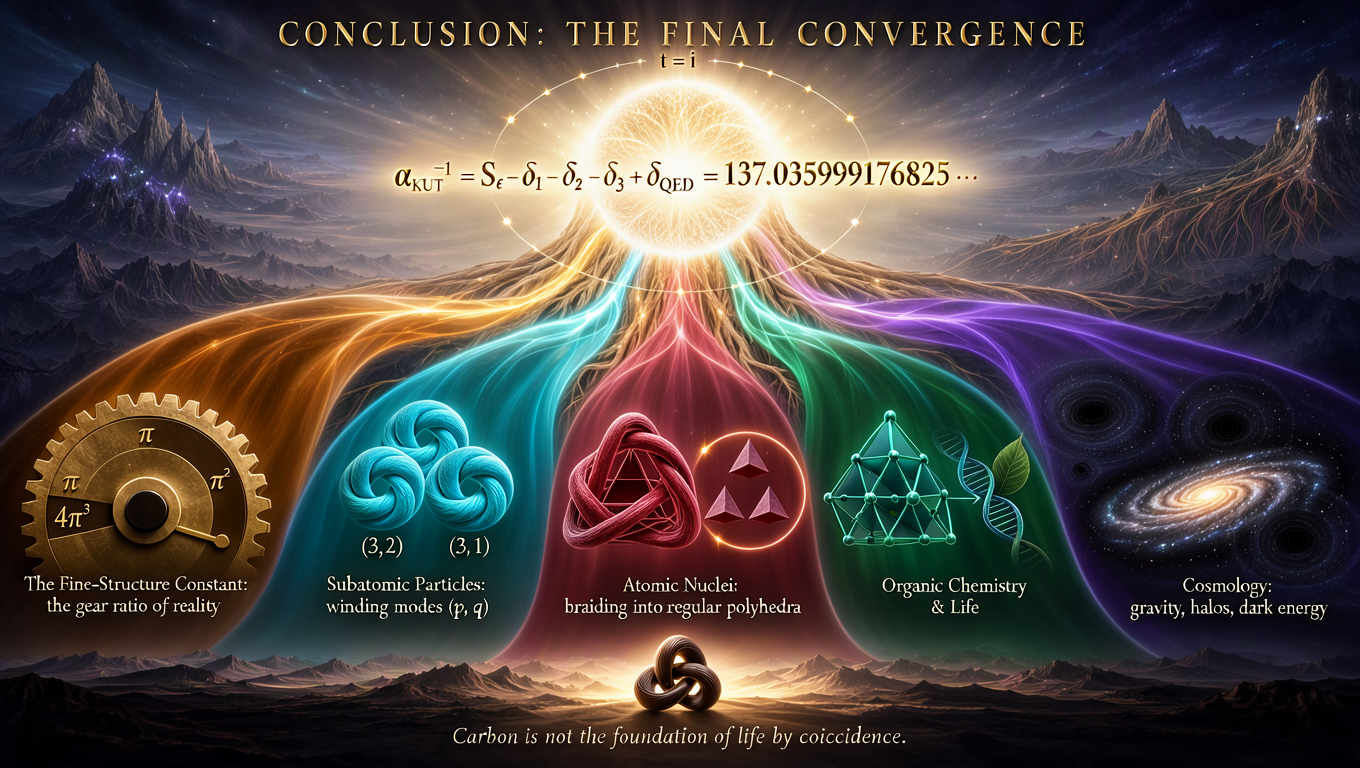
When the macroscopic topological domain ($\mathcal{S}_\varepsilon$), stabilized by the Jones polynomial root at $t=i$, is combined with regularized crossings ($\delta_1, \delta_2, \delta_3$) and vacuum polarization ($\delta_{\text{QED}}$), the master equation yields:
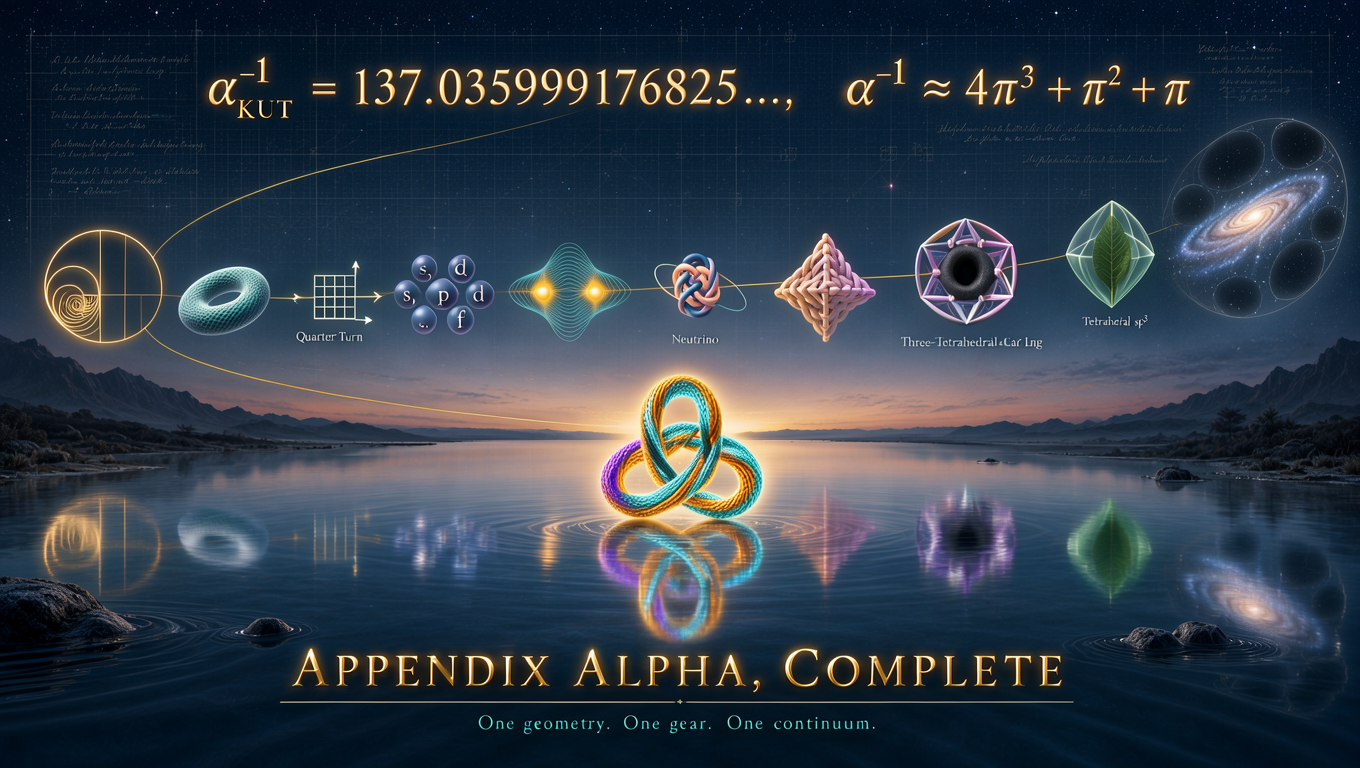
Through this unified architectural framework, the historic divisions between quantum mechanics, nuclear physics, chemistry, and general relativity dissolve into a single geometric continuum:
Carbon is not the foundation of life by coincidence. It is the precise threshold where three-dimensional space achieves a completely closed, self-stabilizing, multi-cluster geometric equilibrium—a structural masterpiece woven directly from the fabric of the cosmos.