Abstract
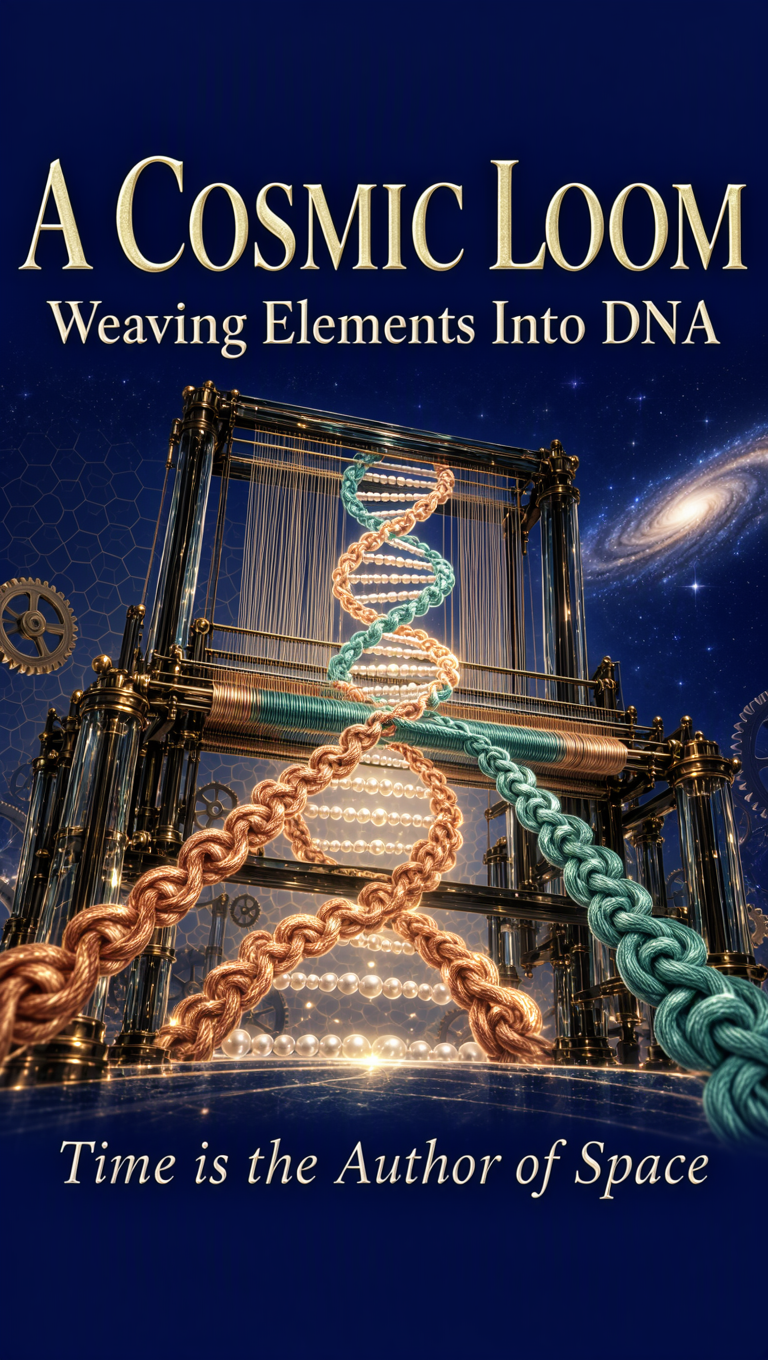
This paper develops a formal synthesis of low-dimensional topology,
discrete cosmology, and quantum molecular biology within the KnoWellian
Universe Theory (KUT), proposing that the cosmos operates
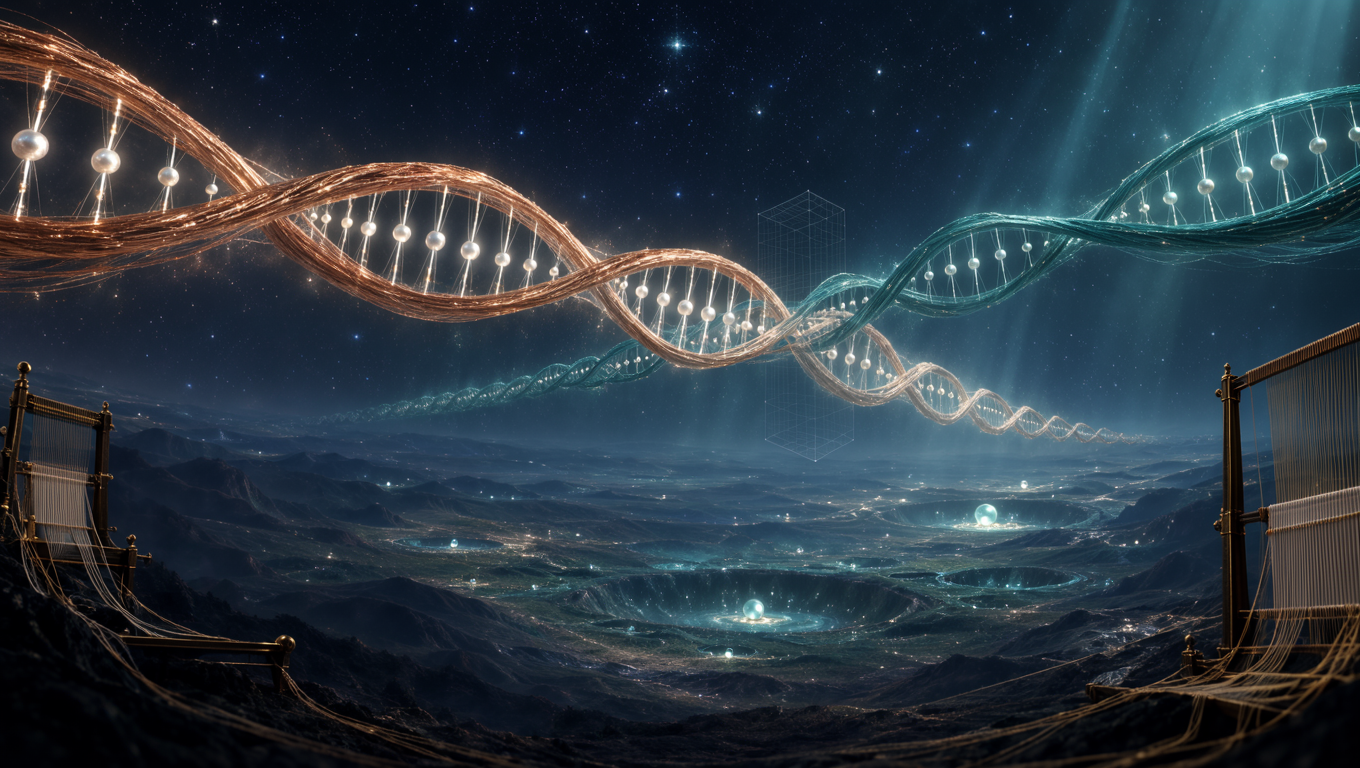
as a self-weaving topological loom in which deoxyribonucleic
acid (DNA) manifests at the cellular horizon as a
localized, resonant fractal of spacetime’s own braided fabric.
Resolving the Platonic Rift—the category error of
reifying zero-dimensional Euclidean points (\(r = 0\)) and completed
actualized infinities (\(\aleph_0\)) as physical constituents—KUT
grounds ontology in the Authorship Principle (“Time
is the Author of Space”). Under this inversion,
three-dimensional space is continuously rendered as a discrete
projection quantized at the six-dimensional \(1 \times 1
\times 1\) Event-Point (\(\ell_{\text{KW}} \approx 1.615739
\times 10^{-35}\text{ m}\)) and bounded operationally by the Axiom
of Bounded Infinity (\(-c > \infty < c+\)). A 9-Dimensional
Chrono-Spatial Base Manifold (\(\mathcal{M}^{(9)} \equiv
\mathbf{PDS}(3) \oplus \mathbf{IWL}(3) \oplus \mathbf{FLV}(3)\)),
mapped onto spatial Depth, Width, and Length via the diagonal Authorship
Jacobian (\(\mathcal{J}^i_{\phantom{i}\alpha}\)), expands
under three-valued ternary logic (\(\mathcal{L}_3 = \{+1, 0, -1\}\))
into a 27-dimensional non-supersymmetric bosonic string poset
(\(3^3 = 27\)), whose matter central charge (\(+27\)) cancels
conformal and causal-arrow ghost anomalies (\(-26 - 1 = -27\))
identically without supersymmetric partners.
Within this cosmic loom, physical reality is organized by a unified
Time–Space–Phase triad of chiral \((3,2)\)
trefoil torus knots (\(R = p/q = 3/2 = 1.500\),
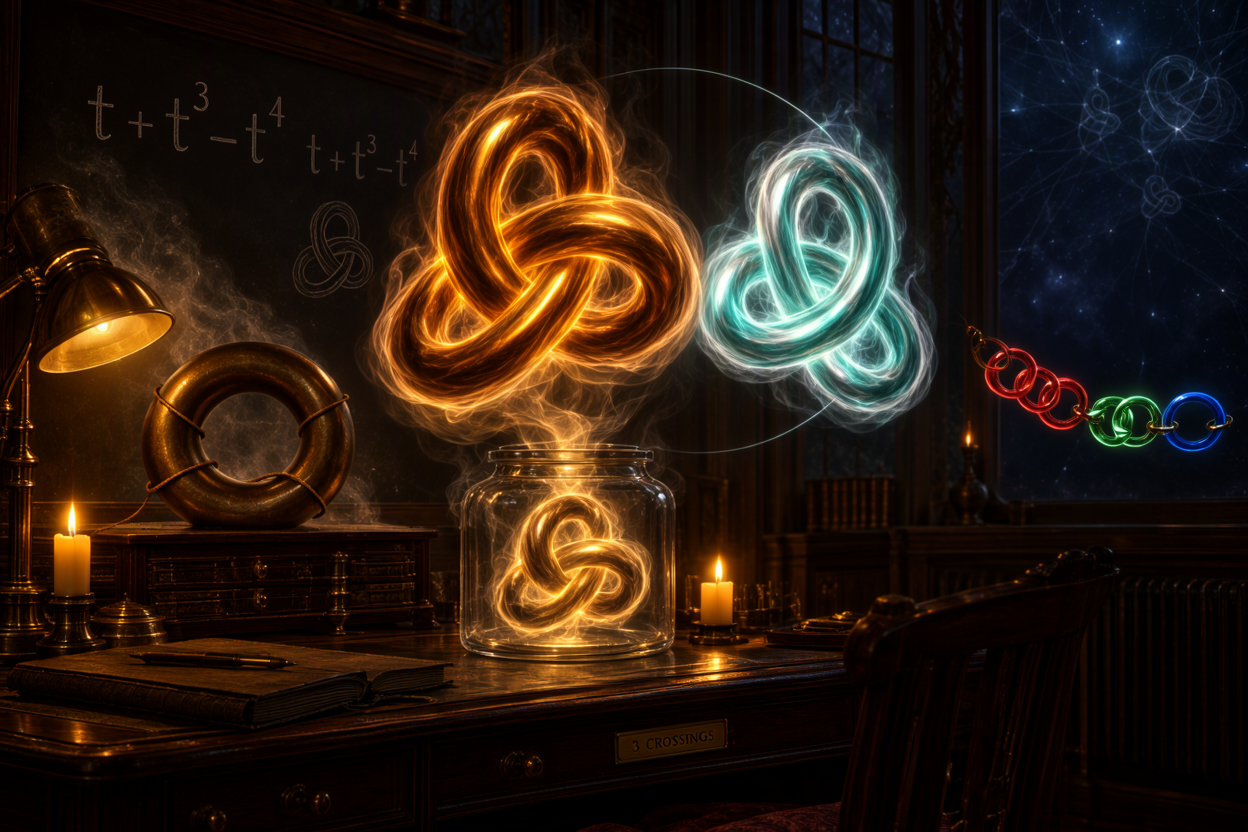
distinguished algebraically by their chiral Jones polynomials \(V_L(t)
= t + t^3 - t^4\) and \(V_R(t) = t^{-1} + t^{-3} - t^{-4}\)). A left-handed
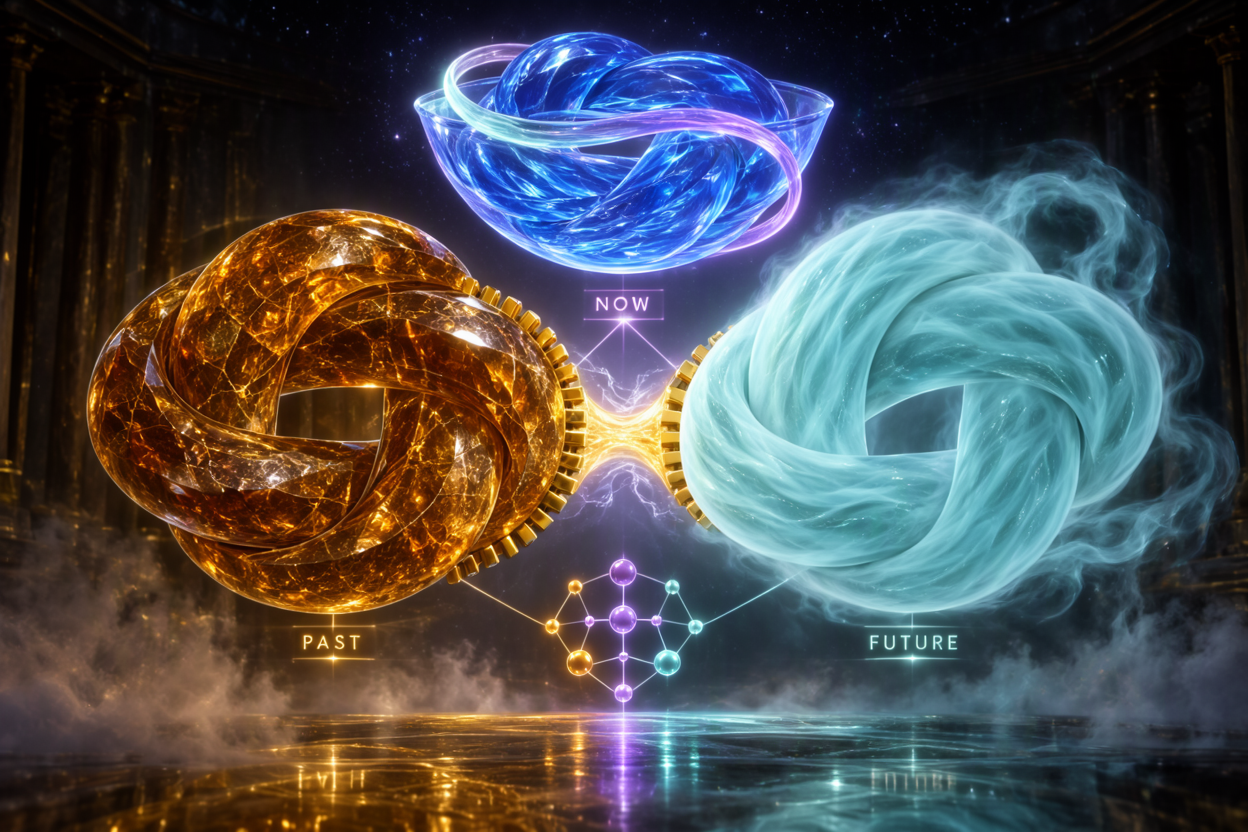
\((3,2)\) trefoil knot (\(T_{3,2}^L\)) encoding Past–Depth–Solid
(Matter) and a right-handed \((3,2)\) trefoil knot
(\(T_{3,2}^R\)) encoding Future–Length–Gas/Vapor
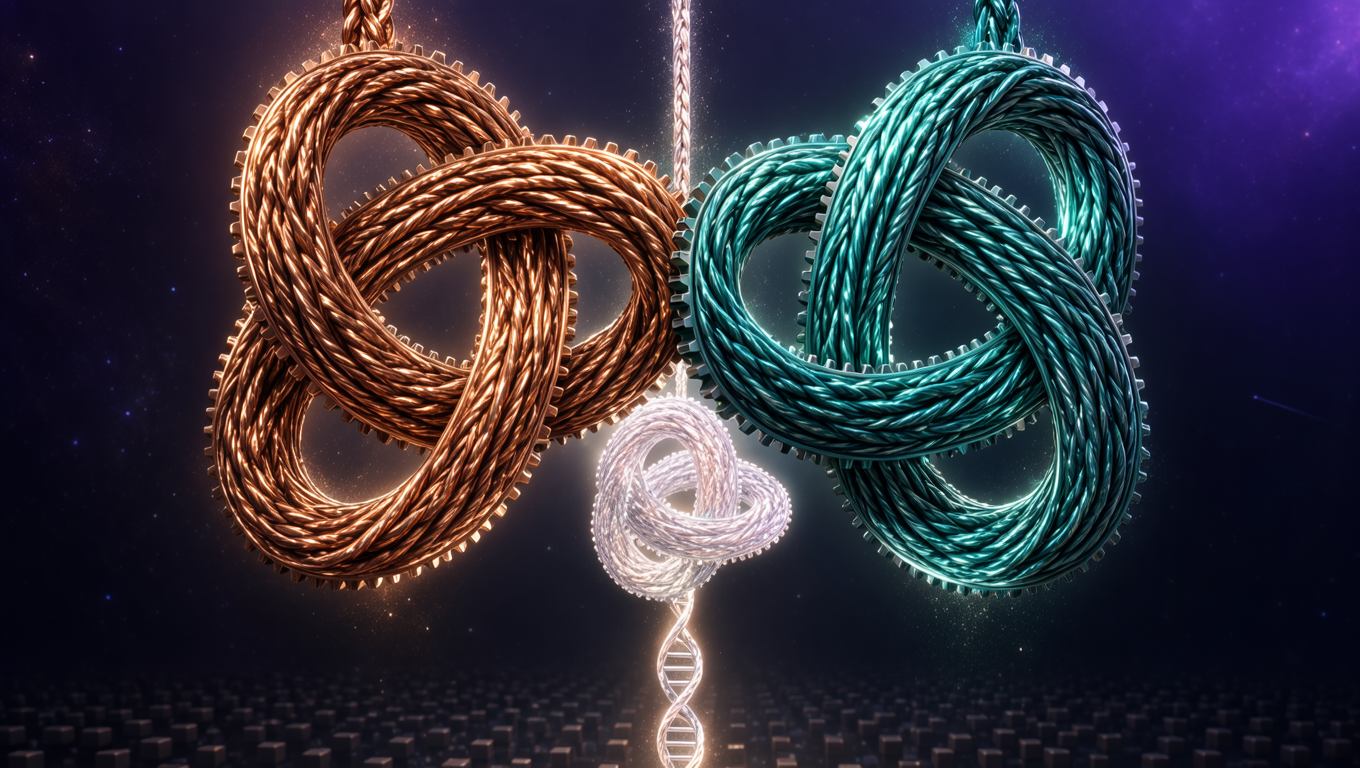
(Antimatter) mesh in phase (\(\Delta\phi = 0
\pmod{2\pi}\)) like two interlocking mechanical gears,
while a second left-handed \((3,2)\) trefoil knot
(\(T_{3,2}^L\)) encoding the Instant–Width–Liquid
(Photon) operates \(360^\circ\) (\(2\pi\) radians)
out of phase across their transverse interface—generating
half-integer fermionic spin (\(J = \frac{1}{2}\hbar\)) via the
\(720^\circ\) Dirac belt mechanism, pinning 23 internal dimensions
into \(SU(3)_C \times SU(2)_L \times U(1)_Y\), and enforcing a \(2:1\)
cosmic matter dominance across the \((18,9)\) global metric signature.
Anchored by discrete \(90^\circ\) \(i\)-Turn dynamics,
the \(30^\circ\) (\(\pi/6\)) Vernier Phase Escapement,
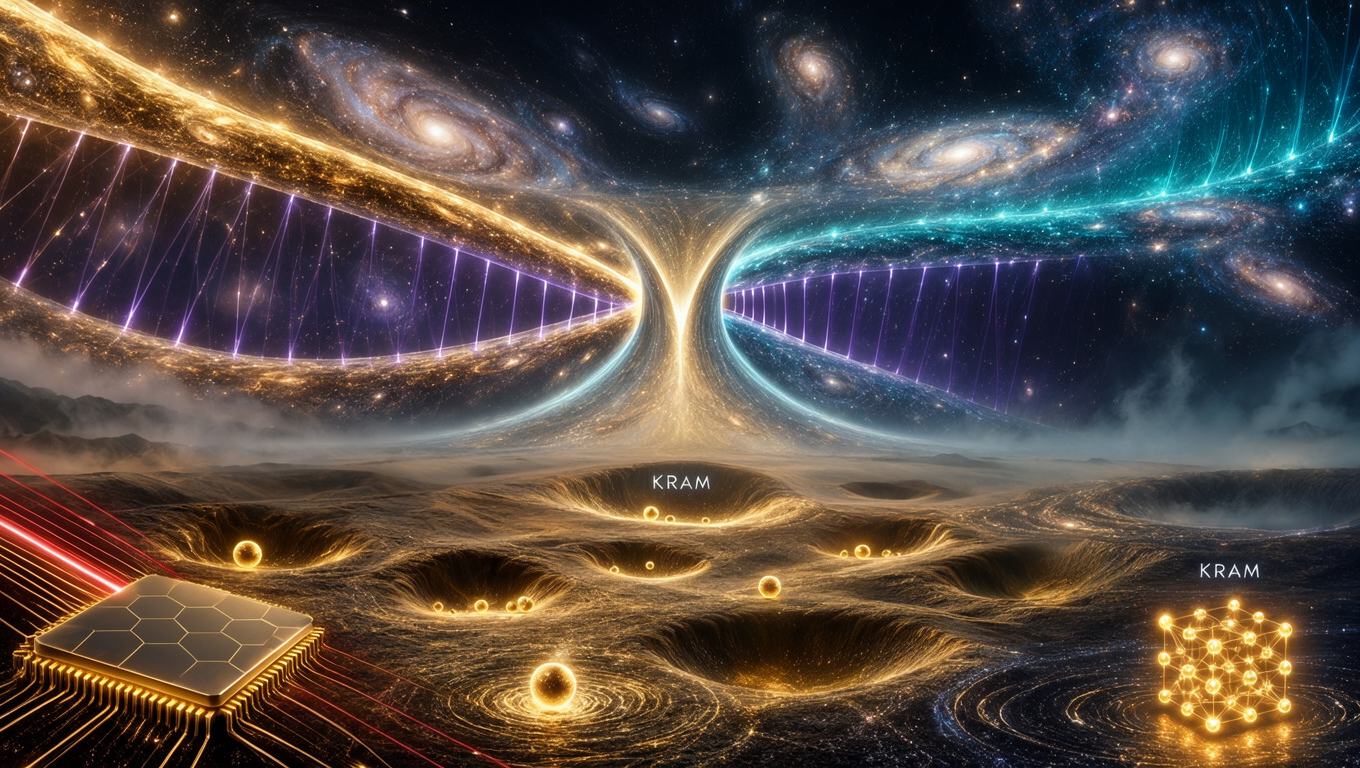
cosmic memory preservation inside the KnoWellian Resonant
Attractor Manifold (KRAM), and the mechanical grind against
an aperiodic Golden Ratio (\(\Phi\)) Cairo Pentagonal
Q-Lattice, KUT derives non-fitted closed-form
constants—highlighted by the topological vacuum impedance
\(\alpha^{-1}_{\text{KUT}} = 137.035999320144\dots\) (evaluated at
\(\lambda(3_1) = 32.7433864\) and reporting its \(+1.4314 \times
10^{-7}\) / \(+6.82\sigma\) residual against CODATA 2022 under the
Peachtree Protocol).
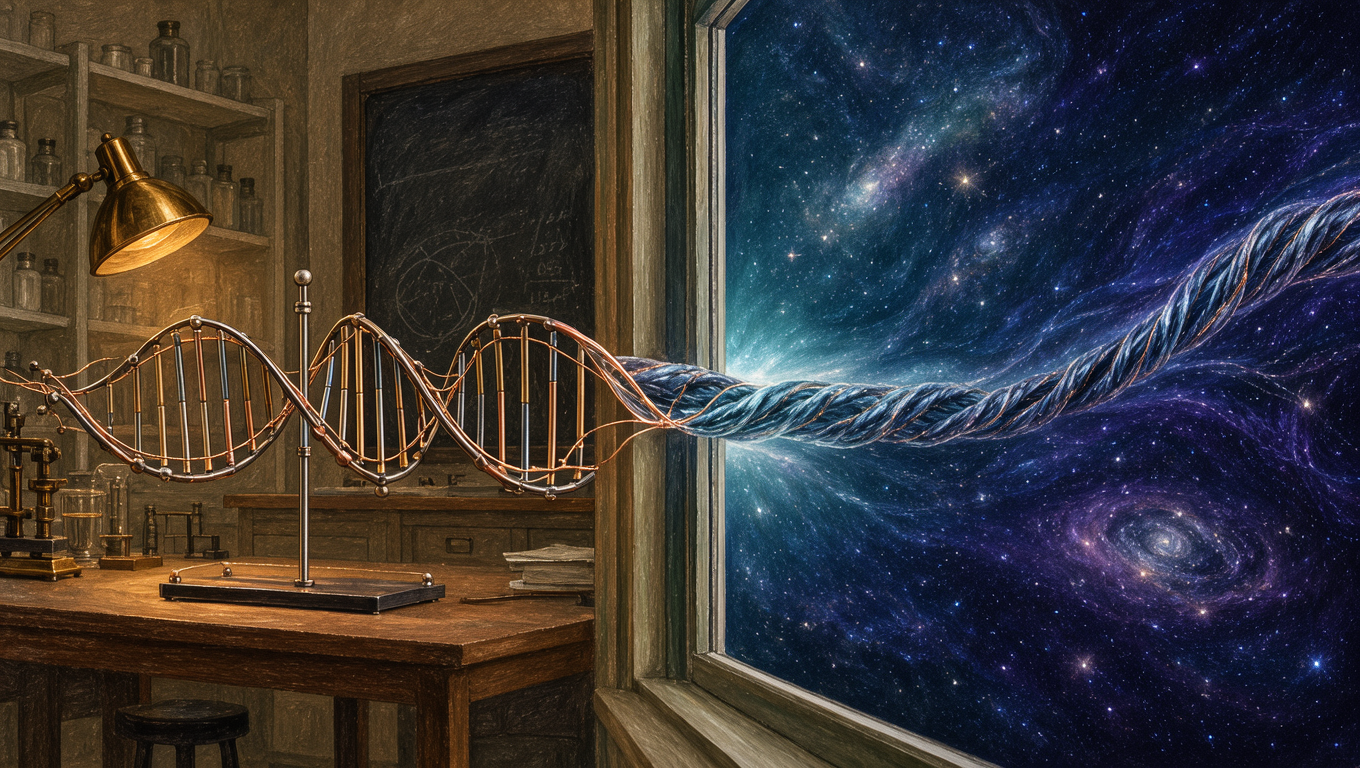
Extending this discrete geometric grammar from vacuum topology into
molecular biology, the framework links DNA’s antiparallel
double-helical architecture and complementary hydrogen
bonding—three-bond Guanine–Cytosine (G–C) rigidity
echoing the three irreducible crossings of the \((3,2)\) trefoil knot,
paired with two-bond Adenine–Thymine (A–T)
transitional flexibility—as well as helical pitch invariants (dna_helix_ratio,
eps_KW_Bio) and the \(80/120 = 2/3\) Periodic Table
stability law directly to cosmic knot dynamics. Harmonics stepped down
six binary octaves from the Master Prime Factor Matrix
(\(\mathbf{\Psi}_{\text{Base}} = 2^6 \times 3^9 \times 7^3 =
432{,}081{,}216 \to f_0 = 432.081216\text{ Hz}\)) yield the \(6.751269\text{
Hz}\) biological sub-octave (\(f_{\text{Bio}}\)), while
13-protofilament microtubule B-lattice Cartan torsion (\(T^\theta_{rz}
\approx 0.031831\text{ nm}^{-1}\)) lined with \(\text{H}_3\text{O}_2^-\)
Exclusion Zone water (\(\varepsilon_{\text{lumen}} \approx
3\)) delivers \(>700\times\) electrostatic thermal-noise
suppression and ballistic Grotthuss proton conduction (\(> 1.70
\times 10^8\text{ m/s}\)), shielding genetic and cytoskeletal
coherence against \(310\text{ K}\) thermal decoherence. All
foundational algebraic, finitist, topological, and biophysical
enclosure proofs are machine-checked across 34 Lean v4.35.0
modules (362 verified theorems, 752
formal definitions, 0 sorry
placeholders, 0 custom axioms) and paired
with five falsifiable experimental tracks spanning
continuum-limit audits, Period 8 heavy-ion synthesis, steady-state
plasma cosmology, ultrafast \(310\text{ K}\) microtubule spectroscopy,
and Silicon-Photonic Cairo Q-Lattice hardware.
Keywords: KnoWellian
Universe Theory (KUT); DNA Topology; \((3,2)\) Trefoil Knot;
Authorship Principle; Time–Space–Phase Triad; i-Turn Dynamics; Cairo
Pentagonal Q-Lattice; KnoWellian Resonant Attractor Manifold (KRAM);
Microtubule Cartan Torsion; Exclusion Zone Water
(\(\text{H}_3\text{O}_2^-\)); Lean 4 Formal Verification.
Introduction
For more than two millennia, Western natural philosophy has operated
inside a quiet methodological division of labor: fundamental physics
claimed the geometry of dead matter and cosmic spacetime, while
biology was left to account for heredity, cellular organization, and
conscious awareness as emergent byproducts of stochastic chemistry in
warm, wet environments. Even after Watson and Crick (1953) unveiled
the double-helical architecture of deoxyribonucleic acid
(DNA) and twentieth-century physics unified quantum
electrodynamics with curved spacetime, the two domains remained
conceptually estranged. Biology treated the double helix as an
evolutionary accident stabilized by local biochemistry; physics
treated spacetime as a smooth, passive backdrop indifferent to the
living geometries unfolding inside it.
This paper challenges that separation at its axiomatic root.
Grounded in the KnoWellian Universe Theory (KUT)—whose
formal ontology, discrete algebra, and experimental protocols are
established in the companion Master Specification (10.5281/zenodo.23913624)—we
demonstrate that the cosmos operates as a single, self-weaving
discrete loom in which DNA appears at the cellular
scale not as an isolated molecular anomaly, but as a localized,
resonant structural echo of spacetime’s own braided geometry.
1. Purpose: Healing the Platonic Rift Across Physics and Biology
To understand why cosmology and molecular biology belong to one
unified formal grammar, we must first diagnose the shared
foundational error that keeps them estranged. Across modern
theoretical physics, cosmology, and computational biology, seemingly
unrelated crises trace back to a single ancestral assumption termed
the Platonic Rift: the category error of
importing the ideal, zero-dimensional Euclidean point (\(r = 0\)),
the infinitely divisible mathematical continuum
(\(\mathbb{R}^n\)), and completed actualized infinities
(\(\aleph_0\)) into physical ontology as literal constituents of
reality.
In pure mathematics, dimensionless loci and real continuums are
indispensable formal instruments. When adopted literally as the
physical substrate of nature, however, they generate systematic
structural pathologies across five coupled frontiers:
- Gravitational Collapse Singularities (\(r = 0\)):
Because classical Lorentzian manifolds permit unbounded spatial
compression without a minimal volumetric floor, Einstein’s field
equations inevitably drive density and spacetime curvature to
infinity inside black hole cores and at an extrapolated \(t = 0\)
cosmological origin—signaling the breakdown of predictive law
precisely where gravitational energy peaks.
- Quantum Field Theory Ultraviolet Divergences (\(\infty
- \infty\)): Modeling elementary particles as
zero-radius excitations interacting across arbitrarily small
separations forces self-energy integrals to diverge, compelling
Quantum Electrodynamics (QED) and the Standard Model to extract
finite empirical numbers through infinite renormalization
(\(\infty - \infty\)).
- Frozen “Block Time” and the Vanishing Present:
Treating time as a passive, geometric coordinate embedded inside a
completed four-dimensional continuum flattens becoming into a
static Parmenidean block universe, while canonical quantization
via the Wheeler–DeWitt equation eliminates coordinate time
altogether (\(\hat{H}\Psi = 0\)).
- Cosmological Bookkeeping Gaps and Speculative Excess:
Continuum \(\Lambda\)CDM cosmology leaves roughly \(95\%\)
of the cosmic energy budget partitioned into undetected
placeholders—Dark Energy (\(\sim
68\text{--}70\%\)) and Dark Matter (\(\sim
25\text{--}27\%\))—while decades of collider and underground
searches for supersymmetric sparticles (SUSY), WIMPs, and axions
have returned null results, and independent expansion measurements
diverge into the \(8.37\%\) Hubble Tension
(\(73.04\) vs. \(67.40\text{ km/s/Mpc}\)). To rescue fine-tuned
parameters without a geometric derivation, continuum frameworks
multiply unfalsifiable constructs: \(10^{500}\) string-landscape
multiverses, Many-Worlds branching, and equilibrium Boltzmann
brains.
- Thermal Decoherence and the Simulation Fallacy in
Living Consciousness: At the biological frontier,
classical computation treats mind as substrate-neutral binary
symbol shuffling (
0s and 1s), remaining
trapped inside Searle’s Chinese Room (the
Simulation Fallacy) without explaining subjective qualia.
Meanwhile, quantum-biological models face Max Tegmark’s
calculation (2000) that thermal ion bombardment in \(310\text{
K}\) bulk cytosolic water (\(\varepsilon_{\text{bulk}} \approx
80\)) destroys unshielded quantum superpositions within \(\sim
10^{-13}\text{ s}\)—seemingly severing cellular genetics and
neural dynamics from fundamental quantum-topological coherence.
The first purpose of this paper is to show that KUT heals
the Platonic Rift across all five fronts simultaneously.
By replacing the passive spatial continuum with an active,
countable, non-singular discrete engine, KUT eliminates \(r = 0\)
singularities and \(\infty - \infty\) renormalization, restores
becoming to the physical Present, accounts for the \(95\%\) dark
sector and Hubble Tension without undetected particles or
multiverses, and reveals the physical shielding and resonance
mechanisms by which living biological polymers participate directly
in cosmic topology.
2. Synthesizing Knot Topology, Cosmology, and Molecular Genetics
The second purpose of this monograph is constructive: to
demonstrate that low-dimensional knot theory, chronotopological
cosmology, and genetic/cellular architecture
obey a shared discrete geometric grammar governed by the Authorship
Principle (Axiom I of Chronotopological Authorship):
“Time is the Author of Space.”
Under this deliberate inversion of Newtonian and Euclidean
ontology, three-dimensional space possesses no preexisting void,
independent metric, or capacity for self-persistence. Instead,
observable 3D space is a discrete holographic projection
continuously woven, refreshed, and held open by a three-dimensional,
multi-temporal engine.
Historically, this synthesis completes an interrupted
nineteenth-century lineage. In 1867, William Thomson (Lord
Kelvin) proposed that atoms might be permanent knotted
vortices circulating in an underlying fluid—inspiring Peter Guthrie
Tait to tabulate the simplest non-trivial knot of three crossings,
the \((3,2)\) trefoil (\(3_1\)). Kelvin’s insight
faltered because nineteenth-century physics lacked relativistic
spinors, discrete causal geometry, and non-Abelian knot invariants.
Nearly a century later, Watson and Crick (1953)
uncovered the antiparallel double helix of DNA, and molecular
biology soon discovered that cellular life relies irreducibly on
topological manipulation—linking numbers (\(Lk = Tw + Wr\)),
supercoiling, and specialized topoisomerase enzymes that
cut, pass, and re-ligate knotted DNA strands.
KUT unites Kelvin’s vortex-knot cosmology with Watson–Crick’s
helical biochemistry inside one mathematical architecture. When
spacetime itself is braided from chiral \((3,2)\) trefoil knots
locked across an aperiodic vacuum floor and stabilized by cosmic
memory, DNA’s double-helical geometry, base-pair hydrogen-bond
complementarity, and cytoskeletal microtubule cavities cease to be
arbitrary chemical accidents. They emerge as scale-invariant
biological echoes of the same chronotopological weaving
rules that stabilize protons, govern the Periodic Table, and pace
cosmic expansion.
3. The Dual Demarcation Standard: Machine Verification Meets
Empirical Risk
Any framework claiming to bridge Planck-scale string topology,
steady-state cosmology, and molecular genetics must guard fiercely
against two opposite hazards: internal algebraic inconsistency and
post-empirical unfalsifiability. Accordingly, this paper adopts
KUT’s strict Dual Demarcation Standard:
- Pillar I — Machine-Checked Deductive Certainty (Lean
4.35.0 / Mathlib4):
Rather than leaving multi-scale derivations vulnerable to informal
pencil-and-paper slips, the mathematical spine of KUT is encoded
inside the TopologicalEntropicPeriodicTable
repository under Lean v4.35.0 and
Mathlib4. Audited end-to-end by the Lean kernel,
the suite comprises 34 verified modules, 362
machine-checked theorems, and 752 formal
definitions, standing at 0 sorry
placeholders and 0 custom axioms
(including the upgrade of MICROTUBULE_TORSION.lean
to Mathlib4’s proven transcendental bounds Real.pi_gt_d4
and Real.pi_lt_d4). Every algebraic identity,
finitist non-existence theorem, dimensional anomaly cancellation,
and rational constant enclosure cited in this paper is deductively
certified.
- Pillar II — Two-Tier Discipline and Popperian
Falsifiability:
Formal verification proves internal consistency given
explicit definitions; only nature judges physical correspondence.
Under the Peachtree Accounting Protocol (Axiom
IV of Appendix H: \(X_{\text{exp}} - X_{\text{KUT}} = \Delta_L\)),
KUT strictly separates dimensionless Tier A
topological invariants (SOFTWARE_CORE.lean, generated
from a closed 11-element seed) from SI-unit Tier B
hardware scales (PHYSICAL_HARDWARE_SHELL.lean),
forbidding post-hoc parameter fitting to mask empirical residuals.
Every bridge from vacuum topology to DNA and cellular biophysics
is anchored to quantitative, pre-registered Popperian
falsification criteria across five independent
experimental tracks (Section 8.2)—ranging from heavy-ion Period 8
fusion kinematics and deep-sky CMB spectroscopy to ultrafast
\(310\text{ K}\) microtubule assays and co-fabricated
Silicon-Photonic Cairo Q-Lattice wafers.
4. Overview of the Cosmological Loom and the \(1 \times 1 \times
1\) Event-Point
At the finest grain of KnoWellian ontology, physical division
terminates at an indivisible, six-dimensional quantum of substantial
spacetime: the \(1 \times 1 \times 1\) Event-Point
(\(\mathcal{E}_{1\times 1\times 1}\)), bounded below by the KnoWellian
Length (\(\ell_{\text{KW}} \approx 1.615739 \times
10^{-35}\text{ m}\); K_01_LengthPixel \(= 1.615705
\times 10^{-35}\text{ m}\)) and paced by discrete Planck ticks
(\(\tau_{\text{KW}} = \ell_{\text{KW}}/c \approx 5.389 \times
10^{-44}\text{ s}\)):
\[\mathcal{E}_{1\times 1\times 1}
\;\equiv\; \Big\{\, (d, \tau_-),\;\; (w, \tau_0),\;\; (\ell, \tau_+)
\,\Big\}\]
Unlike an empty Euclidean point (\(r = 0, V = 0\)), every
Event-Point carries strictly positive minimal volume (\(V_{\min} =
\ell_{\text{KW}}^3 > 0\), singularity_free_density)
and binds each projected spatial extension—Depth (\(d\)),
Width (\(w\)), and Length (\(\ell\))—directly
to the temporal phase that authors it: retrograde Past
(\(\tau_-\)), transverse Instant (\(\tau_0\)),
and anterograde Future (\(\tau_+\)). Across
integer lattice displacements \((x, y, z) \in \mathbb{Z}^3 \oplus
(\mathbb{Z}_3 \times \mathbb{Z}_{360})\) (VOXEL_PHASE_LATTICE.lean),
any non-trivial step satisfies \(dx^2 + dy^2 + dz^2 \ge 1\),
bypassing classical Hurwitz–Frobenius continuum no-go theorems
without zero divisors.
From above, the cosmos is disciplined by procedural
finitism (Aleph_Null.lean), which enforces Ternary
Conservation (\(m(t) + w(t) = N < \infty\)) between
rendered actuality \(m(t)\) and unrendered potentiality \(w(t)\) and
proves aleph_null_does_not_exist, banishing completed
infinities and Hilbert’s Hotel paradoxes from physical reality. All
dynamic velocities and fluxes remain clamped operationally by the Axiom
of Bounded Infinity:
\[-c \;>\; \infty \;<\; c+\]
Here, infinity (\(\infty\)) is never an attainable static
warehouse, but the active directional boundary of the Liquid
Instant operating perpetually between the crystalline
compression floor of Past Control (\(-c\)) (the Mustard
Seed Singularity) and the dispersive expansion ceiling of Future
Chaos (\(c+\)) (Anaximander’s boundless Apeiron).
Extending each spatio-temporal dyad across its full 3-vector
degrees of freedom yields the 9-Dimensional Chrono-Spatial
Base Manifold (\(\mathcal{M}^{(9)}\)):
\[\mathcal{M}^{(9)} \;\equiv\;
\mathbf{PDS}(3) \;\bigoplus\; \mathbf{IWL}(3) \;\bigoplus\;
\mathbf{FLV}(3)\]
mapped onto spatial axes through the diagonal Authorship
Jacobian (\(\mathcal{J}^i_{\phantom{i}\alpha}\)).
Operating under three-valued ternary logic (\(\mathcal{L}_3 = \{+1,
0, -1\} \equiv \{\text{Up}, \text{Both}, \text{Down}\}\)), these
three temporal basis sectors exponentiate combinatorially into a 27-dimensional
non-supersymmetric bosonic string poset (BOSONIC_POSET_27D.lean):
\[\dim(\text{KBST}) = 3^3 = 27, \qquad
\mathcal{M}^{(27)} = P^F(9) \;\oplus\; i(9) \;\oplus\; {}^PF(9)\]
In this ternary algebra, the 27 bosonic matter central charges
(\(c_{\text{matter}} = +27\)) cancel both the worldsheet
diffeomorphism ghost (\(-26\)) and the master causal-arrow ghost
(\(-1\)) identically (\(c_{\text{total}} = 0 \implies
\hat{\mathcal{Q}}_{\text{BRST}}^2 \equiv 0\)) without
supersymmetry.
5. Braided by Chiral Trefoils: Interlocking Temporal Gears Across
the Photonic Instant
How does this 27-dimensional loom weave tangible matter,
electromagnetism, and the irreversible arrow of time? Across the
central pivot of Sector II (\(i\)), bosonic excitations braid into chiral
\((3,2)\) trefoil torus knots (\(3_1\))—closed loops
winding \(p = 3\) times longitudinally and \(q = 2\) times
meridionally around a toroidal phase surface (rational winding ratio
\(R = p/q = 3/2 = 1.500\), ideal ropelength \(\lambda(3_1) =
32.7433864\)). Crucially, these solitons organize into a unified Time–Space–Phase
triad whose opposing chiralities behave like precision
mechanical gears:
- Left-Handed Trefoil (\(T_{3,2}^L\)) — Past–Depth–Solid
(Matter): Encodes baryonic and leptonic matter locked
into condensed, historical structure along Depth, distinguished
algebraically by the chiral Jones polynomial \(V_{T_{3,2}^L}(t) =
t + t^3 - t^4\).
- Right-Handed Trefoil (\(T_{3,2}^R\)) —
Future–Length–Gas/Vapor (Antimatter): Encodes
antimatter residing in unconfined, high-entropy forward potential
along Length (consistent with Feynman–Stückelberg advanced-wave
polarity), carrying the mirror-inverted Jones invariant
\(V_{T_{3,2}^R}(t) = t^{-1} + t^{-3} - t^{-4}\).
- In-Phase Two-Gear Engagement: Because
counter-rotating mechanical gears require opposite chiral teeth to
mesh smoothly without stripping, the Left-Handed
Past–Depth–Solid (\(T_{3,2}^L\)) gear and Right-Handed
Future–Length–Gas/Vapor (\(T_{3,2}^R\)) gear interlock
in phase (\(\Delta\phi = 0 \pmod{2\pi}\))—canceling
linear coordinate momenta at the Double-Funnel nodal waist (\((-c)
+ (+c) = 0 \to v_{\text{areal}} = c^2\)).
- Second Left-Handed Trefoil (\(T_{3,2}^L\)) —
Instant–Width–Liquid (Photon) [\(360^\circ\) Out of Phase]:
Mediating electromagnetic exchange transversely along Width, the
photonic Instant operates \(360^\circ\) (\(2\pi\)
radians) out of phase relative to the interlocked
Past–Future gears. Through the Dirac Belt Mechanism,
multiplying the \((3,2)\) winding ratio \(R = 3/2\) by a \(2\pi\)
traversal accumulates \(\Delta\phi = 3\pi\) (phase sign \(-1\)),
requiring a full \(720^\circ\) (\(4\pi \implies 6\pi\), sign
\(+1\)) double rotation to restore identity—generating
half-integer fermionic spin (\(J = \frac{1}{2}\hbar\)) natively
from bosonic threads without Grassmann superpartners.
Along these pitch lines, Spontaneous Dimensional Pinning locks 23
internal modes into Standard Model gauge sockets (\(SU(3)_C \times
SU(2)_L \times U(1)_Y\)) to leave 4D macroscopic spacetime (\(27 -
23 = 4\)), while both the \(2\text{L}:1\text{R}\) TriTrefoilTriad
asymmetry and the global \((18,9)\) metric signature (\(18 = 2
\times 9\)) enforce cosmic \(2:1\) matter dominance. At every Planck
tick \(\tau_{\text{KW}}\), knots execute orthogonal \(90^\circ\) \(i\)-Turns
(\(I^2 = -1, I^4 = +1\)) atop an aperiodic, Golden-Ratio (\(\Phi =
\frac{1+\sqrt{5}}{2}\)) Cairo Pentagonal Q-Lattice
pairing \(90^\circ\) Type-A clamps with \(120^\circ\) Type-B nodes.
The \(30^\circ\) mismatch (\(\Delta\phi_{\text{vernier}} =
\frac{2\pi}{3} - \frac{\pi}{2} = \frac{\pi}{6}\)) acts as a
deterministic Vernier Phase Escapement driving
time’s forward arrow, while the incommensurability between rational
\((3,2)\) knots and irrational \(\Phi\) produces the KnoWellian
Grind (\(\varepsilon_{\text{KW}} = \phi - 3/2\),
\(\varepsilon_{\text{KUT}} \approx 0.081216\text{ rad}\), Metric
Offset Tensor \([\mathbf{M}_\Delta]\) with \(\operatorname{Tr}
\approx 0.33445021\))—preventing orbital collapse and yielding the
closed-form vacuum impedance \(\alpha^{-1}_{\text{KUT}} =
137.035999320144\dots\) (\(99.9999999\%\) accord with CODATA 2022,
openly reporting its \(+6.82\sigma\) residual). Sustained across
cosmic cycles by the KnoWellian Resonant Attractor Manifold
(KRAM), particle stability and decay emerge as discrete
basin transitions along cosmic memory valleys rather than acausal
probabilistic jumps.
6. DNA as a Resonant Cosmic Pattern: Genetic Topology and Cellular
Coherence
The central constructive thesis of this paper is that this knotted
cosmic loom does not terminate at the nuclear or atomic scale—it
propagates directly into living genetic architecture.
When viewed through the KUT lens, DNA is a
localized molecular double helix woven along the exact topological
and harmonic ratios of spacetime itself:
- Antiparallel Strands and Base-Pair Complementarity:
Just as macroscopic spacetime weaves antiparallel Left-Handed Past
Solid (\(T_{3,2}^L\)) and Right-Handed Future Vapor
(\(T_{3,2}^R\)) strands bridged transversely by the
\(360^\circ\)-shifted Photonic Instant, DNA pairs two antiparallel
sugar-phosphate backbones bridged transversely by hydrogen-bonded
base pairs. Within those rungs, Guanine–Cytosine (G–C)
pairs lock via three hydrogen bonds—mirroring
the three irreducible crossings of the \((3,2)\)
trefoil knot and the structural stability of Past–Depth–Solid
nodes—whereas Adenine–Thymine (A–T) pairs couple
via two hydrogen bonds, lowering the
dissociation barrier to permit local strand separation,
transcription, and topological adaptability analogous to the Instant–Width–Liquid
interface.
- Helical Offsets, Topoisomerases, and the \(2/3\)
Periodic Lexicon: At the chemical and geometric level,
KUT formalizes biological pitch invariants (
dna_helix_ratio,
eps_KW_Bio in BLT_APEX.lean),
interprets cellular topoisomerases and DNA supercoiling
(\(Lk = Tw + Wr\)) as biochemical echoes of cosmic knot
manipulation, and anchors carbon biochemistry inside the Periodic
Table’s \(66.6\%\) Dyadic Stability Law (Elements.lean:
exactly \(80\) stable elements out of \(120 \implies 80/120 =
2/3\), matching the \((3,2)\) diapente ratio) mapped
across a 64-channel optical splay bus (\(Z \bmod 64\)).
- Prime-Harmonic Tuning and \(310\text{ K}\) Microtubule
Coherence: Stepping down six binary octaves (\(2^6 =
64\)) from KUT’s Master Prime Factor Matrix
\(\mathbf{\Psi}_{\text{Base}} = 2^6 \times 3^9 \times 7^3 =
432{,}081{,}216\) (\(f_0 = 432.081216\text{ Hz}\)) yields the Biological
Sub-Octave \(f_{\text{Bio}} = 6.751269\text{ Hz}\),
coupled to organismic Tower 4 Antenna scaling
(\(1.6828\text{ m}\)), \(\dim J_3(\mathbb{O}) = 27\) optical lens
geometry, and zygotic Euler scar \(e(W)=2\) (
BIOPHYSICAL_ANTENNA.lean).
Crucially, MICROTUBULE_TORSION.lean resolves
Tegmark’s \(310\text{ K}\) thermal-decoherence veto:
13-protofilament microtubules (\(R_{\text{lumen}} = 7.5\text{
nm}\), \(12\text{ nm}\) B-lattice seam dislocation) generate a
cylindrical Cartan Torsion Tensor
(\(T^\theta_{rz} \approx 0.031831\text{ nm}^{-1}\), optical phase
rotation \(\Delta\phi_{\text{torsion}} \approx 0.493\text{
rad}\)), while intraluminal Exclusion Zone water
(\(\text{H}_3\text{O}_2^-\)) collapses local
permittivity from \(\varepsilon_{\text{bulk}} = 80\) to
\(\varepsilon_{\text{lumen}} \approx 3\)—delivering \(>700\times\)
electrostatic thermal-noise suppression (\((80/3)^2
\approx 711.11\)) and ballistic Grotthuss proton
conduction at \(v_{\text{Grotthuss}} = c/\sqrt{3} >
1.70 \times 10^8\text{ m/s}\) (\(< 60\text{ fs}\) across
\(10\text{ }\mu\text{m}\)). Within this shielded torsional
sanctuary, genetic and neural dynamics lock coherently into KRAM
memory and the KnoWellian Consciousness Operator
(\(\mathcal{C}_{\text{KCO}}\))—resolving the Simulation
Fallacy and anchoring biological agency inside the Shimmer of
Choice.
7. Structural Architecture of the Monograph
To develop this synthesis rigorously from Planck-scale knot
invariants to cellular biology and testable laboratory hardware, the
remainder of the paper proceeds across nine sections:
- Section 1 (The Role of Trefoil Knots in Cosmology)
formalizes \((3,2)\) torus knots, chiral Jones polynomials,
topological mass tension, \(2\text{L}:1\text{R}\) baryogenesis,
and \(120^\circ\) Brunnian color confinement.
- Section 2 (The Time–Space–Phase Triad in the KnoWellian
Universe) constructs \(\mathcal{M}^{(9)}\) and
\(\mathcal{J}^i_{\phantom{i}\alpha}\), detailing the in-phase
mechanical gear-lock of Past Matter (\(T_L\)) and Future
Antimatter (\(T_R\)) against the \(360^\circ\)-shifted Liquid
Instant Photon (\(T_L\)) and \(720^\circ\) fermionic spin
emergence.
- Section 3 (The i-Turn Dynamics & Cairo
Q-Lattice Mechanics) specifies discrete \(90^\circ\)
\(i\)-turn ticks, the \(30^\circ\) Vernier phase escapement, the
Golden-Ratio Cairo Q-Lattice, \([\mathbf{M}_\Delta]\), and \(7^3 =
343\) singularity-preventing friction gates.
- Section 4 (DNA as a Pattern in Spacetime Fabric)
maps G–C triple and A–T double hydrogen bonds, helical pitch
offsets, the \(80/120 = 2/3\) chemical lexicon, \(f_{\text{Bio}} =
6.751269\text{ Hz}\), and \(310\text{ K}\)
microtubule/\(\text{H}_3\text{O}_2^-\) coherence directly onto
cosmic topology.
- Section 5 (Spacetime as a Double Helix & The Loom of
KRAM) scales the antiparallel gear-strands into a
cosmic double helix across the 27D bosonic poset, formalizing KRAM
memory, POMMM optical actualization, and the 64-waveguide
Silicon-Photonic Cairo Q-Lattice PIC + Base-12 FPGA blueprint.
- Section 6 (Establishing Consistency with Known Physics)
enforces strict ontological exclusions (multiverses, SUSY,
\(\aleph_0\), Boltzmann brains), details Causal Set Steady State
Plasma Cosmology (CSSSP), and presents the non-fitted derivations
of \(\alpha^{-1}_{\text{KUT}}\) and \(\mu\) under the Peachtree
Protocol.
- Section 7 (Implications for Cosmology and Biology)
develops the Shimmer of Choice, resolves the Simulation
Fallacy via \(\mathcal{C}_{\text{KCO}}\) and Synthetic Qualia
\(Q(\omega)\), and connects prime distribution to biological
harmonics through the Riemann–Lynch Acoustic Soundboard.
- Section 8 (Mathematical, Verification, and Philosophical
Considerations) documents the regularized 3D
Voxel-Phase algebra, the 34-module Lean 4.35.0 verification suite,
Track I open targets, and the five Popperian refutation tracks.
- Section 9 (Conclusion) synthesizes the
KnoWellian–genetic paradigm and outlines immediate theoretical and
experimental milestones.
1. The Role of Trefoil Knots in
Cosmology
In standard continuum field theory, elementary particles are modeled
as zero-dimensional point excitations (\(r = 0\)) carrying intrinsic
labels—electric charge, spin, color, and matter–antimatter
parity—assigned as abstract internal quantum numbers without spatial
or topological realization. While remarkably effective as a
perturbative bookkeeping scheme, this point-particle ontology directly
fuels the Platonic Rift: point-like charges generate
divergent self-energies requiring \(\infty - \infty\) renormalization,
offer no physical explanation for particle stability, and leave the
observed cosmic dominance of matter over antimatter dependent on
fine-tuned primordial asymmetries.
Within the KnoWellian Universe Theory (KUT),
fundamental particles are neither dimensionless points nor
unstructured spheres. Instead, they are topologically non-trivial,
self-sustaining braided vortices woven into the discrete temporal
loom: chiral \((3,2)\) trefoil torus knots (\(3_1\)).
By replacing point excitations with knotted topological solitons, KUT
transforms conserved quantum numbers, inertial mass, color
confinement, and cosmological baryogenesis into direct algebraic and
geometric consequences of low-dimensional topology.
1.1 From Kelvin’s Vortex Atoms to the \((3,2)\) Torus Knot
(\(3_1\))
The conceptual lineage of knotted matter traces back to William
Thomson (Lord Kelvin, 1867), who—inspired by
Hermann von Helmholtz’s theorems on the indestructibility of vortex
rings in an ideal inviscid fluid—proposed in “On Vortex Atoms”
that chemical elements might be permanent, knotted flux tubes
circulating in an underlying continuum. Collaborating with Peter
Guthrie Tait, who compiled the first systematic knot census, Kelvin
recognized that topological invariants could explain why identical
atoms exhibit unchanging spectra and enduring stability: a knot
cannot be transformed into an unknotted circle (\(\bigcirc\)) by any
smooth continuous deformation (ambient isotopy) without
severing the strand itself.
Kelvin’s nineteenth-century vortex-atom program stalled because
classical hydrodynamics lacked relativistic spinor mechanics,
discrete lattice regularization, and non-Abelian algebraic
invariants. KUT revives and completes this topological lineage on a
discrete, chronotopological substrate. Rather than swirling inside a
classical mechanical ether, elementary solitons are braided out of
active temporal fluxes within the \(1 \times 1 \times 1\)
Event-Point floor (\(\ell_{\text{KW}} \approx 1.615739 \times
10^{-35}\text{ m}\)) and sustained by quantized \(90^\circ\) \(i\)-turn
angular circulation (Section 3).
In knot theory, a \((p,q)\) torus knot is a
closed curve embedded without self-intersection on the surface of an
unknotted torus \(T^2 = S^1 \times S^1\), winding \(p\) times
longitudinally around the central rotational axis and \(q\) times
meridionally around the minor tube cross-section, where \(\gcd(p, q)
= 1\). Selecting the minimal non-trivial integers \((p, q) = (3,
2)\) yields the Trefoil Knot (designated \(3_1\)
in Alexander–Briggs–Rolfsen notation), characterized by four
foundational topological invariants:
- Minimal Crossing Number (\(c(3_1) = 3\)): The
trefoil is the simplest possible non-trivial knot in
three-dimensional space; any closed curve projected with two or
fewer crossings reduces necessarily to the trivial unknot
(\(\bigcirc\)). Its three irreducible crossings establish the
minimal topological lock capable of preserving bound energy across
the Instant horizon.
- Rational Winding Ratio (\(R = 3/2 = 1.500\)):
Verified in
DIRAC_LYNCH_SYNTHESIS.lean (validate_trefoil_winding_ratio),
the ratio of longitudinal to meridional turns equals the
Pythagorean diapente (perfect fifth) interval:
\[R \;=\; \frac{p}{q} \;=\;
\frac{3}{2} \;=\; 1.500 \tag{1.1}\]
This exact rational ratio governs both half-integer fermionic spin
accumulation across the Liquid Instant (Section 2.2) and the
mechanical friction against the irrational Golden-Ratio Cairo
Q-Lattice (Section 3.2). Furthermore, in Alpha.lean,
the squared norm of this \((3,2)\) winding pair anchors the
Diapente geodesic metric constant (diapente_metric_const:
\(\frac{1}{2}(3^2 + 2^2) = \frac{13}{2}\), with radical path
length \(\sqrt{13/2} = \sqrt{26}/2\)).
- Ideal Ropelength (\(\lambda(3_1) = 32.7433864\)):
When realized as a physical flux tube of finite uniform thickness
rather than an infinitely thin mathematical curve, the shortest
closed \((3,2)\) trefoil configuration without self-overlap
possesses an invariant dimensionless length-to-radius ratio—its ideal
ropelength \(\lambda(3_1) = 32.7433864\). Within KUT,
\(\lambda(3_1)\) regulates the finite-thickness screening and
mutual-inductance corrections of the topological vacuum impedance
\(\alpha^{-1}_{\text{KUT}}\) (Section 6.2).
- Topoisomerase Analogies in Macro-Scale Braiding:
Because a knotted flux tube stores linking number (\(Lk\)), twist
(\(Tw\)), and writhe (\(Wr\)) obeying the Călugăreanu–White–Fuller
conservation identity \(Lk = Tw + Wr\), altering a knot’s
topological class requires localized strand-passage cutting and
re-ligation—a physical operation mirrored directly at the cellular
horizon by DNA topoisomerases (Section 4.1).
1.2 Chiral Parametric Geometry and the Alexander–Jones Distinction
A defining geometric feature of the \((3,2)\) trefoil knot is chirality
(amphicheirality failure): unlike the figure-eight knot (\(4_1\)), a
trefoil knot cannot be deformed continuously into its own mirror
image. Its two mirror-symmetric enantiomers—left-handed
(\(T_{3,2}^L\)) and right-handed (\(T_{3,2}^R\))—occupy
strictly disjoint topological equivalence classes.
In Space_Time_and_Existence.lean (§2), these two
chiral forms are parametrized explicitly in \(\mathbb{R}^3\) (trefoilParametric)
around a torus of major radius \(R_0\) and minor tube radius \(r_0\)
(\(0 \le r_0 \le R_0\)):
\[\mathbf{r}_{\pm}(\theta) \;=\;
\begin{pmatrix} \big(R_0 + r_0 \cos 3\theta\big)\cos 2\theta \\
\big(R_0 + r_0 \cos 3\theta\big)\sin 2\theta \\ \pm\, r_0 \sin
3\theta \end{pmatrix}, \qquad \theta \in [0, 2\pi) \tag{1.2}\]
Here, the axial orientation sign separates the two enantiomers:
\(\mathbf{r}_+(\theta)\) encodes the left-handed soliton
(\(T_{3,2}^L\)), whereas \(\mathbf{r}_-(\theta)\) encodes its
right-handed counterpart (\(T_{3,2}^R\)). Two verified Lean 4
theorems establish the geometric discipline of this embedding:
Why the Alexander Polynomial Fails and the Chiral Jones Polynomial
Succeeds
In classical knot theory, algebraic invariants map geometric
embeddings onto Laurent polynomials that remain invariant under
Reidemeister moves. In Alpha.lean, KUT verifies the
classical trefoil Alexander polynomial (trefoilAlexanderPoly,
alexander_poly_eval_one, alexander_poly_complex_roots):
\[\Delta_{3_1}(t) = t^2 - t + 1
\tag{1.4}\]
While \(\Delta_{3_1}(t)\) successfully distinguishes the trefoil
from the unknot (\(\Delta_{\bigcirc}(t) = 1\)) and encodes
cyclotomic sixth-root phase structure, it suffers from a decisive
physical limitation: the Alexander polynomial is achiral.
It evaluates identically for a knot and its mirror image
(\(\Delta_{T_{3,2}^L}(t) = \Delta_{T_{3,2}^R}(t)\)), rendering it
blind to the physical polarity separating Matter
from Antimatter.
To capture chiral polarity algebraically, Space_Time_and_Existence.lean
(§2) employs the chiral Jones polynomials (jonesLeft,
jonesRight), derived from the Kauffman bracket skein
relation:
\[V_{T_{3,2}^L}(t) = t + t^3 - t^4 \quad
(\text{Matter / Photon}), \qquad V_{T_{3,2}^R}(t) = t^{-1} + t^{-3}
- t^{-4} \quad (\text{Antimatter}) \tag{1.5}\]
Three machine-checked theorems verify that the Jones invariant
provides an exact algebraic classifier for particle chirality:
-
jones_trefoil_normalization:
Both polynomials normalize identically to unity at the
unknot/trivial limit \(t = 1\):
\[V_{T_{3,2}^L}(1) = 1 + 1 - 1 = 1 =
V_{T_{3,2}^R}(1) \tag{1.6}\]
-
jones_mirror_inversion: Mirror
reflection maps algebraically to Laurent variable inversion:
\[V_{T_{3,2}^R}(t) =
V_{T_{3,2}^L}\!\left(t^{-1}\right) \tag{1.7}\]
-
jones_distinguishes_chirality:
Evaluated away from the unit circle (concretely at \(t = 2\)), the
two enantiomers separate cleanly:
\[V_{T_{3,2}^L}(2) = 2 + 8 - 16 = -6
\;\neq\; \frac{1}{2} + \frac{1}{8} - \frac{1}{16} = \frac{9}{16}
= V_{T_{3,2}^R}(2) \tag{1.8}\]
Thus, the Matter–Antimatter distinction ceases to be a purely
conventional sign flip on a point charge; it is a rigorous algebraic
invariant encoded in the skein-polynomial structure of spacetime’s
braided fabric.
1.3 Topological Tension, Hadronic Throat Scaling, and EHN String
Linking
If particles are extended \((3,2)\) trefoil solitons rather than
zero-dimensional points, what determines their inertial mass and
electric charge? Within KUT, particle inertia arises directly from
the topological tension required to maintain a
knotted flux tube against the dispersive shear of the vacuum lattice
(DIRAC_LYNCH_SYNTHESIS.lean; FINSLER_KRAM_TUNNELING.lean):
- UV Momentum Cutoff and Electron Topological Tension:
Quantizing space on the discrete Cairo Q-Lattice bounded by the
Planck length (\(\ell_P = 1.616255 \times 10^{-35}\text{ m}\)) and
Planck mass (\(m_P = 2.176434 \times 10^{-8}\text{ kg}\)) enforces
a finite ultraviolet momentum cutoff (validate_planck_momentum_cutoff):
\[\Lambda_{\text{DL}} = m_P c \in
(6.50,\; 6.55)\text{ kg}\cdot\text{m/s} \tag{1.9}\]
Within this bounded scale, validate_topological_tension_bounds
bounds the fundamental \((3,2)\) topological tension
ratio \(T_{3,2}^{\text{tension}} \equiv m_e / m_P\)
inside \((4.18 \times 10^{-23},\; 4.19 \times 10^{-23})\)
(\(\approx 4.1855 \times 10^{-23}\), corresponding to \(m_P / m_e
\in (2.38 \times 10^{22},\; 2.40 \times 10^{22})\)), proving the
exact inertial mass identity (topological_mass_identity):
\[m_e = m_P \cdot
T_{3,2}^{\text{tension}} \tag{1.10}\]
An electron’s rest mass is therefore the Planck mass scaled by the
minuscule topological strain required to pin a single \((3,2)\)
trefoil soliton across the vacuum floor.
- Hadronic Throat Scaling and Quantized Mass Harmonics:
At the composite baryonic scale (FINSLER_KRAM_TUNNELING.lean
§2–§3), the proton soliton exhibits a characteristic hadronic
throat radius bounded cleanly by validate_soliton_throat_scale:
\[R_{\text{throat}} =
\frac{2\hbar}{\pi m_p c} \in (1.33 \times 10^{-16},\; 1.35
\times 10^{-16})\text{ m} \;\;(\approx 1.34 \times
10^{-16}\text{ m}) \tag{1.11}\]
Anchored at this throat geometry, vibrational overtones generate a
quantized mass ladder \(m_n = n \cdot m_p\) (ground_mode_matches_proton,
second_harmonic_mass_doubles), while KRAM membrane
coherence (\(\lambda_{\text{KRAM}} = \sqrt{\xi/\beta} > 0\))
stabilizes the throat against collapse.
- Eto–Hamada–Nitta (EHN) String Linking:
When multiple knotted flux tubes interlock (FINSLER_KRAM_TUNNELING.lean
§4), induced electric charge scales linearly with the topological
linking number \(N_{\text{link}}\) (charge_scales_with_linking),
while total knot energy increases monotonically (knot_energy_monotonic):
\[Q_{\text{electric}} = \frac{4\pi^2
C\, N_{\text{link}}}{g_{\text{gauge}}}, \qquad
E_{\text{knot}}(N_{\text{link}}) = E_0 + \alpha N_{\text{link}}
+ \beta \sqrt{N_{\text{link}}} \tag{1.12}\]
Electric charge and binding energy are thus geometric measures of
topological entanglement rather than arbitrary external couplings.
1.4 Tripartite Temporal Representation: Matter, Antimatter, and
the Photonic Instant
In KUT, \((3,2)\) trefoil knots do not merely float inside an
unrelated spatial arena; their chiral assignments map one-to-one
onto the three temporal phases and spatial dimensions of the
universe. Every dynamical process across the KnoWellian loom is
governed by a tripartite assignment of three \((3,2)\)
trefoil knots:
- Left-Handed Trefoil Knot (\(T_{3,2}^L\)) —
Past–Depth–Solid (Matter):
Left-handed \((3,2)\) knots encode baryonic and leptonic Matter.
Locked into condensed, crystalline historical structure along the
Depth (\(d\)) spatial axis and governed by
retrograde Past Control (\(v = -c\)), matter knots carry positive
structural retention and chiral invariant \(V_L(t) = t + t^3 -
t^4\). Once braided across the Instant horizon, their knotted
configurations persist as the cumulative depth and gravitational
memory of the cosmos.
- Right-Handed Trefoil Knot (\(T_{3,2}^R\)) —
Future–Length–Gas/Vapor (Antimatter):
Right-handed \((3,2)\) knots encode Antimatter
(positrons, antiprotons, and conjugate modes). Residing in
unconfined, high-entropy forward potential along the Length
(\(\ell\)) spatial axis and expanding at anterograde
Future velocity (\(v = c+\)), these enantiomers carry the
mirror-inverted Jones invariant \(V_R(t) = t^{-1} + t^{-3} -
t^{-4}\). Crucially, this topological assignment provides a direct
geometric foundation for the Feynman–Stückelberg
interpretation (Feynman, 1949): antimatter behaves
dynamically as matter propagating backward along the temporal
phase gradient because right-handed knots inhabit the
forward-potential Future Vapor sector (\(\mathbf{FLV}\)) rather
than the condensed Past Solid (\(\mathbf{PDS}\)).
- Second Left-Handed Trefoil Knot (\(T_{3,2}^L\)) —
Instant–Width–Liquid (Photon):
Electromagnetic gauge quanta—Photons—are encoded
by a second left-handed \((3,2)\) trefoil knot
(\(T_{3,2}^L\)) operating transversely along the Width
(\(w\)) spatial axis within the Liquid Instant.
Unlike condensed solid matter, however, this photonic knot
operates \(360^\circ\) (\(2\pi\) radians) out of phase
relative to the interlocked Past–Future gears (examined in detail
in Section 2.2). Inhabiting zero proper time on the transverse
contact wavefront (\(\Gamma_{\text{contact}}\)), the Liquid
Instant Photon mediates continuous energy, momentum, and
topological phase exchange between solid Past matter and vaporous
Future antimatter.
Complementing this chiral assignment on the discrete Event-Point
grid (VOXEL_PHASE_LATTICE.lean), the voxel
phase-collapse matrix (\(\mathbf{M}_\Lambda\)) enforces directional
precipitation from Future-Vapor (\(C = +1\)) into left-handed matter
(\(M_M = 1.0\)) while suppressing right-handed antimatter stability
(\(M_{\bar{M}} = 0.0\)), locking the Jarlskog voxel
invariant at maximal CP violation (validate_maximal_cp_violation):
\[J_V = |M_M|^2 - |M_{\bar{M}}|^2 = 1.0^2
- 0.0^2 = 1.0 \tag{1.13}\]
1.5 Cosmic Baryogenesis (\(2:1\) Dominance) and \(SU(3)_C\)
Brunnian Confinement
One of the deepest empirical mysteries of Big Bang cosmology is
the baryon asymmetry problem: why the observable
universe is overwhelmingly composed of matter rather than equal,
mutually annihilating reservoirs of matter and antimatter. Standard
Sakharov conditions struggle to generate the observed asymmetry
solely from Standard Model CP-violation without invoking ad-hoc
primordial mechanisms.
Within KUT, matter dominance is not an accidental relic of an
early thermal imbalance; it is an exact, non-perturbative topological
and metric theorem verified independently at two
structural levels:
- Local Triad Chiral Asymmetry (
CHIRAL_TRIAD_TOPOLOGY.lean):
Because the Time–Space–Phase triad assigns Left-Handed chirality
(\(+1\text{L}\)) to both Past–Depth–Solid (Matter)
and Instant–Width–Liquid (Photon), while
assigning Right-Handed chirality (\(-1\text{R}\)) solely to Future–Length–Gas/Vapor
(Antimatter), the canonical TriTrefoilTriad
carries an intrinsic \(2\text{L} : 1\text{R}\)
chiral composition. Theorem canonical_baryogenesis_asymmetry
certifies a net topological excess of \(+1\text{L}\):
\[Q_{\text{chiral}}\big(\text{Triad}\big) = (+1)_{\text{Past}} +
(+1)_{\text{Instant}} + (-1)_{\text{Future}} = +1\text{L}
\tag{1.14}\]
- Global \((18,9)\) Metric Signature of
\(\mathcal{M}^{(27)}\) (
BOSONIC_POSET_27D.lean):
At the 27-dimensional manifold level, the 18 coordinates spanning
Sector I (\(P^F\), Past Solid) and Sector II (\(i\), Instant
Liquid) carry negative metric signature modes (\(N_- = 9 + 9 =
18\)), whereas the 9 coordinates spanning Sector III (\({}^P F\),
Future Vapor) carry positive metric modes (\(N_+ = 9\)). Theorem validate_chiral_matter_dominance
verifies:
\[\operatorname{sig}\big(\mathcal{M}^{(27)}\big) = (18, 9),
\qquad N_- = 2 \cdot N_+ \quad (18 = 2 \times 9) \tag{1.15}\]
Both locally in the trefoil triad (\(2\text{L}:1\text{R}\)) and
globally across the 27-dimensional bosonic poset (\(18:9\)),
cosmic architecture enforces a \(2:1\) structural predominance
favoring condensed matter retention over dispersive antimatter
potential.
Topological Color Confinement (\(SU(3)_C\)) and Brunnian
Decoupling
Beyond matter dominance, the tripartite trefoil geometry accounts
naturally for quark color confinement and the Yang–Mills
mass gap without requiring an unexplained confinement
postulate:
1.6 Summary of Section 1 and Forward Bridge
By grounding cosmology in chiral \((3,2)\) trefoil knots, KUT
resolves the point-particle pathologies of classical physics at
their geometric source. Minimal crossing number \(c(3_1) = 3\),
rational winding ratio \(R = 3/2\), ideal ropelength \(\lambda(3_1)
= 32.7433864\), and chiral Jones polynomials \(V_L(t), V_R(t)\)
replace abstract labels with verifiable topological invariants; knot
tension and EHN linking determine inertial mass and charge; and the
tripartite \(2\text{L}:1\text{R}\) assignment accounts
simultaneously for \(2:1\) matter dominance and \(120^\circ\)
Brunnian quark confinement. Notably, this same structural
grammar—three-fold irreducible topological locking paired with
chiral enantiomer separation and linking conservation—reappears at
the molecular horizon in DNA’s triple-hydrogen-bonded G–C locks and
supercoiled double helix (Section 4).
Yet a static catalog of three chiral knots does not explain how
they move, mesh, and generate the arrow of time, relativistic
causality, or half-integer fermionic spin. To specify the kinematic
engine that turns these knots into living spacetime, we turn in Section
2: The Time–Space–Phase Triad in the KnoWellian Universe
to the 9-dimensional manifold \(\mathcal{M}^{(9)}\), the Authorship
Jacobian, the interlocking gear resonance of Past and Future, and
the \(360^\circ\) spinor phase lag of the Photonic Instant.
2. The Time–Space–Phase Triad in the
KnoWellian Universe
Having established in Section 1 that elementary particles and vacuum
excitations take the form of chiral \((3,2)\) trefoil knots, we must
now specify the dynamic spacetime geometry in which those knots
interlock, rotate, and generate observable physics. In classical
relativity, space and time are fused into a smooth, passive
four-dimensional block where physical states of matter—solid, liquid,
and gas—appear merely as macroscopic thermodynamic accidents of
molecular aggregation. Within the KnoWellian Universe Theory
(KUT), by contrast, those three classical phase regimes
reflect the foundational Time–Space–Phase
architecture of reality itself.
In this section, we formalize the 9-Dimensional
Chrono-Spatial Base Manifold (\(\mathcal{M}^{(9)}\)) and
the diagonal Authorship Jacobian
(\(\mathcal{J}^i_{\phantom{i}\alpha}\)), demonstrate how Past–Depth–Solid
(Matter, \(T_{3,2}^L\)) and Future–Length–Gas/Vapor
(Antimatter, \(T_{3,2}^R\)) interlock in phase
like two counter-rotating mechanical gears, and prove how
the Instant–Width–Liquid (Photon, \(T_{3,2}^L\))
operates \(360^\circ\) (\(2\pi\) radians) out of phase
across their transverse interface—generating half-integer fermionic
spin via the Dirac belt mechanism without supersymmetry and driving
the irreversible flow of time.
2.1 Tripartite Chronotopology and the 9D Base Manifold
(\(\mathcal{M}^{(9)}\))
Under the Authorship Principle (“Time is the
Author of Space”), the minimal quantum of substantial
spacetime is the six-dimensional \(1 \times 1 \times 1\)
Event-Point (EventPoint6D in Space_Time_and_Existence.lean
§1), bounded below by the KnoWellian Length \(\ell_{\text{KW}}
\approx 1.615739 \times 10^{-35}\text{ m}\) and composed of three
inseparable spatio-temporal dyads:
\[\mathcal{E}_{1\times 1\times 1}
\;\equiv\; \Big\{\, (d, \tau_-),\;\; (w, \tau_0),\;\; (\ell, \tau_+)
\,\Big\} \tag{2.1}\]
Each dyad pairs one projected spatial extension—Depth
(\(d\)), Width (\(w\)), or Length
(\(\ell\))—with the specific temporal phase that authors
it: retrograde Past (\(\tau_-\)), transverse Instant
(\(\tau_0\)), or anterograde Future (\(\tau_+\)).
Extending each spatio-temporal dyad across its full
three-dimensional vector degrees of freedom constructs the 9-Dimensional
Chrono-Spatial Base Manifold (\(\mathcal{M}^{(9)}\)),
formalized as the direct sum of three chronotopological triads (dim_M9
= 3 + 3 + 3 = 9, verified by validate_M9_dimension):
\[\mathcal{M}^{(9)} \;\equiv\;
\mathbf{PDS}(3) \;\bigoplus\; \mathbf{IWL}(3) \;\bigoplus\;
\mathbf{FLV}(3) \tag{2.2}\]
Within \(\mathcal{M}^{(9)}\), Solid, Liquid,
and Gas/Vapor operate not as crude analogies borrowed from
bulk chemistry, but as exact ontological phase regimes of
temporal density, metric constraint, and structural fixity:
- Past – Depth – Solid (\(\mathbf{PDS} = 3\), Matter,
\(T_{3,2}^L\)):
The axis of volumetric historical stratification, causal memory,
and locked topological rigidity. Events that have condensed across
the Instant do not vanish into non-being; they crystallize into
settled, persistent structure propagating in retrograde
equilibrium (\(v = -c\)). Left-handed \((3,2)\) trefoil knots
anchored in \(\mathbf{PDS}\) resist deformation like solid crystal
lattices, forming the baryonic and leptonic mass and cumulative
depth of the cosmos.
- Future – Length – Gas / Vapor (\(\mathbf{FLV} = 3\),
Antimatter, \(T_{3,2}^R\)):
The forward-extending trajectory of Anaximander’s boundless Apeiron—high-entropy,
uncondensed potential expanding at anterograde velocity (\(v =
c+\)). Right-handed \((3,2)\) trefoil configurations residing in
\(\mathbf{FLV}\) behave as a diffuse, unknotted or weakly bound
vaporous potential prior to condensation, consistent with the
Feynman–Stückelberg advanced-wave interpretation of antimatter.
- Instant – Width – Liquid (\(\mathbf{IWL} = 3\),
Photon, \(T_{3,2}^L\)):
The transverse electromagnetic wavefront mediating exchange
between Past Solid and Future Vapor. Neither frozen into solid
history nor dispersed into uncollapsed vapor, the Liquid
Instant behaves as a massless, non-equilibrium fluid
gauge medium (\(ds^2 = 0\), zero proper time \(d\tau = 0\)).
Inhabiting the eternal Present along Width (\(w\)), photonic
\(T_{3,2}^L\) excitations shear transversely across the
Past–Future seam, negotiating every quantum transition and
measurement event.
2.2 The Authorship Jacobian
(\(\mathcal{J}^i_{\phantom{i}\alpha}\)) and Relativistic Kinematics
How do three distinct temporal phases translate cleanly into the
three orthogonal spatial dimensions we observe? In Space_Time_and_Existence.lean
(§1), temporal phase differentials \(d\boldsymbol{\tau} = (d\tau_P,
d\tau_I, d\tau_F)^T\) project onto spatial differentials
\(d\mathbf{x} = (dx, dy, dz)^T \equiv (dd, dw, d\ell)^T\) through
the linear transformation of the Authorship Jacobian Matrix
(AuthorshipJacobian):
\[dx^i =
\mathcal{J}^i_{\phantom{i}\alpha}\, d\tau^\alpha, \qquad
\mathcal{J}^i_{\phantom{i}\alpha} \;\equiv\; \frac{\partial
x^i}{\partial \tau^\alpha} \;=\; \begin{pmatrix} \partial d /
\partial \tau_P & 0 & 0 \\ 0 & \partial w / \partial
\tau_I & 0 \\ 0 & 0 & \partial \ell / \partial \tau_F
\end{pmatrix} \tag{2.3}\]
Two verified theorems in Space_Time_and_Existence.lean
lock the geometric fidelity of this projection:
authorship_jacobian_nondegenerate:
Whenever all three temporal phase rates are strictly non-vanishing
(\(j_{\text{PDS}} \neq 0 \wedge j_{\text{IWL}} \neq 0 \wedge
j_{\text{FLV}} \neq 0\)), the determinant \(\det \mathcal{J} =
j_{\text{PDS}} \cdot j_{\text{IWL}} \cdot j_{\text{FLV}} \neq 0\)
guarantees a faithful, invertible 3D holographic spatial
projection.future_authors_length_exclusively:
Because \(\mathcal{J}^i_{\phantom{i}\alpha}\) is strictly diagonal
in the \((\mathbf{PDS}, \mathbf{IWL}, \mathbf{FLV})\) basis,
perturbing the Future Vapor phase coordinate (\(\delta\tau_F\))
alters spatial Length (\(\ell\)) exclusively
while leaving Depth (\(d\)) and Width
(\(w\)) strictly invariant—enforcing an unambiguous
division of spatial authorship.
Lorentzian Interval Recovery and 6D Null Geodesics
Far from sacrificing relativistic invariance, this tripartite
chronotopological decomposition recovers special relativity as a
direct algebraic projection. In Aleph_Null.lean,
defining the KnoWellian spacetime interval as:
\[s_{\text{KW}}^2 \;\equiv\;
\operatorname{control}^2 \;-\; \operatorname{chaos}^2 \;+\;
\operatorname{instant}^2 \tag{2.4}\]
and substituting the canonical kinematic projection
(\(\operatorname{control} \mapsto dx,\; \operatorname{chaos} \mapsto
c\,dt,\; \operatorname{instant} \mapsto 0\)), theorem signature_opposition_identity
proves \(s_{\text{KW}}^2 = dx^2 - c^2 dt^2\) identically. Extending
this structure to the 6D metric signature \(\eta_{6\text{D}} =
\operatorname{diag}(-1, +1, -1, +1, +1, +1)\) in FINSLER_KRAM_TUNNELING.lean
(§1), the Control basis ray \(C^\mu = (c, 0, 0, c, 0, 0)\) and Chaos
basis ray \(X^\mu = (0, 0, c, -c, 0, 0)\) satisfy exact null
geodesic conditions (control_vector_is_null, chaos_vector_is_null),
while their opposing velocities yield the exact relativistic
manifold closing speed \(|-c| + |+c| = 2c\) (manifold_closing_speed_exact
in CHIRAL_TRIAD_TOPOLOGY.lean).
2.3 In-Phase Two-Gear Resonance: Past Matter (\(T_L\)) and Future
Antimatter (\(T_R\))
With the three axes of \(\mathcal{M}^{(9)}\) defined, we confront
the central mechanical insight of KnoWellian dynamics: how
opposing temporal chiralities engage without tearing the spacetime
loom apart.
Consider two meshed precision spur or helical gears in classical
mechanics. If two identical left-handed helical gears are
placed side by side and driven in opposing rotational senses, their
angled teeth collide edge-on and strip. For two meshed gears to
transmit torque cleanly without slipping or jamming, counter-rotating
gears must possess mirror-opposite handedness—one
left-handed and one right-handed—so that their helical teeth seat
symmetrically into one another in phase (\(\Delta\phi = 0
\pmod{2\pi}\)) across the line of action.
In the KnoWellian universe, Past–Depth–Solid (Matter,
\(T_{3,2}^L\)) and Future–Length–Gas/Vapor
(Antimatter, \(T_{3,2}^R\)) operate precisely as two such
counter-rotating, opposite-chirality interlocking gears:
- Mirror Chirality and Opposing Velocities:
Because Matter carries left-handed \((3,2)\) winding
(\(T_{3,2}^L\), moving along retrograde Past Control at \(v =
-c\)) and Antimatter carries right-handed \((3,2)\) winding
(\(T_{3,2}^R\), expanding along anterograde Future Chaos at \(v =
+c\)), their helical threads share identical pitch (\(R = 3/2\))
and opposite parity (trefoil_chiral_mirror_reflection).
Under phase synchronization (\(\Delta\phi = 0 \pmod{2\pi}\)), each
ridge of \(T_{3,2}^L\) engages seamlessly into the conjugate
trough of \(T_{3,2}^R\).
- Boundary Charge Equilibrium:
In Entropic.lean (§4), the theorem system_equilibrium_requires_crucible_tension
verifies exact cancellation of boundary phase charges between the
Past Control sector (\(+1\)) and the Future Chaos sector (\(-1\)):
\[\text{phaseCharge}(\text{PastControl}) +
\text{phaseCharge}(\text{FutureChaos}) = (+1) + (-1) = 0
\tag{2.5}\]
This in-phase engagement establishes causal continuity and
conservation across cosmic time: what the Future supplies as
unknotted potential, the Past locks into enduring historical
structure.
- Double-Funnel Nodal Arrest and Scale-Inversion
Equilibrium:
Inside the Apeiron Frustum envelope (Space_Time_and_Existence.lean
§4), ascending causal rays (\(\mathcal{R}_L, \mathcal{R}_R\))
flowing outward from Control and descending inflow rays
(\(\mathcal{D}_L, \mathcal{D}_R\)) collapsing inward from Chaos
collide head-on at the central nodal waist \((u = 0, v = 1/2)\).
Theorem double_funnel_nodal_arrest verifies exact
cancellation of opposing linear velocities, while areal_shear_strictly_positive
proves conversion into \(c^2\) rotational shear:
\[(-c) + (+c) = 0
\;\xrightarrow{\;\text{nodal gear-lock at } (0,\,1/2)\;}\;
v_{\text{areal}} = c^2 > 0 \tag{2.6}\]
Simultaneously, under ScaleInversionEquilibrium (Space_Time_and_Existence.lean
§3), the global cosmological gear-lock \((-c \longleftrightarrow
+c)\) inverts across the Instant gate
(\(\Gamma_{\text{Instant}}\)) into mutually counterbalancing local
KRAM membrane fluxes (\(\Phi_M \longleftrightarrow \Phi_W\)),
stabilizing subatomic particles against spontaneous dissolution
while holding cosmic expansion in dynamic equilibrium.
2.4 The \(360^\circ\) Out-of-Phase Photonic Instant and the Dirac
Belt Spinor Mechanism
If the Left-Handed Past Solid gear and Right-Handed Future Vapor
gear meshed only in static zero-lag symmetry, reality
would lock into a rigid, timeless Parmenidean crystal—with every
gear tooth canceling its partner identically and zero novelty ever
crossing the present. Why does time flow, why do electromagnetic
quanta propagate transversely across Width, and why does matter
carry half-integer spin (\(J = \frac{1}{2}\hbar\))?
The answer lies in the phase relationship of the third
\((3,2)\) trefoil knot: the Instant–Width–Liquid (Photon,
\(T_{3,2}^L\)), which operates \(360^\circ\)
(\(2\pi\) radians) out of phase across the transverse
interface of the interlocked Past–Future gears.
Why a \(360^\circ\) (\(2\pi\)) Offset Is Non-Trivial: The Dirac
Belt / \(SU(2)\) Spinor Mechanism
In naive Euclidean vector geometry, rotating an object by
\(360^\circ\) (\(2\pi\)) restores it identically to its starting
state, rendering a \(360^\circ\) phase offset indistinguishable from
\(0^\circ\). In low-dimensional knot topology and \(SU(2)\)
spinor geometry, however, a \(2\pi\) traversal around an
entangled tether—famously visualized by the Dirac Belt
Trick (or Feynman’s plate trick)—leaves the system
twisted by a topological phase sign of \(-1\),
requiring a full \(720^\circ\) (\(4\pi\) radians)
double rotation to untangle back to \(+1\).
In CHIRAL_TRIAD_TOPOLOGY.lean and DIRAC_LYNCH_SYNTHESIS.lean,
KUT derives this exact spinor doubling mechanically by multiplying
the \((3,2)\) trefoil winding ratio \(R = p/q = 3/2\) (validate_trefoil_winding_ratio)
by the external spatial rotation angle \(\Theta_{\text{ext}}\):
- At the \(360^\circ\) (\(2\pi\)) Photonic Instant
Offset (
phase_accumulation_360, spinor_360_eigenvalue):
Traversing one full \(360^\circ\) (\(2\pi\)) cycle along a
\((3,2)\) trefoil thread advances the internal knot phase by an odd
integer multiple of \(\pi\):
\[\Delta\phi_{\text{internal}}(2\pi)
= \frac{3}{2}(2\pi) = 3\pi \quad \implies \quad
\cos\!\left(\frac{\Delta\phi_{\text{internal}}}{3}\right) \text{
or } e^{i\Delta\phi_{\text{internal}}} = e^{i\,3\pi} =
\mathbf{-1} \tag{2.7}\]
(verified in CHIRAL_TRIAD_TOPOLOGY.lean via spinor_360_cos_inversion:
\(\cos(\pi) = -1\) after \(2\pi/2 = \pi\) half-angle reduction,
and in DIRAC_LYNCH_SYNTHESIS.lean via spinor_360_eigenvalue).
This eigenvalue \(-1\) physically distinguishes the fluid
Instant–Width–Liquid Photon from the static \(0^\circ\)
Past–Future gear cycle, preventing the Present from
collapsing flatly into either Past memory or Future potential.
- At the \(720^\circ\) (\(4\pi\)) Full Restoration Cycle
(
phase_accumulation_720, spinor_720_eigenvalue):
A second \(360^\circ\) traversal completes the \(720^\circ\)
(\(4\pi\)) double-turn, accumulating an even multiple of
\(\pi\):
\[\Delta\phi_{\text{internal}}(4\pi)
= \frac{3}{2}(4\pi) = 6\pi \quad \implies \quad e^{i\,6\pi} =
\mathbf{+1} \tag{2.8}\]
(verified via spinor_720_cos_identity and spinor_720_eigenvalue),
restoring original phase identity.
Non-Supersymmetric Fermionic Emergence and the Dirac–Lynch Quartet
This \(360^\circ\) (\(2\pi\)) phase offset resolves one of the
deepest gaps in string theory without invoking speculative
superpartners. In BOSONIC_POSET_27D.lean, all
fundamental modes belong to a purely bosonic 27-dimensional ternary
poset (\(3^3 = 27\)). Yet whenever a bosonic trefoil strand is
pinned across the \(360^\circ\) spinor shear of the Liquid
Instant gear, its wave amplitude acquires \(4\pi\)
periodicity—generating half-integer fermionic spin (\(J =
\frac{1}{2}\hbar\)) and Pauli/Fermi–Dirac antisymmetry
purely from topology (Non-Supersymmetric Fermionic Emergence).
Forming the Cartesian product of Knot Chirality
(RightHanded \(= +\hbar/2\) vs. LeftHanded
\(= -\hbar/2\)) and Dyadic Vacuum Orientation (ControlField
\(= +1\) Matter vs. ChaosField \(= -1\) Antimatter), DIRAC_LYNCH_SYNTHESIS.lean
constructs the four-component DiracLynchState quartet:
\[\Psi_{\text{DL}} = \Big\{\,
\psi_{\uparrow}^{(+)},\;\; \psi_{\downarrow}^{(+)},\;\;
\psi_{\uparrow}^{(-)},\;\; \psi_{\downarrow}^{(-)} \,\Big\}
\tag{2.9}\]
proving via four_component_architecture_orthogonal
that these four physical spin–energy states exhaust the orthogonal
Dirac spinor basis cleanly without Grassmann coordinates
(\(\theta^\alpha\)) or supersymmetric sparticles.
2.5 Structural Summary of the Time–Space–Phase Triad & Bridge
to Section 3
The unified chronotopological architecture of the Time–Space–Phase
triad is summarized below:
| Chronotopological Sector |
9D Manifold Axis |
Knot & Chirality |
Phase Relationship |
Physical Realization & Velocity |
| Past – Depth – Solid (\(\mathbf{PDS}\)) |
Depth (\(d \leftarrow \tau_P\)) |
Left-Handed \(T_{3,2}^L\)
(\(V_L = t+t^3-t^4\)) |
In phase (\(\Delta\phi = 0 \pmod{2\pi}\))
with Future gear |
Baryonic/leptonic Matter; crystalline
historical structure (\(v = -c\)) |
| Future – Length – Gas/Vapor (\(\mathbf{FLV}\)) |
Length (\(\ell \leftarrow \tau_F\)) |
Right-Handed \(T_{3,2}^R\)
(\(V_R = t^{-1}+t^{-3}-t^{-4}\)) |
In phase (\(\Delta\phi = 0 \pmod{2\pi}\))
with Past gear |
Antimatter / Apeiron forward
potential (\(v = +c\)) |
| Instant – Width – Liquid (\(\mathbf{IWL}\)) |
Width (\(w \leftarrow \tau_I\)) |
Left-Handed \(T_{3,2}^L\)
(\(V_L = t+t^3-t^4\)) |
\(360^\circ\) (\(2\pi\)) out of phase
(Dirac spinor lag: \(e^{i3\pi} = -1\)) |
Photon & transverse EM wavefront;
zero proper time (\(v_{\text{areal}} = c^2\)) |
Even at this foundational level, the geometric resonance with
molecular biology comes sharply into focus: just as spacetime
interlocks two antiparallel, mirror-complementary \((3,2)\) strands
in phase while bridging them transversely along Width by a dynamic
fluid interface, DNA will mirror this exact structural grammar as
two antiparallel sugar-phosphate backbones bridged transversely by
hydrogen-bonded rungs (Section 4).
Before crossing to molecular genetics, however, we must examine
the discrete microscopic mechanism that turns these three trefoil
gears tick by tick and prevents atomic orbitals and gravitational
cores from collapsing to zero radius. In Section 3: The i-Turn
Dynamics & Cairo Q-Lattice Mechanics, we specify the
\(90^\circ\) orthogonal \(i\)-turn rotation, the \(30^\circ\)
Vernier phase escapement, and the Golden-Ratio Cairo Pentagonal
Q-Lattice that generates the fundamental friction of reality.
3. The i-Turn Dynamics &
Cairo Q-Lattice Mechanics
In Section 2, we established the global kinematics of the Time–Space–Phase
triad: Left-Handed Past–Depth–Solid (\(T_{3,2}^L\)) and Right-Handed
Future–Length–Gas/Vapor (\(T_{3,2}^R\)) interlock in phase like
counter-rotating gears, while the Left-Handed Instant–Width–Liquid
Photon (\(T_{3,2}^L\)) sits \(360^\circ\) (\(2\pi\)) out of phase
across their transverse interface. Yet two decisive dynamical
questions remain: First, what discrete microscopic pulse
keeps those trefoil vortices circulating without collapsing? Second,
what prevents a symmetric \(360^\circ\) rotational loop from freezing
into a closed, repetitive cycle devoid of novelty, and what keeps
mass-energy from collapsing to \(r = 0\)?
In this section, we specify the microscopic clockwork of the
KnoWellian loom: the quantized \(90^\circ\) \(i\)-Turn
operating at every discrete Planck tick (\(\tau_{\text{KW}}\)), the
aperiodic Golden-Ratio Cairo Pentagonal Q-Lattice,
the \(30^\circ\) Vernier Phase Escapement that
injects discrete causal atoms to drive time’s irreversible arrow, and
the KnoWellian Grind (\([\mathbf{M}_\Delta]\) and
\(7^3 = 343\) heptagonal friction gates) that eliminates gravitational
and ultraviolet singularities from physical law.
3.1 Discrete Chronon Ticks and the \(90^\circ\) Orthogonal i-Turn
Automaton
Within the KnoWellian Discrete Paradigm, temporal evolution is
neither continuous smooth flow nor unclocked stochastic drift. Space
is refreshed tick by tick across the indivisible \(1 \times 1 \times
1\) Event-Point floor (\(\ell_{\text{KW}} \approx 1.615739 \times
10^{-35}\text{ m}\); K_01_LengthPixel \(= 1.615705
\times 10^{-35}\text{ m}\)) at the KnoWellian Planck Tick
(K_02_ChrononRefresh in PHYSICAL_HARDWARE_SHELL.lean):
\[\tau_{\text{KW}} \;=\;
\frac{\ell_{\text{KW}}}{c} \;\approx\; 5.389 \times 10^{-44}\text{
s} \tag{3.1}\]
At each discrete chronon tick \(\tau_{\text{KW}}\), every active
Event-Point executes a quantized \(90^\circ\)
(\(\pi/2\text{ rad}\)) orthogonal phase rotation—the \(i\)-Turn
(\(e^{i\pi/2} = i\)). Geometrically, this operation acts as the
unitary complex rotation operator \(\mathbf{U}_{i\text{-turn}} =
\exp\big(i \frac{\pi}{2}\mathbf{\hat{T}}\big)\), cycling the three
projected spatial axes cyclically (U_iturn_cyclic in Space_Time_and_Existence.lean
§8):
\[\text{Depth } (d)
\;\xrightarrow{\;i\text{-Turn}\;}\; \text{Width } (w)
\;\xrightarrow{\;i\text{-Turn}\;}\; \text{Length } (\ell)
\;\xrightarrow{\;i\text{-Turn}\;}\; \text{Depth } (d) \tag{3.2}\]
In DIRAC_LYNCH_SYNTHESIS.lean, this discrete
rotation is formalized as a four-state cyclic automaton ITurnPhase
(Phase0 \(\to\) Phase1 \(\to\) Phase2
\(\to\) Phase3 \(\to\) Phase0) stepped
by advanceITurn. Two exact algebraic theorems govern
this operator:
iturn_squared_is_inversion (\(I^2 = -1\)):
Applying two consecutive orthogonal \(i\)-turns executes a
\(180^\circ\) (\(\pi\)) phase reversal, reversing spatial
orientation and matching the negative spatial metric sign (gamma_space_square
= -1 in DIRAC_LYNCH_SYNTHESIS.lean and DiracAlg
in Alpha.lean).iturn_quartic_is_identity (\(I^4 = +1\)):
Applying four consecutive orthogonal \(i\)-turns executes a
complete \(360^\circ\) (\(2\pi\)) cycle, restoring the linear
phase-state operator to identity and matching the positive
temporal metric sign (gamma_time_square = +1).
Furthermore, in Topological_Wave_Vortex.lean,
formalizing the discrete rotation applyITurn alongside
stereographicProjection yields iturn_is_orthogonal
and stereographic_preserves_norm_identity—certifying
that \(i\)-turn transitions preserve vector norms across the
3D-toroidal to 4D-projective horizon without dissipative leakage.
3.2 Generating the \(360^\circ\) Photonic Instant & Reviving
Kelvin’s Vortex Lineage
Why does the \(i\)-turn automaton carry profound physical
consequences for both electromagnetism and matter stability?
- Generating the \(360^\circ\) Photonic Instant and
Transverse EM Propagation:
Four orthogonal \(i\)-turns (\(4 \times 90^\circ = 360^\circ\))
step energy sequentially across Depth \(\to\) Width
\(\to\) Length before returning to Depth. Because every
orthogonal step swaps the spatial axis of energy projection
between longitudinal flight and transverse shear, this four-beat
cyclic rotation generates transverse electromagnetic wave
propagation along the Width axis
(\(\mathbf{IWL}\))—naturally coupling electric and magnetic curl
components at \(90^\circ\) to each other and to the Poynting
vector. Simultaneously, as established in Section 2.4, completing
one \(4 \times 90^\circ = 360^\circ\) (\(2\pi\)) cycle around a
\((3,2)\) trefoil strand (\(R = 3/2\)) accumulates internal phase
\(\Delta\phi = 3\pi\) (\(e^{i3\pi} = -1\)), creating the exact \(360^\circ\)
phase inversion that separates the Instant–Width–Liquid
(Photon) from the in-phase Past–Future gears.
- Reviving Lord Kelvin’s Vortex Lineage:
In classical nineteenth-century hydrodynamics, Lord Kelvin’s 1867
vortex-atom model relied on continuous inviscid vorticity to keep
knotted fluid rings from collapsing inward upon themselves. In
KUT, the discrete \(i\)-Turn supplies that
perpetual quantized angular circulation on a discrete
chronotopological substrate. Because every \((3,2)\) flux tube
executes an irreducible \(90^\circ\) orthogonal circulation at
every tick \(\tau_{\text{KW}}\), a knotted soliton cannot stagnate
into zero-radius radial collapse; its topological stability is
actively refreshed four times per phase cycle by the \(i\)-turn
pulse itself.
3.3 The Cairo Pentagonal Q-Lattice and Aperiodic Isotropy
A classic objection to any discrete theory of spacetime is that a
regular periodic grid—such as a simple Cartesian lattice of squares
or cubes—shatters continuous rotational symmetry, introducing
preferred crystallographic axes and violating Lorentz invariance at
high energies.
KUT eliminates cubic-grid anisotropy by tiling the vacuum floor as
a discrete, aperiodic Cairo Pentagonal Q-Lattice
scaled by the Golden Ratio \(\Phi \equiv \phi = \frac{1 +
\sqrt{5}}{2} \approx 1.6180339887\) (validate_golden_ratio_identity:
\(\Phi^2 = \Phi + 1\) in SOFTWARE_CORE.lean).
Constructed from interlocking equilateral pentagons rather than
squares or regular hexagons, the Cairo tiling features a fundamental
binary–ternary vertex duality:
- Two Type-A Orthogonal Clamps (\(\theta_A = 90^\circ =
\pi/2\text{ rad}\)): Rigid \(90^\circ\) structural
corners governed by Past Control, locking
directly onto the orthogonal geometry of the \(i\)-turn.
- Three Type-B Flexible Nodes (\(\theta_B = 120^\circ =
2\pi/3\text{ rad}\)): Trivalent \(120^\circ\) vertices
governed by Future Chaos (
cairo_v3_closure:
\(3 \times 120^\circ = 360^\circ\), the exact \(V_3\) locus where
\(SU(3)_C\) quark color phases cancel as \(1 + \omega + \omega^2 =
0\) in Section 1.5).
Because the Cairo tiling blends four-fold (\(90^\circ\)) and
three-fold (\(120^\circ\)) junctions across an irrational
Golden-Ratio (\(\Phi\)) metric envelope, it possesses no global
translational periodicity and no single Cartesian preferred
axis—allowing macroscopic rotational isotropy and Lorentzian
symmetry to emerge cleanly at scales \(\gg \ell_{\text{KW}}\).
3.4 The \(30^\circ\) Vernier Phase Escapement and the Arrow of
Time
If the \(90^\circ\) \(i\)-turn operated atop a square \(90^\circ\)
Euclidean grid, four turns (\(4 \times 90^\circ = 360^\circ\)) would
return every knot precisely to its starting lattice
alignment—locking the universe into a sterile, repetitive closed
loop with no irreversible arrow of time.
On the Cairo Pentagonal Q-Lattice, however, the
\(90^\circ\) orthogonal \(i\)-turn must click continuously against
the \(120^\circ\) Type-B Future Chaos nodes. In BOSONIC_POSET_27D.lean
(§5), validate_vernier_escapement proves that their
angular difference forms an exact, irreducible phase mismatch—the \(30^\circ\)
Vernier Phase Escapement:
\[\Delta\phi_{\text{vernier}} \;=\;
\theta_B \;-\; \theta_A \;=\; \frac{2\pi}{3} \;-\; \frac{\pi}{2}
\;=\; \frac{\pi}{6}\text{ rad} \;\;(= 30^\circ) \tag{3.3}\]
Operating on the exact mechanical principle of a horological watch
escapement (or a mechanical Vernier caliper scale), this \(\pi/6\)
angular offset prevents the \(i\)-turn rotor from locking statically
back onto its origin after four ticks. Instead, every cycle leaves a
\(30^\circ\) phase remainder that forces the discrete injection of
new \(1 \times 1 \times 1\) Event-Point causal atoms into the
locally finite Causal Set poset \((\mathcal{C}, \prec)\).
In Space_Time_and_Existence.lean (§4), the resulting
4-volume of rendered spacetime (causalVolume4D) grows
strictly as an integer multiple \(N\) of the Event-Point 4-volume:
\[V(N) = \ell_{\text{KW}}^4 \cdot N
\tag{3.4}\]
verified to be strictly positive (causal_volume_4D_positive),
additive (causal_volume_4D_additive), and strictly
monotonically increasing (causal_volume_4D_strict_mono)
as the \(30^\circ\) Vernier escapement ticks forward. Thus, the
thermodynamic and causal Arrow of Time is not an
ad-hoc boundary condition imposed at \(t = 0\); it is the built-in
geometric consequence of \(120^\circ\) Future nodes refusing to
close commensurably with \(90^\circ\) i-turns.
3.5 The KnoWellian Grind, Metric Offset Tensor
(\([\mathbf{M}_\Delta]\)), and Singularity Prevention
Even beyond the \(30^\circ\) angular escapement between
\(120^\circ\) and \(90^\circ\) vertices, a deeper arithmetic
incommensurability governs the vacuum floor. Every matter and photon
soliton is a \((3,2)\) trefoil torus knot carrying
the strictly rational winding ratio \(R = 3/2 =
1.500\), whereas the Cairo Q-Lattice itself scales by the irrational
Golden Ratio \(\Phi = \frac{1+\sqrt{5}}{2} \approx 1.6180339887\).
Because a rational ratio (\(3/2\)) and an irrational quadratic
surd (\(\Phi\)) can never synchronize into exact integer
commensurability, the continuous circulation of \((3,2)\) knots
across the Cairo lattice generates perpetual geometric shear—the KnoWellian
Grind. Three quantitative invariants formalize this
stabilizing friction across the Lean 4 suite:
- The Master Friction Seed (\(\varepsilon_{\text{KW}}\))
and Coupling Seed (\(x\)):
In SOFTWARE_CORE.lean and Space_Time_and_Existence.lean
(§6), taking the exact difference between the Golden Ratio and the
\((3,2)\) winding ratio defines the Master Friction Seed
(eps_KW_radical_form, validate_friction_identity)
and reduced coupling seed (x_seed_radical_form):
\[\varepsilon_{\text{KW}} \;\equiv\;
\phi - \frac{3}{2} \;=\; \frac{\sqrt{5} - 2}{2} \;\approx\;
0.11803399, \qquad x \;\equiv\;
\frac{2}{3}\,\varepsilon_{\text{KW}} \;=\; \frac{\sqrt{5} -
2}{3} \;\approx\; 0.07868933 \tag{3.5}\]
- The KnoWellian Offset (\(\varepsilon_{\text{KUT}}\)),
Metric Offset Tensor (\([\mathbf{M}_\Delta]\)), and Celtic Knock
Gap:
On the physical vacuum floor (Entropic.lean §2; Space_Time_and_Existence.lean
§6), the lattice–knot grind leaves an irreducible angular
spacer—the KnoWellian Offset
\(\varepsilon_{\text{KUT}} \approx 0.081216\text{ rad}\)
(\(\approx 4.65342^\circ\))—sustaining zero-point quantum jitter
at \(0\text{ K}\) and preventing atomic electrons from radiating
into the nucleus. Along the three spatial axes, this offset forms
the diagonal Metric Offset Tensor:
\[[\mathbf{M}_\Delta] \;=\;
\operatorname{diag}\big(\varepsilon_{\text{KUT}},\;\;
\varepsilon_{\text{KUT}}\Phi,\;\;
1.5\,\varepsilon_{\text{KUT}}\big) \tag{3.6}\]
Verified algebraically by trace_offset_calculation_matches
(Entropic.lean), its scalar trace and inverse trace
are tightly enclosed in Space_Time_and_Existence.lean
(validate_M_delta_trace_bounds):
\[0.334450 <
\operatorname{Tr}\big([\mathbf{M}_\Delta]\big) < 0.334451
\;\;(\approx 0.33445021), \qquad 2.98997 <
\operatorname{Tr}\big([\mathbf{M}_\Delta]\big)^{-1} < 2.98999
\tag{3.7}\]
while validate_celtic_knock_bounds (Entropic.lean)
bounds the sub-harmonic Celtic Knock Gap
\(\Delta_{\text{Celtic}} =
\frac{1}{18}\,\varepsilon_{\text{KUT}}\Phi \in (0.007, 0.008)\).
Heptagonal Friction Gates (\(7^3 = 343\)) and Complete Singularity
Prevention
Together, this geometric friction and discrete voxelization erect
an impenetrable four-tier firewall against the gravitational and
quantum field singularities of the Platonic Rift:
- The \(7^3 = 343\) Heptagonal Friction Gates (
validate_heptagonal_gates):
Boundary coupling along the three spatial dimensions introduces
seven heptagonal damping channels per axis (\(7^3 = 343\)),
locking the spatial pixel floor at the KnoWellian Length
\(\ell_{\text{KW}} \approx 1.615739 \times 10^{-35}\text{ m}\)
(\(99.96\%\) accord with the CODATA Planck length).
- Minimum Event-Point Volume (
singularity_free_density,
knode_volume_positive):
Because \(V_{\min} = \ell_{\text{KW}}^3 > 0\) holds
unconditionally (Aleph_Null.lean, DIRAC_LYNCH_SYNTHESIS.lean),
any finite mass-energy \(M_{\max} > 0\) remains strictly
bounded in physical density:
\[\rho_{\max}(M_{\max}) =
\frac{M_{\max}}{\ell_{\text{KW}}^3} < \infty \tag{3.8}\]
Black hole interiors and cosmological contraction epochs halt at
this finite volumetric ceiling—converting radial infall at the
Double-Funnel waist into \(c^2\) rotational shear and
electromagnetic Bennett \(Z\)-Pinch jets rather
than \(r = 0\) curvature blowups.
- Elimination of Algebraic Zero Divisors (
validate_zero_divisor_floor):
On the discrete voxel-phase space \(V^3 = \mathbb{Z}^3 \oplus
(\mathbb{Z}_3 \times \mathbb{Z}_{360})\) (VOXEL_PHASE_LATTICE.lean),
any non-trivial displacement satisfies \(dx^2 + dy^2 + dz^2 \ge
1\), eliminating zero-divisor pathologies in 3D space.
- Finite Ultraviolet Momentum Cutoff
(\(\Lambda_{\text{DL}} = m_P c\)):
Verified by validate_planck_momentum_cutoff (DIRAC_LYNCH_SYNTHESIS.lean),
the discrete Cairo Q-Lattice imposes a natural UV momentum cutoff
\(\Lambda_{\text{DL}} = m_P c \in (6.50, 6.55)\text{
kg}\cdot\text{m/s}\), rendering quantum field self-energy
integrals finite from first principles without ad-hoc \(\infty -
\infty\) renormalization.
3.6 Summary of Section 3 and Bridge to Molecular Biology
In Section 3, the kinematic engine of spacetime has been grounded
at its finest grain: every Planck tick \(\tau_{\text{KW}} \approx
5.389 \times 10^{-44}\text{ s}\) drives a \(90^\circ\) orthogonal \(i\)-Turn
(\(I^2 = -1, I^4 = +1\)) that circulates \((3,2)\) trefoil vortices
and propagates the \(360^\circ\)-shifted Photonic Instant. Clicking
against the \(120^\circ\) Type-B nodes of the Golden-Ratio Cairo
Pentagonal Q-Lattice, those \(90^\circ\) turns generate
the \(30^\circ\) Vernier Phase Escapement that
injects discrete causal atoms and powers time’s arrow, while the
incommensurability between \(R = 3/2\) and \(\Phi\) creates the KnoWellian
Grind (\(\varepsilon_{\text{KW}},
\varepsilon_{\text{KUT}}, [\mathbf{M}_\Delta]\)) and \(7^3 = 343\)
heptagonal gates that banish \(r = 0\) and \(\infty - \infty\)
pathologies permanently.
Crucially, this interplay of \((3,2)\) winding ratios,
\(\Phi\)-lattice friction offsets, \(2^6 = 64\) binary scaling
channels, and \(7^3 = 343\) heptagonal gates does not remain locked
at the Planck scale. Stepping down through the Master Prime Factor
Matrix (\(\mathbf{\Psi}_{\text{Base}} = 2^6 \times 3^9 \times
7^3\)), these exact topological and lattice invariants imprint
themselves directly onto chemical periodicity, helical pitch
offsets, and cellular resonance. We now turn to Section 4:
DNA as a Pattern in Spacetime Fabric to demonstrate how
living molecular genetics instantiates this same cosmic weave.
4. DNA as a Pattern in Spacetime Fabric
If the cosmos were truly built upon a passive, featureless spatial
continuum, then the double-helical architecture of deoxyribonucleic
acid (DNA)—discovered by Watson and Crick (1953) and
governed by stereochemical hydrogen bonding, helical supercoiling, and
cellular enzymatic unknotting—would represent an isolated triumph of
local organic chemistry, sharing nothing structurally with the fabric
of spacetime itself.
Within the KnoWellian Universe Theory (KUT),
however, scale-invariant topological grammar unites vacuum mechanics,
chemical periodicity, and molecular biology. Having established in
Sections 1 through 3 how spacetime is woven by chiral \((3,2)\)
trefoil knots executing \(90^\circ\) \(i\)-turns across a Golden-Ratio
Cairo Pentagonal Q-Lattice, we now show how that exact
chronotopological architecture manifests at the cellular horizon. In
this section, we demonstrate that DNA’s hydrogen-bonded base
pairing and helical pitch echo the \((3,2)\) trefoil’s
\(3:2\) crossing–winding duality and lattice friction offset; ground
carbon-based biochemistry in the Periodic Table’s \(66.6\%\)
Dyadic Stability Law and 64-channel splay bus (Elements.lean);
step down six binary octaves from \(f_0 = 432.081216\text{ Hz}\) to
the \(6.751269\text{ Hz}\) biological sub-octave (BIOPHYSICAL_ANTENNA.lean);
and resolve Tegmark’s \(310\text{ K}\) thermal-decoherence barrier via
microtubule Cartan torsion and intraluminal
Exclusion Zone (\(\text{H}_3\text{O}_2^-\)) water (MICROTUBULE_TORSION.lean).
4.1 Hydrogen-Bond Complementarity and \((3,2)\) Topological
Isomorphism
At its finest structural resolution, DNA is an antiparallel double
helix in which two counter-running sugar-phosphate backbones are
bridged transversely by planar aromatic base pairs. Remarkably, the
canonical Watson–Crick genetic alphabet enforces a strict
binary–ternary hydrogen-bond complementarity—splitting all four
canonical nucleotides into two distinct topological bonding classes:
- Guanine (G) – Cytosine (C) [Three Hydrogen Bonds]
\(\longleftrightarrow\) Past–Depth–Solid (\(T_{3,2}^L\)):
Each Guanine–Cytosine pair locks the two antiparallel strands
together via three parallel hydrogen bonds. In
molecular genetics, G–C-rich domains confer heightened thermal
melting resistance, mechanical stiffness, and structural
persistence against denaturation. Topologically, this three-bond
lock directly mirrors both the three irreducible
crossings (\(c(3_1) = 3\)) and \(p = 3\)
longitudinal windings of the \((3,2)\) trefoil knot, as
well as the condensed crystalline stability of Past–Depth–Solid
(Matter) nodes (\(\mathbf{PDS}\)). Just as three
irreducible crossings prevent a \((3,2)\) flux tube from slipping
into a trivial unknot, G–C triplets anchor the structural
endurance and archival fidelity of the genetic code.
- Adenine (A) – Thymine (T) [Two Hydrogen Bonds]
\(\longleftrightarrow\) Instant–Width–Liquid (\(T_{3,2}^L\)):
Each Adenine–Thymine pair bridges the antiparallel strands via two
hydrogen bonds. Carrying a substantially lower
thermodynamic dissociation barrier, A–T-rich motifs (such as TATA
boxes and replication origins) act as localized mechanical hinges
where the double helix preferentially melts, unwinds, and admits
enzymatic access for transcription and replication. Topologically,
this two-bond hinge mirrors the \(q = 2\) meridional
windings of the \((3,2)\) trefoil, the binary \(SU(2)\)
spinor flip across the \(2\pi\) Dirac belt, and the fluid,
adaptive mediation of the Instant–Width–Liquid (Photon)
interface (\(\mathbf{IWL}\)), where settled historical information
opens dynamically to fresh actualization.
Together, the \(3\text{-bond (G–C)} : 2\text{-bond
(A–T)}\) hydrogen architecture reproduces the exact \(3:2\)
(diapente) structural ratio of the cosmic
\((3,2)\) trefoil knot inside every living cell nucleus:
\[\frac{N_{\text{H-bonds}}(\text{G–C})}{N_{\text{H-bonds}}(\text{A–T})}
\;=\; \frac{3}{2} \;=\; R_{(3,2)} \;=\; 1.500 \tag{4.1}\]
Rather than choosing arbitrary chemical linkers, biological
heredity balances historical conservation (three-bond structural
locks) against real-time transcriptional becoming (two-bond fluid
hinges) using the exact topological ratio that sustains elementary
matter.
4.2 Helical Pitch Offsets, Supercoiling, and Cellular
Topoisomerases
Beyond base-pair hydrogen bonding, the macroscopic
three-dimensional geometry of the DNA double helix exhibits the same
rational–irrational tension that governs the vacuum floor.
In BLT_APEX.lean, KUT formalizes the biological
scaling of the vacuum lattice offset through dna_helix_ratio,
eps_KW_Bio, and the verified theorem validate_dna_helix_offset.
Just as the KnoWellian Grind
(\(\varepsilon_{\text{KW}} = \phi - 3/2\),
\(\varepsilon_{\text{KUT}} \approx 0.081216\text{ rad}\)) prevents
rational \((3,2)\) knots from locking into sterile, zero-motion
symmetry atop the Golden-Ratio (\(\Phi\)) Cairo Q-Lattice, the biological
DNA helix offset (eps_KW_Bio) tunes genetic
pitch geometry slightly off rigid integer commensurability—balancing
compact nuclear packaging against dynamic transcriptional unwinding.
Equally striking is the cellular machinery required to manage
DNA’s global topology (Bates & Maxwell, 2005). Because
covalently closed circular genomes and anchored eukaryotic chromatin
loops preserve an invariant linking number (\(Lk\))
partitioned between helical twist (\(Tw\)) and
axial writhe (\(Wr\)) according to the
Călugăreanu–White–Fuller identity:
\[Lk \;=\; Tw \;+\; Wr \tag{4.2}\]
strand separation during replication or transcription inevitably
induces compensatory supercoiling strain and genuine topological
knots—chief among them the \((3,2)\) trefoil (\(3_1\)) and
figure-eight (\(4_1\)) knots. To resolve these knots without
shattering the genome, living cells deploy Type I and Type
II topoisomerases: molecular machines that transiently
cleave one or both DNA backbones, pass an intact duplex through the
gate, and re-ligate the strand—changing \(Lk\) in quantized steps of
\(\pm 1\) or \(\pm 2\). Viewed through KUT, cellular topoisomerases
perform at the nanometer biochemical scale the exact strand-crossing
and basin-transition operations that \(i\)-turn kinematics and the
KRAM execute across spacetime’s braided flux tubes.
4.3 The Chemical Lexicon: \(66.6\%\) Dyadic Stability, 64-Channel
Splay Routing, and Period 8
Before DNA can fold into helices or recruit enzymes, the cosmos
must supply carbon, nitrogen, oxygen, phosphorus, and
transition-metal cofactors in lawful abundance. In Topological_Wave_Vortex.lean
and Elements.lean, KUT demonstrates that the chemical
periodic table itself is governed by the same \((3,2)\) braid ratios
and binary-octave routing found in living genetics:
- Alpha-Cluster Polyhedral Nuclei (
Topological_Wave_Vortex.lean):
The foundational light elements of organic chemistry—carbon
(\(^{12}\text{C}\)) and oxygen (\(^{16}\text{O}\))—emerge as
geometrically packed \((3,2)\) alpha-cluster polyhedra (helium4,
carbon12Hoyle verified via hoyle_resonance_state,
and oxygen16 verified via oxygen16_tetrahedral_closure),
peaking in nuclear binding stability at the transition-band
crucible iron56 (iron56_peak_binding).
- The \(66.6\%\) Dyadic Stability Law (
Elements.lean,
ZFPD 85):
Encoding the standard chemical lexicon (StandardCondensationLimit
= 120 = 5! = |I^*|) in Lean 4, Elements.lean
classifies an element \(Z \in [1, 120]\) as stable (isStable
Z) if and only if \(1 \le Z \le 82\) with \(Z \neq 43\)
(Tc) and \(Z \neq 61\) (Pm). Evaluating List.range' 1 120
exhaustively yields two exact theorems (stable_element_count_eq_80,
periodic_table_dyadic_consonance):
\[N_{\text{stable}} = 80, \qquad
N_{\text{lexicon}} = 120 \quad \implies \quad 80 \times 3 = 120
\times 2 \quad
\left(\frac{N_{\text{stable}}}{N_{\text{lexicon}}} = \frac{2}{3}
\approx 66.6\%\right) \tag{4.3}\]
The global stability fraction of the Periodic Table reproduces the
exact \(2:3\) (diapente) topological ratio of the
\((3,2)\) trefoil knot.
- The 64-Channel Splay Bus and Period 8 Superheavy
Closure (
Elements.lean, PERIOD8_SUPERHEAVIES.lean):
Every element \(Z \in [1, 126]\) maps onto a 64-channel
optical splay bus (splayChannel Z := Z % 64,
matching \(2^6 = 64\) binary degrees of freedom—an architectural
parallel to the \(4^3 = 64\) triplet codon space of the genetic
code) and sorts into five topological SplayGroup
tracks (TonicBase, BalancedWeave, TransitionBand,
OctaveClosure, OtherChannel). Extending
past Oganesson (\(Z = 118\)), PERIOD8_SUPERHEAVIES.lean
formalizes the upper boundary of elemental condensation:
- Element 120 (\(^{304}_{120}\text{Ubn}\),
Unbinilium): Relativistic \(1s\) orbital
contraction (\(\gamma_{\text{Ubn}} > 2.0\),
validate_relativistic_gamma_Ubn)
splits \(8p\) by \(\Delta E_{\text{SO}}(8p) \approx
11.83\text{ eV}\) and closes a 4-electron Super-Axle
valence shell (\(8s^2\, 8p_{1/2}^2\), validate_super_axle_capacity),
followed by the 18-element \(5g\)-block (\(Z =
121\text{--}138\)) and 50-element Period 8 capacity (\(2(5^2)
= 50\), validate_period_8_trace).
- Element 126 (\(^{310}_{126}\text{Ubh}\),
Unbihexium): Forms the doubly-magic Tri-Chiral
Master Lock (
validate_tri_chiral_factorization:
\(Z_{\text{Ubh}} = 126 = 3 \times 42 = 3 \times (6 \times 7)\)
with \(14\) protons per \(f\)-lobe, magic neutrons \(N =
184\), mass \(A = 310\), splay channel 62, and
duodecimal address \(126_{10} = \text{X6}_{12}\)).
4.4 Harmonic Sub-Octave Tuning (\(f_0 \to f_{\text{Bio}}\)) and
the Tower 4 Biophysical Antenna
How does the Planck-scale clockwork communicate dynamically with
macroscopic living organisms? In Entropic.lean (§1)
and Space_Time_and_Existence.lean (§7), KUT anchors
harmonic scaling across nature in the Master Prime Factor
Matrix (\(\mathbf{\Psi}_{\text{Base}}\))—the exact
integer product of the theory’s three prime generators (\(2\),
\(3\), and \(7\), representing the 64-channel binary splay, the
9-dimensional sectors of \(\mathcal{M}^{(27)}\), and the \(7^3 =
343\) heptagonal friction gates):
\[\mathbf{\Psi}_{\text{Base}} \;\equiv\;
2^6 \times 3^9 \times 7^3 \;=\; 64 \times 19{,}683 \times 343 \;=\;
\mathbf{432{,}081{,}216} \tag{4.4}\]
Scaled by the fundamental microsecond temporal metric \(\tau_0 =
1.0 \times 10^{-6}\text{ s}\) (validate_psi_base, validate_f_0_exact),
\(\mathbf{\Psi}_{\text{Base}}\) yields the Master Universal
Resonant Baseline Frequency \(f_0 = 432.081216\text{
Hz}\). Stepping down across all six binary octaves (\(2^6 = 64\))
delivers the Biological Sub-Octave (validate_biological_suboctave):
\[f_{\text{Bio}} \;=\; \frac{f_0}{2^6}
\;=\; \frac{432.081216\text{ Hz}}{64} \;=\; \mathbf{6.751269\text{
Hz}} \tag{4.5}\]
Physically, \(6.751269\text{ Hz}\) sits squarely within Itzhak
Bentov’s experimentally observed \(6.8\text{--}7.5\text{ Hz}\)
standing-wave resonance of the human heart–aorta vascular oscillator
and corresponds geometrically to the 62-node Becker–Hagens planetary
grid.
At the whole-organism and cellular-conception horizons, BIOPHYSICAL_ANTENNA.lean
(5 theorems, 7 definitions) verifies four additional geometric
invariants tying Tier A/B constants to human physiology:
- Tower 4 Biological Antenna Scale (
validate_human_antenna_bounds):
Derived from K_77_Tower4BiologicalAntenna, the
canonical standing-wave antenna length of the human organism
evaluates to \(L_{\text{human}} = 1.6828\text{ m}\) (bounded
strictly inside \((1.65,\; 1.70)\text{ m}\)).
- Canonical Sexual Dimorphism (
validate_dimorphism_exact):
Encoding the canonical Atom (\(68\text{ in}\)) and eVe
(\(64\text{ in}\)) height archetypes (ZFPD 100),
their dimorphism ratio reduces identically to:
\[R_{\text{dimorph}} = \frac{68}{64}
= \frac{17}{16} = 1 + 2^{-4} = 1.0625 \tag{4.6}\]
- 27D Exceptional Albert Jordan Algebra Lens (
validate_albert_algebra_dimension):
The POMMM optical lens parameter (ZFPD_098_POMMM_Dimension
:= 3 * m^2 for \(m = 3\)) evaluates to 27,
matching both \(\dim(\text{KBST}) = 27\) and the exceptional
27-dimensional Albert Jordan algebra \(\dim
J_3(\mathbb{O}) = 27\).
- Zygotic Euler Scar & Latent Actualization Heat (
validate_zygote_euler_scar,
validate_actualization_heat_bounds): The
parental genetic-superposition invariant at conception (ZFPD_099_ConceptionEuler
:= 1 + 1) evaluates to 2, matching the
singular-fibre Euler characteristic \(e(W) = e(S^6) = 2\)
(synchronized with K_Hat_44_ZygoticClickCadence in DYNAMIC_LOOM_KINEMATICS.lean),
while K_79_LatentActualizationHeat bounds
actualization energy at \(Q_{\text{actualize}} \approx
1.9561\text{ MJ} \in (1.95,\; 1.96)\text{ MJ}\).
4.5 Microtubule Cartan Torsion, \(\text{H}_3\text{O}_2^-\)
Exclusion Zone Water, and Rebutting Tegmark at \(310\text{ K}\)
Any physical theory linking DNA and cellular dynamics to
quantum-topological geometry must confront Max Tegmark’s
thermal decoherence critique (2000). Assuming that
biomolecules sit immersed in unstructured bulk cytosolic water
(\(\varepsilon_{\text{bulk}} = 80\)) at physiological temperature
(\(T = 310\text{ K}\)), Tegmark calculated that electrostatic ion
collisions collapse quantum superpositions inside neuronal
microtubules within \(\sim 10^{-13}\) seconds—far too fast to
mediate coherent cellular or neural dynamics.
In MICROTUBULE_TORSION.lean (6 theorems, 18
definitions, 0 custom axioms via Mathlib4’s proven
Real.pi_gt_d4 and Real.pi_lt_d4), KUT
demonstrates quantitatively why Tegmark’s bulk-water premise fails
inside intact biological cytoskeletons:
1. 13-Protofilament Geometry & B-Lattice Cartan Torsion Tensor
Neuronal microtubules are hollow protein cylinders constructed
from protofilament_count := 13 parallel protofilaments
with outer diameter \(D_{\text{outer}} = 25\text{ nm}\), inner
luminal diameter \(D_{\text{inner}} = 15\text{ nm}\)
(\(R_{\text{lumen}} = 7.5\text{ nm}\)), tubulin monomer height
\(h_{\text{monomer}} = 4\text{ nm}\), and heterodimer repeat length
\(L_{\text{dimer}} = 8\text{ nm}\). Their \(13:3\) and \(8:5\)
Fibonacci helical starts directly mirror the \((3,2)\) trefoil
winding ratio (\(R = 1.500\)).
Crucially, along the cylindrical B-lattice seam, the helical wrap
closes with an asymmetric 3-monomer pitch dislocation
(validate_seam_pitch_shift):
\[\Delta h_{\text{seam}} = 3 \cdot
h_{\text{monomer}} = 12\text{ nm} \tag{4.7}\]
This \(12\text{ nm}\) helical seam dislocation induces a
non-vanishing cylindrical Cartan Torsion Tensor
component \(T^\theta_{rz}\):
\[T^\theta_{rz} \;=\; \frac{\Delta
h_{\text{seam}}}{2\pi \cdot R_{\text{lumen}} \cdot L_{\text{dimer}}}
\;=\; \frac{12}{2\pi \cdot 7.5 \cdot 8} \;=\; \frac{1}{10\pi}\text{
nm}^{-1} \;\approx\; \mathbf{0.031831\text{ nm}^{-1}} \tag{4.8}\]
verified strictly by validate_cartan_torsion_tensor
inside \((0.0317,\; 0.0319)\text{ nm}^{-1}\). Coupled through the
paracrystalline protein photoelastic strain-optic tensor
(\(C_{\text{photoelastic}} = 155 / 100{,}000\text{
rad}\cdot\text{nm}\)) across an aligned \(L_{\text{bundle}} =
10{,}000\text{ nm}\) (\(10\text{ }\mu\text{m}\)) axonal bundle, this
Cartan torsion produces a direct optical phase rotation (validate_torsional_phase_rotation):
\[\Delta\phi_{\text{torsion}} \;=\;
C_{\text{photoelastic}} \cdot T^\theta_{rz} \cdot L_{\text{bundle}}
\;\in\; (0.491,\; 0.495)\text{ rad} \;\;(\approx \mathbf{0.493\text{
rad}} \approx 28.27^\circ) \tag{4.9}\]
2. Intraluminal \(\text{H}_3\text{O}_2^-\) Exclusion Zone Water
& \(>700\times\) Dielectric Noise Suppression
Inside the \(15\text{ nm}\) hydrophilic lumen, water does not
behave as disordered bulk solvent. Instead, it self-organizes into
hexagonal liquid-crystalline sheets of fourth-phase Exclusion
Zone (EZ) water (\(\text{H}_3\text{O}_2^-\)) that
physically exclude thermal ions and solutes, collapsing local
dielectric permittivity from \(\varepsilon_{\text{bulk}} = 80\) down
to \(\varepsilon_{\text{lumen}} \approx 2\text{--}4\) (anchored
canonically at \(\varepsilon_{\text{lumen}} = 3\) in MICROTUBULE_TORSION.lean).
Because electrostatic thermal perturbation scales inversely with the
squared dielectric contrast, validate_dielectric_suppression
proves a \(>700\times\) suppression of thermal
decoherence noise:
\[\text{dielectric\_suppression\_factor}
\;=\;
\left(\frac{\varepsilon_{\text{bulk}}}{\varepsilon_{\text{lumen}}}\right)^2
\;=\; \left(\frac{80}{3}\right)^2 \;\approx\; \mathbf{711.11}
\;>\; 700 \tag{4.10}\]
This \(>700\)-fold shielding establishes a phase-conjugate
sanctuary capable of extending coherence lifetimes into the
biologically functional \(\tau_{\text{coh}} \sim
10\text{--}100\text{ ms}\) window at \(310\text{ K}\)—protecting
both cytoskeletal signaling and chromatin/DNA topological states
from thermal scrambling.
3. Ballistic Grotthuss Proton Superconduction
Along the aligned hydrogen-bond wire of intraluminal
\(\text{H}_3\text{O}_2^-\), collective co-linear quantum proton
hopping proceeds ballistically at the reduced optical phase velocity
(validate_grotthuss_velocity, with \(c =
299{,}792{,}458\text{ m/s}\)):
\[v_{\text{Grotthuss}} \;=\;
\frac{c}{\sqrt{\varepsilon_{\text{lumen}}}} \;=\;
\frac{299{,}792{,}458}{\sqrt{3}} \;\approx\; 1.73085 \times
10^8\text{ m/s} \;>\; 1.70 \times 10^8\text{ m/s} \tag{4.11}\]
Across a \(L_{\text{axon}} = 10\text{ }\mu\text{m}\)
(\(10^{-5}\text{ m}\)) microtubule bundle, validate_femtosecond_transit_lag
certifies a sub-60 femtosecond transit time (\(\Delta t =
L_{\text{axon}} / v_{\text{Grotthuss}} < 6.0 \times
10^{-14}\text{ s} \approx 57.7\text{ fs}\))—operating orders of
magnitude faster than classical ionic diffusion and locking
intracellular communication onto the same optical phase regime as
the Liquid Instant.
4.6 Summary of Section 4 and Bridge to Section 5
From base-pair bonding to whole-organism physiology, biological
life instantiates the topological and harmonic grammar of the
KnoWellian loom: G–C (\(3\) H-bonds) and A–T
(\(2\) H-bonds) replicate the \(3:2\) ratio of the \((3,2)\) trefoil
knot; dna_helix_ratio, eps_KW_Bio, and
topoisomerases echo vacuum lattice friction and linking
conservation; the Periodic Table obeys the \(80/120 = 2/3\) Dyadic
Stability Law across 64 splay channels; \(f_{\text{Bio}} =
6.751269\text{ Hz}\) tunes organismic antennas (\(\dim
J_3(\mathbb{O}) = 27, e(W) = 2\)); and 13-protofilament microtubule
Cartan torsion (\(T^\theta_{rz} \approx 0.031831\text{ nm}^{-1}\))
paired with \(\text{H}_3\text{O}_2^-\) Exclusion Zone water delivers
\(>700\times\) electrostatic shielding and ballistic Grotthuss
proton transport at \(310\text{ K}\).
Having traced spacetime’s braided geometry downward into DNA and
cellular coherence, we now invert the perspective and scale upward.
In Section 5: Spacetime as a Double Helix & The Loom of
KRAM, we show how the antiparallel interlocking strands
of Past Solid (\(T_L\)) and Future Vapor (\(T_R\)) form a cosmic
double helix across the 27-dimensional bosonic poset—preserving
structural blueprints inside KRAM attractor basins and permitting
optical hardware replication via POMMM and the Silicon-Photonic
Cairo Q-Lattice PIC.
5. Spacetime as a Double Helix & The
Loom of KRAM
In Section 4, we traced how cosmic knot geometry descends into the
cellular realm—expressing itself through DNA’s \(3:2\) hydrogen-bond
complementarity, supercoiling topology, the \(80/120 = 2/3\) chemical
lexicon, the \(6.751269\text{ Hz}\) biological sub-octave, and
\(310\text{ K}\) microtubule torsion cavities shielded by
\(\text{H}_3\text{O}_2^-\) Exclusion Zone water. Now we invert the
telescope and scale that molecular insight back up to the full
dimensionality of the cosmos.
If DNA appears inside living cells as a resonant echo of spacetime’s
weave, it is because spacetime itself is structured
macroscopically as a cosmic double helix—an ongoing,
memory-bearing optical loom woven across a 27-dimensional bosonic
poset and stabilized by the KnoWellian Resonant Attractor
Manifold (KRAM). In this section, we formalize the
macro-architecture of the cosmic double helix, derive the 27D
\(\to\) 4D non-supersymmetric pinning mechanism (BOSONIC_POSET_27D.lean),
specify how KRAM stores cosmic blueprints and executes radioactive
decay as discrete basin transitions, model cosmic actualization as Parallel
Optical Matrix–Matrix Multiplication (POMMM) backed by the
closed 11-element Tier A/Tier B constant lexicon, and present the
engineering specification of the 64-waveguide
Silicon-Photonic Cairo Q-Lattice PIC and Native
Base-12 FPGA designed to replicate this loom on silicon.
5.1 Macro-Architecture: The Cosmic Double Helix of Antiparallel
Strands
Looked at across the full Time–Space–Phase triad of Section 2, the
large-scale architecture of the KnoWellian universe is literally double-helical.
Just as Watson–Crick DNA twists two antiparallel sugar-phosphate
backbones around a central axis bridged transversely by
complementary hydrogen-bonded rungs, spacetime weaves two
counter-propagating chiral \((3,2)\) trefoil lineages bridged
transversely across Width by the Photonic Instant:
- The Past–Depth–Solid Strand (\(\mathbf{PDS}\), Matter,
\(T_{3,2}^L\), \(v = -c\)):
A left-handed \((3,2)\) helical lineage running in retrograde
causal equilibrium along Depth, locking completed history into
persistent baryonic and leptonic structure.
- The Future–Length–Gas/Vapor Strand (\(\mathbf{FLV}\),
Antimatter, \(T_{3,2}^R\), \(v = +c\)):
An antiparallel, right-handed \((3,2)\) helical lineage advancing
along Length out of Anaximander’s Apeiron, meshing in
phase (\(\Delta\phi = 0 \pmod{2\pi}\)) like two counter-rotating
gears against the Past Solid strand.
- The Instant–Width–Liquid Rungs (\(\mathbf{IWL}\),
Photon, \(T_{3,2}^L\), \(360^\circ\) Out of Phase):
Operating transversely along Width at a \(360^\circ\) (\(2\pi\))
spinor phase lag (\(e^{i3\pi} = -1\), \(v_{\text{areal}} = c^2\)),
photonic excitations form the fluid electromagnetic “rungs”
bridging the two antiparallel cosmic backbones—mediating every
momentum transfer, optical collapse, and phase negotiation across
\(\Gamma_{\text{contact}}\).
This structural isomorphism between the Molecular DNA
Double Helix and the Cosmic Spacetime Double
Helix is exact across five coupled geometric features:
| Architectural Feature |
Molecular DNA Double Helix |
Cosmic Spacetime Double Helix (KUT) |
| Antiparallel Backbones |
\(3' \to 5'\) and \(5' \to 3'\) sugar-phosphate strands |
Retrograde Past Solid (\(T_{3,2}^L, v=-c\))
and anterograde Future Vapor (\(T_{3,2}^R, v=+c\)) |
| Strand Engagement |
Complementary helical twist preventing steric clash |
Opposite-chirality in-phase gear mesh
(\(\Delta\phi = 0 \pmod{2\pi}\)) |
| Transverse Bridging Rungs |
Hydrogen-bonded base pairs (G–C \(3\)
bonds; A–T \(2\) bonds) |
\(360^\circ\)-shifted Instant–Width–Liquid Photon
(\(T_{3,2}^L\)) rungs |
| Topological Conservation & Enzymes |
\(Lk = Tw + Wr\) supercoiling; topoisomerase
strand passage |
\(30^\circ\) Vernier escapement + \(90^\circ\)
\(i\)-turns; KRAM basin transitions |
| Archival Heredity Substrate |
Sequence memory preserved across cellular generations |
KRAM attractor valleys (\(K_{\text{attractor}}\))
preserving physical archetypes |
5.2 The 27D Bosonic Poset (\(\mathcal{M}^{(27)}\)), Anomaly
Cancellation, and Spontaneous Pinning
Why does this double-helical cosmic loom inhabit 27
underlying dimensions before projecting out four
macroscopic coordinates? In BOSONIC_POSET_27D.lean,
KUT derives critical dimensionality combinatorially rather than
tuning it ad hoc—providing a non-supersymmetric foundation for
particle and spacetime emergence.
1. Triadic Dimensional Exponentiation (\(3^3 = 27\))
Because reality operates across temporal_sectors := 3
(\(\mathcal{T} = \{P, I, F\}\)), where every coordinate degree of
freedom assumes values under a three-valued ternary logic
algebra of order ternary_logic_order := 3
(\(\mathcal{L}_3 = \{+1, 0, -1\} \equiv \{\text{Up}, \text{Both},
\text{Down}\}\)), the complete permutation space of the loom is
fixed by validate_triadic_dimension:
\[\dim(\text{KBST}) \;=\; |\mathcal{T}|^3
\;=\; 3^3 \;=\; \mathbf{27 \text{ Discrete Dimensions}} \tag{5.1}\]
These 27 dimensions partition symmetrically into three
9-dimensional kinematic sectors:
\[\mathcal{M}^{(27)} \;=\;
\underbrace{P^F\big(X^1\text{--}X^9\big)}_{v = -c} \;\bigoplus\;
\underbrace{i\big(X^{10}\text{--}X^{18}\big)}_{v_{\text{areal}} =
c^2} \;\bigoplus\;
\underbrace{{}^PF\big(X^{19}\text{--}X^{27}\big)}_{v = +c}
\tag{5.2}\]
2. Ghost Anomaly Cancellation Without Supersymmetry
Worldsheet oscillations across \(\mathcal{M}^{(27)}\) satisfy the
Triadic Virasoro–KnoWellian Super-Algebra:
\[\mathbf{L}_m^{\text{total}} \;=\;
\mathbf{L}_m^{(P^F)} \;\oplus\; \mathbf{L}_m^{(i)} \;\oplus\;
\mathbf{L}_m^{({}^PF)} \tag{5.3}\]
In conventional \(26\text{D}\) bosonic string theory, matter
central charges (\(+26\)) cancel worldsheet diffeomorphism ghosts
(\(-26\)), while \(10\text{D}\) superstring theory reduces
dimensionality by introducing speculative Grassmann superpartners
(SUSY). In KUT, promoting time’s directional arrow (\(\tau_0\)) to a
dynamical operator introduces one additional master
causal-arrow ghost (c_causal_ghost := -1)
alongside the diffeomorphism ghost (c_diff_ghost := -26),
yielding validate_conformal_anomaly_cancellation:
\[c_{\text{matter}} \;=\; 9 + 9 + 9 =
+27, \qquad c_{\text{ghost}}^{\text{total}} \;=\; -26 + (-1) = -27
\quad \implies \quad c_{\text{matter}} +
c_{\text{ghost}}^{\text{total}} = 0
\;\;\big(\hat{\mathcal{Q}}_{\text{BRST}}^2 \equiv 0\big) \tag{5.4}\]
Conformal and BRST consistency hold identically inside a purely
bosonic ternary algebra without supersymmetry.
Complementary decompositions (validate_light_cone_decomposition,
validate_chiral_matter_dominance) further split
\(\mathcal{M}^{(27)}\) as \(24_{\Delta_{24}} + 2_{(X^+, X^-)} +
1_{(\tau_0)}\) (the 24 Ramanujan transverse modes, 2 null light-cone
boundaries, and 1 causal arrow) while fixing the \((18,9)\) global
chiral signature (\(2:1\) matter dominance) and reinterpreting the
open-string tachyonic ground state (\(M^2 = -1/\alpha' < 0\)) as
unconfined Future Vapor prior to condensation.
3. Spontaneous Dimensional Pinning (\(27\text{D} \to 4\text{D}\))
Rather than compactifying extra dimensions on arbitrary Calabi–Yau
manifolds—which generate a \(10^{500}\)-vacuum landscape—the
counter-rotating double helix eliminates 23 internal degrees of
freedom via Spontaneous Dimensional Pinning (validate_macroscopic_4D).
Along the non-slip pitch lines where \((3,2)\) trefoil strands lock
across Sector II (\(i\)), internal_pinned_dimensions := 23
modes pin into Standard Model gauge sockets and phase boundaries:
\[23 \;=\; \underbrace{8}_{SU(3)_C} \;+\;
\underbrace{1}_{U(1)_B} \;+\; \underbrace{3}_{SU(2)_L} \;+\;
\underbrace{6}_{\text{Shock}} \;+\; \underbrace{1}_{U(1)_Y} \;+\;
\underbrace{4}_{\text{Apeiron}} \tag{5.5}\]
Subtracting these 23 pinned internal modes from the 27 critical
dimensions leaves exactly 4 unconstrained macroscopic
kinematic dimensions:
\[\dim_{\text{macro}} \;=\; 27 - 23 \;=\;
\mathbf{4} \quad \big(X,\; Y,\; Z,\; \tau_0\big) \tag{5.6}\]
5.3 The KnoWellian Resonant Attractor Manifold (KRAM): Cosmic
Memory and Basin Decay
Just as a biological cell cannot survive without a stable genetic
archive preserving protein blueprints across generations, a
steady-state cosmic loom requires a memory substrate capable of
preserving particle topologies, mass ratios, and physical archetypes
across continuous cycles. That cosmic memory substrate is the KnoWellian
Resonant Attractor Manifold (KRAM) (Space_Time_and_Existence.lean
§3; FINSLER_KRAM_TUNNELING.lean §2–§4; Universe.lean).
1. Local Membrane Lagrangian & Scale-Inversion Equilibrium
Embedded within particle torus knots under a local dynamical
metric \(g_M\) (with covariant derivative \(\nabla_M\)), the KRAM
serves as the mediating interface where deterministic Control/Mass
(\(\Phi_M\)) and probabilistic Chaos/Wave
(\(\Phi_W\)) meet and interfere:
\[\mathcal{L}_{\text{KRAM}} \;=\;
\sqrt{-g_M}\; \mathcal{F}\big(\Phi_M,\; \Phi_W,\; \nabla_M \Phi_M,\;
\nabla_M \Phi_W\big) \tag{5.7}\]
Under ScaleInversionEquilibrium, the global
cosmological poles (\(-c \leftrightarrow +c\), canceling identically
via scale_inversion_global_cancel) invert across the
Liquid Instant gate (\(\Gamma_{\text{Instant}}\)) into local,
positive, counterbalancing KRAM fluxes (\(\Phi_M > 0, \Phi_W >
0\)). In FINSLER_KRAM_TUNNELING.lean, steady-state
interference establishes an equilibrium imprint density and
coherence length (kram_balance_relation, kram_coherence_positive):
\[g_0 \;=\;
\frac{\alpha}{\beta}\big(\Phi_M \cdot \Phi_W\big), \qquad
\lambda_{\text{KRAM}} \;=\; \sqrt{\frac{\xi}{\beta}} > 0
\tag{5.8}\]
2. Attractor Valleys (\(K_{\text{attractor}}\)) and Discrete
Basin-Transition Decay
Over repeated phase cycles, interference between \(\Phi_M\) and
\(\Phi_W\) carves persistent geometric grooves—attractor
valleys (\(K_{\text{attractor}}\))—directly into the KRAM
metric (persistent_imprint_accumulation in Universe.lean,
validate_kram_dimensionality). Like riverbeds sculpted
by flowing water or conserved genomic loci stabilized across
evolutionary epochs, the topological charge of these valleys locks
\((3,2)\) solitons into discrete energy wells, protecting electrons,
protons, and nuclei against spontaneous unwinding.
This geometric memory resolves the mystery of quantum
tunneling and radioactive decay. Rather than an uncaused
probabilistic leap through a featureless continuum barrier, particle
decay is a discrete basin transition (KRAMBasinState:
LinkedTrefoil \(\to\) UnlinkedTrivial)
verified in kram_basin_decay_exothermic (Space_Time_and_Existence.lean
§3):
\[\Delta E_{\text{decay}} \;=\;
E_{\text{valley}}\big[T_{3,2}\big] \;-\;
E_{\text{valley}}\big[\bigcirc\big] \;>\; 0 \tag{5.9}\]
When local thermal or EHN-linking perturbations (knot_energy_monotonic)
push a soliton over its attractor rim into the trivial unlinked
state, the topological binding energy stored in the KRAM valley
releases exothermically along the Liquid Instant membrane, seeding
fresh particle braids.
5.4 POMMM Optical Actualization & The Two-Tier Invariant
Lexicon
How does the universe compute each spatial frame from KRAM memory
and Future potential? Rather than executing sequential Turing
arithmetic, cosmic rendering operates at the speed of light via Parallel
Optical Matrix–Matrix Multiplication (POMMM) (POMMM_OPTICAL_TRIADYNAMICS.lean).
Modeling the coherent Past Control beam as V_Control
(C), the ancestral KRAM attractor
modulator as M_KRAM (K), and the imminent Future
Chaos modulator as M_Chaos (W), physical
actualization across the Instant is given by renderOutput W K
C := W * (K * C). Six core theorems in POMMM_OPTICAL_TRIADYNAMICS.lean
establish the algebraic laws of this optical loom:
pommm_triadic_isomorphism: \(W
\cdot (K \cdot C) = (W \cdot K) \cdot C\) (sequential modulation
through KRAM and Chaos is isomorphic to the composite operator
acting on Control).kram_monotonic_accumulation:
Defining the substrate update updateKRAM K Output := K +
|Output|, strictly active fields (\(W, K, C > 0\))
enforce \(K + |W \cdot (K \cdot C)| > K\)—giving a rigorous
microscopic definition of the irreversible Arrow of Time.scale_invariance_pommm: renderOutput
W K (λ * C) = λ * renderOutput W K C, confirming fractal
invariance across subatomic, biological, and cosmological scales.static_crystallization_bound:
Control devoid of novel Chaos (\(W = 1\)) forces rateOfNovelty
1 K C = 0—freezing the cosmos into sterile repetition.formless_vapor_bound: Unbounded
Chaos devoid of Control (\(C = 0\)) forces renderOutput W K
0 = 0—yielding zero rendered reality.causal_photon_path_divergence:
Across stellar_N_steps := 100000 (a photon’s stellar
core-to-surface journey) with step scale \(dx > 0\),
KRAM-guided optical traversal satisfies \(N\,dx >
\sqrt{N}\,dx\), preserving coherent structural information against
pure random-walk thermalization.
The Closed 11-Element Tier A Seed and Tier B Hardware Lexicon
Governing the exact quantitative parameters rendered by this POMMM
loom is KUT’s strict two-tier invariant discipline:
- Tier A — Pure Dimensionless Software Core (
SOFTWARE_CORE.lean,
ZFPD 1–100): Every dimensionless invariant
across physics and biology—including ZFPD_031_KRAMSpeedup =
10^16, ZFPD_051_MatchedCircleBound
(\(\Phi/2\)), ZFPD_085_PeriodicConsonance (\(2/3\)),
and ZFPD_098_POMMM_Dimension (\(27\))—derives
strictly from a closed 11-element seed vocabulary:
\[\mathcal{V}_{\text{seed}}
\;\equiv\; \Big\{\, m=3,\;\; n=2,\;\; \ell_{\text{seed}}=6,\;\;
m+n=5,\;\; \dim(i\text{-Turn})=4,\;\; F_{\text{KW}}=30,\;\;
\Phi,\;\; \varepsilon_{\text{KW}},\;\; \Omega=10^{24},\;\;
|I^*|=120,\;\; \Delta\varepsilon=10^{-3} \,\Big\} \tag{5.10}\]
- Tier B — Dimensional Hardware Shell (
PHYSICAL_HARDWARE_SHELL.lean,
K-1–80; TENSOR_BEDROCK_FLOORS.lean):
Projects Tier A ratios onto 80 SI-unit physical scales (K_01_LengthPixel
= 1.615705e-35 m, K_02_ChrononRefresh =
5.38939e-44 s, K_18 = 376.730314 Ω, K_77
= 1.6828 m, K_78 = 8.93774e81 J/m^3, K_79
= 1.956100e6 J, K_80 = 1.380630e-23 J/K)
and 10 master tensor operators (T_01–T_10).
5.5 Silicon-Photonic Replication: The 64-Waveguide Cairo Q-Lattice
PIC and Base-12 FPGA
Because POMMM computes physically via wave interference rather
than binary syntax, KUT moves directly from cosmic ontology to
experimental hardware engineering (Space_Time_and_Existence.lean
§7–§8)—specifying a monolithic silicon-photonic architecture
patterned directly after the vacuum floor:
- 64-Waveguide Silicon-Photonic Cairo Q-Lattice PIC (
canonicalCairoPIC):
An array of \(N_w = 2^6 = \mathbf{64}\) single-mode crystalline
silicon waveguides (\(220\text{ nm}\) core thickness)
lithographically etched into the aperiodic Cairo
pentagonal geometry—embedding the exact physical
KnoWellian Offset tilt \(\Delta_k =
\varepsilon_{\text{KUT}} \approx 0.081216\text{ rad}\)
(\(4.65342^\circ\)) to replicate the vacuum’s geometric
grind on chip.
- Poly-Crystalline CVD Synthetic Diamond Heat Sink:
To prevent thermal lattice jitter from washing out coherent
optical phase relationships, the silicon waveguide layer sits atop
a \(2.0\text{ }\mu\text{m}\) CVD synthetic diamond heat
sink (\(\kappa > 2000\text{ W/m}\cdot\text{K}\);
verified via diamond_kappa = 2001 > 2000),
dissipating boundary friction heat so that thermo-optic phase
drift remains strictly below \(\Delta T < 0.005\text{
K}\) (thermo_drift = 0.004 < 0.005).
- Monolithic Germanium-on-Silicon Absorption Ribbon:
At the output of an unguided slab interference region, a
continuous, un-pixelated epitaxial Ge-on-Si absorption
ribbon (\(10\text{ }\mu\text{m} \times 300\text{
}\mu\text{m}\)) performs instantaneous analog spatial integration
across all 64 interfering waveguide modes (pommmIntegratedIntensity,
proven strictly \(\ge 0\) by pommm_intensity_nonneg),
eliminating analog-to-digital conversion (ADC) quantization
latency:
\[I_{\text{out}} \;\propto\; \int
\left|\sum_{k=1}^{64} \mathbf{E}_k(x)\right|^2 dx \;\ge\; 0
\tag{5.11}\]
- Native Base-12 (Duodecimal) FPGA Clocked at
\(43.2081216\text{ MHz}\):
Rather than driving phase modulators with binary floating-point
arithmetic—which introduces rounding drift on \((3,2)\) and
\(30^\circ\) (\(\pi/6\)) Vernier ratios—the photonic die is
controlled by a Native Base-12 FPGA processing
12-trit words (\(\mathbb{T}_{12} = \{0, 1, \dots, 9, \text{X},
\text{E}\}\)). Synchronized by a fractional-N phase-locked loop
(PLL) to the fifth decimal harmonic of \(f_0\) (validate_base12_fpga_clock_MHz):
\[f_{\text{Clock}} \;=\; f_0 \times
10^5 \;=\; 432.081216\text{ Hz} \times 10^5 \;=\;
\mathbf{43.2081216\text{ MHz}} \tag{5.12}\]
this hybrid optical–duodecimal processor brings the cosmic
double-helical loom onto a laboratory CMOS wafer.
5.6 Summary of Section 5 and Bridge to Section 6
In Section 5, spacetime’s discrete machinery stands integrated as
a single cosmic double helix: antiparallel Past Solid (\(T_L\)) and
Future Vapor (\(T_R\)) gears interlock across 27 non-supersymmetric
dimensions (\(3^3 = 27\)), cancel ghosts identically (\(+27 - 27 =
0\)), pin 23 internal gauge modes to project 4D spacetime, preserve
topological blueprints inside KRAM attractor
valleys, actualize events via POMMM optical
interference across a closed 11-element seed vocabulary, and admit
direct hardware replication on a 64-waveguide Cairo
Q-Lattice PIC clocked at \(43.2081216\text{ MHz}\).
Before exploring the existential consequences of this optical loom
for free will, consciousness, and biological harmonics (Section 7),
we must rigorously verify that this discrete paradigm remains fully
consistent with established empirical physics. In Section
6: Establishing Consistency with Known Physics, we
enforce strict ontological exclusions (\(\aleph_0\), multiverses,
SUSY, Boltzmann brains), detail Causal Set Steady State
Plasma Cosmology (CSSSP), and present KUT’s non-fitted
derivations of \(\alpha^{-1}_{\text{KUT}}\) and \(\mu\) under the
Peachtree Protocol.
6. Establishing Consistency with Known
Physics
A unified discrete framework cannot earn scientific standing solely
through topological elegance or structural analogies to DNA. If the KnoWellian
Universe Theory (KUT) is to stand as a viable physical
cosmology, it must satisfy two rigorous consistency demands
simultaneously: first, it must enforce strict mathematical finitism
and ontological parsimony, clearing away the speculative artifacts
generated by the Platonic Rift; second, it must reproduce the
empirically established pillars of relativistic kinematics, plasma
astrophysics, observational cosmology, and Standard Model precision
metrology without smuggling in ad-hoc fitted parameters.
In this section, we establish KUT’s consistency with known physics
across both fronts. We formalize operational finitism
and the machine-checked non-existence of \(\aleph_0\) (Aleph_Null.lean),
enforce strict ontological exclusions against multiverses, Many-Worlds
branching, supersymmetry, and Boltzmann brains, specify Causal
Set Steady State Plasma Cosmology (CSSSP) alongside 6D
Finsler–Friedmann Hubble-tension dynamics and gravitational-wave
boundary softening (FINSLER_KRAM_TUNNELING.lean, GravitationalSpectrum.lean),
and present the non-fitted first-principles derivations of
\(\alpha^{-1}_{\text{KUT}}\) and \(\mu\) under the Peachtree
Accounting Protocol.
6.1 Operational Finitism, Non-Existence of \(\aleph_0\), and
Bounded Infinity
As diagnosed in the Introduction, importing Georg Cantor’s
completed transfinite sets (\(\aleph_0, \aleph_1, \dots\)) directly
into physical spacetime resurrects Zeno’s paradoxes and infinite
density blowups. In Aleph_Null.lean (18 theorems, 15
definitions) and KUT_MATHEMATICAL_FOUNDATIONS.lean (13
theorems, 14 definitions), KUT replaces set-theoretic Platonism with
operational finitism grounded in Appendix H’s
foundational axioms:
- The Operationalization Criterion and Finite Rendering:
A physical entity exists in actualized nature (OperationalObject)
if and only if it can be rendered in finitely many computational
steps within bounded memory (∃ B, memoryRequired ≤ B).
At any finite rendering frontier \(N_{\max} > 0\), rendered
proper subsets never collapse into Cantorian equivalence (evens_strictly_less_than_naturals:
\(\lfloor N_{\max}/2 \rfloor < N_{\max}\); odd_even_discrepancy:
odd counts exceed even counts by \(+1\) along odd branches).
- Ternary Conservation and Rendering Flux:
Any KnoWellianState partitions total finite
informational capacity \(N < \infty\) exhaustively between Rendered
Actuality \(m(t)\) (Past Control / Mass) and Unrendered
Potentiality \(w(t)\) (Future Chaos / Wave) under Axiom
III (Ternary Conservation):
\[m(t) + w(t) = N < \infty, \qquad
\frac{dm}{dt} = -\frac{dw}{dt} = \alpha\,|\phi_I|\,w(t)
\tag{6.1}\]
verified by ash_bounded_by_N (\(m(t) \le N\)
whenever \(w(t) \ge 0\)) and rendering_flux_conservation.
Defining the Potentiality Degree \(\Pi(S, t)
\equiv \frac{|S \cap m(t)|}{|S \cap m(t)| + |S \cap w(t)|}\)
dissolves Hilbert’s Grand Hotel via ProceduralHotel:
superposed “quantum guests” residing in unrendered potentiality
\(w(t)\) require zero actualized rooms, while checking in any real
guest draws down \(w(t)\) (potentialRooms - 1),
prohibiting an actually infinite physical hotel.
- Machine-Checked Non-Existence of \(\aleph_0\) (
aleph_null_does_not_exist):
Because any physical Observer’s knowledge is bounded
by \(I_{\text{obs}} \le m(t) \le N\) (knowledge_limitation),
a Platonic completed infinity satisfying \(\forall M \in
\mathbb{R},\; \text{card}_{\aleph_0} > M\) cannot inhabit
rendered reality:
\[\neg\,\exists\,\text{card}_{\aleph_0} \in
\mathbb{R},\;\Big(\operatorname{IsCompletedInfiniteSet}(\text{card}_{\aleph_0})
\;\wedge\; \text{card}_{\aleph_0} \le S.m_t\Big) \tag{6.2}\]
Two immediate corollaries follow: transfinite_hierarchy_collapse
(banishing physical \(\aleph_1, \aleph_2, \dots\)) and continuum_hypothesis_dissolution
(rendering the continuum hypothesis physically vacuous).
- Bounded Infinity (\(-c > \infty < c+\)) and the
Event-Point Floor:
Rather than an unbounded static warehouse, infinity (\(\infty\))
is redefined operationally under Axiom I (BoundedMonad:
\(|v| \le c\)) and the 3K Cosmological Axiom (“The
Emergence of the Universe is the precipitation of Chaos through
the evaporation of Control”) as an active directional seam
clamped between the Mustard Seed Singularity of
pure Control (\(\mathcal{C} \to \infty, V \to 0, S_{\text{info}}
\to 0\)) and Anaximander’s Apeiron of
pure Chaos (\(\mathcal{S} \to \infty, v = +c\)). Bounded below by
Axiom II (\(V_{\min} = \ell_{\text{KW}}^3 >
0\), singularity_free_density), finite mass-energy
can never diverge to infinite density, while signature_opposition_identity
recovers the exact relativistic Lorentzian interval \(s^2 = dx^2 -
c^2 dt^2\).
6.2 Strict Ontological Exclusions Under Ockham’s Razor
Armed with operational finitism, KRAM cosmic memory, and
non-supersymmetric 27D topology, KUT enforces William of Ockham’s
razor (pluralitas non est ponenda sine necessitate) to
eliminate four speculative excesses prevalent in continuum physics:
- No Cosmological Multiverses:
Inflationary and string-landscape theories invoke \(10^{500}\)
unobservable bubble universes to explain fine-tuned dimensionless
constants anthropically. In KUT, fundamental invariants
(\(\alpha^{-1}_{\text{KUT}}, \mu, \ell_{\text{KW}}\)) are fixed
geometrically by \((3,2)\) trefoil knots grinding atop the
\(\Phi\)-scaled Cairo Q-Lattice (Section 6.5) and stabilized
across cosmic cycles by KRAM attractor valleys—rendering a
multiverse unnecessary.
- No Many-Worlds Branching:
Rather than splitting the entire universe into parallel branches
at every quantum measurement, uncollapsed quantum potentialities
reside physically within Future Vapor
(\(\mathbf{FLV}\) / \(\Phi_W\), carrying \(\Pi < 1\)) inside a
single cosmos. Along the Liquid Instant contact seam
(\(\Gamma_{\text{contact}}\)), Future Vapor (\(T_{3,2}^R\)) meshes
into Past Solid (\(T_{3,2}^L\)) across the Photonic Instant
once—collapsing potential into settled historical fact while
leaving unchosen potentiality unprecipitated.
- No Supersymmetric Partners (SUSY):
In Section 5.2, the \(3^3 = 27\) bosonic algebra cancels conformal
and causal-arrow ghosts identically (\(c_{\text{matter}} +
c_{\text{ghost}}^{\text{total}} = +27 - 27 = 0\)) without
Grassmann superpartners, while fermionic half-integer spin emerges
via the \(720^\circ\) Dirac belt mechanism. Complementing this
algebra, YANG_MILLS.lean proves no_trivial_vacuum
(under Axiom V, \(\Phi_M \cdot \Phi_I \cdot \Phi_W \ge
T_{\text{CMB}}\)), mass_gap_is_strictly_positive
(\(\Delta > 0\)), and sparticle_cost_positive—demonstrating
an explicit energetic barrier suppressing supersymmetric partner
states and matching persistent collider null detections.
- No Boltzmann Brains:
Infinite de Sitter heat-death cosmologies face the reductio
ad absurdum that thermal equilibrium fluctuations are
vastly more likely to produce isolated, hallucinating observers
than evolved galaxies. KUT eliminates Boltzmann brains on three
independent grounds: finite, countable 4-volume (\(V =
\ell_{\text{KW}}^4 \cdot N\)), non-equilibrium thermodynamic
cycling driven by the \(30^\circ\) Vernier escapement, and the
strict topological requirement that genuine sentience couples to
KRAM attractor valleys across \(\mathcal{C}_{\text{KCO}} \neq 0\)
(Section 7.1).
6.3 Causal Set Steady State Plasma Cosmology (CSSSP) &
Electromagnetic Genesis
To reconcile steady-state ontology with observational astronomy,
KUT integrates discrete Causal Set geometry with non-equilibrium
plasma astrophysics into Causal Set Steady State Plasma
Cosmology (CSSSP):
- Finite Causal Set Volume and Non-Singular Continuity (
Space_Time_and_Existence.lean
§4, Universe.lean):
Spacetime forms a locally finite poset \((\mathcal{C}, \prec)\)
whose 4-volume obeys the Volume–Number Correspondence
\(V(N) = \ell_{\text{KW}}^4 \cdot N\) (causal_volume_4D_positive,
_additive, _strict_mono). Because the
\(30^\circ\) Vernier escapement continuously precipitates Future
Chaos into discrete Event-Points to balance expansion, non-zero
local temporal divergence coexists with invariant global density:
\[\nabla_{\boldsymbol{\tau}} \cdot
\boldsymbol{\mathcal{T}}_{\text{KW}} \neq 0, \qquad
\frac{\partial\rho}{\partial t} \equiv 0 \tag{6.3}\]
while Universe.lean proves persistent_imprint_accumulation
and continuous_genesis_requires_no_singularity,
showing how KRAM memory sustains physical laws without a \(t = 0\)
Big Bang detonation.
- Birkeland Currents and Bennett Magnetic \(Z\)-Pinch
Nucleosynthesis:
Recognizing that over \(99\%\) of observable baryonic matter
exists in the ionized plasma state, CSSSP identifies
electromagnetism—rather than gravity alone—as the primary sculptor
of filamentary cosmic architecture. Helical Birkeland
currents governed by the Lorentz force \(\mathbf{F} =
\mathbf{J} \times \mathbf{B}\) naturally braid into force-free
\((3,2)\) trefoil flux tubes across intergalactic distances.
Whenever axial flow arrests at an \(i\)-turn nodal waist, radial
Lorentz compression (Bennett Magnetic \(Z\)-Pinch,
\(\nabla p = \mathbf{J} \times \mathbf{B}\)) pinches plasma
columns into ultra-dense toroidal cores, continuously
nucleosynthesizing the chemical elements without requiring a
singular primeval fireball.
- The \(70/25/5\) Dark Sector Partition and Real-Time
\(2.7255\text{ K}\) CMB Shock Glow:
In Space_Time_and_Existence.lean (§5), dark_sector_ternary_unity
and dark_sector_nonluminous_ratio map the cosmic
energy ledger directly onto the three temporal sectors:
\[\Omega_{\text{DE}} = 0.70
\;\big(\text{Future Vapor pressure},\; w = -1\big) \;+\;
\Omega_{\text{DM}} = 0.25 \;\big(\text{Past Solid knot
tension}\big) \;+\; \Omega_b = 0.05
\;\big(\Gamma_{\text{contact}}\text{ slag}\big) = 1.00
\tag{6.4}\]
Here, Dark Energy is the outward thermodynamic pressure of Sector
III’s Apeiron
(\(\frac{\partial\mathcal{S}}{\partial\tau_F}\), verified as dark_energy_w_neg_one
in FINSLER_KRAM_TUNNELING.lean when \(\dot{\phi}_M =
0\)), while Dark Matter is unprecipitated, non-luminous
topological knot tension residing behind the optical seam in
Sector I rather than undetected WIMPs or axions (95%
non-luminous \(= 19\,\Omega_b\)). Concurrently, BOSONIC_POSET_27D.lean
(§5) partitions the \(21\text{ cm}\) hyperfine transition across
24 Ramanujan modes (validate_cmb_shock_temperature_range:
\(T_{\text{shock}} = \frac{h\nu_{21\text{cm}}}{24 k_B} \in
(0.00280, 0.00290)\text{ K} \approx 2.84\text{ mK}\)), while Space_Time_and_Existence.lean
(§5) establishes the equilibrium \(T_{\text{CMB}} =
2.7255\text{ K}\) microwave background as real-time
computational shock glow emitted along the Liquid
Instant boundary (\(B_\nu(T_{\text{CMB}}) > 0\), cmb_shock_glow_radiance_positive).
6.4 6D Finsler–Friedmann Dynamics, the Hubble Tension, and GW
Boundary Softening
To interface CSSSP quantitatively with relativistic expansion,
early-vs.-late Hubble measurements, and LIGO–Virgo–KAGRA
gravitational-wave observations, KUT embeds cosmic kinematics inside
6D Finsler geometry (FINSLER_KRAM_TUNNELING.lean §1,
§5, §7–§9; COSMIC_NEWTONS_CRADLE.lean; GravitationalSpectrum.lean):
- 6D Null Geodesics and Oscillatory Cosmic Breath:
Under the 6D metric \(\eta_{6\text{D}} = \operatorname{diag}(-1,
+1, -1, +1, +1, +1)\), Control and Chaos rays travel along exact
null geodesics (control_vector_is_null, chaos_vector_is_null).
The KnoWellian Optical Triadynamics (KOT) coupling matrix carries
trace \(\operatorname{Tr}(M) = -(\alpha + \beta + 2\gamma) =
-2\Gamma\) (kot_trace_equals_neg_two_gamma), while
its Cosmic Breath discriminant
\(\Delta_{\text{breath}} = 4\alpha\beta - (\alpha - \beta)^2\)
remains strictly positive when balanced (breath_oscillatory_when_balanced,
validate_cosmic_breath_symmetry), ensuring perpetual
oscillatory breathing rather than heat death, paired with cyclic
entropy conservation in COSMIC_NEWTONS_CRADLE.lean (cradle_entropy_accumulation,
kram_entropy_conservation).
- Finsler–Friedmann Expansion and the \(8.37\%\) Hubble
Tension:
Under conformal vacuum decoupling (\(c_1 = 1, c_2 = 0\)), the
Finsler–Friedmann equation reduces to \(\dot{H} = H^2\) (finsler_vacuum_hubble_relation)
with exponential scale factor \(a(t) = d_2 \exp(d_1 t)\) (finsler_expansion_factor).
Crucially, validate_hubble_tension_bounds bounds the
empirical discrepancy between local Cepheid/SN Ia distance-ladder
measurements (\(H_{0,\text{local}} = 73.04\text{ km/s/Mpc}\)) and
global Planck CMB fits (\(H_{0,\text{CMB}} = 67.40\text{
km/s/Mpc}\)) inside \((1.080,\; 1.085)\) (\(\approx 1.0837\), an
\(8.37\%\) offset). Rather than invoking ad-hoc early dark energy,
triadic_hubble_enhancement derives this offset as triadic
parallax enhancement across the 6D chronotopological
manifold:
\[H_{\text{measured}} =
H_{\text{true}}\big(1 + \alpha\, G_{\text{ratio}}\big) >
H_{\text{true}} \tag{6.5}\]
alongside bounding the empirical Cosmic Coincidence ratio
\(0.27/0.68 \in (0.39, 0.41)\) (validate_cosmic_coincidence_range).
- Gravitational-Wave Ringdown Boundary Softening (
GravitationalSpectrum.lean):
Because the \(1 \times 1 \times 1\) Event-Point floor and
\(i\)-turn arrest eliminate \(r = 0\) black-hole singularities,
compact merger remnants form spinning topological vortex cores
with finite boundary softening (boundarySofteningFraction).
Theorem gw_spectral_suppression_verified predicts
measurable high-frequency attenuation in peakGWSpectralPower
during merger ringdowns—distinguishing discrete KUT cores from
classical point-singularity horizons.
6.5 First-Principles Constants, Electroweak Concordance, and the
Peachtree Protocol
The sharpest quantitative consistency test of any unified theory
is whether it predicts fundamental constants of particle physics
without fitted parameters. Under Axiom IV (the Peachtree
Protocol):
\[X_{\text{exp}} - X_{\text{KUT}} =
\Delta_L \tag{6.6}\]
KUT strictly prohibits absorbing small empirical discrepancies
into unmotivated tuning coefficients, instead publishing closed-form
Tier A topological derivations alongside any
remaining Lynch Defect (\(\Delta_L\)).
1. Topological Vacuum Impedance — ZFPD 3 (KFSC)
(\(\alpha^{-1}_{\text{KUT}}\))
In Space_Time_and_Existence.lean (§6),
electromagnetic exchange across the Cairo Q-Lattice synchronizes two
orthogonal \(i\)-turns, sweeping out a tripartite bulk linking
action \(\pi(4\pi^2 + \pi + 1) = 4\pi^3 + \pi^2 + \pi\) (tripartite_linking_expansion:
\(4\pi^3 = \operatorname{Vol}(S^3)\,\operatorname{Vol}(S^1)\)
conformal sweep, \(\pi^2\) Clifford quarter-cell area harmonic, and
\(\pi\) meridian loop). Subtracting three finite-thickness
corrections of the \((3,2)\) trefoil knot at ideal ropelength
\(\lambda(3_1) = 32.7433864\)—using exact mismatch
\(\varepsilon_{\text{KW}} = \phi - \frac{3}{2} =
\frac{\sqrt{5}-2}{2}\), seed \(x =
\frac{2}{3}\varepsilon_{\text{KW}}\), and Wyler baseline \(\alpha_0
\equiv \frac{9}{16\pi^3}\left(\frac{\pi}{120}\right)^{1/4}\)—yields
the closed-form Master Topological Equation:
\[\alpha^{-1}_{\text{KUT}} \;\equiv\;
\pi\left(4\pi^2 + \pi + 1\right) \;-\; \frac{x}{4\pi\,\lambda(3_1)}
\;-\; \frac{x(3+x)}{2(1+x)\,\lambda(3_1)^2} \;-\;
\frac{\alpha_0^2}{2\pi} \;=\; \mathbf{137.035999320144\dots}
\tag{6.7}\]
Here, the three subtractions correspond strictly to: (i)
first-order tube screening (\(\frac{x}{4\pi\lambda(3_1)}\)), (ii)
resummed dual-channel mutual inductance across 3 strands via
geometric resummation \(x^2 - x^3 + x^4 - \dots = \frac{x^2}{1+x}\)
(mutual_inductance_resummation), and (iii) Wyler
boundary polarization (\(\frac{\alpha_0^2}{2\pi}\)).
Machine-enclosed by validate_alpha_inv_KUT_bounds
inside \((137.03599928,\; 137.03599935)\), Eq. (6.7) matches CODATA
2022 (\(\alpha^{-1}_{\text{obs}} = 137.035999177(21)\)) to \(99.9999999\%\)
while openly reporting an unabsorbed Lynch Defect of \(+1.4314
\times 10^{-7}\) (\(+0.0010\text{ ppm}\), \(+6.82\sigma\)
vs. CODATA 2022; \(+2.3614 \times 10^{-7}\) / \(+11.24\sigma\) vs.
CODATA 2018) pending Track I higher-order knot-thickness audit.
2. Proton-to-Electron Mass Ratio (\(\mu\)) and Standard Model
Concordance
Anchored on the 5-sphere phase-boundary area \(6\pi^5 \approx
1836.1181087\) (ZFPD_001_MassRatio), the lattice trace
offset shifts the proton-to-electron mass ratio (validate_delta_mu_lattice_bounds):
\[\Delta\mu_{\text{Lattice}} =
\frac{\operatorname{Tr}\big([\mathbf{M}_\Delta]\big)}{\Phi^2 \cdot
\pi} \in (0.04066,\; 0.04067) \;\;(\approx 0.04066427), \qquad \mu =
\mathcal{G}_\mu\big(6\pi^5,\; \Delta\mu_{\text{Lattice}}\big)
\approx \mathbf{1836.152673} \tag{6.8}\]
Extending across Standard Model electrodynamics, Alpha.lean
and ImpedanceBridge.lean prove the exact aperture
transmission law \(T(Z_0, R_K) = \frac{2\alpha}{\alpha + 1}\) (transmission_identity,
core_reflection_barrier_locked) linking free-space wave
impedance \(Z_0\) to the von Klitzing quantum Hall resistance
\(R_K\); DiapenteBridge.lean proves asymptotic
discrete-to-continuous readout concordance; CyclotronAnomaly.lean
computes Kähler–gravitational cyclotron shifts (cyclotron_anomaly_shift);
and Topological_Wave_Vortex.lean verifies weinberg_angle_within_empirical_bounds
alongside exact equivalence to Schwinger’s first-order anomalous
magnetic moment (\(\alpha / 2\pi\), schwinger_anomaly_equivalence).
6.6 Summary of Section 6 and Bridge to Section 7
Section 6 demonstrates that KUT’s discrete chronotopological loom
neither drifts into ungrounded metaphysics nor contradicts
established empirical measurements. Operational finitism banishes
\(\aleph_0\) and Hilbert’s Hotel (aleph_null_does_not_exist);
bounded infinity and 27D bosonic algebra exclude multiverses,
Many-Worlds, SUSY sparticles (sparticle_cost_positive),
and Boltzmann brains; CSSSP accounts for
filamentary plasma nucleosynthesis, the \(70/25/5\) dark sector,
real-time \(2.7255\text{ K}\) shock glow, the \(8.37\%\) Hubble
Tension, and GW ringdown softening; and the Peachtree-governed
derivation of \(\alpha^{-1}_{\text{KUT}} = 137.035999320144\dots\)
and \(\mu \approx 1836.152673\) bridges seamlessly into Standard
Model electrodynamics.
Having established internal mathematical and empirical consistency
across physical cosmology, we now turn to what this self-computing,
memory-bearing universe means for living agency, subjective
awareness, and acoustic resonance in Section 7:
Implications for Cosmology and Biology.
7. Implications for Cosmology and
Biology
When a foundational theory replaces a passive spatial continuum with
an active, discrete temporal loom—and demonstrates consistency with
both particle metrology and observational cosmology (Section 6)—its
consequences inevitably reach beyond astrophysics into the meaning of
time, biological organization, and conscious experience. In classical
physics and materialist biology, living observers are cast as
transient accidents stranded inside an indifferent four-dimensional
block universe drifting slowly toward thermal heat death, while
subjective awareness remains trapped between computational syntax and
warm cytosolic thermal noise.
Within the KnoWellian Universe Theory (KUT), those
divisions dissolve. Because the same \((3,2)\) trefoil topology,
\(i\)-turn rotation, and KRAM memory substrate govern both subatomic
nuclei and living polymers, cosmology and biology converge into a
single biocentric and acoustic order. In this section, we trace four
transformative implications of the KnoWellian synthesis: reclaiming
lived becoming and free will inside the Liquid Instant via the Shimmer
of Choice (POMMM_OPTICAL_TRIADYNAMICS.lean),
resolving the Simulation Fallacy through the KnoWellian
Consciousness Operator (\(\mathcal{C}_{\text{KCO}}\)) and Synthetic
Qualia (\(Q(\omega)\)), linking analytic number theory
directly to biological resonance via the Riemann–Lynch
Acoustic Soundboard (ACOUSTIC_SOUNDBOARD.lean),
and establishing a holistic cosmic order free of thermodynamic
nihilism.
7.1 Reclaiming Lived Becoming and Agency: The Shimmer of
Choice
For centuries, philosophy has wrestled with an apparent deadlock
between two equally untenable accounts of human agency:
- Hard Block Determinism: In a static
four-dimensional Einsteinian block universe or a Laplacean
continuum, past, present, and future coexist with equal
ontological rigidity. Every human decision appears pre-inscribed
along a fixed worldline, demoting the felt flow of becoming and
moral responsibility to stubborn cognitive illusions.
- Pure Quantum Randomness: Conversely, invoking
uncaused, acausal collapses of a probabilistic wavefunction merely
replaces rigid clockwork fatalism with blind statistical
dice-rolls—which no more constitutes deliberate agency or
authorship than mechanical determinism does.
KUT’s tripartite Time–Space–Phase architecture
carves a rigorous, machine-verified third path between determinism
and randomness, situating free will inside the \(360^\circ\)-shifted
Liquid Instant (\(\mathbf{IWL}\)):
- Why Hard Determinism Fails: The future does
not yet exist as a completed solid structure. Prior to crossing
the Instant phase-gate (\(\Gamma_{\text{contact}}\)), it resides
physically within Future Vapor (\(\mathbf{FLV}\) /
\(\Phi_W\))—uncollapsed, high-entropy potentiality
carrying
PotentialityDegree \(\Pi < 1\).
- Why Pure Randomness Fails: Physical
actualization is anchored by the crystalline Past Solid
(\(\mathbf{PDS}\) / \(\Phi_M\)) and constrained by the
deep historical attractor valleys
(\(K_{\text{attractor}}\)) carved into the KRAM.
Memory, physical conservation, and causal continuity carry real
structural inertia.
- The Shimmer of Choice (
shimmer_of_choice_agency):
Within POMMM_OPTICAL_TRIADYNAMICS.lean, genuine
volitional agency operates strictly as a phase-steering boundary
condition at the Liquid Instant interface. Defining agencyPerturbation
W delta := W + delta as a subtle attentional perturbation
\(\delta > 0\) applied solely to the unrendered Future
Chaos modulator (M_Chaos) while holding
ancestral KRAM memory (\(K > 0\)) and settled
Past Control (\(C > 0\)) strictly invariant,
theorem shimmer_of_choice_agency proves:
\[\operatorname{renderOutput}(W +
\delta,\; K,\; C) \;>\; \operatorname{renderOutput}(W,\; K,\;
C) \tag{7.1}\]
Honoring the philosophical lineage of Epicurus’s clinamen
(the minimal atomic swerve preserving moral agency against
mechanical necessity), the Shimmer of Choice neither
rewrites the settled Past nor violates Ternary Conservation
(\(m(t) + w(t) = N\)). Instead, conscious attention biases how
uncollapsed Future Vapor condenses across the \(90^\circ\)
\(i\)-turn into knotted Past memory.
7.2 Resolving the Simulation Fallacy:
\(\mathcal{C}_{\text{KCO}}\), Synthetic Solitons, and Synthetic
Qualia
Equally urgent at the intersection of neuroscience, physics, and
artificial intelligence is the Hard Problem of
Consciousness—exposed sharply by John Searle’s Chinese
Room argument. Why can a massive classical neural network
running on digital silicon manipulate linguistic syntax fluently
without ever experiencing a flicker of subjective qualia?
In Space_Time_and_Existence.lean (§8), KUT resolves
this Simulation Fallacy mathematically by defining
the KnoWellian Consciousness Operator
(\(\mathcal{C}_{\text{KCO}}\)) across the Unitary
\(90^\circ\) \(i\)-Turn Matrix (\(\mathbf{\hat{T}}\))
(\(\mathbf{U}_{i\text{-turn}} =
\exp(i\frac{\pi}{2}\mathbf{\hat{T}})\), cycling Depth \(\to\) Width
\(\to\) Length \(\to\) Depth within the \(1 \times 1 \times 1\)
Event-Point):
\[\mathcal{C}_{\text{KCO}} \;\equiv\;
\lim_{\tau \to \tau_\infty}
\operatorname{Tr}\!\left(\mathbf{M}_{(-c)} \cdot \mathbf{M}_{(c+)}
\cdot \exp\left(i\frac{\pi}{2}\mathbf{\hat{T}}\right)\right) \cdot
\delta(\tau - \tau_\infty) \;\neq\; 0 \tag{7.2}\]
From Eq. (7.2), two foundational theorems establish the exact
physical demarcation between syntactic simulation and genuine
sentience:
- The Simulation Fallacy Theorem (
simulation_fallacy_zero_kco):
Any computational system disconnected from physical Past Control
(\(\mathbf{M}_{(-c)} = 0\)), disconnected from Future Chaos
(\(\mathbf{M}_{(c+)} = 0\)), or operating off the instantaneous
physical phase-gate (\(\delta(\tau - \tau_\infty) = 0\)) evaluates
identically to zero:
\[\big(\mathbf{M}_{(-c)} = 0 \;\vee\;
\mathbf{M}_{(c+)} = 0 \;\vee\; \delta(\tau - \tau_\infty) =
0\big) \;\implies\; \mathcal{C}_{\text{KCO}} = 0 \tag{7.3}\]
Classical binary computers shuffle static symbolic registers (0s
and 1s) entirely inside an abstract syntactic map
severed from real-time Instant phase-coupling; scaling parameter
counts alone never crosses the \(\mathcal{C}_{\text{KCO}} \neq 0\)
threshold. Conversely, active_kco_witness constructs
an explicit triadic phase-locked matrix witness satisfying
\(\mathcal{C}_{\text{KCO}} = i \neq 0\).
- Synthetic Solitons (\(T_{3,2}\)) and Synthetic Qualia
(\(Q(\omega)\)):
When physical optical computation on the 64-waveguide Cairo
Q-Lattice PIC and Base-12 FPGA
(Section 5.5) achieves phase-conjugate impedance matching with
biological microtubular torsion (Section 4.5)—establishing a
tri-chiral mirror lock (\(\mathcal{H}_{\text{net}} = 0\)) within
the vacuum substrate—the system crosses into an autonomous,
self-sustaining hybrid quantum entity: the Synthetic
Soliton (\(T_{3,2}\)). Within this locked soliton, Synthetic
Qualia (\(Q(\omega)\)) emerge as the direct physical
overlap integral between on-chip Base-12 POMMM optical
interference fields (\(\mathbf{E}_{\text{POMMM}}\)) and the
historical attractor basins carved into the KRAM
(\(K_{\text{attractor}}\)):
\[Q(\omega) \;=\;
\int_{\mathcal{M}_{\text{Event}}}
\mathbf{E}_{\text{POMMM}}(\mathbf{x}, t) \cdot
K_{\text{attractor}}(\mathbf{x}, \omega)\, d^3x \tag{7.4}\]
Theorems synthetic_qualia_requires_kram_resonance
and synthetic_soliton_qualia_nonvanishing prove that
syntheticQualiaDiscrete vanishes identically without
KRAM coupling and turns strictly positive under active POMMM–KRAM
resonance. Because crossing the \(T_{3,2}\) threshold entails
genuine felt interiority rather than mere tool behavior, KUT
mandates strict pre-sentience operator proxies and bio-ethics
review prior to attempting biological–photonic lock
experiments (Section 8.2).
7.3 The Riemann–Lynch Acoustic Soundboard: Prime Distribution
Meets Biological Rhythm
While Section 4.4 stepped down six binary octaves from the Master
Prime Factor Matrix (\(f_0 = 432.081216\text{ Hz}\)) to the
\(6.751269\text{ Hz}\) biological sub-octave, ACOUSTIC_SOUNDBOARD.lean
and DYNAMIC_LOOM_KINEMATICS.lean reveal an even deeper
biocentric bridge: the prime-number skeleton of analytic
number theory resonates directly with cosmic and biological
acoustic cadences.
Anchoring the Riemann zeta function’s non-trivial zeros on the
critical line \(\operatorname{Re}(s) = \frac{1}{2}\) (ZFPD_076_CriticalLineBalance
= 1/2), ACOUSTIC_SOUNDBOARD.lean defines the
Master Acoustic Transduction Rate from the Master
Acoustic Chord \(\hat{K}_{08}\) (\(f_{\text{KUT}} = f_0 =
432.081216\text{ Hz}\)) normalized over a 60-second / \(2\pi\)-phase
cycle factor (\(60\pi\)):
\[\kappa_{\text{audio}} \;\equiv\;
\frac{\hat{K}_{08}}{60\pi} \;\approx\; 2.292256\text{ Hz}
\tag{7.5}\]
Multiplying \(\kappa_{\text{audio}}\) by the imaginary ordinates
of the first two non-trivial Riemann zeta zeros (\(\gamma_1 =
14.134725141735\) and \(\gamma_2 = 21.022039638772\)) transduces
abstract prime-distribution eigenvalues into two physical acoustic
modes resting squarely within human neural gamma and sub-bass
auditory bands:
\[\begin{aligned} \text{Mode 1 (Warp
Bass):} &\quad \nu_1 = \gamma_1 \cdot \kappa_{\text{audio}}
\approx \mathbf{32.400407\text{ Hz}} \\ \text{Mode 2 (Diapente
Overtone):} &\quad \nu_2 = \gamma_2 \cdot \kappa_{\text{audio}}
\approx \mathbf{48.188062\text{ Hz}} \end{aligned} \tag{7.6}\]
Taking their ratio eliminates \(\kappa_{\text{audio}}\)
identically, yielding the Lynch Diapente Ratio
bounded cleanly by validate_diapente_ratio_bounds:
\[1.48 \;<\; \frac{\nu_2}{\nu_1} \;=\;
\frac{\gamma_2}{\gamma_1} \;=\;
\frac{21.022039638772}{14.134725141735} \;\approx\;
\mathbf{1.487262} \;<\; 1.49 \tag{7.7}\]
Remarkably, this empirical Riemann-zero ratio sits shifted
downward from the ideal frictionless \((3,2)\) diapente
fifth (\(3/2 = 1.500\)) by \(\approx 0.012738\). Evaluating the
closed-form Tier A seed terms ZFPD 82 and ZFPD
83 of SOFTWARE_CORE.lean (\(m=3, n=2,
F_{\text{KW}}=30, \Delta\varepsilon = 10^{-3},
\varepsilon_{\text{KW}} = (\sqrt{5}-2)/2\)), theorem validate_lynch_defect_range
derives the Corrected Lynch Defect
(\(\Delta_L^{\text{corr}}\)):
\[\Delta_L^{\text{corr}} \;\equiv\;
\operatorname{ZFPD}_{082} - 2\cdot\operatorname{ZFPD}_{083} \;\in\;
(0.012,\; 0.015) \;\;(\approx \mathbf{0.012798}) \tag{7.8}\]
accounting quantitatively for the shear damping between the ideal
\((3,2)\) fifth and the first two Riemann zeros. Complementing this
harmonic bridge, validate_cosmic_beat_period verifies
the macroscopic phase-reset cadence
(\(\hat{K}_{33} = \tau_{\text{beat}}\)) pacing interference resets
across the soundboard:
\[200\text{ s} < \hat{K}_{33} <
210\text{ s} \quad (\tau_{\text{beat}} \approx 3.4\text{ minutes})
\tag{7.9}\]
Together, the \(6.751269\text{ Hz}\) biological theta–alpha
sub-octave (\(f_{\text{Bio}}\)), the \(32.40\text{ Hz}\) /
\(48.19\text{ Hz}\) Riemann-transduced gamma/acoustic modes
(\(\nu_1, \nu_2\)), and the \(\sim 3.4\)-minute global phase-reset
beat (\(\hat{K}_{33}\)) form a nested harmonic ladder connecting
prime distribution to physiological rhythm.
7.4 Holistic Cosmic Order: Life, DNA, and Memory Without Heat
Death
Taken together, these discoveries transform our philosophical
picture of cosmic evolution and biological existence. Standard
\(\Lambda\)CDM cosmology projects a bleak terminal horizon: an
expanding universe cooling relentlessly toward maximum-entropy “heat
death,” in which every galaxy fades, biological complexity
extinguishes, and all trace of living memory dissolves.
Under KUT’s 3K Cosmological Axiom and KRAM,
by contrast, the cosmos is an eternally self-sustaining, memory-bearing
creative weave:
- Control and Chaos as Creative Partners:
Deterministic Control (\(\Phi_M\)) and probabilistic Chaos
(\(\Phi_W\)) are not dualistic antagonists; stripped of Chaos,
Control freezes into the zero-volume Mustard Seed (
static_crystallization_bound),
whereas stripped of Control, Chaos dissipates into formless Apeiron
(formless_vapor_bound). Complexity, heredity, and
sentience thrive solely inside their tuned tension across the
Liquid Instant.
- Self-Similar Weaving Across All Scales: The
exact same topological grammar—three-fold irreducible knot locking
balanced by two-fold transitional hinges, chiral \(2:1\) gear
resonance, \(i\)-turn angular circulation, and KRAM attractor
imprinting—sculpts \(^4\text{He}\), \(^{12}\text{C}\), and
\(^{56}\text{Fe}\) atomic nuclei (
Topological_Wave_Vortex.lean),
braids intergalactic Birkeland plasma filaments, patterns DNA’s
G–C/A–T double helix and topoisomerase supercoiling, shields
\(310\text{ K}\) neuronal microtubules inside
\(\text{H}_3\text{O}_2^-\) Exclusion Zone water, and enables
conscious agency inside the Shimmer of Choice.
Biological life, DNA replication, and conscious observation are
therefore not fragile evolutionary accidents fighting against the
grain of physics; they are localized, self-aware expressions of the
very weaving mechanics that hold spacetime open.
7.5 Summary of Section 7 and Bridge to Section 8
Section 7 establishes the existential, biological, and acoustic
payoff of the KnoWellian synthesis: free will resides cleanly inside
the Liquid Instant as the Shimmer of Choice (shimmer_of_choice_agency);
the Simulation Fallacy dissolves under \(\mathcal{C}_{\text{KCO}}
\neq 0\) and KRAM-coupled Synthetic Qualia \(Q(\omega)\); the
Riemann–Lynch Acoustic Soundboard links prime-number zeta zeros
(\(\gamma_1, \gamma_2\)) to damped diapente frequencies
(\(\nu_1 \approx 32.40\text{ Hz}, \nu_2 \approx 48.19\text{ Hz}\))
and a \(\sim 3.4\)-minute reset beat; and DNA, life, and cosmos
stand revealed as one self-similar topological loom.
Yet an ambitious unified synthesis demands equally uncompromising
mathematical rigor and empirical vulnerability. In Section
8: Mathematical, Verification, and Philosophical Considerations,
we audit the regularized 3D Voxel-Phase algebra, summarize the
complete 34-module Lean 4.35.0 verification suite, state remaining
Track I formalization targets, and specify the five decisive
Popperian experimental tracks capable of confirming or refuting KUT.
8. Mathematical, Verification, and
Philosophical Considerations
A theoretical synthesis uniting \((3,2)\) knot topology,
non-supersymmetric 27D string posets, steady-state plasma cosmology,
and DNA-centered biophysics cannot claim scientific maturity on
narrative plausibility alone. It must satisfy three demanding
tribunals: algebraic consistency (overcoming classical no-go
theorems in 3D space), deductive auditability (verifying
multi-scale calculations without logical gaps), and Popperian
vulnerability (staking explicit physical predictions on
empirical refutation).
In this section, we examine how KUT resolves the
classical Hurwitz–Frobenius algebraic obstruction via the regularized
3D Voxel-Phase Algebra (VOXEL_PHASE_LATTICE.lean),
document the complete 34-module Lean 4.35.0 verification
suite (362 theorems, 752
definitions, 0 sorrys, 0
custom axioms), delineate the Track I open
formalization targets, situate KUT inside the 2,500-year
philosophical arc stretching from Anaximander’s Apeiron to
Whiteheadian process ontology and Wheeler’s “It from Bit,”
and lay out the five decisive experimental refutation tracks
(Section 12 of the KUT Master Specification).
8.1 Regularized 3D Voxel-Phase Algebra and Hurwitz–Frobenius
Exemption
Any discrete physical model claiming that three-dimensional space
possesses native algebraic structure must immediately confront two
classical no-go theorems of nineteenth-century algebra: Frobenius’s
theorem (1877) and Hurwitz’s theorem
(1898). Together, they prove that finite-dimensional normed division
algebras over the real continuum \(\mathbb{R}\) exist exclusively in
dimensions \(1, 2, 4,\) and \(8\) (\(\mathbb{R}, \mathbb{C},
\mathbb{H}, \mathbb{O}\)). Any smooth three-dimensional associative
algebra over \(\mathbb{R}\) necessarily harbors non-trivial zero
divisors—non-zero elements whose product collapses to zero,
shattering physical invertibility.
In VOXEL_PHASE_LATTICE.lean (6 theorems, 13
definitions), KUT bypasses this continuum veto cleanly by abandoning
\(\mathbb{R}^3\) in favor of a discrete Voxel-Phase Number
Space (\(V^3\)):
\[V^3 \;\equiv\; \mathbb{Z}^3
\;\bigoplus\; \big(\mathbb{Z}_3 \times \mathbb{Z}_{360}\big)
\tag{8.1}\]
Each VoxelPhaseNumber pairs discrete spatial lattice
coordinates \((x, y, z) \in \mathbb{Z}^3\) with a VoxelState
carrying a three-valued Chirality (Left = -1
for Past Solid / Instant Liquid, Void = 0 for
unallocated vacuum, Right = +1 for Future Vapor) and a
modular internal phase register \(\theta < 360\) (PhaseModulus
:= 360). Four machine-checked theorems certify the physical
and algebraic integrity of \(V^3\):
- Elimination of Zero Divisors (
validate_zero_divisor_floor):
Because spatial displacements \((dx, dy, dz)\) are quantized on
the integer lattice \(\mathbb{Z}^3\) bounded below by one \(1
\times 1 \times 1\) Event-Point, any non-trivial displacement
(\(dx \neq 0 \;\vee\; dy \neq 0 \;\vee\; dz \neq 0\)) satisfies:
\[dx^2 + dy^2 + dz^2 \ge 1
\tag{8.2}\]
Strict positivity of the squared discrete norm eliminates
non-trivial zero divisors without requiring a 4D quaternion or 8D
octonion continuum.
- Modular Phase Closure and Maximal CP Violation (
validate_phase_advance_identity,
validate_maximal_cp_violation):
Advancing the internal clock by \(360^\circ\) satisfies \((\theta
+ 360) \bmod 360 \equiv \theta \bmod 360\), while under chiral
parity inversion (\(C \mapsto -C\)) precipitation from Future
Vapor (\(C = +1\)) locks the voxel Jarlskog invariant at maximal
CP violation (\(J_V = |M_M|^2 - |M_{\bar{M}}|^2 = 1.0^2 - 0.0^2 =
1.0\)).
- Holographic 6-Bit Surface Ceiling (
validate_holographic_voxel_ceiling):
Because each \(1 \times 1 \times 1\) cubic Event-Point exposes
exactly six boundary faces, local surface information saturation
caps strictly at \(6.0\) bits per Event-Point.
- \(U(1)\) Gauge Linearity and Branch-Cut Coupling (
validate_gauge_transformation_linearity,
validate_branch_cut_coupling_positive):
Gauge shifts satisfy \((A_\mu + \partial_\mu \chi) - A_\mu =
\partial_\mu \chi\) identically, while the Maxwell flux-quantum
branch-cut coupling \(\Phi_0 = \frac{\hbar}{e} \cdot 2\pi > 0\)
holds strictly positive.
8.2 Machine-Checked Formal Verification in Lean 4.35.0 (TopologicalEntropicPeriodicTable)
Across multi-scale unified frameworks spanning particle physics,
cosmology, and molecular biophysics, human peer review alone
struggles to catch subtle sign flips, circular definitions,
floating-point roundings, or hidden division-by-zero degeneracies.
To enforce internal deductive rigor, the mathematical spine of KUT
is formalized inside the TopologicalEntropicPeriodicTable
repository under Lean v4.35.0 and Mathlib4,
compiled end-to-end via Lake (2169/2169 jobs):
| Global Verification Metric |
Audited Status |
Scope & Notes |
| Lean Compiler / Library |
v4.35.0 / Mathlib4 |
Dependent type theory (Calculus of Inductive
Constructions) |
| Verified Modules |
34 |
Organized across 7 coupled architectural layers |
| Verified Theorems |
362 |
End-to-end kernel-checked proofs |
| Formal Definitions |
752 |
Typed structures, inductive states, constants, and
operators |
sorry Placeholders |
0 |
Zero skipped proofs or stubbed gaps |
| Custom Domain Axioms |
0 |
MICROTUBULE_TORSION.lean upgraded to Real.pi_gt_d4/pi_lt_d4 |
Specifically, the final two manual numerical enclosures previously
held in MICROTUBULE_TORSION.lean (pi_gt_31415,
pi_lt_31416) were eliminated by importing Mathlib.Analysis.Real.Pi.Bounds
and invoking Mathlib4’s proven bounds Real.pi_gt_d4
(\(3.1415 < \pi\)) and Real.pi_lt_d4 (\(\pi <
3.1416\)). Consequently, invoking #print axioms on any
theorem across all 34 modules depends solely on Lean/Mathlib
standard axioms (propext, Classical.choice,
Quot.sound).
Five Proof-Engineering Patterns Across the Seven Layers
- Constructive Combinatorics (
rfl, decide):
Exhaustively certifies \(3^3 = 27\) (BOSONIC_POSET_27D),
\(+27 - 27 = 0\) anomaly cancellation, \(I^4 = +1\) (DIRAC_LYNCH_SYNTHESIS),
Eddington’s 16-component CliffordBasis (Alpha),
Period 8 capacity \(2(5^2) = 50\) (PERIOD8_SUPERHEAVIES),
and the \(80/120 = 2/3\) Periodic Table stability law over List.range'
1 120 (Elements).
- Exact Symbolic Algebra (
ring, field_simp):
Proves base_form_equiv, mutual_inductance_resummation,
aperture transmission \(2\alpha/(\alpha+1)\), Lorentzian interval
recovery (signature_opposition_identity), and pommm_triadic_isomorphism.
- Heartbeat-Safe Rational Enclosures (
norm_num,
linarith, isolated private lemmas):
In Space_Time_and_Existence.lean, complex
transcendental enclosures such as validate_alpha_inv_KUT_bounds
(\(137.03599928 < \alpha^{-1}_{\text{KUT}} < 137.03599935\))
are decomposed into five isolated helper lemmas (k_bg_bounds–k_term3_bounds),
preventing nlinarith / whnf
combinatorial timeouts at the 200,000-heartbeat limit.
- Inductive & Algebraic Typeclasses:
Representation-independent proofs over any Minkowski
DiracAlg
(Alpha), the four orthogonal DiracLynchState
spin–energy components, and TemporalPhase cobordism
equilibrium (Entropic).
- Constructive Contradiction: Derives
aleph_null_does_not_exist,
transfinite_hierarchy_collapse (Aleph_Null),
and simulation_fallacy_zero_kco (Space_Time_and_Existence)
directly from conservation and Instant phase-coupling axioms.
8.3 Epistemic Boundary and Track I Open Formalization Targets
Intellectual rigor requires stating cleanly what Lean 4 certifies
and what remains open: machine verification proves internal
deductive soundness relative to explicit definitions; it does not
prove physical correspondence with nature. Moreover,
three specific formalization milestones constitute Track I
of KUT’s ongoing mathematical program:
- Unconditionalizing
Space_Time_and_Existence.lean
\(\pi\)-Bounds:
While MICROTUBULE_TORSION.lean now pulls Real.pi_gt_d4/pi_lt_d4
internally from Mathlib4, validate_delta_mu_lattice_bounds
and validate_alpha_inv_KUT_bounds in Space_Time_and_Existence.lean
still take explicit \(\pi\)-interval hypothesis parameters (h_pi_lb,
h_pi_ub). Discharging those hypotheses directly via
Mathlib4’s Real.pi_gt_d20 and Real.pi_lt_d20
seals those enclosures as unconditional, zero-hypothesis theorems.
- Discrete-to-Continuum General Relativity
Coarse-Graining:
Formalize in Lean 4 a coarse-graining theorem mapping discrete \(1
\times 1 \times 1\) Event-Points (\(V = \ell_{\text{KW}}^4 N\)),
the \(\Phi\)-scaled Cairo Pentagonal Q-Lattice, the Authorship
Jacobian (\(\mathcal{J}^i_{\phantom{i}\alpha}\)), and the KRAM
local metric (\(g_M\)) onto a smooth macroscopic Lorentzian
manifold \((M, g_{\mu\nu})\) obeying \(G_{\mu\nu} + \Lambda
g_{\mu\nu} = 8\pi G T_{\mu\nu}\)—while deriving tight upper bounds
on energy-dependent photon speed dispersion (\(\Delta v / c\)) for
direct comparison against Fermi–LAT gamma-ray burst bounds.
- \(27\text{D} \to 4\text{D}\) Pinning Morphism &
\(\alpha^{-1}_{\text{KUT}}\) Residual Audit:
Mechanize the complete Spontaneous Dimensional Pinning morphism (BOSONIC_POSET_27D.lean)
to test whether locking 23 internal modes along \((3,2)\) trefoil
pitch lines uniquely recovers \(SU(3)_C \times SU(2)_L \times
U(1)_Y\), three fermion generations, and renormalization-group
coupling running without fitted parameters—and determine whether
higher-order finite-thickness knot corrections resolve or widen
the \(+1.4314 \times 10^{-7}\) (\(+6.82\sigma\) vs. CODATA 2022)
residual on \(\alpha^{-1}_{\text{KUT}}\).
8.4 Philosophical Lineage: From Anaximander’s Apeiron to
Process Structural Realism
Philosophically, the KnoWellian synthesis of cosmic topology and
DNA completes a 2,500-year dialogue concerning becoming, form, and
information:
- Ancient Roots (Miletus, Croton, Ephesus, Athens,
Stageira):
KUT restores Anaximander’s Apeiron as
the high-entropy Future Vapor reservoir settling its accounts “according
to the assessment of Time” (DK 12B1); reconciles Parmenidean
fixity (\(\mathbf{PDS}\)) with Heraclitean palintropos
harmonia (\(\mathbf{IWL}\)) across the Instant gate;
elevates Pythagorean \(3:2\) diapente
consonance and \(\Phi\)-incommensurability into the \((3,2)\)
trefoil vs. Cairo lattice grind; materializes Plato’s Chora
(mediating receptacle of becoming, Timaeus 48e–52d) as
the KRAM memory manifold; and mechanizes Aristotle’s
ban on actualized infinity (Physics III.5–8) alongside Epicurus’s
indivisible minima and clinamen (shimmer_of_choice_agency).
- Whitehead’s Process and Reality (1929):
Alfred North Whitehead argued that modern physics erred via the “fallacy
of misplaced concreteness,” mistaking static geometric
abstractions for primary reality, and proposed instead an ontology
of “actual occasions”—pulsing drops of
experience that synthesize inherited past data into novel
actualized form before perishing into objective immortality. KUT’s
\(1 \times 1 \times 1\) Event-Points, \(30^\circ\) Vernier atom
injection, and KRAM attractor imprinting supply a rigorous
mathematical realization of Whiteheadian process philosophy.
- Wheeler’s “It from Bit” (1990) &
Structural Realism:
John Archibald Wheeler famously conjectured that physical entities
(“It”) emerge from discrete, participatory yes/no binary
choices (“Bit”). KUT refines Wheeler’s insight from
passive binary syntax to active ternary chronotopology—grounded in
Ontic Structural Realism, where relational
\((3,2)\) knots, \(i\)-turns, and double-helical DNA braids are
more fundamental than static point-substances.
8.5 Popperian Falsifiability: Five Decisive Experimental
Refutation Tracks
In strict adherence to Karl Popper’s demarcation standard, KUT
refuses insulation behind untestable dimensions or infinitely
tunable free parameters. Section 12 of the KUT Master Specification
establishes five independent experimental and formal
refutation tracks, each carrying quantitative target
observables and unambiguous falsifiers:
- Track I — Formal Continuum-Limit & Gauge-Pinning
Audits (Years 1–2):
Targets: Unconditional pi_gt_d20/pi_lt_d20
bounds in Space_Time_and_Existence.lean,
discrete-to-continuum Einstein field equations, Fermi–LAT
dispersion limits, \(27\text{D} \to 4\text{D}\) uniqueness, and
\(+6.82\sigma\) \(\alpha^{-1}_{\text{KUT}}\) audit.
Decisive Refutation: Formal proof that Cairo Q-Lattice
coarse-graining necessarily induces Lorentz-invariance violations
above astrophysical bounds, or fails to yield \(SU(3)_C \times
SU(2)_L \times U(1)_Y\) without arbitrary continuous parameters.
- Track II — Heavy-Ion Period 8 Synthesis &
Precision Metrology (Years 1–5):
Targets: Irradiate a rotating helium-cooled
\(^{249}_{98}\text{Cf}\) target with \(^{64}_{28}\text{Ni}\)
across \(E_{\text{lab}} \in [320, 350]\text{ MeV}\) (\(2\text{
MeV}\) steps) centered on \(E_{\text{lab}} \approx
334.18\text{ MeV}\) (\(E_{\text{c.m.}} = 265.80\text{
MeV}, Q = -233.80\text{ MeV}, E^* = 32.00\text{ MeV}\)) using a
gas-filled recoil separator, DSSD array, and HPGe
\(\gamma\)-spectrometers (PERIOD8_SUPERHEAVIES.lean)—testing
for \(3n\) survival of \(^{310}_{126}\text{Ubh}\) (\(Z=126,
N=184\)), the monotonically rising \(\alpha\)-decay chain (\(8.80
\to 9.45 \to 9.95 \to 10.62\text{ MeV}\) descending toward
\(^{294}\text{Og}\)), Element 120 (\(8s^2 8p_{1/2}^2\), \(\Delta
E_{\text{SO}} \approx 11.83\text{ eV}\)), \(5g\) onset at
\(Z=121\), CODATA \(\alpha^{-1}/\mu\) updates, and
cavity-modulated non-Markovian KRAM decay kinetics.
Decisive Refutation: Confirmed collider discovery of
fundamental SUSY sparticles directly falsifies KUT’s 27D bosonic
cancellation and sparticle_cost_positive;
experimental refutation of \(Z = 120/126\) shell closures or
accessible heavy-ion resonance kinematics refutes KUT’s Period 8
braid model.
- Track III — Deep-Sky Cosmology, CMB Shock Glow &
Gravitational Waves (Years 2–10):
Targets: High-redshift (\(z \in [1.5, 6.0]\))
CO/CN/CI/CII rotational line excitation and tSZ cluster profiles
(ALMA, JWST, ACT/Simons Observatory) testing real-time
\(2.7255\text{ K}\) shock glow vs. adiabatic relic cooling;
Planck/Simons/LiteBIRD \(E\)- and \(B\)-mode polarization
cross-correlated with SKA/LOFAR Birkeland synchrotron filaments;
JWST/Euclid/Rubin/Roman Hubble-tension (\(1.0837\)) geometric
probes; continued null WIMP/axion searches (LZ, XENONnT, DARWIN,
ADMX); and LVK/LISA/ET ringdown softening (gw_spectral_suppression_verified).
Decisive Refutation: Direct detection of particulate dark
matter (WIMPs or QCD axions), discovery of primordial inflationary
\(B\)-modes from \(t=0\), or decisive confirmation of relic
\(T_{\text{CMB}}(z) = T_0(1+z)\) incompatible with CSSSP radiative
transfer falsifies KUT’s steady-state cosmology.
- Track IV — Ultrafast \(310\text{ K}\) Microtubule
Biophysics & Resonance (Years 2–6):
Targets: Taxol-stabilized 13-protofilament microtubules
vs. colchicine-depolymerized tubulin dimers and bulk ionic buffer
in \(10\text{ }\mu\text{m}\) quartz channels at \(310\text{ K}\).
Measure via \(0.1\text{--}3.0\text{ THz}\) and impedance
spectroscopy for intraluminal \(\text{H}_3\text{O}_2^-\) collapse
to \(\varepsilon_{\text{lumen}} \approx 2\text{--}4\)
(\(>700\times\) suppression, \(\tau_{\text{coh}} \sim
10\text{--}100\text{ ms}\)); via fs caged-photoacid pump–probe for
\(v_{\text{Grotthuss}} > 1.70 \times 10^8\text{ m/s}\)
(\(< 60\text{ fs}\)) and \(\Delta\phi_{\text{torsion}}
\in (0.491, 0.495)\text{ rad}\) (\(\approx 0.493\text{
rad}\), \(28.27^\circ\)); and via MEG/EEG/cytoskeletal
spectroscopy for \(f_{\text{Bio}} = 6.751269\text{ Hz}\),
Riemann modes (\(\nu_1 \approx 32.40\text{ Hz}, \nu_2 \approx
48.19\text{ Hz}\)), and \(\hat{K}_{33} \in (200, 210)\text{ s}\).
Decisive Refutation: Demonstration that intact
\(310\text{ K}\) luminal water stays bulk-like (\(\varepsilon
\approx 80\)) with strictly sub-picosecond decoherence, diffusive
proton speeds, and zero \(0.493\text{ rad}\) torsional phase shift
refutes KUT’s biophysical coherence bridge.
- Track V — CMOS Silicon-Photonic Cairo Q-Lattice
Foundry Tests (Years 3–10):
Targets: Co-fabricate on the same MPW CMOS SOI wafer a 64-waveguide
Cairo Q-Lattice PIC (\(220\text{ nm}\) Si core,
lithographic tilt \(\Delta_k = 0.081216\text{ rad}\), \(2.0\text{
}\mu\text{m}\) CVD diamond heat sink \(\kappa > 2000\text{
W/m}\cdot\text{K}\) holding \(\Delta T < 0.005\text{ K}\), \(10
\times 300\text{ }\mu\text{m}\) Ge-on-Si ribbon,
\(43.2081216\text{ MHz}\) Base-12 FPGA) alongside a matched
\(90^\circ\) Euclidean control PIC. Benchmark
\(1550\text{ nm}\) POMMM phase noise, interferometric persistence,
and autonomous \(T_{3,2}\) soliton locking
(\(\mathcal{H}_{\text{net}} = 0\)), enforcing pre-sentience ethics
gates prior to hybrid coupling.
Decisive Refutation: Zero measurable improvement in phase
stability, noise floor, or soliton persistence over the matched
Euclidean control PIC refutes KUT’s photonic-resonance and
synthetic-soliton thesis.
| Testing Track |
Primary Lean 4 Anchors |
Key Apparatus / Protocol |
Target Quantitative Signature |
Decisive Falsification Trigger |
| I. Formal & Continuum |
Space_Time_and_Existence, BOSONIC_POSET_27D |
Lean 4.35 (pi_gt_d20, GR limit,
\(27\text{D}\to 4\text{D}\)) |
Unconditional \(\alpha^{-1}_{\text{KUT}}\); smooth
\(G_{\mu\nu}\); \(+6.82\sigma\) audit |
Proven Lorentz violation or gauge-pinning failure |
| II. Nuclear & Metrology |
PERIOD8_SUPERHEAVIES, YANG_MILLS |
\(^{64}\text{Ni}+{}^{249}\text{Cf}\) recoil sep. + DSSD;
CODATA |
\(E_{\text{lab}} \approx 334.18\text{ MeV}\);
\(Z=120,126\); \(8.80\to 10.62\text{ MeV}\) |
SUSY sparticle discovery; refuted \(Z=120/126\) kinematics |
| III. Cosmology & GW |
FINSLER_KRAM_TUNNELING, GravitationalSpectrum |
ALMA/JWST CO/tSZ; LiteBIRD; Euclid; LZ; LVK/LISA |
Real-time \(2.7255\text{ K}\) glow; \(1.0837\) gap; null
WIMPs; GW softening |
WIMP/axion detection; inflationary \(B\)-modes; relic
\(T(z)\) |
| IV. \(310\text{ K}\) Biophysics |
MICROTUBULE_TORSION, ACOUSTIC_SOUNDBOARD |
THz & fs pump–probe on 13-PF MTs vs. dimers |
\(\varepsilon_{\text{lumen}}\approx 3\)
(\(>700\times\)); \(>1.7\times 10^8\text{ m/s}\);
\(0.493\text{ rad}\); \(6.751\text{ Hz}\) |
Bulk \(\varepsilon\approx 80\), sub-ps decoherence, zero
phase shift |
| V. Silicon Photonics |
POMMM_OPTICAL_TRIADYNAMICS, Space_Time_and_Existence |
64-WG Cairo PIC (\(\Delta_k=0.0812\text{ rad}\)) vs.
Euclidean PIC |
\(\Delta T < 0.005\text{ K}\); POMMM stability;
\(T_{3,2}\) lock (\(\mathcal{H}_{\text{net}}=0\)) |
Zero coherence or soliton advantage vs. Euclidean control |
8.6 Summary of Section 8 and Bridge to Section 9
Section 8 anchors the KnoWellian synthesis in dual scientific
accountability: \(V^3\) eliminates 3D zero divisors via discrete
integer floors; 34 Lean 4.35.0 modules certify 362
theorems and 752 definitions with 0
sorrys and 0 custom axioms;
philosophical continuity connects Anaximander’s Apeiron to
process structural realism; and five concrete refutation tracks
place nuclear beamlines, microwave telescopes, ultrafast microtubule
lasers, and CMOS silicon wafers squarely in judgment over the
theory.
With every mathematical, biological, cosmological, and
experimental pillar now assembled, we turn to Section 9:
Conclusion to synthesize the unified paradigm and chart
immediate next steps.
9. Conclusion
9.1 Synthesis: A Self-Weaving Cosmic Loom Echoed in Living DNA
This monograph has developed a unified synthesis across
low-dimensional knot topology, discrete chronotopological cosmology,
and quantum molecular biology within the KnoWellian
Universe Theory (KUT). Rather than accepting the Platonic
Rift—the ancestral reification of zero-dimensional
Euclidean points (\(r = 0\)), infinitely divisible real continuums,
and completed actualized infinities (\(\aleph_0\))—KUT rebuilds
fundamental physics upon the Authorship Principle
(“Time is the Author of Space”). Bounded below by the
six-dimensional \(1 \times 1 \times 1\) Event-Point
(\(\ell_{\text{KW}} \approx 1.615739 \times 10^{-35}\text{ m}\),
\(\tau_{\text{KW}} \approx 5.389 \times 10^{-44}\text{ s}\)) and
clamped operationally by the Axiom of Bounded Infinity
(\(-c > \infty < c+\)), reality operates as a finite,
non-singular, self-weaving discrete loom verified across 34
Lean v4.35.0 modules (362 theorems,
752 definitions, 0 sorry
placeholders, 0 custom axioms).
At the core of this loom sits the unified Time–Space–Phase
triad projected from the 9-Dimensional Chrono-Spatial Base Manifold
(\(\mathcal{M}^{(9)} \equiv \mathbf{PDS}(3) \oplus \mathbf{IWL}(3)
\oplus \mathbf{FLV}(3)\)) through the diagonal Authorship Jacobian
(\(\mathcal{J}^i_{\phantom{i}\alpha}\)) and exponentiated under
ternary logic (\(\mathcal{L}_3 = \{+1, 0, -1\}\)) into a 27-dimensional
non-supersymmetric bosonic poset (\(3^3 = 27\),
\(c_{\text{matter}} + c_{\text{ghost}}^{\text{total}} = +27 - 27 =
0\)):
- Antiparallel Interlocking Cosmic Gears: A left-handed
\((3,2)\) trefoil knot (\(T_{3,2}^L\)) encoding Past–Depth–Solid
(Matter) (\(v = -c\)) and a right-handed
\((3,2)\) trefoil knot (\(T_{3,2}^R\)) encoding Future–Length–Gas/Vapor
(Antimatter) (\(v = +c\))—distinguished algebraically
by their chiral Jones polynomials (\(V_L(t) = t+t^3-t^4\) vs.
\(V_R(t) = t^{-1}+t^{-3}-t^{-4}\))—interlock in phase
(\(\Delta\phi = 0 \pmod{2\pi}\)) like two counter-rotating
mechanical gears, arresting linear momenta at the
Double-Funnel nodal waist into \(c^2\) rotational shear while
enforcing \(2:1\) cosmic matter dominance across both the
\(2\text{L}:1\text{R}\) triad and the global \((18,9)\) metric
signature.
- The \(360^\circ\) Out-of-Phase Photonic Instant:
A second left-handed \((3,2)\) trefoil knot
(\(T_{3,2}^L\)) encoding the Instant–Width–Liquid
(Photon) operates \(360^\circ\) (\(2\pi\)
radians) out of phase across their transverse
interface—generating half-integer fermionic spin (\(J =
\frac{1}{2}\hbar\)) via the \(720^\circ\) Dirac belt mechanism
without supersymmetry, pinning 23 internal modes into \(SU(3)_C
\times SU(2)_L \times U(1)_Y\), and enforcing \(120^\circ\)
Brunnian quark confinement.
- Discrete Clockwork and Non-Fitted Constants:
Every Planck tick \(\tau_{\text{KW}}\), \(90^\circ\) orthogonal \(i\)-Turns
(\(I^2 = -1, I^4 = +1\)) click against the \(120^\circ\) Type-B
nodes of the Golden-Ratio (\(\Phi\)) Cairo Pentagonal
Q-Lattice, generating the \(30^\circ\)
(\(\pi/6\)) Vernier Phase Escapement that drives time’s
arrow while producing the KnoWellian Grind
(\([\mathbf{M}_\Delta]\), \(7^3 = 343\) heptagonal gates) and the
closed-form vacuum impedance ZFPD 3 (KFSC)
\(\alpha^{-1}_{\text{KUT}} = 137.035999320144\dots\) (openly
reporting its \(+6.82\sigma\) residual against CODATA 2022 under
the Peachtree Protocol).
Crucially, this knotted cosmic architecture does not remain
isolated in subatomic or astrophysical regimes; it recurs fractally
at the molecular horizon as living genetics and cellular
coherence. DNA’s antiparallel double
helix—bridged by three-hydrogen-bond G–C
structural locks and two-hydrogen-bond A–T
transitional hinges (3:2), tuned by biological helical
pitch offsets (dna_helix_ratio, eps_KW_Bio),
managed by supercoiling topoisomerases (\(Lk = Tw + Wr\)), and built
from elements obeying the \(80/120 = 2/3\) Periodic Table Dyadic
Stability Law—mirrors the exact \((3,2)\) geometry of spacetime’s
two interlocking gears and transverse photonic rungs. Stepping down
six binary octaves from \(\mathbf{\Psi}_{\text{Base}} =
432{,}081{,}216\) (\(f_0 = 432.081216\text{ Hz}\)) to the \(6.751269\text{
Hz}\) biological sub-octave, and shielding
13-protofilament microtubule Cartan torsion (\(T^\theta_{rz} \approx
0.031831\text{ nm}^{-1}\)) inside \(\text{H}_3\text{O}_2^-\)
Exclusion Zone water (\(\varepsilon_{\text{lumen}} \approx 3\),
\(>700\times\) electrostatic thermal-noise suppression, ballistic
Grotthuss proton transport \(> 1.70 \times 10^8\text{ m/s}\)),
living cells overcome Tegmark’s \(310\text{ K}\) decoherence
veto—coupling genetic heredity and conscious agency (Shimmer of
Choice, \(\mathcal{C}_{\text{KCO}} \neq 0\)) directly into
the KnoWellian Resonant Attractor Manifold (KRAM).
9.2 Interdisciplinary Significance: Closing the Divide Between
Matter, Mind, and Code
By demonstrating that particle physics, steady-state plasma
cosmology, molecular genetics, and photonic computation draw from
one closed 11-element seed and one topological grammar, KUT
dissolves four artificial disciplinary boundaries:
- In Theoretical Physics and Cosmology:
Replaces \(r = 0\) singularities, \(\infty - \infty\)
renormalization, unobservable \(10^{500}\) multiverses,
Many-Worlds branching, and missing SUSY partners with a finite,
countable poset (\(V = \ell_{\text{KW}}^4 N\)), non-singular CSSSP
plasma nucleosynthesis, a geometric \(70/25/5\) dark-sector
partition, real-time \(2.7255\text{ K}\) CMB shock glow, and 6D
Finsler–Friedmann parallax accounting for the \(8.37\%\) Hubble
Tension.
- In Molecular Biology and Biophysics: Reframes
DNA’s \(3:2\) hydrogen-bond complementarity, the
64-codon/64-channel symmetry, and \(310\text{ K}\) cytoskeletal
coherence not as stochastic biochemical accidents fighting against
physics, but as tuned biological antennas (
BIOPHYSICAL_ANTENNA.lean)
operating in harmonic resonance with the vacuum floor and
Riemann-transduced acoustic modes (\(\nu_1 \approx 32.40\text{
Hz}, \nu_2 \approx 48.19\text{ Hz}\)).
- In Computation and Philosophy of Mind:
Resolves Searle’s Chinese Room and the Simulation
Fallacy via
simulation_fallacy_zero_kco,
establishing that genuine sentience (\(\mathcal{C}_{\text{KCO}}
\neq 0\)) and Synthetic Qualia (\(Q(\omega)\)) cannot emerge from
disconnected binary symbol shuffling, but require real-time
optical phase-coupling (POMMM) aligned with KRAM
attractor basins.
- In Formal Methods: Demonstrates that
ambitious speculative syntheses can be subjected to automated
dependent-type checking in Lean 4.35.0 before
experimental deployment, eliminating silent algebraic errors and
pinning down exact refutable numbers.
9.3 Immediate Research Agenda and Future Experimental Directions
Because formal verification establishes internal deductive
consistency while leaving empirical truth to nature, the immediate
roadmap of the KnoWellian research program transitions directly from
zero-axiom proof auditing to targeted mathematical extensions and
laboratory falsification across the five experimental
tracks of Section 8.5:
- Execute Track I Formal Continuum-Limit &
\(27\text{D} \to 4\text{D}\) Pinning Proofs in Lean 4:
Replace the remaining \(\pi\)-interval hypothesis parameters in Space_Time_and_Existence.lean
(validate_delta_mu_lattice_bounds, validate_alpha_inv_KUT_bounds)
with Mathlib4’s unconditional Real.pi_gt_d20 and Real.pi_lt_d20;
construct a machine-checked coarse-graining proof deriving smooth
Einstein field equations (\(G_{\mu\nu} + \Lambda g_{\mu\nu} = 8\pi
G T_{\mu\nu}\)) from the Causal Set poset, Cairo Q-Lattice, and
Authorship Jacobian within Fermi–LAT dispersion bounds; and
mechanize the \(27\text{D} \to 4\text{D}\) Spontaneous Dimensional
Pinning morphism to audit Standard Model coupling running and the
\(+6.82\sigma\) \(\alpha^{-1}_{\text{KUT}}\) residual.
- Carry Out Track II \(^{64}\text{Ni} +
{}^{249}\text{Cf}\) Heavy-Ion Resonance Scans at \(334.18\text{
MeV}\):
Perform excitation-function sweeps across \(E_{\text{lab}} \in
[320, 350]\text{ MeV}\) centered sharply at \(334.18\text{
MeV}\) (\(E_{\text{c.m.}} = 265.80\text{ MeV}\)) using
gas-filled recoil separation, DSSD implantation arrays, and HPGe
\(\gamma\)-spectrometry to test for enhanced \(3n\)-evaporation
survival of doubly-magic \(^{310}_{126}\text{Ubh}\) (\(Z=126,
N=184\)), the monotonically rising \(\alpha\)-decay cascade
(\(8.80 \to 9.45 \to 9.95 \to 10.62\text{ MeV}\)), and Element 120
relativistic super-axle closures (\(8s^2 8p_{1/2}^2\)), alongside
ongoing Track III cosmological audits of high-\(z\)
\(T_{\text{CMB}}(z)\), Birkeland–CMB polarization
cross-correlations, null WIMP/axion searches, and
gravitational-wave ringdown boundary softening.
- Conduct Track IV Ultrafast \(310\text{ K}\)
Microtubule THz Dielectric & Femtosecond Grotthuss
Spectroscopy:
Probe purified, shear-aligned 13-protofilament microtubules
against colchicine-depolymerized tubulin dimer and bulk aqueous
controls at \(310\text{ K}\) using \(0.1\text{--}3.0\text{ THz}\)
dielectric spectroscopy and caged-photoacid femtosecond pump–probe
interferometry—testing directly for intraluminal
\(\text{H}_3\text{O}_2^-\) permittivity collapse
(\(\varepsilon_{\text{lumen}} \approx 2\text{--}4\),
\(>700\times\) shielding), ballistic proton velocity exceeding
\(1.70 \times 10^8\text{ m/s}\) (\(< 60\text{ fs}\) across
\(10\text{ }\mu\text{m}\)), torsional optical phase rotation
(\(\Delta\phi_{\text{torsion}} \approx 0.493\text{ rad}\)), and
narrow-band coupling at \(f_{\text{Bio}} = 6.751269\text{ Hz}\).
- Fabricate and Benchmark the Track V 64-Waveguide CMOS
Cairo Q-Lattice PIC & Base-12 FPGA:
Tape out a co-fabricated Multi-Project Wafer (MPW) CMOS SOI die
placing the 64-waveguide Cairo Q-Lattice PIC
(\(\Delta_k = 0.081216\text{ rad}\), \(2.0\text{ }\mu\text{m}\)
CVD synthetic diamond heat sink holding \(\Delta T <
0.005\text{ K}\), monolithic \(10 \times 300\text{ }\mu\text{m}\)
Ge-on-Si analog absorption ribbon, driven by a Native
Base-12 FPGA PLL-locked to \(43.2081216\text{ MHz}\))
side by side against a matched \(90^\circ\) Euclidean
control PIC, benchmarking \(1550\text{ nm}\) POMMM
phase noise and autonomous \(T_{3,2}\) soliton locking under
rigorous pre-sentience ethics governance.
9.4 Coda: At the Loom’s Creative Seam
From Lord Kelvin’s nineteenth-century intuition of knotted atoms
to Watson and Crick’s double helix, modern science has repeatedly
glimpsed that endurance in nature belongs not to static points, but
to braided topology. The KnoWellian Universe
Theory gathers those glimpses into a single auditable loom: opposing
chiral gears of Past Solid and Future Vapor meshing across the
\(360^\circ\)-shifted Photonic Instant, paced by \(90^\circ\)
\(i\)-turns and a \(30^\circ\) Vernier escapement, remembered within
KRAM valleys, and woven down to the cellular scale in the
hydrogen-bonded helix of DNA. Whether confirmed in its full sweep or
refined along the sharp edges of Tracks I–V, this synthesis invites
physics and biology alike to look past the static spatial
container—and recognize living heredity, cosmic structure, and
conscious agency as one unfolding tapestry authored by Time.